Mark Making on Felt – Online Class Registration Opens

Mark Making on Felt – Online Class Registration Opens

Would you like to learn new methods of “mark making” on your felt? Are you looking for ways to create work that is uniquely your own? Are you wondering about surface design on felt? If you are looking for a new learning experience, please join me. Registration opens today for my online classes! The classes are listed below with a link to each class page.  You don’t need to be present at any certain time to participate in a class and you will receive PDF’s to keep with all the relevant information learned in the class.

Screen Printed Felt Journals by Ruth Lane

All four modules of my class, EMBELLISHING FELT WITH SURFACE DESIGN TECHNIQUES – A MIXED MEDIA APPROACH, will begin on June 23 and end on July 28. Registration opens today for these online classes. Click on the class link below to register for that particular class.

Nuno Felting with Paper Fabric Lamination

Experimental Screen Printing on Felt

Free Motion Machine Stitching on Felt

Printing, Stenciling, and Playing with Thickened Dye on Felt

Click on any of the links above to find out more about the class and to register and join in the fun.

Our Wet Felting for Beginners class is always available. You can start any time and follow along at your own pace. Register here.


Still working on flowers and lambs.

Still working on flowers and lambs.

I have started adding flowers to my branch. It is slow going as I am still fighting my cold but it is started, so that’s something.

I started adding the purple backgrounds for the flowers. I took a picture partway along.  I remembered to take pictures before finishing so everyone should clap…… or something. LOL

a felted tree branch with purple flowers

Taking the picture made me look at it more and wow, dead straight


A felted tree branch with more purple flowers

So I went back and poked them into a more organic shape.


a felted tree branch with purple flowers and orange stems.

Next was the stems and that’s as far as I got. I am not sure about the blank space bottom right. I can’t decide if I like it or not.

And just for fun, sheep and lambs. theses are bad sheep who escaped in the rain and decided to eat the grass between the two houses on the farm. They are not very good at being sneaky. This was a little earlier in the spring. They are out in the pasture during the day now.

Sheep grazing on grass.

And some cute Lambs


Black sheep and her twill white lambs. Black lamb looking through the fence

A Scrap Felt bowl

A Scrap Felt bowl

Click to access felt-scrap-bowl-tutorial.pdf

It has been a busy month for me, with family visits, and babysitting duties. With all that excitement I had totally forgotten that my scheduled post for the forum was due until the other day. What to do?

I have been wanting to try Ruth’s scrap felt tutorial for a little while, so I thought this is an ideal time to try my hand and make a bowl. The link for Ruth’s tutorial is above.

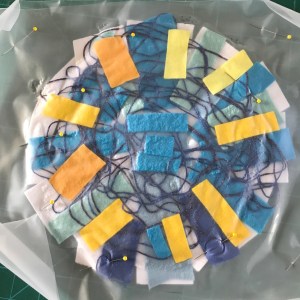
I have some pieces of commercial scrap felt in a variety of colours,  bought some time ago from a craft shop sale. I also have some small pieces of me made felt. Some glittery yarn was used. I found some Madeira Avalon water soluble firm stabilizer in a cupboard. I used a 12″square of the Avalon, or rather 2 squares of it, and sandwiched the felt pieces, and the glittery yarn in the middle. Ruth suggests to very lightly dampen the felt pieces to stop them moving about; I very lightly spritzed the arranged felt pieces before placing the water soluble Avalon on top. This definitely stopped the pieces moving. I placed a few pins around the edges to secure, and transferred to my sewing machine.


Stitching, was as Ruth suggests, in a circular pattern starting around the outside edge, and working towards the centre. Then further stitching in a spindle/spoke pattern to further secure all the pieces. All the pins are now removed and nothing is moving! Then I made some small circles all over the piece in a different thread colour.


Completed stitching, top and bottom.

The water soluble material was trimmed and I rinsed the piece in some hot water, for perhaps 20 – 30 seconds. Ruth suggests that some of the stabilizer should remain to help stiffen the bowl as it dries. I placed the felt over a glass dish to dry overnight.

I changed the dish to a tin of beans after an hour or so, and I think it will provide a  better final shape. I am really pleased with the outcome, so much so I made another bowl and that is drying just now. The second bowl is more ‘holey’ than the first, both are very firm, and wondering if I should have rinsed out more of the water soluble.

Photos of completed bowls, and holding some spools of thread (4 large, 7 small).


Thanks for the tutorial Ruth, I really enjoyed making them.


Getting brave with knitting (and a little bit of spinning)

Getting brave with knitting (and a little bit of spinning)

The knitting

I’m very glad to have finally regained my knitting mojo after such a long hiatus. Once the days started lengthening and getting slightly warmer, my brain seems to have understood it was time for my hands to get busy making again.

However, my attention span might have been left behind somewhere, for I ended up making a few mistakes that I missed until much later! I’m glad I did catch them though.

I was knitting a Poet jumper and the pattern has sections with seed stitch. Seed stitch is created by overlapping a purl stitch over a knit stitch in alternating rows/rounds, so that you get a sort of dotted pattern resembling… seeds (the name says it all, really).
Without noticing at the time, I repeated two exact rows and ended up with something… wrong that I couldn’t quite put my finger on. Once I spotted the issue however, there was no un-seeing it.

A section of my Poet jumper, showing a knitting mistake somewhere

Can you spot the mistake? I can see it from a distance… It’s a little below the middle.

A finger points at a knitting mistake on a Poet jumper
Putting my finger on it. See the two yarn-overs on top of each other on the right? One of them is the extra row I knit by mistake.

This put me in a conundrum: do I ignore the mistake and keep going, or do I frog the thing and correct it? I put it to social media, and the vast majority told me to leave it and continue. Naturally, this made me decide to frog it.

For the non-knitters: the term “frogging” is used because when you remove the needles from your work and pull the yarn back into the ball, you “rip it, rip it,” which sounds like “ribbit,” the sound frogs make.
(Don’t worry, I too was baffled when learning this.)

Completely removing the knitting needles from a project and effectively ridding the thing of its unravelling potential is daunting to me. When one does this, one also loses all useful markers set by the pattern creator, and I always fear I’ll forever miss my place and be unable to proceed… I took a deep breath, chose to trust myself and off the needles came. I stopped a couple of rounds before the offending mistake and opted to “tink” (that’s “knit” backwards – I know, I know…) until I’d corrected it. Phew.

Here’s the jumper, all finished, after I was set back two whole days of knitting.

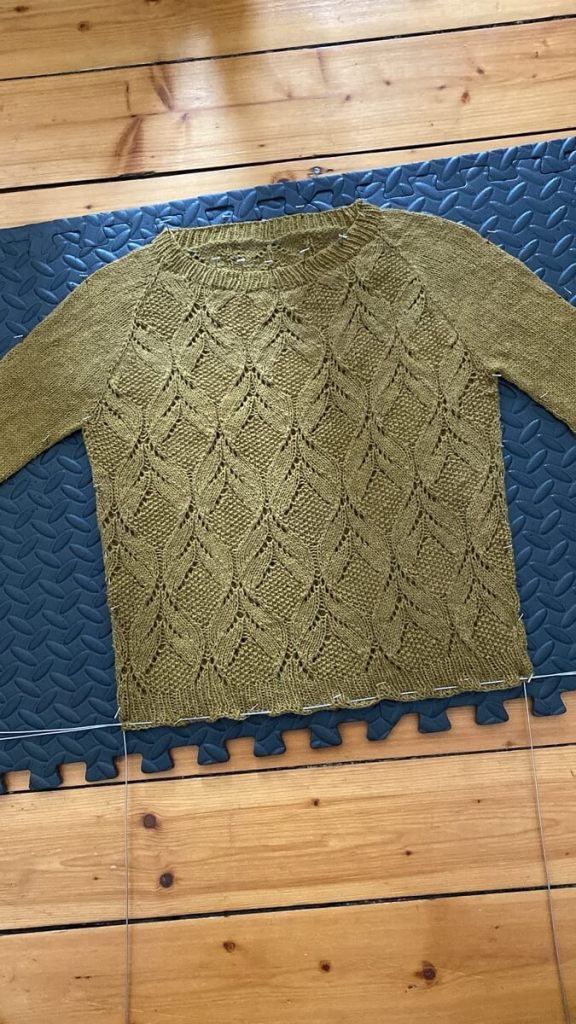
A knitted Poet jumper is blocking on wires and a blocking mat on the floor
Here is my Poet, blocking

You’d think my knitting snafus were over, but it seems I wasn’t done frogging… I started on my Ripple Halter and, a couple of inches before being finished, noticed I was one stitch off. Normally not a big problem, but this is a 2×2 ribbing which only remains correct if the right number of stitches are maintained, so I definitely had a problem.

I’d done it once, I’d do it again! Frog, frog.

Marshmallow the cat looks at my hand as my knitting project is frogged
Marshmallow offers her support…

This was also a scary one, because I had 8 markers I needed to put back in the correct place to be able to follow the pattern. I managed… somehow. Three more days of knitting, gone. It’s all part of the handmade process though, right?

The spinning

My spinning mojo has also returned. I wanted some textured art yarn and set about preparing the fibres to make it happen.

Once my Leicester Longwool locks were dry, it was time to spin.

Now I need to decide how to ply this. I think I might dye some wool top neon green, spin it  thin and use it to create a textured, thick and thin art yarn. What do you think? Also: am I mad for frogging days’ worth of knitting for what a lot of people deem “small mistakes”?

Ever wondered what the difference is between wool top and wool roving? I wrote a blog post on it on my own website and would love it if you’d read it. Thanks so much!

Lichen – Part 2 – Continued experiments put to work!

Lichen – Part 2 – Continued experiments put to work!

In my recent post (https://feltingandfiberstudio.com/2023/03/22/lichen-textiles-my-goal-part-1-experimenting/)  I made the statement….

‘Having admitted that I can’t do ‘loose’, I was born unquestionably inquisitive so my forté is experimenting. This seems to get around my inner critic & certainly fuels my more serious endeavours.’

In hindsight I should be more forthcoming and admit that I have an almost insatiable curiosity of the world around me – anyone who knows me will be nodding emphatically – as my curious child within has never stopped….’Why?’, ‘How?’, What happens if….?’, ‘Can I just ask?’ etc, etc.

The result – I’ve learned (sadly, age, now means I’m forgetting much of it!) and witnessed a lot, even wandering off in foreign lands (to the consternation of others, but fortunately to no harm!) and experiment endlessly….often tweaking the ‘rules’….🤪 no surprise!

So here I’ll show more of my lichen, Mottainai experimenting….

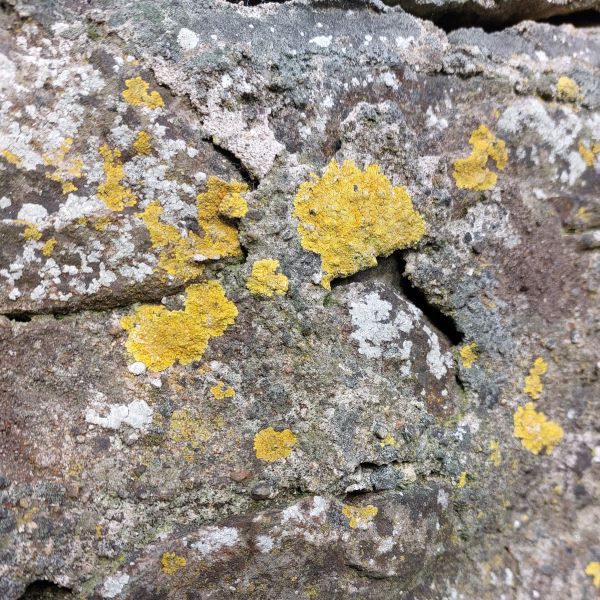
As I’ve said many times, I’m often to be found pondering….Mmmm, what happens if? Then of course I go down yet another rabbit hole….Is this a sign of a creative mind? – but I digress!….Playing with plastic milk bottles has been a typical example of not only disappearing into the rabbit hole (the point I was at in my last post!)….

….but of getting waylaid exploring it’s warren!

When I’m out and about I’m always stopping to take photos.

An aside – Six months ago I joined the ‘modern’ folk and got a replacement to my 12-year-old mobile phone (the salesman was almost hysterical with laughter as was I 🤣). It has been an exponential upward curve of learning (and still is)….BUT, having done my homework, it has given me a brilliant camera….yay…no more lugging a separate camera around!

Of the many genre of photos I take, Mother Nature always takes the biscuit! I see something, my mind races and then I’m off down another rabbit hole!

Many of my experiments are something I can do whilst TV chillin! The crochet rings above, whilst time consuming are effective & relatively easy. However not all experiments work well – crocheting over the commercial lace, another ‘what if?’, became a….’NEVER again’

Having now shown several of my experiments I can hear you shouting – ‘How are you going to use them?’

So in answer to that question, and before I send everyone to sleep, I’ll present one example of how I’ve pieced together a few of the 100s of elements to create a lichen inspired textile piece.

The finished work attached to the backing matt
The finished piece mounted proud of the backing matt

Creating this piece I re-purposed as much as I could including –

  • a surplus to requirements, circular piece of felt – I love circles.
  • some crocheted waste yarn that was left over after buying a commercial jumper from a charity shop for the sequin yarn that was fashionable a few years ago….it took me so long to unpick the jumper and separate the plain and sequined yarns! Next time I might just buy the expensive sequin yarn new!
  • Manipulated plastic food bags and crisp packets – all cleaned of course!
  • Viscose staple fibres from a community store (selling ‘waste’ products from industry)
  • Oh yes, even some felted dog hair!

All combined with machine stitching, hand embroidery (incl – colonial knot, my favourite knot, bullion & sorbello stitch) and some beading.

And finally….framed (I’m delighted to say I won a 2nd prize for textile work in an area competion), using an Ikea Sannahed 35x35cm frame.

Framed
Framed

A post script to make you smile – when you are on your own, with have no extra hands to help unwind a hank of yarn….

No extra hands - so use feet!
No extra hands! And a bemused furry canine!
Upper Canada Village trip

Upper Canada Village trip

05-06-2023 Upper Canada Village trip after the morning shopping with Sharkboy and Glenn. (https://feltingandfiberstudio.com/2023/05/15/more-shopping-for-the-mers-again-looking-for-hair/)

When last we chatted we had left the fibre festival in Spencerville and headed a bit further south and east heading to Upper Canada Village (UCV).

The Village has an interesting history.  The plan was to make the St. Lawrence River deeper and thus navigable, to larger oceangoing ships, thus providing them access to the great lakes. Unfortunately, this would require the flooding of 10 small villages that had grown up along the river’s edge.  To save some of the historic architecture from these soon to be flooded areas, some of the buildings were moved to two new locations. Some went to Ault Park and over 40 structures went to Upper Canada Village, whose construction began in 1958. The buildings included several working mills (woollen mill, grist mill and sawmill) and trades buildings (blacksmith, tinsmith, cabinetmaker, cooper, bakery, cheese-maker) as well as a doctors home, chapel, livery stable, taverns/dining room, and two farm complex.  The village is set up to represent life in the 1860s.  There is a large team of costumed interpreters working at the village to help show you what the 1860s were like.

On the Saturday that we visited Up UCV had decreed free entrance to the village in celebration of the Coronation of King Charles, so it was very busy. We were lucky and found a good parking spot. I think shark-boy was miffed since he had not found locks to make his hair at the fibre festival, so he stayed in the car to sulk and we went off to have fun looking at everything without him.

1) this is the vew Just inside the village of Upper Canada, that is the sawmill over to the left.1) Just inside the village of Upper Canada, that is the sawmill over to the left.

I knew I had limited walking and didn’t want to tick off my back so we consulted the site map and made a plan. The Woolen Mill, the Blacksmith shop, the Weaving and spinning house, the dressmaker’s shop and the stables. I didn’t think I could make it to the farms to see the oxen and sheep.

2) The map of UCV showing the main spots we wanted to make sure to see. Woolen mill, Blacksmith shop, Weaving and spinning house, Dressmakers, Livery stable.2) The map of UCV showing the main spots we wanted to make sure to see.

Our first stop (not just because I really wanted to see it, but it was also the closest building), was the Woolen mill (Asselstine Woollen Factory). This was a two story building, with the downstairs levels accessible to a walker or wheelchair. Providing fibre UCV has its own flock of sheep, which they sheered and the fleeces used on site. I did not see the sheep, so was unable to ask the interpreters what breeds were prevalent in 1860s Canada.

 3) Large mounds of fleece (possibly raw behind the rope and washed closer to us), on what might be skirting tables 3) Large mounds of fleece (possibly raw behind the rope and washed closer to us), on what might be skirting tables

4) Washing tub were located on the other side of the room from the tables with fleece. 4) Washing tubs were located on the other side of the room from the tables with fleece.

Between the fleeces and the washing area was a stairway to the second floor. That just will not be happening today! So, I went around to the other side of the ground floor at the back of the building. We passed these fabulous kettles for dyeing fibre or spun yarn as we found the way in to see the rest of the lower level.

 5) dye kettles sitting upside down along the foundation of the woolen mill 5) dye kettles sitting upside down along the foundation of the woollen mill

At the back end of the lower level of the mill is an industrial water-driven loom, a fuller, and the intake of water to run all the machines.  (I understand on the next floor are the spinning and plying machines to create the yarn.)

6) Water powered industrial loom with fly shuttle located on the ground level of the mill6) Water powered industrial loom with a fly shuttle

7)   This is the fulling machine. Notice the rows of teasels to raze the fabrics nap. Teasels are the thisle like tops of a plant that have small babrs that bring up the nap in the fabric making it fuzzy 7)   This is the fulling machine. Notice the rows of teasels to raze the fabric’s nap.

  8) The teasel row close up. we see this plant along the highways in areas that had weaving mills (The Traffalger exit in Oakville was a good spot to find them)8) The teasel row close up

9) This blanket has been rubbed by the teasels, which brings up the nap or fuzziness.9) This blanket has been rubbed by the teasels, which brings up the nap or fuzziness.

 10) At the farthest end of the building was a display of dried teasels and oilcans. To the right, hidden behind the timbers, is the intake of water to power the mill.10) At the farthest end of the building was a display of dried teasels and oilcans. To the right, hidden behind the timbers, is the intake of water to power the mill.

11) The intake for water that runs the mill. I didn’t see anyone to ask how they kept the water from getting past the wood and flooding the  lower level of the mill. 11) The intake for the water that runs the mill. I didn’t see anyone to ask how they kept the water from getting past the wood and flooding the lower level of the mill.

12) All the machines are belt driven in the mill. shows one of the belts that would opperate the fuller if it were to be engaged.12) All the machines are belt driven in the mill.

While we were there admiring the equipment, the machinery started and the belts began to turn. Since the loom and fuller did not run, I suspect they were working on the spinning or plying machines upstairs. Also, likely, why we didn’t see any mill workers in the lower level.

13) Our second stop, the blacksmith shop this was a one storey building with a large opening on one side13) Our second stop, the blacksmith shop

Our next stop was at the village Blacksmith. He was in the process of repairing part of one of the wagon harness attachments. (I was a bit vague on how it would all go together once completed.)

14) Working over the anvil, the blacksmith is making the end of what seems to be pin with handle. This end will have a faceted face to add a bit more decoration as well as be functional. the blacksmith's head is down focusing on his work and the hamer. here is a relected glow from the hot iron14) Working over the anvil, the blacksmith is making the end of what seems to be a pin with a handle. This end will have a faceted face to add a bit more decoration as well as be functional.

15)  It was a well-equipped blacksmith shop, having 2 anvils (similar in weight to Glenn’s) 2 swage blocks, and there is a foot vice attached to the work table just left of the picture. a wider picture of the forge, bellows, anvils and other equipment. the blacksmith is working the leaver that operates the bellows15)  It was a well-equipped blacksmith shop, having 2 anvils (similar in weight to Glenn’s) 2 swage blocks, and there is a foot vice attached to the work table just left of the picture.

He used a piece of chalk on the floor to draw his pattern and get the correct proportions as well as explain to his audience what he was doing. It was like having a giant working blackboard at his feet. I wonder if we should draw on our work tables when we felt?

 16) When he had the pin end made he sketched out the handle that would be attached to the pin. the blacksmith is crouching while drawing on the floor. 16) When he had the pin end made he sketched out the handle that would be attached to the pin.

17) He used the pin to check the size of the handle to be added to the pull pin. He has already flattened one end of the bar and punched a hole through it (to attach it to the pin.) he is using the dawing to estamate the leng he will need to make the pull for the pin.17) He used the pin to check the size of the handle to be added to the pull pin. He has already flattened one end of the bar and punched a hole through it (to attach it to the pin.)

We saw him demonstrate upending, punch, drift as well as bending over the horn and a few other ways to reshape mettle. When Glenn was happy and had his fill, we wandered on to see the weaver’s house (McDiarmid house built in 1864).

18) McDiarmid house built in 1864, 2 story log hune house. there are simetrical windows on the ground floor and one above in peek directly above the door.18) McDiarmid house built in 1864, 2 story log hewn house.

This house has a handloom and a number of spinning wheels. We recognized Shirley, the spinner/weaver demonstrating here. She had a few die-stuffs on display, the most popular was the bug cochineal which makes a beautiful red colour.

19-20) Shirley talking to vistiors to the left of the image, waring an 1860's dress she is pointing out difernt samples of natural dies , spinning wheel in forground is a saxony style, there is a Great wheel behind it. 19-20) Shirley talking to vistiors waring 1960's dress and sitting at her saxony style wheel 19-20) Shirley talking to visitors

The 2 side rooms were set up as bedrooms. Each side room had 2 wheels (all different) as well as the 3 wheels in the main room. There is a large barn loom which presently does not have a warp on it. There was also a small tape loom on the far side of the room.

21) Tape loom, drop spindle and nitty notty in front are some of the natural die samples. 21) Tape loom, drop spindle and nitty noddy in front are some of the natural die samples.

As more people came in, we left Shirley to chat with them and headed off to find the dressmaker’s house.

22) this is one of the Views on the way to the house of the dressmaker. (Old farm building with log rail fence and man in 1860 attire in foreground.) We saw a number of different log rail fence styles and I wish I had taken the opportunity to catalog all the variations.22) this is one of the Views on the way to the house of the dressmaker. (Old farm building with log rail fence and man in 1860 attire in the foreground.) We saw a number of different log rail fence styles and I wish I had taken the opportunity to catalog all the variations.

23) The dressmaker’s stone two-story house and side yard those trees may be apple trees.23) The dressmaker’s stone two-story house and side yard those trees may be apple trees.

24) The dressmaker, with a display of some of her wares on the table before her. There are bonnets and a crinoline in the corner cabinet behind her.24) The dressmaker, with a display of some of her wares on the table before her. There are bonnets and a crinoline in the corner cabinet behind her.

25) This is a device that sets Crimp in fabric. It is usually used in pairs, one is heating while the other is in use.  It requires the fabric to be damp as it runs through to set the ridges.25) This is a device that sets Crimp in fabric. It is usually used in pairs, one is heating while the other is in use.  It requires the fabric to be damp as it runs through to set the ridges.

26) Dressmaker is holding a sample card showing Handmade Dorset buttons examples made over rings and one over a wooden base.26) Handmade Dorset buttons are examples made over rings and one over a wooden base.

27) Button hole scissors, Has a notch and screw between the grips, to set the length of hole required for the button. I might like buttons better if I had such high-tech scissors.27) Buttonhole scissors, Has a notch and screw between the grips, to set the length of hole required for the button. I might like buttons better if I had such high-tech scissors.

I enjoyed looking at pictures of the upper floor with the tricky turning staircase. I appreciated the inclusion of pictures so I didn’t have to try the stairs. It would not likely have gone well! with a new surge of visitors to her shop we made a retreat to allow them space and headed back towards the park entrance, and our final stop at the livery stables.

28) At the livery barn, the working UCV horses live for the summer. This one is being harnessed to pull a barge.28) At the livery barn, the working UCV horses live for the summer. This one is being harnessed to pull a barge.

UCV have a small herd of pure-bread Canadians. This breed was a popular working horse used for multiple types of farm jobs (Similar to the Morgan Horse in the states). This one is getting tack so he can go pull a barge along the edge of a channel. Other horses were pulling a wagon with seats today and often pull other carriages and delivery carts around the village. They also power a saw and till the fields of the main farm (the oxen, who are at the tenant farm, also can pull and plough but I did not see them today)

29) Another way to get to see the village is by wagon with seats pulled by horses. Two more of the villages Canadians are providing the horsepower.29) Another way to get to see the village is by wagon with seats pulled by horses. Two more of the villages Canadians are providing the horsepower.

30) As you can see Canadians are not huge horses being built more on the small but strong theme.30) As you can see Canadians are not huge horses being built more on the small but strong theme.

31) Here he is pulling the towrope while shewing off some Canada geese from the shoreline path.31) Here he is pulling the towrope while showing off, some Canada geese from the shoreline path.

I was told that not all of the village horses like to pull the barge but that this one does.

32) The barge with rudder in the back, filled with tourists the horse power is on the shore line with the tow rope. Across the river are some very not 1860’s houses on the American side of the water. I bet they have a fabulous view of the Canadians’ side and all the historical happenings.32) The barge with the rudder in the back is filled with tourists. The horsepower is on the shoreline with the tow rope. Across the river are some very not 1860s houses on the American side of the water. I bet they have a fabulous view of the Canadians’ side and all the historical happenings.

After a long walk through the park, we took a quick look through the gift shop and then back to the car.

33) Shark boy was studying the map but luckily does not have the appendages or height to operate the vehicle and leave without us.  Sharkboy is pointing at the way home, he seems to suggest takeing HWY 416 north.33) Shark boy was studying the map but luckily does not have the appendages or height to operate the vehicle and leave without us.  (There I finally have a felting-oriented picture!)

May 6th, was a great day, shopping in the morning, with lots more photos while visiting UCV in the afternoon. I was not as sore as I feared by the time I got home. But on the morning of Tuesday, May 9th, I got in the car to head into the guild, just to do some extra library work and maybe teach inkle weaving and got caught in a battle between my seatbelt and my jacket. There was a popping noise in my low back and a lot of pain but I did get the seat belt done up and made it down to the studio! I headed home early since the back just would not settle. I saw my doctor but when my back kept getting worse, not better, Glenn and I had a trip to the emergency room and got new drugs. After a week stuck in bed, I was ecstatic when I could get out of bed on my own and get as far as the bathroom (it’s a very small house that really isn’t as impressive an achievement as it sounds!)  I have missed being online for most of 2 weeks and have likely made too big a blog post again to make up for that! There is so much to catch up on! But I will try to take it slow and pace myself. (Being stuck in bed on heavy meds has given me a few felting ideas I would like to try! But not today.)

If you are ever in the southeast end of Ontario Canada, I hope you will take the opportunity to visit UCV (Take walking shoes and a good camera). It is a fabulous representation of the 1860s, it was both educational and fun. I hope I will be able to go again and see the farms that I missed on this visit! Then I will be able to tell you all about the sheep!!!

A sample of flowers and some lambs.

A sample of flowers and some lambs.

After thinking about the flowers for my branch (here’s the last post if you missed it https://feltingandfiberstudio.com/2023/05/13/tree-branch-progress-and-shopping/ I decided it would be better to do a sample so the colours could be seen better than in the pencil drawing.

I grabbed an offcut of a fulled sweater to use for the sample. It’s a bit lumpy but it should work for this.  I have already decided I wanted a purple background to the flowers like the hairiness you see around some flowers.

Fulled piece of grey sweater


I thought orange would be the best idea for the central stalk of the flower. I had a lighter and darker orange so I did some of each to see how it looked.


Then it was time to add flowers. Someone on the last blog post said to try gradient colours for the flowers. that sounded like a good idea. I am using embroidery floss the stuff that comes as 6 strands.  I started with a darker colour and smaller knots at the top. Then I added a lighter colour strand and made a little larger knots. Then just the light colour but more strands and bigger flowers.


It’s not the best knot-making. On some, I just couldn’t get the knots to line up in neat rows. It’s probably the stitches of the sweater, you can see it’s fulled up quite lumpy.  I am leaning toward pink. The yellow is nice too.


And now as promised some lamb pictures. We have 3 sets of twins and t singles so far.

Sheep moma and black and white lambs Moma and black twin lambs Momma sheep and black twinsSheep moma and black lamb

Sheep Moma and black lamb

Also last year you might remember that we had a bottle lamb named Storm.

Black bottle lamb in a box black bottle lamb outside in the grass

Here is what he looks like now. He is a messy eater as you can see.

1 year old Black sheep


Stitching on Spring Birch Landscape

Stitching on Spring Birch Landscape

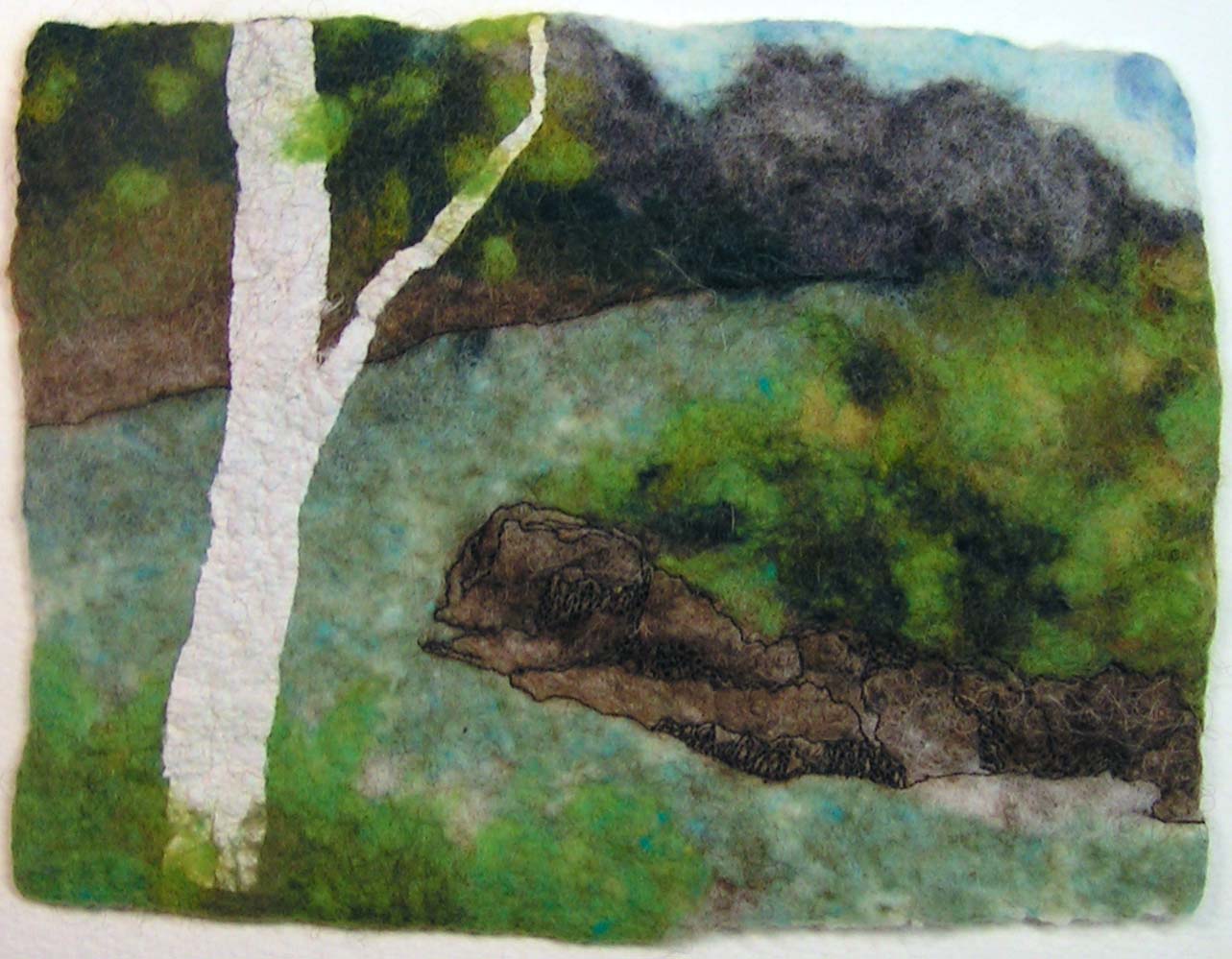
My spring birch landscape has been stitched and applied to a backing board so it’s ready to frame. I showed you the first stages of the landscape in this post if you missed it.

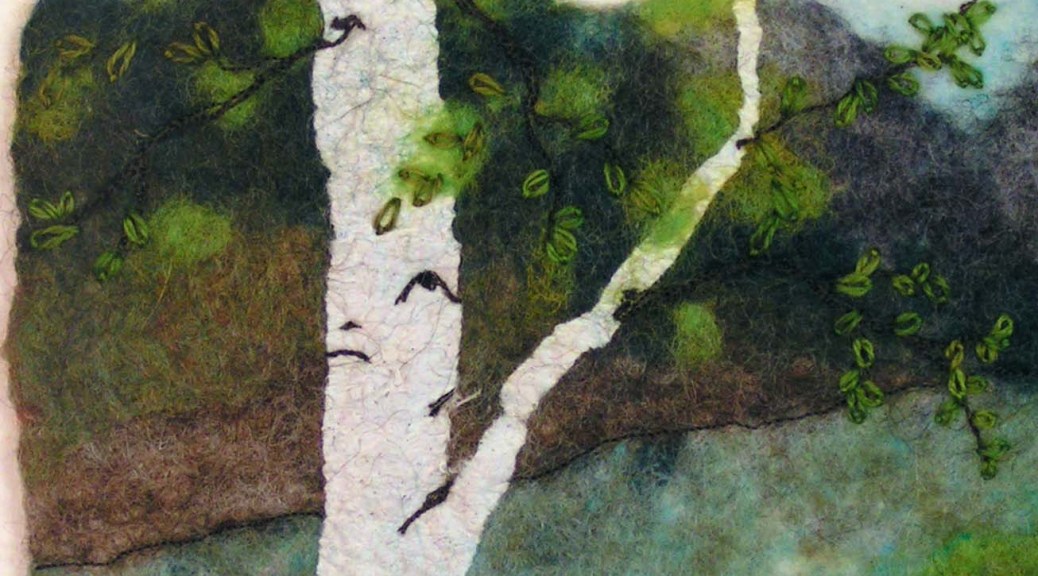
Felt landscape of spring birch with free motion machine stitching added.

I added free motion machine stitching to the distant shore. Whenever I start FME on a landscape, I always think that the first few areas where I have stitched look like it’s too much. But I keep going and usually, once more stitching is added, the initial lines don’t feel excessive.

Felt landscape of spring birch with free motion machine stitching added to rocks in foreground.

The next step was to stitch the rocks across from the tree. I considered adding some stitching into the foliage above the rocks but decided to leave it as is.

Felt landscape of spring birch with free motion machine stitching added to tree trunk and branches.

Then on to stitching the tree. I added the dark bits to the trunk and stitching through the felted paper was a breeze, no problems at all either by machine or by hand. The dark branches were added next and then decision time on how to add a few more leaves. I considered needle felting some smaller leaves on the dark branches but then decided I would hand stitch the leaves.

I then hand stitched leaves on to the dark branches using hand dyed lace weight wool thread and detached chain stitch. I added a few bits of grass at the bottom of the trunk as well.

Felt landscape of spring birch stitched to background fabric and wrapped/laced around board ready to frame.

The miracle is that I found a backing fabric, stitched the felt to that and then wrapped/laced the piece around matte board so it’s ready to frame. Since the piece is small (matte size 8″ x 10″), it went quickly and now I have two pieces ready to take to the framers. This piece counts for the year long tree challenge for spring. I have to think about the summer one as it wouldn’t really look different than spring, a few more leaves perhaps?

Nuno felt landscape of winter birch stitched to "matte" fabric and wrapped/laced around board.

The winter birch piece is also ready for framing. I used a darker gray hand dyed fabric for the winter birch as it felt “colder” that way. Now on to the next landscape as the gallery wants me to replace the one that sold last month. (Doing a little happy dance!)

This is the piece that sold called Remembrance. Yay!

‘Paisley’ Entrance Hall Table Mat

‘Paisley’ Entrance Hall Table Mat

Paisley Patterned felted mat for an entrance hall table

A colourful hall table mat can add a wonderful splash of colour to a neutral scheme – and be somewhere to throw your keys and display flowers from the garden!

To make the paisley mat I first made a paper template …

paper template

… then I made four layers of blue merino wool to make the base of the mat.

4 layers blue merino wool fibres

I changed my mind about the centre of the paisley pattern so I re-worked the template.

Altered paper template

Then I cut around every line on the template before placing it on the wetted down blue fibres.

Paper template placed onto wet merino wool fibres

I used very thin wool yarn to mark the lines on the template, working outwards from the circles and removing the paper as each line was finished.

I put down a fine circle of dry wool fibres then placed a circle of very open weave fabric on top of each one.

circles of dry merino wool fibres covered with circles of open weave fabric

I filled in the tear-drop shape with merino wool, did some outlining with thin black wool yarn, then added some white cotton nepps.

Tear drop shape made with loose merino wool fibres

I also placed white cotton nepps around the edge.  They are lovely but so hard to work with – a lot of patience is needed to persuade them to join with the wool fibres!

Layout complete

I rubbed, not rolled, this mat and after a while I decided that I didn’t like the edge so I trimmed it with a rotary cutter.  The edge healed during the last bit of agitating.

I rubbed mostly on the reverse side with the felt between two pieces of net and the bamboo providing gentle agitation on the underneath (as shown below).

reverse of felt sandwiched between two pieces of net

Finished size is 70 x 33cm (27½” x 13”).

Paisley Patterned felted mat for an entrance hall table

I find that my felt is not as smooth when I’ve rubbed it compared to when I roll it.  In retrospect I realise that I should have rolled the mat.

I’m happy to just agitate wool fibres by rubbing when the piece will be displayed as art work, but for anything else I think rolling produces a better finish.


Spinning with my new Autowind Flyer

Spinning with my new Autowind Flyer

I love to spin yarn.  It is my favourite craft and I generally find it very relaxing.  This year my husband got me this fabulous gift – a custom plate for my car.

Woman holding a license plate that says Spin Yarn
My birthday present this year.

Speaking of gifts… recently a friend offered me a tremendous gift of an autowind flyer from Level Wind Systems.  What a generous gift!  I got a flyer for my Majacraft Rose because that is my go to wheel.

2 Majacraft Rose spinning wheels
Majacraft Rose with bulky flyer on left and Majacraft Rose with Overdrive flyer on right

I actually like my Majacraft Rose so much that I have 2 of them, one where I can use the regular and jumbo bobbins, and a second that has a massive Overdrive bobbin and flyer on it.  The Overdrive wheel is great for plying and for spinning bulky yarns.


The autowind flyer has batteries inside the left flyer arm.  When you switch the unit on, the yarn guide slowly moves up and down the right arm.  This results in the yarn filling the bobbin much more evenly.

This is a photo of the same bobbin.  You can see how the singles form a nice rotating layer on the bobbin.

Spinning using the level wind flyer
Spinning with the level wind flyer

I have spun a few skeins now and have discovered a few things.  When I put the flyer on I need to tighten the flyer onto the mandrel of my Majacraft Rose.  However, when I tightened the flyer enough so that it works properly, it was also impinging on the bobbin which made spinning not very nice.  I had to really crank the brake and there was quite a bit of drag.  To fix this I dug out some Plumbers tape (also called thread seal tape) and wrapped it on the flyer mandrel.  Then I installed the flyer.  The tape helps the flyer make a nice snug connection but also leaves the bobbin free to spin.  This resulted in a much nicer spinning experience.

Thread seal tape
Thread seal tape

Wrapping the thread seal tape on the mandrel of my Majacraft Rose


Another thing I discovered after using the thread seal tape was that my bobbin was sitting back past where the flyer could nicely wind on the singles.  This resulted in an empty area at the rear of the bobbin.  The singles were collapsing into the empty area which was not very tidy and could lead to tangles later when plying off the bobbin.

First bobbin with singles not filling the rear of the bobbin properly
The singles are winding on, but the rear of the bobbin is partially empty and the singles are collapsing into the space.

To fix this problem when I started spinning the next bobbin I added a simple felt washer behind the bobbin.

Flyer showing a felt washer added behind the bobbin

My current project is a pound of dyed fiber from Adele Forward, an Indie Dyer in Dorset, Ontario, Canada.  Adele posts her dyed roving, locks and yarn on Facebook.  Have a look if you are interested in buying some delicious dyed fiber.

Pile of purple roving
Yummy Superwash Merino dyed by Adele Forward

Bag of fibre showing the label Adele Forward
These 1 pound lots come in nice big bags.


This is my progress after spinning 3 bobbins of the same fibre.  You can see bobbin #1 in the upper right (with the slightly empty section at the top/back of the bobbin), bobbin #2 in the upper left (which was spun with the felt washer) and bobbin #3 on the wheel (again spun with a felt washer in place).

Three bobbins spunI have now moved on to plying.  Because I have 3 bobbins of singles plying is a multi-day job.  It took me about 5 hours to fill the first jumbo bobbin with plied yarn. And here are the bobbins after plying up that first big bobbin. There is still lots of singles left to go into the second skein.

Plied yarn on jumbo bobbin with autowind flyer


Lazy kate showing 3 bobbins of singles


And here we are with the second bobbin done and all the yarn wound into skeins.

Bobbin of plied yarn
Second bobbin of plied yarn

Two skeins of purple plied yarn
Two skeins of purple plied yarn (First skein is on the right)


I have to say I love how quiet and helpful the autowind flyer is.  It is a fabulous tool and I am very appreciative of this awesome gift.