Starting on a needle felted bunting

Starting on a needle felted bunting

As you may have guessed, my family lives in London, United Kingdom at the moment, but English is not our mother-tongue. We happen to celebrate our birthdays all in UK, though, so during the years I managed to collect a few birthday party buntings here: of course, all of them celebrate “Happy Birthday!” in English and none in our language, Italian.  Also, I only have a short felt one and all the rest are plastic. I like the felted one a lot better than the plastic ones, it’s so much easier to store without worrying about creases, it is always in perfect shape and luxurious looking, even though it was not actually more expensive than the flimsy Lego themed one!

I decided to make us a new felted bunting with the Italian equivalent of “Happy Birthday!” written on it: as it will use Italian words, it will be longer than the English one, and I will be able to add more elements to make it longer still. It will be very colourful and it could be used for all our birthdays for years and years to come, and no more worries about creases and folds. It seemed a nice plan.

It is a fairly easy basic kind of felting project: one just needs to make as many flat triangles shapes as needed to spell the words and punctuation (in my case “Buon” and “Compleanno!”, so it’s 15), with one more for the space between the words, and as many more for decoration as one likes. On the triangles, you can needle felt the letters in contrasting colours.

Then, a satin ribbon will be passed through slits on the upper part of the triangles: this will mean that one will be able to adjust the length of the bunting to different size spaces. If you do not wish to have an adjustable bunting, you could make a felt cord of the desired length and attach the triangles to it at fixed intervals by needle felting or sewing them to the cord. And the bunting will be ready to go.

I wanted to go for needle felted triangles, although I guess it could be a much quicker job if you wanted to wet felt them : just wet felt different wool colours and cut them in triangles, then seal the edges with rubbing.

Well, I need the needle felting practice, so I took out my needle felting supplies and had a go at making a needle felted triangle shape.

Red merino wool laid out in a vague triangle shape on a foam mat
I laid out the wool on a vague triangle shape on my small foam mat
Needle felting supplies on a wooden table: there are some red merino wool, two wooden needle holders, a small plastic box of felting needles and two white finger protectors on a foam mat
My supplies for needle felting are laid out on my foam felting mat.
On the foreground, Kiki's hand is holding some needle felting needles in different colours. On the background there is red merino wool on a foam mat on a table.
I have different sized felting needles that are colour coded for ease.
Two wooden felting needle holders are on the foreground, and there is some red merino wool on a foam mat on the background
My two wooden needle holders, one can hold 6 needles and the other only 1 needle at a time: I enjoy the feel of the wood!

I needed a thicker needle for the first shaping stabs: that would be a 32 gouge, that is silver coloured in my set.

On the foreground a 32 G felting needle, on the background red merino wool.
My, it is quite thick, you can see the gouges quite clearly.
A 32G felting needle gets placed in a wooden needle holder
My one-place needle holder is quite easy to use: just insert the needle into the gouge of the inner bit, and push the inner bit+needle into the handle.
Kiki's thumb and index finger into finger protectors.
Donning my finger protectors that I bought at http://www.heidifeathers.com
Felting needle stabbing at red merino wool
Now I can start roughly shaping my wool!

Never mind the photo, that I was taking with my phone while moving the needle with my right hand: I actually started shaping my triangle by stabbing and shaping the edges of the triangle first, then moving towards the center.

I lifted the shape from the foam mat and stabbed a bit more on the other side as well, adding some more wool if I thought that some parts were uneven or not thick enough.

A vague triangle shape in red merino wool on a foam mat
It is taking shape nicely on a side, let’s see the other..
A red merino wool triangle shape a bit distorted on a foam mat
That is the fluffy B side: it needs working on.
Red merino wool being stabbed with a felting needle on a foam mat
I noticed some thin areas in the corner, so I added wool in.

Then, I saw that it was the time to change the needle to a thinner one.

A triangle shape of red merino wool prefelt on a foam mat
It is coming along well, but still a bit too fluffy: time to change needle.

I usually like to use a 38 gouge needle, colour coded red in my set, to do more detailed work when I am needle felting. Sometimes I pass through the 36 gouge needle (green one in my set)  before the 38 g, or use a 40 g needle (blue in my set) to finish, but in this case the job was fairly basic, and I did not want to change too many times.

A 38 gouge felting needle is shown on the foreground while prefelted wool is on the background
Choosing a 38G felting needle to go on with my project

After stabbing more, I felt that the shape was looking good. If you wanted it more regular, and were not lazy like me, you could make it more regular  than mine by starting at the beginning with a rectangle shape and then folding the rectangle in half diagonally into a triangle shape, and stabbing more. But if I have to make more than 15 triangle shapes I am not going to bother making them regular: I am just so lazy!

Triangle needle felted shape in red merino wool on a foam mat
My first triangle does not look too bad, although it is a bit irregular.

I guess one could stab on and make the shapes very firm, but I have no patience and was eager to go on (14 plus triangles to go, you know…), so I selected a bit of merino wool roving in teal for the first letter to add to my triangle shape. You do not need a big amount to complete one letter, you can use leftovers from other projects. I like to use carded merino slivers if I have them for small areas of flat needle felted decoration, I find that it is easier to shape them into small regular shapes.

Some teal merino wool roving on the foreground, a red triangle felt shape in the background
A small amount of merino wool roving is enough to shape the flat letter on the triangle shape.

I used the same red 38G needle to stab the teal wool on the triangle shape. It is not difficult to make the wisps of carded wool take the shape that you want, you just need to work on the surface, really, without stabbing too enthusiastically.

A felting needle stabs into some teal merino wool on a red prefelt
Stabbing the teal roving on the triangle shape to form the first letter.
A felting needle shaping the letter B in contrasting wool on a prefelt
The letter is getting shaped bit by bit.
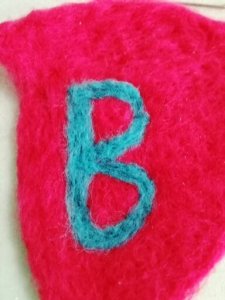
A triangle shaped element for a felted bunting, with the letter B on it
The first letter is done! B for Bravo!

I managed to finish my first letter quite quickly, but, guess what, I stopped there and never mustered the will to make all the other 14+ triangles! Well, the first birthday coming is not till ages….

P.S. the nail varnish was courtesy of my daughter, who wanted to play nail decorator that day!

more shopping for the Mer’s, again looking for Hair

more shopping for the Mer’s, again looking for Hair

As is the way with my life, I have had another change of plans.

My goal was to find hair for two more of the Mer family. My plan was to look for long locks at the fibre festival “For the love of Fibre”, in Spencerville and if that didn’t work out I would look at the Peterborough Weavers Guild fibre fest on the following weekend. We had also discovered that because of the Coronation Upper Canada Village would have free admission the same Saturday as the event in Spencerville (much closer to UCV than Ottawa.)

So part one of my plan was on May 6th to head to Spencerville. Then if I felt up to it, on to the Historical 1860s village at Upper Canada Village. I had a couple of friends who were working there last summer and have wanted to see it for quite a while. Let me show you how the first part of the plan went.

Last year “For the Love of Fibre” was the first post pandemic fiber festival that I got to attend. It was held in Johnstown, just a bit further south than this year. I am pretty sure I showed you that exciting.

May 6th arrived looking like it might be a sunny day with big puffy clouds to add to the photographic opportunities. We got up extra early to gather the couple of things we would need to bring. I had planned to bring Mrs Mer as well as her son Shark Boy to look for long locks for their hair. I discovered she was…. ummmm, busy canoodling (aggressive cuddling, enthusiastic hugging?) with her husband, so I just turned their project bag around and went to find her son. I picked up my camera and Shark Boy’s1q project bag and headed to the car.

It was a nice drive down. The trees are in the budding to early leaf stage and I was suspecting we might see the first trillium as we headed south. We got there early, arriving just before Ann. She took a picture of us getting Shark Boy settled and us ready for shopping (Glenn brought a book). You can see how excited Sharkboy looks! It must be the thought of getting his hair. I think he has decided on a Mohawk with long hair down his back, sort of an extra-long mullet. I think the Mohawk is to complement his front Dorsal fin.

1) Sharkboy standing in his project beg attached to Jan’s black walker with her husband (and the back of my Grey Kea Soul, I am sure you were expecting I possessed a black soul!).1) Sharkboy standing in his project beg attached to Jan’s black walker with her husband (and the back of my Grey Kea Soul, I am sure you were expecting I possessed a black soul!).

There were 3 outside vendors, with the rest inside.

2) Stone Spindle Farm Booth; with alpaca yarn, fiber and hats. The vender is hanging up suit cages full of low-grade alpaca to provide the birds as nesting material.2) Stone Spindle Farm Booth; with alpaca yarn, fibre and hats. The vendor is hanging up suit cages full of low-grade alpaca to provide the birds as nesting material.

 I was admiring some indigo-dyed alpaca but wanted to wait until I found out if there were any locks inside. (OH the not-buying remorse I felt later!!! I do know who bought it and that it will be well enjoyed.)

3) baskets strewn artistically under a pule trees with an E-Bike near the front with panions baskets.3) baskets are strewn artistically under a few trees with an E-Bike near the front with pannier baskets.

Did you notice the cool bike baskets, some have lids.

Inside we found a few of our guild members had booths! I did a fast wheel around the venue looking for long locks but to no avail. Sorry, Sharkboy! We will have to try plan 2, next weekend. Even with not having the long locks I was looking for there was a good selection of vendors having Yarn, fibre, baskets, bags, and fibre tools. I didn’t get every booth but here are some of the highlights.

4) A quick over view of part of the venders.4) A quick overview of part of the vendors.

5) digging for colours in balls of hand died Super wash Marino fiber.5) digging for colours in balls of hand died Superwash Marino fibre.

6) More fiber from the Black Lamb booth.6) More fibre from the Black Lamb booth.

7) Beautiful project bags and peruses7) Beautiful project bags and purses

8) Moose hill woodworks had lots of fiber tools, all beautifully made. (Yes, I got another spindle of a type I didn’t have.)8) Moose Hill Woodworks had lots of fibre tools, all beautifully made. (Yes, I got another spindle of a type I didn’t have.)

9) Odd new spindle, I was trying it with some of the new extremely soft Finn wool I also purchased. The back of the tag says Yellow Birch, 1.3oz/39g9) Odd new spindle, I was trying it with some of the new extremely soft Finn wool I also purchased. The back of the tag says Yellow Birch, 1.3oz/39g

10) Beaux Arbres booth had basketry10) Beaux Arbres booth had basketry

11) This booth had fiber samples you could feel (the bags of them are behind the table.)11) This booth had fibre samples you could feel (the bags of them are behind the table.)

12) This is the side table of the same booth with the fiber. Check out her fine ponies!12) This is the side table of the same booth with the fibre. Check out her fine ponies!

 13) Fin roving it is actually semi-worsted the vender has her own mill!!! I have never felt such a soft finn sheep.13) Fin roving is actually semi-worsted the vendor has her own mill!!! I have never felt such a soft Finn sheep.

Ann investigated further and found out it was from a lamb. I only bot 2oz I should have bout more! Ann also got some to make her trees with.

14) This was an ingenious support spindle case.14) This was an ingenious support spindle case.

15) The booth the support spindle bag came from had more spindles and lots of rolages. 15) The booth the support spindle bag came from had more spindles and lots of rolags.

16) A couple booths had yarn for weaving and knitting.16) A couple of booths had yarn for weaving and knitting.

17) This Was Susan Allen’s Booth with weaving yarns, I think this was a Cotton or a Cottolin that Ann was looking at.17) This Was Susan Allen’s Booth with weaving yarns, I think this was a Cotton or a Cottolin that Ann was looking at.

18-19) Janet's Basketry, hand made basket with handwoven fabric presented in rolls18-19) Janet's Basketry, handwoven baskets one with antler in it.18-19) Janet’s Basketry

20) Janet’s booth, she is just finishing setup as the first customers arrive20) Janet’s booth, she is just finishing setup as the first customers arrive

 I wandered into Janet Whittam’s booth, she has a combination of weaving and basketry, and she also has beautiful woven jackets and wraps.

21) sharkboy standing in his project bag, attached to my walker.21) Shark Boy standing in his project bag, attached to my walker.

Even though he didn’t have any luck finding hair I think Shark Boy enjoyed his outing. It was still a worthwhile shopping trip with new fibre and spindle.

I was still feeling pretty good so we decided to head on to UCV, maybe it would cheer up Shark Boy! There is a mill, the blacksmith shop, the weaving house (with spinning) and the dressmaker’s house. We packed up the car and headed a bit further south and east arriving at a very busy Upper Canada village parking lot. We found a good parking spot in the mostly empty handicapped section (I was very glad for that parking permit by the time we made it back to the car!)

22) Sharkboy checks out the special parking for Mer-people (and those with walkers) as we arrive at UCV.22) Shark Boy checks out the special parking for Mer-people (and those with walkers) as we arrive at UCV.

Unfortunately, that change of plans thing I mentioned at the beginning happened Tuesday morning and is preventing me from telling you about the rest of my visit. As soon as I can I will tell you all about the fun we had visiting the village, and a bit of its background.

23) The entrance buildings of Upper Canada village.23) The entrance buildings of Upper Canada village.

Tree Branch Progress and Shopping.

Tree Branch Progress and Shopping.

I have moved forward a little on my tree limb. I decided to go with a grey sky as a background so that I had more choice with colour.

                          felted grey background for a picture

I added a branch in brown It isn’t as flat a brown as it looks in the picture but I think I need to add a different brown to it.  I will work on that.

                           felted branch picture

Then I sketched the branch to think about colours. I decided on an orange central vein. That is probably not the right name for it but it is what I can think of to call it. Then a purple fuzzy haze with flowers in it. and some idea of budding leaves.


So far people here like the pink ones. I am not sure. Which ones do you like?

After searching my stash for another brown to go with my branch I had nothing. So it was good timing that there was a fibre event near me called For the Love Of Fibre. This is its second year. https://www.facebook.com/groups/1167963160700589

I was looking for brown but it seems I turned the wrong way went in and ended up in Top of the Whorl Spindles https://www.facebook.com/katspindles She had no brown wool but she had these amazing sample boxes that are just the right size for me.

fall coloured rollags in a box         Fall coloured rollags in a box

spring coloured rollags in a box        spring coloured rollags

I wandered around and stopped at the Black Lamb https://theblacklamb.ca/   They have lots of wool but not the right brown so I got a piece of Black Felt (it’s more than prefelt but less than felt) It is thicker than the prefelt or felt you typically see. In the picture, it looks like there are lots of white hairs in it but that is just what it picked up in the stack of prefelt. I think if I run the lint roll over it, it will be good. They also gave me a size 40 spiral needle to try out.

black felt and felting needle

Then after doing a full circuit of the room just to the right of the entrance, there was Farfelu Fibreworks https://farfelufibreworks.ca/ and she had the perfect brown. It is a little darker than it appears in the picture but lighter than the pencil roving in the picture with it.

brown fin wool

It is Finnish wool so I was surprised at how soft it was. I asked her later and it is a lamb fleece.  I asked people at the guild social to guess what it was I got superfine merino, alpaca and angora as guesses. I will have to see how it wet felts as well as needle felting. I think I will be wanting more so naturally she lives on the other side of the province. Oh well, maybe we can get her to come for our guild Sale and Exhibition in November.


More Experimentation with Felting and Paper

More Experimentation with Felting and Paper

I have continued with my experimentations with mulberry paper and felting. My first post is here if you missed it.

Mulberry paper with embossed leaf laid out over green wool ready to felt.

I have had this mulberry paper with leaves embossed on it for quite a while. I loved the paper but never used it for anything. It is fairly thick and the embossed portions are really thick. The question was whether it would felt easily to the surface. I tore out a single leaf and placed it over a small torn piece of green, short fiber merino batt.

Mulberry paper with embossed leaf laid out over green wool wet down on felting surface.

The wool and paper were then wet down (sorry for the blurry photo) and I felted as I had on my previous paper samples, treating the paper as if it was fabric as in nuno felting. I wondered whether I would lose the embossed lines of the leaf, whether the paper thickness was too heavy to felt in easily and if it would felt differently than the thinner papers I had tried previously.

Mulberry paper with embossed leaf felted to green wool as a sample.

Here’s the end result. You can still see the leaf. It felted very easily and doesn’t seem much different than the thinner papers. I think if I had done a lot of wringing of the felt it would have distorted the leaf but I was careful to avoid fulling in that manner.

Hmmm… how can I use this leaf paper in a design? What would happen if I added ink or dye to the paper before felting? What if I dry brushed paint over the surface of the paper after felting? What else could I do to the surface to enhance the feel of leafiness? How would hand or machine stitching look on the surface? Will it be easy to stitch through? Any other experimental ideas for me? Obviously, more samples to follow.

Wool laid out for landscape with birch tree, river and distant trees and mountains. Birch tree from mulberry paper on the surface of layout.

Next on to experimenting with paper in my landscapes. This is the layout of wool and a paper birch tree. (This also works for my spring tree for our year long tree challenge.) The piece is pretty small and ended up about 7″ x 9″ after felting.

Wool wet down for landscape with birch tree, river and distant trees and mountains. Birch tree from mulberry paper on the surface of wool.

Here’s the piece after wetting down and curbing the edges a bit before felting. Again, I treated this gently to allow the paper to felt in.

Wet felted landscape with birch tree, river and distant trees and mountains. Birch tree from mulberry paper felted to the surface.

Here’s the piece after felting. I plan to add some free motion machine stitching to add more interest in the tree and more branches as well. I will probably add a few more leaves to the tree as well and perhaps a bit of detail to the rest of the landscape. The tree worked well and the paper really stands out to make the tree the focal point of the landscape. I definitely need to do more experiments with landscapes and paper. How else could I use the paper besides tree trunks? How would scraps of green paper felt in to make foliage? What would a variety of colors of paper layered over each other and then felted look like?

I love asking ‘what if’ and trying out these ideas, which lead to new ideas and further experimentation. I haven’t even begun to scrape the surface with how paper and felt can be used together. I would love to hear your ideas for experimentation so please leave a comment with your “what if’s”.


Lapwings Felt Picture

Lapwings Felt Picture

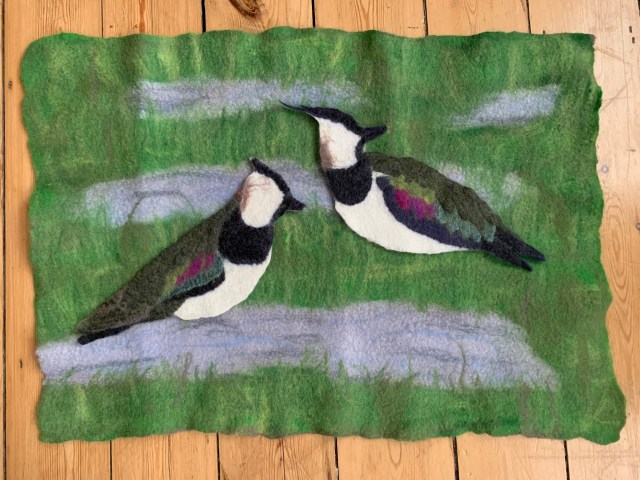
I’ve recently made a new felt picture of lapwings so I thought I’d show you how I went about it.

As you’ll know, if you’ve read my other blogs here, I live on the East Kent coast in the UK and am particularly fond of the local birds. I’ve seen some beautiful flocks of lapwings including at a small nature reserve just along the coast at Oare. I’ve not attempted lapwings before though they are really beautiful birds, so I thought I should have a go.

I’ve only seen lapwings in quite large flocks – I’ve never seen one on its own – so I thought I should have at least 2 birds in the picture. I did a quick sketch to help me decide on the size and stance of the birds

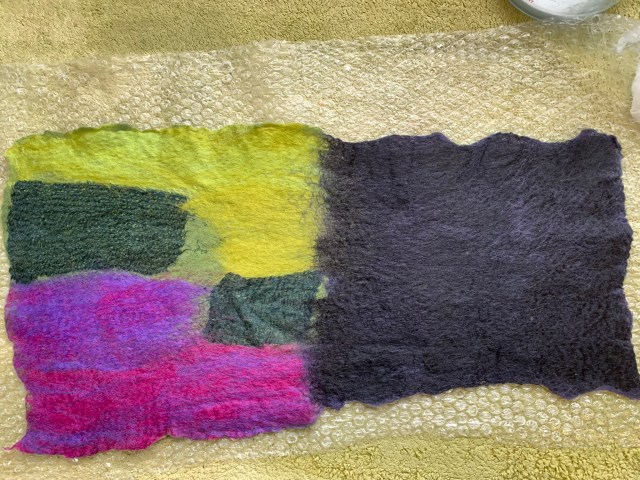
I started with the background. The birds at Oare were on the wet, grassy edges of a lake, very near the sea. Here’s the background laid out & ready to start felting.

I spent a while thinking about how to represent the lapwings’ lovely iridescent feathers and decided on lots of prefelt.

I had some blended greenish wool that was perfect for the main feathers though I had no idea where it came from or what it was. As I made some prefelt I tested out the shrinkage – mostly just to be sure it would felt rather than getting a specific shrinkage.

Then I set about prefelt for all the other lovely colours. The dark green sections are scraps of recycled silk from my favourite source: a charity shop scarf. The others are mixtures of different merino wool colours. I was particularly pleased with the dark section on the right which was a bottom layer of blue and top layer of charcoal grey. It was just the effect I was hoping for. With hindsight I should have used silk for the light green & pink / purple too as that would have given me more shine.

Here’s the prefelt cut up & arranged in a bird shape.

And here are the 2 birds once fully felted but still wet

And here I am deciding how to position the birds on their background.

I needle felted the birds into the background then added eyes, other face details, legs (using recycled tapestry wool) & head plumes. If you look closely you can see I also fiddled a little with the background: needling in extra strands of grass to soften the edges of the water.

The lapwings went straight into an exhibition with 4 other big pictures plus some smaller pieces at my local gallery: the wonderful Horsebridge Community Arts Centre in Whitstable. Here’s my display (not a great photo, sorry).

And I’ll finish with a quick shot of a beautiful painting I bought at that exhibition.  I’ve been looking for something to hang over my bed for ages and I thought this was perfect.

Painted by my friend, the artist Josephine Harvatt. The title “When you wake up it’s a new morning”  is particularly apt for over the bed. I love it. If you want to see more of Josephine’s beautiful work, here’s an Instagram link.

https://instagram.com/josephineharvatt?igshid=NTc4MTIwNjQ2YQ==

Fun With Colour – Dartmoor Dyeing

Fun With Colour – Dartmoor Dyeing

The Albany (on Auckland’s North Shore) Spinners held their annual dye in April that they titled, “Dartmoor dyeing”. Dartmoor dyeing involves splitting your unwashed fleece into 4 equal portions, dyeing the portions red, yellow, blue and green, then dividing each colour 4 times, keeping 1 portion aside and dyeing other 3 portions from each colour in the other colours (so 3 of the 4 blue pieces would be distributed to the red, yellow and green dye vats). From what I have read, you can achieve some lovely variations within each section of fleece due to the lanolin in the fleece inhibiting dye uptake in some areas more than other.

I hadn’t heard of the term Dartmoor Dyeing before (have you?) but I have seen dye courses that describe mixing dyes in cups, I expect with very similar results, does that technique have a name? Sequential dyeing perhaps? This all got me thinking about a colour theory course I took as part of my Diploma in Art and Design and the dyed samples I made after the course.

Anyone who knows me or my work will probably have noticed I have a soft spot for bright colours, particularly complementary or split complementary combinations. If you’re not sure what complementary colours are, this link covers the basics of colour theory in a fun interactive way* (the tool in the top right is great if you are looking for colour inspiration too). I think colour theory, and especially its impact on human psychology, is fascinating.

*Edit – feel free to skip over the sections where they discuss the RGB colour wheel, this is specific to optical colour mixing (what computers and TVs do) and completely at odds with how dyer’s and painters mix colours.

I am always sorely tempted by the dizzying array of colours on the Dharma Trading web site but you really don’t need to buy every colour. The vast majority of colours can be mixed from just the 3 primary colours.

A word of caution before you go shopping: The dyer’s colour wheel differs slightly from the red, blue and yellow primary colours of the traditional / painter’s colour wheel. For most dye brands, the primary colours are magenta, turquoise and yellow. The brands with a wider a range of colours will almost certainly also have a red and a blue but they are invariably made from a mix of the primary dye pigments, this means that when you start mixing them with other colours you will end up with muddy tones to your colours. If your brand offers a choice of yellows and it is not clear which one is the primary yellow, pick the brightest / coolest yellow i.e. a lemon yellow rather than a sunset yellow. Yellows with the warmer tones may have been mixed with a tiny amount of magenta which will make it impossible to achieve a bright green.

My go-to colours for dyeing are magenta, turquoise, yellow, black and silver grey. As you will see below it is fairly easy to make your own black by dyeing with magenta and turquoise to saturation but I find it handy to have black premixed. I find silver grey is a tricky colour to achieve by colour mixing and I like using it for space dyeing so I keep a small pot of it in my stash.

My Dye Set Up

This set up is for acid fast dying of animal fibres (wool, silk, feathers etc) but the colour mixing could easily be adapted for fibre-reactive dyes used on plant-based fibres.

Instead of the traditional vat / large pan full of dye method, I like to use zip lock bags in a steamer so I can dye multiple different colours simultaneously with just one heat source. Because this is a low immersion technique you will get more variation in the depth of colour across the contents of each bag, if you are wanting solid, even colours using the dye vat / pan method is recommended, this allows you to move your fibre through the dye pot so the fibre is more evenly exposed to the dye.

To achieve reproducible results, especially if you are dyeing small amounts (less than 100g) of dry fibre, I recommend premixing your dye powder with water. This also means you don’t need to wear a face-mask for the whole dye session (masks are only needed while the dyes are still in powder form). I keep my liquid dyes at room temperature and they all work well, even after several months on the shelf.

To make a liquid concentrate I mix 1g of dye per 10ml of water and store them in water-tight jars. The dye tends to settle out of solution while stored so the jars will need a shake before each use.

For the dye bath, I prefer to use citric acid crystals rather than vinegar to avoid that residual “fish and chip shop” smell you get with vinegar. I use citric acid at a rate of 15-20g per 5 litre bucket of warm water and add about a teaspoon of dish-soap to that to aid wetting out of the fibres.

I pre-soak my fibres in the acid / soap solution for a few minutes while I prepare the dye and dye bags.

Let the fun begin!

For this project I was working with 10 x 10 cm (4″) squares of merino prefelt and tiny skeins of super-wash merino yarn, so diluted 2 ml of dye concentrate in 10 ml of water (this made my working solutions 0.2g of dye in 12ml water).

I chose to work with just the 3 primary colours but you could add any of the secondary colours if you wish, but note you will get a range of browns and grey tones in some of your samples.

I ended up with 16 different colours from the 3 primary colours:

Turquoise Yellow Magenta
TY YM MT
TTY YYM MMT
TYY YMM MTT
TTYM YYMT MMTY
TYM

With so many different colour combinations it is easy to lose track, so I pre-labelled all my bags:

Tip: I stand each bag in a 1 litre jug before pouring some acid water (about 150ml – just enough to cover the fibre) from the bucket the fibre is soaking in. You can add extra water after adding the fibre if you find there isn’t enough to cover it.

Then I added 1.5 – 2 ml of my diluted dye. For example the MMY bag received 1 ml of Magenta and 0.5 ml of Yellow. The TMMY bag received 0.5 ml Turquoise, 1 ml Magenta and 0.5 ml Yellow.

The bag was jiggled to mix / disperse the dye before dropping in a piece of pre-soaked felt. Excess air was squeezed out of the bag, the bag sealed and stacked in the steamer with the “zip” uppermost (just in case it pops open as any trapped air inside expands) .

I steam my bags for an hour (the dye only needs about 30 min at around 80 degC to fix but they also need some time to get up to temperature). I leave the bags in the steamer to cool overnight before rinsing the next morning.

Tip: The water in the bag should be clear when you come to rinse the fibre, if it isn’t you have used more dye than you needed to but you can still use the remaining dye to dye some more fibre a paler colour – just drop in your pre-soaked fibre and steam as you did before.

After rinsing, I left the samples on their bags to dry so I could figure out which was which!

Here are some of the samples arranged in the primary, secondary and tertiary colour wheel that most people will be familiar with:

Similar to mixing paint, I have noticed the yellow dye is not as intense as the magenta and turquoise, this is most obvious in the MY (equal quantities of yellow and magenta) square, which should give an orange colour but is closer to a scarlet red and the YYM square that should be a yellowy-orange but is orange.

The same samples as above but with the complementary colour mixes (for example mixing red and green or yellow and purple) added to the centre, by including all 3 primary colours in different quantities you can get different shades of browns and greys:

I suspect I forgot to jiggle the TMY bag before dropping the sample into it, oops!

I also dyed some super-wash yarn to saturation (approx. 0.1g dye per mini-skein) – all of these bags had a tinge of colour in the water after dyeing. The samples at the violet end of the range (bottom of the photo) are very nearly black.

I had a few mini skeins left over after the saturation dyeing so dropped those in with the felt samples, just to see how they would compare to the “saturated” skeins. The blocks in the photo with 2 skeins on them are the extra skeins. Most are predictably very similar in colour to the felt block they were dyed with but the TTM skein is definitely more blue than its felt block.

If you don’t have time to dye lots of wool samples but want a record of which colours you can achieve by mixing the dyes you already have, you can use the same technique but brush the mixed dyes onto heavy weight cartridge or water colour paper. This is an example from one of my sketchbooks where I have mixed slowly increasing amounts of one dye colour into the other:

The 3 columns on the right are what you can expect to achieve it you mix complementary colours (green with magenta, violet with yellow, turquoise with orange).

I also did something similar with my watercolour paints, this is just one page of 4 charts – I find these charts really useful reference when I am trying to mix a specific colour:

Covers for Carders

Covers for Carders

New Carders need new covers

In a recent post, I was asked about carder covers. I made mine quite a few years ago, ok at least 20 years ago, but had not got around to making ones for the other hand carders I own. (it’s just the others didn’t get out much and I got distracted, you know how that can happen I am sure!)  I had picked up 3 pairs second hand I think as part of a box lot at an auction.  They were ones with curved backs and not as old as some hand carders I have seen. These probably come from the 1970s. I have no guess as to the manufacturer. The only clue is a mysterious symbol on the back of each set.   “A”, “B”. “C”, I am afraid that these mystic symbols are not illuminating as to their origins. Luckily these strange symbols have not affected their ability to card wool.

Last week I picked up another hand carder, this one with significantly stiffer teeth than my present collection. I have also found that my safety carders have been coming with the Mers and will also need some safety covers (but not today). I have used a thin packing foam for the pet combs until I can make them covers too.

First, let’s have a look at the new carders;

My latest acquisition is made from a soft wood that is ruff on the end grain. I suspect it is probably pine.  The handles, although the same colour, seems to be made of a slightly firmer wood. The teeth are embedded in a canvas fabric, then glued and tacked to the wooden carder. Bernadette said she had a similar pair and that the stiff teeth are excellent for courser wool.

As I said the teeth are very stiff and have little flexibility. This doesn’t mean I don’t want to protect them.

second hand carders, wood is ruff on edges and teeth are very stiff handle of second hand carder, ruff with small dents (needs sanding)1-2 The new to me, carders before sanding

3 close up of Foam drying pad cut to cover carder teeth3 close up of Foam drying pad cut to cover the carder teeth

What you will need to make these carder covers

fome and microfiber dish drying mat elastic and velcro straps Quilt squares with sheep alpaca and mice foam sanding block (sandpaper would work too)4-7 Items used to make the carder’s covers

  • 1 Dish drying foam mat
  • 2 Elastic and velcro straps
  • Interesting fabric
  • (you may need a sanding block or sandpaper if your carder is a bit ruff)
  • A ruler, pen and sewing machine are also helpful.

When I made my first cover, I wanted to have something a bit softer than just the fabric cover to protect the teeth.  I found a bathroom soft scrubby pad, it said polyurethane foam covered by a “new” microfiber top. They were available at Walmart and then Dollarama, so picked a few up. Silly me I did not reserve all I had purchased for the hand carder protection as planned but used some for their original purpose of cleaning!!! they were available for about 3 years and then mysteriously disappeared from both my sources. They were replaced by a much larger, but similar, product called a “microfiber dish drying mat”. Its tag says Polyurothatin foam and 100% polyester cover. It is very much like the original pad but huge at 15” X19.5”! (I  could cover a large drum carder rather than just small hand cards with it!  ….HUM………NO! NO! That will have to be a later project!!) Luckily it is easy to cut to the correct size to fit the little carders with my cheap paper scissors. Ok, now I have the foam pads to protect the teeth.

For my newest set of carders, because the end grain is ruff, I will also need a sanding block to smooth it and prevent splinters. (Splinters are never good, they wind up in either your fingers or the wool.) I found a two-pack of foam sanding blocks at Dollarama. The local hardware store will have them or some old fashion sandpaper and a block of wood. In a pinch, a foam nail file will work as sandpaper too

  8 sanding the back of the hand carder taking out chips at edges ad little scratches and punctures8 sanding the back of the hand carder taking out chips at the edges and little scratches and punctures

half the hand carder handle is sanded the other half is still ruff 9 half the handle is sanded(lower half)

working at smothing the end grain of the carder, the wood is likly a soft pine10 working at smoothing the end grain

Now that I have the worst of the roughness smoothed and have pieces of foam to protect the teeth. now I can get the fabric and measure it out to make the covers.  The overall pattern is simply, a rectangle with long tabs attached at one end.  Depending on the shape of the fabric you have, changes where you will put your seams.  If you don’t have much of the fabric you like (say one with sheep), you can use a different fabric on the inside. luckily I have just enough!!

To make the cover closure you have a few options, sew-on Velcro is easy to use and seems to be common.  If you haven’t quite got around to sewing on the Velcro, you can try what I have been using  “Stretch utility straps” (elastic with Velcro on the ends.)I wrap the elastic over the tabs and connect the velcro to hold it closed.  I remember seeing closers made from ties, and even buttons, but I like the Velcro and strap closer the best.

Shark Boy has offered to help show you the old carder cover so we can make a pattern.

11 Sharkboy volunteers (his parents are cuddling in their project bag)11 Sharkboy volunteers (his parents are cuddling in their project bag so he offered to help)

This slideshow requires JavaScript.

12-21 Shark boy removing the cover and foam pads off my old carders

Now that Sharkboy has opened the carder cover,  we can look at the shape and make measurements.

This slideshow requires JavaScript.

22-28 measuring the original carder cover

29 size I am going with yours may be a bit different depending on your carders size29 This is the size I am going with, yours may be a bit different depending on your carders size

We should also notice you have three main options as to how you orient your carders for storage.  (the variations are more dramatic when viewing the curved cards than the flat ones but it’s still worth considering the options available for both styles.)

30 teeth to teeth (the handles now spread away from eachother)30 teeth to teeth

Option 1 stored teeth together – this leaves the teeth inter-meshing, while it may keep the teeth from snagging on any nearby object it is not great for the teeth. It also causes the handles to point outward if you have a curvature to the paddle part of the carders. This is the way most naked carders are stored.

31 Back to back/ teeth out (the teeth face out and are unprotected, the handles tuch at the end but dont ballance well on eachother)31 Back to back/ teeth out

Option 2 stored teeth out – this is a bit silly (but it is a possibility even if it’s silly), it will put the teeth in contact with anything in the vicinity (including your fingers) and give the carding cloth surface no protection. The only advantage is that the handles don’t stick out oddly. (I am trying to be positive.)

like the 3 bears looking for the perfect bed, this brings us to the final configuration.

 32 teeth to back (the handle fit together, so dose the curvature of the carder back. but teeth will be pressiung into the back of one carder) 32 teeth to back

Option 3 stored teeth in the same orientation – Since one carder sits above the other, this would cause the teeth to be stored against the back of the upper carder. Ah, this is where the foam pad comes in. There were masks on the backs of the new second-hand carders which suggested this was one of the ways they had been positioned. This orientation also alines the handles which makes them fit easily into a bag or basket when they need to travel.

Now let’s make the pattern.  There are two main rectangular shapes for carders; a shorter rectangle for wool carders and a longer rectangle for cotton carders. I have now seen “Student” carders which are smaller than the standard wool carders. Both shapes of carder require a very simple pattern so just adjust it to fit your size. If you are not trusting of numbers you can make a pattern using a couple taped together pieces of paper to check the fit.

I had been over at Walmart looking in their craft/sewing department. There was a selection of precut “quilting squares”, which were actually rectangles, that I looked through. They were not the finest of thread counts but they had 3 patterns with sheep, the odd cat/alpacas and one with mice.  The size works out to approximately 16” wide by about 20.5” long, close enough to what I had used last time!!  this is not like sewing an Elizabethan corset so if your fabric is a bit shorter in length it will still work, but with shorter tabs.  As long as you have fabric adequate to cover the width and enough length to wrap around the carders with their foam spacers protecting the teeth, the extra will be the tab length.  Two of my older carders have lived with a stretchy elastic with velcro and the foam pads for many years (they’re the ones that don’t get out much!) so you can fudge it if you are a bit tight on your favourite fabric.

Your other option is to make the cover out of 2 different fabrics if you’re short. This could be a fashion statement, flipping whichever side out that seems to fit your outfit that demo.

Let’s get sewing

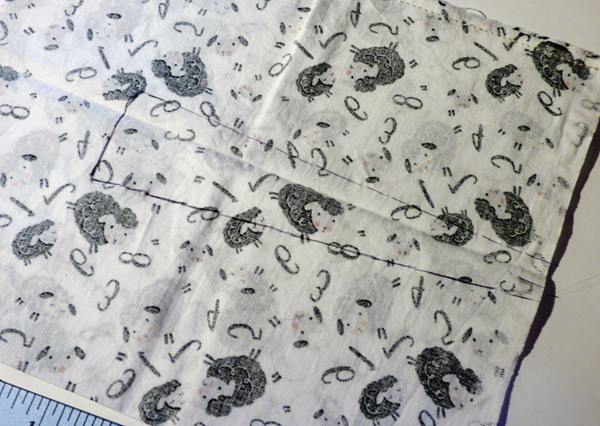
 33 End and side seem in, laing the old cover over the new fabric for locating tab length 33 End and side seem in, locating tab length

Since I am folding on the long side, I will have a seam at the end and down the opposite side. (seam is on the left short side and at the top long side)

34 Making wider tab ends34 Making wider tab ends

35 Marked in pen on backside of fabric to sew in tabs35 marked for sewing

This time I wanted to try a wider end tab to give a bit more protection for the carder. I found the center on the unsewn end and estimated the seam placement.  I used the edge of the pressure foot to give a thin seam allowance. Remember to leave the center area between the tabs open so you can turn the cover inside out. (I almost didn’t on the first one! It has been a while since I have been sewing, I should practice more.)

 36 NO WRONG WAY!!! (leave the space between the tabs un-sewn) i put the presherfoot down in the rong spot! 36 NO WRONG WAY!!! (leave the space between the tabs un-sewn)

37 extra wide seem allowance along open section, about 1 inch with a diagonal cut into both corners

Trim the area between the tabs to about 1 inch from the end of the sewing line. clip back to the corner  (see the pictures). The flaps will get turned into the opening and the nail pressed down after the cover is turned inside out.
38 turn out body of carder through opening left between tabs38 Turn out the body of the carder through the opening left between tabs

39 turning out tabs39 turning out tabs

Turn the body out through the open space then turn each tab right side out.  Tuck in the extra wide seam allowance at the opening. If your iron is not handy you can nail-press the opening.

40 turn out corners with chopstick

Lastly, take a rounded-end chopstick and get the corners poked out. There are more expensive tools for sewers to get into corners but this works and was in with the felting tools.

The elastic straps with Velcro

41 Sharkboy shows you the two different lengths of velcro (short and long)41 Sharkboy shows you the two different lengths of velcro (short and long)

The elastic straps at Dollarama come in two sizes which are not always the same length. pick one that is not too tight and compressing the foam covers but not so loose it won’t hold the carder cover on. (I know that was obvious but some really are quite different small or large than the previous ones I have purchased.)

If you want to make yours extra fancy, top stitch along all the edges. You can add two strips of sew-on velcro to the tab and the main body of the cover (try it on your carder to get the best position. If you want a fashionable 2-sided carder cover I would go with the elastic and Velcro arrangement my first cover has. (so you can turn it either side up)

For odd-size carders, you need to add teeth protection and stack them as you would like to store them. measure the distance from the base of one handle (at the edge of the carder) going directly across the width of the carder down to the underneath carder, across it stopping when you reach the other handle base. Call that X. Now decide how long you would like your tabs (t). X+T+ seam allowance= the long side of your rectangle. The width plus seam allowance x 2 is your other dimension. When in drought just use a string with knots or make a mock-up in paper. (I have found numbers can be just as tricky as letters!)

I do hope this is somewhat clearer than mud! If you decide that this is all too much work or you can’t remember where you put your sewing machine or your hand sewing needles there are a number of people selling premade covers on etsey.

Lastly, Sharkboy got all the new covers on the carders and staked them up for me. He has been working very hard and needs a treat to reward him.

Sharkboy is trying to stack the carders he has wraped 43 he is determand to get the 4 newly covered carders neatly gathered

42-43 Sharkboy is determined to organize the newly covered carders

This weekend (back willing) Mrs. Mer and her son Sharkboy will be going to a fibre festival south of Ottawa in search of hair. I will let you know how all our shopping goes.

Sharkboy says goodnight he is standing on his tail-fin and leaning on a carder he has been trying to move.44 Sharkboy has had a busy day helping with this project and says goodnight

Finished Pin Cushion.

Finished Pin Cushion.

My Pin cushion is finished. the start of it is here:

https://feltingandfiberstudio.com/2023/03/04/making-a-pin-cushion/

I added a door so the hobit could get into the house. I used wool that I have had for years, it’s a mix of browns with a little dark purple. I don’t think they sell fibres anymore. all I could find was yarn.


And then I seem to have forgotten to take pictures until I added the stream. I added the stream with the felting machine. It was so much faster and easier.

Next, I added a window and some bushes and a tree. Here are a few shots of that.


I wanted to add flowers but wasn’t sure if I should do French knots or little felted blobs. Then I thought I don’t need to add any flowers, the pins will work as flowers. I had some pins with little coloured heads.  I am sure the little neat flower garden in the front won’t stay that way but it looks nice for now. I also added a door knob on for the door.


Felt Mushroom

Felt Mushroom

Teri wrote a post a while back about making mushrooms. She inspired me to give it a try. I already had a small circle resist (7 inch diameter) and just needed to add the stem. I cut a rectangular piece of floor underlayment (6.5 inches x 2.5 inches) to add to the circle.

Book page resist for mushroom created out of duct tape and floor underlayment foam.

Here it is after I duct taped it together. Now ready for wool. I wanted the process to be fairly quick so I chose some colors from my selection of short fiber merino which felts very quickly.

Purple and yellow wool laid out over resist to create mushroom.

I decided to ad a few pieces of pre-yarn in brown to the base. I should have put these on the outside layer but I covered with more yellow before wetting down.

Here you can see both sides of the mushroom resist covered with four layers of wool and wet down. Then on to rubbing and making sure the edges were taken care of so I wouldn’t end up with a ridge around the resist.

Purple and yellow felt mushroom upside down on shelf lining material before removing resist.

Here’s the mushroom before I removed the resist.

Felt mushroom laying on it's top with stem upward, felt cut and resist removed.

Once it was partially felted, had a good skin and starting to shrink, I removed the resist. Then on to working the cut edges and begin more aggressive felting, fulling and shaping.

And here’s the finished mushroom on a plastic base with a rod in the center to hold the mushroom erect. I didn’t quite get the bottom even enough for it to stand on it’s own. This was a fun, quick project and I plan on making a few more with a bit more surface design next time. Thanks for the inspiration Teri!


Where wool begins: Keeping sheep safe

Where wool begins: Keeping sheep safe

In my last post, I introduced you to how we raise sheep (and wool!) a little differently than most in Canada — our sheep live outside year-round and graze solar installations and cover crops as their day-job.

In that post, our livestock guardian dogs made an appearance and garnered plenty of attention, as they should. We couldn’t graze sheep like we do without our dogs!

Where we farm, coyotes are a major threat to sheep. Our sheep are also vulnerable to attacks by ravens and even bears, though it has been years since that has happened here. Did I mention we are in Ottawa city limits? We are! But yes, there are black bears, sometimes wolves, and plenty of coyotes to worry about.

There are a few options for guardian animals, including dogs, llamas, and donkeys. We’ve had the greatest success with dogs — it takes a predator to smell, spot, and deter a predator. And that is our goal: unless a coyote or group of coyotes is preying on our sheep, we leave them alone. We would rather not hunt or trap the coyotes, but it does happen from time to time that a troublesome animal or family moves in and even the dogs can’t keep them back.

We’re always asked what breeds of dogs we use. Most of our dogs are a mix of breeds — there are a surprising number of guardian dog breeds, all of which have been developed over hundreds of years alongside sheep flocks. Most of our dogs are Maremma (an Italian breed), with some Great Pyrenees, Akbash, and Karakachan in the mix.

A child and adorable puppies
Charlie and some puppies, March 2022

Our dogs are sometimes born here, or at other sheep farmer’s set ups, but it’s so important that they be from working parents and are born and raised with the charges they will protect. A pup needs to bond with sheep from the beginning so that they treat them as their own. The instincts these dogs have been selected for are truly amazing, but they still require training and support to eventually make it as a livestock guardian. Not all of them do.

We run about one adult dog per 200 ewes, but prefer that the dogs work in pairs. The final number (up to three or four) all depends on the coyote pressure, the terrain, fences, and whether we are lambing or not. There are always young dogs coming on and older dogs slowing down. It’s a real challenge to find the balance of new and experienced.

A livestock guardian dog watches as a ewe has her lamb
A livestock guardian dog watches as a ewe has her lamb. The paint on the ewe is to identify with breeding group she is in. It mostly washes off the wool, I promise.

We’ve just started lambing this week (see above) and two of our newest dogs are doing an amazing job keeping watch over the newest lambs. These dogs not only keep the ewes and lambs safe they also clean up the lambing areas (gross!) which serves a real purpose — less scent for predators to pick up on or come in to investigate. The relationship between these dogs and their flocks is incredible.

Even with many good dogs, losses still happen. This past fall and winter were some of the hardest for coyote kills in close to 10 years. They even took down a mature ram, which is rare. We did have a few trapped, and that seemed to help, but our goal is to add more dogs to keep the pressure down.

A livestock guardian dog looks over his sheep after being sheared
T-Dawg, a livestock guardian dog, looks after sheep

Until next time, enjoy the sunshine and if you’d like to see more of our solar grazing and lambing adventures check us out on Instagram at @Shady_Creek_Lamb!