Browsed by
Author: Shepherdessann

Small Spiral Fail

Small Spiral Fail

I want to make some small spirals that will work on the stick-type keychain/bag charm things I have. I did them with some sheep I had last year.

I have a T-shirt that says; Hold on, Let Me Overthink This. And this is where I am starting with this project. I took Helen’s Spiral course last year, and it was amazing. If you have a chance, you should take it. I want to scale this down to end up about a 3-inch drop on the spiral. So I am starting by thinking this is going to be really hard to do, so naturally it is.

I started by making an underlay spiral to use as a template and resist.

The spiral was small, as I said, so I had to cut my fibre as it was far too long for one of the layers. Can you hear the spinners screaming NOOOO in the background? LOL Also, I was being supervised by Jan’s Llama

After much fiddling, it was sturdy enough to be removed from the resist. I worked on it more, but the layout was not good, and there were thin spots and narrow spots.

All in all, a sad looking spiral.

Next, I  made some prefelt to try.

I tried to stretch and shape it around the resist. I already knew this was not going to work well. Wet felted prefelt does not have the stretch of commercial needle felted prefelt. But I kept going anyway.


This one is better, but although it’s hard to see, the middle of the spiral is very lumpy.

Here they are flat side by side. You can see the pumpy parts of the pink better here.
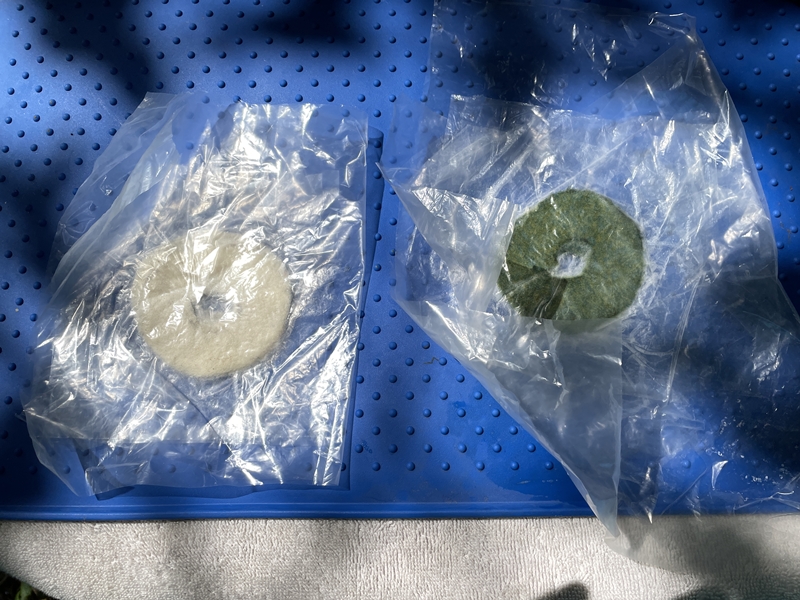
 

Oh well, it was fun trying. My friend Hether decided they were just what she needed for her bike.


Medieval Spinning

Medieval Spinning

I took a Class in Medieval spinning with a distaff last Thursday. I originally signed up for the class before the COVID-19 lockdown.  So I have been waiting a while to do this class.  This was a 2-hour evening class.  We were learning 2 things at once. How to spin in hand and how to use a distaff. Our teacher Judy said it’s like patting your head and rubbing your tummy at the same time.

First, we got some distaffs to dress. This means we had to tie the fiberbatts to a stick. Judy had a couple of nice wooden ones, but mostly we had forked branches she had taken the bark off.

Judy brought several spindles with different whorls. The whorl is the disk that adds weight, so the spindle spins better. The whorls are removable. Once you have some yarn built up on your spindle, you can remove the whorl.

First, we practised twirling the spindle with the leader.  You have to make a half hitch on the end of the spindle and then twirl it.

Judy showing us how to twirl our spindle

Lucie is seeing if it is easier standing up.

Then we practised the drafting and the twirling at the same time. milking cow motion on the right and twirling on the right. This is the patting your head and rubbing your tummy part. The only thing we had to bring to class was a belt to stick the distaff in. I do not own a belt, so I got some bailer twine and braided myself a belt for the night. You can see this great fashion piece below.

Then we started spinning. It’s hard to know where to look, at the hand that’s trying to twirl correctly or at the hand trying to draft the fibre down from the distaff.

Here I am winding on. The idea is to make a football (rugby ball) shaped cob on the spindle.

Here’s a close-up of twirling and short suspension. You can let it drop a bit on the last twerl before winding on. Usually, you need to keep it in-hand so you can twirl it again.

Here is what I managed to make by the end of the class. It’s lumpy and thick and thin just like the yarn I made when I first started spinning. I was just starting to wind off when I remembered to take a picture. I haven’t decided if I will ply it or not. First, I have to find my spindles.  I’ve seen them recently in their little case. Of course, I couldn’t find them before the class. I will find them again when I am looking for something else. I hope I will be smart enough to grab them and not think I will remember where they are.

A class and this and that.

A class and this and that.

I taught a Nunofelt Scarf class a couple of weekends ago. I had a fun group of ladies who were really interested in learning this technique.

Here are a couple of pictures of the setup with the ladies working on thier layout. They used hand-dyed silk blanks and Merino wool. Then there were lots of extras for them to add, lots more merino in many colours,  handspun yarn, speciality wools and several types of silk, silk top, silk hankies and silk throwsters’ waist. A few brought some of thier own alpaca too.

and the scarves they were working on.

This slideshow requires JavaScript.

And then we were too busy enjoying the felting for me to remember to take more pictures. Well, I thought I took more pictures, but I guess I didn’t do it properly.

I had two ladies who had to leave early as they had a long drive. They worked diligently to be done before they had to leave. They did a great job, and I hope to see them again.


Here are the other 6 ladies and thier finished scarves. I am pretty sure they had a good time.

After that fun I had to get to work myself. I had to resupply The Log Farm store. They sold the last of everything during Sugar Bush. I have been busy making Dryer Balls and Felted Soap


Next are some drop spindle kits.

All 3 of these are fairly easy to put together and sell well at a relatively low price point. What do you make and sell in this price category? I have been thinking that cards with pictures of my felt might be a good idea.

Making a Shell

Making a Shell

After seeing Helene use some prefelt ribbon, I decided to give it a try too. I am thinking of differential shrinkage to get the shape of a shell.  I thought it might work well with a spider conch shell to make the ridges.

I got my ribbon from the Olive Sparrow in Toronto. She doesn’t have it on her Etsy, but if you contact her, she has it. You can, of course, make prefelt and cut strips. But this is a fast and easy way to get going.

I made a 2-part resist so there would be an overlap on one side.

I made the inside pink, then added strips of the prefelt ribbon.

I added some blue for the outside. Sorry for the really bad picture.

Then of course the was lots of rubbing. I am using a rubbing tool from Moose Hill. It has a nice weight, not too heavy like others I have tried. I like to start gently.  It does have a nice, wide handle, so it’s easy to hold and press down when that is what you want. Jan used my phone to take many of these pictures for me. She took about a dozen of this one, complaining that I was not smiling. Seems I do not smile when I am working.

Once it had shrunk a little, I cut out the resist and removed the non-spined side of the extra resist. If I left it, I think there would have been too much to curl inside for the middle of the shell. Then of course, fulling and shaping.

It wasn’t long into the fulling when I knew I had not used enough prefelt to get the differential shrinkage I wanted. I suppose I should have known better. But often that’s the way. You need to be reminded of what you already know.

Still, it didn’t turn out so bad

When I got home, I fulled the ridges in some and then clipped it all into shape to dry. As you can see, this made the base of the folded part pointy, and that remained after I took the clips off and let it spread out.

I wet just that part and fulled it back to round in a very short time. I had been anticipating a fight with it.  I had tried to shrink this part more before clipping it with no success. This just reminded me of how, sometimes,  it is easy to get more shrinkage after it has rested or dried and is rewet. I have no idea why that works, but it does.

After it was dry again, I was not happy with how the top with the points wanted to curl around instead of standing out, so I put a couple of invisible stitches at each end to hold it in position.

And finished. I like the finished shell, even if it didn’t go the way I planned.

I may give it another try over the summer, but as spring slowly arrives here( we had a little snow again the other day), I find I have lots of ideas and more energy to do things. I have things to make for the guild sale in the fall.

Felted Vessel Workshop

Felted Vessel Workshop

A few weeks ago, I taught a felted vessel class. A lovely bunch of ladies full of enthusiasm. As usual, I didn’t take as many pictures as I wanted, but here you can see the setup.

After everyone had their base ready, people got to work on embellishments. This is the hardest part, but also the most fun for most people. So many choices of wool and silk. They have to think about where they will cut their felt to take the resist out, to open it up, how big they want the opening and whether they want a very round pot or a flattish one. Where is the top, and where is the bottom?

I didn’t take as many pictures as I wanted to,  so we jump to the end.

Two ladies decided to cut slits and make their vessels into small bags. They need to work on the edges some more.

And one lady decided to turn hers into two small bowls. One was turned inside out so you can see the pattern better.


All in all, I think they did very well having never felted before, I don’t think any of them had ever handled fibre before.


3D Multi Part Resist Workshop Opens for Registration

3D Multi Part Resist Workshop Opens for Registration

Where did time go? It is almost spring. The 3D musti-part resist (book resist) workshop opens for registration today. A Masterclass on Book Resists. You can sign up using this form on the workshops page: 3d-multi-part-resist

The class runs from March 1st to March 29 2026. The instructor is available multiple times a day to answer any questions and give advice, so you can take the workshop from anywhere in the world.

This class is for people who have done some basic felting and used a simple resist and want to try something more challenging, learn some new skills and have some fun with them.

Here are some pictures from the last class.

There is a full class description and registration form here: 3d multi part resist


Felted Lantern Cover Workshop.

Felted Lantern Cover Workshop.

I got to teach a felted lantern cover class recently. It was mostly people who had never handled wool before. This class is fun, interesting and technical. This project requires a very thin layout, but if it develops holes, that’s ok because it lets the light out.  It’s a great one to use to practice thin layout.

I made a new sample with prefelt shapes on the inside and sari silk on the outside. I didn’t have a sample of either of those. It always amazes me how much the sill disappears when you wet it, even on contrasting colours

And the finished sample. The inside shapes worked really well. Some of the mwere swallowed by the scrunched-up part, but that’s ok.

I had eight students. I let them choose if they wanted to make it all enough to be able to make part of it scrunched, or just tall enough for it to fit the glass vase/lantern. I almost forgot to take pictures.  It was about an even split. Scrunching them makes a fairly simple design stand out.

I almost forgot to take pictures. Here they are laying out their wool, lots of different ideas.

Then, of course, there was all the rubbing and rolling

Here are some finished but still wet. I am not sure how I ended up with only 5 of them. I was sure I took a picture of each of them.

And here are some pictures my students sent me when they were all dry.

I think they look great. This is a great project if you don’t have a lot of time, but want the satisfaction of start to finish in one session.

Happy New Years

Happy New Years

Happy New Year, everyone. I hope you are having a great holiday time. May the new year treat you well and help you get where you want to be.

Last year was a bit of a crazy, busy year. One thing I did that I have been wanting to do for a long time is to make an online workshop. I had to make a firm commitment that I would do it by a certain date, or I would never have managed to get to it. It was a huge amount of work, but so worthwhile. It’s funny, I was sort of dreading doing it, even though it was something I wanted to do. This year, I am planning to expand the existing workshop and possibly create another one. I am thinking of a ruffle scarf workshop, but we will see. I don’t know if it’s something people would like to learn.

I am taking a how-to photograph you fibre art workshop in the spring, so maybe my pictures will be even better


The second thing I want to do this year is take more pictures of scenery, plants, and things. I want to have a better library of pictures to work from. I am sure I will never get to Jan’s level, but I can work on it. This is some frosted milkweed in my garden


The third is to take some workshops. I am signed up for the Photographing Fibre Art that I told you about above, Spindle Spinning with a Medieval Distaff and Build your own LEGO Spindle.  They are all taught by the Ottawa Valley Weaves and spinnes guild. I would have liked to take Rock wrapping, but everything I signed up for is clustered together, and rock wrapping is in the same time frame, plus I am teaching twice during that time.  It never fails. Oh well, hopefully it will be offered again, and I can take it then. If you’re in the Ottawa, Ontario, Canada area, here’s a link to the workshops the guild is offering this winter/spring. https://www.ovwsg.com/workshops/

Lastly, I want to learn to crochet. I understand the concept. I’ve made a chain before. I am told I should make some dishcloths to start, but that doesn’t appeal to me. What other beginner/learner project do you know about? How did you start?

TOFT - Three NEW pure wool sheep kits for British #woolweek . https://www.toftuk.com/PL.aspx?CatName=animal_kits/farmyard Marian the Corriedale, Wayne the Gotland and Everett the Romney. #edsanimals #sheep #sheeplove #corriedalesheep #gotlandsheep ...
3 TOFT sheep


Happy Holidays

Happy Holidays

Happy holidays, everyone. Christmas for us this year will be late. We won’t have family dinner until Sunday, when everyone can be together. The littles will still get Christmas day and Santa, but we big people will wait. I am hoping that that means I can play in my studio on Christmas Day. I think that will be a great present for me.

Currently, I am still working on my picture from Jan’s class.  This is how it was in the last post. I don’t like the tree trunks I added at the end, and I am not fussy about the fog.

First thing, take the tree trunks off and pull back the fog. I also want to soften the bottom edge of the fog. Although we do get fog that is just like that, with a hard line bottom sitting several feet off the ground, it’s not looking great in the picture.

I did try adding a leafless tree near the shed, but I pulled it off again before I took a picture. I also do not like this fogound tree. The branches are too round. I like the trees behind it and to the right. That will have to be next.

Jan suggested I try a frame on to get a better look at it. The picture is a little bigger than the frame opening, so I tried it with a little less sun and with a little less snow. Sorry about the bad( worse than usual) pictures. I thought I had them straight when I took them. I think I like it better with a little less snow and a lower horizon. What do you think?

I am still thinking about a fence along thetee line. Jan suggested making it at an angle across and out the side. I am not sure. I like the snow. I was thinking of adding just a small clump of grass in the snow on the right to balance things.


Nuno Felt Scarf Class

Nuno Felt Scarf Class

Last week I taught my final workshop of the year. It was Nuno Felt Scarf.  I had 8 students. Previously, I have been restricted to 6. The old class space at the guild was a snug fit with 6, but since some rearranging of space, I can now teach 8 students comfortably.

This was a fun class; one lady had bought 5 spaces to surprise her family with a Christmas workshop. They had no idea what they were doing until they arrived. They were all game, but I did see some scepticism there too.

I started with a little more explanation than usual to help the surprised students get a better idea of what we were going to do. I had lots of samples to show them to help decide how they wanted their scaves to look. Then I explained all the embellishment fibres. It’s a lot to take in when you’ve just started thinking about it. Most students have been thinking about it for a while and have an idea of what they want to do.

They picked scarf blanks and then base colours. There was a lot of back and forth to pick wool colours, and then the embellishment fibres.  Everyone was encouraging and helpful with colour choices and what goes together. All colours go together, just in case you didn’t know. I always enjoy watching everyone work out colours and often working up the courage to be bold and add all the extra bits of colour they want.

After everyone gets their scarves wet, it’s time for lunch.

Usually, lunch is a bring-your-own, or there are a couple of fast-food places around. However, the student who had bought her family had decided to provide everyone with lunch. It was very tasty, cold cuts, cheese, salad and bread. Then there were homemade cookies and fruit for dessert. I felt very spoiled.

After lunch, they moved on to rubbing and rolling.

I am sure some of them thought it was never going to work. Then they noticed it was really shrinking. Then, when it was time to finish fulling, it was so fast, and they could hardly believe they were done. They were all very happy, and there was talk of doing another class; it was so much fun.