Yarn Bombing Our Hanging Pots

Yarn Bombing Our Hanging Pots

This post is going to be short and quick. It’s been a crazy couple weeks for us, and on top of that I am experiencing vertigo. Apparently a crystal in my inner ear, is floating around, where it’s not supposed to be. Eventually this crystal piece will move along, through the fluid in my middle ear, and out. Until then, I have to be careful of every movement of my head.

Today, I want to show you an idea, Brian came up with. We made a trip to Home Depot, the Friday before Mother’s Day, and my crystal incident. I wanted to get a nice potted plant for the inner courtyard at Mom’s Memory Care facility. I’ve never had good luck, at Home Depot in general, but this time we were pleasantly surprised. We found carts full of glorious colorful blooms, herb plants that were strong and healthy, and a couple varieties of heirloom tomatoes. Yay! Best of all, by the checkout, we saw a freestanding hanging plant stand, that would be perfect for hanging herbs off the ground and away from a curios canine. Brian created a perfect area for growing herbs, last year, when our puppy was very young. But, through the winter, Porter (at 75 lbs.) found my sage bushes, perfect for hiding lost tennis balls, and super comfy to lay on.

Double begonia flowers in bright orange and hot pink, herb plants, surrounding a bright white bucket.
Beautiful plants and herbs surrounding a very white bucket.

Home Depot displayed their plant stand, with plastic 2 gallon paint buckets, filled with gardening tools. I thought that idea was genius. Hanging pots are so expensive, and paint buckets are relatively cheap. My only problem, all that white overwhelmed everything. Brian came to the rescue with the suggestion “Why don’t you Yarn Bomb them.” That’s a great idea, Brian!”

white bucket, turned over, crochet covering it
This was my first attempt. Didn’t consider drainage holes leaking dirt all over my hand dyed yarn.
Man holding a decorated pot
I think they call this free form crochet! I started with super bulky yarn, a US-P size hook, and made up my own doily pattern.

We had to think a few minutes, about how to attach the crochet to the bucket. Suddenly I realized, “S” hooks would work, and we had some with our grid wall supplies. That worked for the first bucket, so I ordered more hooks from Amazon. They were on our porch the next afternoon. With my dizziness, I was only able to get 3 of the 4 finished.

This is how it looks so far.

We have some fun ideas in mind: like hanging a full recycled bottle of water from a hole in the rim of the buckets. That will tip the buckets, so the plants will grow as if they are pouring out. No matter what happens with this project, we’ve had a lot of fun, thinking outside the box. I hope you find some joy in your own crafting this week!

Capi

Update: Thank you everyone for your wellness wishes. Thankfully, the crystal issue is gone. I had been tested and diagnosed with low Vitamin D years ago: we live in Michigan, so that’s not surprising. I normally take extra Vitamin D every day, but recently a new doctor warned me I was taking too much! I lowered the dose…and had crystal issue within 4 months. (I’m not a doctor, so don’t trust the following information without consulting with your own physician.) There are thoughts by some in the medical field, that extra Vitamin D3 chemically binds with crystal chemical properties…and essentially moves them along. I’m not saying that happened for me, but coincidentally after returning to my original dose, it cleared up quickly. 🤔

Making Waves Update

Making Waves Update

In my last post I mentioned a few of the projects I was working on with the “Making Waves” theme, along with other members of the Waltham Windmill Textile Group. I’d begun work on a 50cm x 90cm felted wallhanging inspired by the markings on large stone slabs on the beach at Seahouses in Northumberland.

Having recently bought myself a drum carder I carded a variety of left over bits of fibre, mainly blues, greens, yellows and neutrals, to make my background and laid them out with off cuts of hand dyed silk fabric, scrim and large nepps. On the left is how it looked after felting and on the right is where it’s at right now. I’ve added synthetic sheers, machine wrapped cords, hand and free motion stitch and in some areas I’ve heavily machine stitched to push them back and encourage the adjacent areas to stand out. The original bottom left section wasn’t working with those silk circles so they were pulled off and replaced with some stiffened, rust dyed fabric circles, recycled from another piece of work. I’m calling it Going With The Flow because a) it’s inspired by a trip to the beach b) it has flowing lines and c) like most of my work its design wasn’t preplanned. It’s evolving as I work on it, adding bits in and taking bits off until it feels right. It’s got a way to go yet before I can call it done.

One of the other challenges within the Making Waves theme is to make a 3D fish and my immediate thought was to create what many would regard as an ugly fish but which I prefer to think of as a fish with shedloads of character……..one that would get noticed amongst a group of pretty fish!

Having typed  “ugly fish” into Google I lost many hours over the next few weeks looking at images and some incredible videos of life deep in the depths of the oceans. Each new search revealed yet another fascinating species of fish, some quite honestly didn’t look real while some, like the Tasseled Scorpionfish were strangely beautiful. One of the weirdest I discovered has to be the Red Lipped Batfish. If ever there was proof we descended from the oceans this red lipped, whiskered fish that “walks” on its specially adapted fins has to be it! 

Last month the Waltham group had a day making felted fish, some are finished, others are still work in progress.

Lucy made a wonderful wet felted Puffer Fish adding recycled plastics, including pipette tips, wine bottle netting and glass beads with recycling symbols underneath, to highlight the plight of our oceans.

Sue is very new to wet felting but she’s taken to it like a fish to water (couldn’t resist!) and has made “Angry Fish”. I think he looks more sulky than angry but he’s terrific!

Barbara’s felted fish is still work in progress but looking great, as is her sketch book and fabric fish purse!

Originally I had intended to wet felt my ugly fish but, after all those hours of studying them and getting excited about what I was going to make, for some reason when I took out my carded Corriedale fibres I found myself felting a cartoon version of an Angelfish…….I didn’t see that coming! Her name is TroutPout and she’s approximately 33cm x 36cm excluding her fins.

I’ve been enjoying teaching 3D Seed Pod workshops recently using wire wrapped with Tyvek fabric so decided to make my Anglerfish from wire rather than fibre. It was only when I’d got the 60cm x 33cm framework made that I sat back and realised I’d gone past the stage where I had meant to start adding my fabric! Time for plan B…..maybe I could use wire mesh to give it “body”?

I looked for some online but hesitated as I wasn’t sure how flexible or suitable the mesh would be. Having put the fish to one side, a few days later I joined the Lincolnshire Textile group and at my first meeting I was offered a piece of silver coloured Sinamay. Sinamay is one of the most popular hat-making foundations. It’s woven from the processed stalks of the abaca tree, a type of banana native to the Philippines. I couldn’t believe my luck……..being silver coloured this off cut looked like wire mesh but wasn’t and if I sprayed it lightly with water I could easily shape it to fit and stitch it with aluminium wire to my framework. So this is how far I’ve got. I’m going to add a few more wire spirals and do something more interesting with the eyes. He should have menacing teeth but I might not go that far!

Another feature of next years Making Waves exhibition will be an Octopus’s Garden so once the fish are done it’s straight on to making lots of coral and a few Octopus. I’m loving this theme and could quite happily continue with it way beyond our event next year…….it has to be the most interesting and enjoyable we’ve had so far!

What Do I Do With These Weird Colored Fabrics?

What Do I Do With These Weird Colored Fabrics?

Comments I’ve received in some of my previous blog posts have asked me to share some of the makings from my various fodder explorations. Sometimes it’s very hard to cut into any of those things we’ve spent so much time making. We need to save them as samples, right? They become too precious to us to even think about cutting them up!

I recently got a little push from that mentality.

One of the quilt guilds I belong to (Contemporary QuiltArt Association https://www.contemporaryquiltart.com/) needed to replenish their fiber art pieces for their fundraising stash. At the last in person meeting I attended, I picked up two yards of fabric that had been hand dyed by two past members and wasn’t selling at the fundraising events as raw yardage. We were asked to try to add surface design techniques to the fabrics to see if the pieces would sell better as yardage if they had another layer on them. The other option was to make some fiber art pieces using that fabric. I decided to try using up some of my own stash and collaging onto the hand dyed fabrics. I had picked an orange color and a grayish color. I decided to focus on the orange fabric first because I like orange! I wasn’t having much luck finding colors to match from my stash until I came across some of the printer ink pieces I had made in a Lorna Crane (https://lornacrane.com/) online class I took from Fiber Arts Take Two (https://www.fibreartstaketwo.com/). FATT has great YouTube interviews of a variety of artists from Australia and Europe. The fodder from Lorna’s class was in my PRECIOUS category.

These are the brushes I made after taking Lorna’s class (before they got ink all over them!)

Pretty primitive but very effective!

handmade paint brushes


And here is some of the fodder I made using those brushes and Epson printer ink. I didn’t have any ink for her class, the delivery of my order was a week or so away and I really wanted to get started on her process. I had purchased the wrong ink for my Epson printer and was going to send them off to the thrift store when I started wondering if I could use them. I did a bit of research and it looked like they might work. Each color was 65 ml. I just had to figure out how to get the ink out without spilling it all over the place before I could get it into a more accessible container.

I also used the brushes I made to paint the ink onto the paper and added some other mark making and acrylic paint layers.

fabrics and papers awaiting collage process

This is a mixture of inked paper and fabric pieces made into scrolls. Each of the scrolls is 3” wide x 35” long. I have quite a bit of leftover paper and fabrics plus these scrolls, so I think I have enough for my 5” x 7” series. (In the end I couldn’t cut the scrolls for use in the 5 x 7’s but DID cut them up for use in some 12” x 12” pieces).

finished scrolls

The printer ink made some unusual colors on the fabrics and papers.

But the background fabric is unusual as well. I tore pieces at 7” x 9” so I would have some play room for fussy cutting the finished size. I could get 6 pieces out of one 9” tear. (At this stage, I was thinking “OMG what am I going to do with the other 26” of this weird colored fabric??”)

Six 5x7 fabric pieces ready for collage

I’m still learning how to collage. It’s a combination of design principles and intuition and in my honest opinion not an easy feat. Especially when dealing with odd colors.

Here is a photo of them after working on them the first day.

fabric collages first try

Here is a photo of them after the second day. I was thinking about adding some blue to the mix, which is why you see my baggy of blues in the upper left. I found it difficult to try to add new colors in. They just weren’t working.

fabric collages 2nd try

I was grateful to have the white window tool to view them as I worked on them. They look really chaotic to me without a frame to contain them.

On the third day, faces started appearing. I’ve been focusing on portraits in my current work so maybe it’s to be expected that faces started appearing to me.

How silly is this guy!?

collage 4 with face

I think one could fiddle with these for days, but I needed to keep moving or I’d never get this blog posted!

The next step was trying to figure out how to adhere the pieces to the background fabric.

The collage pieces are a combination of paper and fabric. I didn’t want to stitch them down so I thought I would use either Matte Medium or Soft Gel Matte to glue them down as well as put a layer over the top of the whole piece. I bravely took one of my least favorite 5 x7’s and started with the Matte Medium. Ack! The white of the organza fabric blended into the orange fabric after gluing. Would it dry back to white or stay orange? Of course, I should have tested the Matte Medium before I possibly ruined one of my 5 x7’s but I was living large that day! I’ve also had some experience with the Matte Medium on cloth so I kind of knew how it would look. I took a deep breath and left the piece to dry overnight. I was pleasantly surprised when I looked at them the next day. There is a hint of white but mostly orange showing up. I went ahead and used the Matte Medium on the other 5.

Here is a before and after comparison.

BEFORE

collage before gluing


AFTER

collage after gluing

Next, I needed to decide if I wanted to do any stitching on them. I ended up running some straight machine stitches with black 30 wt Sulky thread in a couple of the areas.

I’m pretty happy with how they all turned out. The guild will mount each of them behind an 8” x 10” mat board. Hopefully each of them will find a new home and make the guild some money so we can continue to have all our wonderful speakers each month.

They are going to have to really like orange though!

Here are the finished pieces.

collage 6 done

collage 5 done

collage 4 done

collage 3 done

collage 2 done

collage 1 done

Now I need to figure out what to do with the gray fabric!

Happy Creating! Thanks for reading!

Tesi Vaara


Blacksmithing and working on the dino-purse…oops

Blacksmithing and working on the dino-purse…oops

This past weekend was Father’s Day and to celebrate we went off to the Glengarry Pioneer Museum to watch a blacksmithing event. This year the workshop was to create a replica antique door latch (Norfolk Latch). It was a 2 day workshop and fascinating to watch most of it. Blacksmiths and blacksmithing are very photogenic, with about 430 shots from Saturday and only 290 from Sunday (the battery died and the backup was in a similar state of uselessness. Don’t panic!!! I promise I will not show you all the photos but there were a few that you might enjoy.

the Norfolk Latch that was being recreated, a rolled collar on round stalk1 the Norfolk Latch that was being recreated, a rolled collar on round stalk (it will be part of the handle)

2 brushing scale off the tenon of the handle created a spark, tongs in front of a lit coal forge.2 brushing scale off the tenon of the handle created a spark, tongs in front of a lit coal forge.

There were 10 students, an instructor and an assistant. There were also blacksmiths who were not participating but were still watching and enjoying the demonstrations.

3 thick smoke hanging in the air from 10 coal forges starting up.3 thick smoke hanging in the air from 10 coal forges starting up.

This is not more smoke from the wildfires, this is 10 coal forges starting up under one side-less barn building.

After the weekend of photography, it was back to fun in the guild library. I added a new magazine, got the library open and ready to use, collected incoming books and got the outgoing ones ready to put into the circulation file. Since the library is now in hand I would get a chance to draw out a couple of options for the wet felting purse. (See I did get to felting!) I had wanted to try the Stegosaurus 3d bag which will be much trickier than the manta ray purse option.  Remember I like my felting dry, I can wet felt but making my own shape for a resist is not a common occurrence. Let’s see if I can work this through (With little math and minimal spelling!)

Option 1: this was a more cartoon proportion of a stegosaurus.

4 very simple shape with legs the same length front and back.4 very simple shape with legs the same length front and back.

Option 2: is still quite cartoonish but the back legs are closer to correct

5 still simplified but more anatomically correct than the previous Stegosaurs.5 still simplified but more anatomically correct than the previous Stegosaurs.

Next, the phone test;

6 laying the phone over the two drawings from #4 and 5 to make sure the phone will fit.6 laying the phone over the two drawings from #4 and 5 to make sure the phone will fit.

As much as I prefer the more realistic version, there is better space in the more cartoon one. Ok, so I should polish that one up a bit more.

7 expanding the scrap paper so I can add a better angle and length of tail and the tops of 2 plates.7 expanding the scrap paper so I can add a better angle and length of the tail and the tops of 2 plates.

Next, trim the sides so I can figure out the gussets for both the back and belly

8 taped strip of paper to figure out the belly gusset of the dinosaur.8 taped strip of paper to figure out the belly gusset of the dinosaur.

First attempt at the belly gusset;

9 estimating gusset for under tail, body, neck and head.9 estimating gusset for under tail, body, neck and head.

I checked the fit by using painter’s tape to set in the belly with the side

10 Belly gusset fits nicely with side.10 Belly gusset fits nicely with the side.

Once I liked the belly I started to work on the back gusset and taped that in to check the fit.

11 inside view with back and belly gussets in.11 inside view with back and belly gussets in.

12 adding width to the head and marked where a zipper would go if I choose to use one.12 adding width to the head and marked where a zipper would go if I choose to use one.

I wondered if I could attach the belly with the body between the legs and see if I could join the two parts

12 adding width to the head and marked where a zipper would go if I choose to use one.13 The belly is attached at the belly and behind the legs but not on the neck and tail.

The belly strip would only be half the width but I would have to raze the tail and head. But that might work. I will get a second opinion from Ann when she arrives. I had a quick message chat with Ann to review percentages and shrinkage for firm felting. We decided on 50%. So, I needed to scale up from the finished paper size.  I started by measuring the longest and tallest sections.

14 the longest line through the body and the height through the front leg.14 the longest line through the body and the height through the front leg.

I then took it further and graphed the general shape so it would be easier to scale up

15 1 inch graph added to the body.15 1-inch graph added to the body.

I tried to estimate the height and length but was having trouble scaling up the legs and still having space for the belly…. Ah. I started at the centre and between the legs and worked out from there.

16 i have most of the body estimated adding half to each side. The graph is making it easier to scale up.16 I have most of the body estimated adding half to each side. The graph is making it easier to scale up.

17 This is what I had graphed out by the time Ann arrived.17 This is what I had graphed out by the time Ann arrived. (there was a lot of measuring and adding while I was unsupervised.)

18 Ann lay the paper mock up on top of the resist18 Ann lay the paper mock-up on top of the resist

Ann (who is very experienced with wet felting resists) said she thot something looked a bit off. Other than the spikes I was sure I had carefully added the same amount all the way around. Oh…. You meant to add half of what I had, not half on all sides. Sorry, I think I am thinking in 3-D again.

So I now have a shoulder bag-sized dinosaur, not a phone and i-pod audiobook reader sized bag. Well, I could add wool and a couple of spindles at this size but I probably better go back and reconsider my math. I will probably just use the calculator I found last week and had meant to use and totally forgot! (I should never trust my own ability with numbers it is just as bad as my interpretation of spelling! It’s like interpretative dance only much more interpretative.)

So it’s back to the drawing board! Or, I could make it all out of dry… no be brave! I can always wear gloves and keep dry!! I will have to have a little pause and get back to working on 3 more chickadees which I may need for this coming weekend. I just need more hours in the day but for tonight it’s way past my bedtime and I will shortly either fall backwards off my stool or face-plant my keyboard.  I will keep you updated with the horrors of math or if I just decide I will make a bigger purse!

Have fun and keep felting!

Second quarter challenge flowers finished

Second quarter challenge flowers finished

I have finished my flowers but I don’t think I am finished with the picture.

The last time I had gotten this far

felted flower back grounds


I started adding flowers, thinking that the branch end would be the last to open, I started with a darker colour and fewer threads to make buds. I made smallish french knots.

adding french knots to felted flowers


Next, I went to a lighter shade of pink and a few more strands for the next size-up flower buds

adding french knots to felted flowers adding french knots to felted flowers


For the next group, I used my final pink colour but added in a few strands of the darker colour. I should have probably used half and half because the darker pink didn’t show up as much as I hoped. I did these at home so you got 4 progress pictures.

2 colours of embroidery thread

adding french knots to felted flowers adding french knots to felted flowers adding french knots to felted flowers

Today while I was at the market, I finished, with the lighter pink being for the bigger flowers. I decided to try colonial knots instead of french knots. I am not sure I wrapped them all the right way band I added some extra wraps around the needle to bulk them up a bit.

adding french knots to felted flowers adding french knots to felted flowers

I liked the way they turned out. I am thinking maybe I should add a little bit of yellow to the middle of the bigger flowers to make them look more open. I also think adding some green flower buds might be a good idea too. So that is next, and hopefully, I will make it before the end of June.

And now just because they are cute, the 2 ducklings that visited our booth this morning. they belong to the Farm and were out for a walk with their youngest.

Two baby ducklings


In Memory – Marilyn aka Pandagirl

In Memory – Marilyn aka Pandagirl

It is with great sadness that I am writing this post. I was notified that Marilyn, aka Pandagirl, died from complications of a respiratory illness, while recently visiting her family in California. I emailed her husband Craig and expressed our condolences from The Felting and Fiber Studio. He kindly gave his permission for me to write a post in memory of Marilyn.

Marilyn joined The Felting and Fiber Studio forum in June of 2013, where she has written almost 5,000 posts. When one of our original members stepped down, Marilyn joined our team and posted to the website here for five years (March 2014 – April 2019). She had a background in marketing and wrote quite a few posts about how to market artwork and gave some great ideas on boosting small businesses like many of us run.

In Marilyn’s first post, she introduced herself and talked about her fascination with textures. I think a lot of fiber artists have that inclination to be a “hands on” type of person and Marilyn showed us many different fiber textures over the course of her posts.

Marilyn’s work ranged from Easter baskets, nuno felting, felt bags, dyeing, surface design, 3D pods, creating her own hand carded batts, and many felt pictures. She often made gifts for her family members and even one for her retiring physician (wine bottle cover above).

When I asked our other members about their memories of Marilyn, I heard over and over how kind and thoughtful she was. I have included their comments below, interspersed with photos of Marilyn’s work.

“I remember Marilyn from my first postings on the Forum, she was always very present and generous in her suggestions.” Caterina

“She will be missed. Marilyn always contributed to TFFS, either in her posts or with her thoughtful comments.” Antje
“It was only last week that I was wondering how Marilyn was.  Soon after I joined the Studio, I remember a post from her mentioning that she was not well.  Having delved into the archives from time to time, I have come across her posts and I remember that they were always very upbeat and interesting.” Ann B.
“Marilyn was an enthusiastic felter (one of her many talents) and she made beautiful items – many of which were gifts for her family in California. She was always cheerful and very encouraging in her comments on all members efforts. She will be sadly missed by many.” Lyn & Annie
“It was always lovely to see Marilyn at our gatherings, always cheerful and bright.   I briefly knew her through social media (Facebook).   She came across as a beautiful person with family at the centre of her universe.” Helene
“I’m heartbroken to hear that Marilyn passed away. She and I used to exchange emails occasionally, talking about our lives and exchanging news. She always had lovely photos of her grandchildren to share and made me feel a little like I was part of her family life. Marilyn was a lovely human being, always ready to help and always upbeat (even when her illness was taking its toll). I’ll miss her dearly. She’s actually the reason I started blogging with TFFS, so she could have some time off – so Marilyn is the reason I got closer to you wonderful people :)” Leonor
“I remember Marilyn as much for her encouragement as for her interesting and inspiring posts. When I first started felting and discovered this wonderful online community she was so supportive. No matter how crude my early attempts with fibre were Marilyn always responded with a positive comment and that encouraged me to continue trying!” Karen
“This is very sad news, Marilyn was such a lovely person, always cheerful, kind and generous, she will be sorely missed. She was the inspiration behind this watercolour sketch from 2018, may she always be happy and smiling.”  Teri
“She was always so positive and encouraging in her kind comments that I felt I got to know her a little as a kind, loving and generous person.” Lindsay W.
Marilyn will be missed by us all. If you have memories of Marilyn or wish to express your condolences to her family, please leave us a comment. If you would like to read more of Marilyn’s posts, use the search function on the right side bar using “Marilyn Aka Pandagirl” and her posts will come up.
A welcome return to in-person sessions and we were all scissor happy!

A welcome return to in-person sessions and we were all scissor happy!

A recent workshop saw a welcome return to my facilitating face to face felting sessions.

I was asked by our local felting guild, Feltmakers Ireland to run one of their Sunday Sessions.  These are social woolly gatherings.  They generally take place in the morning on the second Sunday of each month and last 2.5 hours.

I was given a free reign to present whatever topic took my fancy.  I thought a fun morning which I called ‘Demo and Do’ might fit the bill.  The topic was felt embellishments.  My idea was to demonstrate two basic techniques, then quickly show samples of how I had developed these techniques in my own practice to contextualise use, after which the members could have a go.

The first technique was ‘Cracked Mud’ which I learnt many years ago from the wonderful Lyda Rump.  This was quick and easy to learn so I allocated a smaller portion of the session to completing it. If you are unfamiliar with the technique, here are two of the samples I prepared for the session.  I used three colours, red, grey and black.  Alternating between the red and black (top and bottom layers) totally transformed the finished samples when I cut into them:

The second technique was the creation of a basic wet felted geode.  I was taught this technique by Marjolein Dallinga  at a superb workshop she gave when she travelled to Ireland many years ago. This technique was a bit more complex so the group spent longer working on it.  Again, so that you can have a visual on this, here are my samples.  I used the same colours as for the cracked mud technique samples.  The top of the photo shows some of the off cuts from the finished samples:


As time was short, I decided to make up packs which the participants could purchase if they did not wish to bring along the materials.  These packs comprised of a number of prefelts.  The cracked mud prefelts were industrial and the geode prefelts were handmade; three colours over six layers.  Each one was different (I bore easily so I wanted variety when I was making them).  Each square measured 20cm and weighed around 15 grams.  Here they are prior to wetting out:


And here they are after they had been lightly pre-felted.  They were all so colourful:

There was a lovely party atmosphere and altogether 20 worked on samples while 3 chose to observe.   Here are some photos from the morning.  Many thanks to Clodagh McDonagh of Feltmakers Ireland for taking these photos:


Just look at how focussed we all were! I promise there was a lot of laughter and misbehaviour  too!


A number of the participants were new to wet felting and luckily they all sat together so I was able to give them a bit more time and answer their questions following the demonstration.  I am very proud of them all as each one produced finished samples.


Here is a photo montage of the participants’ work.  Many of them brought their geode pieces home to finish but all of my ladies who were new to felting got theirs finished in time.  I am really proud of how hard they all worked.  I also prepared an electronic PDF of the technique for the participants which was sent to them later in the day.

It was a real treat to resume these activities and to meet up again with such a lovely group of women.

Have you ever gotten scissor happy with your felt!  Do you fancy sharing your results?  I would love to seem them. You can upload your photos here.

Thanks in advance and happy felting!

Craft Basket Makeovers – part 1

Craft Basket Makeovers – part 1

A good few years ago now, after I had acquired and learned how to use my spinning wheel, I was casting around for some means of storing the associated equipment in a reasonably respectable way.  The wheel and associated bits lived with us in our living room and needed to be tidy.

Quite by chance I came across a shop selling off cheaply a large deep cane laundry (I think) basket.  It was only going cheap because one of the handles was broken and it had no lid.  The much reduced price compensated for something which was no problem as far as I was concerned.

I used to work in Maidstone (Kent) and nearby there was a lovely shop called C&H Fabrics (sadly no more) which sold both dressmaking and curtain fabrics and haberdashery.  I could never bypass their remnant section – they almost always had something good and large enough to be really useful.  I managed to purchase several large pieces of curtain fabric of a design which was really “with it” at the time (most rarely  for me, I am usually following several years behind fashion fads).  This was during the time when Macramé made it’s first appearance and I was very “into” this.  So I removed the remaining cane handle and instead added two twisted cord macramé handles.

laundry basket without lid, with macramé handles, filled with spinning equipment


Then I set to and lined the whole of the basket using the curtain material, making sure that there were pockets around the sides of sufficient size to take threading hook, spare bobbins; flyer; carders; ball winder and my Neatsfoot oil – my wheel had a leather connection between the treadle and the footman – the bits that actually drive the wheel, and the neatsfoot oil is a good natural conditioner for leather and ok for oiling the metal parts.  The rest of the associated bits – fleece, box of carded rolags, tea towel used as a lap cover, cord for tying skeins and niddy noddy would just sit in the middle.

Now I needed a lid for the basket to keep the dust out (our bungalow was very dusty because part of it was still a building site).  So I cut two circles of the fabric and a circle of wadding.  I attached the wadding to the wrong side of one of the circles, by machine quilting around the pattern/motifs printed on the fabric. On the other circle, which would be the underside of the lid, I added a zipped pocket.  I then finished the lid by stitching the circles right sides together with another length of macraméd cord attached to one side.  Then, after turning the circles the right side out, and hand stitching the turning gap, I attached the other end of the cord to the basket. The lid sat on top of the basket with everything safely inside; well except for the niddy noddy which was too tall and had to stick out of the side, so it made do with a length of cord to attach it to the basket.  My brother in law had made the niddy noddy for me, having already made one for my sister.  It is purposely on the large side because each circle of a skein wound on it would be 1 yard long.  This made it easy to calculate the skein’s length.

Lined spinning basket with lid folded open to shop equipment in pockets
Finished basket open

Finished basket with closed lid to show quilting, with niddy noddy poking out of top.
Finished basket, closed.

The fitted out basket sat comfortably by my chair and spinning wheel while I was working at home, but was a bit big to take with me when I went to my spinning group each week. Luckily my sister, having visited the Willows and Wetland Centre on the Somerset Levels, gave me a large basket which she had bought there.  The Levels is a large flat low lying area where Withy Willows have been commercially grown for basket making for at least the last 200 years.  In fact willow baskets and other items have been made there since pre-Roman times.  If you are interested there is more information on the area here: Somerset Levels (As an aside, Glastonbury Abbey, also referred to in the link, used to own much of Sturminster Newton where I now live, despite Shaftesbury Abbey being much nearer to us and owning most of the rest of the surrounding land.)

But I digress.  The basket which my sister gave me was intended as a picnic basket.  It was short and wide and it’s carrying handles positioned so that it was carried flat.

picnic basket on lawn with handles up
See how the handles work to carry the basket flat?

It was just what I needed to carry tops (roving?) and spinning equipment when I was away from home.  Of course it needed to be fitted out with pockets to keep everything tidy and safe.  I had sufficient fabric left of the remnants used for the large basket to make them match.  I lined the base of the basket adding pockets at one end for flyer and bobbin, lap cover and oil.  I didn’t want to spoil the look by using the plastic box for my rolags and by then I had learned basket making courtesy of the WI.  So I made a basket to fit, lined it and made a lid with more of the fabric.  The lid of this little basket was quilted in the same way as the lid of the large basket, and also attached with macramé cords made from fine crochet cotton, with a wooden toggle closure.

small handmade cane basket with fabric lid attached by macramé cord with macramé and wooden bead closure
Rolag basket in the sun

By this time I was also “into” Tunisian Crochet. I had been making ordinary crochet items for as long as I could remember but fell for this new (to me) technique. So in addition to storage for threading hook, personal bits, glasses etc., I needed storage for at least one Tunisian crochet hook – this looks like a knitting needle, but instead of a point it has a hook. I also needed somewhere safe to put large sheets of paper patterns, as I tend to use diagram type patterns and they take up a lot of room. So I set-to to line the lid of the basket with just one layer of the fabric, but with pockets, short & fat and long & thin attached. I sewed this onto the inside of the lid but left one of the shorter ends unattached so that I could tuck paperwork etc., inside.

Open lined picnic basket showing lid lined and with pockets, and with rolag basket and other equipment in the basket.
All my equipment (almost) in the basket.

Incidentally, the sharp eyed amongst you may have noticed that odd bit of hooked wire tucked away in the longer tube/pocket and be wondering what it is.  It’s a do-it-yourself lazy kate – a device for assisting with plying yarns from one, two or more separate bobbins.  An old shoe box (or a basket) and this bit of wire are all you need, poke the wire through one end of the box, slot the bobbin(s) on and poke the wire through the other end of the box.  It’s not the best way to do it, but if you put some tension on the yarn by passing it from the bobbin around the wire once before taking it to the wheel for plying, it works.

Oh and a quick boast – can you see the handle of the threading hook poking out of one of the lid pockets?  The handle was actually a light pull which I had made while having a go at wood turning some years earlier, and the hook is only an unbent paperclip – but it works ok too.

So that was my basket set up and ready for journeys.  Oh yes, the niddy noddy.  That was too big again, so it had to sit on top.

Closed picnic basket with niddy noddy on top attached by cords but with handles down.
Basket with niddy noddy (but the handles are down so I’ll have to remove the niddy noddy, put the handles up and replace it because the right handle won’t go over the end of the niddy noddy – then I can pick up the basket.)

Eventually the cane hinges of the lid, and the cane closure wore out so they were replaced with macramé cords.

Some time before I moved from Kent to Dorset in 1999, I wrote an article about these baskets and submitted it, with photographs, to the Journal for Weavers Spinners & Dyers as I thought it might be of interest to them.  Apparently not though; I eventually received a letter returning the photos (but not the article, so I’ve had to rewrite it!) and saying “… the Editorial Committee … felt that the article was rather too indirectly concerned with weaving, spinning and dyeing ….”   Oh well!

Working on a new project, the design part

Working on a new project, the design part

Working on a new project, the design part

During my time stuck in bed last month, (literarily, not figuratively), I relented and agreed that my “Smart” phone was rather dim and it was probably time to upgrade to something that could at least text as well as make phone calls.  I am still of the opinion that if you are holding a cell phone and you want to communicate with me, why text the dyslexic when you could just phone? Ann mentioned there was a Motorola for sale at Costco and maybe my hubby should investigate it. I was mostly out of it so didn’t get to have much impute but getting the same brand as what I have had should make the transition easier…… that thot went not quite as I expected.

When I was able to get out of the house and into the car (as a passenger), Glenn took me to the phone store and we got them to set up the new phone. He offered to transfer data and apps, but when he looked at my old phone, he laughed and said I only had about 10 contacts and no apps so he suggested it would be good practice to enter them myself. He also said there are many YouTube videos that would explain apps to me. (I still feel mostly in the dark but may get this figured out. in the meantime, I can sometimes make phone calls!)

My old phone was 3×5.5” and fit nicely in a handwoven pouch. The new one is much longer and has more buttons on the side, which I keep accidentally pushing when I pick it up! (Ok this learning curve keeps getting steeper, I am not a total Luddite really!!!) With a new phone, I will need a new case and glass cover. Since I had No luck at the phone store, I went online to find the accessories to protect the new phone.

 1) New phone, Old Phone, and iPod 1) New phone, Old Phone, and IPod  comparing size. the new phone is about an inch taller than the old phone.comparing size.

I found the phone covers online and accidentally started to notice small interesting purses (presumably to put your phone in?). A few of which I would be interested in trying to make in felt. (See I did have a felt topic hidden in all this phone upgrade chatting). I happily browsed through a shark and a whale, then found dinosaurs!!! There was a triceratops, a Tyrannosaurus or Allosaurus (hard to tell which) and finally a stegosaurus but without the tail spikes. none are anatomically accurate but all were very cute. They seem a bit small and all are made from fake leather and some have mettle studs for decoration.

Of the water life, I think I would do a manta ray with an opening at the mouth. It would be safer than trying to stick my hand in a shark’s mouth to retrieve a phone.  My other option would be a blue whale since they have such a large mouth. They both eat krill so my fingers would be safe, which would make it easier to find the phone.

2) Manta and blue whale (clip art for reference)2) Manta and blue whale

I have a couple of the metal hardware for coin peruses that are too small or the wrong shape for this use, but the concept may work.

3) The 5 Kiss clasp clutch or purse hardware I already have. large half rectangle, 3 L shapes and a small half cercile3) The 5 Kiss clasp clutch or purse hardware I already have.

 Let me check online and see if I can find a couple of shapes that might work. And they are ordered, Arrival is expected in early July.  Kiss clasps come in lots of shapes. You will notice that the metal arms have small holes along their length. These are to sew in the fabric (in our case Felt) that will make the opening of the bag.
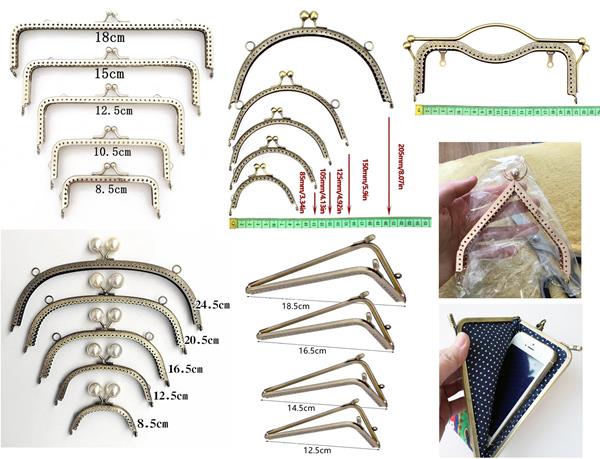
4) Some of the shapes and sizes of kiss clasps avalible on line 4) Some of the shapes and sizes of kiss clasps

They seem to be called kiss clasps and vary in size from one suited to a small coin purse to about 20.5cm. They come in various shapes, half circles, various arches (sort of flattened half circles), half squares and half rectangles and even L shapes (which I have 3 but won’t suit for this project).

I was also intrigued by the dinosaur bags (some are too small to fit a cell phone and maybe meant as a kid’s change purse so watch the sizes if you want to order one.)

5-6) fake Leather Dinosaur bags; Stegosaurus, Triceratops, and close ups of the bags T-Rex bag and close ups of the bags5-6) fake Leather Dinosaur bags; Stegosaurus, Triceratops, T-rex

Plotting and Planning

To create a phone-holding device, (purse), I have the option of working in either dry or wet felting or using some of each technique.

First thought: I am most comfortable with dry felting and could create a purse using needle felting techniques and a bit of sewing to add the cavity closures, but it would likely take even longer than working on the Mer’s. (I think I need something a bit quicker to finish).

Second thought: I could create a resist to wet felt over, making the main body and cavity for the phone holder. That would be quicker but adding appendages and spines might get tricky only using wet felting. I would still have to sew on the clasp or other closing method.

Stray thots that flit through while I am trying to concentrate on this wet Vs dry dilemma:  If I try a manta phone-holder I will want to have it hang curved ageist my hip or side. This may suggest a wire armature in the wings or at least the leading edge of the wings. I will also need a mouth opening large enough to stick my hand in to find the phone. If I go with the stegasorous I will want it to stand up on its own solid firm legs. I would also want the neck and tail (with spikes) to be bendable so I can again curve it as it hangs beside me. I would also want to make a more anatomically correct dinosaur or Sea creature. (Not pink! ok, we don’t know for sure they weren’t pink but I am extremely hopeful pink was not a common body colour for dinosaurs)

I could insert a stiff single wire like I did to augment Mr Mer’s lower back problem (the firmness of the felting overpowering the wire gauge I had originally used. So I augmented it by inserting arthroscopically Harrington rods of 10ga aluminium with sharpened tips.) The con to that option is that when the distance to be strengthened is lengthened then the likelihood of getting a straight insertion is much more challenging. I wonder if I could baste on the wire, then needle felt over top to cover the inclusion?

If I am going to think about wet felting I will need a few pieces of resist (floor underlayment). I don’t think I have any resist hanging around the house but I can find some at our local hardware store! So I was off to the local home depo. Oh, it only comes in BIG roles I guess I can now make a few options or one very big purse!
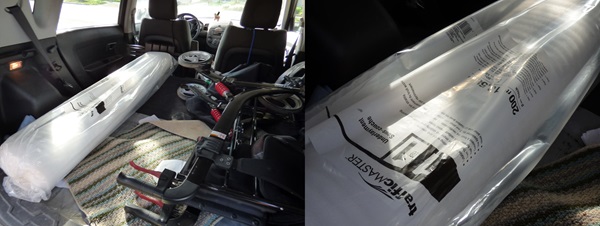
7) Flooring Underlayment, in back of my car with my walker. it comes in a large role, 2mm thick and 200sq feet.7) Flooring Underlayment comes in a large role, 2mm thick and 200sq feet.

The next thing to consider is the size and shape the resist should be to make the phone-holding opening. If I go with a manta, the actual resist can be much smaller than the wings and tail. I would also have to make an inset to the mouth to attach the kiss clasp too. My other option would be a zipper but it would put more strain on the mouth area so it would need to be very firmly felted. I could add a bit more strength if I used a bit of silk or gauze.

For a stegosaurus, I would need to add a belly between the legs. I think adding supplemental resists for the legs, which I could then backfill with firm felt should work. I want it to stand up if it was sitting on a flat surface. I would also have to add plates along either side of the spine and then spikes for the tail.

There are also the horrors of Math!  Estimating the shrinkage then expanding to make the template…. Math…. Ick.

Well, I may have circumvented part of the horrors of math by finding this site! it may be helpful to other math challenged felters.  Look about halfway down the page for “Wet Felting Wool Shrinkage Calculator”  https://www.abcrafty.com/wool-shrinkage-calculator/

My next step will be to make a mock-up of the potential resist shape, but while I await the arrival of the clasps I have a couple of other things to work on.  Bernadette had some locks that may work for Mrs. Mer’s hair and I guess that will also give me time to get a bit more work done in the garden. We had a break in the smoke and had a moment of sunshine this afternoon! (a wonderful change from the smoke and odd smells of the last few days so I wanted to share the sunshine with you.)

8) shots from my front garden, Chives& Taragon, Columbine, Alum, Black Iris, Snow peas with mint and basal, the front of the garden looking back towords the benches.8) shots from my front garden

Mark Making on Felt – Online Class Registration Opens

Mark Making on Felt – Online Class Registration Opens

Would you like to learn new methods of “mark making” on your felt? Are you looking for ways to create work that is uniquely your own? Are you wondering about surface design on felt? If you are looking for a new learning experience, please join me. Registration opens today for my online classes! The classes are listed below with a link to each class page.  You don’t need to be present at any certain time to participate in a class and you will receive PDF’s to keep with all the relevant information learned in the class.

Screen Printed Felt Journals by Ruth Lane

All four modules of my class, EMBELLISHING FELT WITH SURFACE DESIGN TECHNIQUES – A MIXED MEDIA APPROACH, will begin on June 23 and end on July 28. Registration opens today for these online classes. Click on the class link below to register for that particular class.

Nuno Felting with Paper Fabric Lamination

Experimental Screen Printing on Felt

Free Motion Machine Stitching on Felt

Printing, Stenciling, and Playing with Thickened Dye on Felt

Click on any of the links above to find out more about the class and to register and join in the fun.

Our Wet Felting for Beginners class is always available. You can start any time and follow along at your own pace. Register here.