Another experiment with long wools

Another experiment with long wools

There is an innovative indie-dyer who to supplements my addiction from time to time. She has access to some lovely long wools such as Teeswater and Masham, great blends, and exotics that don’t come my way very often. She is superlative at using colour and just great fun in her experimentation. This past winter I decided to take the plunge and buy some of her less expensive offerings of a mixed bag of long wools. These bags can have any kind of breed. They generally are a little felted or cotted but not impossible to work with for spinning.

Because the locks were slightly felted I decided to use small dog combs as flick carders to open the wool. That was a surprise! A lock that was five inches long ended up 14 or more inches after being carded. The dog combs are very fine and do a good job on the locks if used gently.

The colours in the grab bag were mouth watering and spoke of spring.

Each lock was kept separate and spun individually. The singles were plied using the chain ply method to let the colours remain in blocks.

The bag was primarily long wool, but had a great variety of lengths, so I think it was more a grab bag of breeds.

The residual wool caught in the carders was short and had some neps. This was carded as for wool spinning, some was run through wool combs to see if that would yield any decent results, but the wastage was very high, so I gave up on that as a processing method and went back to using carders.

The wool caught in the dog combs was slightly blended and the colours were muted.
The dog combs pulled out short bits and neps that will add texture to this woollen spin.


I haven’t spun the wool waste yet, but it should be fairly quick to do and easy to finish if I do long draw.  The colours will be more heather than the crisp colours that I’m trying to maintain by carding the individual locks, but they will have a muted heather look and will be attractive in their own way.

Each lock was spun individually into singles, which were then cable plied as a three ply.  This is the only way I know to protect the individuality of the colours.

Singles of different “long wool”

The final result is interesting, but a little bit “all over the place” and frankly a little disappointing. It had no clear purpose, no underlying colour theme, no direction and it shows.  If this is used in weaving I will use a monochrome warp and complimentary weft to help pull it together and make one or two specific colours pop.  Right now, none of the colours really stand out.  The yarn itself is actually surprisingly soft for long wool.  It’s lusterous, silky and smooth.

Three ply cable yarn that is lustrous and surprisingly soft.

I’ll keep trying different kinds of long wool, I enjoy them, but I think I’ll try finding my own fleece supplier if possible and see what I can do with my own cleaning and dyeing. I need to find out what the fleece are like right from the animal.  So the learning curve continues.

Makings, Musings and Mathematics

Makings, Musings and Mathematics


A recent post from on spinning by Shepherdess Ann reminded me of a wonderful trip to Finland back in 2013.  This weeklong trip brought together representatives from many European Union countries. We spent the time together in an Artists’ commune in Järvenpää experimenting with various fibre media.  It was an incredible experience; there was lots of learning and some great friendships were formed during our time together.  Participants were each given a drop spindle and a lesson in how to use it.  My spindle has taken pride of place (gathering dust) in among the Tunisian crochet hooks.  That was until I saw Shepherdess Ann’s beautifully spun fibre.  I had to try my hand at it again.

A dear friend had gifted me some tops which came in 25 gram packs so I decided I would use these for my experiments.  As my previous lesson was long forgotten, I consulted YouTube tutorials and marvelled at the near balletic elegance of the teacher’s movement. I soon discovered that like ballet, ease does not mean easy.

During my first attempt I endeavoured to copy the tutor, pulling on the tops so that a uniform amount of fibre was spun.  I will not even refer to what I produced as ply – it was thick in places and perhaps less thick in other spots.  A friend introduced me to a new language when she asked me if I was using the ‘park and draft’ method.  I hadn’t a clue what she was talking about (back to Google again!)  Here is the result of my first attempt:

I thought I would play a bit and use it to crochet.  Using my 15mm (US size P) hook I made a magic circle (ring) with the aim of starting some hyperbolic crochet after the first few rounds.  There was so little yarn that the end result was flat (except for the risen centre) (4 rounds).

For my next attempt I decided to pay more attention to the division of the fibre so this time, using my eye as a guide, I separated strands of the tops and started spinning.  The result was a bit better but there were still areas of thickness when the yarn was spinning.  Two possible causes identified; the fibre was thicker where I joined ends and I got distracted and at times used too much fibre in the process.  Still this was an improvement from the point of view of the length of yarn I had produced.

In order that I could compare my samples, I used the same methods making my hyperbolic piece.  I was happier with the result as I started to see curling at the outermost edge.  (7 rounds)

My third sample was made using the orange/purple fibre.  On this occasion I decided to use my scales to weigh out the fibre, rather than relying on my eye. I know it’s not the correct way to do this but I just had to see if I could find a more even way to divide the fibre.  So, I ended up with 25 lots at 1 gram each.  It produced a more even width on the yarn.  Now I was aware of another issue, tension.  I had no control over it so it was back to YouTube.  From this I surmised that I should be pushing the twist up through the fibre as I spun but I found this tricky.  Despite the still imperfect result and the problems with tension I managed to get more yardage and it was a lot more even than the previous samples.

Notwithstanding the dreadful tension I was quite pleased with the shape of the hyperbolic crochet.  In fact I felt that the tightness (tension issues) of the yarn gave quite an attractive finish to the stitches. Also, I was delighted that I managed 8 rounds before the yarn ran out.


I don’t know if I was feeling frustrated by my efforts while making this third sample but I started thinking of how spinning was second nature to females throughout the millennia. The Tarkhan dress, excavated in Egypt in the 1900’s was subsequently carbon dated and found to be at least 5,000 years old.  In fact according to the Harvard Gazette (2009) a team of archaeologists and paleobiologists discovered flax fibres that are more than 34,000 years old, during excavations in a cave in the Republic of Georgia.  They surmised that the flax collected from the wild could have been used to make linen and thread quite possibly to make clothing. In early Ireland (I’m Irish), spinning and weaving skills were so important that the Brehon Laws, written about 600-800 A.D. lay down as part of a wife’s entitlement in case of divorce, that she should keep her spindles, wool bags, weaver’s reeds and a share of the yarn she had spun and the cloth she had woven (https://weavespindye.ie/history/). Spinning was still carried out by females prior to the arrival of the Spinning Jenny just over 250 years ago. In essence, a skill which was once learnt by girls on their mother’s knee was lost to many with the arrival of the Industrial Revolution.  I could deduce from this that what once came naturally to the female line of my ancestors is now the cause of much personal frustration. I am resolved to find somebody once the world reopens who will be prepared to sit beside me and guide me through this process so that I can gain this lost skill.

Back to Finland:  One of the other skills I learnt while with the group was how to crochet. I have since found it very meditative, especially when I just crochet for the fun of it (no pattern).  So, some years ago, in this frame of mind and with a pile of pink spare yarn on my hands, I decided to crochet a hyperbolic plane.  I had no pattern, I just wanted to see what would happen if I started with 6 stitches on a magic circle (round) and doubled my number of stitches in each row.  By Row 10 my round had 6,144 stitches.  I committed to one more round (12,288 stitches) and decided to change my colour to green so that I could monitor the row’s completion.  Let’s just say it took a while to complete.  Although it is a number of years since I completed it, I still love to pick it up and run my fingers through the ruffles.  It’s actually quite soothing.  My adult comfort blanket!


Spinning wheel Birthday-Xmass pressent arived

Spinning wheel Birthday-Xmass pressent arived

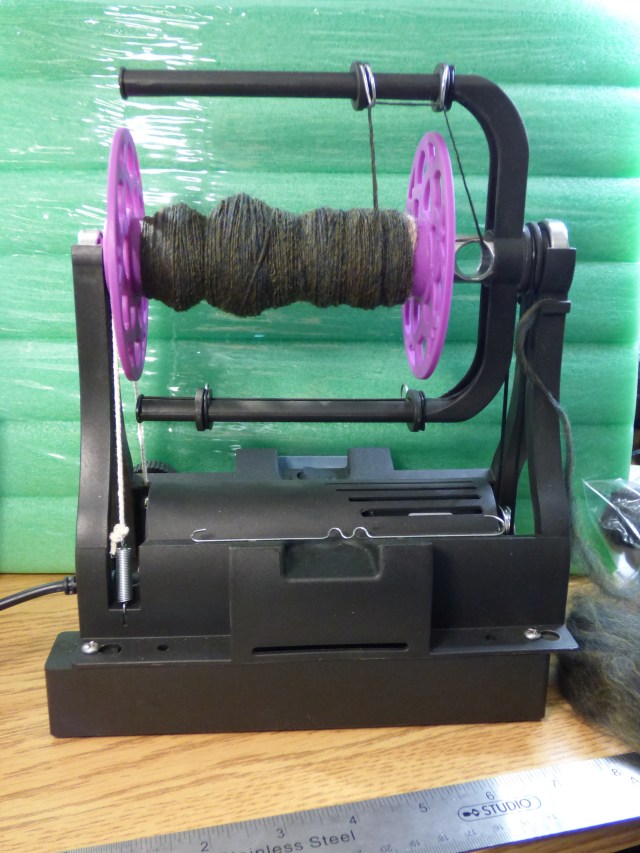
Electric Eel Wheel 6.0

Last year during the early covid of 2020 Glenn was browsing Kickstarter, likely looking for no-fun-train-board-games which he enjoys. This time he found an electric spinning wheel looking for funding. I had a tiny portable electric wheel from the same developer which worked great but I found the tiny bobbins frustratingly tiny! Glenn was sure a bigger bobbin and a upgraded motor strength would be a perfect x-mass/birthday present.

 Electric Eel Wheel (EEW) 6.0 was described as a production eSpinner that offers large bobbins, quiet operation and could both spin and ply. It was developed by Maurice Ribble (his company is called Dreaming Robots).

(what a cool logo!!!)

The Kickstarter campaign was active May 21 2020 – Jun 20 2020 (30 days) and 1,791 backers pledged $445,892 to get the project going by pre-ordering EEW 6.0’s. Maurice was very good at keeping everyone up to date with development, testing, and manufacturing. He asked for impute for the instruction booklets and made instruction Videos too. (He has made 114 update videos so far on you tube.) if you missed the Kickstarter but would like one too he is selling them on his website. https://www.dreamingrobots.com/

Earlier this month a mysterious box arrived at our postal box, it was a very sturdy box and seemed to be quite full of something…. Could it be? YES!!!

The Unboxing:

1-2 Well packaged, a good weight, there must be something interesting in here.

3 Excellent packaging, but I may have opened the bottom end.

4 I wonder what this is?

5-6 Oh my! Is this the Lazy Kate parts?

7-8 Six bobbins and a flyer,

9-10 and the base with power cord, foot on/off switch and battery holder.

This is obviously a box with no bottom it just keeps adding more stuff to the table!!!

11 No I am mistaken there is a bottom!! How did it all fit in there?

Glenn took the parts away to do the assembly but got distracted watching something on his computer, after a couple “is it done yet?’s” it was and I got to try it out.

I think there are 3 of us in the guild that have received this wonderful new wheel, Angela T, Terry N and myself. Angela was fast and had hers unboxed, assembled and photographed before mine even made it home from the post box. I posted pictures of the box, its contence and a video of the first spinning on my new wheel in the guild Facebook group. If you are looking for a reasonably priced, lightweight, electric wheel with a big bobbin and orifice, you may want to check this out. I hope we will be able to resume socials sometime this summer, I am suspect all three of us will be bringing our new wheels. (There is a battery you can get so you don’t need a long extension cord!!)

12 test driving new electric wheel

12 Here is the video. (i am working on finding a format will keep trying)

I was working on this post, had only spun a bit, when I finally got through to my Doctors’ office to ask questions about the Covid vaccine and was advised just get whatever was on offer. So next call was to one of the local pharmacy to ask more questions and inquire how long the waiting list was. I was extremely surprised to get the offer of a cancellation later the same day. I did mention I have not done well with flu shots in the past and have an odd assortment of allergies. So, I fretted until it was time to drive over for the Shot. I wound up with the AstraZeneca shot with a second coming in August. The Pharmacist did a fabulous job with the injection. However, within 3 hours of the injection I started to feel all over achy, nauseous, headache…. and crawled off to bed with my plastic bucket. It took about 3 days to climb back out of bed with only a stiff shoulder, exhaustion and bouts of wanting to go back to bed. With that much of a reaction, it defiantly means I got a dose that works.

13-14 having fun

I have had a chance to spin a bit more and am enjoying quiet motor, large bobbins and the adjustable speeds. I haven’t tried plying on it yet, but suspect that it will be as easy spinning is.

Autumn Nuno Slow Stitch Update

Autumn Nuno Slow Stitch Update

I haven’t updated you recently on my slow stitching project. I hate to admit it but after my last post in January, I got out of the habit of daily stitching. It’s amazing how easy it is to stop doing something and then find it hard to get back into the habit again. But I did start stitching again towards the end of March and I have made a little progress.

Here’s the entire piece now. I have added some darker values in the foreground trees, added a few leaves down in the trunk areas and stitched some of the “shrubbery” to the left of the trees. I also added some darker values in the middle ground area to give it more depth.

Here’s a closer look at the area to the left of the trees. I am planning on continuing the stitching in the foreground areas to give the look of bushes and undergrowth. So the slow stitching will continue. I could probably forgo the stitching in the foreground but I like the look of the dense stitching and want to cover the entire surface. It’s not about the time spent on this one but the journey.

I thought it would be interesting to compare a very early photo on the left to the way it looks now on the right. A bit different?


Wet felted wallhanging

Wet felted wallhanging

This is a wet felted wall hanging, it was made for a customer order. She wanted something modern but with not too many colours.

So I started with wool yarn to make the design.

As I started the process, I was inspired and I knew it will look great.

Than I filled with wet coloured wool and than covered with layers of wool.

The felting process take about 3 days of hard work for me.

The customer was very pleased. I hope you enjoy my work!

Rainbow Baby Mobile

Rainbow Baby Mobile

We have a new grand baby in the family, so we thought it would be nice to make a gift for her.  So Alex and I had a think, and came up with the plan to make a baby’s mobile.  Now we don’t know about you, but we absolutely love rainbows.  Their colourful display are enough to brighten anyone’s day.  As the baby’s Dad is from Wales but they live in Yorkshire, we also thought it might be nice to also incorporate some Welsh driftwood into the project to represent the baby’s Welsh roots.

When thinking of the design, we also thought we would add some clouds, to give context to our rainbow, but being quite novice felters, we opted to do needle felted clouds, so they would appear light and fluffy.  We started by making a template to represent the base of the clouds, as when we look up into the sky, clouds often appear to have a flat base, with plumes of fluffy clouds above.


We wanted a rough design to follow, so that we ended up with a cloud the size we wanted.  We needle felted some cloud shapes out of an off-white wool.  Unfortunately, it didn’t have a label for us to identify the type of wool!!  Once we had a layer of cloud, we could then start to build upwards…

Cloud base

We continued to make small clouds, which we then added to our base…

Building up the cloud

Alex had a go at needle felting once it was assembled.  There was less risk of him stabbing his fingers by this stage!!

Alex having a go

We decided that it would be lovely to have some lights inside our cloud.  We bought some battery operated LED lights, which were small enough to fit inside.  We bought off white, warm white and multicoloured, but in the end decided on the multicoloured lights to reflect the rainbow colour scheme!

Battery operated LED string lights

We pushed some of the lights down into the base layer of cloud, and hid the rest in amongst the top layers of cloud.

We have lights!!!

But we needed to have access to them in order to operate the light switch and be able to change the batteries.  So we left an access hole in the top of the clouds…

Access point

The next step was to make the felted balls.  We used 3 grammes of wool per ball and tried a few different methods.  Firstly Alex had a go at hand felting them, but as he doesn’t know his own strength, it was difficult to keep them circular!

Hand felting the rainbow balls

So we then tried using a salad spinner to gently tumble them…

Alex enjoyed this bit!!!

But although this worked quite well, they still looked like they needed some more felting so we tried bubble wrap to cushion the pressure of hand felting…

This worked well!

Success!! We ended up with some really well felted balls that were fairly round and even…

Raindrops!!

Having finished both the clouds and the rainbow, it was time to start assembling our mobile…BUT….disaster struck!!!  When we went to pick up our rainbow of balls, we were missing a green one.  Now where could it have gone to?? Two minutes before, it was right beside us and now it had vanished.  We started to look everywhere and after about 20 minutes of moving furniture and searching three rooms, we found it…..

Our beautiful little green ball was now a jumbled mass of scarecrow-looking mess!!!

How could one little ball end up so big and fluffy?  I even weighed it to check it was the same ball but yes, it weighed 3 grammes, the same weight as the original.  There was only one explanation…..

Here is the culprit!!!!!  Elliot!!!

Not content with the numerous homemade felted mice he has been given, Elliot was determined to get his claws into the rainbow.  We should have known, as he spotted them in the making!!!  So – we then had to make another one to replace it, which set us back a few hours while we waited for it to dry!  But in the end, we were able to assemble our felted rainbow mobile and Alex is very happy!!!

The finished mobile

And the lights look amazing!!!

Our rainbow cloud

We would like to try this project again, but using wet felting for the cloud.  It will be good to compare the two.  It was a fiddly project to make, including trying to balance everything to ensure that it hung straight!! But all in all, we are very pleased with how it finally turned out.  But I think next time, we will be hiding the raindrops from Elliot!!!


Getting Organized and 2nd Quarter Challenge Part 2

Getting Organized and 2nd Quarter Challenge Part 2

I have been beaten to the first completed prize. That’s just bragging rights. 🙂 No worries. Just getting it done on time is a major win. If you would like to see the first completed piece and read the lovely storey to go with it pop over here. https://feltandfiberstudio.proboards.com/thread/4271/2021-second-quarter-challenge

As I added layers the layout grew beyond the template outline so I trimmed it. After leaving it overnight it had mostly dried. It made it easy to cut and separate the layers for later.

I originally thought I would do diamonds but after sever attempts I couldn’t get them all the same and it looked odd so I went with rectangles.

I wanted to do some waves on the back. when I looked at the art deco waves they were not even lines but they got thicker and thinner.

It looks a bit messy but I think it will be alright after felting.

It turned out pretty well, not too much shifting. after drying I decided it wasn’t wide enough. I wet it down and pulled it top to bottom and then ironed it for good measure. Now it’s not quite as long to will fit things that are a little taller.

When it’s folded up the back will look like this:

The front closed will look like this:

The inside looks like this:

I have decided to do some stitching on it before sewing it up and dividing it into sections. I am not sure what yet. I think I may outline the waves in a dark yarn to smooth them out and a diamond pattern on the blank flap and some lines or something in the squares. I will be looking up some colour palates of art deco.


Colour to dye for

Colour to dye for

When getting my materials together I was often frustrated that I could not get the colours I wanted. This was especially true of silk materials and you had to buy a large quantity to get only a small amount which could be expensive. It was not until my past time of trawling through Youtube videos that a came across the “colour your life, Rae Wollnough” episode. What a revelation. With a very simple process, I could dye not only silks but fibres too.

So I set about getting the materials I needed. Firstly the dyes themselves. I use EasiFix all-in-one protein dye. These dyes work on natural materials like silk and wool etc (I get these from Etsy). These dyes are fixed by heat so no need for a fixing agent. I use a mixture of silk but here I have used a ponge which has a lovely lustre.

Ponge 5 silk

The process is so simple. Cover your table in cling film and wet it with a spray bottle. Place your silk on top, here I have flattened the material out but you can get some nice effects if it’s scrunched too. Your silk must be wet as the colour spreads better and it will burn when heated if it is dry.

Next the fun bit. I use pipettes, brushes or simply pour the dye onto the silk.

Silk wrapped

Once I am happy with the dyeing I wrap the cling around the piece gently patting out as much air as possible. Once wrapped I pop it in the microwave. Only a couple of minutes does a small piece like this. Be mindful to follow the safety instructions of the dyes and only use equipment that is specific for dyeing and nothing you will use domestically.

Once heated I leave the piece to cool completely and it’s this that sets the dyes as well as the heat. This is the worst part of the whole process as I cannot wait to see the outcome. It is not an exact process but the results can be magical.

The piece is rinsed until the water runs clear and it’s done. You can re-dye if you are not happy or think it needs more.

The colour you can achieve are wonderful, the weaker the dye the paler the colour and you can achieve your own colours by mixing also.

Here is a mix of materials I have dyed, silk, silk hankies, throwsters waste. It works equally well on nepps also.
A couple of scarves.

The possibilities are endless and results are well worth the effort as little as it is.

ReConnect – The Online Exhibition of the International Feltmakers Association March 2021

ReConnect – The Online Exhibition of the International Feltmakers Association March 2021

This is a guest post from Ann B.  Thanks for the post, Ann!


After reading Karen’s post on how she found her inspiration for her entry for the International Feltmakers Association proposed online Exhibition, I was encouraged to have a crack at it.

I had found it extremely difficult to find inspiration from the theme of their previous exhibition, which was “Kaleidoscope”. I have a very literal mind and could not think of how to portray that idea – I don’t/can’t do non-representational, but I must try to think “outside the box”.

At first I found it impossible to think what to do. First I looked up “reconnect” in a good dictionary – the Cambridge dictionary said:

1. “to join or be joined with something else again after becoming separated”

2. “to improve a relationship that has become less good or less close”

3. “to make you feel or understand something that you had stopped feeling or understanding”

4. “to create a relationship with someone again after a period of time”

as well as the obvious of reconnecting a disconnected phone call or internet link.

How on earth was I going to depict any of that? Initial thoughts ran along the lines of the connecting stitches in garment construction, and the more obvious stitches connecting inserted lace and tapes and how to use this in a felted piece. All this was going round in my head, when I happened to notice one of my husband’s photographs of the Scissor Arch holding up the tower in Wells Cathedral pop up on my laptop screen saver and this brought my attention to connections with the past and the future.

I started to mull over the idea of a piece of felt with the scissor arch as cut open channels on a piece of felt, which were then sewn together again, i.e. reconnected.

I cropped the image and printed a grey scale picture so that I could more easily gauge the colour values, and I subsequently decided to stick with the grey scale as it seemed to add to the drama of the image.

I then made a tracing of the main features, leaving out a lot of the detailed glimpses of the crucifix, the Jesse Window, the organ and the vaulted ceilings behind the arches. I used this to plan the piece: what prefelts I would need; what resists I would use; the order of placing resists and layers of prefelts. I wanted to start dark and come forward into the light, so that the arch itself would be white. I decided originally that there would be a minor variation from the greyscale palette – I would use the fact that the vaulting of the ceilings was picked out in gold paint and I added pale yellow to the list of prefelts.

This picture shows the prefelts I made, but in the end I did not use the mid grey, nor the yellow.

I made a couple of photocopies of the tracing so that I could cut out templates for the resists and the prefelts, and then I cut them out. I made a “crib sheet” setting out the order in which I needed to work – I have been known to forget what I was supposed to be doing halfway through a project, and I didn’t want to do that this time. I have not attached a copy of this as you probably wouldn’t be able to read my scrawl.

This picture shows the resists and templates after use. In fact there should be a resist in the shape of the little curly topped bit shown centre bottom. Unfortunately it’s still in the piece somewhere I couldn’t find it so left well alone. It was supposed to reveal the white base of the picture being lit from the Jesse Window shining through above the organ.

Once I had finished the initial fulling, I cut out the resists, (those that I could find) the resist for the scissors was cut at the cross so that I could pull it all the way out, as I did not want to cut the channel just above the cross. The top of the arch and the lower “legs” section I did cut all the way so that the darkest grey would show behind the white. I then inserted a piece of metallic grey fibre inside the top channel so that when the stitching reconnected the cut edges it would resemble the slashed and pinked work in Tudor costumes. I then finished the fulling, sealing the cut edges. I then set it to dry, but unfortunately I did not pay sufficient attention to where I laid it to dry as it has a distinct lean to one side at the top, and I didn’t notice this until I came to photograph the finished piece.

Although I had abandoned the idea of adding the pale yellow prefelt inside the top of the scissors arch to try to echo the gold paint on the arches there, I decided to pick out the nearer arches in gold thread and used a back stitch. I decided to stick with gold as the only colour in the picture and reconnected the cut channels with two goldwork yarns using sorbello stitch, which is an embroidery stitch used for insertion work. Using some silk yarn which I had hand dyed variegated grey many moons ago, I emphasized the edges of the scissor legs and the circles connecting them to the walls of the cathedral.

Having abandoned the yellow prefelt, I wondered what I should do with the blank space that left me with. I’m not sure why I decided to add the masked face instead. It just seemed the thing to do as we have to wear the things so often at the moment.

By this time, I was heartily sick of the piece anyway, so I took the required photographs, filled in the application form and sent it all off; and lo and behold I eventually received an email confirming that it had been accepted for the Exhibition.

This is the finished piece and the close-up of the Sorbello stitched lower arch.

This is the link to the Exhibition on the IFA’s website . If you click on an image it takes you first to the part of the submission form with a description of inspiration etc, and then to more photos of the work. If you click on those images you can see the complete photograph – in some cases they had to be cropped to thumbnails for the general exhibition page.

https://www.feltmakers.com/online-exhibitions/

A Wet Felt Study Group

A Wet Felt Study Group

With workshops on hold, my guild decided we could run some study groups online. I will be leading a wet felt group. The plan is to felt a standard size square using different wools. https://www.ovwsg.com/events/event/2103-wet-felted-fibre-study-group/

We will compare how they felt at different stages, ease of felting and possible uses. We will all do Merino and Corriedale so we can compare how we all felt the same thing and then move on to different wools. We don’t all have to have the same wools. It would be nice to have and many different breeds as possible depending on what people already have on hand and or want to order. Some mixed fibre would be interesting too.


The group starts April 21st. We will meet on zoom once every 2 weeks and meet on a Discord server ( a place to share photos, chat and ask questions between zooming). Discord was chosen because some people don’t like Facebook or are not on Facebook. We didn’t want to exclude anyone.   Or if everyone is on Facebook we could make a private group there if that is what people want.

Everyone will get a worksheet to record information on so we are all gathering the same information to share.

I am based in Ottawa Canada, (GMT-4hrs.) I think that makes our Zoom meetings 9 am the next day in Sydney Australia. I hope you can join us and learn something while having some wet woolly fun.

Here is the link again.  https://www.ovwsg.com/events/event/2103-wet-felted-fibre-study-group/