Now it is a long time since any of my offspring expressed an interest in soft toys. That said, I still enjoy making them every now and then.
Back in 2013, I was very fortunate to be awarded a trip to Finland. It was under the European Union’s Lifelong Learning Programme. The project brought together European citizens from throughout the Union and the aim of the project centred around new skills’ acquisition and learning/appreciating other countries’ cultures. Subjects covered included spinning, weaving, sewing and crochet and the focus was on reuse and recycling. It was a fantastic week. I got hooked on crochet and when I returned home I enjoyed myself crocheting with and without patterns.
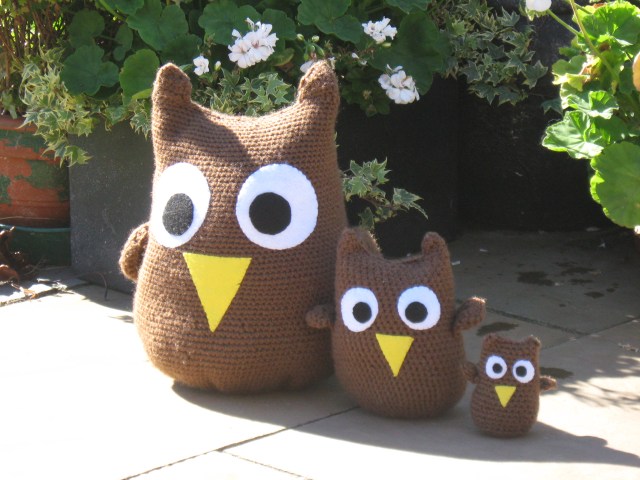
I started crocheting owls, they were great fun to make, I made tiny ones and huge ones – One ended up being used as a cushion by its young recipient. Here are some of the owl family:
These led to a collaboration with a Maths teacher and these three ended up at an international maths conference:
Then came my interpretations of the famous Minions. These ended up being gifted to various households:
When my friend became a grandmother, baby added this bunny to her soft toy collection (made with pattern):
This little guy had to stay here with me as I used teddy eyes (choking hazard). He stands in a corner overseeing my work:
Most recently, I made this little hare for another friend’s little girl (again made with a pattern). He hasn’t left the house yet and our off-spring (age range 25 to 31) reposition him regularly – I am liable to find him in various parts of the house – it is possibly best if I hand him over before he gets lost.
Here’s a few of the toys I have sewed in recent years. The patterns came from a website Bustle and Sew (https://bustleandsew.com/free-patterns/) and are worth checking out.
I made a number of the elephants. Here are a couple of them. The brown material was sourced from the inherited stash – the floral (orange/green base) material came from the days when Debenhams used to sell dress fabric (the name was printed on the selvedge:
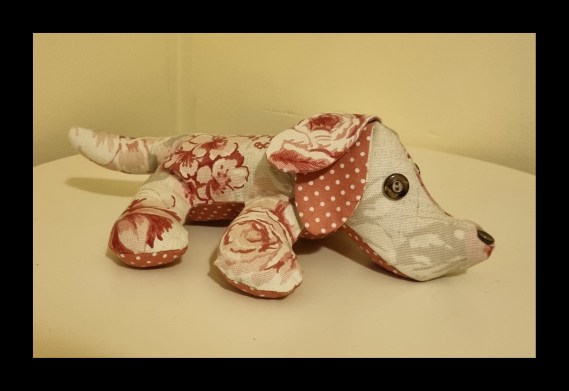
I also made a few of the little dogs. The pattern came from the same website:
I made this little teddy (again, the pattern was free from https://www.lovecrafts.com/en-gb/c/article/teddy-bear-sewing-pattern . I found the fabric while rummaging through my husband’s aunt’s stash which she had bequeathed me. It was an unfinished dress and the fabric is cord. Again this little toy was to keep due to its sentimental origins (and its teddy bear eyes):
A more cuddly version made from fleece suitable for an older child (again the eyes and nose were the issue):
Another friend recently asked me to make her little one a Christmas stocking. Both she and her hubby are visually impaired (she has around 5% sight and he was born without sight). So I thought it would be good to add a very definite colour to the stocking so that she could see it more easily. The stocking was pretty straightforward and measures 16.5 inches (42cm) by 12.5 inches (32cm). I appliquéd the little one’s name unto the front of the stocking. It really was a fun make.
So this is my last post for 2021. I hope some content within my posts got your creative juices flowing in perhaps a different direction. I hope you all get a chance for some R & R over the festive season and I wish each and every one of you good health and much happiness in 2022.
As you may have noticed Ann, Bernadette and I, all belong to the same local guild. The guild has both a studio and a classroom located in Heartwood house, which is the umbrella organization that is Home to 22 Non-Profit & Charitable Organizations. The building we are now in was formally a Giant Tiger store with an attached strip mall and apartments above the mall. Heartwood house purchased the building in 2012 and renovated space for each of the various groups. We all moved in at the end of the summer of 2013. (It was a huge move for the library but that is another story.)
With covid, part of the time the building was closed and no groups could use their spaces. As lock-downs eased, a few people (masked) were allowed into the various spaces (the number depended on the size of the room). We are one of the groups that have been hit hard by the restrictions. Ann and I with help from other members have been keeping the library books circulating (knock on the window and pick up your books by the side door) each month but the weavers have only started to work on the studio looms in the last couple of weeks. We have moved our Monday night socials to Zoom which is fabulous for the easy Commute but not quite as much fun as chatting in person.
Heartwood House has noticed that, with fewer people in the building, the groups are not interacting with each other as much as they would normally. They came up with a plan for festive door decorating and asked the groups to participate. They would bring Coffee and muffins or pizza for lunch to those that did add festiveness to their door.
At our December meeting, the Heartwood house liaison asked if anyone would be willing to decorate our door. I was going to be going in to work on the library anyways so figured it would be reasonable if I volunteered so no one needed to make a special trip in.
The instructions were to decorate the door, something festive. I wanted to represent the main interests within the guild so Weavers, Spinners and Felters (we have basket makers too but I did not have anything in the way of basket-making supplies to represent them. Sorry!!!)
I have never worked in a regular office environment or lived in a cubical world for work so I have never tried to decorate a door before (or a cubical). I had seen two other doors under construction, one was a fireplace with a Santa the other was an upside-down reindeer. Both used construction paper, card stock, stickers, and there was even a garland. The office for Heartwood house had a couple stocking up and looked like something else would be added later.
Scoping out the Neighbours, their doors in progress;
This slideshow requires JavaScript.
I thought about it for a while and decided on sheep, with a star/comet. Maybe some snow? And some pine trees? As a composition, a door is a tall skinny vertical space. I like long horizontal compositions. Oh well, fewer trees and make it a taller tree. Let’s start on the star! Ann will recognize the cookie-cutter snowflake I used for the star shape.
a quick cookie-cutter shooting star!
This slideshow requires JavaScript.
(Oh no! The book I was listening to ended so on to the next audiobook)
I used some of the World of Wool, core wool that I had hand-carded and really cheap felt from the dollar store. (This is not the even cheaper felt that may be made of coloured dryer-lint held together with cheap glue.) Other than being extremely thin, it wasn’t too bad to work with. I embedded it into the wool I was adding into the cookie-cutter from one side then the other. I used both the single 36T as well as the 3-needle handle that seems to hold T40’s in it. I focused on trying to get the edges firm but should have spent more time establishing the crispness of the edge shape. My poor little star is looking more like a flower.
OK, now let’s look at the sheep. I kept to the same fibre, made a body, with handspun yarn legs, and felted feet. Hum….. needs a head. I sculpted a head with ears and felting from the back and sides of the neck attached it to the body. I like the head so much I made 2 more of them!
This slideshow requires JavaScript.
Ok, we have the Felters represented!
At this point the plot of my book got distracting and there may have been a break for YouTube, so I missed the photos of spinning woollen (I usually am a worsted or semi-worsted spinner) while hoping I could make Fluffy Yarn.
For the spinners, I made lengths of mostly lofty 2 ply which I sewed onto a cardboard shape for the sheep body. It was the inside of a Ritz cracker box and worked very well. Sewing the head on was a bit more challenging but I used a curved mattress needle into the center of the poor sheep’s neck and tied it on through the back of the cardboard. I think she turned out to be quite a nice sheep!
For the weavers, I considered a cast-off fragment of weaving I had salvaged from the studio fibre-garbage-bucket. However, it was blue linen and not white like the other sheep. I did not want the weaving sheep to feel ostracized from the flock. So back to the cardboard Ritz box and cut out another sheepish body shape. I had scored some loom waste (thrums) at some point over the last year or so. The warp is a similar colour to the wool I have been working with. I wrapped and taped down on the back yarn over the sheepie shape on the diagonal. If I had done a square or rectangular sheep body it would have been much easier! But it would not look very sheepish. I used a long blunt needle and wove through the warp I had just taped down. After the weaving was done I stabilized the edges and sewed on the head.
I used some of the 2 ply I had spun to make the legs and attached them at the back of each sheep. Now I was all set to head in and decorate the door, well except for a quick stop at Dollerama on the way in for a few more decorating options. (Please don’t be out of Cardstock!!)
This slideshow requires JavaScript.
Yeah!!! There was cardstock, wrapping paper, glue, foam double-sided tape, wooden snowflakes! I also brought more wool, a foam pad, yarn, as well as thread and needles in case I needed them.
Our door
Now the door. With the depression for the window, I wanted to have the cardstock as a base layer. I held up the first blue piece and liked the effect the edge of the door gave. It looked a bit like a matt.
This slideshow requires JavaScript.
I had to do a bit of trimming so the door handle would fit!
Lise, one of the guild weavers, was in weaving and held up one of the wrapping papers I had selected for the sky. We both liked the effect with the blue background.
14 transparent wrapping paper over cardstock
Ok, I know what we are doing for the sky, now let’s look at the snow for the bottom half of the door. This would have gone a bit more smoothly with just one more hand but Lise had already finished up her weaving by then and had headed out. Oh well, I managed to get 3 hills in my snow.
15 snowflakes in the sky and snow on the ground
I opened the solid green paper and found Christmas trees on the inside….. well I guess I could just use that side and make a forest but the trees are a bit small.
16 Surprise! it’s not solid green on both sides
You can imagine my surprise when not only did my solid green have trees but the solid brown has a grid on the inside!
17 Oh my the brown paper isn’t brown on both sides either!
My idea was to make a pine tree-ish shape on the side and have the sheep beneath that. The brown was to be the bark and trunk of the tree. So I squished and folded it length-wise to give it a bit of 3D.
18 a bit of 3D in the trunk
19 background and tree started
It’s still looking a bit pathetic, better add more green bits. I did debate with myself if I should put the trees on the outside rather than the solid green.
This slideshow requires JavaScript.
23 I need a few more embellishments!!! It must be more festive!!
Perfect!! Can you guess what I am making this time? I have the wooden snowflake, some fine wool yarn, a bit of wool and a T36 needle!
24 Ah! much more festive!!
Can you see where I put those festive items? No? Maybe a bit more close-up will help!
25 sheep in their festive attire!
Yes!! I made Festive sheep Bonnets or maybe they are hats? I will have to ask Ann what kind of festive sheep attire she has for her sheep. If she doesn’t have festive hats maybe we can start a new sheep fashion trend!!!
26 Festive Felt Sheep
27 Festive Spinning Sheep
28 Festive Weaving Sheep
Now I need a bit more bling, let’s add more of the wooden snowflakes
This slideshow requires JavaScript.
While I have been setting this up, one of the Guys that works in the Heartwood house Office stopped by to check out how it was coming. He really liked the sheep but said I should put pillows at the bottom of the door in case anyone fell asleep while they counted our sheep! (These must be super strong sheep if they can put you to sleep with only a count of 3!!)
32 all done ready for tomorrow!
All done now off to home and back tomorrow to work on the library.
When I got in the next morning the snow had melted!! The sheep were in a pile at the base of the door! Now I see why we needed a pillow!! (for the sheep!) It must be the unseasonably warm weather that has made the snow unstable and melt. Change of plan, fix the door then work on the library!
33 the snow melted and I had to put it back on!!!
I think I got the middle snow hill upside down but it still looks good (I was rushing!! )
Our Neighbour’s doors
Here are some of the other groups’ doors
This slideshow requires JavaScript.
I did get a small pizza for lunch (which was delicious) and got some work on the library done. There were a lot of people from the other groups throughout the day checking out each other’s doors. It was a fun event and I think they may do it again next year.
I still have more library work to do before the end of the month and hopefully some felting too! I hope all of you are having fun felting and are enjoying the festive season.
I had intended that the next Theatre Textiles post would be about the costumes which I had made for us once we had transferred to our new venue. However in the meantime I had started work on part of a costume for our next Pantomime – The Little Mermaid. No, not the Disney version, but even so the Director has decided that the Sea Witch will be part human/part octopus (to be named Iphelia – pronounced I-feel-ya, which gives an idea of how our pantos appeal to adults as well as children!) and I have been asked to dress her. Other than make the designs and collect fabrics and accessories matching the palette of purple and “sludge” green, there isn’t much I can do until the part is cast.
The piece of the costume that I have started on is the necklace which Iphelia will wear when she takes full human form for part of the panto. So I decided that I should keep detailed notes and photos of what I’m doing so that I could tell you about it. I have designed her “human” costume so that it will have as many references to octopuses (octopi?) as possible. I was inspired by a necklace which I saw on the BBC News website (can’t remember what it was about though) and I did a quick screen clip which I added to my “costume ideas” folder. The necklace is, I think, of a snake about to devour a cabochon stone. I had also spotted, some time ago, part of a piece which appeared to be a tentacle holding a sphere. Nothing like an octopus but the stone made me think of an octopus “head”.
I thought that the tentacles could issue from behind a large stone and form the links to the rest of the necklace. Since the necklace will be worn with a top which is asymmetrical and therefore has an off centre neckline, I wanted a necklace which was also asymmetrical. This would mean that it would have to be very light so that it wouldn’t keep slipping round while it’s being worn. I knew that I could make felt look like something other than wool – I had made the horns for my highland cow from just felt, plus lots of PVA glue and a bit of graphite from a soft pencil, so I didn’t see why I couldn’t make the necklace in a similar way.
cow horns
I want the necklace to look like proper jewellery from a distance, that is a large cabochon for the head with bead eyes, with the tentacles smooth and shiny. Let’s see if I can do it.
Equipment, materials and design ideas
I decided that the best way to make the tentacles bendable would be to use a wire armature and since I still have a quantity of craft pipe cleaners I went for them. I would use my core wools – scoured merino – and some coloured tops for the surface layer.
Starting the tentacles
I carded some scoured merino and wrapped 8 half lengths of pipe cleaner, leaving an end uncovered on each. Then I made an octopus head shaped “stone” from the core wool and covered it in deep purple merino tops.
First body
I wet felted the tentacles, smoothing them out as much as possible. While the tentacles were still wet I curled up 3 of them and fixed them with light wire to help them “remember” the curves when they had dried – at which point I lost the curled up ones. (I blame The Borrowers.) As a result I had to make three more tentacles and, since they were to be curled anyway and I needed them quickly, I just made wet felted cords which were curled up.
New Curls
By the time these were dried the Borrowers had obviously decided that they didn’t want the original curled tentacles as they had reappeared. I tried various positions of body and tentacles to see how the necklace might look.
mock up of layout
That was when I decided that the octopus body should not be purple but green, looking a bit like jade, and that the tentacles needed to be purple rather than the muddy green I had pulled out to use. So I stripped off the purple tops from the body and replaced it with more carded scoured merino. Then I wet felted it and gave it a good coating of PVA glue, and I also PVA’d the tentacles.
Colour change
When they had dried I got out the metal nail file and the emery board. A good filing with these smoothed out all the ridges and bumps caused by the hairy surface under the glue. I gave them a couple of coats of Chinese Evergreen acrylic paint on the body, and of Mulberry Cream on the tentacles. These were “match pot” paints which I had acquired from a local DIY store. I find that decorating acrylic paint samples are very useful, since they have very good coverage and a fantastic range of colours. When I have a project like this, I visit and select from as many of the local(ish) stores as I can as they usually all carry a different range and therefore different colour choices.
When the paint had dried I decided that I would give the tentacles a coat of metallic purple paint (which I had acquired some time ago from a branch of The Range’s artists supplies). If it turned out the way I hoped it should look a bit like enamelling. I liked the result and, with the addition of a coat or two of clear nail varnish, it could be said to resemble enamel.
More Paint and Nail Varnish
I thought that the “jade” body stone might look good with a little purple “marbling” so added a few fine lines of a lilac coloured acrylic match paint, rubbed it a bit with my thumb and then varnished that too. Then I filed, painted and varnished the curled tentacles. Since I needed to have only two tentacles reaching up to each side of Iphelia’s neck, the rest would need to be curled around elsewhere. I thought that they could be grasping smaller pieces of “jade”, so I painted some wooden beads green and varnished those too. Having shaped the tentacles as I thought might be best, I gave everything another varnish.
When the varnish had dried I fitted the, now green, beads in the curled tentacles and stitched them in where necessary. One of them actually fitted over the tip of the tentacle and didn’t need stitching. I gave those tentacles a further final varnish to fix the beads firmly. It then occurred to me that to make the tentacles look more like jewellery I could make use of some of the jewellery findings which I had accumulated. I found some cord tips and, having added them to the ends of the tentacles without beads, painted them with an iridescent nail varnish since their “silver” colour had deteriorated to dull grey.
Varnished parts and Tentacles before brightening the cord tips
As I was about to assemble the octopus I realised that it hadn’t got any eyes and, although it is possible to sew through the painted and varnished surface, I decided that I didn’t want to risk poking a needle through in the wrong place. I needed to glue something down, but I’ve learned not to trust glue on stage. It always lets go just at the wrong time. Belt and braces are best!. I remembered then that I had acquired some glitter glue some time ago and having turned it out (eventually)I decided to just use blobs of it as the eyes. If they came off I doubted it would be noticed. I also decided that a “setting” was needed for the “cabochon” so I added a little braid which was painted and varnished.
Next I had to find a piece of the right green ribbon which I would permanently attach to one side of the necklace, and with a hook on the other end which could latch round the opposite side. Since the necklace would need to be removed quickly during the quick change which the actor would have, I would need to find a fastening that wasn’t fiddly. I had some furrier’s hooks and eyes, which are large and wrapped with yarn. I used a hook which I painted with the Chinese Evergreen acrylic and stitched that to the other end of the ribbon. And we were done.
Here is the finished piece. Hopefully in due course you will see it worn by the actor in costume.
Hello. My name is Capi Puszcz (pronounced Push,) and I am a new contributor to FFS. I am an indie yarn dyer, fiber artist, and shop owner in Macomb, Michigan. My father was a lifelong fiber artist, and I started my fiber adventure very early in life. We had a weaving studio in the late 1960’s, and a needlepoint shop soon thereafter. I worked at the needlepoint shop every day after school, and all day, every Saturday. To this day, I am amazed at the number of fiber crafts I am fluent in. Now, onto the topic at hand: color.
It was the late 60’s in Detroit; the Vietnam War was in full swing, and the Hippie Movement was alive on Plum Street. On Sunday’s we would often, take a ride, to see the local street artists. My parents weren’t “into the drug scene,” but my Dad was intrigued by the art inspired by those drugs. I was too young to understand, what was really going on, in those houses on Plum Street. But I sure loved, the bright Psychedelic colors, that surrounded me.
Fast forward to this very day: I still love bright colors. 💞 Anyone who sees my hand dyed yarns, comment on the beauty of the colors. My color choices are bright, but not brash; clear, but not muddy. They are colors that make us feel alive, and add joy to my life. I have tried to understand the color wheel, and have spent way to much time, and money on tying to learn it…my brain is simply not wired that way. (ADHD is all over our family’s DNA)
Most of these yarns are dyed by me. The others are dyed by Logan of LeonAlexander yarns.
I apologize in advance, to any trained artists in the community, for the audacity of my next statement. I don’t feel you have to be trained, to make nice color combinations. I think you can take a couple colors that speak to you, (or are in your bin of leftover yarns)and take to the Internet. I get my best yarn dyeing ideas on Pinterest by searching color [colour] combinations color [colour] palettes. Then scroll through the pretty colors. You can search further by adding other words; like pastels, brights, purples, or by color name like “aubergine.”
But my favorite method of choosing colors is called Stash Busting. My current, ongoing project, is crocheting hexagons. I call them my “Happy Hexi’s” as I get such a kick out of combining my color combinations. The pattern I am using is a free pattern on Ravelry: rubyhexagonblanket by Nova Seals. I’m using DK weight yarn on a US-H (4.5mm). When Ruth asked me to write on a topic, I decided to analyze the process I go through to choose colors.
This is the stash I chose from…and yes I have way more yarns than this!
With my hexagons I have found, alternating solids and multicolor yarns, to work quite well. 90% of the time I start with a multicolor yarn like this:
I chose this one.
My next color is a solid color present in the multicolored yarn. In this case the blue. (Yes, sometimes it’s the smallest bit possible to choose from.) Then from here I take it one step at a time, choosing a 2nd multicolor, that has elements of the first 2 colors. Then I choose another solid, followed by a multicolor, and finally a solid that works with it. Most of the time, my method leads to success.
Progression of yarn choices: showing how each one relates to the others.
I’m not going to lie, once in a while a hexagon leaves me scratching my head. But it’s easy to take care of … I just rip back and try again! Here’s how this one turned out:
A Happy Hexi for sure!
I hope this inspires you to try out this lovely pattern, and pick some colors that make you happy!
Well it’s definitely that time of the year, when are lot of us are all getting into the holiday spirit. I’ve been making some needle felted gnomes and Santas, which have proved quite popular. As I was making five Santas for my cousin Debbie, I thought I would share them with you. Alex and I got into the Christmas spirit last year with Alex’s wet-felted Santa stocking so we thought it would be good to keep up the Santa tradition!
They are quite easy to make, but a word of warning…. KEEP THEM AWAY FROM CATS!!!!!!!!!!!! To say I’ve had a few disasters would be an understatement. Twice Elliot has managed somehow to get his paws on them and he managed to completely destroy one Santa and had me running around trying to catch the marauding feline, as he darted under the sofas, tables and anything else he could see in a bid to keep hold of his spoils. To see him speeding through the house with a gnome in his jaws, looking like he’d caught the prize mouse was quite a sight. I wouldn’t mind so much if I hadn’t already provided him with a range of felted mice to keep him entertained in the hopes he would leave my felting projects alone!! But unfortunately, one poor Santa has been completely stripped bare of his beautiful red coat and his beard, not to mention the state on the rest of him! I still can’t believe this Ninja cat managed to get his paws on them, considering they were in a sealed bag, up on top of the highest of my stacked felt supply plastic boxes, literally 9″ from my ceiling!! At this rate, I’m going to have to put them in a padlocked box!
I just had to share this….
RIP Santa!
And here is the culprit…..
You may recognise his mug shot from his last felting crime!
Anyway, back to the main topic for discussion, the needle felted Santa! I used some off-white core wool to make the body. It’s very narrow as you can see, so I had to roll it very tightly to make the body, For the life of me I can’t remember what wool it is I’m sorry, other that to remember it was a batch of core wool I bought last year. But it works really well for this kind of project, and it felts quite nicely into quite a firm ‘body’.
Core Wool
Santa’s body
I made the body about 5 1/2″ long – but you can make them as big or small as you like. I don’t tend to weigh the wool as I just ‘go with the flow’ but I would suggest that if you have to make a batch that are all the same size, you would need to be more precise with the quantities you use. I like to firm up the underneath/bottom of the body, so that he will stand up on his own. We can’t have Santa looking like he’s had one to many Sherries can we!!
Once I have the body made, I start on the hat. I like to be quite ‘freehand’ with the hats as well as the coats! Again I haven’t weighed anything, I just like to guess my way through the process. I find that because I have such a busy life, it’s nice sometimes not to worry about being precise about things (as you can see!) The great thing I have found about needle felting, is that it is easy to add extra wool when you haven’t put enough or when you find a thin spot!
I literally just lay out a piece of wool batt roughly the size to fit around his head! Then I get started felting!
I like to use a multi tool, as it felts quite quickly.
Then I start to wrap the wool around Santa’s head..
As you can see, there is a little white poking through, but this didn’t matter as I was able to fold the wool down over that part of his head, to make the tip of the hat. I continued needle felting it into a rough shape that resembles a lop-sided bobble hat.
Here I’m starting to felt the tip of the hat into shape…
Once I’m happy with the shape of the hat, I felt it so the tip drapes down the side of the hat. That way, I can attach a nice bobble on the bottom, using a small ball of the core wool again. (I forgot to take a photo of me doing this bit!)
The next step is to give him a nose. I use the same process as for the bobble, using skin coloured wool batt, and folding it tightly upon itself, to form a tubular ball. I needle felt it until it holds its shape, before attaching it to Santa.
It’s quite a large nose!
To attach it, I like to poke through where the nostrils would be – that way, you can get it securely attached and create nostrils at the same time!
The last step is to make his cloak. Like the hat, I was very laid back about the whole process, so didn’t weigh the wool and guesstimated the amount I’d need (not helpful I know but sometimes it’s so nice just to play with the wool and let it find its course!)
Apologies for the blurry image!
As you can see, I felt away until I have a rough size that will wrap around Santa’s body.
The next step is to firm up the bottom of the cloak, wrap it around Santa and start giving his cloak a fur trim (enter the core wool again, which is great for this!)….
As you can see, I start the fur trim before I wrap the cloak fully around him – it’s easier to tuck in the loose ends of wool that way.
I work the trim all the way around the cloak, and finally add trim around his hat. It’s important not to ‘over-felt’ the trim, because you want it to look like fur rather than felt.
The final step is to attach his beard. For this I’ve used some lovely off-white locks. They look great as a beard. I attached them by needle-felting them in underneath his snout! That way, they can be firmly attached but still free-flowing.
We hope you like our Santa…
Merry Christmas to you all, may you be blessed with a a wonderful, happy and healthy 2022.
Best wishes, from Lisa, Alex and our Christmas friends xxx
P.S. The gnomes are just as easy to make, using the same method as for Santa!
A little about me. I am from Ireland, but I have lived in the UK since mid 1970s. I trained as a Registered Nurse in Yorkshire, moved to Herefordshire in the 1990s, continuing to work in the NHS, and eventually qualified as a Nurse Practitioner. I really enjoyed this change and challenge in my working life. I retired from work 6 years ago, and decided to teach myself a bit more about sewing, and making things. A friend told me about a felt class about 3 years ago, and I was keen to learn about this magic of wool, water and soap. The class was provided by our local council, it was fairly informal, but we did have a ‘topic’ to focus on for each term. This cushion was my project for our ‘layered fabrics’ topic last January, although I did not know it would turn into a cushion at that time! This was to be our last term due to the funding for the class being withdrawn. The classes for most of 2020 were very ad-hoc due to COVID, and Zoom meetings were eventually introduced, and that was the only way to continue.
The inspiration for this piece of felt started last Christmas 2020. It was a very cold and frosty morning and I saw a frozen spider’s web on my washing line. It looked almost perfect, there was a few broken links, but still it was a thing of beauty on such a crisp cold morning. I took a photo of it.
After Christmas, we entered our third ‘lockdown’, and with so much information and misinformation in the media around COVID, my feeling was that I wanted to convey something of this with my piece of felt.
I made a piece of flat felt in white, with some strands of differing colours of yarn felted in on the surface. I wanted these floating pieces of yarn to appear as broken pieces of the web. To make the web, I used several strips of silk and organza fabric radiating from the centre, to form the spokes, and around the edge, and then stitched these down. I found some shiny white embroidery floss from a previous project, and used this to sew a chain stitch between the spokes. The chain stitch does not reach or attach to all of the spokes, again to illustrate damage to the web.
I had to think what to do to the centre of the web, and that there should be a spider present as well. I had a piece of very floaty fabric with pink roses on it. I cut out a rose and stitched it to the centre. I googled for an image of a spider and traced a suitable one onto the rose. I stitched the rose down, and then very gingerly I stitched over the spider, trying not to make a mess of it.
Now, I needed a phrase that referenced the spider, but that also had meaning for me, and these dark times that we were all going through. Google again, and I found the phrase that I needed. I had a little (child’s) alphabet stamp set, and stamped my phrase onto a piece of fabric, and stitched it in place on my felt.
I did not want to put my ‘masterpiece’ in the cupboard, so I thought I would make a cushion cover. I stitched the felt onto a piece of calico, and then found a lovely piece of fabric to make the backing.
I am really pleased and happy with the outcome.
Reference for quote:
“In the spider web of facts, many a truth is strangled” BrainyQuote.com. Brainy media Inc. 2021, accessed on 4/11/2021.
Paul Eldridge 1888 – 1982. Educator, poet, novelist.
I considered the aerodynamic properties of creatures who are propelled by Magic or possibly a lot of hot air. Should the wing be thicker to trap more air thus giving him better lift with air displacement? Alternatively, would thicker wings add too much weight and should I look at a thinner more gossamer wing structure to keep his overall weight down? He has those industrial strength hands and feet so maybe not adding more to his overall weight would be preferable.
Bumblebees, dragonfly’s or hummingbirds, all of whom have delicate wings compared to their body use increased beats per second of those wings to overcome gravity. Dragon also has the option of magic and possibly hot air so he should be fine with the finer wing structure.
How am I going to achieve this “light” wing structure?
I had Dragon preen his wings until he was pleased with them. Then he reclined with his wings on a piece of paper. I traced the shape of each of the wings (I think he may be ticklish) on the paper. This gave me a template to lay out fibre for the web of the wing.
1) Wing armature tracings
If I had wanted to wet felt the wings I would have transferred the outline to a clear plastic or overlay a clear plastic over the paper. (I have a couple of transparent plastic duo-tang covers that would work and lots of permanent waterproof markers.) As you likely have noticed, I am not fond of unnecessary wetness so decided to continue working dry.
I mixed thin layers of wool and silk. Adding fibre, I was focusing on the bony side of the wing and thinner on the trailing web side. I lightly rubbed the fibre, to start the felting process, then moved it to the foam working surface.
2) layout of fibre over the template
3) transferred to the felting mat.
I started by tacking the wool along the front (bony) edge then used the fake clover tool to consolidate the web part of the wing.
4) using the fake clover tool to make the thin felt webbing.
It looked a bit thick to start but it flattened down quite a bit. I checked the length of the wing and found it had expanded slightly as I had felted it. I worked with a single needle almost horizontally pushing the fibre from the outside to shrink the leading edge to fit his wing length.
I placed the wing armature, which I had wrapped in wool, on top of the web so that the wing armature will be below the web on the wing. This gave me two ways I can attach the wing web to the armature, first, using a single needle to the leading edge, then continuing attaching down the ribs. Then laying wisps of wool across the ribs and felted that into both the web and the rib. I had a bit of extra fibre at the leading edge, which I wrapped over and attached it to the armature and leading edge of the web. After working from the underside of the wing I repositioned Dragon then worked from the top side of the wing.
5) The underside of the wing. Attaching whips over the ribs and working on the leading edge of the wing.
6) First wing is done and now on to the second wing.
7) Second wing, “Dragon, Lie down and relax, try not to move!”
8) Second wing detail
Working the web onto the wool wrapped armature, I was using the single needle to shrink the length a bit more as I attached the second wing web.
9) Dragon showed off his New wings
10) Snoozing comfortably in his project box ready for his trip home.
Back in Ottawa, I added a bit more silk to the wings then started to work on the crest. I had made the crest with Corriedale and added small wisps of silk to either side of the crest. The silk roving I am using has blues into blue-purple. I used some of the blue-purple above the hips but found it quite jarring so have removed it at this point and may revisit adding the purple closer to the final top layer. I still have more work to do adding more highlights in both the Corriedale and the silk or silk blended with Corriedale.
11) Yawn and stretch of the wings, maybe a bigger project box would be better, but at least he has a bag of silk as a pillow.
He is showing off his fine wings and the beginnings of his crest. He still needs eyes and a few more details to be added. Here is his photoshoot showing off the progress so far.
This slideshow requires JavaScript.
12-20 Dragon shows off his wings and progress on his crest
I still have quite a bit to do but Dragon is enjoying his new wings and the pillow of silk fibre in his project box! I hope I will be able to add more detail but I think the rest of this month may be very busy. (I heard a rumour X-mass is only weeks away!!! I am hoping for a second opinion!!)
My weavers’ and spinners’ (and felters) guild has had to move online during the pandemic. One way we have been interacting is with Study Groups. For those who don’t know a study group is a bit like a workshop but not. There is a leader, and they facilitate the learning and do the organizing. It is an interactive learning experience with everyone participating and sharing information.
The group runs for 5 Zoom sessions over 10 weeks and has a dedicated space to share pictures, information and ask questions between sessions. The space will be available for 3 weeks after the last session.
Dates:
Wednesday, January 12, 2022, 7:30 pm – 8:30 pm(EST)
Wednesday, January 26, 2022, 7:30 pm – 8:30 pm(EST)
Wednesday, February 9, 2022, 7:30 pm – 8:30 pm(EST)
Wednesday, February 23, 2022, 7:30 pm – 8:30 pm(EST)
Wednesday, March 9, 2022, 7:30 pm – 8:30 pm(EST)
Time Zone: North American Eastern Standard Time(EST)= GMT-5
We will be sampling wool and how it felts. We will sample as many kinds of wool as possible and share results online and using a standard form and pictures, so we are all getting the information the same way. We will discuss possible uses for the different wools and outcomes.
We will share pictures (taking and sharing pictures is a requirement) and if everyone agrees to the extra work and expense(fibre and shipping), I will collect and distribute real samples to everyone in the group. If time and resources permit, we will try some non-wool fibres and possibly how adding non-felting fibre affects the felting outcome
The prerequisite for the study group is to be able to layout a simple 10×10 square and feel it and take and share pictures. We will discuss techniques and how they affect the outcome. This study group requires you to participate so everyone can learn and grow, it is all about sharing.
I hope some of you can join us for this fun way to find out about different wools and share with a group of like-minded people.
It would be a great Christmas or whatever you may or may not be celebrating (Happy Friday works for me) present for yourself or a friend. And no shipping fee. Adding some unusual wool would make it even better.
We had quite a response to our recent tenth anniversary giveaway post with over 175 comments. We’d love to hear from you more often on our regular posts.
The winners were drawn by random number generator and the choice of prize was given on number generated first through last of the 178 comments.
#1 – Kristina wins an online class of her choice.
Thank you for the continuous inspiration and sharing so many skills! I’d love to take the Free Motion Machine Stitching on Felt course.
#2 – Linda Prine wins a sari silk pack.
If I win, I choose the sari silk. Thanks, Linda Prine
#3 – Cate Lake Thompson wins an online class of her choice.
Congrats are due for this 10 year anniversary! Wonderful posts!
I would love to learn free motion stichery on felt.
Cate
#4 – Debbie Loveland wins a sari silk pack.
Happy 10th, FFS! I have been enjoying your posts for the last few years. Thank all of you who share your talent. I wish FFS continued success! I would love to win one of the classes. Print, Stencil and Play with Thickened Dye on Felt looks particularly interesting.
#5 – Shoshana Avramovitz wins a sari silk pack.
Congrats on ten years Ruth!!!
Your posts are always such I highlight for me I so appreciate you 💕
I would love the Sari silk as I have been inspired by your work, to try new things:)
Hope to be here with you for the next ten years
Hugs Shoshana 🤗
Congratulations to all of the winners. We will contact you directly by email to get your information and send your prize.
Now on to what I have been working on. The photo on the left shows one of the nuno backgrounds that I made a while ago that has been waiting for further embellishment. I decided I wanted to use the photo on the right of weeping birch as inspiration. Now to find some fabric that I could applique to the background. I went through my entire stash and found absolutely nothing that would work. What to do? Then I was looking through the silk that I use for nuno felting and realized that I still had a piece of the same fabric. The original background was felted on to black prefelt. What if I used the same fabric and felted it on to white prefelt? That should give me trees that would work with the background but still have enough difference that the trees would stand out. I considered covering a larger piece of prefelt with the silk and then cutting the trees out after felting. But what if I cut the prefelt into tree shapes and then covered with the silk fabric and felted? A new experiment in felting to try!
I cut out the trees free hand, hoping for the best. Isn’t the difference in the background to the original fabric astonishing? The black wool really migrates through and changes the colors and values. The photo on the right shows how I cut the silk to “fit” the tree shapes. I left a border of silk to wrap around to the back side of the prefelt.
I then began felting the silk into the prefelt trees. I did rough up the prefelt a bit with a brush to get good migration of wool through the silk. I did quite a bit of rubbing and minimal fulling. I had given myself a bit of extra room for shrinkage, but not enough for complete fulling. since this is a piece of wall art, I wasn’t worried about the trees not being completely fulled. They just needed to hold together enough for me to stitch them down once dry.
The photo on the left shows the felted trees laying on the background. They have been appliqued down in the right photo. I used a medium value tan thread and the tiny stitches are hardly visible. I have also started adding a couched branch on the right hand tree. This is as far as I have gotten so far.
Here’s a closer look at the stitched branches. There will be more of this type of branch added to the left hand tree as well. I used bullion stitch to make the little seed poddy things at the end of the branches. I will probably add a few more thread colors to the branch.
I haven’t decided yet whether the trees are too much of a contrast from the background. I am considering adding some shading with grey on one side of the tree trunks for shadows most likely done with paint. I am going to add more small branches before I decide. What do you think?





 Core Wool


 Apologies for the blurry image!


 I work the trim all the way around the cloak, and finally add trim around his hat. It’s important not to ‘over-felt’ the trim, because you want it to look like fur rather than felt.


 1) Wing armature tracings
 2) layout of fibre over the template
 3) transferred to the felting mat.
 4) using the fake clover tool to make the thin felt webbing.
 5) The underside of the wing. Attaching whips over the ribs and working on the leading edge of the wing.
 6) First wing is done and now on to the second wing.
 7) Second wing, “Dragon, Lie down and relax, try not to move!”
 8) Second wing detail
 9) Dragon showed off his New wings
 10) Snoozing comfortably in his project box ready for his trip home.
 11) Yawn and stretch of the wings, maybe a bigger project box would be better, but at least he has a bag of silk as a pillow.


Thank you for the continuous inspiration and sharing so many skills! I’d love to take the Free Motion Machine Stitching on Felt course.
#2 – Linda Prine wins a sari silk pack.
If I win, I choose the sari silk. Thanks, Linda Prine
#3 – Cate Lake Thompson wins an online class of her choice.
Congrats are due for this 10 year anniversary! Wonderful posts!
I would love to learn free motion stichery on felt.
Cate
#4 – Debbie Loveland wins a sari silk pack.
Happy 10th, FFS! I have been enjoying your posts for the last few years. Thank all of you who share your talent. I wish FFS continued success! I would love to win one of the classes. Print, Stencil and Play with Thickened Dye on Felt looks particularly interesting.
#5 – Shoshana Avramovitz wins a sari silk pack.
Congrats on ten years Ruth!!!
Your posts are always such I highlight for me I so appreciate you 💕
I would love the Sari silk as I have been inspired by your work, to try new things:)
Hope to be here with you for the next ten years
Hugs Shoshana 🤗
Congratulations to all of the winners. We will contact you directly by email to get your information and send your prize.