Fleece Challenge

Fleece Challenge

Back at the beginning of the Century, when I was a fairly new member of the Dorset Guild of Weavers Spinners & Dyers, and an enthusiastic entrant for challenges, the Association of Guilds of Weavers Spinners & Dyers (referred to by older members as “National”) via it’s quarterly magazine “The Journal” decided to run a Rare Breed Challenge.

National would provide a quantity of raw (unprocessed) fleece to any member of a Guild who entered with the intention that the member would process the fleece and send in a report for publication in the Journal. I thought that I should have a go.

The piece of fleece that arrived in October 2001 weighed 5¼  oz (145 gr.) before washing.  The staple was 4” long with a pronounced crimp, and it was quite oily. 

Staple

I placed the whole sample in my “patent fleece washer” (about which more sometime in the future) and left it to soak in plain rainwater for two days. The garden benefitted from the mucky water afterwards.
The fleece was drained but not dried, and then given two further long soaks in rainwater and Fairy liquid. A final overnight soak in rainwater and Woolite was followed by two rinses in rainwater (it must have been a wet autumn). The fleece was drained again and then spread out on a rack in the airing cupboard to finish drying.

Raw Fleece, as it arrived
Washed Fleece

I was surprised to find that almost all of the lanoline had been removed from the fleece, despite the fact that the rainwater had not been heated at any time. However, as this was the first time that I had washed fleece, I should possibly have expected this result. Because the fleece was so dry, I added a smidgin of Johnson’s Baby Oil as I carded it. At least to begin with – until I got fed up with the smell and added some lavender oil.

I decided to make a shawl or stole, because the fibres felt a little too scratchy for a scarf or anything which would be close to the skin. I did not think that there would be sufficient yarn to make a garment to be worn on top of other clothes. I felt that a fine yarn to make into a lacy article would be best – it would go further than a thicker yarn and, with care, be “light and airy”.

I wanted to spin much more finely than I have done in the past and had read somewhere that thin rolags would be better for fine spinning. So when carding, I separated each bat into two layers (one from one carder and one from the other) and formed the rolags round a knitting needle to make long thin rolags.

Carding the fleece.
“Pencil” Rolags

I had also heard that it would be easier to spin finely if I padded out my bobbins. (You can tell that I’m mainly self taught from watching others spin or reading books, as I don’t know the mechanics behind these theories – but I’m was learning.) I used foam pipe insulation around the spindle of my bobbins and this worked very well.

It appeared to be quite easy to spin finely, at least for the first two bobbins. After that I was using the rolags from the bottom of the pile. They had suffered from compression and were more difficult to spin without too many slubs appearing. I plied the first two bobbins and took off the resulting two-ply yarn onto my niddy noddy. This is a very handy size. It was made for me by my brother-in-law and each full round measures a yard. I was therefore easily able to calculate that the length of my first skein was 118 yards. I set the ply by dipping the skein in cold (tap) water and Fairy liquid.

When it had dried I found that, despite having been spun semi-worsted, the yarn was quite fluffy. I felt that this would result in a blurring of most pattern stitches and decided therefore to try Broomstick crochet. I made a sample (a very rare occurrence for me) and found that, if I combined Broomstick with Tunisian crochet, I could make quite an attractive triangular shawl.

In case you are not conversant with Tunisian Crochet, let me give you a brief lesson. The hook used for these stitches is crossed between a knitting needle and a standard crochet hook – i.e. a knitting needle with a hook at the opposite end to the knob. (It is also possible to get a double (hooked) ended Tunisian hook for more complicated work). Each row is worked in two halves – a forward and a return row. Tunisian Simple stitch forward row is in fact unfinished Double (Single in US) Crochet. The final loop of each stitch is left on the hook so that at the end of the row you have a hook full of stitches, as in knitting. The return row is made by chaining off the stitches so that you end up with just one loop on the hook and are ready to start the next row.

According to Muriel Kent (author of Exciting Crochet – a Course in Broomstick & Tunisian Crochet) Tunisian Crochet is known as Afghan Crochet in North America and has also been called Russian Stitch. She reports that it is a very old craft, older than both knitting and ordinary crochet, and that an example had been found in an Egyptian tomb.
Broomstick crochet (or Witchcraft Lace!) is thought to have originated in North America, the principle being to make loops of a regular size by placing them onto a Broomstick – or very thick knitting needle – and to remove them in regular groups with double (single) crochet.

As I had not yet spun up all the prepared fleece, I had no idea how much yarn I would have in total. Also as time was now getting on, I thought I had better start on the shawl straight away, rather than wait until I had completed the spinning and plying. The safest way to cope with not knowing how much yarn I would finish up with was to start at the point and to increase at either end of the rows as I went along. Then, if I started to run out of yarn, I could avoid more easily ending up with an odd shape.

In the end the stitches I used were not quite those in the sample.  I have used “Tunisian Broomstick” rather than Tunisian and Broomstick.  After forming the Broomstick loops on a 20 mm Broomstick pin, I took them off in groups of six using a 4½ mm Tunisian crochet hook.  Instead of finishing each double crochet in the usual way, I left the last loop on the hook, Tunisian fashion, and then chained them all off. The next row was Tunisian treble (double treble?) stitch, and the increase was carried out at each end of this row – doubling the 12 stitches above the first and last “fan” of Broomstick stitches. This was done by passing he hook through the stitch on the previous row for one stitch, and then between that stitch and the next on the previous row for the new stitch, six times, increasing the stitches on the hook by twelve in total. These three rows form the pattern and give a right angled triangle.

Starting the Shawl
Tunisian Broomstick

I did not get the shawl finished before I had to send in the report, so there was no photo of it, but I note that I did enter it in our Guild Special Exhibition in 2002 which formed part of the Dorset Arts & Crafts Exhibition that year.

Update on Mr. Mer part 1

Update on Mr. Mer part 1

For those of you who have not met Mr. Mer, here he is last year as I was working on his anatomy.

This slideshow requires JavaScript.

1-2 Mr. Mer 2021

Mr. Mer was underwhelmed with how I had left his basic under-structure of his fishy bits.  I agreed with him that he was not quite as pike-like as I would like. The fish part of the body needed to be thicker and more muscular when compared to my photo reference. How can you fight snapping turtles with such a scrawny lower body?  I still liked the vestigial knees but felt the idea had not yet coalesced into a good integration between man and fish.  I will think more on this as I add bulk to his fishiness.

3 parts of the green fibre collection.

I dug through the greens I had been using, I was almost out of one of the colours I had blended and will have to blend more of it! I was using the large ball of “Olive” Corriedale as the base and adding other greens to mottle and create the colour for the under-structure.  The darker top that I was blending with the olive I am pretty sure some was the Superwash I had bought from the Black lamb.

This slideshow requires JavaScript.

4-5 blending wool to build up Mr. Mer’s fish body and tail.

Since I needed a reasonable amount of fibre to build up his fish end I used the hand carders to partly blend the colours. (Nature tends not to have flat colours.) Although I usually hand blend small amounts for details, using the handcards or even dog brushes is easier on the hands and wrists than working with the same amount of fibre hand blending.  When I take the fibre off the cards, it is still quite a long staple. For the under layer and blocking in the basic shape this will work. However, as I get closer to the final shape I tend to tear the fibre into pieces from half an inch to an inch long.

Although I started with the armature and adding shapes build-up of fibre as per Sara’s instructions I have deviated well away from her original Mer-Maid design. She tends to work by adding formed shapes, but for this one, she added a wet felted skin layer to put over her under-structure. I have had more fun using a more blended approach of both additive and subtractive sculpture.  (Adding pre-formed shapes and felting them into place is a lot faster than what I tend to do with using layers and small amounts of loose fibre to sculpt into the desired shape).

You can see I have moved from legs with a tail shape Mer-Man to the beginnings of a more human-fish hybrid.

This slideshow requires JavaScript.

6-8 upgrading Fishy-bits underway

I like the direction but need to increase the height and a bit more width of the fish section. I am investigating the popliteal space (the area behind the knees).  I like the angle of the intersection but want to raise the fish spine a bit higher.

This slideshow requires JavaScript.

9-10  Needs a bit more

Oh no,  he is not going to like the way that tail looks, it’s a bit bear. I over fanned the armature of the tail and then added wisps of full-length staple. I added a bit to each side using a variety of needles and finally the punch tool (fake clover tool). so when I adjust the tail to the correct position the webbing should ripple like partly closing a fan.

This slideshow requires JavaScript.

11-12 Working on the tail

That seems a bit better so I switched back to the body again.

13 elevating the top line of the fish body

I have made both the top line higher and am investigating the angle of integrating behind the knees. Tomorrow Is Library Day for the guild and I will ask Ann what she thinks. So it’s time for Mr. Mer to get into his project bag (not that I expect to have any time to work on him tomorrow) but I am sure he will enjoy getting out of the house and Ann will like seeing how he is coming along.

14  On Library Day, Ann Checked out  Mr. Mer’s Progress, she had a few suggestions.

This slideshow requires JavaScript.

15-17 Ann critiques him

As we got the library ready for book pick up, Mr. Mer took up position on top of a small 8 harness loom to watch for guild members wanting their requested books.

This slideshow requires JavaScript.

18-20  Mr. Mer is watching for Library patrons

 I noticed he was having trouble bending and has to maintain a push-up to allow him to look out the window.  I have to see what I can do to help him. I will start with an assessment of his ROM (Range of Motion) particularly at his waist but that will be in my next post.

I will hope you are not getting bored with the fishiness of my posts and promise to try to work on something different, but the next post will be part 2. There may be surgery involved!

Have fun and keep felting!!

I am running behind so…..

I am running behind so…..

I declare throwback Tuesday. I seem to have run out of time this week so I thought you might like to see this post from 2017. Jan posted some pictures in our guild group and it reminded me and I thought it was worth another look. I hope it and the links to the other 2 posts about it will give you lots of inspiration for your own work.

Ann


This is the 3rd and final set of pictures from this exhibit. http://mvtm.ca/?exhibition=colour-unboxed the first is here: https://feltingandfiberstudio.com/2017/01/18/colour-unboxed-by-out-of-the-box/ and the second here: https://feltingandfiberstudio.com/2017/01/26/out-of-the-box-part-2/ Again I apologize for some of the odd angles as it was very crowded with people enjoying the exhibit. In the last picture, you may find it hard to see but there is a very long weaving draped across the ceiling.

This slideshow requires JavaScript.


Another Nuno Landscape Completed

Another Nuno Landscape Completed

I have been working away on my nuno felt landscapes this winter. I always sell more work in the summertime, so it’s good to get ahead of the game and get work ready to be framed in the spring. So what to do with this background. I felt like the diagonal lines of color felt too “tie dyed” and needed to break them up. The colors reminded me of summer flowers so that’s where I decided to go with this background.

I played around with a variety of cotton fabric and cheesecloth and laid these out on the nuno background.

I added a small bud to the small, lower right hand flower.

I pinned the pieces in place and added interfacing to the back to provide support for the machine stitching. I could have fused them down but I find that I don’t like the way the fusing flattens the fabric and doesn’t allow “movement” of the fabric with stitching. This is a personal preference and it is easier to stitch if everything is fused in place but I prefer to pin or baste the pieces in place. I also was looking at possibly bringing some of the dark blue up into the area above the flowers. I tested this out by cutting some small bits of #5 perle cotton and laying it down to give the impression of blue flower stalks.

I free motion machine stitched all the green first. I used two different shades of green to give a little depth to the stems and leaves.

I used three different shades of thread in the centers of the flowers and two colors on the petals. I decided to bring a bit of the burnt orange down into the petals to give a look of a bit of shadows near the centers. Last, I added dark brown to the bottom of the centers which definitely helped define the centers.

Lastly, I added blue French knots with #5 perle cotton thread. I then stitched it down to the background “matte” fabric and laced it on to card. So it’s ready to frame. I decided to call this one “Summer Fireworks”. I have run out of nuno felted backgrounds so I guess that will be my next project.


Weaving for the First Time

Weaving for the First Time

This is our first blog for 2022 and I can’t believe we are in February already!  Christmas seems ages ago now, but I wanted to talk about a gift that I had for Christmas.  I’ve been wanting to have a go at weaving, and have been looking for an excuse to splash out on a loom for quite some time.  But I was really lucky, because my partner Peter bought me one for Christmas.  Boy was I chuffed!! Having it as a Christmas present meant I didn’t have to explain why I was adding even more fibre equipment to my ever-expanding hobby!   Poor Pete, at this rate he’ll be baa-ing me from the house!   I knew that he was getting me one, as having tried to find his way around the copious models and types of loom, he thankfully realised that a surprise was probably not the best way to proceed! So I was lucky enough to get the loom I’d had my eye on for about 8 months, having settled on an Ashford 16″ loom as it looked to be a great starter model and the reviews were good.  Nothing to do with the fact that about six months ago, Pete offered to go and pick up a second hand loom I bought off Facebook Marketplace, that turned out to be a 16″ Vari-dent reed instead!! (It could only happen to me lol)


So, after Christmas, I couldn’t wait to get started on putting it together.  I’d watched YouTube tutorials, so had a pretty good idea how to put it together, but I also wanted to make my setup my own, by staining some of the wood a different colour.  I knew from a previous project, that if I diluted Cuprinol external wood paint, I could change the colour whilst still allowing the  grain to show through.  Having stained the stand the colour I wanted using a sponge as an applicator, I left those pieces to dry before waxing every piece of the loom and stand as advised.

Then the fun part – putting it all together.

I’m quite pleased with the final result, and I like some of the parts show the original colour of the wood.  I like that the stand is a different  colour from the loom.  But I found later on that I had not assembled the stand correctly, as the loom wouldn’t tilt downwards.  I found out that the diagonal struts supporting the loom should have been on the outside and not on the inside of the loom! Thank goodness for Facebook, where there are a wealth of knowledgeable people to ask for advice!!!


Once I had corrected the stand, I was ready to start weaving my first project.  Now anyone who knows me, also knows that I want to run before I can walk.  I had told myself that I needed to start with some basic wool, to practice with first.  Mmmm….that didn’t quite happen!!!!!!!  I was so enamoured with this beautiful hand spun Merino Sock Crimpy Yarn I bought from a local Welsh Etsy seller called Misguided Sheep, that I just couldn’t resist the temptation.  Risky I know, but I figured that if I really didn’t like the end result, I could always take it apart and start again!

  It’s so lush, I just couldn’t wait to use it!

For the warp, I dug out some lovely cotton yarn that I had left over from previous projects, which I had used to crochet babies’ hats.  I looked at the cerise pink yarn, and having tested it was strong enough, decided that I would use this for the warp.  I liked the contrast of this yarn with the Merino Crimpy yarn, and decided to experiment.

I didn’t take a photo of the cotton yarn to show you, but I did work out that the WPI (wraps per inch) was 20, to give you some idea of the thickness of this yarn.   I do have a photo of some of the hats I have made with this supply of yarn!


So – having finally managed to secure my loom at one end of my craft table and the peg at the other, I started warping my loom for the very first time!!!

I don’t think I did too badly for my first attempt.  I did have a panic at one point, as I thought I was doing something wrong when the yarn returning from the peg seemed to want to go above the warp stick sometimes and over the warp stick at other times.  But thanks for my friend YouTube, I realised that it is supposed to alternate between over and under each time you go around the warp stick!!!  Oh, the joys of self-taught crafts!!

The next step was threading alternate threads through the eye of each heddle reed.  The reed I used was the basic 7.5 DPI (30/10) one that came with the loom.

Once that was done, then I needed to tie the ends as neatly as I could to the front warping stick.

Yayyyyyy! I had done it!!!!  Now for loading my shuttle with my beautiful ‘Opalescence’ blended yarn!!

But before I did that, I had to work out how to transfer the wool from a skein! I’ve not used wool from a skein before, so this was quite a nerve-wracking moment for me as I had a vision of disappearing under bird’s nest of yarn but I managed to sort it out without too much effort, with the help (or potential interference) of Eccles (one day, I’ll be trusted to do a project without feline supervision!!!).

I found the loom useful for holding the yarn for me, much to the disappointment of Eccles, who only wanted to help bless her! (Likely story!)

So – once that was done, I was ready to start weaving…

I was quite pleased with the effect.  I love how the bobbly bits stand out from the rest of the weave.  The other thing that surprised me was how quickly the project progressed, far quicker than if I had knitted it.

I found it interesting how the bright cerise yarn changed the overall colour of the wool….

One thing I didn’t mention, was that Alex came home for Christmas, but unfortunately the day before he was due to return home, we both tested positive for Covid.  Thankfully, he sailed though it with no major problems, and the up side of covid was that by the time I managed to assemble the loom, he was still here to help me get started with the weaving!!  He really enjoyed learning to weave alongside me…

as you can see………. by the smile on his face!!!!

We were both really pleased with the final result, and we decided to have some ‘Welsh Felters’ labels printed, just for the fun of it, which I attached to the bottom corner of  the scarf!

We know it’s not perfect, but it’s not bad for our first attempt!! After Alex went home, I decided to have another go, and used the same type of cotton yarn for the warp and the same crimpy yarn for the weft.  But this time, I decided to try alternating two different shades of lilac for the warp….

  I love the candy stripes!!!

It’s surprising the difference it makes, just changing one component.  I think there is some improvement second time around, as the weave looks to be a little more even I think?

One think is for sure, we’ll be weaving more projects very soon!!!


A felt clutch bag

A felt clutch bag

Last year I enrolled on Ruth’s class for Paper Fabric Lamination.

I really enjoyed this class, and once the initial mystique of the technique had dissolved, this method of making decorative felt was wonderful to discover.

This is one of the pieces that I made for the class. I chose the bright pink merino, because that was the largest quantity of wool I had at the time, and that I could use during the class.

The ‘net curtain’ fabric was nuno felted to the pink merino after it had been laminated. The areas of darker pink are from the pattern of roses that is on the curtain fabric. The lamination gives a lovely crinkled effect, caused by the acrylic medium that prevented the wool working it’s way through the curtain fabric

When I was thinking about what to make for my post to the forum for February, I looked at this piece again, and thought that it would make a lovely little clutch bag. I drew a rough pattern, adjusting it so that I could use as much of the felt as possible for the bag.

My pattern:

The clutch bag would have a slight curved top, with a zip closure, and a wristlet for security – to use, or not, if desired.

I was not sure whether I could use iron on interfacing on the felt, so I decided to use a small piece of quilt wadding, and cotton fabric in a contrasting colour for the lining.

I had a piece of cotton fabric that I found in a charity shop, to line the bag, for the zip tabs, and the wrist strap.

I secured the wadding to the felt with a few decorative machine stitches, and then attached the zip. It was quite difficult to attach the zip, because of the thickness of the fabric and zip, and my sewing machine groaned a little during the effort, but eventually success was achieved. I had the same battle attaching the lining at the zip edge.


I decided to make a tab with a D ring, so that I could attach a wrist strap for security.

I used a little of the lining fabric for this, and a swivel clip. I wanted a pink zip too, but I could not find one locally, and made do with a beige coloured one that was in my box of ‘bits’.

I stitched up the sides, ‘boxed’ the corners and left a gap at the bottom edge of the lining for turning through. Once I turned the pouch the the right way out, I stitched up the turning through gap.

I think the bag looks very pretty, and it will hold a mobile, small purse, tissues, keys, lipstick or other small essentials for a night out wearing a posh frock!

Photos of both sides.

I enjoyed making this little pouch. It perhaps would have been easier to stitch if I had used an iron on interfacing, but the wadding  does give the pouch a lovely ‘squishy’ feel too. Just a shame about the lack of a pink zip! I am very pleased to find a good use for the piece of work that I made in Ruth’s class.

A little more stitching

A little more stitching

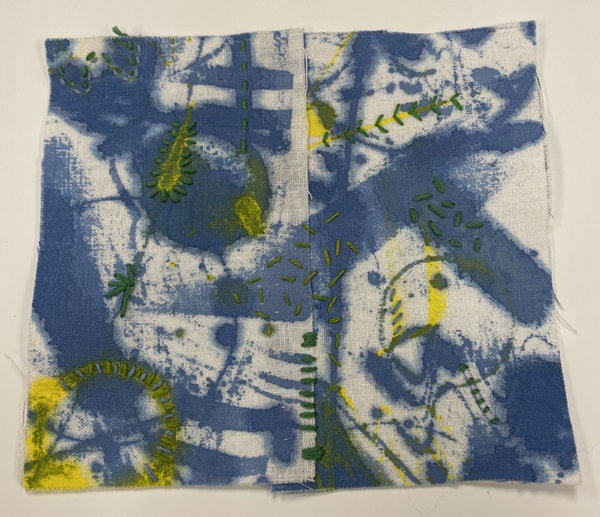
Continuing on from stitch camp I have started stitching. I like the pieces with a lot of negative space best but thought I should try to do something outside my natural inclination. So I picked one with mostly yellow but a nice distribution of blue too to start with.

I did a bit of stitching but decided it was too soft and floppy to work well. The stitching was distorting the fabric even though it wasn’t pulled too tight.   Another thing I could see, that might happen, is the messy stitching on the backside might show through the white fabric. Iron-on interfacing would solve both problems.  I know I have some……somewhere. And the Iron, I have one of those too, I am sure I saw it recently.

I found the iron first, but not before a mouse had found it. The mouse (the one we caught in the fall,) had chewed up the cord. Not a nice chew in half or in one spot but all the way along. You can tell how often Iron because the mouse was caught in the fall, late September or early October. Well, I didn’t like that iron anyway it tended to leak. I will have to buy a new one. Sorry, no picture of the chewed-up cord. I tossed it out on garbage day.


I never know what to buy, so I picked the middle price and the one that says it does not leak on the box. I was tempted by the one with the retractable cord but it was digital with little buttons. I don’t think my iron needs electronics.

Then I found my one-sided iron-on interfacing.


I am less thrilled with the pieces than I was so I picked 3 of the double pieces and one of the singles to use and I will see how that goes. If I start liking them better I can do some more.


I have 2 ironing boards. on is under siege in the spare bedroom and the other one, the small one,  disappeared into the packed things. so I had to do it the old-fashioned way with a wool blanket on the table. I used a small piece of sheeting for the ironing cloth.


Stitching with the interfacing is better.


When I did this bit of badly done satin stitch, I noticed the distortion starting. Adding the interfacing and ironing seems to have fixed it.

I don’t know what stitching to do. I know it’s all just an exercise but I still want it to look good. I did some seed stitch and that is probably my favourite so far. I thought it was done but looking at it now it needs something else across the join down near the bottom between the woven circle and the yellow seed stitch I think.


Since I started writing this post I started the second piece. One of the more blue ones. I decided to use some green thread as there are some green spots where the blue and yellow paint crossed.


So far so good.  I find it hard to decide where to stitch and what to stitch. I am enjoying it and I hope my stitching will improve with the practice. I find it hard to get my needle to go in or come up exactly where |I want it to. I am using a rounded tip needle. Perhaps a sharp one would work better but I didn’t have one with me. Another thing to look for. It is probably stuck in a piece of foam with some felting needles in a project bag or box.

It wasn’t until I started editing the pictures that I noticed this piece has a parrot in it. It is funny how we don’t see things until we take a picture of them. Do you see it too?


Group Order of Sanjo Silk

Group Order of Sanjo Silk

The January Meeting of our local Weavers and Spinners guild had a Zoom presentation on silk from the owners of Sanjo Silk (B.C. Canada). They talked about the different types of silk, about some of their acquisition trips to buy silk and showed us some of what they had in their store.  It was all quite inspiring with the silk giving lots of ideas for future spinning or projects.

1 web page of Sanjo silk showing some of the silk they offer (Fiber, Yarn and cool odd stuff)

After the meeting, there was an inquiry if there would be interest in a group purchase to reduce the cost of shipping. Their website offered free shipping over $200.00 Canadian (before taxes). There was another discount if we had a higher number too, but we doubted we could spend that much.  We had a small number of enthusiastic shoppers express interest and our new Yarn Convener set out to organize our shopping.

We perused the website www.sanjosilk.com/  and selected our drool-able lists. We then added the costs up and each sent our list to Deborah. She collected our payments, tallied the master list and sent out the order. She organized it all through E-Transfers, (I had never sent money by an E-Transfer, it was all very exciting!) She even organized E-refunds when we had collective spend enough for a further price reduction!!

Deborah had some cool stats that may interest you.

After not very long a LARGE box arrived! Deborah did a sort of the loot into each of our lists then dispersed it among the group.

2 the box arrives!!

3 our combined loot out of the box

I had a specific interest in my acquisitions; I was interested mainly in some of the colours that silk comes in besides white. I chose 3 options for further investigation. (Tussah, Muga and Eri)

4-5 Mr. Mer helps me set up for the fibre photoshoot

The Peduncle tussah silk was a silvery brown. This is fibre from the pediculus (foot) of the cocoon.  On their website, it is described as Pewter in fibre form, with a stunning lustre of Brownish-grey. It was the least expensive of the three coloured silks I selected at $11.25 for 50g. I am sorry I did not get more it would be exquisitely blended with fine dark wool.

6-7 Peduncle tussah silk

The Golden Muga silk was a blond colour. This one was described as “liquid gold”. They did warn that there is a lot of natural variation between batches they receive. The differences are caused by variations in diet and environment for the silkworms. They suggest you get enough for an entire project at once so you don’t have variations within the colour range by getting different batches. This one was $16.90 for 50g. I think I would like to see what variation is available so may order again and hope to get it from another batch.

8-9 Golden Muga silk

The Red Eri Silk was a Fox colour orange/gold.  Their website described it as a deep Orange-butterscotch, soft Luxuriously lustrous and long staple-length fibre, prepared in a thick roving. I am wondering if Mrs. Mer would like some of this blended with another fibre for her hair and possibly some fishy body highlight.  This was $18.80 for 50g.

10-11 Red Eri Silk

While browsing I spotted the oddest looking “cocoons” I have ever seen, full of little holes and in a golden colour. I had to add them to the list! They were listed as Gold Cricula Cocoons (wild) from Indonesia. They further explain that this is the outer part that attaches to the tree branch. The strong gold colour is from the Sericin, if it is removed the silk will be a pale yellow. It was suggested that you can “soak your cricula cocoons in water (with a dash of pH-neutral soap); reshape them, enhancing their dome shape with your fingers; let them dry. Or iron them flat for use in 2D projects”.  My brain immediately started thinking about a top for Mrs. Mer!! I am sure that you will think of much more exciting things to try with this cool cocoon attachment! A bag of 5g (a large handful) was $7.00.

12-13 Gold Cricula Cocoons (wild) from Indonesia

The next two selections were similar to each other.  The first was 100% Silk Carrier Rods (7 casings for $6.00.) the description was that “they’re actually part of the silk-reeling process. These carrier rods are stiff, strong, and smooth. Some are straight, some curved – they’re very sculptural. And they dye beautifully. (Also see our Silk Casings, which are thinner and finer.)”

14-15 Silk Carrier Rods 

Yes, I got the bag of the 100% Silk Casings too, they were priced at $6.00 for 14gr. Their description was; “Although these curious items look a bit “insectoid”, they aren’t. They are bi-products of the silk spinning industry. Each one is unique. They’re similar to the Carrier Rods we also carry, but they’re thinner, finer, and more pliable. Some are ridgey and corrugated, some are not. Each package is a variety of shapes and configurations. Use them for jewelry, to embellish art pieces, or just enjoy their stunning good looks.

16 Silk Casings

From the meeting, I remember they described both as waste products of the silk reeling industry. It is good to have what was considered waste be available to us, I am sure we will find a use for it! I had considered from the web picture possibilities for horns but I don’t think I have enough of the ribbed shape to do that. It is still weird and will likely percolate many odd ideas in the future. In the meantime, I will just enjoy their oddness and may add a few to my demo stuff. Oh, note that they have been cut off so the length of the fibre if separated would be short.

Lastly, I did get a white silk blend with Linin, I think this was a mill end, 97% Eri Silk and 3% Linen (trace amounts). The mill that made this has some debate as to exactly how much linen is included but it will be 3% or less. I seem to have a section where I can’t feel or see anything that looks like Linin. Oh well, it is still gorgeous! The Erin is a shot-stale fibre because the silkworm is not killed but allowed to break and leave its cocoon,( aka; Peace Silk). This fibre has been prepared using a woollen prep. It is described as having a soft and lofty character. It is also described as similar to cotton sliver fibre prep. 100g bag (about 3.5 oz.) was $15.60

17-18  97% Eri Silk and 3% Linen

If we order again, I may try a similar option of 65% Bombay Silk 35% Linen (flax) Spinning Fibre, it was slightly more expensive but had more Flax fibre content. That one is 100g for $19.00.

It is nice to have a selection of fibres to inspire you, or have just the right option available as you are in the middle of a project and just need a bit of something. Being part of a guild and thus easier to organize a group order (we saved a lot on shipping and got a bit of a discount too!) was a great help. Deborah did a fantastic job getting us all organized. I hope we did not overwhelm her and we can try this again!  I would like to be able to shop locally (we should be out of partial shutdown by the time I post this, I hope!) but in the meantime, let’s enjoy the bits of fibre shopping we are able to do and live vicariously through looking at each other’s acquisitions.

Did you have a flash of inspiration looking at casings, cocoons or rods? Are you thinking about foxes after looking at the photos of Red Eri Silk?

Now a word about felting

Remember if you are wanting to felt with silk it is not as narcissistic as wool, so it won’t want to stick to itself the way that wool does. Using a tiny wisp of wool over the silk to help lock it in place or blending it with wool as you are preparing your fibres will help it stick. Silk can be used to add a lustre or pop of colour amongst the wool.  Ann has applied it on the outer surface of vessels then used a razor to save back the wool and expose more of the silk to great effect. I have used silk fibres mixed with other fibres like alpaca or Icelandic tog as part of the outer coat of some of my animal sculptures to keep the hair/pelt from felting or matting to the body.

If you are going to be working with silk it’s a good idea to start moisturizing your hands a few days before you start. I also use extra-fine files for my nails. Silk, even though it is reluctant to felt when you want it to, will cling to your fingers and anything else you didn’t want it to stick to.  Bernadette, who also posts blogs here, has done a lot of spinning with silk and silk blends she may have some good suggestions for you about keeping it under control!

Have fun and keep felting!

First Quarter Challenge – Repurposing Sample

First Quarter Challenge – Repurposing Sample

For the First Quarter Challenge, I was intrigued by one of Lyn and Annie’s samples. It was chopped up bits of felt from an old piece added to a new one. Their piece was very colorful bits of felt on white wool but I was thinking in terms of florals in a landscape. I could try a small sample before I did a larger landscape that might not work as planned.

Here is the sample that I planned on repurposing. I made this several years ago and I can’t remember why I thought I should try this but it is wool with layers/ruffles of dyed cheesecloth. It worked but I didn’t really have any kind of plan on how I would use this method and it’s just been in a bin since then. But it had good California poppy colors so I thought I could chop it up into small bits to represent poppies in a landscape.

I only used a very small amount of the sample to chop into bits with my trusty rotary cutter. I have loads left if I decide to create a larger landscape with this technique.

Next I laid down a piece of green prefelt, covered it with a variety of small green bits of wool in a variety of locks, breeds etc. Whatever I had laying around, another way to recycle little bits of wool. Then I sprinkled the orange bits over the bottom portion for the poppies. Sorry for the poor photo quality, I took the photos in the kitchen where the light is poor. The sample size is about 6″ x 8″ or so. I was going for a small sample but one that I could perhaps use as a mini landscape if it turned out well. (You can always use these small samples for greeting cards or small framed pieces.)

Then I wet down the sample and felted as usual. I did lose quite a few of the small orange bits but I didn’t worry about that. I had lots on there and I thought it would still work with the majority of “flowers” that did adhere. This process reminded me of working with wool nepps which have given me some problems sticking to the felt in the past. I could have added a bit more fiber over the top of the orange bits but I wanted to see how they attached without it. Most of what fell off was cheesecloth.

Here is the final sample after felting and fulling. I am deciding whether I want to add any stitching or just frame this small piece as is. I like the “Van Gogh” look of the trees in the background and the orange stayed very bright and true to color without any wool on the surface. I feel confident that I could make a larger landscape with this technique and I can repurpose more samples this way. Thanks for the challenge Annie and Lyn!

Crafting diary – organising your makes for the future

Crafting diary – organising your makes for the future

If you know me at all, you’ll very quickly realise I’m not a particularly tidy person. I seem to make my studio messy simply by looking at it, so for me to be writing about organisation is very funny.

After the holiday season, I normally feel a lack of energy and creativity; I just want to burrow in my duvet, forget the world exists, and survive on tea, books and naps (plus chocolate). I call it Wintering, and this year was no exception.

If the body is sluggish, the brain sometimes has ideas, however. I’d been wanting to keep track of my sewing projects for a while. A sort of diary, if you will, where I could look back and see what I’d made, how I made it and my thoughts of the process.

What do you know, I actually found the energy to start it and I’m here to share some pages with you. Maybe this will inspire you to do the same for your crafting of choice (or maybe you already do?)

An open page from a sewing diary on a desk, with some decorative items around it.

I’d been saving fabric samples for a diary, which I kept in a neat pile, edges pinked to avoid fraying. I’m surprised I never lost them or forgot what the fabrics had been turned into!

Each project has its own page entry. The one above is for my first Metamorphic Dress by Sew Liberated. I start out by writing down who I made the item for, what type of fabric I used, where I bought it, etc. As I progress with this I’m sure I’ll come up with more useful information to add.

Another page of the sewing diary, with fabric samples and a drawing of the project I created

Here is Metamorphic Dress number two. I just had to share this because the fabric is one of my favourites of all time. If you read the note in the lower right, you’ll notice a comment about my mother ruining the dress for me by pointing out it looked like a servant’s uniform. (It does. Don’t tell her I agree. I still like it!)

This type of diary is meant to jog your memory in the future, if you ever want to know when you made something, or what could be changed should you ever decide to revisit the same pattern. I actually have a little detail to add to this particular one to improve fit in the future…

Two photos of a yellow Kochi jacket on a sewing diary page

I also decided to print a few images so anyone else who looks at the diary can have an idea of what I’m talking about (I might also forget in the future so this is also for me). This page says I made a Kochi Jacket (now renamed Luna) by Papercut Patterns but that won’t help if you don’t know what it is, right?

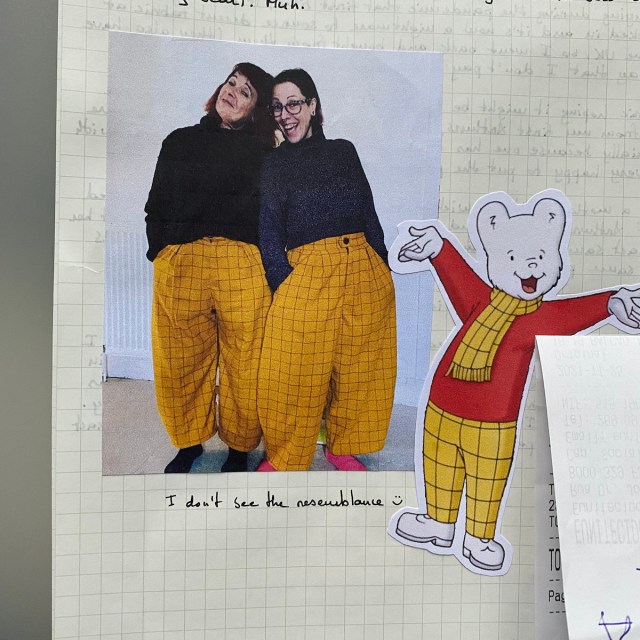
A photo of two women wearing the same model of Arthur Pants, next to a printed drawing of Rupert Bear

Saved the best for last. For Christmas my mum wanted a pair of Arthur Pants. She bought the fabric in Portugal and what do you know? It was the same as mine! She thought it was hilarious.
We got told our outfit was reminiscent of Rupert Bear… I had no idea who Rupert was, but now I do, I want to make a scarf out of the remaining yellow fabric for an extra laugh.

Do you keep a crafting diary? What do you include in it? Any suggestions on how I can improve mine? Let me know in the comments section.