Tree of life

Tree of life

This a wet felting work, one of my favourites, it was made for customer order. I loved to combine the natural colours. All of these colours are hand-dyed.

First I made the design with wool pencil roving and then filled it in with wet wool. After that, I covered it with 3 layers of wool and with the rolling technique finished the wallhanging.

This tree is reflecting our “road” in life, how we evolve and how we manage to handle challenges, day by day…

It was a great project, with a lot of work but it was a lot of fun, with exciting minutes during the felting progress.

Upcycling a Feline-Destroyed Paper Lantern!

Upcycling a Feline-Destroyed Paper Lantern!

Many years ago, we bought some sweet paper lanterns, that we have used a number of times for birthday parties or other fun celebrations.  They always looked warm and welcoming as the sun set, giving a lovely glow hanging from the gazebo.  As we always loved the look of them, I decided to hang them up in the conservatory so we could use them all year round.  Great idea….but….having little furry felines in the house, they thought it would be great fun one day to play football with them!  Sadly, a number of our sweet little lanterns went from this….

……to this!!!!   

As a person who hates the thought of adding plastic to landfill, and always wanting to recycle or upcycle anything and everything; I decided that I would attempt to create a wet-felted version of the paper lantern reusing the plastic components and light.

I recently treated myself to a lovely little book by Mette Ostman, which beautifully explains how to create round open vessels using a resist.  When I was reading the book, I realised that I could use this method to make a ball, that I could hopefully turn into a woolen equivalent of a paper lantern.  I say “hopefully”, because as a complete novice, nothing I create is guaranteed to work!!!!

Just to add…I was hoping that Alex would be here to help me create this month’s masterpiece, but unfortunately my partner has been feeling a bit under the weather and so I made the decision not to have Alex over this week, just in case.  But fingers’ crossed, next time he will be able to felt and create to his heart’s content.

So…I needed to think about materials and design.  A while back, I purchased some viscose in some beautiful colours.  I hadn’t plucked up the courage to use any yet, so I thought this might be the ideal project to give it a whirl.  I wanted the lantern to look attractive, whether or not the lights were on and thought that the viscose would give a lovely sheen to the surface, that would catch the light and make the lantern radiate and shimmer.   Having measured the original lanterns, I wanted the finished ‘ball’ to measure around 20cm diameter (when flat).  Allowing  for roughly 1/3 shrinkage, I considered following the plan in making the resist 30cm.  But in the end, I made it slightly larger (31.5cm), but kept the total wool weight at 45g, in order to make the felt thinner.  I will admit, this was pretty much guesswork, as I’ve never attempted a lamp before and I didn’t really know how thick the felt could be, yet still be able to allow the light to shine through the felt!

The proportions of wool that I used, were an inner layer of off-white wool batt weighing a total of 25g.  Layer two was pale pink merino, weighing 20g and for the final outer layer of viscose, I put together 10g each of green and turquoise.


As you can see, my white wool was in a bit of a jumbled mess so I decided to card it before using it to enable me to have a little more control over how I laid the wool down.

I began laying the white wool as finely as I could….

  and then wet, compressed & flipped it over..         

After layering and wetting the second side, I began laying down and wetting the pink wool..

  as you can see, with the pink wool I put two very thin layers, crossing each other in different directions.  I repeated this on each side before adding my final layer of viscose…

With the two colours of viscose, I mixed them by drafting them together about four of five times to achieve a merging of the two colours, but not so much that they totally blended together.


     From this…


to this     


I wanted to create some blending of colour, but still allow you to still see patches of each individual colour.   At this point, I was very much using guesswork as I have never made a lamp before and I’ve never used viscose!!!!!!!!  Those of you who felt a lot will probably pick up that I overdid the viscose!!! But it’s all a learning curve hey?!!

Having ensured that all layers were thoroughly wet and compressed, I then started to felt.  I began very gently, in order to allow the fibres to begin merging together.

I will be totally honest with you, i did not have a clue how much light would be able penetrate through the felt.  I was faced with a dilemma…to little wool and viscose, and the lantern won’t hold its shape.  But too much wool and viscose, the light won’t show through!  So this was very much was an experiment on multiple levels for me!

I spent quite a long time working the wool through a layer of bubble wrap before I reached the point where I could start rolling the felt.  It seemed to take forever to felt, but I’m guessing this is something that happens with viscose?

However, I was really pleased with how the viscose was taking shape!

I love the streaky effect I was starting to achieve…

  Do you think if looks rather planetary??!!!

After much felting, rolling, removing the resist and fulling, it was time to allow it to dry.  When I removed the resist, I cut the tiniest hole I could, because I didn’t want to risk ending up with a hole that was larger than my plastic components!  I had quite a struggle to get that resist out, but I won in the end!  I then inserted a balloon and inflated it, before beating the ball with a spatula to even out the surface.  I’m afraid I forgot to take a photo of this part of the process, but it worked because the surface was quite smooth by the time I finished, as you can see from the photo above.  Looking at it, I wish I’d known about felting when my youngest son was little because he was totally in awe of the planets and star gazing…I would have loved to make him a whole planetary solar system!!!

Once it was dry, it was time to start assembling the project.  The light box was in two parts.  The light and battery component, with a lid that fixed it in place through the paper.  Now all I needed to do was clip it together either side of the felt.  I made a hole for the light bulb to be inserted through, and two smaller holes to allow the lugs to penetrate the wool and clip onto the lid, which I put inside the ball.

You can see the light poking through inside the lantern.

And here, you can see the battery component that lies the other side of that light bulb!


The top proved to be a little bit more tricky to incorporate….  There were parts of the lid that had little lugs that held the handle in place.  That was easy, as I could poke them through the felt.  But that only meant two sides were attached!  So in the end, I got my needle and thread out, and sewed some snap fasteners to the top of the felt.  The other part of the fastener, I glued to the inside of the plastic ring.

  Here you can see the glued snap fastener!  Sadly, I was too enthusiastic to try them out, and ended up using them too soon, resulting in managing to pull them off and having to  re-glue them!!!!!!!!  Patience is a virtue!!!!!

And this is how it ended up…..

…and from the other side of the world….

To me, it looks like an alternative version of the Earth!  I’m please with the sheen I got from using the viscose.  To be honest, I’d be quite happy to have this hanging from my gazebo just as a decoration…

But…the million dollar question is, does it work as a lamp??!!


Well…to be totally honest with you, I definitely think I overdid the viscose!!! The photo of it as a lamp, shows it in a much better light (pardon the pun!) than in real life.  In the photo, you can see more light showing through the viscose fibre than there actually is.  When I make the next one, I think I will alter the proportions of the wool and viscose to be more wool, and use the viscose more sparingly to form more of a pattern, rather than as an overall coverage.  But I will say that I like the daytime version, where it makes for a decorative ball!  It does hold its shape, but I think I might opt to make it thinner next time and try using some sort of stiffener to ensure it is still able to hold its shape.  That way, I think I will get a better result for use as a lantern light.

Overall, I am quite pleased with the results considering there were a number of ‘experiments’ going on here!  As a novice, I have learned a lot and think next time, I should achieve a better result.  But at least it wasn’t a total disaster!!


Moms Birthday present.

Moms Birthday present.

Last week (https://feltingandfiberstudio.com/2021/07/28/2021-ovwsg-fiber-poker-felting/) I showed you what turned out to be the Arnold Schwarzenegger of Chickadees! He is Humongous!! (There may have been a robin secretly involved in his parentage. Some illicit tryst perhaps?)  As I said last week, I mostly followed Sara’s instructions and upgraded the wire for Mega-chickadee. The wire gauge was defiantly a success there was just too much of it.

A bit of historical interlude (I will get back to felting shortly I promise)

When I was much shorter and could still climb trees, my parents bought land adjacent to a lake but way up a steep slope, so reasonably safe from lake attacks. (You do not want to ask me about the long weekend before I started grade 13. Never trust water!) A small cottage was built looking out across the lake and we enjoyed watching sunsets, sailboats and the local birds, including the great blue heron and the loon family.  Mom and Dad enjoyed the Chickadees, Wrens and hummingbirds particularly. I spent many years bringing mom wonderful presents, of Frogs, in various sizes and shades of green. I finally gave up on my quest for the perfect frog, when Mom rejected a tree frog. it was perfect! How can you object to those huge cute eyes, the sucker tows and cool colours that made him almost invisible sitting on a tree! But no it was like all the other frogs I had brought her. Mom said, “it’s an outside creature take it outside right now!” “Aw, Mom!!!”  I got the same response for grass snakes, garter snakes and black rat snakes (I did not try the snake that looked like a Mississauga rattler but without the rattle). She even rejected turtles, including the almost impossible-to-catch, soft-shelled Mud turtle!!! Look at the nose on one, it’s soo cool!!!

Mom’s birthday is coming up fast and its going to be one of those big number birthdays. This year will be her 90th! So i will have to chose her present carefully! I know frogs, snakes and turtles are out as presents. She did like the small birds at the cottage, but the chickadee I just made would be unacceptably large. The armature would make a fine robin but she still blames the robin for taking out the original railing on the path down to the lake. The robin was a bit Rubenesque and it often hopped down the skinny birch tree that had been used to create the railing. On one trip to the cottage, we realized the railing was broken and lying on the ground! Stupid robin I bet it was jumping on the railing again!! – so no, I had better not make a robin.

She would like a chickadee; they are always so fun and will yell at you if you didn’t fill up the bird feeder fast enough. The ones in my side yard get particularly annoyed with me if I’m out and haven’t topped up the feeder.  Ok, I will have to make a smaller armature at least half the size, maybe a bit smaller.

I am pleased with the armature wire gauges that I had used for Mega-chickadee and they should work for a closer to normal size bird too. The body is 20ga steel floral wire. I measured from the foot, leg, body the added the length for the neck/head. I wrapped the neck/head in black floral tape and then cut the excess off, Which I used for the shoulder/body and tail.  I used 26-gauge floral wire for the tows and extra leg supports. I was enthusiastic in the wrapping of the legs to provide lots of support for posing the little guy.

1 Mega-Chickadee and 2 smaller Chickadee armatures

I selected a short, superfine, highly crimpy fibre from a fleece I had purchased from the Wool Growers Co-Op, (possibly a Shetland). This is the same fibre I used for the mega bird legs too.  I pulled out my scary-looking Viking combs and put them to use. I drafted out a narrow sliver and wound carefully around the wire. Unfortunately, earlier this morning I was moving small plants in pots in the front garden, one of the pots broke and I broke one of my talons much lower than they normally break. OWW!! ( I trimmed the nail down and had to use the left hand as my primary winder.  (One of the few positives of my particular learning disability is my weakness for the concept of left and right, which means I have two lefts or two rights and can often use the wrong right hand to do things. Silly brain).

2 OWWW!

Ok, the left hand is not as good at photography as the right one is.  It may be because all the buttons are on the wrong side for the left fingers. Can you get a left-handed camera? My thumb should be heeled by the weekend but now I’m curious about left-handed cameras…. Focus, back to felting!!

3 legs done and the first under-layer of core wool added.

4 comparing the two new armatures

I did not use the floral tape with its waxiness to increase adhesion on the legs but the wool stayed in place well. I was starting to worry I had guessed the nose (beak) too long. I can trim the nose back if it seems too long but let’s add more wool and find out if it still looks long.

I put away the Viking combs and pulled out the hand cards. I had made a large purchase, from World of Wool, of 2kg of white core wool. The texture is soft but a bit clumpy so just pulling out of the bag to use was not drafting as well as I would like. When I did a quick couple passes with the hand cards I created a lovely soft, lofty, easy to draft out mini batt. From which I could easily pull a section to draft and wrap with.

I used a bit of Corriedale blending of the colours licorice and slate to wrap the beak.  if you can, most living things will look more realistic if you blend more than one tone or colour. In the case of black if you can make that darkness with slate and a really dark brown or green or even a bit of red you will get a much more interesting black than using the colour “out of the tube” as it were.

Then I added more of the core wool white to build up the chest back and head.

5 It’s amazing how much bigger the bird is than the armature.

6 A bit more wool to the front of the face to get a better shape and the beak now looks like the correct size.

Oh good the nose is not too big!! The head, on the other hand, does look a bit tall and large. I need a quick trip back to check my photo reference to get the shape and angles on the head.

7 Here is Mega-Chickadee, normal chickadee and extra armature.

A bit fluffy but coming along nicely. It is now time to mix up more dark charcoal, this time to add the markings on the head.

8 it’s nice to see where you are going! So, I added the eyes.

9 Still a bit too tall so worked on compacting the top of the head.

The armature is strong enough to hold a pose of the head. The legs are also supporting the body weight. This was a good choice of wire gauge.

10 posing the armature and getting the curl in the toes.

11 I think it needs a bit of a creamy tone to the under-wing and sides of the body.

12 much better.

Now that is what I basically want. The core wool does have a bit of kemp, not a lot just the odd bit that protrudes, as well as a light halo of wispiness.  The poor guy seems a bit harry. Ann sometimes Shaves her wool to expose silk fibres, it works wonderfully. I think some tiny scissors may work for my purpose.  Now, where did I put those fine embroidery scissors? Hummmm……

13   Standing on the scissors will not keep me from trying to trim up the flyaway hairs. Is this a subtle hint not to trim anymore?


Need for more Experiments!!

I think I should make a couple of samples of hairy surfaces and try a thin application of hair spray or fixative to see if that will keep the fuzziness contained.  I would want to do a time test to check for yellowing or other discoloration to the wool if either spay is applied.  But for now, just the very basic trim has neatened up the surface of the chickadee greatly.

14 a view of the back

Next, I am off to IKEA, well in the morning, now it’s quite late since I got distracted again while writing this blog. There are bell display bottles “BEGÅVNING – Glass dome with base 7 ” tall”. Yes that is for the morning, “Yawn” I will let you see what I find tomorrow.


Day 2 the “Framing”

Oh, the Excitement!! A trip to IKEA!! (OK it’s only 5 stop signs away from the house. Well, 4 stop signs on the road and 1 in thier parking lot. It is very close, but it’s been over a year since I have been there!!) I consulted the web page and notice that the cafeteria is open for take-away food. Gravadlax or Poached Salmon? Yummm. Ok grab the camera and the Chickadee and headed off to IKEA!

15 the exciting Begavnings in their natural environment!

16 they come in two sizes!

17 the options at IKEA, If I could do woodturning I would consider the glass covers and make a wooden base.

I decided on the smaller size Begavning. Now off to get lunch to bring home.

As a fabulous treat, I went to the cafeteria and found that it was indeed open and you could eat in if you were spaced apart. I sat way at the back of the dining area in a section all by myself. It felt so odd to be eating in public and so tasty!

18 what a treat!

19 I think someone wants my dry cracker. Good thing chickadees can’t open zip lock baggies!

While i was shopping I also found a wooden articulated hand, a pepper grinder and then an umbrella weighted base in AS-IS! I LOVE trips to IKEA!

I brought home the display jar and tried the chickadee in it. The photo shows more reflection than is seen in person. Yes, that is what I am looking for.

20-21 almost ready to wrap

Do I need a piece of corkscrew hazel to give a bit of height? I tried one piece but was not convinced. I think I should add a couple of sunflower seeds and let that be the narrative.

22-25 The photoshoot

Mom’s 90th Birthday is on the 08th of the 08th, I have ordered Chocolate chip cookies from Ann (her favourite) and I have the chickadee done. It will be wonderful to see her. I hope she will like the little guy. I bet she says “at least it’s not a frog” when she opens it!

PS; Don’t tell Mom what she is getting, its a surprise!! (She doesn’t read the blog!)


My Second Poker Challenge: Felting.

My Second Poker Challenge: Felting.

Last time I showed you my spinning poker challenge. https://feltingandfiberstudio.com/2021/07/26/spinning-poker-challenge/ This time it’s the felting poker challenge

In case you didn’t see it the idea is you pick a card from felting four different category card decks. With felting wool is a given.

My picks are:

Fibre: use thread or fine yarn

Colour: use cool colours

Structure/Technique: needle felting

Other: No Larger Than An Index Card ( 3inches by 5inches, 7.5cm by 12.5 cm)

This one took me a while to figure out. I kept thinking of a cold picture even though I do know cool colours doesn’t mean a cold picture. I don’t usually do needle-felt pictures I usually wet felt and then do a little needling and stitching. I am glad it’s only a small piece.

To start I cut the right size piece of prefelt for the base. I got this to try out From Monica of The Olive Sparrow. I have to say so far it is very nice to use. It’s quite thick and nice to needle into, not too hard and not too soft. Just like baby bears bed.


Next, I picked my colours for a nice scene. Most of it is merino except the two-tone green. It is corriedale.


Laying it out. and tacking it all down. I wanted sky and water and a clifftop.


The sky and sea are blending together. I went online and had a look at some sea and sky pictures. There seems to be a definite dark line where they meet but when I added it to the picture, it looked odd. I decided to pop an island in.

That looks better but it looks lonely so I added another one and greyed them out a bit to make them look a little farther away.

That is where it stands now. You will notice there are no threads or fine yarns. That will be next. I will probably add some grasses and flowers to the foreground with stitching and maybe a tiny lighthouse on the rock. I am not sure yet what I want to do.

Registration Open for Felt Hats and Felt Bags Online Classes

Registration Open for Felt Hats and Felt Bags Online Classes

Teri’s online classes will open for registration tomorrow. The classes will begin on August 19. Teri teaches two great classes, one on how to felt concertina style hats and the other one on how to create felt bags. Both of these classes will teach you methods of improving your felting techniques so if you have felted around a resist before such as to make a felt pod, you should consider taking the next step on your felting journey.

For more information and to register for the felt hat class, click here. 

Have you taken a look at other student’s hats that have taken Teri’s class? There are some really fun hats and the variations are quite creative. Take a look at the student hat gallery here.

Teri’s felt bag class is an excellent way to learn how to create a variety of shapes of bags, as well as features such as straps, multiple compartments and pockets. You can find more information and register here.

And the student gallery for felted bags is here.

So what are you waiting for? Jump in and learn some new felting techniques.

Or if you’re just starting out and want to learn the basics, try our Wet Felting for Beginners class. This class can be taken at any time with unlimited access. For more information and registration, click here. 

Second life

Second life

Anyone who tell you they don’t have a box, draw or even cupboard of failures or “ not going how I wanted to” is either in denial or hasn’t done enough yet. My tale is about one such piece. I don’t even have a full original photo to show you so dissatisfied was I. The picture below is the starting block. To explain the original context of the piece it was two logs of wood at the forefront with a tree and mountain scene as the back drop. The second picture is of the top of the piece. I am sure you can visualise them before the chop.

I already had in my minds eye where the piece was going ,as previously having done a rock pool scene ,I wanted to achieve something similar on a woodland setting.

Although in my minds eye I could see the finished piece getting there was unknown. The piece was a wet felt project using dyed silk to create the logs and silk and fibres to create the moss and ground. I then needle felted to create depth and texture.

After studying it for awhile I decided if I established the proportion in the top left hand corner the rest would flow from there. I knew I wanted it to be multi dimensional but wasn’t sure if it would work. I stand here honestly admitting I am not the best embroiderer in the world but best foot forward added grasses in wool yarn and stalk and leaves in silk yarn to the existing blue flowers which I added at the wet felting stage with nepps. Still at this point I wasn’t happy as it still felt “ flat”. I decided to see if I could have a play and make dandelions which I could sew on top separate thus creating the second dimension I wanted.

But how? Out came my trusty stash of bits and bobs where I found some green and yellow prefelt I had made. With my embellishing machine I added further wool in differing shades of green. I then made a template of a dandelion leaf and cut them out. A final run over with the machine to strengthen them and a trim up and they were ready. I did the same with strips of yellow which I sniped and rolled. Sewing the base tightly together made a very pleasing dandelion shape , well in my eyes at least. After positioning them on the piece I was happy and created the stem with string and couching stitch.

I was happy it was now taking shape. The only area I was unhappy with was the blue flower in the foreground was knocking the whole piece out of proportion. After a tentative test decided to remove part of it completely. With this area removed ( the area between the two logs) it made more sense.

I made more leaves on my embellishing machine in different shades of brown and green and along with stones ,which I had needle felted, I added to creat the woodland base. I also embroidered some clover with bullion knots ( don’t look to closely, I have already explained about my lack of skill and this was my first attempt at this stitch).

And so to the foreground. More leaves were made and added to the blue flower. I’m afraid this flower is not a true but made up flower but at least I had free reign to create. I added french knots to the nepps to add depth.

I must admit the piece is not yet complete as I am now adding french knots to create the moss and will be adding more stones and maybe another clover ( if I can master bullion stitch that is).

All in all I am quite pleased with the piece

My point is never give up on a piece. I find some times just moving a mount around a piece of work completely changes you appreciation of it and can send it off in a completely new and pleasing direction.

If anybody would like to see the finished piece I will give a quick update when next I post.

Playing with my new toy: English wool combs

Playing with my new toy: English wool combs

A couple of weeks ago, I ordered a pair of English wool combs. They were sold out at the time but the people in the shop were kind enough to allow me to backorder. Now all I had to do was wait a few days and let the spiky goodness arrive at my doorstep!

Finally, they were here.


Leonor of Eleanor Shadow holds a pair of English combs and looks chuffed


It occurs to me that these would make great Wolverine claws for Halloween, were I in the mood to risk self-injury… Seriously, despite knowing these are pointy, sharp objects, it still surprised me to find out exactly how sharp they were in a slight moment of distraction. Note to self: don’t daydream when handling wool combs.

If you’re not sure what wool combs are for, these brilliant tools are used to process fleeces for spinning. They work by separating, aligning and combing the wool locks, whilst also getting rid of any vegetable matter (VM). The end result is a fluffy and lovely cloud that you’re supposed to carefully diz off the combs, ending up with a longish sort of roving.


Texel cross wool locks on English combs, ready for processing


Ideally, you’ll place the locks facing the same direction, which in my case was cut side nearest the tines, ends on the outside.
These are lovely locks from a Texel cross lamb’s first shear’s fleece. I washed it myself. They’re so soft and all I want to do is bury my face in them.. (which I definitely have. Don’t judge.)


Eleanor Shadow uses English wool combs to process some wool locks


Next, you carefully start teasing the tips of the locks apart with the other comb, which will transfer a bit of fibre to said comb at each pass. As you keep doing this, the longer staples of wool will move and the shortest bits will remain on the clamped comb. You’re meant to discard these short bits, but I keep them to make dryer balls.


English wool combs processing wool on a table

A hand showing wool waste after using English wool combs


You can see above that the fibre left behind retains some VM. I don’t mind it because it’s clean, and won’t be seen once the dryer balls are covered in commercially processed wool top. Waste not, want not.

You will do this transferring of fibre from one comb to the other until you’re happy with how the wool looks. The one below was on the third pass.


Side view of wool on English wool combs, after processing


There was still a tiny bit of VM but I don’t mind.

Since I wasn’t planning on spinning this wool, I didn’t diz it off the comb, I simply pulled it all off  together very gently, so it all came off at the same time.
After 30 minutes I had a few clouds.


A few soft clouds of processed wool on a table


I’ll be gathering a lot of this fluff into a bag and, once I have enough, I’ll card it on my drum carder and make batts to sell to spinners and felters. Lamb wool really is like a cloud and I’m loving playing with it.

To end this post in my usual tradition, here’s a completely unrelated photo I took a few days ago that I find amusing. This was on a building I happened to pass by here in Edinburgh.

Plaque on a wall saying On This Site in 1897 Nothing Happened

So, what’s your current favourite fibre utensil?

2021 OVWSG Fiber Poker (Felting)!!

2021 OVWSG Fiber Poker (Felting)!!

Quite a few years ago, as a way to give a fun summer challenge to guild members, the Ottawa Valley Weavers and Spinners guild executive decided to make a summer poker challenge. But since we are not a card-playing-poker-guild we would do fibre poker instead. I think it was Shirley Browsky who set it up (she has her OHS master Spinner (1991) and is completing her master weaver Certificate). she made a deck of cards listing different types of fibre, different techniques, thicknesses, colours and things to includes like feathers or beads. We drew 4 cards from the deck and could re-select one if we wanted to.

1)  2014 the drawing of the cards

Even after trading in one card for another, we occasionally wound up with conflicting cards, which made the finished item extremely hard to complete. There was also a deck for weaving created. Over the years, more cards have been added to the deck and for the summer of 2020, a felting deck was created. This year, each deck was updated and divided into 4 suits; for felting, it was Fiber, Colour, Technique and Other. This greatly reduced the likelihood of getting impossible conflicts in cards. (Use only plain weave + include overshot).

Cards would be drawn at the June meeting and you would have until the September meeting to create your yarn skein, woven sample or project, or your felted item. The September meeting would be a double show and tell meeting, a sort of what I did on my summer vacation and the poker challenge completed projects.

2) This is my spinning challenge from 2014. I think it was; include Found objects, use Locks, Pigtails and it was either use more than 2 plys or over twist.

3-5) Carl ran Fiber Poker in 2017 with a spinning or weaving option. He carefully wrote down everyone’s picks.

6) This is Ann’s finished skein.

7) A particularly interesting solution to one challenge was seen for “include Locks”

I had not been participating the last few years, due to working on the library architecture migration project; we can chat about that some other day if you are curious. This year we were in lockdown and with the most massive part of the library project done. (There are still a few small manageable chunks left to do.) SO, I can have fun rather than just watching what everyone else has made (and taking pictures of course).

This year the draw with the new decks was over email. I requested a felting challenge and the email arrived of what elements I would have to include. Nothing conflicted and I could do all the elements without researching.  The problem was more what to pick?

8) 2021 my cards

OH my, so many options running through my head!! Slow down and write them down

  • Stained glass with fine yarn using a blue 2D picture with 3D wire element finishing embellishment with beads. Going from 2D to 3D is lots of fun. I have done quite a bit of that with the Guild art show for Canada’s 150th. Keep thinking.
  • Landscape with blue sky as a prominent feature. Wet felt background layout yarn for cloud edges, water ripples, with a tree or rock edges. Lay over yarn with thin wisps of wool, building back words to the backing base. Work the back dry then flip check wet and felt. Let dry enough to Add wire elements to the backing side to push out rocks/trees add edge stiffness to the piece. Add fibre and felt to attach the wire. Push stretch out 3D areas. Let fully dry and add beads. Hmm, that sounds like fun but let’s keep thinking.
  • Hedgehog, yarn for spikes, make a blueberry or blue flower. Use an armature –mouth can open, add beads for eyes. – 1.5 (14ga) aluminum, high twist 2 tone yarn may have to spin it. black beads, white, beige and light gray and brown back. Research: “There are seventeen species of hedgehog in five genera found throughout parts of Europe, Asia, and Africa, and in New Zealand” Also; adult size of 6–8 inches, short legs, but hedgehogs are equipped to waddle around with the help of an about a half-inch long stubby tail for balance. They can lift their underside completely off the floor and run very quickly for short distances. domestication will have five toes on their front feet and only four on their back feet. Spines only grow to be less than an inch long but are sharp enough to provide defence. the quills, which are modified hollow hairs.  For domestication purposes, the white-bellied or four-toed hedgehog, Atelerix albiventris, was bred with the Algerian hedgehog, Atelerix algirusThe structure of their teeth, including two frontal incisors for 36 altogether, They prefer a cat food with meat or poultry listed as the main ingredient, and definitely with a high protein level. a supplementary diet including insects or mealworms. Some additional treats could be boiled egg, fruit, crickets, or vegetables.

Maybe not, i did one (with a soap inside him) recently for Glenn. (he named him Crevice)
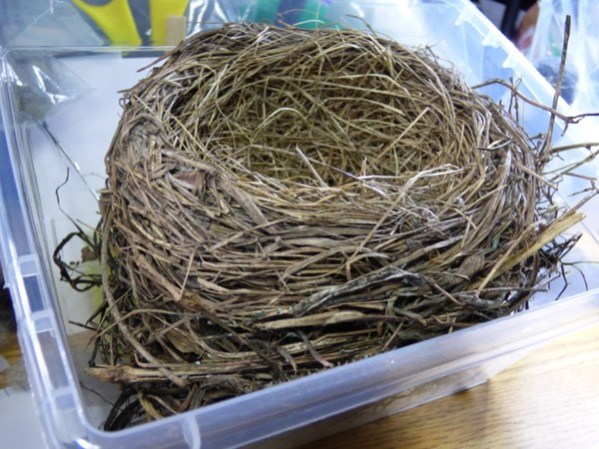
9) Robins nest from a hanging basket at my mother inlaws’.

  • A real Birds Nest arrived from Oakville – make a bird with an armature to go in the nest. Oh, I like this idea. Let’s look at it further.

My favourite colours are blue and black. (ok my favourite colours remind you of a bruise at least it’s not one of those awful green and yellow bruises!) A blue jay is too big for the nest, research birds that are blue in the Ottawa area of Ontario. Birds I like; crows (too big), Blue Jays (too big), chickadees (well they have black but not blue), most of the birds of prey (too big).

Include Wire well that is easy. Add an armature. Didn’t Sara have proportions for a wren recently in a video? Yes. What is she using for her armature? 22ga for legs, it looks like floral wire, 32ga for toes and a pipe cleaner for the body. Hmmm, I do not think that has the strength I want and I don’t have a 32 (I checked my samples). Ok, 20ga legs and body, 26ga toes. Wrens and chickadees’ are close in size. This should work perfectly!…. I carefully watched and re-watched the first bit of the video as she is working on the armature to figure out the size. Leg measurements check, body and toe pieces I have an estimate but I left the wire longer so I could trim to size as I work. This allowed for more support wrapping on the legs, which I had wanted to add while watching the video.

Include Beads Or Sequins: birds need eyes! I have at least 2 sizes of glass beads in the small box of beads. I switched that part of my collection into a different box when I rebuild my office shelves (moved the massage and computer reference stuff out and moved wool, wax, wire and beads in. ok where on the shelf did I put it and why is it not labelled yet? (Another job, add it to the list).  I guess I should either not clean up or remember where I put things!  Ah, one little bag of the right size, perfect! Now how to attach it?

Use Thread Or Fine Yarn: do I know where my beading needle is? ….no. Will one of the long sewing needles in the giant pill bottle by the window work? Maybe… Yes, not all the beads are exactly the same size so some fit over the eye of the needle and some don’t. I pick two that fit. Now for the thread. I just got a couple of huge bobbins of industrial thread for making bags (a shop that made bags was closing so I scored white black and a green, no blue) I picked up some quilting thread that may be a bit better size and it will still be strong enough. What do I find for colours? Black, white and a different green… there seems to be a theme here that doesn’t include blue. Ok, I like black too. Black, it will be. Any other instructions? let me check. No, that’s 4 and I have them covered.

Now to watch the armature section of Sara’s wren video.

Part 1 is here; https://www.youtube.com/watch?v=pHZnSWuz7AY

Part 2 is here; https://www.youtube.com/watch?v=hnZrpAxrwcA

Sara (Sarafina Fiber Art) has a slightly different approach to felting than I seem to be developing. She is more additive and has been working on techniques and vocabulary that can be reproduced by others. She tends to wrap the armature, then makes shapes from the wool and adds them to the armature. (Thus, additive; like sculpting with clay). While I start with the armature and wrapping, I usually add loose wool and sculpt it down to what I want. (Thus more subtractive; like sculpting with stone. Just keep poking and compacting until you get the shape.) I am adding wool in sections and layers to build up muscles but I don’t tend to pre-build the muscle and add it on.

Since I had never tried to make a bird before I should probably try to follow Sara’s instructions and see how that goes… or how long that lasts before I wander off-topic and do my own thing. (I am a challenging student.)

As I said, I watched and re-watched the beginning of Sara’s video to get the armature correct. I modified her wire suggestions to increase the armature strength. For the body and legs, I selected the 18-inch long floral wire in 20ga steel (I used a magnet to pick up a part that fell off the table.)  I measured and cut the legs then added the 26ga garden wire to create the toes and trimmed the excess. I then folded the 18-inch floral wire (20ga) following Sara’s measurements twisting the wires together and attaching the body to the legs. I formed a small triangle for the body and left the rest of the wire to support the tail.

10)  Leg-wire adding the wire for the toes

11) The body added to the legs with the extra wire left for the tail

12-13)  Added black ½ inch floral tape to the beak and neck.

Ok, time to look more closely for reference photos for chickadees. Oh my, there are many chickadee types! Our local one is the black cap Chickadee. Let’s try to find shots from various directions. Why is it so hard to find a shot of the back of the head? I guess it’s hard to sneak up on a chickadee or photographers just don’t think of that as a chickadee’s best side.

Time to add fibre

First, try on the beak, it was a dark grey long-staple fibre but it just didn’t look right. Next, I tried a bit of black merino roving but I wasn’t too happy with that either. Let’s leave that a moment and look at the legs

For the legs, I selected an extremely short crimpy brown/beige fibre.   Although the baggy of fibre was unlabeled, I think it may be a bit of extremely fine Shetland. It is lightly washed and still has a bit of lanolin in it. I drafted out to about an eighth of an inch width started at the top of the leg and worked down to the toes.

14-15) Head and feet

I am still considering the black but let’s add the body and start the neck.

16-17) I anchored one end of my roving and added layers following Sara’s Instructions. It’s starting to look a bit more bird-like.

18)  I continued to follow instructions (mostly), adding a roll of wool for the chest and to build up the back.

19) I am working over a cheaper quality pool noodle.
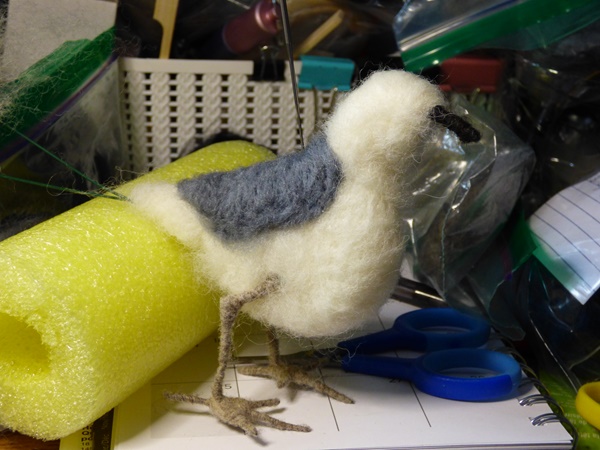
20)  Yes, that looks a lot more bird shaped now. I don’t like that grey tonally. It’s too dark and flat. That’s ok. I have more fibre options.

21)  Blending with hand carders

My options in Corriedale are Liquorish (black), Slate (dark grey), Fog (med-light blue-grey), Grey (med-Dark Grey), White Core wool world of wool. A bit of Fog,  grey and a tiny bit of white and I had what I wanted. I again did not completely blend the fibre to a uniform colour since nature tends to be more creative than flat colours.

22)  lightening the back colour

Now it’s time to consider the tail. The Chickadee seems to have a reasonably long tail so let’s trim a bit off the leftover wire and let that support the tail. I didn’t want to fold over the ends so I used the floral tape to keep them from poking through.

23)  needs a tail

The nose was still bugging me so I took off the merino and replaced it with Slate Coriadale. Ah, much better. I then blended the slate and Licorice to get a non-flat colour for the black head markings and build up the top and sides of the beak.

24-25)  Oops, I got distracted watching the Olympics while I worked  (there was no blood shed but audio-books are safer when felting). At this point I have the wing shapes done but still need to add the feather detailing. I will leave that for later. I just have them held in place with a pin. I think I need a bit more rounding under the wings and the head and markings still need a bit more shaping. I also need to add eyes.

A pause while I go look for the box of beads. I will get back to that in a moment.

Through today I have been sitting in front of the computer (you can see the messy desk piled with wool and implements of wool torture and maybe the Mountain dew I was drinking). Just off to the right(?) is the phone which today is the bane of my felting. After someone wanting to clean my ducks, (how silly, ducks are self-cleaning. it’s the pond they wash in that would need to be washed – I don’t have a pond or ducks), multiple probably robocalls that there is no one on the line so I hang up and finally I got this one. Oh, I have chatted with their co-workers before this could be fun but it’s interrupting my felting.

Transcript: Ring!!! “Hello?” Long pause, “Is this Mrs. Glenn Martin? Noncommittally “this is Jan, Who is this?” “This is Microsoft service department about your computer.” I interrupt “which one, I have a few? If you can tell me the operating system I will know which one you want to discuss, I have some that don’t go on the internet too.” Silence……Click. She gave up much more quickly than I expected. It usually takes them longer to give up. Maybe I sounded like she had interrupted important felting?

After a bit of a search I found the small box of beads and yes I have 2 sizes of black glass beads. The bigger ones look like they will be perfect for this size bird. Now, where are the beading needles? I have a long needle that worked if I was careful selecting the bead (some had larger or smaller openings)

26) adding beads for eyes

So by bedtime, I had got this far. The eyes have been added and the felting highlight around the eye has been added. You can see the notes I took while watching Sara’s video. Unfortunately, I was partway through watching the videos when I heard her say she was working at a larger-than-life, size. Drat!!! Well, that explains why a chickadee fits in a robin’s nest!

27) still needs to have details added to the back and wings but that will have to wait until after the next library day. I promise I will show you it when I am done! I may make another which is more appropriately sized.

Have Fun and Keep Felting!!


Spinning Poker Challenge

Spinning Poker Challenge

Every summer my weavers and spinners guild does a fibre poker challenge. You can choose weaving, spinning or felting. I am doing spinning and felting. This post is about the spinning challenge. I haven’t started my felting one yet.

In these challenges, they make up 4 decks of cards. The cards for spinning are Fiber, Colour, Type of Yarn and General Design. You pick one from each to get your poker hand. You are allowed to return one and draw another.

Mine are

Fibre: surprise us.

Colour: dark rich colours

Type of Yarn: thick and thin

General Design: include locks

I decided I wanted to try spinning some of the silk hankies I have. these looked like dark rich colours. Well, not that dark but not pastel.

I looked up what was the recommended way of prepping them for spinning. It was to poke a hole in the middle and stretch them out. Most of the drafting is done in the stretching out. I did 2 of each colour. They stretch quite far. I am sure I could have stretched them at least twice as long but I didn’t want my yarn that thin.

I

I also have to do thick and thin. I decided the easiest way to do that was to use the required locks to create the thick parts. I think these are Bluefaced Leicester.

I don’t have a spinning wheel. I like to spin small amounts, so I use a drop spindle I have quite a few.


After I finished the 4 silk hankies I made it into a center-pull ball. My original intention was to ply one end against the other.

But then I changed my mind. I spun some purple silk top to use as the other ply.

I made it into a center-pull ball as well. I put one small ball on my thumb and one on a finger. I used a little painter’s tape to keep the outside thread from unravelling as I will be pulling from the center, then I can control how fast it pulls out. I like painter’s tape as it’s just sticky enough to hold but comes off easily without grabbing and pulling the fibres and doesn’t leave any sticky behind. If I was going to store the ball I would tie the two ends together instead.


Somehow I guessed right and had just a little more of the second simple single than the first fancy single.

That’s my laptop lid so as you can see there wasn’t much extra.

I wound it off into a skein. It looks a little wobbly at first but it needs to have a bath to let the spin show what it’s really like.  I used the small extra piece to tie the skein in 4 places. I wanted the 4 ties because I am very good at tangling skeins.


Here it is after its bath and hang to dry. I didn’t use any weight to try to set the yarn, I wanted it to be its natural self. I am quite happy I managed to get a nice balanced spin. I took to pictures flipping it over so you can see both sides.

I spread it out more and took a close-up. I am really please with how this came out. It was difficult to get the locks in because naturally, the twist wanted to go to the thinnest part.


I hope you like it too. It was a bit of a challenge but that’s the point, get you doing something you wouldn’t normally do.  I could have wished for some action shots but it’s hard to spin and hold the fibre and hold the camera. It puts me back to wondering why on earth my prehistoric ancestors got rid of the prehensile tail, it would be so handy.

Autumn Nuno Slow Stitch Update

Autumn Nuno Slow Stitch Update

It’s amazing how my slow stitch project is moving along and almost complete. Twenty to thirty minutes of stitching per day definitely works for me and even though I have been working on this project for a long time, it has been a fulfilling project. I have enjoyed seeing the piece slowly fill in with thousands of stitches.

Here’s where I was the last time I showed you the piece in mid June.

I added a lot of foreground stitching. The bit on the top left shown here is still a little pale for me. It jumps forward in front of the foreground bush in my eye. So there will be a little more stitching there.


I added some running stitch in the distant trees with a “grey” thread. It leans very heavily to purple but really works well to give these tree trunks a bit more definition and to move them further into the distance.

Here is where I am now. It’s getting very close to finished. A few more areas of darkness perhaps. Lindsay asked me a while ago how I decide when it’s finished. What I do with a piece like this is to get to the point where I think it might be finished and then I hang it up on the wall in my studio so I can study it. I look at the piece from different distances and different angles. I give it some time to “rest” and then I add what I think is still needed based on the assessment I have done. Or I pronounce that it’s finished. What do you think?