Felting and thinking


I spent last night processing my planned article in my sleep. I woke up with a solidified plan. ✅ I sent the following message to my BFF Lisa: I’m writing my blog article, which is due tomorrow…finding (fiber) happy places, when we need respite. I was ready to go – then I decided to quickly file for Medicare, which must be done in the US, 3 months before we turn 65. I had already started the process, and was waiting for my window to complete it. No problem, I thought: just tell them what I want, and be done with it. [What on earth was I thinking??]

I’m looking at this photo, with a cup of tea, feeling my shoulders fall. This is a beautiful morning, Brian and I will never forget. It was the first morning of our vacation, and we were off to an excellent start.
I had a short list of photos, I wanted to capture on this trip. My plan is to eventually felt some beach scapes, to hang in our home. Crazy as it seems, I couldn’t picture an accurate sunrise or sunset. This relaxing vacation changed all that. It gave us so many meaningful memories, and beautiful photos at the same time. I am excited to begin playing with my fiber and supplies. I captured interesting photos as the tides came in and out, in the inter-coastal waterways and oceanside.

I thought the ripple patterns made at low tide were fantastic!
I have photos of trees dripping in Spanish Moss, and I can tell you how it grows on the Live Oaks, in the southern US. Our family and friends asked us what we did with ourselves, in 4 weeks, together?? We enjoyed each others company, and the beauty all around us.

I managed to felt a couple examples while there. They are not great by any means, but they were made with what I had with me.

Part 1 can be found here: https://feltingandfiberstudio.com/2023/03/06/first-tests-of-anns-and-jans-new-felting-machines-part-1/
1) Ann found it on Etsy.
We knew Glenn had found it on Etsy and had a long chat with the inventor. He said that there had been illegal copies of his design, but they had not worked well having descriptions of falling apart and breaking quickly. His original design has been well-tested and had good reviews online. Ann and I wanted to try it out and compare it to the Chinese design.
2) The orange Fly from Ukraine.
3) came with Instructions.
Like the Chinese machine, the price is fluctuating due to the changing value of the Canadian Dollar.
There are a couple of safety instructions with this machine which should be noted.
Material that makes up the machine
The first thing you will notice is that The Ukrainian machine is made of a plastic for the majority of its body, unlike the Chinese one whose body is made of metal. I am not sure about the type or projected longevity of this plastic but as with most plastics it should last longer if a few precautions are taken:
4) Hand grips for both machines
Ergonomics/ comfortable grip:
The handle shapes and thus how you grip them are also different. You may find one more comfortable than the other. I found the grip on the Orange one comfortable and it was easy to see where I was pointing the needle.
Switch and switch placement: the switch or small on-off button are both located in the area where the hand will be near. (i did not test the orange fly with the left hand but may add that to the final tests). For the Ukrainian machine, I found the switch to be well located for the Right hand and easy to turn on and off. The tiny black button on the Chinese machine was very sensitive and I inadvertently kept turning it back on as I tried to turn it off. This may just be me being too aggressive with my button-pushing. Ann seemed to be able to turn it off and on with less fumbling. You can see the Ukrainian switch in picture 2 of this post and in picture 7 from the last post, you can see the little black button from the Chinese machine. (https://i0.wp.com/feltingandfiberstudio.com/wp-content/uploads/2023/03/7.jpg?w=600&ssl=1)
Noise: the Orange Fly is slightly quieter than the Silver Chinese machine.
Needle penetration /Vibration/kickback; very little resistance to any of the surfaces or work pads with this one needle machine. (the exception was a fulled bulky knit sweater which gave a bit of kickback but this was fixed by increasing the speed.) This could be partly due to the decrease in resistance when working with one needle when compared to more needles working in close proximity. We were also not sure of the exact gauge the silver machine was using. Ann has some of the Crown 40-111 needles I sent over to her. These may improve the operation of the Chinese Silver machine and make the test more even. We will report back after her husband has a chance to de-crank the needles so they will work in the machine.
The second thing to mention about vibration is to further Ann’s finding or more correctly losing of a small screw from the Chinese machine. I found that one of mine (not one holding a needle) had loosened off when I was running a test comparing it with the Orange one. I spotted the black screw on the silver machine before it had a chance to fall out.
5) working on wool felt pad and wool felting base /Needle penetration from the back
6) pre-felt on medium felt pad
7) pre-felt on a bristle brush
Changing needles
While using the tiny allen key with the Chinese machine was fiddly but reasonably easy, getting the needle into the Orange machine was a bit more complicated. The instructions definitely had English words but seeing a video of putting the needle in fixed the confusion. Not having to have the pre-step of cutting off the crank (which is required for the silver machine) is an added incentive to look favourably on this one.
Overall, I liked this machine even more than I expected and Ann liked it too. Next Ann and I will expand our investigation just a bit more and look at 3 thicknesses of wet felt bases. We will look at both the Ukrainian and Chinese machines. Ann may have a third machine, this one is coming from Georgia, and has multiple needles. if it arrives soon enough we will add it to the wet felt base info and let you know what it is like to work with too. I will try to give a synopsis of the machines.
We will also see if our suspicion that the crown needles with their shallow working depth will improve the interaction between the felting surface/wool, brush or foam pad and the Chines machine.
PS: I have spent the last 2 days at the Ottawa Valley Farm Show, demoing felting with Mr. and Mrs. Mer as well as doing a bit of spinning on one of my travel wheels. I do want to show you some of the fun we got up to but wanted to tell you about the second felting machine before getting distracted again. I am hoping the spelling is ok and I haven’t forgotten anything! I am about to face-plant the keyboard so I think it’s time for bed!
After doing my tree experiments( here if you missed it Tree Experiment ) and being happy with the results I am moving on to doing the first quarter challenge. If you haven’t seen the challenge it is here: https://feltingandfiberstudio.com/2023/01/01/2023-first-quarter-challenges/
I picked a piece or felt I had and added the sky and snow backgrounds. I used 3 shades of natural white wool for the snow so that it wasn’t so flat. I used Merino, Corriedale and something strong and shiny. the shiny wool may have been BFL or even Mohair.

Then I started working on the tree. I worked on a separate surface so as not to disturb the background too much as it is only lightly needle felted. I decided to work in two layers for the tree so this is the darker back layer. I started by just fluffing it up and then using a knitting needle to move fibres around to get a better tree shape. then gave it a dry felting ( just flattening and wiggling it a bit so the fibres stick together) to move it onto the background.

I picked a redder brown for the second layer. I forgot to take a picture of it when it was separate. I must have been in the felting zone. I put the tree slightly off-center. I tried it in the middle and I didn’t like it.

Here’s a close-up so you can see the 2 layers

I poked the tree all over to tack it in place and started fiddling with the roots, so it won’t fall over in the wind.

and some more snow

And that was as far as I am right now. I will probably fiddle with it more before wet felting it and then fiddling more, of course. I am thinking of adding a shadow but not sure how to tackle it. I am not sure where the sun is. I may have to go out to the field and look at shadows.
Have you started your tree challenge or maybe you’re going with making something useful or both?
We would all like to see photos of challenge pieces and if you are unable to upload photos directly onto The Felting and Fiber Forum ‘studio challenges’ thread, then please use the link below.
https://feltingandfiberstudio.com/community-photo-submissions/
I have been working on my winter birch landscape. Here are the posts for part 1 and part 2 if you missed them.
I finished appliqueing the birch trunks and adding the machine stitched branches. I’m happy with the trees, now on to foreground snow.
Most of the comments on my last post thought it would be a good idea to add some snow in the foreground. I found a piece of white prefelt which I tore apart and auditioned in the left photo. The middle photo is with wool locks and the right photo is with wool slubs and nepps. I’m not happy with any of them. The one I like the best is on the left but I don’t have a good way to adhere the wool. I could needle felt it in but I really don’t like to needle felt into the silk of the nuno felt. I am thinking the foreground snow is not happening.
Another suggestion was to add red twig dogwood bushes. That seemed like a good idea to add in a contrasting color. I made a sample here on another piece of the nuno felt background. I used wool thread in dark orange, red and darker red. I first tried two threads, mixing the colors. The branches felt too fat. So I switched to one thread and decided to use the red and dark red threads. I hand stitched the bush using stem stitch.
Next came stitching it on the piece. I do like the addition of the red. Now I am letting it rest for a bit to decide if I want to add the red in one other area of the landscape. I think it might look more balanced if I had a few bushes further in the background. What do you think?
I’ve recently finished a felted picture – mostly wet felted but with needle felted elements. ‘How long did it take to make that?’ I’m often asked when people see my work. I find it difficult to answer precisely. ‘Quite a long time’ isn’t very helpful so I usually say something like ‘About four days’. I don’t really know if that’s true. It’s my best guess. As the felt-makers among you will know, most people have no idea how much work can go into making felt, so as I was making my latest picture I thought I’d try to document the stages and see how long it all takes. That’s what I’m going to show you here, plus take you on a little visit to the town where I work.
I’ve already decided to make a picture of a turnstone feeding at the water’s edge so I set about making prefelt sheets for the pebbles. I live on the North Kent coast and love watching the local water birds: how they look, move and interact with their environment. It’s mostly pebble beach on the stretch of coast nearest to my home so pebbles are a good place to start.
First a piece of natural grey merino prefelt. Then a piece of mixed browns


It takes a surprisingly long time to cut all the pebble shapes
Here’s the grey cut up and an offcut of nuno prefelt which I’m gong to add into the mix.

And finally a sort of orange / yellow piece.

I use prefelts as they give the pebbles more definition than if I just add blobs of wool. I’d guess all of the above is about a day’s work.
Now I can start the layout. This is going to be quite a big picture so will take up pretty all the space on my standing work desk. Here’s the first layer – natural white merino.

The second layer starts off with pewter for the water. While I’m working on the water section I add some dark blue low lights.


After I complete the second layer with more natural white merino, I lay out different coloured wool on top of the pewter and dark blue. I’ve previously carded pewter wool with a variety of light blues and greens using large hand carders. I haven’t even thought about adding that time to my calculations. I use this for the top layer of the water, mostly covering the dark blue which I want to add depth without being too prominent.
Here you can see that I’ve also added all the cut up pebble shapes to the bottom of the picture, plus some scraps of silk cut from old scarves, leaving a white section where I will add the wave.

For the wave I’ve chosen mohair because it has a slight shine and I hope it will be wiggly when felted. Along with the mohair I add lots of silk hankies and wool locks: I’m trying to get lots of texture into this section.


There’s also a piece of sort of knitted yarn that I picked up in a charity shop a while age. It’s meant to be knitted into a scarf (according to the label) but I lay a line of it under the wave, hoping it will look like the foam from a previous wave. I also pop some offcuts into the wave for more texture. I finish by adding a few locks to the water to look like small cresting waves and I’m at the end of day 2.
A couple of days later I start the wetting down. Because it’s large, I decide to work in three sections, starting with the pebbles. I like to use voile netting over and under the wool – which you can see in this photo.

I spend a couple of hours prefelting the picture, working both sides. Here’s the back. I can see the pebble outlines pushing through the white so can be confident the layers are starting to felt together. At this point I decide to take a break and go for a wander outside.

I work in a small rented studio in the historic town of Faversham, about 8 miles from where I live, in Whitstable. The studio is in a former industrial building (originally a late-Victorian brewery bottling plant) which is now a lovely not-for-profit gallery, café and shop called Creek Creative Studios. It also includes 32 small studios filled with a good variety of busy individuals including painters, jewellers, potters and glass workers on the ground and lower ground floors; writers, illustrators, stringed instrument specialists, web designers and other small businesses on the upper floor.
Faversham is a gorgeous medieval market town so wandering about at lunchtime (and of course checking out the charity shops) is one of my favourite pastimes. It’s a lovely sunny day so I thought I’d share a few photos with you.


Top left is the historic market place with its stilted guildhall. Top right is the Shepherd Neame shop: there’s a long history of brewing here and Shepherd Neame is Britain’s oldest brewery. Some days it does mean the town is rather ‘aromatic’. Second right is the lovely Yarn Dispensary. Originally an apothecary, the building dates back to 1240 and has a beautiful, separately listed wooden apothecary interior. It also sells a delicious selection of yarns. Bottom left is an old pub; next is the old water pump in the marketplace and a couple of the other buildings that surround the market place. There’s still a market here 3 days a week plus regular monthly ‘best of Faversham’ and antiques markets at the weekends.
Back at the studio I spend the rest of the day rubbing and rolling the felt until it’s fairly firm. Because it’s a picture and going behind glass it won’t endure much wear and tear but I still like to ensure it’s properly fulled. End of day 3.
I leave the background to dry and return to it about 6 days later, as I start to think about the turnstone or turnstones. Working from my own photos, I roughly sketch a couple of birds and cut them out so I can see how they might look.


Although I like the 2 birds they are a bit small (the waves round here aren’t that big) so I decide to go for one pecking bird but bigger than the sketched one. First step is to make some prefelt for the feathers.
Here it is as I’m starting to wet it down (left) and as a light prefelt (right – apologies for the poor quality of the second photo)


I cut up the feather prefelt and lay out a general bird shape. At this stage I am leaving the head large and a bit vague. I’ve learned that it’s better to make it too big and cut it to size later rather than trying to get the exact size and shape and risk having to add more wool or felt.

Here’s the bird felted and with a lightly trimmed head. Sorry it’s not a great photo as it’s electric light and I’m casting a shadow but I hope you can see it well enough to get the overall idea.

From layout decisions to the felted bird has taken most of day 4.
The next stage is to needle felt the bird into the background and needle in the eye and legs as well as refining the beak. For the legs I used some of the orange-ish prefelt I made for pebbles, adding strands of wool on top.
Using a broken needle I pick at the wave to raise some of the texture from the silk hankies and wool locks. I’m not sure whether it’s visible in this photo but it does make a difference in the actual picture.
I didn’t take progress shots of the needle felting but I’d say it took a good half day. It’s difficult to know when to stop fiddling around with it and declare it finished.

So, here is the final picture before framing.
And a shot in its frame.

Frame size is 63 x 86 cm (approximately 25 x 34 inches)
I used an adhesive hook tape – like the hook side of Velcro – which I stick to the mount board. The hooks hold the felt in place without impacting the fabric.
So, it looks like my 4 day estimate was a bit low. Next time someone asks how long it took me to make this picture I could say ‘About 4 ½ days, oh, plus the carding, the nuno prefelt and the framing….’ . Maybe I’ll just settle for ‘About 5 days’.
Do you try to work out how long you spend making things or just go with the flow?
An interesting post popped up in one of the textile FB pages I follow, it described an art-based game day in June, where you hide and seek “‘shrooms”. It’s called, “Game of Shrooms”, have you heard of it or taken part? Apparently this is the 5th year it has been running.
If you want to join in, the date for your diary is 10th June 2023. This link will take you to the home page with more information on how to sign up and take part. There are also links to participating artists so you can join the hunt for your own piece of artwork to keep. The art you make can be in any medium but should feature or be inspired by mushrooms. Obviously, I had to make mine in felt and thought I would share my pattern and process in case you want to play along too 🙂
For my first attempt I thought I would make a traditional fairytale (Fly Agaric) mushroom. I cut a simple flat resist, laid out 4 layers of wool, red on the top of the dome, white everywhere else and sprinkled white nepps over the red wool.

This resist worked but resulted in an oval-shaped cap, if you want to make a flat resist, I suggest trying a more rounded (circle) shape on top of the stalk.
For attempt #2 I used a flap on the resist. While a bit more fiddly to lay out the wool, the resulting mushroom shape was much closer to what I had in mind.

I had some beautiful space-dyed silk hankies, so used those over a simple dark blue wool layout:

And created some gills on the underside with some hand-spun yarn (Tip: the higher the wool content of your yarn the better it will bind to the base wool, avoid using super-wash yarns and synthetic yarns to make your life easier).
Notice how I didn’t take the yarn all the way up to the base of the flap / stalk (only at the sides of the flap), this is because I will create a tube-shaped stalk, if you take the yarn up to where the flap joins the circular resist, the “gills” will extend down the stalk on the finished shroom.

Once the yarn and silk were well attached I cut along the bottom of the stalk to remove the resist before spending a few minutes kneading and throwing the felt to start it fulling, I love the textures in the silk you get from throwing the felt:

After a few minutes, throwing, rubbing and stretching I was happy with the shape and it was strong enough to hold it’s own weight without collapsing:

I loosely stuffed it with some white wool from a batt, using a chopstick to push it into the corners. You could also use polyester fibre-fill / toy stuffing for this. Tip: don’t over-stuff it – you still need to finish shaping it. I left the stalk unfilled so I could continue fulling it (the felt of the stalk needs to be very firm to support the weight of the cap).

Fulling the stalk with a fulling tool – I support the felt with a finger inside the felt tube and rub with a textured tool:

This tool is also great for fulling the inside of the stalk.
Once the stalk, and where it meets the cap, feel stiff you can rinse the soap out and stuff the stalk with wool batt / fibre-fill.
Using a suitably sized, flattish-bottomed rock found in the garden, I stretched the stalk over it, the weight of the rock will help to stop the mushroom from toppling over on its rather narrow base:

Once the felt dried, I removed the rock and glued it into place.
I also made a white shroom with the same space-dyed silk hankies:

The finished troop of ‘shrooms enjoying some early autumn sunshine:

If you make some shrooms, or better still decide to take part in game of shrooms, please post a link to your finished shrooms / your clues to find them in the comments. Happy hunting!
Before I forget…. registration is now open for the Concertina Hat and Felted Bags online classes. Please click on the links for more information about each class and to sign up.
This past Christmas I received an electric needle-felting tool. This one was made in Ukraine using 3D printing. It had a small motor driving a single needle. Glenn found it on Etsy after he notice I had been having long online chats with a representative, (Amy), of the brand XianDafu, sold by William Wool Felting Supplies Store. Who manufactures a different style of hand-held electric Felting machine from China.
Poor Amy, I spent a long time asking questions, mostly about their needles, what gauge, shape, and how many barbs per side. They are using needles with the crank and part of the shaft cut off (there are a couple of hand-held needle holders that require that the crank be removed too, but they’re not common). Ann’s very kind husband has cut needles for her before but I thought it sounded a bit intimidating so had been hesitant to buy one. Amy was excellent to chat with, being quite familiar with the machine but didn’t have as much background with commercial felting needles. So I went into teaching mode and likely overwhelmed her with details and info on needle shapes, gauges, barb placement…… and finally manufacturers I suggested checking out both the Chinese manufacturer Doer and the German Gross-Brecket. I passed on her information to Ann who decided it sounded interesting and placed an order.
By the time Ann’s order arrived and I got the chance to check it out, I decided it might be useful to have a second style of machine) the price had gone up! (Stupid fluctuating dollar value). The positive was that now there were a few options for accessories; I could order extra needles and/or extra screws. (They are tiny screws, so I thought it might be a good idea to get extras)
1) Ann’s Unboxing 1
2) Ann’s unboxing 2 retractable guard
You can see my unboxing here https://feltingandfiberstudio.com/2023/02/04/felting-machines-from-ukraine-and-china/ The synopsis, in case you don’t want to go back and read the post, for the packaging from China it was amazing in its use of extreme layers of skid wrap, over Bubble wrap, over shrink wrap and inside the box, lots of good foam. I suspect the Ukrainian machine was also well packed for shipping, but it was not wrapped for shipping when I was given it, in Christmas wrapping. (I am pretty sure it did not arrive through the mail covered only in Christmas wrapping paper)
The concepts of having an electric needle-felting machine are:
other things to think of, Mechanical considerations:
Ann and I have been trying to meet on a Monday before a social at the local guild to try out your new felting tool. We had a few things we wanted to test with both machines. My pre-test suspicion was that the Chinese machine would be best for pictures and the single-needle Ukrainian machine best for sculpture. Let us see if I am correct and what you think from our initial test runs.
Let’s start by looking at the Silver Metal Electric Needle felting tool from China first. (The script on the box seems to say “Zendaifuku fibre moulding machine”)
Let’s start with how to add needles, since if it is not reasonably easy to change needles then you will be less likely to use the machine.
3) Ann adding needles to her China-made machine
This machine requires that the top of the needle (the crank and part of the upper shaft) needs to be removed. This can be done with needles you already have or you can purchase precut needles from the manufacturer of this machine. This is an extra step that the Ukrainian machine does not have. On the other hand, being able to use up to 4 needles gives you more options than a single-needle machine.
We both found that adding or changing needles to this machine was not difficult. Because the screws are tiny, those with reduced eye acuity or essential tremors in their hands may find this a bit more challenging but it should still be achievable. Caution: if you want to run this one with less than 4 needles, I would suggest taking out the empty place screws and storing them in the little screw topped vile holding your needles. I would also suggest ordering extra screws they are so tiny and likely to disappear if you don’t keep your eye on them while changing needles. (Sneaky screws!!)
4) Needle-holding vile with a screw top (these are Ann’s, mine has extra screws in the vile)
Ann lost one of her screws while running the tests for this machine. She took out two of the four needles to see if fewer needles would create less resistance and less kickback. She had left the two screws in the machine without the needles. She noticed one of the screws without a needle was missing and we used a tool I have shown you before to look for it. (Princess Auto has these, extendible-handled-magnet-with-light. Very handy for picking up needles, screws or pins from your weaving)
5) Extendable magnetic with light
We started with the different felting surfaces we had with us; Firm foam pad (yellow), pool-noodle-type garden kneeling foam pad (green), and medium firmness wool pad (charcoal).
pool-noodle-type garden kneeling foam pad (green)
6) My accessories and felting machine on the green foam with extra needle cases, Allen keys and tiny screws. Back of 100% wool felt base with Ann’s machine with only 2 needles.
The green kneeling pad produced some kickback, but the Chinese machine did embed the fibre into the green wool felt base. Though it did work better with Ann’s machine with 2 needles rather than mine with 4 needles.
Firm foam base (a piece of the kneeling pad) yellow
7) Firm foam base (a piece of the kneeling pad) yellow
The yellow firm foam had the most resistance to the needles and had the most kickback. Holding the machine on an angle helped the needle barbs engage the fibre.
Wool mat (medium softness) (I have one that is thinner and firmer and one that is thicker and softer)
8) 2D and 3D on a wool mat with the Chinese machine
On first impressions with this tool and this wool mat, Ann liked the 3d more than the 2d felting.
9) Increasing Speed
Increasing the speed improved felting in both 2 and 3 D but she is still having some kickback with 4 needles. She also found that working on an angle worked better than vertically. We again suspected that the lower angle might be engaging more of the barbs with the fibre, than when held vertically. With the amount of resistance felt with this surface, we may not have the speed, gauge and number of needles set up to optimize for this machine. We will investigate further.
Ann held the tool at an angle and found it worked better. We think that the surface may be too resistant to the needles in use. We suspected finer gauge needles or fewer needles might improve the felting. For a second try, Ann switched to two needles instead of four this reduced the kickback but didn’t remove it.
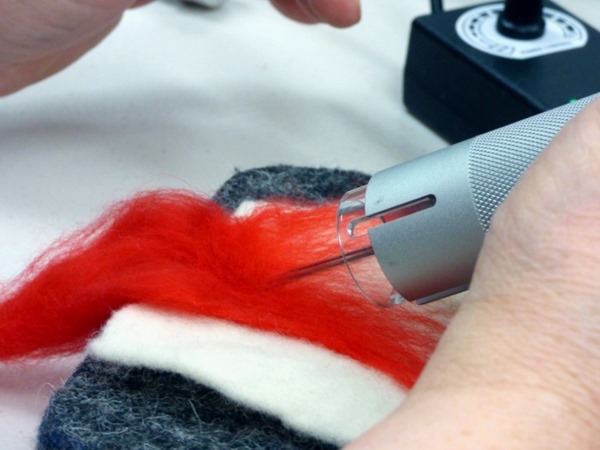
10) Ann reduced to two needles and tried the wool mat again. it was more effective.
11) We also tried a 3-D object, using 2 needles and without an armature.
This caught and entangled fibres into the felt successfully. As you can see, Ann was running it with the guard locked in the retracted position.
After checking the mats we had with us, we came to the conclusion that there may be too much resistance and maybe we needed something more like the clover brush pad to allow the machine to work to its best potential. Neither Ann nor I have one and they are so small a work surface. We needed to come up with an alternative. I found my red kitchen scrub brush and Ann went to a hardware store and found a bristle scrub brush and a driveway brush. So we now had 3 brushes of different stiffness, height of bristles and bristle density to try next.
12) 3 brushes to try
13) Princess Auto red scrub brush; tightly packed, stiff plastic bristles.
14) Whisk brush with handle from Home Hardware, longer and softer bristles that are tightly packed.
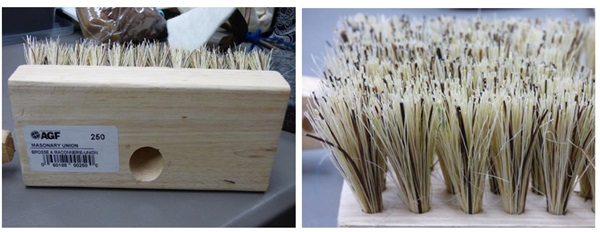
15) Driveway brush without its pole handle also from the hardware store; firm bristles more dispersed than the other two brushes.
16) Prefelt over the driveway brush
Using the driveway brush as you would a clover brush seemed to be the most effective of the options we have tried. The other two brushes were found to be too stiff (Red) and on the other, the bristles seemed too close (Black). The driveway brush created less resistance than even the pool noodle-type garden kneeling pad foam, which was better than the wool or hard foam with this machine.
I suspect that if changed to finer needles, with the barbs located closer to the tip we would again see an improvement in fibre engagement.
If this company makes a new version I would suggest it would be nice to have the guard able to lock at a couple of spots so you could set the depth the needles would penetrate. Secondly add “Extra Fine” needles to their options, with barb placement close to the tip. (a shallow working depth but maybe not as shallow as the crown needles)
The machine itself felt comfortable in the hand, it felt safe and solid to work with. The adjustable speed worked well and we remembered not to get too excited and overwork the machine, so no more than 10 minutes on. We probably were working more in the 5-minute run times, then letting it rest as we set up the next bit of wool to work on.
Next, we will look at the “orange Fly” electric needle felting machine from Ukraine. We can then compare the two.
Ann and I would be interested to hear if you have tried the metal electric needle-felting machine from China. How did you find it?
This is the link to the Chinese Needle felting Machine. The price has fluctuated quite a bit due to the strength of the Canadian dollar. https://www.aliexpress.com/item/1005004984061419.html?spm=a2g0o.detail.1000014.4.64382604aj7QsK&gps-id=pcDetailBottomMoreOtherSeller&scm=1007.40050.281175.0&scm_id=1007.40050.281175.0&scm-url=1007.40050.281175.0&pvid=c33f93e0-5aac-4884-bd34-54c5fe444a00&_t=gps-id:pcDetailBottomMoreOtherSeller,scm-url:1007.40050.281175.0,pvid:c33f93e0-5aac-4884-bd34-54c5fe444a00,tpp_buckets:668%232846%238114%231999&pdp_ext_f=%7B%22sku_id%22%3A%2212000031240835199%22%2C%22sceneId%22%3A%2230050%22%7D&pdp_npi=3%40dis%21CAD%21206.27%21206.27%21%21%21%21%21%402101d1b516779458756708517ed103%2112000031240835199%21rec%21CA%211912286868
For Christmas this year my granddaughter gave me a small bowl. Her mother says she saw it and was excited and adamant that I would love it. We have no idea why. She is right I do like it but maybe not for the reasons she thinks. I love it because it’s from her and because she is so sure I would. I do not think she knows what Lord of the Rings or Hobbits are.
I wanted to think of some way to use it that wasn’t just popping it in with the other bowls in the cupboard. I decided on a 3D scene to use as a pin cushion. And what else could I make for the scene but a hobbit house? I started with a dryer ball to save time filling it and some green/brown mixed roving to make the top and the hill.
I had to make a hill for the hobbit to live in. I made the hill with the same green brown wool. For the front of the house where the door will go, I used much more of the brown/burnt grass colour. Then at our last meeting as part of the felting machine test, which you will start to hear about in Jan’s next post, I used Jan’s needle felting machine to attach the front of the hobbit house to the hill
This is as far as I have made it. I need to make the door and attach it, then the hill is ready to attach to the wool base in the bowl. Now I have to decide if I am happy with the green “grass” I think it may need a little bit of brighter green.
I suppose I should go do some research online to see the colours that are used. So far I was just going with the picture on the bowl. It’s a slow project but it is coming along. Slow and steady wins the race….right?
If you missed my other posts about this mixed media handmade book you can find post #1 here, post #2 and post #3. It’s a work in progress that I’m taking slowly, adding bits and pieces as I get inspired.
As I was getting ready for my upcoming Level 4 Art and Design class which will involve printmaking, I was going through my stamps and also some previously printed papers that I haven’t used. I thought they would make a good addition to the book. This is a print of an aspen branch with leaves and catkins. I added the black outline with a felt pen. The aspen branch is printed on the back of an eco print.
I found a print of a weeping birch which I added to this painted brown paper page.
While I was looking through my prints, I found a cutout of another aspen branch. I’m not sure what I made it for but thought it was perfect for this green painted page. I might add a few more details into the leaves with colored pencil. I’m not sure yet.
The back of the green painted paper above, was white. I added some ink in orange, green and brown around the edges so the white wouldn’t show around the print I planned to add there. This is the center of the book.
Here is is with the print I added. I also finally bought some gesso and added it to all the white pages. Now I can do some painting or sketching on those pages with more ease.
Here’s the last print I added. I have more prints, but for now, I think I have added enough. This book has a lot of pages and I have a long way to go to get it completely filled. I think I will start sketching on the white pages next.
And for those of you who think I haven’t done any felting for a long time, here’s a felted lotus pod that I created for an online class I took with Gladys Paulus. The class was marvelous and if you get a chance, it’s well worth taking.
Also, registration is open for Helene Dooley’s Hanging Felted Spiral online class. Click on the link and scroll down to the bottom of the page to register. This is a great class to learn more about complex three dimensional felting. You need to be an intermediate felt maker who has worked with resists and three dimensional felting. The class is online and can be accessed throughout the class period at any time. You don’t need to be online at any certain time. So join Helene to create wonderful felted spirals!