I feel that you can never have too many cushion covers for cushions. They are such useful items of soft furnishings, and they can help brighten a room in no time.
My offering this month is a mixture of felt, thread and fabric waste, and free motion stitching to make a cushion cover. I wanted to give the impression of looking into a puddle with leaves floating on top.
This is the front and rear, before cushion cover making.
I used a variety of left over threads, pieces of felt, and fabric trimmings. I placed all of these on a piece of white fabric, and covered everything up with a piece of tulle. This was stitched down very securely, and it did begin to look as if it was a watery puddle.
I had some pieces of felt, left over from another project, and I cut some leaf shapes from this, and placed them over the stitched down tulle. I added some leaf veining as I arranged and stitched them down, in a fairly random placement on the surface.
I do think it turned out quite nicely. Then I had to choose some fabric to complete the cushion cover, in a colour to complement the orange leaves. I had found some purple fabric with a oil slick type pattern, in a charity shop last year, and as soon as I placed them side by side I knew it was a perfect match.
When I was in hospital, there was a good view of some trees from the window of my ward. This is a tree that I became fascinated with. I am still convinced that I can see Mr Mer sitting in the branches! Maybe it is just me!!
If you’re anything like me, you’ll find it very hard to stick to one hobby alone. After all, there are too many temptations out there, and each creative endeavour fuels the brain differently – it’s fun to discover new materials to play and interact with, and see what comes out of the experimentations.
I rediscovered the love of journaling last October, and have since then filled two notebooks of ramblings, ideas, memories and opinions. As I progressed in my writing however, I noticed I was also very attracted by the notion of doing something visually creative with paper and stationery.
Now, I must add a disclaimer here: I don’t think the pages I filled are special. They’re not particularly beautiful or unusual, and that’s definitely not a negative thing – I started doing collages simply for the joy of playing with images and colours, and these were the space for me to have some non-commercial, creative fun. It was my way of relaxing and letting go of expectations, of “what will others think of this,” of any idea that one’s creative endeavours must always be amazing. I just wanted to get messy with glue and glitter.
This is the cover of my A5 size notebook. It’s decorated with some leftover fabric (featuring cats, obviously) and the artwork from a tin of… Sardines? Cod? I might add more stuff to it as I go along, since I don’t consider any of the pages here “finished.”
This notebook came with different types of paper, so I play with it depending on the “canvas” I want. As you can see, the middle pages have been used the most, and apparently I’ve not much love for plain white paper.
I tend to go by colour and texture, more than whether the things make sense together. My brain seems to enjoy adding stuff to paper until it looks filled enough and has things to make the eye wander.
Fabric scraps and teabags are game. See the eye on the lower left corner? I stole that from my husband’s studio, he’d removed it from one of his paintings – does this count as artistic appropriation?
If you can’t read the weird Balzac quote above, it is as follows: “No man should marry until he has studied anatomy and dissected at least one woman.” What a weird fellow he was (and I hope no one followed his advice!)
I say this again proudly: none of these collages are groundbreaking or particularly good. What they are, is FUN. I loved making them with no end game in mind, no agenda and, until I decided to share them here, I was perfectly convinced none would ever see the light of day. It’s very liberating to create with full freedom from our inner critic and, if you’ve never tried, I urge you to give it a go. It might even fuel your creativity for the more “serious” stuff you make.
How many hobbies do you have? Are they all fibre- or textile-related? Let me know what’s tickling your crafty mojo lately in the comments section.
This will be a “short post” since we have had a third machine to add to our investigation (which I hope will continue on next Monday). Ann has received a package from Georgia, hopefully containing the Solar Bee she ordered. It is vary similar to the design of handle and motor placement of the Orange fly but instead of a single needle it can have up to 4 needles. We will let you know what we find out about it soon.
The continuing investigation into the first 2 electric felting machines (China and Ukraine)
A quick look at trying detail work on pre-felt:
I tried fine detail work on pre-felt with merino, first with the Orange Fly (Ukraine). I did not have trouble working along the edge of main branches but found that it felted much faster than I am use to. the increased speed of felting is especially noticeable when we tried felting the tiny branches. Although it worked well, I did not feel as confident in my control of wool moving, I suspect I just need more practice.
1- dry felting on dry pre-felt.
Next I wanted to try a piece of pre-felt that had been wet felted by Ann. This was one of her tree prototypes that she did not use as her finished tree.
2-3 pre-felt with one of Ann’s wet felting tree tries.
4-6 I wanted to try adding little cardinals (red birds) to the tree.
I found that the machine grabbed the fiber and pushed it with enthusiasm into the pre-felt. A bit more than I had expected. Again I think more practice would improve the bird-ish-ness of my red blobs!
7 the back of the pre-felt showing the red fibers pushed to the back.
I also tried on the orange Fly on 2 more wet felted bases with good results and not as good results.
Our next test base was a felt Ann had made in two colours of brown.
It was about the thickness for a wet felted hat but could be a good surface for a picture.
The single needle of the orange fly did not have trouble embedding fiber into the felt.
8-11 working on solid wool felt.
I found that I felt more fiber movement when I angled the needle insertion. This would allow more barbs to engage fiber without having to imbed the needle into the wool felting mat. (Angling the needle reduces the depth of insertion while still allowing more barbs to grab and entangle fiber.)
Having only one needle should be slower when laying in a general background colour. But, it is still quite quick, and there was no stress on my wrists, fingers, elbow or shoulder. Ann and I should try a race between the felting machines vs. the 10 needle bar tool, which I find very fast for laying in backgrounds. But speed is not the only factor that the machines address.
We also considered the mettle machine from china. As you remember the mettle machine did not like most of the felting surfaces as much as the orange fly did. We used the fake clover brush (driveway asphalt painting bush from the hardware store) which is what seemed to be its favorite surface so far in our investigations.
12 Mettle machine felting into wet felted wool on the driveway brush
Wet felted (Fulled) knitting as a felting surface.
Ann had fulled a piece of knit sweater and brought a piece to try felting into. the orange fly did transfer the white fiber through the knitting successfully but it was a bit more resistant than the firm felt. (It is quite firmly fulled knitting.)
13-14 Orange Fly felting fulled wool knitting on a wool pad
Next I tried the mettle machine on the same surface. I noticed one of the screws loosening so stopped and tightened it. I suspect that you may want to check all the screws occasionally just so you do not lose one.
15-16 mettle machine felting into fulled sweater on wool mat, one of the tiny screws had started to loosen.
There is less resistance when using the driveway brush as a work pad but there was still the most resistance when we were felting on the fulled sweeter. Running with 2 needles was also less resistance than running the machine with 4.
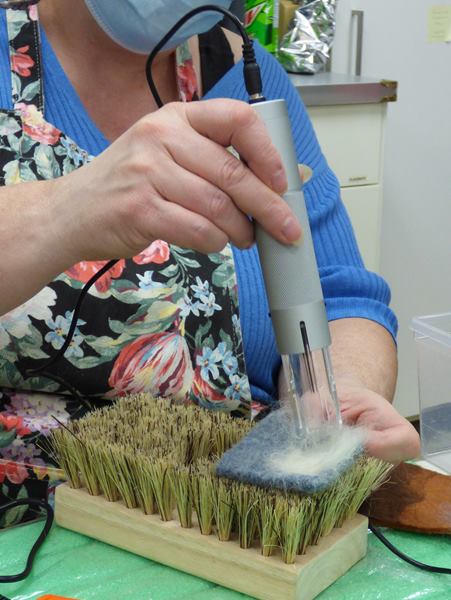
17-19 checking work angle and comfort holding mettle machine
I again tried holding the machine vertically and on an angle. Both were comfortable to hold and there was less vibration/resistance when using the brush with this machine.
I have been making a chart for the 3 machines so next we will investigate the machine from Georgia and fill in the rest of the chart. We will open the package and put it through its paces next Monday (which is a holiday) and hope to have some test results ready for the next blog post!
For working on wet felting the orange fly seems to be a bit more enthusiastic towards embedding fiber into the felt/fulled 2D picture ground . I will not give up on the mettle machine, I suspect we have not found its forte yet. I want to look further at 3-D sculpture. i am a bit concerned with the machines hitting armature wires (I may have to find some safety goggles before I try that!)
Until we can find out what’s in Ann’s mysterious package, Have fun and keep felting!
I had another wonderful day teaching some ladies to nuno felt scarves.
I was busy ( talking) and didn’t take as many pictures as I would have liked at the beginning. So no pictures of the starting silk. I dye the blanks myself using the scrunch method of low-immersion MX dying. I learned how to form Paula Burches All about hand dyeing site. It is an amazing site. Don’t go unless you have some time to explore, there is so much information. http://www.pburch.net/dyeing.shtml
If you click any of the pictures they should open up larger in a new tab.
Back to the class, here are the layouts just before we wet them down.
and then everyone got rubbing. This is the time it’s great to have a chatty group. It makes the work go faster. And I don’t have to do all the talking.
Sorry, no rolling pictures. The problem with a chatty group is I love to chat too and forget to take pictures.
But I do have some pictures of the finished scarves once all the fulling was done.
here’s a nice group shot from the end of the class.
One of the ladies went home and dried her scarf so she could wear it right away. Doesn’t Kim look great? The colours really suit her.
Denice also sent me a picture of hers when it was dry. I love the silk flowers.
It was a fun day for everyone.
I taught a short sheep class the other day. They were young people so just one picture of the finished sheep.
Calling all fibre lovers – knitters, weavers, stitchers, crocheters and felters – challenge yourself to make a table runner or mat.
Here are a few that we’ve made in the past 😊
This starry felt mat not only protects the hall table but it looks good too …
…and it looks just as pretty on the reverse!
Here’s a cobweb felt (merino wool and silk top) table runner that we nicknamed ‘Miss Havisham’ …
… and a 3D felt decorative table runner ‘Spring Flowers in the Snow’.
This plant pot mat, in the style of Clarice Cliff, was made for a previous challenge.
In the first quarter challenge, it was suggested that you find a tree you like and depict it as it awakens in spring with buds/new leaves/blossom – it could be realistic or representational.
If you’d like to continue with the tree challenge, then please do so! Depict your tree in its next season.
Please post your entries in Studio Challenges here:
I have finally completed my winter birch landscape that I have been slowly working on. You can see the prior posts here if you missed them. I had about determined to skip adding any extra snow in the foreground but then I decided I should try a sample of needle felting the snow.
And, surprise, surprise, it worked better than I thought it would. So I added a bit of snow and then needed to figure out the distant red twig dogwood bushes. (You can see the snow in the final photo.)
First I tried using a marker on my sample to see if I could get away with something easy. The thinner marker made a very light line and the heavier marker was too heavy. Plus, using a marker on nuno felt gives a very uneven line. On to the next idea.
Next, I tried needling the wool thread into the sample background. It didn’t feel like there was much difference between the stitched bushes in the foreground compared to the needled line on the top left.
I decided I would try a cotton machine thread (30 weight). The stem stitched sample on the left shows two different colors. The redder color is straight off the spool but I wanted the thread to be a bit darker and variegated. So I colored the thread by hand with a black marker. The photo on the right shows the thread before it was darkened (left side) and the thread on the right side of the photo has been darkened with a black permanent marker. It worked perfectly although it’s a little messy on the fingers.
So here’s the finished landscape. I used the machine thread for the distant red twig dogwoods and you can see the small amounts of snow that I added. I’m happy with it but I will put it on the design wall to look at to make sure it’s finished. Then I will need to choose a “matte” fabric and get it ready for framing. I’m thinking of calling the piece “Winter Color”. Or I could stick with “Winter Birch”. Which do you prefer?
I’ve been practicing my spinning skills for a while now, and although I have mastered the technique of spinning finer yarn, I have a true passion for the more bulky, art yarns. I’m not a great knitter, I do occasionally enjoy crochet but I much prefer to weave. When I first took up spinning, like everyone I found that my yarn loosely resembled an ‘art yarn’ more than a fine yarn. It lacked a sense of purpose and it didn’t have that look of “yes, I intended to make this”! So my priority was to be able to spin an art yarn that looked like it was meant to be an art yarn! However, at the same time, having read so many comments about people who can only spin fine yarn or art yarn I didn’t want to reach a point where I was only able to spin one or the other. So I have tried really hard to chop and change my ideas, to try and avoid the pitfalls associated with spinning only one style of yarn. I’ve also tried really hard to make an art yarn that looks like it is meant to be an art yarn. I definitely think I am making some progress on this front. Let me know what you think…
I started with a selection of merino wool top in various colours, including an orange, cerise pink and teal as a base for my art yarn. I then decided to jazz it up with some beautiful turquoise bamboo, which I thought would add some sheen and lustre to the project. Like all good art yarns, I wanted to add in some interest so decided I would use curly locks of various different colours. Finally, to finish the interest side of things, I decided to include some recycled sari silk that was made up of different random colours.
To start off, I began to add the base merino to the carder. Unfortunately, I have broken one of the belts on my carding machine – it’s the one that operates the smaller of the two drums. But for this project, it didn’t really matter as I was not wanting a fully blended batt. So I was able to add all of my fibre direct to the larger drum. I did use my little packing brush to flatten it down as I went along.
You can see some of the recycled sari silk running through this photo.
In this photo, I’m adding sari silk again to the the mix. It was helpful that it seemed to work using it like a bangle, wrapped around my wrist enabling me to place it where I wanted it. If I hadn’t done it this way, it would have been hanging down and could easily have got caught up in the drum.
Once I’d finished carding a nice thickness of batt, it looked like this…
I was happy with the way in which it turned out as I wanted to keep the definition and not have a muddy blend at the end of it. But before I started making any more, I decided to spin it, just to check I was happy with the way in which the colours turned out.
These are some shots of the spun art yarn on the bobbin but only after I plyed it! Unfortunately, I got slightly carried away because I was enjoying myself so much, I forgot to take any photos! For the main art yarn, I spun this using a fine mohair yarn to core spin around. I made a mixture of thick slubs and thinner spun yarn, so that when I came to plying I could make some nice twirly spirals to add interest. When spinning the core yarn I also added in some random curly locks, which were all sorts of colours, that contrasted with the base colours I’d used in the batts. I also added some extra sari silk into the spin at random points through the yarn when I felt it needed a bit of Va Va Voom!
I was quite pleased with the spin…but as I said, unfortunately I didn’t take any photos of the yarn before I began plying. However, I did take a photo of one of the fat singles in teal. I also spun some in orange but no photo sorry.
A fat single in teal merino.
As you can see, there was quite a lot of twist in this as I was scared it would all fall apart when I was plying!
This was my first attempt at core spinning, so I was pleased to see it coming together as I intended. I started plying the art core spun yarn with the fat single, and it looked promising…
As you can see, I’m using an Ashford Jumbo Bobbin with my Ashford Traditional wheel.
I then transferred it to my niddy noddy. I didn’t want to soak the yarn in case I damaged the slubby spirals, so decided to set it using a hand held steamer. These are a few photos of the yarn on the niddy noddy.
I tried to take different angles to show the range of effects.
All in all, I made two batts of art fibre, which were about 100g each that I used for the core spin. I didn’t weigh the fat singles but by the end, I had four skeins of art yarn, weighing approximately 300g.
Looking at three of the skeins hanging up together, it looks quite ‘jewel’ like. So pretty, I’m pleased with the colours…
These skeins look almost ‘jewel like’
I wanted to use my yarn to make a woven scarf. However, I’m not confident enough in my home spun yarn yet to risk using it as a warp. This was especially true as I was hoping to use this project for the blog. I was mindful that the art yarn was going to be quite chunky. I only had a 7.5 30/10 dent reed for my rigid heddle loom, which would have been much too small for the art yarn. This was another reason I had to choose a different yarn for the warp. Having used mohair in the core spinning, I toyed with the idea of using it as a warp. However, I had read that mohair is very ‘sticky’ when used in weaving, so I did some research first before trying it. I did find some advice that said you can use it, if you utilise a pick-up stick behind the heddle to help clear the shed. The only way to know if it would work was to try it! So, having looked at my reed, I decided that given the thickness of the art yarn I would only use every third reed. That way, I envisaged that I would be able to space the warp out evenly when I when I separated each strand. Also, it would allow more space for the art yarn to show in all its glory.
This is the warp before I started weaving. As you can see, I decided to use three different colours of mohair, just to see what the effect would be…
This photo show how fluffy that mohair really is!
I started to weave with the art yarn, and to my surprise it was far easier to weave with than I had anticipated. The ‘stickyness’ of the mohair really didn’t present any issues for me. I think that because I had only warped every third reed, it didn’t have the impact it could have had, which was good.
I only took these two photos of the actual weaving process. One thing that I discovered when doing this project, was that I don’t actually have the weaving loom that I thought I did. When I first got this loom, as I always intended weaving with art yarn so I also purchased a freedom roller. I didn’t want to have the restriction in length of weave that I would face when using really chunky art yarns. Having never used the freedom roller before, I decided I would fit it onto the loom for this project as I really didn’t know how bulky the final weave was going to be.
However, when I got the freedom roller out and started looking at how it would fit on the loom, I soon realised that there was no way it was going to work! I struggled to understand why, so I took some photographs of the freedom roller and my loom, and sought some advice on a Facebook weaving group. It was only then, I discovered that my rigid heddle loom was in fact a samplet loom!!! I realised that what I thought I had ordered, was not in fact the loom I did order! School boy error on my part, as a complete novice!
In the end, all was good as it turned out, I didn’t need the freedom roller after all (she breathes a sigh of relief!). When the project was finished, I removed it from the loom, and considered what to do with the ends. The mohair was very thin and sparse, so would not make for a good fringe. Having twirled the mohair into little tassels, I then decided to tie some additional curly locks to pad out the effect.
Here, you can see one end completed…
When I tried on the scarf, I realised that I had made it a little too wide to make it into a comfortable scarf. So it was at this point, I decided that rather than using it as a scarf, it would work better as a stole. However, this now presented me with another need…
If I was going to use this as a stole, it would need to have some sort of decorative pin to hold it in place. I didn’t want to have anything too colourful or fussy, as that would be lost in amongst the art yarn. So I decided to make a wet felted butterfly, with wings that were primarily one colour, with some accents of a different shade.
Here is my blue butterfly…who does have an orange body, just to make the body stand out a little…. The wings and body are made from merino and the accents of paler blue, are made of the bamboo, which I fixed with wisps of the merino to felt them into place. I decided to leave the resist inside, just to provide a little more firmness to him.
I did try to add some sequins as way of creating more sparkle, but as they were so small, I found them difficult to sew on (my fingers are not so nimble as they used to be!). I tried gluing them in place, but that didn’t work either! So in the end, I just left him as he was. I do intend making him some antennae, but I haven’t had time to add those in yet. He is attached to a large kilt pin, so he can be used to hold the stole in place.
I’m really happy with my first project, using my own spun yarn, hand woven, and completed with wet felted butterfly pin. I’ve used three different skills in this project, and I’m really pleased with the end result. I was surprised at how dense the weave turned out. Having only used every third reed, I expected it to be much looser than it ended up. Perhaps next time, I will try an even wider warp, using the whole loom and leaving a larger gap between the warp threads. It’s all a learning curve, but for now, I am really pleased with the results. It’s lovely and warm too! I’m almost sad summer is on the way, but I’m sure I’ll get lots of use out of it next winter,
One of the things I’ve noticed from being at felting workshops is how predictable we tend to be when it comes to choosing our colour schemes. Whether we’re making a wearable, a bag, a vessel, etc whatever it is the majority of us will reflect that colour back in what we are wearing or the accessories we carry on that day. Before a class begins we can mostly tell at a glance who will be working with reds, who with greens, who with neutrals, etc, etc.
Personally I’ve always been drawn to neutrals, working with fibres in various shades of grey and beige with a small amount of accent colour, usually yellow or green. Unsurprising then that my wardrobe also tends to be filled with neutral colours. So what happened when the Waltham Windmill group launched their latest theme “Making Waves”? I could have followed the theme while sticking with my neutral pallet but for some reason I found myself wanting to work with blues, and not just as an accent but as the main colour. What I hadn’t realised until this last week is that blue hasn’t just found it’s way in to my studio but, without making the connection, it’s also started appearing in my wardrobe and I really hadn’t seen that coming!
The shades of blue Making Waves vessel
Within the groups theme we have free reign to make whatever we want plus we’ve agreed a number of specific items we will each make, one of them is a jelly fish. Having done a bit of research into the many and varied species of jelly fish I came across the spotted Blue Jellyfish which is native to UK waters. My first thought was to create a “wet look” using Merino fibre covered with lots of viscose which would create a sheen and then I would free motion stitch the spots. That was quickly replaced with the idea of making my fish from sheer fabrics…..I seem to have accumulated lots of sheers and only ever use tiny amounts so this would be a perfect opportunity to use up some of my stash. After rummaging through a huge sack of fabrics, almost losing hope of ever finding the colour I needed, I came across a small piece of blue and another of turquoise, just enough to do the job…..so much for stash busting!!
The remnants of fabric, and the size of my embroidery hoop, determined the size of my jelly fish. I’d got some of the wash away stabiliser left over from a project I did a few years ago so that would be useful for stiffening and shaping the jelly fish.
I had enough blue fabric to cut out two circles plus one slightly larger from the turquoise. I also added a small white circle of fabric underneath thinking it would highlight the spotty area. Next I cut up some scraps of felt for the spots and arranged them on the blue discs before covering with the turquoise sheer. This sandwich was then put in the hoop and I machine stitched around the spots…..or at least that was my intention! Unfortunately I struggled to see where some of the felt was so it’s a bit hit and miss but it was near enough!
After removing it from the hoop I washed out some of the stabiliser retaining a good bit of the glue on the fabric to enable me to shape it over a plastic bowl. I didn’t think to photograph the drying stage so the next image shows it dry with the unattached tentacles cut from tulle and sheers.
The final step was to wet felt a blue “inner”, with additional thin felt tentacles, sew the fabric tentacles inside it and insert into its casing.
The finished spotted blue jelly fish.
I’m quite pleased with the finished result and this particular area of the exhibition should be interesting as we’ve used lots of different styles and techniques between us.
Another piece I’ve made for the theme is a felted sculpture inspired by a spiked shell, I’ve simplified the shell shape, lengthened the spikes and it’s currently hanging on my wall but it doesn’t feel finished. I think it maybe needs more colour variation and possibly a few embroidered barnacles…..what do you think?
Spiked shell inspired sculpture
Speaking of which, I’ve always had a fascination for Barnacles and can’t resist collecting them when I find them on stones and shells. These marine crustaceans are related to the crab and lobster and tend to live in shallow and tidal waters, typically in erosive settings.
There are around 1,000 different species and, as adults, typical barnacles are covered with calcareous plates and are cemented, head down, to rocks, shells, pilings, ships’ hulls, driftwood, or seaweed, or to the bodies of larger sea creatures, from clams to whales.
They feed by reaching into the water column with eight pairs of thoracic limbs called cirri which are long and feathery. The cirri extend to filter food, such as plankton, from the water and move it towards the mouth as you can see in this video. (Follow the link and scroll down to Ecology)
Barnacles on rusty metal
I’ve always liked this photo of barnacles on a rusty piece of metal which was taken on a visit to Ullapool harbour so I’m experimenting with different fabrics, including cotton and Tyvek, to make a barnacle inspired wall hanging. So far I’m leaning towards the Tyvek fabric.
Cotton fabric barnaclesTyvek fabric barnacles
Something else I think will lend itself to the theme is dendritic printing. I love the vein like patterns, very reminiscent of coral, which can be created by pressing acrylic paint between two sheets of glass or plastic and then printing with it. I’ve been trying this out on different surfaces including paper, Lutradur, chiffon and cotton.
The most surprising result was a the print on felt, I was amazed at the clarity of it and I can see this being developed further with added stitching.
Working on ideas for felted sea anemones
There are so many possibilities within this theme that my mind is working overtime and I’ve a few other projects on the go right now. One of them is this small 20cm dia embroidery being worked on an eco print cotton fabric……note the lack of blue!
Another is a 95cm x 54cm background I made a couple of days ago throwing everything I had to hand in to the mix! There’s Bergschaf, Merino, Viscose, Silk, chiffon, synthetic net, slubs, knitting yarn, etc. I see this being an ongoing project for quite a while….something I can build on, picking up and putting down over time, adding stitch and texture until it feels finished.
At our next meeting, this coming Friday, several of us will be creating wet felted fish which we are all excited about. I will show you how those turned out and give an update on the other projects in my next post. Now………where did I put my blue cardigan?
Lately I always seem to have several stitching projects going on at the same time and I have found it helpful to use one basket per project to store my threads, etc. in. I have a friend that makes lovely pine needle baskets and I have mainly been using them. But lately I seem to have more projects going at one time and found that I didn’t have enough baskets for all of them! I found myself going around my house emptying the contents of other baskets so I could use them for my projects. (This of course, led to another issue about where to put all the stuff I was taking out of those baskets!) I guess that tells you how crazy things are at my house!
When I was at a retreat in February, one of my friends was making fabric covered rope baskets for her projects. She also likes to have all her project’s supplies in one spot, and she likes to be able to easily move them from place to place as well as have the option of stacking them. My thoughts kept going back to her baskets as I kept running out of storage for my things.
Over 20 years ago I took a class at my local quilt shop and made a fabric covered rope basket. It’s been sitting in my closet all these years waiting for me to attach the handle. It’s kind of big and funky but I love the colors. I think I planned on using it for my knitting projects. I could still do that, but I decided to use it right now to store my wool socks in. I don’t need the handle attached although I guess I could still do that. (Maybe in another 20 years??) I am also kicking around the idea of deconstructing it and making 2 or maybe 3 more usable size baskets out of it.
This one is 9” tall and around 12” in diameter. I think I was having too much fun sewing it together and didn’t know when to quit!
These are still all my favorite colors!
The way the rope was covered in that class 20 years ago was not how I wanted to make a new one. Back then, we wrapped folded fabric around the rope and straight stitched it to the rope which was a nice feature as there were no raw edges visible. Today that seems like a lot of prep work that I really don’t want to do. My friend was just wrapping approximately 1” strips of fabric around the rope and zigzagging the covered rope pieces to each other. Much faster process. I’m all for getting things done faster! These baskets are a great way to use up fabric scraps or fabrics you wondered why you bought them in the first place.
I followed the tutorial from my friend’s website Create Whimsy and tweaked it to my needs.
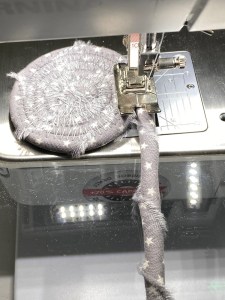
I had a jelly roll of 2 1/2” fabric strips sitting around that I was never going to use for a quilt. I tore them in half and started wrapping my 20 year old leftover rope and zig zagging them together.
I wanted the bottom of the basket to be at least 6” wide and the sides to be around 2” high. I wasn’t sure how much rope I would need to make the size I wanted. (I ended up having enough rope left to make a smaller basket if I want to.)
I was happy with my first basket even though I wasn’t crazy about the fabric used for it to begin with. Those big white blobs are the selvedges. I decided I didn’t like how they appeared, so I started cutting them off as I introduced new strips. I like how the stars on the fabric appear as bits of white. Overall, I’m quite happy with how this turned out! It will be very usable and will definitely not be sitting in my closet for the next 20 years!
I also had some fabric covered rope left over from my 20 year old basket project so I thought I’d see if I could make a basket out of it.
It was interesting to see how different the two methods of covering the rope were when zigzagged together. I think I like the newer method of just wrapping the fabric around the rope and not caring about the raw edges or the joins. It’s kind of fiddly but looks just fine to me after stitching. The “prewrapped” rope had lots of puckers to it, the wrap as you go method coiled together with a snugger fit.
Here is the finished second basket. It definitely had a looser feel to it although it is still sturdy enough for a project basket.
Here’s a peak at my little menagerie of baskets, including my two newly made ones.
It was fun to make them, and they sewed up rather quickly. If you try one, I’ll forewarn you that you’ll go through quite a bit of bobbin thread. And they are kind of addicting to make.
I also found two felted bowls in my closet that I had made years ago. (Wonder what else is in that closet that I could put to use today?) They were knitted to begin with, and they were my one and only foray into felting. This one was under consideration for becoming a project basket, but it’s too flimsy. I am now using it for my thread bits. Perfect use for it!
I’m enchanted by lichen. Also, by moss, fungi and forest floor wonders, although to a slightly lesser degree. Sit quietly next to a tree, some old wood, weather-worn stone or metal and look….really look……..you can easily be transported into a micro magical world of different shapes, texture and growth patterns, not to mention the incredible subtlety of colours.
Close up of moss & lichen on wooden garden bench
Just as we have omnivores, vegetarians and vegans etc, curly hair, straight hair or….no hair 😉, in the lichen world there are 3 main types – foliose, fruticose and crustose. The last two are almost self-explanatory – fruticose, bearing fruiting bodies whilst crustose is….well, crusty! This is an extreme simplification….so any lichenologists reading this (yes, I learnt there are such specialists, along with funginerds or funginuts), please – don’t shout at your screen!
Common orange lichen, Xanthoria parietina
Why do I love them?
Lichens are our pioneers. Generally, they are the first to settle anywhere, growing in so many different substrates and habitats including in some of our planet’s most extreme conditions (artic tundra, mountains, hot deserts, after fire destruction, even toxic environments) some even grow inside solid rock (!!!) and they cover about 7% of our planet’s surface.
Six lichen photos by Richard Droker
Lichens are symbiotic so if they live on a plant, they only use it as a base rather than stealing nutrients. They can be used for food, dyes, and medicine and, due to their long life-span and slow regular growth (the world’s oldest living organism, Rhizocarpon geographicum, ‘map lichen’ is thought to be 8,600 years old) some lichen species are used as a means of telling the age of rocks. The oldest lichen fossil dates from about 400 million years ago. Generally, growth is extremely slow, with most crustose lichen growing only 1-2mm in diameter per year! There are about 20,000 known species and can be regarded as self-contained miniature eco-systems that often thrive in communities.
Wow – as humans we should be learning so very much.
Colours, depending on special pigments, can vary from reds, oranges, yellows and browns or bright green to olive grey and black. Then there is another whole overlay of colour depending on whether the lichen is wet or dry.
Four Lichen photos by Richard Droker
I’ve been fascinated for years with the amazing beauty of lichens and thought I’d finally do something about it.
So, I’m currently working on a personal project – translating what I see, and perhaps feel, into mixed media/textile creations. There are so many extremely talented artists, worldwide, who are recreating realistic representations particularly in textiles (Amanda Cobett is one such artist), that I’d fail miserably if I went down that route.
My sketches of interesting patterns from lichen etc
My goal is to ‘see’ either from life or research online photos (Richard Droker, above, is just one of the many amazing photographers worldwide) and interpret my findings using what I have to hand around me. At this point I need to add, that I’m a firm believer in the Spirit of Mottainai – the idea of respecting resources and not wasting them.
View down one side only of a wool shop in Germany, with shelves stacked full of so many wonderful yarns
Yes, I will buy new supplies (I’m always being seduced by luscious yarns – who isn’t! – as evidenced by a recent trip to Germany), but I also want to repurpose and re-use where possible. I simply couldn’t throw out an extremely, seriously (you get the message!), wear-challenged sofa cover….it offered far too much potential. We won’t talk about where it will be stored!!!
Worn, thready, fabric stiched onto a contrast fabric snippet
I want simply to evoke the magical landscapes I see. Mmmm….’evoking’,’ Mottainai’, ‘re-purposing’….I didn’t set out to write a mission statement….😜
An interplay of fabric pieces, including a very thready worn-out sofa cover & paper, all heavily hand stitchedLichen, dry, on various gathered fallen twigsTwig with common orange lichen or yellow scaleClose up of 2 different tree lichens, dryHeavily branched lichen on a wooden garden bench
My poor EPH (Ever patient husband) dare not throw anything out. I often see a clutter of spent, used items (garbage in other words), on the kitchen work surface….
’What the devil?’
’I didn’t know if you needed them?’
Guaranteed the one item he does throw away was the very item I particularly wanted! Oh yes, my hairdresser, shop keeper and even our car mechanic haven’t escaped unscathed!
Bags & bags of experiments, all stored in boxes.
My experiments involve sewing both by machine and hand, crocheting (I dislike knitting intensely), ironing, printing, playing with liquids for chromatography, burning (many methods & always next to the sink – I value my house too much!), bending metal, soldering….in other words – I’ve been wracking my brain for every technique I’ve ever used….over very many decades!
I’ve also, mischievously (there’s always one!), taken the opportunity during our local textile group’s workshops to further my exploits.
Two cut lino designs, one of lichen the other of tree barkThree colour-blended prints from the bark designOthers thought the bark design looked like a landscape with the sun More prints. Two are very feint but will be useful at some point.
Some experiments fall in line with Thomas A Edison’s theory – “I have not failed. I’ve just found 10,000 ways that won’t work”.
Wool & carded wool tops needle felted together – not a good result
Having studied a great many lichens online, I tend to see something destined for the bin & then think ‘ah ha – that reminds me of….’
So herewith a few other experiments to date….
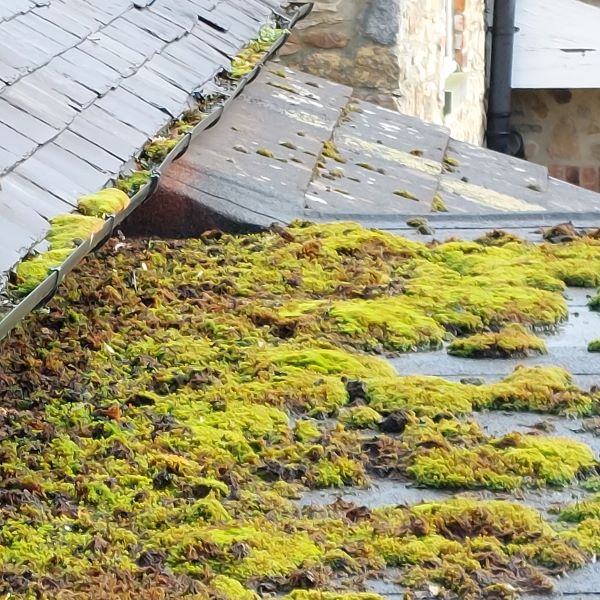
Photos by Richard Droker of Peltigera lichenFruit protection cardboard trays cut and manipulatedWet waste paper pulp poured & dried over a branched twigDifferent structures of lichen, dry, from curly broad leaf to fine wire. Aall branched and bushyA collection of lichen inspired paper experimentsSuphur yellow crustose lichen on a metal garden chairSplotches, that have merged, of creamy white edged grey crustose lichenOverlaid coffee stains on packaging paperCoffee stained paper with silver flecks ironed off wrapping paperCromatography and burned edgesCromatography paper pieces some marked up with pen & inkCrustose lichens on a tree trunk looks like a map of countriesFlat scrunched plastic bags filled with various bitsFine yellow almost powdery lichen with mini droplets of bright orange jelly spot fungusPlastic milk bottles cut to produce various shaped pieces3D plastic milk bottle pieces wrapped with yarnFlat irregular shaped donut pieces from plastic milk bottles wrapped with yarnIntergrated hummocks of wet moss on a roofVariety of random shaped hummocks of yarn
I also need to explain at this point that whilst I do have patience, I like the creation of individual elements to be the most effective and speediest….for me!!!! This involves challenging myself to find an easier method to achieve the same result – ie trying to create 3D mounds to represent moss, I tried several old techniques including velvet stitch and Victorian tufting, but my patience was not of the centennial variety. So, I thought long and hard and devised a method using the sewing machine and hand stitching. EPH reckons I only need a few more to make our new carpet!
Miniture hummocks of green moss growing on a brick pathA collection of gentle rounded hummocks of yarnA tree stump covered in moss, showing its growth structurePlastic packaging manipulated to emulate the structure of moss
The challenge also includes remembering to keep detailed notes 😉
Notes & samples of experiments
All I need now is ‘time’ to put my experiments to good use….it is on my wish list!
I hope the next time you look at any lichen you will delve below the surface. Let us know of your findings.




 1- dry felting on dry pre-felt.
 2-3 pre-felt with one of Ann’s wet felting tree tries.

 4-6 I wanted to try adding little cardinals (red birds) to the tree.
 7 the back of the pre-felt showing the red fibers pushed to the back.


 8-11 working on solid wool felt.
 12 Mettle machine felting into wet felted wool on the driveway brush
 13-14 Orange Fly felting fulled wool knitting on a wool pad
 15-16 mettle machine felting into fulled sweater on wool mat, one of the tiny screws had started to loosen.

 17-19 checking work angle and comfort holding mettle machine
 20 the mysterious package arrives at Ann’s


 I tried to take different angles to show the range of effects.

 This photo show how fluffy that mohair really is!

 When I tried on the scarf, I realised that I had made it a little too wide to make it into a comfortable scarf. So it was at this point, I decided that rather than using it as a scarf, it would work better as a stole. However, this now presented me with another need…
 I did try to add some sequins as way of creating more sparkle, but as they were so small, I found them difficult to sew on (my fingers are not so nimble as they used to be!). I tried gluing them in place, but that didn’t work either! So in the end, I just left him as he was. I do intend making him some antennae, but I haven’t had time to add those in yet. He is attached to a large kilt pin, so he can be used to hold the stole in place.