Browsed by
Category: felt art

Next is a Spring Tree.

Next is a Spring Tree.

I have been thinking about my spring tree for the 2nd quarter challenge. I have decided I will not try to make my tree a real tree but an imagined one. That will give me more scope to play. I did some thinking and the best way to show flowers will be to do a close-up of a branch.  I did some sketching on my pad for that. I am not a very good drawer but I think it’s not a bad branch.

sketch ideas for a tree and branch  sketch of a tree branch

I’ve decided I want some long, hanging flowers.

sketch of a tree branch

Next, it was off to the internet to look at long, hanging flowers. I think I know how I want to do them.


Then I had to have a good rummage to find the felt I used last time. How do things become lost so quickly? Well, I know really, I don’t put things away. 🙂 I did find it, and some felt I had forgotten about. I will try not to lose it again. It is just a white rectangle at the moment. I am trying to decide if I leave it that way or if I felt it light blue for the sky. I am not sure.

white felt for making a picture

That’s as far as I am at the moment. We are working on clearing things that don’t belong out of my studio. I need to rearrange in the house, to get another piece out. Another job for the list.


First Quarter Tree Challenge well on its way.

First Quarter Tree Challenge well on its way.

After doing my tree experiments( here if you missed it Tree Experiment ) and being happy with the results I am moving on to doing the first quarter challenge. If you haven’t seen the challenge it is here: https://feltingandfiberstudio.com/2023/01/01/2023-first-quarter-challenges/

I picked a piece or felt I had and added the sky and snow backgrounds. I used 3 shades of natural white wool for the snow so that it wasn’t so flat. I used Merino, Corriedale and something strong and shiny. the shiny wool may have been BFL or even Mohair.


Then I started working on the tree. I worked on a separate surface so as not to disturb the background too much as it is only lightly needle felted. I decided to work in two layers for the tree so this is the darker back layer. I started by just fluffing it up and then using a knitting needle to move fibres around to get a better tree shape. then gave it a dry felting ( just flattening and wiggling it a bit so the fibres stick together) to move it onto the background.

I picked a redder brown for the second layer. I forgot to take a picture of it when it was separate. I must have been in the felting zone. I put the tree slightly off-center. I tried it in the middle and I didn’t like it.

Here’s a close-up so you can see the 2 layers


I poked the tree all over to tack it in place and started fiddling with the roots, so it won’t fall over in the wind.

and some more  snow

And that was as far as I am right now.  I will probably fiddle with it more before wet felting it and then fiddling more, of course. I am thinking of adding a shadow but not sure how to tackle it. I am not sure where the sun is.  I may have to go out to the field and look at shadows.

Have you started your tree challenge or maybe you’re going with making something useful or both?

We would all like to see photos of challenge pieces and if you are unable to upload photos directly onto The Felting and Fiber Forum ‘studio challenges’ thread, then please use the link below.

https://feltingandfiberstudio.com/community-photo-submissions/

Winter Birch Update

Winter Birch Update

I have been working on my winter birch landscape. Here are the posts for part 1 and part 2 if you missed them.

I finished appliqueing the birch trunks and adding the machine stitched branches. I’m happy with the trees, now on to foreground snow.

Most of the comments on my last post thought it would be a good idea to add some snow in the foreground. I found a piece of white prefelt which I tore apart and auditioned in the left photo. The middle photo is with wool locks and the right photo is with wool slubs and nepps. I’m not happy with any of them. The one I like the best is on the left but I don’t have a good way to adhere the wool. I could needle felt it in but I really don’t like to needle felt into the silk of the nuno felt. I am thinking the foreground snow is not happening.

Small red twig dogwood bush handstitched on nuno felt for a sample. Sampling different weights and colors of thread for the branches of the bush.

Another suggestion was to add red twig dogwood bushes. That seemed like a good idea to add in a contrasting color. I made a sample here on another piece of the nuno felt background. I used wool thread in dark orange, red and darker red. I first tried two threads, mixing the colors. The branches felt too fat. So I switched to one thread and decided to use the red and dark red threads. I hand stitched the bush using stem stitch.

Next came stitching it on the piece. I do like the addition of the red. Now I am letting it rest for a bit to decide if I want to add the red in one other area of the landscape. I think it might look more balanced if I had a few bushes further in the background. What do you think?


A Turnstone Picture: Step by Step

A Turnstone Picture: Step by Step

I’ve recently finished a felted picture – mostly wet felted but with needle felted elements.  ‘How long did it take to make that?’ I’m often asked when people see my work.  I find it difficult to answer precisely. ‘Quite a long time’ isn’t very helpful so I usually say something like ‘About four days’.  I don’t really know if that’s true. It’s my best guess. As the felt-makers among you will know, most people have no idea how much work can go into making felt, so as I was making my latest picture I thought I’d try to document the stages and see how long it all takes. That’s what I’m going to show you here, plus take you on a little visit to the town where I work.

I’ve already decided to make a picture of a turnstone feeding at the water’s edge so I set about making prefelt sheets for the pebbles.  I live on the North Kent coast and love watching the local water birds: how they look, move and interact with their environment. It’s mostly pebble beach on the stretch of coast nearest to my home so pebbles are a good place to start.

First a piece of natural grey merino prefelt. Then a piece of mixed browns

It takes a surprisingly long time to cut all the pebble shapes

Here’s the grey cut up and an offcut of nuno prefelt which I’m gong to add into the mix.

And finally a sort of orange / yellow piece. 

I use prefelts as they give the pebbles more definition than if I just add blobs of wool. I’d guess all of the above is about a day’s work.

Now I can start the layout. This is going to be quite a big picture so will take up pretty all the space on my standing work desk. Here’s the first layer – natural white merino.

The second layer starts off with pewter for the water. While I’m working on the water section I add some dark blue low lights.

After I complete the second layer with more natural white merino, I lay out different coloured wool on top of the pewter and dark blue. I’ve previously carded pewter wool with a variety of light blues and greens using large hand carders.  I haven’t even thought about adding that time to my calculations.  I use this for the top layer of the water, mostly covering the dark blue which I want to add depth without being too prominent.

Here you can see that I’ve also added all the cut up pebble shapes to the bottom of the picture, plus some scraps of silk cut from old scarves, leaving a white section where I will add the wave.

For the wave I’ve chosen mohair because it has a slight shine and I hope it will be wiggly when felted. Along with the mohair I add lots of silk hankies and wool locks: I’m trying to get lots of texture into this section.

There’s also a piece of sort of knitted yarn that I picked up in a charity shop a while age.  It’s meant to be knitted into a scarf (according to the label) but I lay a line of it under the wave, hoping it will look like the foam from a previous wave. I also pop some offcuts into the wave for more texture. I finish by adding a few locks to the water to look like small cresting waves and I’m at the end of day 2.

A couple of days later I start the wetting down.  Because it’s large, I decide to work in three sections, starting with the pebbles. I like to use voile netting over and under the wool – which you can see in this photo.

I spend a couple of hours prefelting the picture, working both sides.  Here’s the back. I can see the pebble outlines pushing through the white so can be confident the layers are starting to felt together.  At this point I decide to take a break and go for a wander outside.

I work in a small rented studio in the historic town of Faversham, about 8 miles from where I live, in Whitstable.  The studio is in a former industrial building (originally a late-Victorian brewery bottling plant) which is now a lovely not-for-profit gallery, café and shop called Creek Creative Studios. It also includes 32 small studios filled with a good variety of busy individuals including painters, jewellers, potters and glass workers on the ground and lower ground floors; writers, illustrators, stringed instrument specialists, web designers and other small businesses on the upper floor.

Faversham is a gorgeous medieval market town so wandering about at lunchtime (and of course checking out the charity shops) is one of my favourite pastimes.  It’s a lovely sunny day so I thought I’d share a few photos with you.

Top left is the historic market place with its stilted guildhall. Top right is the Shepherd Neame shop: there’s a long history of brewing here and Shepherd Neame is Britain’s oldest brewery. Some days it does mean the town is rather ‘aromatic’. Second right is the lovely Yarn Dispensary. Originally an apothecary, the building dates back to 1240 and has a beautiful, separately listed wooden apothecary interior. It also sells a delicious selection of yarns. Bottom left is an old pub; next is the old water pump in the marketplace and a couple of the other buildings that surround the market place. There’s still a market here 3 days a week plus regular monthly ‘best of Faversham’ and antiques markets at the weekends.

Back at the studio I spend the rest of the day rubbing and rolling the felt until it’s fairly firm.  Because it’s a picture and going behind glass it won’t endure much wear and tear but I still like to ensure it’s properly fulled.  End of day 3.

I leave the background to dry and return to it about 6 days later, as I start to think about the turnstone or turnstones.  Working from my own photos, I roughly sketch a couple of birds and cut them out so I can see how they might look.

Although I like the 2 birds they are a bit small (the waves round here aren’t that big) so I decide to go for one pecking bird but bigger than the sketched one.  First step is to make some prefelt for the feathers.

Here it is as I’m starting to wet it down (left) and as a light prefelt (right – apologies for the poor quality of the second photo)

I cut up the feather prefelt and lay out a general bird shape.  At this stage I am leaving the head large and a bit vague.  I’ve learned that it’s better to make it too big and cut it to size later rather than trying to get the exact size and shape and risk having to add more wool or felt.

Here’s the bird felted and with a lightly trimmed head.  Sorry it’s not a great photo as it’s electric light and I’m casting a shadow but I hope you can see it well enough to get the overall idea.

From layout decisions to the felted bird has taken most of day 4.

The next stage is to needle felt the bird into the background and needle in the eye and legs as well as refining the beak. For the legs I used some of the orange-ish prefelt I made for pebbles, adding strands of wool on top.

Using a broken needle I pick at the wave to raise some of the texture from the silk hankies and wool locks.  I’m not sure whether it’s visible in this photo but it does make a difference in the actual picture.

I didn’t take progress shots of the needle felting but I’d say it took a good half day.  It’s difficult to know when to stop fiddling around with it and declare it finished.

So, here is the final picture before framing.

And a shot in its frame. 

Frame size is 63 x 86 cm (approximately 25 x 34 inches)

I used an adhesive hook tape – like the hook side of Velcro – which I stick to the mount board. The hooks hold the felt in place without impacting the fabric.

So, it looks like my 4 day estimate was a bit low.  Next time someone asks how long it took me to make this picture I could say ‘About 4 ½ days, oh, plus the carding, the nuno prefelt and the framing….’ .  Maybe I’ll just settle for ‘About 5 days’.

Do you try to work out how long you spend making things or just go with the flow?

Making a Pin Cushion

Making a Pin Cushion

For Christmas this year my granddaughter gave me a small bowl. Her mother says she saw it and was excited and adamant that I would love it. We have no idea why. She is right I do like it but maybe not for the reasons she thinks. I love it because it’s from her and because she is so sure I would. I do not think she knows what Lord of the Rings or Hobbits are.

I wanted to think of some way to use it that wasn’t just popping it in with the other bowls in the cupboard. I decided on a 3D scene to use as a pin cushion. And what else could I make for the scene but a hobbit house?  I started with a dryer ball to save time filling it and some green/brown mixed roving to make the top and the hill.

I had to make a hill for the hobbit to live in. I made the hill with the same green brown wool. For the front of the house where the door will go, I used much more of the brown/burnt grass colour. Then at our last meeting as part of the felting machine test, which you will start to hear about in Jan’s next post, I used Jan’s needle felting machine to attach the front of the hobbit house to the hill

This is as far as I have made it. I need to make the door and attach it, then the hill is ready to attach to the wool base in the bowl. Now I have to decide if I am happy with the green “grass” I think it may need a little bit of brighter green.

I suppose I should go do some research online to see the colours that are used. So far I was just going with the picture on the bowl. It’s a slow project but it is coming along. Slow and steady wins the race….right?

2D felted landscape workshop

2D felted landscape workshop

Saturday, Feb 11th, 2023, was the date scheduled for the next 2D felted landscape workshop at the local guild. Before Xmas we had a lot of workshops have to reschedule. Either the weather was against us, or the instructor or the students had caught the flu going through town. (Technically that is better than covid but it still sounded awful.)

In the aftermath of the sudden arrival of winter the weekend before, I had been left fighting Glenn’s generosity (he gave me his cold). I had noticed I was feeling better each day from about Wednesday so by Saturday I was pretty optimistic that I had defeated most of it and would be able to teach. (I had been avoiding Glenn but it is a small house.) I had spent the week slowly gathering supplies, sorting out all the things the students would need and had Glenn do a run to Dollerama for the missing items.

Saturday morning started very early, Glenn loaded the supplies, samples and many bags of different fibre. When everything was in the car, there was still room in the front seats for both of us.  Seeing out the back is not that important, I have side mirrors! So, off we went to the studio to set up before the workshop.

 1) small grey 4 door Kea Soul with Glenn bringing in as much as he could carry each trip. The parking space is still covered in snow and the Dairy Queen on the other side of the street is not yet open. 1) small grey 4-door Kea Soul with Glenn bringing in as much as he could carry each trip. The parking space is still covered in snow and the Dairy Queen on the other side of the street is not yet open.
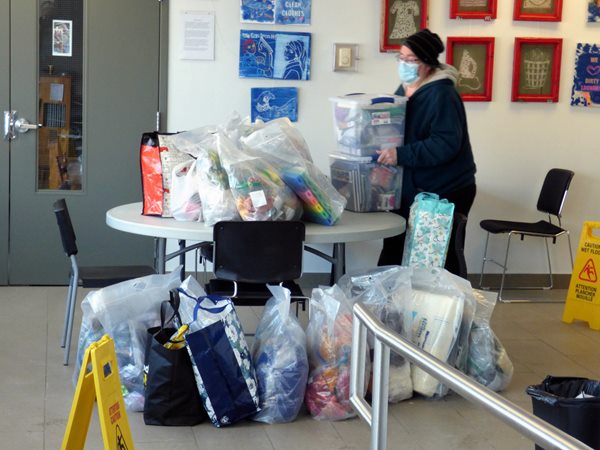
2)  clustered around or on the table outside the studio; 12 giant zip lock bags, 4 large bags, one file holding plastic box, and Glenn placing the last 2 mid-size clear ruff totes on round plastic topped table. There are “caution wet floor” signs in the foreground and off to one side.2)  clustered around or on the table outside the studio; 12 giant zip lock bags, 4 large bags, one file-holding plastic box, and Glenn placing the last 2 mid-size clear ruff totes on a round plastic-topped table. There are “caution wet floor” signs in the foreground and off to one side.

Glenn unloaded the car and set up the extra tables in the studio so I could set out the student’s supplies and set up the examples.

3) Class room set up with each students notes, foam pad, frame, needles set out at there place. To the right are examples of my work (including the Mr. and Mrs. Mer to show 3D Dry Felting). In the background, Glenn is reading and you can see a smaller table full of other supplies we will need as well as a 5 foot table overflowing with bags of wool. (There are a couple bags sitting on my walker).3) Classroom set up with each student’s notes, foam pad, frame, and needles set out at their place. To the right are examples of my work (including the Mr. and Mrs. Mer to show 3D Dry Felting). In the background, Glenn is reading and you can see a smaller table full of other supplies we will need as well as a 5-foot table overflowing with bags of wool. (There are a couple of bags sitting on my walker).

4) Close up of examples of 2D and 3D needle felting and 3 books (Art in Felt and Stitch, Jaana Mattson's Landscapes in Wool: The Art of Needle Felting and Painting With Wool Landscapes) I had brought for the students to look at.4) Close up of examples of 2D and 3D needle felting and 3 books (Art in Felt and Stitch, Jaana Mattson’s Landscapes in Wool: The Art of Needle Felting and Painting With Wool Landscapes) I had brought for the students to look at.

In the student’s notes, I gave them a list of books that may be of interest if they enjoyed 2D picture felting.

  • Painting With Wool Landscapes by Bethany Harris
  • Creating Felt Pictures by Andrea Hunter
  • The Art of Moy Mackay by Moy MacKay
  • Art in Felt and Stitch Felting Book by Moy MacKay
  • Jaana Mattson’s Landscapes in Wool: The Art of Needle Felting  by Jaana Mattson
  • The Art of Felt Felting Book by Loumange Francoise Tellier (inspirational)

5) Three bins and a bag of other things the students might need or could try. Fake clover tools, bags of scissors, extra needles, pins, small pet brushes that work like mini carders, and a bag of permanent markers are arrayed on the table. There are also a couple more small samples of felting and using different types of backing or ground felt.5) Three bins and a bag of other things the students might need or could try. Fake clover tools, bags of scissors, extra needles, pins, small pet brushes that work like mini carders, and a bag of permanent markers are arrayed on the table. There are also a couple more small samples of felting and using different types of backing or ground felt.

6) 13? Bags of wool on a five foot table over flowing with one on the floor and two bags on my walker.6) 13? Bags of wool on a five-foot table overflowing with one on the floor and two bags on my walker.

7) Well-padded rolling desk chair with green and black pillow sits behind a folding table with all the students’ supplies.7) Well-padded rolling desk chair with a green and black pillow sits behind a folding table with all the students’ supplies.

I found out that one of my students had hurt her back and was not sure if she could make it or how long she would be able to felt, so had one of the comfy chairs and pillow ready for her arrival.

8) A close up of one of the students workshop supplies, with various candy and chocolates for stamina (keep watching the pictures and you will see more of the candy selection).8) A close-up of one of the student’s workshop supplies, with various candies and chocolates for stamina (keep watching the pictures and you will see more of the candy selection).

Most of the students had chosen an image from a selection I had sent earlier in the week. We wound up with two students working on the tree in winter with a fence and two on an ocean image. Since I had not heard from all the students I thought I better bring all the colour options so I would be ready for whatever they wanted to try. We had two missing students, one was a booking error that had been corrected but was not on my list, and the other was actually missing. ( I found out when I got home that she had not felt well and had tested positive for covid that morning!)

I had set out the student’s supplies; Name tag (rectangle thick wool felt): (safety pin & sew-on pin, sock yarn, piece of scrap paper and Marker).  Foam Kneeling pad, 1 sheet of 100% wool felt (enough for two 5×7 pictures), 1 sheet of acrylic craft felt, I sheet of card stock (to make a window mat), a Plastic ruler, a Wooden Frame with a mat from Dollarama, XXL Project bag, bag for the needle, 21 pages notes and Felting needles.

  • 2x  T36-333 needles (Blue)
  • 2x  T38-333 needles (PINK)
  • 2x  T42-222 needles (Turquoise)
  • 1x Crown 40-111 needles (Orange)
  • 1x Reverse 40-222  needles (Green)

We started with a name tag; making your name in yarn to practice eye-hand coordination and get used to the needles.   I usually review what’s in the notes, the basics of history of landscape, mentioning the golden mean and the rule of 3’s for photography,  a review of perspective, some of the techniques that apply to pastels, acrylics and watercolours that can be used with wool.  As well as blending fibres by hand or by hand cards to get the colours you want. I also chatted briefly about ways to transfer images to the felt.

I didn’t go into as much detail as I usually do since I was starting to feel a bit more brain-stuffed up than I had been when I arrived and started to set up.  I was sure I was feeling better, but this cold seems to keep trying to sneak back and hit you again. Even so, the students did very well. Maybe not overloading them with info helped.

This time everyone wanted to use the “lightbox” (or window) method so I reminded them that the template version, which is good for thicker felt bases or dark-coloured base felt, was in their note if they needed to use it in the future.

9) Student with ocean view with lots of blues teals light teals, grey and white wool strewn around. There are is also a package of rockets candy rolls in the foreground9) Student with ocean view with lots of blues teals light teals, grey and white wool strewn around. There are is also a package of rockets candy rolls in the foreground

For each image I had two copies of the original image (in case they chose the template method), a colour blocked version and a colour saturation image to show hidden colours they may want to consider.  I can do this with Microsoft Word 2010. (Sometimes things work and upgrade then lose the effects you want.)

10) The second Ocean image again has fiber strewn around it. In the foreground, my male cardinal on a branch, using the template method for transfer. Like Watercolour painting, layers of thin colour for the back ground and a thicker more like acrylic approach to the bird.10) The second Ocean image again has fibre strewn around it. In the foreground, my male cardinal on a branch, using the template method for transfer. Like Watercolour painting, layers of thin colour for the background and a thicker more like acrylic approach to the bird.

Normally each student has chosen a different image, this time one of the ocean images was popular and the tree in winter with a fence and hill had found favour with the other 2 students.

11)student working on background behind the tree first. This time the fiber is a mix of white, grey, green-grey, light blue and brown with gray. In the foreground there is the green handle of the clover tool rake (originally designed to clean a clover brush) but works very well to hold down the wool as you felt, it keeps your fingers away from the pointy end and less bloodshed.11) Student working on their background behind the tree first. This time the fibre is a mix of white, grey, green-grey, light blue and brown with gray. In the foreground there is the green handle of the clover tool rake (originally designed to clean a clover brush) but works very well to hold down the wool as you felt, it keeps your fingers away from the pointy end and less bloodshed.

12) The second tree image is having its fence added. in the foreground are a works in progress of a night winter tree and on the cheap Dollar Tree craft felt a pair of sheep (you can just see the eye) a pair of hand carders sitting on a copy of the students 21 pages of notes. Next to that is a brass nautical caliper, a wooden frame with an XXL project bag and a box of mini boxes of smarties (candy coated chocolates).12) The second tree image is having its fence added. in the foreground are works in progress of a night winter tree and on the cheap Dollar Tree craft felt a pair of sheep (you can just see the eye) and a pair of hand carders sitting on a copy of the student’s 21 pages of notes. Next to that is a brass nautical calliper, a wooden frame with an XXL project bag and a box of mini boxes of smarties (candy-coated chocolates).

Winter trees were also popular.  I reminded the class that they could play God and move, remove or change trees, clouds or anything else that offended them. It was their landscape and they could adjust it so it would suit their liking.

I talked about how to think like a watercolour painting with washes and layers of thin wisps of fibre building up to a final image (not the fastest way to work but it can be very effective as in the fox who still needs to have whiskers added and I’m at about 30 hours). I also mentioned that after laying in the trunk and main branches, wisps of fibre worked well to create a hallow of tiny branches for the winter tree.

13) The first tree picture, Using a 5x7 opening to check the framing of the image. Behind the image and card stock mat is the foam kneeling pad that we were using as a felting surface.13) The first tree picture, Using a 5×7 opening to check the framing of the image. Behind the image and card stock mat is the foam kneeling pad that we were using as a felting surface.

Using a mat or just a card stock stand-in for a mat will give your eye and brain another view of the image you have been working on.

14) The second tree picture, held up to getting a quick check for position in the mat.14) The second tree picture, held up to get a quick check for position in the mat.

Both trees look great and are their own tree, even having used the same inspiration to start with. The same individual personality happened with the stormy sky ocean picture.

15) a vary active roiling sky with sea and beach underneath, there is a seagull added to the right side. 15) a very active roiling sky with sea and beach underneath, there is a seagull added to the right side.

16) a turbulent sky and sea with a beach in the foreground.16) a turbulent sky and sea with a beach in the foreground.

Both have great movement in their pictures, again when using the same image each saw and focused on different aspects of the image.

I have found sometimes after working on an image for a while I need to take a break. I will put it aside and come back to consider it again later. I may decide “yes I am happy” and the picture is done or I may decide it needs a bit of fibre added here or there to complete it. Sometimes using a card stalk mat will help me consider the image, looking at the picture in a mirror or turning the image and the felt picture upside down will help you see what you are looking at, rather than what your brain says it thinks it is looking at. (It makes it easier to see the negative space and compare the image with the picture you are making).

I hope they had fun and I hope that this opened up a new expression of creativity with wool.

The class finished up early but they also took a much shorter lunch than the last class. I had given each student a project bag (giant XXL zip lock bag) to store their extra wool, felt samples and needles in. They had the leftover fibre from their first picture and a couple selected a second image to try. A different water picture and a sheep in a field of snow.  it was impressive how far along they got in an hour on their second images.

17) An hour in on a second image of a sheep in a snowfield and snowy sky, sitting in a card stalk mat17) An hour in on a second image of a sheep in a snowfield and snowy sky, sitting in a card stalk mat

I seem to have missed getting a shot of the other ocean image! I was really only working at about 90% efficiency. It took me about an hour to pack up the workshop supplies and Glenn loaded them back into the car. Then put away the extra tables (I think tomorrow is a spinning workshop and they will need the space).

There is a very good restaurant across the street from the building the guild is in, I think I get a happy Sherpa by making sure I linger in the parking lot while he runs over and orders dinner. It was very good, the car smelt like hot pizza all the way home.

Winter Birch Continued

Winter Birch Continued

Blue and white nuno felted background with tulle pine tree shapes on the left and birch trees cut from silk paper on the right.

Here’s where I was with Winter Birch the last time I wrote about the project. I was trying to decide how to represent the pine trees in the distance. This is black tulle burned with a heat tool to represent the trees.

Tulle pine trees created by burning with a heat tool in greens and navy blue.

I made more tulle trees in the same manner with dark green and navy blue tulle. In theory, it seemed like a good idea to overlay these over the black tulle trees. But then when I did that, the trees were just a mish mash and you couldn’t really see them. So I decided to just use the black ones.


Nuno Felted background with silk paper applique birch trees over tulle pine trees. Audition of how pine trees will look in the distance.

Here are the black trees with the birch in place before I stitched them down.

Nuno Felted background with tulle pine trees hand stitched in place with feather stitch. Close up.

I hand stitched them down with a dark variegated thread and used feather stitch. It added a little bit of green but nothing you could see from a distance.

Nuno Felted background with handstitched silk paper applique birch tree over tulle pine trees.

Then I moved on to the birch trees on the left that are in the background. I hand appliqued the silk paper birch trunk in place and then free motion machine stitched the branches. I want the branches to overlap and not appear all on one “level” so that is why I am stitching each trunk and branches separately.

Here is the progression of the stitching on the background birch trees. This always takes longer than I think it should. But I did like alternating between hand and machine stitching.

Nuno Felted background with four handstitched silk paper applique birch trees on the left over tulle pine trees. Auditions of foreground birch trees overlapping other trees in the distance.

Here I am auditioning the foreground trees over what I have stitched so far. I think I will probably stitch down the background birches on the right side first but I do like to see how the overlapping trees affects the piece. I am also trying to decide if I should attempt adding more snow to the picture. What do you think?

Adding Lichen to the Mossy Driftwood

Adding Lichen to the Mossy Driftwood

My next step in finishing the driftwood piece was to create lichen. I had made lichen before from Tyvek but alas, I had none in my stash. So I looked for other materials that could be shaped with a wood burning tool and that would shrink and make interesting shapes with a heat gun.

What I found was a fusible lightweight Pellon interfacing and nylon organza. The interfacing does not need to be fusible to work, it’s just what I had on hand. I can’t remember why I bought it but hopefully, it would work so I wouldn’t have to buy anything else.

Painted pastel blue green interfacing and nylon organza on white background

I painted the small pieces of interfacing and organza with a light layer of acrylic paint. As you can see here, the paint was not heavy and the shade of blue green was very light in value.

wood burning tool burning lichen shapes into painted interfacing

Next, I got out my wood burning tool and a piece of glass to burn on. I made random lichen shapes in the interfacing. I also did the same with the nylon organza. Once they were cut out, I held the small pieces with a pair of tweezers and used the heat gun to make them shrink up and get curly. I also added a bit of brown marker to the edges of the lichen as there are definitely brown bits on the real stuff.

Here’s the result. Yay, it looks like I wanted it to. Success. Now to add it and the dead teabag leaves to the mossy driftwood. I glued the lichen in place as it was mainly on the wood itself. I stitched the leaves down to the felt in a couple of places.

Textile Art Piece - driftwood covered with felt, stitched moss, stitched tea bag leaves and lichen from interfacing and organza

Here’s the result. You can click on the photo to enlarge it.

And the close up views. I’m happy with how it turned out and it was a really fun project.

2022 Landscape workshop

2022 Landscape workshop

Landscape workshop

It is fabulous to get back to felting!

Last week I spent a lot of time looking through my fibre stash, rereading my notes and finding all the supplies in preparation for Saturday’s needle felting workshop. I sorted out and made sure the supper wash was labelled and in a separate bag, yes I do have superwash merino, it’s just too tempting in all sorts of fabulous hand-dyed colours. Most of which has come from the black lamb. She has been selling small balls of fibre at various fibre fests, such temptations of colours! I admit I have caved and purchased supper wash!! Luckily with a bit of extra poking or a bit of blending, we can needle felt with it.

I found the box with the supplies I would need. Hum, I had this ready to go for 2020 so that makes the markers only…..2 years old… better get new ones just in case.

Six sets of 21 pages of note, and 4 versions of each picture chosen by each student, oh no the printer finally actually means it’s out of ink….it has been almost a year of saying it was going to run out at any second. Ouch! The price of new toner has gone up and needing to replace all the colours at once is painful!

Early Saturday morning arrived and Glenn loaded up multiple bags of wool, the box of supplies, a bag of frames and notes and finally the important bottle of Mountain due and off we went to set up the Ottawa Guild studio for the workshop. He was able to extract three six foot long folding tables from behind the looms one of which wound up covered in bags of wool.

1 large clear bags of little bags of wool, separated sort of by colour. There are also small dog brushes, scissors for paper and mettle rulers ready to use in the workshop1 large clear bag of little bags of wool, separated sort of by colour. There are also small dog brushes, scissors for paper and mettle rulers ready to use in the workshop.

It took me a while to get all the parts of the student’s kits organized on the table. Last I set out 2 packages of the mini chocolate bars.  I got half of a cheese and cream cheese bagel eaten and I was ready for the students to arrive.

2 student supplies pile sitting on the table; foam pad, picture frame, notes and photos, needles, name tag stuff, project bag, cheap craft felt, 100% wool felt.2 student supplies pile sitting on the table; foam pad, picture frame, notes and photos, needles, name tag stuff, project bag, cheap craft felt, 100% wool felt and thick 100% wool felt for name tag.

3 the tables, with the supplies, sitting in a C shape so I could sit in the center and see what each student was working on3 the tables, with the supplies, sitting in a C shape so I could sit in the center and see what each student was working on.

I had purchased foam kneeling pads from Dollerama but had brought a few other work surfaces to show the students.

4 Samples of different types of works surfaces; wool pads, wool ironing pad, cellulose sponge, foam cushion4 Samples of different types of works surfaces; wool pads, wool ironing pad, cellulose sponge, foam cushion

When I first did needle felting a cellulose sponge was the surface suggested.  (WARNING; Do not leave needles in a cellulose sponge, it will absorb moisture and humidity and rust the needles). The foam cushion (this one is 18”x18”) worked very well for pictures and later sculptures.  I also brought the thicker soft wool felt mats (Grey and white) and the thinner ironing 100% wool pad. In a previous post, we chatted about some of these felting surfaces.

In the week before the workshop, I had emailed a selection of photo options to the students most let me know which one they wanted to try. I had four photos for them printed off in approximately 5”x7”; two with no alteration, one version that was colour blocked and the final version was done in extreme colour saturation. The colour blocking gives suggestions of colour value and the extreme saturation gives suggestions of hidden colours. Both can be helpful when looking at and assessing the original image.

The students arrived and we started on time.

Some of the students had felted before while others had not. To get them started I had them make a name tag using a thicker 100% wool felt made by the black lamb and a fine sock yarn. I had a scrap piece of paper for them to get the correct size of name to fit the tag. This is a good way to practice eye-hand coordination and fewer Band-Aids are needed later in the workshop.

In the notes, I covered multiple ways to transfer images to the felt base.  A couple used the template method (good for thinkers or darker felt ground) and a couple used the window or lightbox method (easy if you have thin or light-coloured felt ground).

5 Two of the students getting started, cutting a window in cardstock, used to check the size of your image so it will fit in the mat when you’re done felting. The table is cluttered with their supplies including photo reference and tiny chocolate bars5 Two of the students getting started, cutting a window in cardstock, used to check the size of your image so it will fit in the mat when you’re done felting. The table is cluttered with their supplies including photo references and tiny chocolate bars.

6 three of the students starting their pictures. There were 2 students per 6 foot table6 three of the students started their pictures. There were 2 students per 6-foot table.

7 two of the students now a bit further along working on their pictures7 two of the students, now a bit further along, working on their pictures

A couple had combined images or added elements from one picture to another. So we had a quick chat about light sources (but there was more about light sources in the notes).

8 using the original photo of 3 sheep and a round hay bale in snow and replacing the sheep with her own goats. She had emailed me the goat photos and I had shrunk them to a size similar to the sheep.  I had also made mirror copies so she could rotate them if she wanted in the composition.8 using the original photo of 3 sheep and a round hay bale in snow and replacing the sheep with her own goats. She had emailed me the goat photos and I had shrunk them to a size similar to the sheep.  I also made mirror copies so she could rotate them if she wanted in the composition.

9 The sheep are gone and the goats are almost done!9 The sheep are gone and the goats are almost done!

Goats were replacing sheep and a few others made changes to their landscape.  I had told them they are the God of their landscape! If a tree offends you then you can banish it from the picture, “Be gone Tree”!! If you would rather it was a different kind of tree or if you would like your tree to gain or lose weight that was up to you too!! (The power is Heady!!! < Maniacal chuckling in the background! >)

As I mentioned before I had brought in a number of different types of working surfaces to show them or let them try.  There was a bit of interest in the wool felting pad, this is the one from amazon that has gone up to exorbitant prices (wait for the price to drop since it was about $13.00 when I got it and it was $53.00 when I checked last week). There is a similar but much cheaper version out of china too.

10 students hands trying out the 100% wool felting mat with her picture. She Liked the darker grey mat better.10 students’ hands trying out the 100% wool felting mat with her picture. She Liked the darker grey mat better.

The sheep and hay bales were popular, both in their original form and also used with other photo parts of landscapes. Even with the same picture, the interpretation was quite different but definitely the same image.

11-close up of student working on sheep with hay bales picture. 12 another interpretation of the sheep and hay bales picture. Showing more of fiber around pictuer on table11-12 another interpretation of the sheep and hay bales picture.

I chatted about approaching wool painting like a watercolour, washes of thin layers of fibre or like an acrylic, blending to match the image then affixing the colour to the ground.  They worked from the background to the foreground.

13 one student holds up her picture and she and two other students look at her progress.13 one student holds up her picture and she and two other students look at her progress.

By late in the afternoon most were to the point that they were ready to put their pictures into their frames. This is the first time I did not have any of the students stay a bit late to finish the last bit of their picture. It took me a while to finish packing up and cleaning up the studio so it would have been ok. There was a threat of more snow so with a few having a long drive home everyone made a break for it at the end of class.

14 close up of the tree with fence felt picture now in a black frame14 close-up of the tree with fence felt picture now in a black frame.

Working from the back to the front is particularly helpful in this image. Having the background done behind the tree and then adding the tree on top is much easier than trying to fill in all the background between the many little branches.

15 matted picture of sheep with hay bales held by the artist and admired by a fellow student. She used small locks to create curls on the sheep. It was very cute!15 matted pictures of sheep with hay bales held by the artist and admired by a fellow student. She used small locks to create curls on the sheep. It was very cute!

16 the finished framed  hay bale with goats! Also very cute!16 the finished framed hay bale with goats! Also very cute!

17 one student framing her picture while one keeps working on hers.17 one student framing her picture while one keeps working on hers.

18 the picture of sheep and hay bales framed18 the picture of sheep and hay bales framed

The students seem to have enjoyed the experience. there was a bit more work to finish for two of the students but I made sure they all had enough fibre to finish and get them started on their next picture. I hope they will drop into one of the guild socials or post on the guild’s Facebook page so I can see what they are up to.

Tomorrow I am off to the basement to find some of my inkle looms because next weekend I switch gears and I’m teaching introduction to inkle weaving. That workshop involves boxes of smarties candies (but you have to take the workshop to find out why!!)

I want to thank my students for a wonderful workshop, I was very impressed with what they accomplished in just a few hours of happy stabbing of wool! (and only one finger) I hope they will continue felting (Dry or Wet or Both) and find images to inspire them. I hope the photos from this workshop inspire you to think about small landscapes, they make excellent Christmas presents!!

Magazines

Magazines

The Other Ann had posted about a challenge in a magazine she gets. Inspiration Magazine. https://www.inspirationsstudios.com/product/inspirations-issue-116/ it’s a needlework magazine. It looks really cool. So, I thought it might be an idea to ask people what magazines they read for knowledge and inspiration. Everyone seems to really love the Christmas beetle brooch. So I thought I would edit in the price for the kit, $129.00.  I am assuming that is Australian dollars.

I read Filz fu4n. the guild subscribes and there is an English supplement available. https://www.filzfun.de/magazin/en/

Wild Fibres is another interesting one. Lots of interesting articles and pictures.  https://www.wildfibersmagazine.com/

I look through Ply https://plymagazine.com/ and Spin-Off https://spinoffmagazine.com/ magazines at the Weavers’ and Spinners’ Guild too. They don’t do felting but I spin and there are lots of colour inspirations.


I would love to see Felt Matters but can’t bring myself to pay $65 for a digital and $81 for a printed ( 4 per year) magazine.

I like to leaf through unrelated magazines too when I see them. art quilt magazines are inspiring. They are good at showing you how to break down and simplify a picture. Nature magazines of course are great for inspiration. I have an old National Geographic magazine that talks about wool. It’s packed away but I found a picture


So tell us which magazines do you read to learn, and/or get inspired.