Browsed by
Month: November 2021

Recycling isn’t easy

Recycling isn’t easy

The idea of upcycling and recycling is enormously appealing given the situation we all face. But going back and undoing work from others’ hands is challenging.  For those of you who have come late to my adventures in recycling,  I am disassembling worn out silk kimono to weave into more modern type of jacket, still with an Asian look, but done in a rag weave. This is part of the Japanese tradition of using materials to their utmost, so I don’t feel too bad about taking these garments apart.

The process of tearing or cutting the fabric is boring, boring, boring and just for a change of emotion it’s frustrating too!  I have dulled blades on fabric cutters, dulled scissors and now I’m trying a combination of rotary cutter and ripping, but still I’m not having great success.


Sometimes the silk tears into perfect strips

Sometimes the silk tears perfectly and the strip can be used exactly as it comes off the fabric, then the next strip goes completely haywire for no discernible reason.  These are really old kimono so my suspicion is that they have started to shatter, but that should be working in my favour when ripping, so I’m at a loss.

I have pressed and folded the silk and laid it out on the quarter inch.  This is when the straight edge and rotary cutter come out.  The silk used here is very fine, from the lining, so the width of the ribbon is a little more than the quarter inch. The poor rotary blade was starting to sound pretty grim after eight deep cuts.  I’ll look for a small sharpener to try to extend the life of the blades.

The ribbons are joined into one long ‘thread’ using a split knot.  A small cut is made in each end of the ribbon about a quarter inch from the ends.


The right hand ribbon is threaded through the slit in the left hand ribbon.

Then the very end of the left hand ribbon is threaded through slit in the right hand ribbon.

And finally, they are gently given a slow and gentle pull until they come together in a little butterfly knot that will be a design element of the weave.  It will be random and just pop up here and there on the fabric.

I find doing this hour after hour nearly mind numbing, and can only do this for a few hours a day or two at a time.  I really want to finish this kimono project but it’s getting to be a slog so I have to take breaks.  I will finish it, but not in the original time line.  What do the rest of you do when you have a project that starts to pale as time goes on?

This time boredom prompted me to crack out the dye pot and do something vivid and cheery for a November day.

Framing; To Glass or not to Glass is that confusing?

Framing; To Glass or not to Glass is that confusing?

Many years ago, almost forgotten in the mists of time…. Ok, when I was 16. I realized I could not possibly get an office or secretarial type summer job as many of my friends were getting (you have seen my spelling.  Even now with the helpful suggestions from the computer I really cannot spell.) Working as a cashier was out because of the dyscalculia (Numbers are almost as bad as letters). So that left jobs the boys would not take at student manpower (shovel jobs) and finally I wound up working as a picture framer. Even with moving crates of glass (which are not light) it was better than shovel jobs. I wound up picture framing for 13 years until i damaged my ulnar nerve and switched careers but that is another story.

I was very lucky when I started to work.  I was taught by a picture framer who was trained as a conservator.  Acid free matting, backing and making rice paper glue with proper T hinges were part of my training. Mounting textiles on a ground was also something I did from small textile pieces to large quilts.

I even got to explain to people why their incredibly wrinkled Diploma could not be dry mounted because it was made of real parchment. I got that job because I would get so excited by real parchment I would explain how it was made and point out where the hair follicles had been.  I would tell them how impressive it was to have parchment (made from stretched and prepared skins; usually calf, sheep or goat) rather than boring paper, so it was worth considering a conservator to get rid of the wrinkles. I would also explain not to hang it in the bathroom or direct sunlight. By the time I was done they were usually requesting the expensive restoration and very pleased with their masters or even sometimes a B.A. degree.

I framed small Tapestries in Theo Moormen technique with double glass and double mats on the front and single mat on the back. This allowed viewing of both sides of the piece but protected it from dust and handling.

Why would we want to frame a 2D felt picture?

  1. Framed work gives it more gravitas (something framed will be looked at differently than something not framed. A framed piece (or one finished to hang in another way) suggest more value than one that is not framed. This is why presentation or hanging is important for display in a gallery.)
  2. Protects the work from dust and unwanted handling/ fingering. (it also protects from possible vacuuming by over enthusiastic persons)
  3. Protects the fiber from the evils of wool moths or other horrors! (Such as a wooden frame with a paper backing or sandwiching your work between matts then add glass to the front and back. For further protection from dust or moths, the layers can be sealed with AF cloth tape along the edges.)

Why do some suggest Felt should not be framed with glass?

  1. Water damage when behind glass from wicking when washing the glass (this happens when Windex or other cleaning liquids are sprayed directly on the glass and drip down into the frame.) This wetness can wick around the glass and onto the work. If it is a photo it can actually become stuck to the glass, damaging the photo when the glass is removed. When cleaning framed pictures with glass, it is preferable to spray the cloth lightly with Windex or other cleaner then use the dampened cloth on the glass. Never spray the glass because of the possibility the liquid may leak into the frame and wick behind the glass or into the matt.
  2. Glass distorts the image. Using the wrong glass can distort the image. As non-glare glass is designed to work directly against the image but when elevated off an image it will blur and distort the image below.  Choose Glass that is appropriate to your intended use. If you are using a shadow box, a filler strip under your matt or even sometimes just a double matt, consider either plain glass or one of the new glasses with a museum coating. Check if there is distortion at the height you will be placing the glass before final framing.
  3. Humidity forming behind the glass due to sunlight on it. (a lot of dyes,  like paint, are fugitive.  They fade in prolonged exposure to direct light.) Due to fugitive pigment, artwork should not be hung in direct sunlight, with or without glass. There are very expensive glass types that can reduce the UV damage but it’s better to just not put it there. Do not put artwork (or real parchment) in a very humid environment. You can damage the artwork and warp or distort the matt and backing. Sculptures with pipe cleaner armatures can also have trouble in places of high humidity too.
  4. Glass can flatten the felt. There are ways to elevate the glass off the pictures to allow for textural elements. If you have some 3-D elements in your picture you may require a shadow box (a frame with a very deep inside that your picture can expand into) if you only have a bit of texture or fluffiness you want to maintain you may only need to use a double mat (acid free). If you need a bit more height you can make a support to raise the matt up by adding foam core supports ether under the matt or between the layers of the double matt. (Under is more common). As you create a deeper collection of backing art, spacers, matts and glass.  You may want to look more at a deeper wood frame although there were a couple options for deeper metal frames too. (There are some fiber artist that are laying out there wool in a picture and not felting it. Instead they are compressing it with the glass to hold it in position.)
  5. Glass is expensive and heavy. (Some of the specialty glass can be expensive, and in large sizes, it can be quite heavy. Plexi can be lighter but is not necessarily cheaper in larger sizes.)

Other considerations.

Framing is expensive. One way to reduce the expense is making sure your work is a standard finished size.  This will allow you to pick up a stock frame matt and Glass.  You can do this by making a matt template out of cheap cardstock or out of a cereal box type cardboard. Make templates with common matt opening sizes; 5×7, 8×10 and 11×14. You saw examples of this when I was working on my Christmas cards and the cardinal in previous posts.

If you are working from a photograph, try to scale your image to one of the standard sizes. Before you print it out to work with.

1 Tulip scaled to fit in a 5×7 matt opening

Use a template (so you don’t get the matt dirty) to check as you work that you are keeping the image to the size you intended.  I do often expand over the border just a bit so I have the option to shift my picture or elevate the matt without showing the underfelt.

 2 Tulip Framed

This is a Dollerama wooden frame, mat and glass I used from my mother’s day post Happy Mother’s Day 2021;   May 17, 2021   https://feltingandfiberstudio.com/2021/05/17/happy-mothers-day-2021/

You can see the same technique of using a template used with the cardinal I was working on at the farm show demo.

This slideshow requires JavaScript.

 3-7 Cardinals with matt template

The cardinals were from this blog post; So much time.  So much to do!  March 23, 2020  https://feltingandfiberstudio.com/2020/03/23/so-much-time-so-much-to-do/

Repurpose Frames you have or find

From the same blog, I showed you a different kind of frame I had found at a second hand store. They are called memory boxes or memory frames. There was a fabric backing over cork in the back of the frame and the front face with glass was hinged so you could change out what you put in there. Magnets hold the face and glass closed creating a shallow shadow box. The glass will protect the felt from dust but can be opened to clearly show that the picture is made of wool and not paint or pastels.

This slideshow requires JavaScript.

8-10 Memory Frames (decorative pins to hold the felt would work well)

These frames are fantastic for demos or felting displays so if you trip over one secondhand please consider buying it. I have the arctic landscape which was a water based challenge pinned in with sewing pins temporarily (I really should get a matt or felt to the edge but it shows that the piece is felt quite well.) Unfortunately they are a bit dinged up but still work well to protect and show the felt picture.

My final example of working with a mat template is from Sneaky Presents;  January 10, 2019 blog post https://feltingandfiberstudio.com/2019/01/10/sneaky-presents/

The inside of an empty cereal box was my template. I again used the wooden frame mat and glass from Dollerama.

11-12 Snowman

I wound up making three 5×7 pictures for that x-mass trip; The snowman, the cardinal and the bunny. All were expressing parts of Oakville (ok, the snowman was a bit optimistic considering the number of green Christmases we have had while visiting!)

 12-13 Christmas pictures

Ok I think we have the concept of using a template to make a standard size image to frame, fully explored. Now that you have the matt in front, what should you consider putting behind the pieces?

A few last things about Matts

Matts are available in both acid free and non acid free stock. Both types usually have an interior bevel of 45deg or a reverse bevel of the same angle but in the opposite direction. You can have a black or coloured core to the matt. Matts come in a huge array of colours, surfaces and textures. Some matts are hand made wrapped in silk, others some have lines or patterns drawn on them or powdered colour added (french matting).  You can even add a wooden lip to the edge of the matt. All these options have a cost. Ideally try to get an Acid Free matt and backing that enhances your work.

Matts are cut on a matt cutter. If you are going to be framing a lot of your work you may consider an introductory course on matt cutting and framing.  The price of a matt cutter for semi-professional use has come down so it may be worth investigating. A good quality matt cutter will save you a lot of frustration and wasted mattboard so don’t skimp on this tool.

Behind your artwork;

Ideally, a 2ply acid free matt board but since my days in framing this seems to have fallen out of favour. So let’s consider why we used to use one and what options there are now.

The 2ply was a barrier between the artwork (usually paper) and the cardboard backing. It was there to keep the piece from reacting with the cardboard and becoming either brittle or discoloured. This is not as much of a problem since the felt is not as sensitive to acidic cardboard but ideally a good acid free backing would be best for it.  So let’s consider, if we can’t get 2 ply, what can we use instead?  We can buy a sheet of 4ply  to cut down for a backing (it’s a bit pricey to buy it by the small size you need since the backing you need for the 8×10 piece is almost the cost of a full uncut sheet. Since the cost is so close  it is more economical to buy a full sheet and cut it carefully for what you need and save the rest for other picture backings.

Another option is acid free foamcore or even regular foamcore. Both make a good backing but they will start to add thickness so if you are working with a limited amount of depth in your frame this may not be as feasible.

Thinking a bit outside the frame you can find acid free paper in most reasonable quality sketchbooks. I have even spotted some available at Dollerama although they do cost $4.00 not $1.00! So, if you don’t want to sacrifice a sheet of your arches watercolor paper this may work as a separator from any acidic cardboard.

if you want to float your work on the backing, i would suggest using a fine pointed awl or heavy gauge sewing needle to punch 2 or more sets of small double holes through your backing and then you can carefully sew into the back of your work and down into the mounting board. With two holes you can tie a not on the back of the mounting board which will not be seen from the front.

There is a product called Coroplast, which is a fancy name for cardboard made from plastic. It can be used as backing without fear of acidity. You can see coroplast in a lot of yard signs (often a thinner quality but also cost less) or a thicker version is available at hardware stores like Home Depot. If you have a very thin felt picture (pre-felt with a light wool covering you may be able to sew or lace the felt around the foamcore or coroplast. Coroplast is stronger in one direction than the other. it is stronger with the holes running vertically with your work, (i hope this is clear). The felt can than be framed, but i would suggest a spacer to lift the glass. spacers can be made from foam core or you can buy clear acrylic strips which were available in my day for this purpose.

A non traditional approach to framing

 14 Farm show demo display with 3D felt pictures

The framing/hanging for the last guild art show required I start with a standardized 12×12 canvas. The rule was I could not exceed three inches in height so I removed the canvas and used the stretcher bars. I wrapped my felt to the lower level giving me almost an extra inch in height! The way I attached them is a combination of sewing (button hole thread) and lacing with a bit of needle felting to keep the center depressed. I had to felt the base quite firmly to keep the base recessed.  You can see more here; Polar bear for the 150th Anniversary Art show February 12, 2018 https://feltingandfiberstudio.com/2018/02/12/polar-bear-for-the-150th-anniversary-art-show/

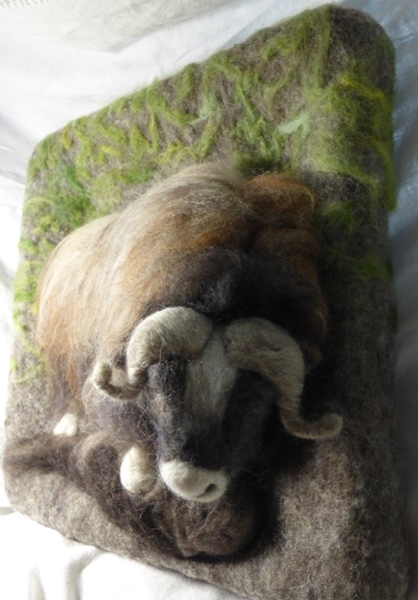
How odd!  I do not seem to have a picture of the back to show you… oh time for another photo shoot! Muskox has volunteered.

15 Sewing, lacing and felting to secure the picture to the stretcher bars

You can see the combination of lacing( with button hole thread) and then needle felting to give a solid base around the stretcher bars. (Something similar can be done over one or more layers of coroplast). This gave a finished ready to hang edge. Due to the depth of the figures, if I decide to frame this with glass I will need a deep shadow box or a bespoke (custom order) plexi box.  Since the felt envelopes the back and front of the frame I may need a more complex way to keep the back moth proof.  As it is, today we used screw eyes to the back of the frame as a way to hang it. We were using, I think, a #3 wire so I am not sure why I have a bit of spun yarn on the back of this one?

16 -17 Musox picture Back and Side

You can see how much depth I have in the head which is wired so it can adjust a bit.

18 Muskox Front

Now let’s get back to more normal framing considerations. We have made the piece, discussed the matt and the backing.  let’s consider how do we attach the piece to these parts. ( you can just pay for custom framing and not worry about how things are attached but if you want to make sure it is done to your specification or you want to save money you can do this yourself)

With paper items; rice paper T-hinges or there were also acid free tapes available to hold the artwork to the backing. With wool; most of these option will not stick well unless the felt is very thin and light. For most textiles a bit of careful sewing to attach it to the backing was usually the best option. It was removable and usually would do the least damage.  A few fine textiles owners would insist their piece needed to be dry mounted but there was acid free dry mount tissue available. This might work for very light thin felt (like nuno felt) but I would not suggest it for anything thicker or heavier.  You may also have problems with adhesion to the backing. (I would suggest a small separate test sample if you are sure this is the way you want to attach it.)

Another option for a base to mount on is a matt board with a bit of batting on top.  Then wrap silk fabric over the batting. The felt picture can be pinned or sewn in place on the silk.  Because the felt is floated on the silk an uneven or random edge can show as a feature of the piece. I would still put ether a matt or a spacer to elevate the glass off the felt.

With some felt pieces you may be able to pressure fit the felt between the matt and backing. This means no sewing, just carefully position the picture between the matt and backing, clean and add the glass, then place the frame over top. Turn everything over to show the back carefully and add the nails or bend over the tabs to keep everything in place.  This does not always work as in the case of a shadow box so a few careful stiches hidden under the matt or into the back of the piece may be needed.

What are our options for Glass?

Now let’s consider glass options and I use the term loosely since Ikea’s “glass” is now Plexi. I have framed with very large sheets of plexi for commercial purposes (they were for the real estate industry; large floor plans and drawing of what the houses would look like) The plexi, especially at that size, was a pain. It tended to scratch easily, it distorted the image if the plexi was not very close to the image and it built up a static charge when you took off the protective coating (which would not be good for lightly felted wool). Its’ good point is that it did not cut you like glass occasionally tried to do. It looks like plexi has also improved over time so you may want to ask more questions at your local framing store. Do inquire about the static problem we use to encounter.

Most pre-made frames will come with standard regular glass. There are more options if you want to upgrade the glass. Since my time as a picture framer there are many more options for glass ranging from the cheapest, regular glass, to various types of coatings to reduce glare or UV damage to the artwork (some are quite expensive). Some of the new coatings look very effective but also advise not to use regular glass cleaners on them or you will destroy their coatings effectiveness. (Always apply any dampness to the cloth, not the glass when you are cleaning – remember about wicking and damaging your artwork)

Some of the “non-Glare” glasses are not suitable for shadow box applications since their pebbled surface distorts the image when not adjacent to it. You may want to consult your local framing store if you want to investigate the various glass options.

One other option when considering glass is you can show both sides of your felt by having glass at the front and back of the piece.  When I framed some of my own parchment I showed both the front and back so you could see it was parchment and not paper. Oh no, I better grab the camera and show you what I mean.

 19 parchment with acid free suede matt and Museum glass

This was very expensive museum quality glass when I framed this about 30 years ago. (The piece has not been in direct sunlight and there has been no noticeable colour change over time. so i would say the price was worth it.) The glass on the back is regular glass since it would not be visible most of the time and not exposed to excessive light. I painted and framed it for my mother in law who was always very fond of angels.  She sent it home with us last year. It now sits beside my husband’s computer. it is not in direct sunlight but is near a window.

 20 light showing through the parchment

I held the picture in front of the window so you can see the sun light coming through the parchment with the begonia shadows.

21-22 framed in double glass and matts showing the front and back

There are matts on both sides of the parchment, covered by glass. There is tape over the edge of the glass and frame.  The turnbuckles were screwed in through the tape on the frame. The tape is sealing the back so no dust can get in. If you noticed, the ripple in the top of the parchment is not due to humidity.  This piece is from the outer edge of the skin  and the ripple is showing where one of the tie points on the deer skin edge was.


A profile view of some types of framing

23- 25 Different parts of frames:

The Frame

Finally, let’s look at the frame. For traditional framing (with glass), you will need ether a wooden or metal frame. Wooden (or if you are looking at the dollar store versions some “wood” is actually plastic) Real wood is the direction I would tend to suggest for a strong frame and the ability to seal the back in brown paper. Once your have your piece assembled but before you put the hangers on, if you are not using double glass, you can add a paper dust cover to the back of a wooden frame. Stick the paper to the back edge of the frame with double sided tape. You can get rid of the excess paper around the edges of the frame by using a sanding block on a slight angle to cut off the extra paper. This gives a nice neat finished look to the back and keeps out dust and wool moths. Consider the profile (shape) of the frame for the positioning of the hanging wire. If you have used double glass you may need to elevate the wire position and keep the wire snug so it will not stretch above the frame when hung.

With wooden frames the glass/matt/felt/ backing are usually secured in place with finishing nails, brad points or turnbuckles if you are flush with the frame. There are a few options for hanging devices but most common were screw eyes and wire which are usually placed in the top 1/3 or the frame. An Awl makes a handy measuring device to make sure your positioning them at the same level!

Metal frames are available and are often a cheaper option. They go together with a screwdriver and usually use clips to hold the glass securely to the front of the frame.  As long as you use a strong well-fitting backing and lots of metal spring clips, you should be able to keep the wool moths from being able to get to the wool. (As well as keep the dust out and protect from anyone wanting to vacuum the felt.)

As i showed you with the Guild Art Show, there are other ways to present a felt picture or hang a tapestry which does not involve traditional framing (with or without glass). Some of my examples; frog/ lily pad, polar bear and muskox are finished and ready to hang but are not formally framed.  Ruth has had a number of posts with effective ideas to create a neat hanging presentation but without the traditional look. Depending on the piece you have created and the aesthetic you are creating you may want to try a less formal presentation. If you want to look at a more formal one, I hope I have given you a few frugal ideas and a starting point to work from.

Have Fun and Keep Felting!!!

Throw back Thursday Christmas Tree.

Throw back Thursday Christmas Tree.

There is a throwback Thursday post for you. These are the Christmas trees I made in 2014. This is my last week of crazy baking for the Christmas Farmers’ Market. I hope to have something new for my next post.

We have been trying to decide where we can put our Christmas tree this year. Even if we use only half of it and put it on a table it is still too big to put anywhere. So time to make one that will fit on the small table available.

I carded several greens together

green wool green wool blended

Then I made a template. It is 4 feet tall, the width of the table. I had a really hard time getting a picture of it. I made a smaller one too about 2 feet tall.

tree layout

This is rubbing on the plastic cover.

tree rubbing

Then it was roll and roll and roll some more. I kneaded and dropped and threw and heated it and did it some more. This is the shrinkage on the smaller one. The tip I made solid out past the tip of the template.

small tree shrinkage

While I was making the trees I was trying to figure out what I would use as a structure for the inside. For the smaller one, I was thinking a countertop paper towel holder would work. It was too short but while at the dollar store I saw a tinsel tree on a frame. I bought it and removed the tinsel garland that was wrapped around it. It was a little too tall but a son with some bolt cutters fixed that.

small tree on stand

It looks like a green witch’s hat. For the large one, I ended up using an upside-down tomato cage. The tree looks like a Whoville tree. I ran out of light to take a picture of the big one so you will have to wait for my next blog post to see it. It will be decorated by then too. What have you used for a tree?

Here is a link to the post with the finished trees, I hope you like them.  https://wp.me/p1WEqk-2GH

Happy Turkey Day to all our American readers

Don’t forget to enter to win on Tuesday’s Post.

Ten Year Anniversary Giveaway

Ten Year Anniversary Giveaway

Comments on this post are now closed as

the drawing is December 2nd. Winners

will be announced on the post of

December 3rd.


Believe it or not, it has been ten years since we started The Felting and Fiber Studio. Our first post was on November 20, 2011. Some of the original members have changed, we have added more contributors but we are still sharing our fiber art adventures. We decided to have a ten year anniversary giveaway. We really appreciate you, our loyal readers and would like to give you a chance to win some cool prizes as we celebrate ten years of fiber creativity and fun. We are offering five prizes, three mixed packs of sari silk and two winners of your choice of our current online class selection (dates in 2022).

To enter the giveaway, please comment below with your choice of which prize you would like to win. You can choose either the silk sari pack or one of the online class offerings in 2022. We will have five winners. Make sure that your email address is associated with the comment. If we can’t get in touch with you, we can’t give you the giveaway prize. Only comments directly on the post will count. Comments on other social media such as Facebook will not be entered into the drawing. The drawing will be held with a random number generator on December 2 and the winners will be announced on December 3.

The sari silk pack will be made up of 10 grams of each color shown for a total of 60 grams of silk.

The online class options are:  Felt Concertina Hat or Felt Bags both with Teri Berry.

Hanging Felted Spiral with Helene Dooley


Experimental Screen Printing on Felt

Nuno Felt with Paper Fabric Lamination

Print, Stencil and Play with Thickened Dye on Felt

Free Motion Machine Stitching on Felt

(four courses listed above with Ruth Lane)

Wet Felting for Beginners with Ruth Lane and Ann McElroy

To enter the giveaway, please comment below with your choice of which prize you would like to win. You can choose either the silk sari pack or one of the online class offerings in 2022. We will have five winners. Make sure that your email address is associated with the comment. If we can’t get in touch with you, we can’t give you the giveaway prize. Only comments directly on the post will count. Comments on other social media such as Facebook will not be entered into the drawing. The drawing will be held with a random number generator on December 2 and the winners will be announced on December 3.

Thanks again for reading, we hope you have enjoyed the last ten years because I know we have!


‘Tis the season to … make a Christmas tree

‘Tis the season to … make a Christmas tree

Given that it is already nearly the end of November, I thought I would finally indulge myself with thoughts of the festive season.  As I am sitting here writing, a few thoughts came to mind including how advertising for Christmas seems to get earlier each year.  Here in Ireland I have seen ads in August which, like the vampire seeing sunrise, causes me to turn quickly away, run in the opposite direction, and bury my head.

That said, we have a local and, until recently, privately owned supermarket who sells Easter eggs on Christmas Eve.  What started as a joke one year became a tradition locally.  The supermarket owner, sadly now gone to his reward, would hold an annual Christmas dinner for his elderly customers.  Every year each customer was gifted a shopping trolley load full of groceries which they got to wheel home from the party.  This kindness was not advertised.  It was not used as a form of promotion.  This is what made it so special.  I suspect this story is not unique.  There are a lot of kind folk in our world.  If you can lighten our hearts with a story like this one please feel free to share it in the comments section.

In the spirit of sharing I thought it might be fun to make and share a felted Christmas tree with you all.  It is made around a very simple book resist (only three pages) and takes less than 50g of merino wool.  I am including full instructions for anyone new to felting or to the concept of using book resists so if you would like to give it a try, here is what you need:

  • Your usual felting equipment (bubble wrap or equivalent, soap, warm water, vinegar, your hands, towel etc)
  • 50g Merino wool
  • Enhancements (eg silk viscose etc) – optional
  • Bandage cotton (or a piece of cotton with a really loose weave)
  • Heavy plastic for resist (I use under floor insulation material) also decorator’s plastic which will act as a protector between the pages of the book resist.
  • Ruler, marker
  • Pins, needle, thread, scissors
  • Kitchen roll holder (optional but good for popping the tree on to shape and dry)

Step 1 – making the book resist:

Using the floor underlay (resist material) draw an Isosceles triangle – draw a 40cm line and mark at 20cm.  Now draw a 60cm line up from that point.  Join the top to both sides of the 40cm line as in the photo:

Now cut out two of these triangles from the resist material and join them together along the central line using a needle and thread.  Also put a little stitch through the two resists (see the arrow in the picture).  This will create a three page book resist:

Step 2 the layout:

Next, cut out three triangles, the same size as the resist, from the bandage cotton.  Place the first one on the first page of the resist.  Since it is white on white it is hard to see in the photo.   Spray it with water to keep it in place.

Weigh out 3 x 15g of the merino wool.  Using approximately 10g, lay down the first layer of the fibre in a “criss cross” manner.  Now lay out the additional 5g and then add on embellishments.


Wet down and cover with a sheet of light plastic protector.  Wet the protector and rub the fibre through the protector:

Once the fibre is wet through, lift up the bottom of the protector.  Place a thin roll of fibre along the fibre just at the base of the resist.  Now fold over the excess of the laid out fibre over this roll.  Wet down and add a little embellishment to the base.  This will tidy off the base.  Cover with the protector.

Then turn the page to page 2 of the resist:

Next lay out the second triangle of bandage cotton and spray it to keep it in place.  Then, fold over the edge of the fibre onto the second page of the resist (see arrows):

Repeat the laying out process in the same manner as before.  Once this is complete, cover with another sheet of the protector and continue on to page three of the book resist.  Tidy in all the loose fibres around the edges:

Step 3 felting and fulling the tree:

Start the felting process, gently rubbing the fibres through the protector.  Take special care of the edges of the pages.  Once the fibres are secure, it’s time to roll.  Using the bubble wrap pool noodle and towel  and leaving the protectors in place roll approximately 60 times in each direction (north, south, east and west) on each page:

Once the tree has started to shrink, set aside the pool noodle and the bubble wrap and roll using the protector (leave the resist in place) 60 times in each direction on each page:

Then remove the book resist and the protectors:

Turn the tree inside out and continue fulling with the bandage cotton on the outside.  Check every now and again to make sure the tree surface is not felting together:

Work the bottom edge by rolling the edges (see arrow in photo):

Keep shrinking the tree until there’s 40% shrinkage (the tree’s height reduces from 60cm to about 36cm.  During this process, I warmed the felt up in the microwave (40 to 50 seconds on high each time being watchful not to burn the wool):


Step 4 – Getting scissor happy and finishing off:

Measure out spaces for slits and cut into each space at an angle so that the flaps are shaped like a V.  I graded these so that the bottom layer is 3cm deep, next layer up is 2.5cm etc.  In total there are 6 columns of flaps.  (Just be aware that the first and third photos here  show just one of three sides of the tree – I still have it shaped like the book resist is inside). Tidy up the bottom of the tree and seal all the cuts.


Rinse using some vinegar in the final rinse and roll in a towel to remove excess water.  Shape the tree pulling out the flaps along the way.  Leave to dry:


Looking slightly wonky when wet!

Here’s a view from the top of the tree to show how I chose to shape mine.

Here is the finished tree.  The 40% shrinkage has helped with stability despite its height.  I popped a set of fairy lights inside it to finish it off.  With the benefit of hindsight, I should have added contrasting embellishment to the tree as I found the ‘green viscose on green merino quite flat, especially when the light is turned off.  Examining the surface closely the sheen of the viscose has been lost, especially given the amount I used.  I think white would have been a lot more impressive.  Having said that, this will give me the opportunity to take fabric paint to the piece.  Gold or silver, what do you think?

Here are alternatives I made a few years ago.  These little trees were felted on ordinary resists using small, medium and large triangles.  Sorry the photos are not better but the trees are still in storage.  I embroidered silver stars on the red tree, inserted lights in the green one and sewed little baubles onto the white one:

I love hand made Christmas decorations.  It doesn’t really matter what they are made of – it could be fabric or felt or perhaps paper. Maybe crochet or knit.  I believe that the one thing they all share is that they are made out of love.  What do you think?  Do you have some favourite pieces that you would like to share?  Or perhaps this piece has spurred you on to making something – perhaps even a Christmas tree.  I would love for you to share them here.

Wishing you joy, peace, health and happiness this Christmas!

sending a virtual hug to each and every one of you,

Helene

Recycling, upcycling…..and how one thing leads to another

Recycling, upcycling…..and how one thing leads to another

It’s that time of year when there are lots of Christmas fairs coming up & I need to make some festive items. 

Recently, I picked up some Christmas-themed small wooden blanks (for tree decorations, or maybe gift tags) very cheaply in a charity shop. I started doodling on them with acrylic pens and found I was enjoying myself – it made me think about the recent popularity of adult colouring books.  Good for mindfulness.

Some examples of the painted blanks – there was quite a variety of shapes.

I know these aren’t fibre-related but it set me off thinking about doing something similar with felt. I bought some bauble-shaped wooden blanks online and after colouring a few in (colouring in is a little addictive) …..

 Some of the painted baubles

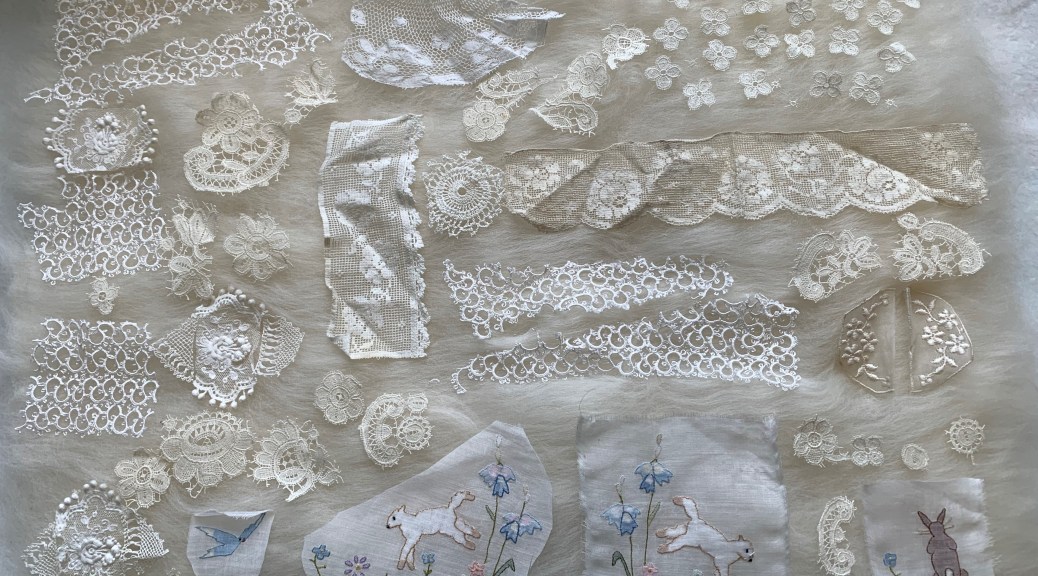
….. I decided to make a sheet of white felt, decorated with bits of vintage lace, old tatting and shadow-work embroidery, all bought in charity shops. I have a box full of old strips of hand and machine made ‘lace’, old dressing table doilies, bits of fine crochet….anything I think might felt. I thought this was an ideal opportunity to do some creative up-cycling. 


As I was making the felt it struck me that I have lots of handmade felt off-cuts, test pieces and samples that I could use in a similar way. A good opportunity to recycle work and release a little studio space. To continue my recycling theme, I even used charity-shop-bought crochet cotton for the hanging strings. 

These were cut from square samples I made during Fiona Duthie’s Ink + Felt class


Left, some more ink + cloth samples. Right, samples I made for my ‘hippie’ bag earlier this year

Left photo: Top left a nuno sample I made using recycled linen; the others were off-cuts from other projects

Right photo – the yellow was a coaster I made with coloured yarn; the green and pink are nuno samples, the blue is an example of paper felt with some acrylic pen

Finally, I painted some of the wooden bauble-shapes white, and married them with a broad strip of black vintage lace. 

So, the chance purchase of second-hand wooden blanks led me to upcycling vintage textiles and recycling some of my own felt off-cuts and samples. I love seeking out and using second-hand materials, especially small hand made things, usually made by women, that tend to be disregarded by many people. Often they are from something that has worn out, like a pillow case, or is rarely now used, like dressing table sets or antimacassars.

I have one particular piece of embroidery on fine silk that I couldn’t bring myself to use. The work is so fine I endlessly marvel at the skills of the woman who made it. It’s so intricate and beautiful with such tiny stitches it makes me feel slightly sad.  I bought it in a charity shop for £2. To me it’s a disregarded masterpiece.

Silk and embroidery (hand / finger included for scale)

The silk is starting to disintegrate and I’m really not sure what to do with it. Any suggestions? 

Needles and Their Uses

Needles and Their Uses

Comment: Hello! I am a beginner who just started 2D needle felting, and I have a few questions that I wanted to ask. When do we use each type of felting needle and what kind of design works best for each type? Also, are there any tips on how to felt yarn (especially for single strands that are used to outline shapes) so that the yarn doesn’t split? I’ve been having some trouble with the yarn splitting into thin fibers and not staying properly on the fabric. Thank you so much!”

___________________________________________________________________________

Needles and their uses.

This week a question was passed on to me about felting needles. The question was from someone who has recently discovered the wonders of 2D picture felting in wool. In the first part of her question, She wanted to know what each needle was best used for and when to use them. Needles are a Huge topic and not just a quick email so I thought maybe I better do a blog post since there may be more questions about needles out there.  I am not an expert but as you know I love to research and this is one of the topics I have investigated before and I keep returning to.

So, first, let’s Welcome this new felter to the amazing world of fibre! I am sure you will find it as fun and addictive as I have!  if you have more questions, yes I will likely inspire more questions, please ask. Don’t be afraid to jump in and experiment you may find something absolutely wonderful and will be able to share it with the rest of us. Now back to your questions.

Instead of thinking about what each needle does best individually, we may have more success if we think of needles on a sliding scale of how much fibre each style of needle will move or how aggressive it is in moving it. I will chat about that in a moment. Like wet felting tools, which are often repurposed for our use, our needles were not originally designed to be used by hand.  Let’s look at where our needles come from and what they were meant for originally.

Where our tools came from
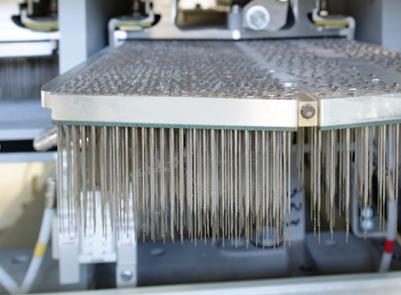
 1) Andritz – needle board

 2) Groz-Beckert – needle board

What we are using are actually industrial needles meant to go into industrial felting machines. There are two main ways to make industrial felt; one is with steam and agitation and in the second the fibre stays dry and the industrial felting needles are used.

The industrial machines make (non-woven) fabrics used in car interiors, acoustics (sound dampening), padding, landscaping cloth and other uses. I had read that the first needle felting machine was patented in 1857 but I remember seeing a picture of a needle patent from the end of the 1800’s, that isn’t too important for us just that the needles were originally designed to fit into the beds (boards) holding hundreds of needles which would be raised and lowered into the fibre passing through the machine.

The German Company Groz-Beckert claims to make over 2000 Needle variations for different applications and the machine used. These are changes in the barb placement and/or barb type, length and size or gauge of needle and the shape of the working part. Groz-Beckert is not the only company making needles although they make very nice needles. I have also used needles by a company called Doer sold out of China. I can’t seem to get much info on them but so far the needles I have ordered have been fine. (Be careful if you are ordering needles online and they are described as “short, medium and long”, you may get all the same gauge just in different lengths!)

For us, it’s the needle that is important, not the machines that hold them so I will try not to get off on a tangent.  All needles have common elements with some variations. Let’s start by looking at the common features of Felting needles.

 3) parts of a felting needle

The crank – the 90degree bend at the top of the needle. It seats it in the bed/board of the machine. It’s used in some holders to keep the needle stabilized but at least one holder requires it to be cut off. (Not so easy to cut needles so I did not buy a second of those holders.)

The Shank, the tapers (either one or two) and sometimes an Intermediate section are all parts that are important to the various machines that the needles are designed to fit in. For us, it’s a place to hold onto or stick in a holder.


The working part has a number of variations which will change the type of non-woven fabric the needle makes commercially. This is the part that as a hand needle felter we are more concerned with.  It can be divided into the cross-section shape, the placement, number and shape of the notches (barbs).

Shape – Originally, the triangle shaped needle was what was most commonly available.  Over quite a number of years we have many more types available, as re-sellers and felters became aware of the options in the industry.

Triangle – (3 sides) most common needle and use for both pictures and sculpture.  This is a good basic needle and can be used in most applications. They tend to be a bit less expensive than some of the newer needles that have been more recently introduced.

Star(Cross STAR) – 4 sides – will move more fibre faster since it has one more side than a triangle.

Tri-star  – 3 sides with an indented triangle cross-section.

Eco Star.  – 3 sided. With a profile of an indented and rounded triangular side. Both of these 3 sided stars are said to have less resistance upon entering the felt. I have not noticed a difference but I am not working with hundreds of needles at a time.

Twisted (triangle shape). The blade is twisted, it does not twist as you poke the wool. The advantage is that the barbs are dispersed more evenly around the needle, which engages fibres more evenly adjacent to it.

Crown needles are usually found in finer gauges and are used for detail work.  The barbs are only on one level and are placed near the tip of the needle. You don’t have to stab deeply since the barbs engage soon after the point enters the felt.

Fork needle – these are in a group called Structuring needles and are used in industry to make ribbing or as part of the process to make velour textures. These are just starting to appear and I have not tried them. I will look forward to seeing one in person and seeing what it can do. (I will let you know if I find one to investigate in person.)

Reverse needle – this needle has the barbs positioned in the opposite direction to the other needles. As you poke the needle into the felt nothing seems to change, as you pull the needle out, some of the underlayer (whatever depth the barbs are at) will be grabbed and pulled to the surface. This will create a surface nap or it can be used to blend the transitions between colour changes. The nap created can be reduced by using a regular barbed needle to smooth it.

Conical needles which have a tapered working part. I have only just received this style of needle and have not yet had a chance to investigate it. I am suspecting this will be a good finishing needle if used with the needle making only shallow contact with the felt. Or as a go-to needle if I am trying to increase the stiffness of the felt in a delicate area of a sculpture.

Ones we do not yet see out of industry are:

Vario barb needle Graduated barb size per edge: The closer to the point, the smaller the barb

Teardrop working part – this one has barbs only on one side and there are usually 4-8 of them. This one might be of use to hand needle felters but I have not seen it available yet.  It may be worth investigating if it appears. This one will depend on how much surface distortion (that pitting effect) the rest of the body shape of the needle makes.


Barb” (ok it’s more notch shaped but if the industry is calling it a barb then it’s a barb). This is where a lot of our needle re-sellers are not giving us all the info. There are 4 different barb styles from the German Needle manufacturer alone. Each has unique features, which will affect how the wool is grabbed and pulled into the felt. Some barb shapes are more aggressive.  Some are designed for longer wear in the machines (not quite as important to us since we don’t poke our work millions of times…. well I don’t think I do.  I never actually stopped and counted…. Maybe I should some time… no, maybe not.) Some barb shapes are designed to be gentle on the ground fibres. I have found that the needles I get from different re-sellers, in the same shape and in the same gauge, can still vary in aggression.  Which suggests the needles have a different barb on them. I would like to know so I could request a 40 or 42 with a slightly more aggressive barb when I get the feeling they just don’t have enough enthusiasm sometimes.

4) parts of the barb or notch.

The number of barbs per side is also an issue. Each side may have 1 (as in a crown needle) or up to 3 barbs per side.  On the end of a box of needles, you will see as part of the code 111, 222, or 333, denotes how many barbs are on each face of the needle. Again 3 barbs per side will move more fibre than 2 or 1 per side. Having more sides will also increase the amount of fibre the needle engages with.

 5) boxes of Doer Needles T32’s, T36’s and Crown40’s.

By now you may suspect I have a bias towards the 333’s but It’s not just all about speed and how fast you move fiber.  Sometimes you want to isolate just a few fibres and get them to sit exactly where you want, so a 222 or a crown (111) may be just the needle for you.

The last barb consideration is their spacing on the working part. Look at your needle and recognize that you are moving fibre only where the barbs are. So barbs close to the tip do not have to be plunged deep within the piece to work you only have to go in a bit to entangle the fibres. This is often helpful for people with muscle strain from over enthusiastic stabbing.

Finally, we have reached the end of the needle and gotten to the point (literally) which commercially also has a number of options depending on the required non-woven fabric being made. There are conical-shaped points, tapering points, rounded points and chisel points. What we usually want is something that will pierce the work entangling but not breaking fibres. So far, all the re-seller’s needles I have come across have been fine.

I did a few quick checks online as I was putting this blog post together.  I spotted that the new Surface coatings for needles that had been hinted at a couple of years ago in the industry are now listed as being manufactured. Most of the coatings are to increase the life of the needles in the machines (make them more hard wearing) but some are now listed for use with other fibres (non-wool) and others to expand the Geotextile line.

Needles come in different overall lengths.  This is very important to the machines they are to fit in and can be important to us if we have certain needle holders like the clover tool with a guard or the fake clover tool copy. If you are using an open ended holder (no guard to be shorter than) or using your fingers this is not too important.  Unless you find one length less comfortable than another one.


Our last variable with needles is a very important one to us, their Gauge:

6-7) here are two ways to visualize the gauges of needles

Needles come in a number of gauges.  Like wire, the smaller the number (32 gauge) the larger the needle is. So a 40ga is much finer than a 32ga.  Industrially speaking, there is a much wider range of gauges than we usually find for hand needle felting. Commercially I have seen from 16 to 46ga but we tend to use a smaller range (36-42).

32’s would be used for coarse wool or moving a large amount of fibre quickly. It is good for attaching a limb to the body but it will leave a more noticeable surface dent than a needle that is finer. (Think dents in a grapefruit or orange skin!) This is not a needle commonly use in picture felting since it creates surface distortion. You might use it in quickly tacking together a base for your picture but you would likely move to something finer very quickly.

36’s are also good for moving fibre quickly and leave less of a dent than a 32. I use a 36 frequently in the under layers for sculptures and laying in larger base layers of colour in a picture. (I will switch to a finer needle to add more superficial layers of colour over this layer)

38’s are a little less aggressive but also is less distortion of the surface. I use these for both sculpture and pictures. These are good for working on a bit more detailed sections as well as laying in layers of colour. I have used these to work finished details but most picture felters I have chatted with tend to go to finer gauges for finishing details.

40’s are finer still and move less fibre than the larger needles (remember gauges are backwards, with little numbers being bigger sizes) these are good for pictures and for fine details. They are not as fast as working with the larger gauges.

42’s are now getting quite common, they are finer than the 40’s and have even less distortion of the surface. They again will take longer to move fibre than the larger needles. Using them in a multi-needle holder may improve your speed if you are just firming up an area and is an option if you are working 2D.  I did a review of some of the different holders I have collected earlier this year (it’s all been a bit of a blur) I would suggest looking at the clover or fake clover tool with the guard and the metal bar needle holder from the Woolery for picture felting and painting with wool. Both are very helpful.

8) The Woolley’s 10 needle mettle bar tool

9) the fake clover tool (the really clover tool is green)

Usually, you buy needles by their gauge, depending on what you are going to work on and then fine-tune that by the shape. You may also consider the number of barbs to make the needle more aggressive or less, again depending on what you want it to do.  You will also likely find you tend to favour and use a couple of your needle options predominantly but its still helpful to have a good selection for the occasional time that a different needle would just be perfect!

Some needles are colour coded by the re-seller. This makes it easy to see what you’re working with. Or you can mark the edge of your working surface and store different gauges in different spots. Most of my needles are not marked.  I can tell if it is a finer or larger needle by looking at it or carefully running my finger over the working part and feeling it. If I am not sure, I tend to poke my project somewhere discreet and out of the way. The feel of the needle entering the felt will tell you if you have the correct one.

(Needle palpation– how to feel through your needle)

-did it feel like it grabbed a lot of fibre? Was there a lot of resistance to enter the felt?  Are there large surface dents and you want to do finishing details? Then you may want to try a finer needle.

– did you poke the felt but nothing seemed to happen? Have you been poking the same spot but you don’t seem to be getting anything to stick? Time to move to a heavier gauge

– did the needle break? (and it wasn’t because you changed direction from entering to exiting) Try a finer needle. As you felt the density of the felt increases and shifting to a finer gauge will help let you keep felting if you need to make the felt denser. Some felters do not felt that firmly and this is not a problem they would likely encounter.   Although it is VERY important to make felt that is appropriate to the use it will be put. This means both using a fibre that is appropriate to the use, and felting to a density that will withstand the intended purpose. As an example, Merino, while lovely and soft, will not wear as well if made into slippers.  Finn fibre would be stronger and the slipper made with it would be longer lasting. If you only lightly felt the slippers, they will also not last as long as more densely felted ones. For pictures, if you are framing them behind glass (I want to talk about that at some point) you don’t need the density that a 3D sculptural figure would. If you do not want to have glass your felt must be able to withstand dusting or even the horrors of a possible vacuuming (don’t trust someone won’t try that after you sell your work!).

If you are working on finishing details and you are pretty sure the 40-42 gauge is correct but it’s still not quite feeling right, try a different working part shape.  The stars are more aggressive than the triangles, the twisted will affect fibre more evenly around the needle. If you want to focus on the surface then a crown might be right.  The other advantage to the crown needles is not having to push them too deeply to entangle the fibres. (Less deep poking can equal fewer muscle complaints – maybe I should have another chat about ergonomics? Or maybe Ruth can give us some tips!) If you have switched from a triangle to a different working part shape but still want to increase the amount of fibre you are engaging with the needle, you may want to then consider looking at more barbs per side or fewer if you require a more delicate touch.

So it wasn’t quite as simple a question as it looked. My suggestion is to get a sample pack of needles from one of the re-sellers. Check your local fibre sources and felting supply stores first, then look farther afield like Etsy or Amazon. Look for a pack that has a couple of each of the main needle gauges in a few different shapes. You will likely have a few of the 222’s and 333’s in the collection so you can get an idea of how that affects the needles.  Most of the re-sellers now are colour coding their needles so you can see what is working best for you and order more.  If you have un-coloured needles you can make your own colour code using Nail polish, tool coating dip, permanent coloured markers or spray paint for mettle (just don’t get any of that on the working parts!!)

10) a few of the needles sets I have collected. Fibre Craft had full sets similar to Olive Sparrow’s sets but I seem to have used them.

Another tip is Instead of stabbing frantically, slow down and feel how the needle interacts with the wool. Having a couple of needle holders that have different needle gauges in them is handy too. I still love the metal bar tool from the Woolery for doing background laying-ins quickly (I think I have T36’s(333) in it at the moment). If you read an earlier blog you may remember the fun I had with the (3 needles) holders I bought from china. They are worth having because of the needle spacing and you can always mark with painters tape what gauge is in them (I do forget and really should remember to mark what I put in when setting them up! With a couple of pokes you can always tell if I filled it with 40’s or was it 36’s)

11) it’s good to have different needles in holders so you don’t have to stop and switch needles. These are all needle holders sold out of China

From my workshop notes, this might help too.

REVIEW REALLY IMPORTANT STUFF:

1 – Working depth; look at the distance the barbs extend up the working part of the needle. Maximize the fibre movement and minimize work, try to work only as deep as you need to and not poke through your work (unless it is very thin).  It will push fibre out the other side. If you push past the piece too much you will get the look of a reverse needle (Fuzz) on the backside.

Even though you don’t need a huge selection of needles it’s nice to have a choice, especially when working on small parts.

2 –  Change needles when you need to. If you are feeling increasing resistance in the piece you’re felting (the density of your felt is increasing) if you need it firmer then shift to a finer gauge needle.

Needles with more barbs (3 vs 2), larger gauges or sides (Star vs Triangle) move more fibre but tend to produce more surface pitting. This isn’t important if you’re adding a fur coat to your piece but maybe if you are working on a face or working on a picture.

3 – Stay Focused (and slow down). It’s much easier to avoid the finger if you are not distracted by a movie or TV show. Audiobooks and Music work better since you can keep your eyes on your needle and your fingers so they don’t cohabitate. (that can require Band-Aids)

This slideshow requires JavaScript.

12-23) A few of the pictures I have done or am working on. I seem to have a bit of trouble keeping some of my pictures flat. I hope they will inspire you to jump in and have fun with fibre!

Now the yarn question.

I don’t do a lot of outlining or drawing with yarn but what I have done I found that I started at one end and poked towards the part I had already attached, laying down and attaching a bit at a time. If you are finding your yarn splitting see if you can find a bit of wool of a matching colour and add a bit of that to tack it down. (a bit like a staple.) Make sure your yarn is wool.  It is much easier to work with than acrylic.  For gauges, I tend to use a 38 or 36 gauge with the size of yarn I have played with. You may also try felting the yarn in on more of an angle. So poking closer to parallel to the surface you are attaching it to.  (The direction the needle moves is the direction the fibre will move too).  This also increases the likelihood that you will be engaging with both ply’s. if you are stabbing straight down you may increase your chance of having the needle land in between them, increasing their chance of splitting.

Yarn considerations:

-Size of the yarn (DK to lace weight) try the finer needle with the finer yarns.

-Tightness of the spinning (loose spun may be more prone to splitting than a tighter spun yarn) This could be an interesting investigation! So many thoughts, so little time to felt lately!

-Fiber content (other than superwash) wool is narcissistic and will want to be with itself or other wools, some other fibres are not so enthusiastic about entanglement with others.)

I tend to lay in fibre rather than yarn when I am drawing with wool.  I find I take short thin bits of top or a small amount of a lock then anchor one end with the needle and draft it just a bit more so it’s finer than I think I will need. (Thin lines seem to want to be stronger than I intend them). I start directing my needle at a shallow angle back in the direction I have affixed the fibre. There will be a little take-up but it is from the end with the loose fibre rather than the part I am trying to attach. I have the fear that this may be a clear as mud but I know other blog readers may be able to add more suggestions since they may have investigated yarn more thoroughly than I have.

If you are excited about where our needles come from and the scope of options available you might like to read a PDF put out by the Groz-Beckert company.  https://www.groz-beckert.com/mm/media/en/web/pdf/Felting_and_structuring_needles.pdf (no it’s not homework it’s just in case this topic is as exciting to you as it is to me!!)

I hope this has helped our new felter with the needle question and has been a review for the rest of us. Looking back through past blog posts will give a vast amount of information too! Search under “Needle felting” or “Picture felting” or maybe”Painting with wool”. I promise I will show you how Dragon’s wings are coming along soon! Dragon now has silk highlights!!  How Posh!!!

Have fun and keep felting!!!


An International Project by Line Dufour

An International Project by Line Dufour

Line Dufour has been a practicing textile artist and tapestry weaver for the last 35 years. She is a graduate of the Ontario College of Art in Toronto Ontario and has always had her own studio. She taught weaving to adults for about twenty years, while at the same time doing art/craft shows and exhibitions. She is currently retired from teaching but continues her studio practice. At the moment, Line does not have a gallery that represents her, and if someone wants to purchase one of her pieces they contact her through her website or social media or other channels. Line’s website www.linedufour.com. You can find her cv on there as well. She is currently enrolled at the University of Gloucestershire in the UK and working on obtaining her Master’s in Creative Writing and Critical Thinking.

And now the project


Fundacion Pablo Achtugarry, Punta del Este, Uruguay 2017


Fate, Destiny and Self Determination [] Le Sort, Destin, et l’auto-determination [] Suerte, Destino y Auto-determinación [] Los, Przeznaczenie i Wola [] Das Schicksal, das Geschick und das Selbstbestimmungsrecht

[] 운명, 숙명 그리고 자기가 결정한 팔자. 팔자  []  Usud, sudbina i samoodređenje [] Sorte,Destino,Auto Determinação [] Öde, mål och självbestämmande [] Fato, Destino e Autodeterminazione


Written by Line Dufour.

Fate is defined as a force, energy, principle, element or power that prescribes to each person a set of limits, boundaries and confines. In Islam it is called Kismet. The Greeks called Fate, Moira. Greek Mythology speaks of the three Fates: Clotho, Lachesis and Atropos who supposedly controlled each person’s fate. The youngest, Clotho,  is a spinner and she determines the time of birth and spins the thread of life on her distaff. Lachesis measures the length of the thread to determine the length of one’s life; the time of death is decided by Atropos, who cuts the thread. Inherent in the idea of Fate, is that one has no influence over events and outcomes. Mythology and psychology distinguish between Fate and Destiny. Destiny is considered an expanding field of possibilities alluding to our potential to influence our Fate. This makes Destiny kinetic. “The lives we construct are an inextricably woven fabric of influences, possibilities and accumulated consequences of choices made.” (James Hollis)

The development of the COVID-19 has made all of us more aware of the impact of isolation on our well being. This sense of isolation forms the underpinnings of this installation launched in 2016.  Fate, Destiny and Self Determination was created as social media driven initiative to reduce the isolation artists experienced in their artistic process through co-creating the installation, providing planned hands-on events and gathering them together to exhibit their collective efforts. Inclusiveness is the weft that weaves the installation together.

Fate, Destiny and Self-Determination is composed of three sections. The main tapestry woven panel (on the left) was created by Line Dufour, referencing the contemporary practice of tapestry where artist and weaver are one. The second panel on the right, was woven by visiting participants ranging from the inexperienced and amateur to the professional. This referenced traditional tapestry conventions in that many weavers work(ed) on the tapestry at the same time or at various stages and did not contribute to creating the tapestry designs.

The final section is composed of irregular shapes positioned at varying heights, between the 2 main panels, floating freely in space, as though the tapestry is pulling apart or coming together.  As each shape arrives, Dufour photographs/documents it, posts it to the Facebook page for the project https://www.facebook.com/Fate-Destiny-and-Self-Determination-An-international-tapestry-project-194385150700425 as well as on Instagram@tapestryline and Twitter@tapestry_line. She also includes information about the participants such as their website if they have one, and other comments they have made about the project or about their work and/or life. Thus far, 864  shapes have been received from 43 countries, and a total of about 519 people have participated. The installation continues to expand as it accepts shapes on an ongoing basis. Part of the exhibition includes a list of all participant names. If a label cannot be displayed in the gallery, a QR code label is available so that the gallery viewer can access the web page with the names of all participants.

Each time Fate, Destiny and Self-Determination is installed the shapes are never placed in the same positions, making it interactive and spontaneous, and permits the curator(s) to be part of its creation. Conversely, the curator could also invite the gallery guest to position shapes on the wall between the two panels, having them re-create the installation.

The installation welcomes invitations to be exhibited around the world, and to that effect has been exhibited in the following venues:

  • Craft Ontario in Toronto, Canada
  • The Montreal Centre for Contemporary Textiles, Montreal, Quebec, Canada
  • The Doyle and Margaret Hartman Gallery, Regis University, Denver, Colorado USA
  • Craft Council of British Columbia, Canada
  • The San Jose Museum of Quilts and Textiles as part of the American Tapestry Alliance Biennial 11
  • Guan Shan Yue Art Museum, Shenzen, China. 9th From Lausanne To Beijing
  • The Centre D’Action Culturelle de la MLC de Papineau in Québec
  • World Textile Art Biennial at the Fundacion Pablo Achtugarry in Punta del Este Uruguay
  • World of Threads, Oakville, Ontario, Canada
  • Rosccommon County Council, Roscommon Ireland
  • Tuchmacher Museum, Bramsche, Germany
  • Tuch & Technik Textilmuseum, Neumunster, Germany


Anyone who wishes to do so, can create a shape using a textile/fibre related technique (tapestry, rug, weaving, felt, basketry, etc) or create a piece that references textiles with whatever materials they like. Any hue from the colour wheel is suggested. You can use more than one colour. There is no minimum or maximum size, but the average size is 10cm (4”) . There is no maximum on the number of pieces you can submit. A person can also weave (create) a shape of their country, state or province or any shape except not a square or rectangle.  You can look at the Instagram @tapestryline page for the project to see how other people have created their shapes.

You can never have too much felt art

You can never have too much felt art

Since we moved to our new home in May we have been steadily adorning the walls with the pieces of art that moved with us, as we were deciding what to hang where, Mr TB pointed out that more than half of the art work on our walls is made from wool. I couldn’t disagree but still felt compelled to make a new piece to hang in the hallway, opposite the front door. Something colourful and cheery to greet any visitors. Much to my surprise, instead of complaining that we have too much wool on the walls, Mr TB helped me hang it…

I really wanted to play with a piece of silk purchased at Fibretron (a fibre festival in Hamilton, NZ), it has this wonderful wavy texture and can be peeled into fine sheets a little like silk hankies. I used some to decorate a large sheet of felt, layering and blending different colours as I went.

Once felted, I cut up the sheet into large petal shapes and continued felting them while shaping and blocking them, before laying them out to find an appealing arrangement.

At this stage I felt like the centre really needed something, a complimentary colour perhaps? So I had a play with some different colours…

But they didn’t quite feel right.

I have recently been playing with making different sculptural flower shapes and had one sitting on my bench. This looked much better, this is the piece after I had started gluing and sewing the petals together:

I tried making another central flower in the same blues as the large petals but it didn’t look half as good, it’s funny how some, unplanned, random elements just work together isn’t it? More on the blue flower at the end of this post…

Here is the final piece assembled and hanging on the wall:

It had been hanging on the wall less than a week before one the fluffy terrorists discovered that, if he jumped really high (4 feet off the ground), he could rip the petals off and add to his collection of toys. So far the hanging has lost 2 petals….

Floki with his “prizes” – if you look closely you can also see muddy paw prints on the wall

There were quite a few pieces of felt left over after making this hanging so I re-purposed them to enlarge the small blue flower I made with the intention of it becoming the centre:

Now I feel inspired to make a whole bunch of these to create an artificial flower bouquet….

Summer has finally arrived here in Auckland, I hope the weather is being kind wherever you are.

Fourth Quarter Challenge Or How Felt Doesn’t Like To Be Rushed

Fourth Quarter Challenge Or How Felt Doesn’t Like To Be Rushed

I was in a bit of a hurry to come up with something to post about today. I decided I would go ahead and try out another glass cover in the style of a 60’s artist. Last quarter, I created a similar piece based on Mark Rothko. 


Photo Courtesy of 1stDibs

I searched for artists painting in the 1960’s and found this photo of Stanley Bate’s Year of the Dragon. This looked interesting and I thought it would work in felt.

I kept the photo handy during layout and the first layer was all about values. I wanted to use the black and white prefelt to achieve the correct values once covered with a variety of colors. I laid out the prefelt on each side of a rectangular resist. And this is where the rushing felt problem really began. The two types of prefelt were different thicknesses. I should have done a light layer of fiber underneath the prefelt first but didn’t think of that until later.

I wet down the prefelt and then covered with a variety of yellow to red colors with pops of blue. I made this layer pretty thin. Also, not thinking ahead and trying to get done in a hurry.

I started felting and noticed several areas that were already developing holes. Sigh… So I did add more wool on to the thin areas and moved forward. But the hole problem continued and finally, I just ignored the holes and moved forward with fulling.

The shrinkage was totally different than the Mark Rothko inspired piece due to the use of prefelt. I had thought that perhaps the prefelt would add an interesting textural aspect but it just seemed to develop weak spots between the various pieces. More sighing…

And here’s the result. I ended up not getting enough shrinkage around to fit over the jar I used last time. Instead, I used a large tea tin. If you enlarge the photo, you might be able to see some holes.

I turned it inside out and decided I might like that side better than the original outside. It even looks more sixties to me. You can definitely see the holes here. I guess I can make the holes a design feature and turn it into a light.

How many years have I been making felt? A long time. Do I still try to rush things sometimes? Of course. Will I ever learn? Doubtful. Perhaps it’s just human nature or the world we now live in, that causes me to be hurried when I really should take my time. How about you? Do you get in a hurry sometimes when creating? I’m not sure why I do it when I am rarely satisfied with felt that has been rushed. Taking a deep breath and slowing down.