Browsed by
Month: November 2021

Recycled Coffee Capsules

Recycled Coffee Capsules

It doesn’t seem all that long ago when life was simple and the only decisions we needed to make regarding our daily fix of caffeine were “instant or percolated”, “black or white”, “with or without sugar”?

How times have changed! Nowadays we have a dazzling array of flavours and styles to chose from when visiting our favourite Barista. I did once try a cinnamon and syrup latte in M&S and have never forgotten how vile that was…..give me a straight forward, simple latte every time! On the other hand, if you like your coffee more exotic, there are plenty of rather weird (and probably not so wonderful?) tastes to explore. The Farm Girl Cafe in Portobello Road could be the place to visit if you fancy a black charcoal latte made with activated charcoal, date syrup and cashew milk. Or how about their blue Butterfly Matcha made with organic blue matcha powder (now there’s an interesting ingredient to look up) with almond milk or their most famous creation, the rose latte (a double shot with rose water infused milk and petals)….there is obviously a market for it but personally I think I’ll pass!

Of course we no longer have to go out to get our fix of posh coffee thanks to the popularity of the domestic barista machines and the single use coffee capsule. Although many of these are said to be recyclable, according to Nestle, only around one third of their capsules (Nespresso, Dolce Gusto, Tassimo) were being returned to the manufacturer for recycling in 2020. The rest were ending up in landfill where it’s predicted they will take 500 years to breakdown!

Photo source: http://www.johnlewis.com

A “not for profit” organisation in the UK called Podback are now working with local councils and other organisations to make it easier and more convenient to recycle our capsules with roadside collections alongside other household recycling. Consumers also have the option of leaving them at over 6,500 Yodel drop off points and we should soon (if it’s not happening already) have them collected by supermarkets when they drop off our online shopping.

That’s all sounding good but many of us are finding more creative ways to recycle our coffee pods, albeit on a far smaller scale. One use is to add them as interesting, textural ‘inclusions’ to a felting project. The first time I saw this done was in 2018 when I attended a Felted jewellery workshop with the wonderful German tutor Ricarda Assmann. Although we were working with fabrics, not capsules, three of the necklaces Ricarda brought as workshop samples had the aluminium crushed pods in them. At that time I didn’t have any capsules but the contrast between the hard texture of the metal and the soft feel of the fibres really appealed to me.

Another fabulous feltmaker, Judit Pocs, created this enormous “Gate” wallhanging in response to a commission from the Feltmakers Association. It is something like 2mtrs tall and studded with crushed capsules in a multitude of colours. Judit also makes beautiful rings with them and teaches the technique for making these in her online workshop.

The Gate by Judit Pocs
The Gate detail showing the capsules
Felted capsule rings by Judit Pocs

The year before I attended Ricarda’s jewellery workshop I had the idea to recycle my collection of Tektura acrylic wallpaper samples as inclusions in my pendants (I never throw away anything that might have a use in the future!) It’s a simple process but very effective, wet felting the “waterproof” paper discs between pieces of prefelt. Four years on, and with those papers almost depleted, I’m now starting to use coffee capsules instead. Being thin aluminium they can be crushed by hand (that’s how I did the gold one in the ring) or they will flatten more easily with a little persuasion from a hammer, in which case I find it best to cover them with fabric first to avoid the hammer scratching off the colour. I’ve also started using them in some of my brooches.

I’m sure some of our readers will have tried Felting with capsules and I know Ann did some experimenting with them which you can see here, has anyone else tried this? They could look great in 3D pieces such as bags, sculptures, etc. I did a google search and didn’t find any other images of felt with capsules but I’m sure there’s lots out there somewhere. I did find zillions of “non felted” ideas for recycling on Pinterest, Etsy, YouTube, etc and websites including ecogreenlove.com, these are just a few…..

Nespresso Pendant and Earrings
Necklace
Floral Arrangement

There are so many inventive ways to create with coffee capsules and with Christmas fast approaching they could be used for decorations or even nativity scenes like these found on Pinterest…….

I will leave you with one of the most impressive uses I came across which was the stunning 2017 catwalk collection by Birmingham designer Rhys Ellis. Rhys studied Fashion Design at Birmingham University and, as part of his course, he spent a year in Italy studying at the Politecnico di Milano design school alongside world-renowned tailor, Guiltiero Fornetti.

“It was while I was in one of the markets that I saw a lady making very simple jewellery from these coffee pods and something just clicked and I knew that I could create dresses this way.“ “I also liked the idea of using material that would otherwise be thrown away.”

Photo source: http://www.comunicaffe.com

I won’t be making anything that dramatic but I am planning to make lots more pendants and brooches. I might just add some capsules to my next felted bag too. If you’ve done anything with them we would love to hear about your projects in the “comments” and you could always post them on the Forum.

A Quick Request for Chickadee Eggs

A Quick Request for Chickadee Eggs

As you may have read earlier, I had made Chickadees for all my brothers-in-law and my Mother-in-law.  https://feltingandfiberstudio.com/2021/09/06/an-army-of-chickadees/  Brother in law #4 brought his chickadee home and hid it in his house and waited to see if his wife would find it.  She liked the chickadee but was not so amused that she had to go find it.

While I was in southern Ontario, I was helping my sister in law who is married to brother-in-law number four. She mentioned it would be so cool to have a nest and eggs to go with the Chickadee. I can’t do much about a nest at the moment but I may be able to do something about the second request.

My Mother-in-law’s chickadee was still hanging around the living room. He/she had left the almost empty bowl of nuts and was keeping an eye on the other bowl with different nuts from the coaster holder. Excellent, I can try to get the scale correct.

1  Mary’s Living room Chickadee keeps an eye on the nuts

So off to the internet to do some research but being quite busy with assisting with elder-care, I did not have the leisure of a thorough search of the topic. I did find that the eggs of a Carolina chickadee had been photographed but I had trouble finding images that were definitely labelled as the northern chickadee’s. Well, my sister-in-law (and the chickadee) lives in Virginia so the local eggs would be of a Carolina Chickadee to be correct. (It might confuse the Northern Chickadee but it is unlikely she would find only a Carolina chickadee to date anyways.) Ok, it looks like the eggs are small and mostly white with brownish spots. I can do that.

I had brought the dragon I was working on and a few bags with different colours of wool. So I dug around until I found some white. I think it’s some of the Corriedale roving. I also had a tiny bit of white alpaca and some reddish-brown that was courser than the Corriedale. I am not sure where I picked it up or what it was but it may be perfect for this.

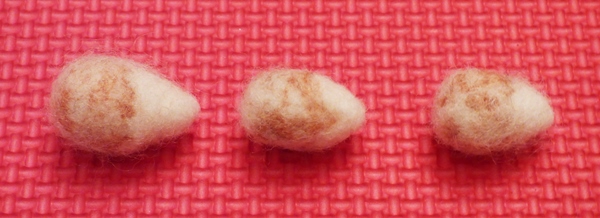
I created the egg shape from the white Corriedale,  then made 2 more since One egg would get lonely. (so that is three in total.)

I blended the alpaca and coarse reddish-brown to give a mottled variegated tone. I then broke the fibres into short pieces under ½ inch long. I selected a thin wispy amount and draped it over the egg shape in a band towards the fatter end of the egg.

I tacked down the fibre in spots, trying both the 36 and 40 triangular needles.  Where poked, the colour darkened significantly and in between the pokes showed a much lighter and less distinct brown.

At this point, I considered using the sharp embroidery scissors. This would trim the fibres so that only the attached fibres/spots would stay making more distinctive dots. The problem with this would be that I would lose the lighter in-between shade and I would have to be sure that each spot was well embedded before trimming.

Plan B; lay over thin wisps of white to bring down the intensity of some of the darkest spots. This worked well. I wish I had a bit more of the white alpaca on hand for the outer layer but the Corriedale work.

Unfortunately, I was very focused on getting a few minutes at a time to work on this and the little dragon project and I do not seem to have taken pictures as the project progressed! I am sorry!  So I can only show you how it turned out.

2 Look I found in the Napkin basket

3 eggs!

4 – 6   Egg close-ups

We had more wildlife in the backyard while I was there.

This slideshow requires JavaScript.

7 – 10 Sparrow, Woodpecker, Robin, Bluejay

I hope you have been having fun felting and playing with fibre.


Update:  I left Oakville promising to be back on Friday evening with my husband. I had planned to sit with my mother-in-law and make Dragon’s wings. (she had been so intrigued watching me bend and twist wire to create the armature. she continued her interest as I added the layers of wool to start the body, so I wanted to let her see what would happen next with the wings.) Unfortunately, my Mother-in-law did not wait for us and died peacefully in her sleep early Friday morning.  Her memorial service went very well and I had suggested her minister may like to have her Chickadee as a reminder. The brothers agreed and we gave her the little bird. She was very happy to receive it. We did not know she had a bird collection but did know she was particularly fond of my mother-in-law. She was an amazing woman and will be greatly missed.

11 Chickadee in her new home with Reverend Sheila


A Little Spinning for My Felt

A Little Spinning for My Felt

I managed this week to get one set of rolags spun and plyed.  I decided to do wildflower sari silk first. It’s the mostly yellow one. Here’s the link to making the rolags if you missed it. https://feltingandfiberstudio.com/2021/10/26/sari-silk-and-spinning/

I spun a single first, naturally. It took a little bit to get used to the silk. The silk is much harder to draft but mixed with the wool it wasn’t too bad. You have to accept you are not going to get a really smooth yarn. You are going to get a great texture.

Next, I did what is the most meditative part of spinning for me. I made a center-pull ball by hand. If you are in a hurry or you have lots to do then a ball winder is the way to go. But I really do enjoy this part. I use a little piece of painter’s tape to make sure I don’t lose the center yarn, while I am winding. Do you enjoy doing something that other people seem to dread doing?


Then the fastest part, plying.

It’s interesting that when it was a single I thought it was a bit dull and muddy but after plying it seems to be brighter and shinier. I really like it. It has lots of colour and so much texture. it will be great as an embellishment on my felt.


I haven’t decided if I will make it into a center-pull ball or a skein for storage.

Finishing Nuno Landscapes

Finishing Nuno Landscapes

I am feverishly working away trying to finish up some landscapes and get them to the framer. I suddenly realized that it’s November and I needed more work to sell for the holiday season. I have always had good intentions of finishing pieces, getting them sewn to the backing fabric and laced to a board when I complete the piece. But somehow, those good intentions are paving the road to procrastination. Here I am again, finishing all the landscapes at once.

I went to the fabric store and found some fat quarters that worked with the various colors. I then hand stitch the nuno piece down to the fabric and lace it around a piece of matte board. Here is “Twilight” on it’s backing board ready to be framed.

This one I chose black fabric for the matting and laced it on to the matte board with a very minimal edge. I only want a tiny bit of black to show. This one is called “Serviceberry” at the moment unless I come up with a better name.

Believe it or not, I have finally decided that my slow stitch project is complete. I stitched it down to some brown fabric but I haven’t gotten this one laced on to the matte board yet. This one is called Autumn Impressions.

For those of you who wanted to see what the original fabric looked like, here it is.  Definitely a bit of a change!

The last one is the green nuno felt that I showed you recently. I finished stitching and decided it was complete. I have it on a dark green fabric background but haven’t stitched it down yet. Hopefully, I will get these finished up this week and get them to the framers by Friday. That’s the plan, anyways.

And here’s a close up of the bottom so you can see the stitching around the poppies. I still haven’t decided what to call this one yet. Several suggestions were made last time and I decided I had to research whether the plant I was thinking of was really Queen Anne’s Lace or whether it was Hemlock. It could be either. So then I kept thinking of titles such as Lethal Serenity, Poisonous or Peaceful?, Deadly Tranquility etc. So I will keep thinking on what it should be called as I finish stitching it down and lacing it.

hippie-style crocheted top & colourful floral felted pod – 4th quarter challenge

hippie-style crocheted top & colourful floral felted pod – 4th quarter challenge

Lyn

In the late 60’s I was taught how to crochet by my Aunt Doris and I loved it.  She showed me how to read a crochet pattern and the first thing I made was a green mini dress for myself.

At that time the ‘granny square’ became popular and I made a long, sleeveless jacket for my mum from brightly coloured squares edged with black.

So coming up with a challenge idea was easy for me.  I had a search of the internet and found a free pattern by Michelle of The Snugglery (free pattern) The pattern is for a 60’s hippie-style top.  Perfect.

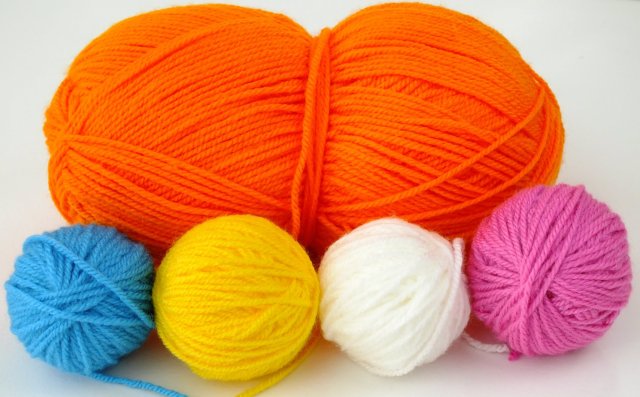
I auditioned my stash of yarns and picked out some bright ones that I thought went together well – orange was a very popular colour in the late 60’s.

I made 8 traditional granny squares to measure 16.5cm (6½”) each – all the same as the one shown below.

If you’d like to know how to crochet a traditional granny square, there are many free YouTube videos – here is a good one but be aware that US double crochet stitch is UK treble crochet stitch.

how to crochet a granny square


How frustrating is it when you come to a knot in the yarn?

Here is Michelle’s pattern showing how to join the squares….

… and here are my 8 granny squares stitched together but not yet joined to make one piece.

A fringe, made with 3 strands of yarn, is essential to the look of this top.  I decided it would be easier to attach a fringe while the squares were flat on the table before joining them to make the top complete.

The thin straps were crocheted using 3 strands of yarn and a simple chain stitch.

Here’s how I kept the 3 yarns from tangling.

The finished top will be donated to a retro charity shop and I hope someone enjoys wearing it – even if it’s for fancy dress!  Here’s the ‘flat’ shot …

… and after much persuasion, here’s Annie modelling it, but she refused to take her tee-shirt off!

Annie

I’ve had plans to make some more pods for a while now and as flowers were popular in designs in the 60’s I thought I’d make a floral one for the 4th quarter challenge.

Usually I put the design on the outside after the fibres are all laid down but this time I decided to do it in reverse. I think it would have worked well with a simpler design but it bent my brain trying to lay down felt flowers, yarn outlines and background fabrics in reverse!

In the end I laid out the design for the first side face up over a template circle so I’d only have to do the other side in reverse.  It was quite complicated with having to wrap the design round the edges.

Then I put the resist on top and flipped it all over so that the design faced into the resist.

I laid down the first layer of fibres over the design then carried on making the pod in the usual way.

After I took the resist out I turned it inside out to reveal the design then carried on felting to shape the pod.  I didn’t really think it through – maybe it would have been easier to just put the design on the outside.  But it was fun to make.  Although it’s not perfect it’s not wasted time – any time spent experimenting and making is time well spent if you ask me!