
FANTASTIC FUNGI
I don’t know if any of you are fantasy fiction fiends. Some years ago now I read the first of a trilogy by Alan Dean Foster, called Spell Singer. It was about a man in the 1960/70s who managed to slip through time/space to a different dimension of our world in which animals wore clothes and talked (including Mudge, the man-sized otter with a foul mouth!) So why am I mentioning this? Well part of the story took place in a marshy area inhabited by a lot of very depressed mushrooms and toadstools with faces, which moaned and groaned and exuded misery, which was catching!
My mind immediately trotted down the rabbit hole of needle felting mushrooms – with faces. Mushrooms and toadstools of different varieties would have different temperaments and expressions. I thought of the white spotted red capped Fly Agaric; plain red capped Gomphidus Roseus (with a name like that they would definitely look odd); white button mushrooms; brown chestnut mushrooms; large flat horse mushrooms; fairy ring toadstools and, eventually, bracket fungi.
So I was off.
I decided that the bases of the fungi with stalks would represent a piece of turf, probably woodland or scrub. I had purchased, a few years earlier, some fibres sold for lining hanging flower baskets. It never got used for that because the bulk of it consisted of sheep’s wool, and I considered that it would be wasted if used for it’s original purpose. From the look of it, and of the quantity of “foreign matter” caught up in it, it was the sweepings from a mill floor or even a shearing shed. (I think that this was a good way of using up what would otherwise be wasted. Unfortunately I don’t think it’s available now.)
All the material was roughly dyed green but luckily so patchy was the dyeing that it was not a flat uniform colour. The different thicknesses of the fibres, the kemp and the vegetable matter all seem to have picked up different shades and tints of green. Just what I needed.
To save on this precious material, I used some scrappy scoured merino bits as a base for the underside of the grassy humps I was making, and then topped them with the basket fibres, and needled the lot together. I was delighted to find that, even close up, the result did look like a bit of scrubland grass.
In each case my fungi were to have faces and, hopefully, characters. I thought that as they were all wearing hats/caps, I’d place the faces at the join of the gills and the top of the stalk. I also decided that, rather than just a single lonely fungus, I’d make families.


The horse mushrooms are hairy, not because they were horse mushrooms but because I used some Herdwick fleece for the caps and didn’t know about shaving in those days.
In the end, the button mushrooms and the chestnut mushrooms not actually having any gills on view, I placed their faces on the top of their caps. I also gave the chestnut mushrooms Fymo eyes – little painted and varnished balls on each end of a piece of wire.


The fragile, skinny fairy ring toadstools were to sit together in a circle, as they do, on a larger piece of grass with so much magic erupting from it that it became visible. This was represented by whisps of iridescent trilobal fibre (of which I have lots.) There was also magic appearing on the tops of their caps. These were made from scraps left over from a large piece of white merino felt in which a large quantity of the iridescent trilobal was embedded. (More about this felt at some time in a future post.)

These were the main families I made, but in the end I did make quite a few solitary mushrooms and toadstools (perhaps that’s why they were so melancholy?)
It was while I was making the Horse Mushrooms, which have black gills and therefore black faces, that I started to think about bracket fungi and Welsh male voice choirs. I can hear you saying “why?” It was the black faces. I am half Welsh. My mother’s family come from a South Wales mining valley, Ogmore Vale, and all my Welsh uncles were miners (hence the black faces), and they were all singers. (I even got to go down a pit on a rare holiday to stay with the family when I was about 7 or 8 – and I cried for the poor ponies down there even though they were well looked after). Anyway Welsh miners were magic to me, and having been thinking about magic since I made the fairy ring toadstools, I wanted to create a magical tree stump on which to grow a male voice choir of bracket fungi.
The inside of the tree stump was made up of part of a Jacob fleece which had absolutely refused to felt, and subsequently ended up in the cats’ bed – disappearing over time bit by bit into the middle of other needle felted items. I covered the stump in more of the basket fibres to represent a rotting, moss covered piece of wood. Thanks to the unevenness of the core Jacob I was able to easily create a surface with the ridges and dips usually found on oak trunks. There were also what looked like various entrances to the hollow centre of the stump. I lined these with black or dark grey fibres to give them depth and added some mixed brown and iridescent fibres to represent magic escaping from the stump. In two of these I also added a pair of (Fymo) eyes peering out at the world.

I added a sort of representation of tree age rings on the top of the stump, but also allowed the hole in the middle of it to remain and added a lot more escaping magic fibres.

I made a lot of bracket fungi, both representing individual singers (baritones and basses – big and bigger ones)


And Tenors, since they were smaller, in groups of three.

I know I researched a type of bracket fungus and was able to give them black “faces” on the undersides and brown tops with pale margins. However I cannot remember what they were, nor can I find my reference pictures. They may have been polypores of some sort.
Having made a batch of the “choir members” I needled them on to the stump, adding faces with singing mouths. I attached the stump to an artist’s canvas board, 20” x 16”, which I had covered with a piece of cotton patchwork fabric, coloured in various greens, to represent the surrounding trees. Originally I wanted to add a “dead man’s fingers” fungus, which could be conducting the choir, but at that time I had not heard of using an armature and it wouldn’t stand up on its own, so I gave up that idea.

My husband thought that the mushrooms would sell like hot cakes, but unfortunately I think I only sold one family. I ended up giving the rest away, apart from the tree stump which I have retrieved from the attic. I’d like to hang it on a wall in my workshop – if I can ever find a space large enough for it – if I can I might have another go at the dead man’s fingers.




 1) 48-piece Rare Earth Magnet and Dispenser Set
 2) Tiny, tiny Enthusiastic Magnets sticking to a felting needle to show you how tiny they are
 3) This may not be the Corriedale you were looking for (spooky Jedi background music)
 4) Eventually there was a head-like shape, sort of
 5) Ears added to the slightly sheepish head
 6) Magnet balancing precariously on superior aspect of sheep neck

 7-8) Extending magnetic picker-upper of things mettle, with built-in light (it Is dark under the table)

 9-10) First I tried lightly felting a bit of wool, then attaching it to the back of the head. This was not totally successful since the magnet migrated lower than where I had been trying to hold it. I also found the needle was very attracted to the magnet when I tried to poke adjacent to it. Interesting.
 11) Sheep head sticking to bulldog clip
 12) Magnet sitting in a bit of a divot and leaving the rest of the loose wool to work over the top of the magnet once it was in position.
 13) The magnet was attracted again to the needle so this may not be quite the best solution
 14) It was a bit more challenging to keep the magnet where I wanted it but the divot did help.
 15) Success! But this took more time but kept the magnet location where I had wanted it.
 17) Now let’s talk about ears.
 18) Time to add the second Magnet and check it sticks through cloths. Yep!
 19) The tiny crimpy locks from Ferme Sol Farm in Wakefield Quebec

 20-21) Front and back view of the sheep broach with a second magnet to go inside your shirt. This is less damaging to fabric than a pin broach back would be.
 22) Here is the sheep with both the curls and ear details added.
 23) A bit of online shopping arrived and I have added the two new boxes to the tools I used for this project (you don’t need quite this many needles I actually only used 3needles, which were each different, to make the sheep)


 Core Wool


 Apologies for the blurry image!

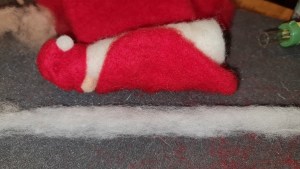


 I work the trim all the way around the cloak, and finally add trim around his hat. It’s important not to ‘over-felt’ the trim, because you want it to look like fur rather than felt.


