Making Waves

Making Waves

One of the things I’ve noticed from being at felting workshops is how predictable we tend to be when it comes to choosing our colour schemes. Whether we’re making a wearable, a bag, a vessel, etc whatever it is the majority of us will reflect that colour back in what we are wearing or the accessories we carry on that day. Before a class begins we can mostly tell at a glance who will be working with reds, who with greens, who with neutrals, etc, etc.

Personally I’ve always been drawn to neutrals, working with fibres in various shades of grey and beige with a small amount of accent colour, usually yellow or green. Unsurprising then that my wardrobe also tends to be filled with neutral colours. So what happened when the Waltham Windmill group launched their latest theme “Making Waves”? I could have followed the theme while sticking with my neutral pallet but for some reason I found myself wanting to work with blues, and not just as an accent but as the main colour. What I hadn’t realised until this last week is that blue hasn’t just found it’s way in to my studio but, without making the connection, it’s also started appearing in my wardrobe and I really hadn’t seen that coming!

Within the groups theme we have free reign to make whatever we want plus we’ve agreed a number of specific items we will each make, one of them is a jelly fish. Having done a bit of research into the many and varied species of jelly fish I came across the spotted Blue Jellyfish which is native to UK waters. My first thought was to create a “wet look” using Merino fibre covered with lots of viscose which would create a sheen and then I would free motion stitch the spots. That was quickly replaced with the idea of making my fish from sheer fabrics…..I seem to have accumulated lots of sheers and only ever use tiny amounts so this would be a perfect opportunity to use up some of my stash. After rummaging through a huge sack of fabrics, almost losing hope of ever finding the colour I needed, I came across a small piece of blue and another of turquoise, just enough to do the job…..so much for stash busting!!

The remnants of fabric, and the size of my embroidery hoop, determined the size of my jelly fish. I’d got some of the wash away stabiliser left over from a project I did a few years ago so that would be useful for stiffening and shaping the jelly fish.

I had enough blue fabric to cut out two circles plus one slightly larger from the turquoise. I also added a small white circle of fabric underneath thinking it would highlight the spotty area. Next I cut up some scraps of felt for the spots and arranged them on the blue discs before covering with the turquoise sheer. This sandwich was then put in the hoop and I machine stitched around the spots…..or at least that was my intention! Unfortunately I struggled to see where some of the felt was so it’s a bit hit and miss but it was near enough!

After removing it from the hoop I washed out some of the stabiliser retaining a good bit of the glue on the fabric to enable me to shape it over a plastic bowl. I didn’t think to photograph the drying stage so the next image shows it dry with the unattached tentacles cut from tulle and sheers.

The final step was to wet felt a blue “inner”, with additional thin felt tentacles, sew the fabric tentacles inside it and insert into its casing.

The finished spotted blue jelly fish.

I’m quite pleased with the finished result and this particular area of the exhibition should be interesting as we’ve used lots of different styles and techniques between us.

Another piece I’ve made for the theme is a felted sculpture inspired by a spiked shell, I’ve simplified the shell shape, lengthened the spikes and it’s currently hanging on my wall but it doesn’t feel finished. I think it maybe needs more colour variation and possibly a few embroidered barnacles…..what do you think?

Speaking of which, I’ve always had a fascination for Barnacles and can’t resist collecting them when I find them on stones and shells. These marine crustaceans are related to the crab and lobster and tend to live in shallow and tidal waters, typically in erosive settings.

There are around 1,000 different species and, as adults, typical barnacles are covered with calcareous plates and are cemented, head down, to rocks, shells, pilings, ships’ hulls, driftwood, or seaweed, or to the bodies of larger sea creatures, from clams to whales.

They feed by reaching into the water column with eight pairs of thoracic limbs called cirri which are long and feathery. The cirri extend to filter food, such as plankton, from the water and move it towards the mouth as you can see in this video. (Follow the link and scroll down to Ecology)

Barnacles on rusty metal

I’ve always liked this photo of barnacles on a rusty piece of metal which was taken on a visit to Ullapool harbour so I’m experimenting with different fabrics, including cotton and Tyvek, to make a barnacle inspired wall hanging. So far I’m leaning towards the Tyvek fabric.

Tyvek fabric barnacles

Something else I think will lend itself to the theme is dendritic printing. I love the vein like patterns, very reminiscent of coral, which can be created by pressing acrylic paint between two sheets of glass or plastic and then printing with it. I’ve been trying this out on different surfaces including paper, Lutradur, chiffon and cotton.

The most surprising result was a the print on felt, I was amazed at the clarity of it and I can see this being developed further with added stitching.

Working on ideas for felted sea anemones

There are so many possibilities within this theme that my mind is working overtime and I’ve a few other projects on the go right now. One of them is this small 20cm dia embroidery being worked on an eco print cotton fabric……note the lack of blue!

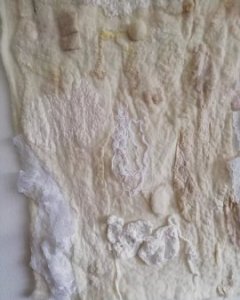
Another is a 95cm x 54cm background I made a couple of days ago throwing everything I had to hand in to the mix! There’s Bergschaf, Merino, Viscose, Silk, chiffon, synthetic net, slubs, knitting yarn, etc. I see this being an ongoing project for quite a while….something I can build on, picking up and putting down over time, adding stitch and texture until it feels finished.

At our next meeting, this coming Friday, several of us will be creating wet felted fish which we are all excited about. I will show you how those turned out and give an update on the other projects in my next post. Now………where did I put my blue cardigan?

Trying To Organize My Stitching Projects

Trying To Organize My Stitching Projects

Lately I always seem to have several stitching projects going on at the same time and I have found it helpful to use one basket per project to store my threads, etc. in. I have a friend that makes lovely pine needle baskets and I have mainly been using them. But lately I seem to have more projects going at one time and found that I didn’t have enough baskets for all of them! I found myself going around my house emptying the contents of other baskets so I could use them for my projects. (This of course, led to another issue about where to put all the stuff I was taking out of those baskets!) I guess that tells you how crazy things are at my house!

When I was at a retreat in February, one of my friends was making fabric covered rope baskets for her projects. She also likes to have all her project’s supplies in one spot, and she likes to be able to easily move them from place to place as well as have the option of stacking them. My thoughts kept going back to her baskets as I kept running out of storage for my things.

Over 20 years ago I took a class at my local quilt shop and made a fabric covered rope basket. It’s been sitting in my closet all these years waiting for me to attach the handle. It’s kind of big and funky but I love the colors. I think I planned on using it for my knitting projects. I could still do that, but I decided to use it right now to store my wool socks in. I don’t need the handle attached although I guess I could still do that. (Maybe in another 20 years??) I am also kicking around the idea of deconstructing it and making 2 or maybe 3 more usable size baskets out of it.

This one is 9” tall and around 12” in diameter. I think I was having too much fun sewing it together and didn’t know when to quit!

These are still all my favorite colors!

Colorful fabric rope basket


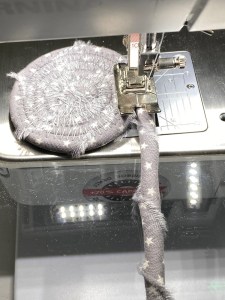
The way the rope was covered in that class 20 years ago was not how I wanted to make a new one. Back then, we wrapped folded fabric around the rope and straight stitched it to the rope which was a nice feature as there were no raw edges visible. Today that seems like a lot of prep work that I really don’t want to do. My friend was just wrapping approximately 1” strips of fabric around the rope and zigzagging the covered rope pieces to each other. Much faster process. I’m all for getting things done faster! These baskets are a great way to use up fabric scraps or fabrics you wondered why you bought them in the first place.

I followed the tutorial from my friend’s website Create Whimsy and tweaked it to my needs.

https://createwhimsy.com/projects/fabric-coil-baskets-and-bowls/

I had a jelly roll of 2 1/2” fabric strips sitting around that I was never going to use for a quilt. I tore them in half and started wrapping my 20 year old leftover rope and zig zagging them together.

Fabric torn for wrapping around rope

sewing beginning of basket bottom using grey fabrics

I wanted the bottom of the basket to be at least 6” wide and the sides to be around 2” high. I wasn’t sure how much rope I would need to make the size I wanted. (I ended up having enough rope left to make a smaller basket if I want to.)

Finished basket in blues, grays and orange

I was happy with my first basket even though I wasn’t crazy about the fabric used for it to begin with. Those big white blobs are the selvedges. I decided I didn’t like how they appeared, so I started cutting them off as I introduced new strips. I like how the stars on the fabric appear as bits of white. Overall, I’m quite happy with how this turned out! It will be very usable and will definitely not be sitting in my closet for the next 20 years!

I also had some fabric covered rope left over from my 20 year old basket project so I thought I’d see if I could make a basket out of it.

Fabric covered rope for basket


It was interesting to see how different the two methods of covering the rope were when zigzagged together. I think I like the newer method of just wrapping the fabric around the rope and not caring about the raw edges or the joins. It’s kind of fiddly but looks just fine to me after stitching. The “prewrapped” rope had lots of puckers to it, the wrap as you go method coiled together with a snugger fit.

sewing beginning of basket bottom using orange fabric wrapped rope

Here is the finished second basket. It definitely had a looser feel to it although it is still sturdy enough for a project basket.

Finished thread bowl in shades of orange and red

Here’s a peak at my little menagerie of baskets, including my two newly made ones.

Fabric covered rope baskets and pine needle baskets

It was fun to make them, and they sewed up rather quickly. If you try one, I’ll forewarn you that you’ll go through quite a bit of bobbin thread. And they are kind of addicting to make.

I also found two felted bowls in my closet that I had made years ago. (Wonder what else is in that closet that I could put to use today?) They were knitted to begin with, and they were my one and only foray into felting. This one was under consideration for becoming a project basket, but it’s too flimsy. I am now using it for my thread bits. Perfect use for it!

Felted thread bowl

Happy stitching!

Tesi Vaara

Lichen, textiles & my goal – Part 1 Experimenting

Lichen, textiles & my goal – Part 1 Experimenting

I’m enchanted by lichen. Also, by moss, fungi and forest floor wonders, although to a slightly lesser degree. Sit quietly next to a tree, some old wood, weather-worn stone or metal and look….really look……..you can easily be transported into a micro magical world of different shapes, texture and growth patterns, not to mention the incredible subtlety of colours.


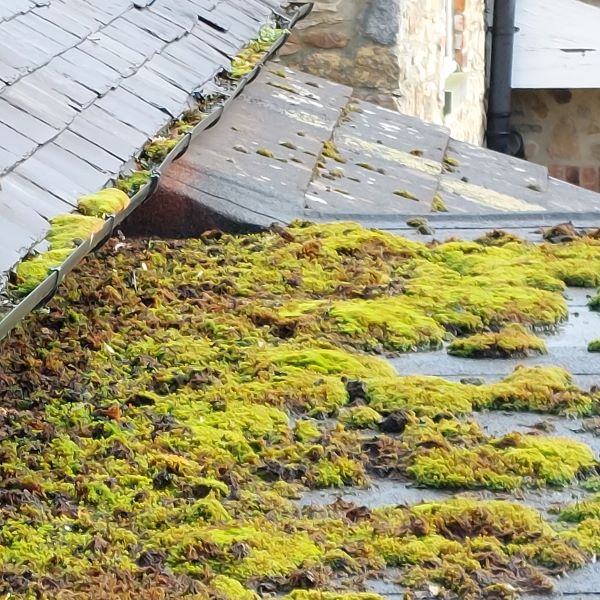
Close up of moss & lichen on wooden garden bench

Just as we have omnivores, vegetarians and vegans etc, curly hair, straight hair or….no hair 😉, in the lichen world there are 3 main types – foliose, fruticose and crustose. The last two are almost self-explanatory – fruticose, bearing fruiting bodies whilst crustose is….well, crusty! This is an extreme simplification….so any lichenologists reading this (yes, I learnt there are such specialists, along with funginerds or funginuts), please – don’t shout at your screen!  

Common orange lichen, Xanthoria parietina

Why do I love them?

Lichens are our pioneers. Generally, they are the first to settle anywhere, growing in so many different substrates and habitats including in some of our planet’s most extreme conditions (artic tundra, mountains, hot deserts, after fire destruction, even toxic environments) some even grow inside solid rock (!!!) and they cover about 7% of our planet’s surface.

Six lichen photos  by Richard Droker
Six lichen photos by Richard Droker

Lichens are symbiotic so if they live on a plant, they only use it as a base rather than stealing nutrients. They can be used for food, dyes, and medicine and, due to their long life-span and slow regular growth (the world’s oldest living organism, Rhizocarpon geographicum, ‘map lichen’ is thought to be 8,600 years old) some lichen species are used as a means of telling the age of rocks. The oldest lichen fossil dates from about 400 million years ago. Generally, growth is extremely slow, with most crustose lichen growing only 1-2mm in diameter per year! There are about 20,000 known species and can be regarded as self-contained miniature eco-systems that often thrive in communities.

Wow – as humans we should be learning so very much.

Colours, depending on special pigments, can vary from reds, oranges, yellows and browns or bright green to olive grey and black. Then there is another whole overlay of colour depending on whether the lichen is wet or dry.

Four Lichen photos by Richard Droker

I’ve been fascinated for years with the amazing beauty of lichens and thought I’d finally do something about it.

So, I’m currently working on a personal project – translating what I see, and perhaps feel, into mixed media/textile creations. There are so many extremely talented artists, worldwide, who are recreating realistic representations particularly in textiles (Amanda Cobett is one such artist), that I’d fail miserably if I went down that route.

Sketches of interesting patterns from lichen etc
My sketches of interesting patterns from lichen etc

My goal is to ‘see’ either from life or research online photos (Richard Droker, above, is just one of the many amazing photographers worldwide) and interpret my findings using what I have to hand around me. At this point I need to add, that I’m a firm believer in the Spirit of Mottainai – the idea of respecting resources and not wasting them.

View down one side only of a wool shop in Germany, with shelves stacked full of so many wonderful yarns

Yes, I will buy new supplies (I’m always being seduced by luscious yarns – who isn’t! – as evidenced by a recent trip to Germany), but I also want to repurpose and re-use where possible. I simply couldn’t throw out an extremely, seriously (you get the message!), wear-challenged sofa cover….it offered far too much potential. We won’t talk about where it will be stored!!!

Worn, thready, fabric stiched onto a contrast fabric snippet

I want simply to evoke the magical landscapes I see. Mmmm….’evoking’,’ Mottainai’, ‘re-purposing’….I didn’t set out to write a mission statement….😜

My poor EPH (Ever patient husband) dare not throw anything out. I often see a clutter of spent, used items (garbage in other words), on the kitchen work surface….

’What the devil?’

’I didn’t know if you needed them?’

Guaranteed the one item he does throw away was the very item I particularly wanted! Oh yes, my hairdresser, shop keeper and even our car mechanic haven’t escaped unscathed!

Bags & bags of experiments, all stored in boxes.

My experiments involve sewing both by machine and hand, crocheting (I dislike knitting intensely), ironing, printing, playing with liquids for chromatography, burning (many methods & always next to the sink – I value my house too much!), bending metal, soldering….in other words – I’ve been wracking my brain for every technique I’ve ever used….over very many decades!

I’ve also, mischievously (there’s always one!), taken the opportunity during our local textile group’s workshops to further my exploits.

Some experiments fall in line with Thomas A Edison’s theory – “I have not failed. I’ve just found 10,000 ways that won’t work”.

Wool & carded wool tops needle felted together not a good result
Wool & carded wool tops needle felted together – not a good result

Having studied a great many lichens online, I tend to see something destined for the bin & then think ‘ah ha – that reminds me of….’

So herewith a few other experiments to date….

I also need to explain at this point that whilst I do have patience, I like the creation of individual elements to be the most effective and speediest….for me!!!! This involves challenging myself to find an easier method to achieve the same result – ie trying to create 3D mounds to represent moss, I tried several old techniques including velvet stitch and Victorian tufting, but my patience was not of the centennial variety. So, I thought long and hard and devised a method using the sewing machine and hand stitching. EPH reckons I only need a few more to make our new carpet!

The challenge also includes remembering to keep detailed notes 😉

Notes & samples of experiments

All I need now is ‘time’ to put my experiments to good use….it is on my wish list!

I hope the next time you look at any lichen you will delve below the surface. Let us know of your findings.

Felting and thinking

Felting and thinking

I wish to show you my last abstract piece: I am quite proud of having included free crocheting and free knitting bits and of having gone bigger than my usual size, all things outside of my comfort zone that were inspired by other artists’ and crafters’ works.

Neutral and white coloured felted abstract artwork with textile embellishments on a white wall
“Good girl bad girl” abstract felt painting, around 80 x 50 cm.

It was about experimenting with felt without the distraction of colour, and I decided to use undyed or white and whitish materials, so as not to distract my eye from the final purpose. This made me think about “lack of colour” and “white” in terms of emotions and morals: how you are not supposed to show a lot of true emotions if you are a “good girl”, how the colour white has been linked to “good” in certain cultures, how silence and demure behaviour (not showing your colours) had been linked to “good behaviour”  in such cultures.
So, this has made me think about what “good girl” and “bad girl” meant when I was growing up, and how problematic those concepts have become for me in time (and have been even then). This led to me choosing specific fabrics and fibers, and techniques to add to the piece. So, I guess, concepts and techniques called one to the other from the beginning of my project and I can’t say which came first, if ideas to express or techniques to try.
I thought of the piece as layered, as our life experience and identity are layered, and being a “good girl” or “bad girl” is not something straightforward either. So, firstly I made a layer of felt to go over a pre-felt background.
But how to make the surface layer? I remembered about the layout for cobweb scarves that  had been suggested in the  Felting and Fiber forum, the one that is made by tearing a long length of merino tops and then carefully teasing the whole length open: I wanted holes and different thickness on my surface layer of felt, so I went for that type of layout for it and it worked very well.

Kiki's left hand is opening up a long bit of natural white merino wool on the bubble wrapping sheet on a table. There is another bit of merino wool waiting on the side.
Laying out my natural white merino wool on for the cob-webbish upper layer

Table covered with towel, bubble wrapping and natural white merino wool in a cob web layout
How the cob web layout progressed

The surface layer was embellished with undyed locks, undyed white eri silk fibers, scraps of undyed habotari silk, white flax, and silk carrier rods. Its shape is very irregular and there are vertical holes from which one can peek at stuff underneath. I liked the fact that it’s not one single white, but many different shades of undyed natural white and of bleached or optic white. Even stretching the idea of “white” a bit to include cream and beige even.
I added a natural-fiber net that I got from my grocery shopping, and on the background strings gotten from labels of clothes and scraps from a cotton handkerchief, to remind me of all the mother-work wife-work women-work that is the “good girl” ‘s lot in life.

Cob web layout of natural white merino wool and embellishments on a table covered with towel and bubble wrap
An overview of my upper layer layout with all the embellishments before felting

Detail of a vegetable carrier net, silk carrier rods and natural wool locks on natural white merino wool
Some of the embellishments that I added on the merino wool : you can spot the vegetable carrier net, locks and a silk carrier rod.

Detail of natural white habotai silk scrap on natural white merino wool
An habotai silk scrap and some locks on another part of the upper layer merino layout before felting

Embellishments on merino wool before felting are used to bridge gaps between merino wool parts
In various areas I used the embellishments as bridges over the holes between the merino wool parts, so as to link all the parts together.

I lightly rubbed it and then used the sander to be sure that all the bits could stay firmly in place. I did not want it felted firmly, and I rolled it only a few times in two directions, horizontally and vertically. I washed it and left it to dry.

Wet prefelt of the upper layer of Kiki's artwork on a table
This wet prefelt of the upper layer does not seem too exciting, yet, but the holes seem just right for what I want to do.

In the meantime I prepared the background layer, with 3 layers of undyed merino wool in a simple horizontal-vertical lay-out. I rubbed it and rolled it a few times, leaving it at the pre-felt stage. I washed it and let it dry.
On the second day, I combined the two layers, that were mostly dry, and all the other embellishment elements.

Two irregular layer of natural white wool prefelt on a brown carpet
I laid out the two prefelt irregular layers on my carpet to have space to work on them and add all the sewing.

I wanted to explore what it used to mean to be a “good girl” and to make mistakes and be a “bad girl”, so on the background and peeking through the holes I placed different things that had been linked to women’s craft and life, including commercial lace, scraps from a child’s wool vest (mothers always used to make their kids put their vest on underneath their shirts) and different fibers and yarns, and strings (women forever tying and untying shoes clothes bags families).

Strings, lace and scraps of upcycled wool fabric on prefelt natural white merino wool, on a brown carpet
A detail of some of the embellishments that I added to the bottom part of the artwork: strings and lace and scraps of an old merino wool baby vest.

On the background, like alpha and omega at the top and bottom, I also wanted “wrong” (but free) crocheting and “wrong” (but free) knitting pieces, and the making of those was an experience in itself, as I found very hard to let go of purpose and of “perfection”, especially in the knitting. I used a cotton yarn for the crochet and a mixed wool yarn for the knitting, as those two types of yarn are most closely related to those crafts to me. I have to say that I quite enjoyed the free crocheting and I maybe will use it again soon, whereas I doubt that the freeform knitting will become a favourite of mines!

On the foreground there are Kiki's hands knitting with a beige yarn, in the background there is Kiki's artwork in progress
My “wrong” knitting at its very beginning

On the foreground there are Kiki's hands crocheting with a white cotton yarn, on the background there is Kiki's artwork in progress on a brown carpet
My foray into free form crocheting

Detail of a white crocheted embellishment in an irregular shape, on a natural merino prefelt on a brown carpet
The irregular shape of the crocheted embellishment quite pleased me.

A detail of a knitted embellishment on natural white prefelt merino wool on a brown carpet
On the top, the knitted embellishment is waiting to be sewed fast and then felted into the artwork.

After placing all the elements where I wanted them to be, I hand stitched them in place with a few hidden stitches each, starting from the top and the outer edges towards the inner parts and the bottom. It took me a bit, but it was essential, as I was much more confident that nothing was going to move when I went on with the following wetting and sanding and rolling. I hate hand sewing, but this time I felt that it was worthwhile!
I washed and dried the piece, and then waited to see if anything else was needed: I often find that I need to let the work get washed and dry out to be able to see what is not fine yet! In fact, I found that the merino wool vest scraps had not quite felted in as I wanted them to do,  so I decided to needle felt them with a bit of added merino wool top fiber. This gave me the itch to add a few needle felted 3D shapes, vaguely organic shapes that are a symbol of the “good girl” sense of her body.

A felting needle working on a merino wool sphere attached to Kiki's felted artwork
A needle felted sphere shape seemed also a good idea

A felting needle is gently stabbing at a doughnut wool shape on Kiki's felted artwork
I added some needle felted organic shapes

I really liked the journey and I think that the piece says what I wanted it to say. Moreover, I enjoyed trying new things in making it, and using those techniques in an organic way to express a world of meanings and experiences that I hope will find resonance in the viewers.

Detail of Kiki's artwork: in the center there is a tight spiral made of a scrap from a merino baby vest.
Some of the embellishments on the finished artwork upper part

Lower left detail of finished abstract artwork by Kiki
Lower left of the finished artwork

Upper right corner of the finished artwork by Kiki: the two felt layers can be seen, along with many embellishments
The upper right corner shows clearly the two layers of felt

Lace embellishment detail on Kiki's finished artwork
The laces have not really felted in, but I was not expecting them to: it’s synthetic commercial lace, so I make sure to sew them to the felt quite well.

Finding Fiber Happiness During Respite

Finding Fiber Happiness During Respite

I spent last night processing my planned article in my sleep. I woke up with a solidified plan. ✅ I sent the following message to my BFF Lisa: I’m writing my blog article, which is due tomorrow…finding (fiber) happy places, when we need respite. I was ready to go – then I decided to quickly file for Medicare, which must be done in the US, 3 months before we turn 65. I had already started the process, and was waiting for my window to complete it. No problem, I thought: just tell them what I want, and be done with it. [What on earth was I thinking??]

Sunrise on the beach
Walking to the Ocean at Dawn.

I’m looking at this photo, with a cup of tea, feeling my shoulders fall. This is a beautiful morning, Brian and I will never forget. It was the first morning of our vacation, and we were off to an excellent start.

I had a short list of photos, I wanted to capture on this trip. My plan is to eventually felt some beach scapes, to hang in our home. Crazy as it seems, I couldn’t picture an accurate sunrise or sunset. This relaxing vacation changed all that. It gave us so many meaningful memories, and beautiful photos at the same time. I am excited to begin playing with my fiber and supplies. I captured interesting photos as the tides came in and out, in the inter-coastal waterways and oceanside.

Beach at low tide

I thought the ripple patterns made at low tide were fantastic!


I have photos of trees dripping in Spanish Moss, and I can tell you how it grows on the Live Oaks, in the southern US. Our family and friends asked us what we did with ourselves, in 4 weeks, together?? We enjoyed each others company, and the beauty all around us.

Spanish Moss draping Live Oak trees
Live Oaks draped in Spanish Moss, were in full bloom.

I managed to felt a couple examples while there. They are not great by any means, but they were made with what I had with me.

Tree limb

Felted Live Oak dyed Teasdale Locks
First Tests of Ann’s and Jan’s New Felting Machines Part 2

First Tests of Ann’s and Jan’s New Felting Machines Part 2

Part 1 can be found here: https://feltingandfiberstudio.com/2023/03/06/first-tests-of-anns-and-jans-new-felting-machines-part-1/

Electric felting tool from Ukraine (Orange Fly felting machine)

 1) Ann found it on Etsy.  

We knew Glenn had found it on Etsy and had a long chat with the inventor.  He said that there had been illegal copies of his design, but they had not worked well having descriptions of falling apart and breaking quickly. His original design has been well-tested and had good reviews online.  Ann and I wanted to try it out and compare it to the Chinese design.

2) The orange Fly from Ukraine.  

Orange Fly from Ukraine came with Instructions.3) came with Instructions.

Like the Chinese machine, the price is fluctuating due to the changing value of the Canadian Dollar.

There are a couple of safety instructions with this machine which should be noted.

  • Do not run without a needle in the machine
  • Oil the bushing and inspect to make sure the needle is not heating (you need to add another drop of oil) also running at high speed will wear out the bushing and it will require replacement when the needle feels loose when sitting in it.
  • I would add keeping hair away from moving parts of the machine (I was one of the first 3 girls in shop class in my high school, and I remember long hair and power tools don’t mix well. It was one of the reasons the shop teacher would not let the girls use power tools in shop class.)

Material that makes up the machine

The first thing you will notice is that The Ukrainian machine is made of a plastic for the majority of its body, unlike the Chinese one whose body is made of metal.  I am not sure about the type or projected longevity of this plastic but as with most plastics it should last longer if a few precautions are taken:

  • Kept out of direct sunlight (can degrade some plastics)
  • Keep it at room temperature, and do not let it freeze or leave it in places of high heat (the dashboard of a car or in a sunny window.) being an electronic device it likely will not appreciate being left or used in high humidity. If in doubt it would be best to contact the manufacturer.

2 pictures of Ann holding the Ukrainian felting gun like machine, and 2 pictures of Ann holding the cylindrical mettle Chinese machine 4) Hand grips for both machines

Ergonomics/ comfortable grip:

The handle shapes and thus how you grip them are also different. You may find one more comfortable than the other. I found the grip on the Orange one comfortable and it was easy to see where I was pointing the needle.

Switch and switch placement: the switch or small on-off button are both located in the area where the hand will be near. (i did not test the orange fly with the left hand but may add that to the final tests). For the Ukrainian machine, I found the switch to be well located for the Right hand and easy to turn on and off.  The tiny black button on the Chinese machine was very sensitive and I inadvertently kept turning it back on as I tried to turn it off. This may just be me being too aggressive with my button-pushing. Ann seemed to be able to turn it off and on with less fumbling. You can see the Ukrainian switch in picture 2 of this post and in picture 7 from the last post, you can see the little black button from the Chinese machine. (https://i0.wp.com/feltingandfiberstudio.com/wp-content/uploads/2023/03/7.jpg?w=600&ssl=1)

Noise: the Orange Fly is slightly quieter than the Silver Chinese machine.

Needle penetration /Vibration/kickback;  very little resistance to any of the surfaces or work pads with this one needle machine. (the exception was a fulled bulky knit sweater which gave a bit of kickback but this was fixed by increasing the speed.)  This could be partly due to the decrease in resistance when working with one needle when compared to more needles working in close proximity. We were also not sure of the exact gauge the silver machine was using. Ann has some of the Crown 40-111 needles I sent over to her. These may improve the operation of the Chinese Silver machine and make the test more even. We will report back after her husband has a chance to de-crank the needles so they will work in the machine.

The second thing to mention about vibration is to further Ann’s finding or more correctly losing of a small screw from the Chinese machine. I found that one of mine (not one holding a needle) had loosened off when I was running a test comparing it with the Orange one. I spotted the black screw on the silver machine before it had a chance to fall out.

5) working on wool felt pad and wool felting base  /Needle penetration from the back5) working on wool felt pad and wool felting base  /Needle penetration from the back

 6) pre-felt on medium felt pad 6) pre-felt on medium felt pad

 7) pre-felt on bristle brush 7) pre-felt on a bristle brush

Changing needles

While using the tiny allen key with the Chinese machine was fiddly but reasonably easy, getting the needle into the Orange machine was a bit more complicated. The instructions definitely had English words but seeing a video of putting the needle in fixed the confusion. Not having to have the pre-step of cutting off the crank (which is required for the silver machine)  is an added incentive to look favourably on this one.

Overall, I liked this machine even more than I expected and Ann liked it too.  Next Ann and I will expand our investigation just a bit more and look at 3 thicknesses of wet felt bases. We will look at both the Ukrainian and Chinese machines. Ann may have a third machine, this one is coming from Georgia, and has multiple needles. if it arrives soon enough we will add it to the wet felt base info and let you know what it is like to work with too. I will try to give a synopsis of the machines.

We will also see if our suspicion that the crown needles with their shallow working depth will improve the interaction between the felting surface/wool, brush or foam pad and the Chines machine.

Ukraine felting machine: https://www.etsy.com/ca/listing/768372661/1-year-warranty-pro-level-felting?click_key=1b08e81e365eb8f181543dde3538da5ff5989e86%3A768372661&click_sum=b89a4923&ref=internal_similar_listing_bot-2&listing_id=768372661&listing_slug=1-year-warranty-pro-level-felting


PS: I have spent the last 2 days at the Ottawa Valley Farm Show, demoing felting with Mr. and Mrs. Mer as well as doing a bit of spinning on one of my travel wheels. I do want to show you some of the fun we got up to but wanted to tell you about the second felting machine before getting distracted again. I am hoping the spelling is ok and I haven’t forgotten anything! I am about to face-plant the keyboard so I think it’s time for bed!

First Quarter Tree Challenge well on its way.

First Quarter Tree Challenge well on its way.

After doing my tree experiments( here if you missed it Tree Experiment ) and being happy with the results I am moving on to doing the first quarter challenge. If you haven’t seen the challenge it is here: https://feltingandfiberstudio.com/2023/01/01/2023-first-quarter-challenges/

I picked a piece or felt I had and added the sky and snow backgrounds. I used 3 shades of natural white wool for the snow so that it wasn’t so flat. I used Merino, Corriedale and something strong and shiny. the shiny wool may have been BFL or even Mohair.


Then I started working on the tree. I worked on a separate surface so as not to disturb the background too much as it is only lightly needle felted. I decided to work in two layers for the tree so this is the darker back layer. I started by just fluffing it up and then using a knitting needle to move fibres around to get a better tree shape. then gave it a dry felting ( just flattening and wiggling it a bit so the fibres stick together) to move it onto the background.

I picked a redder brown for the second layer. I forgot to take a picture of it when it was separate. I must have been in the felting zone. I put the tree slightly off-center. I tried it in the middle and I didn’t like it.

Here’s a close-up so you can see the 2 layers


I poked the tree all over to tack it in place and started fiddling with the roots, so it won’t fall over in the wind.

and some more  snow

And that was as far as I am right now.  I will probably fiddle with it more before wet felting it and then fiddling more, of course. I am thinking of adding a shadow but not sure how to tackle it. I am not sure where the sun is.  I may have to go out to the field and look at shadows.

Have you started your tree challenge or maybe you’re going with making something useful or both?

We would all like to see photos of challenge pieces and if you are unable to upload photos directly onto The Felting and Fiber Forum ‘studio challenges’ thread, then please use the link below.

https://feltingandfiberstudio.com/community-photo-submissions/

Winter Birch Update

Winter Birch Update

I have been working on my winter birch landscape. Here are the posts for part 1 and part 2 if you missed them.

I finished appliqueing the birch trunks and adding the machine stitched branches. I’m happy with the trees, now on to foreground snow.

Most of the comments on my last post thought it would be a good idea to add some snow in the foreground. I found a piece of white prefelt which I tore apart and auditioned in the left photo. The middle photo is with wool locks and the right photo is with wool slubs and nepps. I’m not happy with any of them. The one I like the best is on the left but I don’t have a good way to adhere the wool. I could needle felt it in but I really don’t like to needle felt into the silk of the nuno felt. I am thinking the foreground snow is not happening.

Small red twig dogwood bush handstitched on nuno felt for a sample. Sampling different weights and colors of thread for the branches of the bush.

Another suggestion was to add red twig dogwood bushes. That seemed like a good idea to add in a contrasting color. I made a sample here on another piece of the nuno felt background. I used wool thread in dark orange, red and darker red. I first tried two threads, mixing the colors. The branches felt too fat. So I switched to one thread and decided to use the red and dark red threads. I hand stitched the bush using stem stitch.

Next came stitching it on the piece. I do like the addition of the red. Now I am letting it rest for a bit to decide if I want to add the red in one other area of the landscape. I think it might look more balanced if I had a few bushes further in the background. What do you think?


A Turnstone Picture: Step by Step

A Turnstone Picture: Step by Step

I’ve recently finished a felted picture – mostly wet felted but with needle felted elements.  ‘How long did it take to make that?’ I’m often asked when people see my work.  I find it difficult to answer precisely. ‘Quite a long time’ isn’t very helpful so I usually say something like ‘About four days’.  I don’t really know if that’s true. It’s my best guess. As the felt-makers among you will know, most people have no idea how much work can go into making felt, so as I was making my latest picture I thought I’d try to document the stages and see how long it all takes. That’s what I’m going to show you here, plus take you on a little visit to the town where I work.

I’ve already decided to make a picture of a turnstone feeding at the water’s edge so I set about making prefelt sheets for the pebbles.  I live on the North Kent coast and love watching the local water birds: how they look, move and interact with their environment. It’s mostly pebble beach on the stretch of coast nearest to my home so pebbles are a good place to start.

First a piece of natural grey merino prefelt. Then a piece of mixed browns

It takes a surprisingly long time to cut all the pebble shapes

Here’s the grey cut up and an offcut of nuno prefelt which I’m gong to add into the mix.

And finally a sort of orange / yellow piece. 

I use prefelts as they give the pebbles more definition than if I just add blobs of wool. I’d guess all of the above is about a day’s work.

Now I can start the layout. This is going to be quite a big picture so will take up pretty all the space on my standing work desk. Here’s the first layer – natural white merino.

The second layer starts off with pewter for the water. While I’m working on the water section I add some dark blue low lights.

After I complete the second layer with more natural white merino, I lay out different coloured wool on top of the pewter and dark blue. I’ve previously carded pewter wool with a variety of light blues and greens using large hand carders.  I haven’t even thought about adding that time to my calculations.  I use this for the top layer of the water, mostly covering the dark blue which I want to add depth without being too prominent.

Here you can see that I’ve also added all the cut up pebble shapes to the bottom of the picture, plus some scraps of silk cut from old scarves, leaving a white section where I will add the wave.

For the wave I’ve chosen mohair because it has a slight shine and I hope it will be wiggly when felted. Along with the mohair I add lots of silk hankies and wool locks: I’m trying to get lots of texture into this section.

There’s also a piece of sort of knitted yarn that I picked up in a charity shop a while age.  It’s meant to be knitted into a scarf (according to the label) but I lay a line of it under the wave, hoping it will look like the foam from a previous wave. I also pop some offcuts into the wave for more texture. I finish by adding a few locks to the water to look like small cresting waves and I’m at the end of day 2.

A couple of days later I start the wetting down.  Because it’s large, I decide to work in three sections, starting with the pebbles. I like to use voile netting over and under the wool – which you can see in this photo.

I spend a couple of hours prefelting the picture, working both sides.  Here’s the back. I can see the pebble outlines pushing through the white so can be confident the layers are starting to felt together.  At this point I decide to take a break and go for a wander outside.

I work in a small rented studio in the historic town of Faversham, about 8 miles from where I live, in Whitstable.  The studio is in a former industrial building (originally a late-Victorian brewery bottling plant) which is now a lovely not-for-profit gallery, café and shop called Creek Creative Studios. It also includes 32 small studios filled with a good variety of busy individuals including painters, jewellers, potters and glass workers on the ground and lower ground floors; writers, illustrators, stringed instrument specialists, web designers and other small businesses on the upper floor.

Faversham is a gorgeous medieval market town so wandering about at lunchtime (and of course checking out the charity shops) is one of my favourite pastimes.  It’s a lovely sunny day so I thought I’d share a few photos with you.

Top left is the historic market place with its stilted guildhall. Top right is the Shepherd Neame shop: there’s a long history of brewing here and Shepherd Neame is Britain’s oldest brewery. Some days it does mean the town is rather ‘aromatic’. Second right is the lovely Yarn Dispensary. Originally an apothecary, the building dates back to 1240 and has a beautiful, separately listed wooden apothecary interior. It also sells a delicious selection of yarns. Bottom left is an old pub; next is the old water pump in the marketplace and a couple of the other buildings that surround the market place. There’s still a market here 3 days a week plus regular monthly ‘best of Faversham’ and antiques markets at the weekends.

Back at the studio I spend the rest of the day rubbing and rolling the felt until it’s fairly firm.  Because it’s a picture and going behind glass it won’t endure much wear and tear but I still like to ensure it’s properly fulled.  End of day 3.

I leave the background to dry and return to it about 6 days later, as I start to think about the turnstone or turnstones.  Working from my own photos, I roughly sketch a couple of birds and cut them out so I can see how they might look.

Although I like the 2 birds they are a bit small (the waves round here aren’t that big) so I decide to go for one pecking bird but bigger than the sketched one.  First step is to make some prefelt for the feathers.

Here it is as I’m starting to wet it down (left) and as a light prefelt (right – apologies for the poor quality of the second photo)

I cut up the feather prefelt and lay out a general bird shape.  At this stage I am leaving the head large and a bit vague.  I’ve learned that it’s better to make it too big and cut it to size later rather than trying to get the exact size and shape and risk having to add more wool or felt.

Here’s the bird felted and with a lightly trimmed head.  Sorry it’s not a great photo as it’s electric light and I’m casting a shadow but I hope you can see it well enough to get the overall idea.

From layout decisions to the felted bird has taken most of day 4.

The next stage is to needle felt the bird into the background and needle in the eye and legs as well as refining the beak. For the legs I used some of the orange-ish prefelt I made for pebbles, adding strands of wool on top.

Using a broken needle I pick at the wave to raise some of the texture from the silk hankies and wool locks.  I’m not sure whether it’s visible in this photo but it does make a difference in the actual picture.

I didn’t take progress shots of the needle felting but I’d say it took a good half day.  It’s difficult to know when to stop fiddling around with it and declare it finished.

So, here is the final picture before framing.

And a shot in its frame. 

Frame size is 63 x 86 cm (approximately 25 x 34 inches)

I used an adhesive hook tape – like the hook side of Velcro – which I stick to the mount board. The hooks hold the felt in place without impacting the fabric.

So, it looks like my 4 day estimate was a bit low.  Next time someone asks how long it took me to make this picture I could say ‘About 4 ½ days, oh, plus the carding, the nuno prefelt and the framing….’ .  Maybe I’ll just settle for ‘About 5 days’.

Do you try to work out how long you spend making things or just go with the flow?

How to Make Magic Mushrooms

How to Make Magic Mushrooms

An interesting post popped up in one of the textile FB pages I follow, it described an art-based game day in June, where you hide and seek “‘shrooms”. It’s called, “Game of Shrooms”, have you heard of it or taken part? Apparently this is the 5th year it has been running.

If you want to join in, the date for your diary is 10th June 2023. This link will take you to the home page with more information on how to sign up and take part. There are also links to participating artists so you can join the hunt for your own piece of artwork to keep. The art you make can be in any medium but should feature or be inspired by mushrooms. Obviously, I had to make mine in felt and thought I would share my pattern and process in case you want to play along too 🙂

For my first attempt I thought I would make a traditional fairytale (Fly Agaric) mushroom. I cut a simple flat resist, laid out 4 layers of wool, red on the top of the dome, white everywhere else and sprinkled white nepps over the red wool.

This resist worked but resulted in an oval-shaped cap, if you want to make a flat resist, I suggest trying a more rounded (circle) shape on top of the stalk.

For attempt #2 I used a flap on the resist. While a bit more fiddly to lay out the wool, the resulting mushroom shape was much closer to what I had in mind.

I had some beautiful space-dyed silk hankies, so used those over a simple dark blue wool layout:

And created some gills on the underside with some hand-spun yarn (Tip: the higher the wool content of your yarn the better it will bind to the base wool, avoid using super-wash yarns and synthetic yarns to make your life easier).

Notice how I didn’t take the yarn all the way up to the base of the flap / stalk (only at the sides of the flap), this is because I will create a tube-shaped stalk, if you take the yarn up to where the flap joins the circular resist, the “gills” will extend down the stalk on the finished shroom.

Once the yarn and silk were well attached I cut along the bottom of the stalk to remove the resist before spending a few minutes kneading and throwing the felt to start it fulling, I love the textures in the silk you get from throwing the felt:

After a few minutes, throwing, rubbing and stretching I was happy with the shape and it was strong enough to hold it’s own weight without collapsing:

I loosely stuffed it with some white wool from a batt, using a chopstick to push it into the corners. You could also use polyester fibre-fill / toy stuffing for this. Tip: don’t over-stuff it – you still need to finish shaping it. I left the stalk unfilled so I could continue fulling it (the felt of the stalk needs to be very firm to support the weight of the cap).

Fulling the stalk with a fulling tool – I support the felt with a finger inside the felt tube and rub with a textured tool:

This tool is also great for fulling the inside of the stalk.

Once the stalk, and where it meets the cap, feel stiff you can rinse the soap out and stuff the stalk with wool batt / fibre-fill.

Using a suitably sized, flattish-bottomed rock found in the garden, I stretched the stalk over it, the weight of the rock will help to stop the mushroom from toppling over on its rather narrow base:

Once the felt dried, I removed the rock and glued it into place.

I also made a white shroom with the same space-dyed silk hankies:

The finished troop of ‘shrooms enjoying some early autumn sunshine:

If you make some shrooms, or better still decide to take part in game of shrooms, please post a link to your finished shrooms / your clues to find them in the comments. Happy hunting!

Before I forget…. registration is now open for the Concertina Hat and Felted Bags online classes. Please click on the links for more information about each class and to sign up.