Fabric Collage Landscape Part 1

Fabric Collage Landscape Part 1

I was inspired by Antje’s post recently about creating a fabric landscape. I have had this on my list of things I wanted to do for a long time. So thanks Antje, for giving me the push to get it started. I have piles of hand dyed and commercial fabric. Many are just small pieces and scraps and I thought this would be a good way to use some of them up.

First I needed to find some inspiration. I looked through my photos of Glacier National Park and I wanted to create a landscape featuring Hidden Lake where we had hiked several years ago. Sadly, that was one of the years that we had thick smoke in the area from wildfires so my photos were not impressive. So I googled images of Hidden Lake and found one I liked to use as inspiration.

I used heavy interfacing as a backing and then started putting together my sky fabrics. In Antje’s post, she didn’t mention anything about fusing the fabric down as I would normally do so I decided to just wing it. I added threads over the top and then started stitching.

I started with light blue thread and stitching across trying to catch all the various elements down. I switched to a darker blue thread and then to two tones of orange thread. It was a little frustrating as pieces moved as I went but I just kept going.

I had less control over where each piece of fabric was and that made it less “perfect”. But that’s OK because I was trying to see if I could do a piece that was more “abstract”. (Not that I ever get too abstract.)

Then I started finding the mountain fabric colors and giving them a trial against the sky. I did put fusible on the backs of the mountains so I could iron them in place before I added the “texture” on top.

I continued to play around with a variety of fabric pieces to get the mountains the way I wanted.

Then I moved on to the green mid ground. On the left, I am trying the fabric I might use to see if it is the correct value and color. Then I cut out pieces to the correct shape for the mid ground area with trees.

I realized at that point that I would need to place the water before I attached the green as there was water on the left hand side underneath the green “fingers” of land that stretched into the lake. So this is a trial for the water.

Then I needed the reflection of the sunset in the lake. I tried a piece of cheesecloth on the left but it was a bit too pink and also too textural. I wanted the water to feel smooth against the textures of the trees and foliage. So I found a couple of pieces of hand dyed sheer silk organza and gave them a try. It’s looking better but still feels a bit dark in the reflected area. I also tried the green in the foreground. It’s looking more like a landscape but I still have a long way to go. It takes a lot of time for the trial and error of finding the right piece of fabric for each portion of the landscape not to mention the time spent stitching.

I hope you don’t get tired of seeing the process of this fabric collage as it appears there will be several posts to go before it is completed.

Fourth Quarter Challenge 2019 Colourscapes

Fourth Quarter Challenge 2019 Colourscapes

This challenge is inspired by our trip to Mottisfont Abbey where Kaffe Fassett exhibited over 70 glorious items including furniture fabric, clothing and wall hangings.

“I create in palettes of colour because that is my main obsession.” Kaffe Fassett

We were allowed to take photographs of Kaffe’s work at the exhibition – this is one of his wall hangings …

Kaffe Fassett Exhibition at Mottisfont

…and a close up of another.

Kaffe Fassett Exhibition at Mottisfont 1

Please click on the link below, scroll down a little, and you will come to a very short video of Kaffe Fassett talking about and showing some of his work.

https://www.nationaltrust.org.uk/mottisfont/features/kaffe-fassett-exhibition-at-mottisfont

So this quarter’s challenge is to make a “colourscape” using whatever fibre media you enjoy working with.  It can be realistic or abstract and any shape or form.

Go wild with this challenge and be as free as you like!

We often use our photos to inspire us, so we’d like to share some with you.

Chihuly Glass installation at the Bellagio in Las Vegas, US

Chihuly glass installation at the Bellagio in Las Vegas 1

Chihuly glass installation at the Bellagio in Las Vegas 2

Bar top in a hotel in Las Vegas, US

Bar top in a hotel in Vegas

A Peacock in Madrid, Spain

Peacock in Madrid

Jellyfish in a Singapore aquarium

Jellyfish in Singapore aquarium

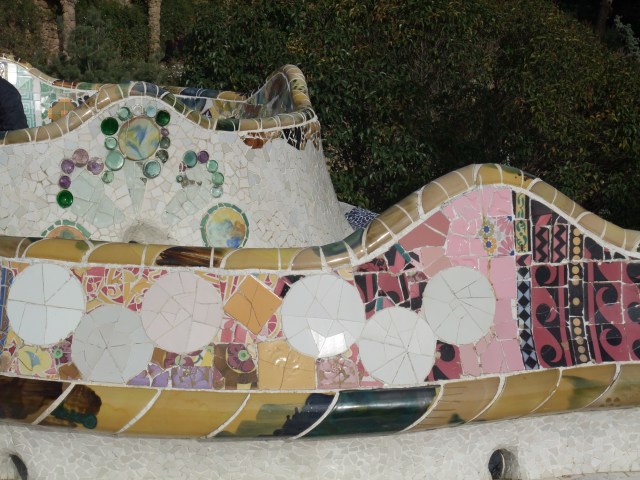
Gaudi mosaic in Barcelona, Spain

Gaudi mosaic in Barcelona

Meadow in Christchurch, UK

Meadow in Christchurch, Dorset

Leaves on the ground at Kew Gardens, London

Leaves on the ground at Kew Gardens, London

Fishing nets in Crete

Fishing nets in Crete

Glass House in West Dean gardens, Chichester, UK

Glass house at West Dean gardens, Chichester

Trees at Mottisfont Abbey, UK

Trees at Mottisfont Abbey

Lego installation in Singapore botanical gardens

Lego installation in Singapore botanical gardens

And finally some blueberry leaves in our garden in the autumn …

blueberry leaves in the autumn in our garden

… and at this time of year, in some parts of the world, the trees and shrubs will be giving a wonderful display of colour!

We hope that you enjoy this challenge and that it brightens this quarter of the year.

In the Begining

In the Begining


In the beginning;

In 1989 I joined the OVWSG at their annual general meeting and became their librarian. I did tell them I was Severely Dyslexic and was assured by the executive that would not be a problem. I was given 5 boxes of books that had to be entered into the library before the September meeting which I did with a bit of help from Glenn. Things went on quite well until I built them a subject catalogue and they discovered what dyslexia was. Isn’t Urope always filed under U? E-Urope sounds like a burp not a continent. Annoying English! I think you should all convert to dyslexia and spelling would all be phonetic with occasional decorative letters you stick in because you likely forgot to use them earlier.

In 1993 I went back to school and Clara took over the library at the guild with the goal of fixing the subject catalogue by making cards with the “English spelling” -See – “Dyslexic version of the word”. I returned to Ottawa in 1996 and got the Library into a Database with fewer spelling errors or foreign languages.

I am pretty sure that somewhere between the 1989 start with the guild and the return to school I took my first felting class. It was with Maggie Glossop. She has had the starting of many of us into the addiction of fibre accumulation both for Spinning and Felting. When I checked on line to make sure I spelt her name correctly I found her resume http://www.convergenceart.com/Maggie%20Glossop%20Resume.htm Impressive!

The workshop I took was making a small bag in felt over a resist embellished with an image. Mine were Iris, a bit stylized, but definitely flower-ish. I discovered I was entranced by laying out layers of wool, making pictures and not so fond of wet hands. But it sparked enough interest I took more workshops with other teachers as they were offered but Maggie was the first to introduce me to this medium (so it’s likely her fault you are reading this).

This slideshow requires JavaScript.

1-4

I had thought she was a pretty amazing person but hadn’t realized just how many people she has touched with her teaching. To illustrate I should tell you what I was up to yesterday. Friday (which was yesterday) was the first day of a 3 day demo at the Carp Fair. I was organizer (Just don’t blame me for today’s weather. I didn’t ask for rain / drizzle and mist). Friday we had Elizabeth and Cindy who are both Master spinners (OHS spinning certificate) and myself, who is not one but does a lot of felting, spinning and occasionally weaving.

56 5-6

Maggie was at the Fair and stopped by the demo to say Hi! We were all very glad to see her. In her teaching career of both spinning and Felting Instructor, we realized she had taught all three of us.  For me she had ignited an ember of interest that grew to include wet and dry felting both 2D and 3D.  Without her would I have discovered this art form or would I have listened to myself “ick Water” and avoided wetfelting? I don’t remember what her workshop description was but it was enough to get me curious (maybe she omitted the part about getting your hands wet) and started me on this path.

I want to thank Maggie for her patience with this student and her obvious deep enjoyment of her art which has started the path of interest I am now following. Teachers can be such a strong influence on their students. By sharing their knowledge with a student their information can inspire them into totally new and interesting directions and adventures. Seeing Maggie made me think about my first class, my first time laying out wool, my first flower. I still have that piece and look at it as I walk by the bookshelf it sits on.


Busy busy busy

Busy busy busy

This week has not been a big felting week. I managed to make a few more lock pins. These ones are smaller, a little better for on a hat.

Mostly it has been baking and working on the upcoming Ottawa Valley Weavers’ and Spinners’ Guild Sale and Exhibition.  I think I told you a somehow ended up as co-chair of the organization committee. I have a great group of ladies helping out. we are trying to get it all organized with timelines and procedures written down so when the next people have to take over they don’t have to start again. A lot of what we are doing is moving everything from a paper set up to a digital set up. we hope to start making 2 and 5-year plans for the Show.  So far it seems to be going well. The Show is November 2 and 3.

https://www.facebook.com/event 

Or if you aren’t on Facebook: https://www.ovwsg.com/sale/

We have 3 farmers markets left. So there has been lots of baking as people start to think of stocking up.

Dimensional Felting with Prefelt

Dimensional Felting with Prefelt

I tried another experiment with dimensional felting with prefelt. You can see my other experiments here and here. This one I decided to use an already made prefelt and then just cut it to fit the shape.

I started with the resist shape shown above. I covered the resist with a thin layer of red wool. I laid the wool so that it wrapped around the long edge of the resist.

I then cut out the prefelt to fit the resist shape. I think I would have preferred making the prefelt over the same shaped resist as the edges and curves had to be cut more than I wanted and there were more edges to deal with when felting. Next time, I also would make the center prefelt shape a bit shorter and the end pieces longer.

I then rubbed and rubbed to get the red and the brown wool to felt together and to felt the edges down carefully. I then cut out the resist along the red edge and finished felting and fulling.

And here’s he final shape that I ended up with. The colors in the above photos are more true than the in process photos. It is definitely red as opposed to orange. These experiments have been a fun learning process. I have found the most important thing to remember is to make the prefelt thick, perhaps 3-4 times thicker than the underlying support wool layer. Now to figure out some more shapes that will be interesting to try.

Sublimation printing with Dawn Dupree

Sublimation printing with Dawn Dupree

This is a guest post by Kim Winter of Flextiles.

A couple of weeks ago I went on a sublimation printing workshop with Dawn Dupree, a well-established textile printer based in south London near me. She specialises in multilayered collage, often made using sublimation printing techniques,  like those below.

Sublimation printing uses a heat press and solid ink, usually painted on paper, and only works on synthetic fabric. You put the inked paper face down on top of the fabric, sandwich it between newsprint to prevent the ink from getting on the heat press, then press it in a heat press for around 30 seconds.

The heat causes the ink to sublimate to a gas and also opens the “pores” of the fabric, allowing the gas to penetrate. As the fabric cools down, the ink returns to a solid state and becomes part of the fabric. Unlike with heat transfer printing, the colour does not sit on top of the fabric so doesn’t crack or peel off.

You can buy ready made dye papers in different colours, and you can also make your own papers by painting them with dye and leaving them to dry. The colour of the paper is usually very different to the final colour on the fabric – the fabric is much brighter! So it’s better to do some sample testing if you are after a particular colour.

You can create collages in several ways. The simplest way is to cut the dye paper into different shapes, or use stencils to create a negative outline. You can also use transfer the dye to a photocopy in the heatpress and then use the photocopy to create an image on fabric. Carol’s pieces below, based on the beautiful work by her daughter Alex, used these techniques.

You can also transfer the dye to other items, such as lace, doilies, or yarn, like Gabriela and Maritza did below.

With the heat press you can also add foil to highlight various parts. Catherine’s multilayered piece below included foiling.

I wanted to see how shibori techniques worked in the heat press. So I took a piece of Vilene and folded it in a series of knife pleats in one direction and then the other. I printed this folded piece in one colour, and then unfolded it, repleated it along different folds, and printed with another colour.

Below you can see the folded Vilene on the right after printing with two colours. The purple dye paper is on the left.

Below is after printing withe four colours:

And this if the final piece after printing with five colours:

I also tried stitching. I stitched a piece of white polyester with five rows of running stitch, pulled up the stitches into pleats and then printed it with pink dye paper.

This is what it looked like when opened up.

I removed the stitches, pressed it and restitched in different places, and printed with a second colour.

I repeated this twice more. Then I tore the piece in half and foiled one half (the piece at the bottom).

I noticed that the papers I used for printing retained a very clear image of the stitched fabric. So I used them to print on other pieces of fabric, which looked amazingly 3D.

I hope you enjoyed this post, even though it doesn’t include any felt! Please note that the post is being scheduled to publish while I am on holiday, so I may not be able to respond to comments immediately.


Visiting Fiber festivals in Eastern Ontario and Western Quebec, 2019

Visiting Fiber festivals in Eastern Ontario and Western Quebec, 2019

The end of summer.

This is a busy season for me, made more so by adding a few surprise fleeces found while making the emergency anti-raccoon-garage-repair. OK add two storage bins of large, vary fine, crimpy fleeces and another bin of smaller bags of assorted fleeces.  Since you endured all the skirting, washing, spin-drying of the fleeces leading up to the surprise it’s a Shetland, let us not chat about that. Instead let us instead enjoy a momentary paws, take a breath and look back on the opportunities of acquisition so far this year.

Although we have a couple of  yarn stores with some felting supplies in Ottawa such Wabi Sabi on wellington, they don’t carry everything I’m looking for.  We are very fortunate in Eastern Ontario and western Quebec there have been a number of shopping-worthy festivals of fiber within a drive able distances of Ottawa.  It’s convenient to shop on line but it’s not the same as seeing something rite in front of you, being able to touch it and ask questions of the vendor about what you are looking for.

The first started in January 2019 with “Wheels on Fire Spin in”. It is just across the Ottawa River, 16km and google claimed was 40 min away. (It took about 25 minutes so we were early) https://feltingandfiberstudio.com/2019/02/07/wheels-on-fire-spin-in-2019/ . There were various vendors selling fiber useful in wet or dry felting.

11 Wheels on Fire Spin in

February brings the Chesterville Spin In, in chesterville, south of Ottawa by 82km and about 53 minutes away. There were vendors with fiber and felting needles. I was not the only one felting at a spin in!

22 Chesterville Spin In

March  saw us in  Peterborough, for the the Fibre Arts Festival & Sale organized by the Peterborough weavers guild, which is 267km or 3h 11m to get there. http://www.ptbo-hwsg.com/events/fibrefest-2016/ . There were 4 vendors selling felting supplies.

33 Peterborough,  Fibre Arts Festival & Sale

March is also the start of demo season (3 days Deming at the Farm show).

44 Ottawa Valley Farm show

May sent us off to Picton for the Prince Edward County FibreFest, that’s 261km and 2h 33m away.  I picked up more base felt for pictures and of course more needles and fiber. We drove back along old highway 2 which was longer but much more scenic. We even stopped at a Blacksmith forge for Glenn.

56

5-6 Picton, Prince Edward County FibreFest

June had a few more demos which had a lot people stopping to talk to me who were interested in Felting.


7-9 Felt at Demos

August was Twist festival in Saint-André-Avellin, Quebec it’s 91.9km and takes 1h 9m to drive there. There were the two main Supply vendors I see regularly at fiberfestivals; Olive Sparrow and FiberCraft.  There were lots of booths witch had a bit of felting supplies, or were selling felted items.  There was a sculptural Artist working in felt who was very impressive. She also treated wool like a Watercolour! I had a most enjoyable chat with her and got a few more ideas to work with.  https://festivaltwist.org/en/textile-market/tinnalaine/


This slideshow requires JavaScript.

10-14 Twist festival in Saint-André-Avellin, Quebec

If you make it to Twist don’t forget to look for the restaurant “La Toquade”. (http://toquade.ca/coordonnes/ ) We always stop for the “Club Sandwich au Confit der Canard” (the comfy duck sandwich….yummmm.) If you have room the “Crème Brulee a la vanille”  is also exquisite!

1515 Club Sandwich au Confit der Canard – apricot raisin bread, apple, celery, onion, duck , bacon and herb mayonnaise

In September there is Fiberfest in Almont, sponsored by the Mississippi Valley Textile Museum.  This is the one I wanted to tell you about. You may have notice I enjoy taking pictures. A number of years ago I shared the ones I took at Fiberfest with the Museum, which has led to a request for me to take more pictures for them! The photos are used on their web site, in publicity and to document what booth displays looked like. In 2018 I took about 600 shots. In 2019 there were 1,051 photos.  Don’t Panic!! I will not show you all of them!! But keep an eye out for Ann McElroy she was one of the venders there!


This slideshow requires JavaScript.

16-22 Fiberfest in Almont

Each year there are the same numbers of vender spots. This year they added more outside venders and kept the very popular alpacas. The guild displays were in the area before you enter the arena.  Participants included; Out of the box (a Fine arts Group), Knitters, smawlkers and embroidery guilds were there as well as West Carlton fiber guild and the OVWSG. When you entered the arena you found the 101 venders booths.  There were a few double booths but that still is a lot of venders!

23-27 Outside Fiberfest

Upstairs (there was an elevator) were workshops starting on Thursday and running through to Sunday. This is becoming a trend with quite a few of the fiberfestivals. Check the websites well in advance and see if they have something interesting offered. Workshops can cut down on the time for shopping but time for learning may be even more important!


When I snuck upstairs to take a few shots I found there were 2 Felting workshops under way as well as a rug hooking workshop just finished up. Wendo was teaching her 3-D needle felted tulips. There was also a wet felted bowl workshop using a resist nearby. I didn’t catch the name of the teacher sorry!


28-31 Two of the workshops upstairs at Fiberfest

This year I had a notebook in which I had written each booth number, the company and contact name. I photographed my reference page info then continued photographing the booth so I would be able to sort them more quickly and make it easier for Michael, the Museum Curator and his hard working crew to find shots they wanted.  This worked very well except there were a few booths that had not set up on Friday night when I started taking shots or had draped there booth with covers before I could get a shot. So returning early Saturday morning I started to photograph as many booths as I could see without peeking under sheets or intruding into their space. I brought the monopod (it’s an extending tripod but with only one leg) so I could zoom in close and not worry as much about my hands shaking.  I diched the monopod as soon as the customers started to come in and shop.


This slideshow requires JavaScript.

32-36 Ann’s page and a few of her shots

I took Saturday night going through and renaming shots so I could tell which booths had been missed or booths I only had a couple shots of. I drew a quick map of the venders in my note book circling each booth I had to go back to. I also noted how many shots I had at each booth so far. So back for more photos including the cute alpacas in front of the arena.

The Museum had requested time laps shots, which I had taken last year but were not the best since I have to take shots through the safety net or the hockey glass. They were hoping for hourly shots but nether my camera or my phone is connected to the internet so I couldn’t help with that. I did focus on booth documentation, vinyets trying for at least one from each booth (usually more) and some Happy shopping shots.  I even documented the food vendor! They had some very interesting sandwiches and veggie arrangements, highly photogenic and the ones we tried were very tasty.

  37-40 Food at Fiberfest

My husband /trusty porter of stuff, Glenn joined me. There was a handy bench and a few chairs beside the museum table. This seemed to be the husbands/spouse drop off location, which occasionally had a resting-from-shopping wife/spouse. Glenn accompanies me to most fiber activates to make sure I don’t lift anything that winds me up in bed for a day or two. He usually brings a book and takes care of my acquisitions while I keep looking, photographing and shopping. He has also been spotted sound asleep at all the fiber festivals we attend. Oh well, I didn’t catch him snoring and he did carry my shopping to the car.

4041

41-42 Spousal snoozing area and my shopping acquisitions

We stopped for British fish and chips in Stitsville and saw an awesome sunset. It may inspire some abstract felting picture in the future.

This slideshow requires JavaScript.

   43-47 Sunset in Stitsville

The Monday after Almonte was the first OVWSG meeting since the summer (so lots of library work).  Tuesday was the West Carlton Guild meeting and I was able to burn off 2 DVD’s of Photos to be passed on to the museum. Then back to fleece washing and this week it’s been more fleece and car doctor appointments and a car spa day (she got her undercoat spray done). While my kea Sole was getting her various treatments I took the Lendrum Rook spinning wheel and spun in both waiting rooms. I was working at the giant Shetland fleece I just washed. (Sorry I didn’t get a picture of me)

Next is a fiber festival is in Kempville this coming weekend I have not attended before. The following weekend is the big demo for the Carp fair. Then I suspect the workshop schedule for the guild will be ready for me to turn it into a catalogue! Which means the Guild Show is almost here!!!  And somewhere in there I want to get to doing a bit more felting!! I saw another sheep face I would like to try!!

I hope you are as fortunate  as we are lately in Ottawa to have so many opportunities not too far away to buy supplies and like Ann sell you creations at all these fiber related festivals.


Lovely Locks and the 3rd Quarter Challenge

Lovely Locks and the 3rd Quarter Challenge

I told you I was at Fibrefest in Almonte earlier this month. I only bought one thing while I was there. CURLS!

I went to Adele’s Locks of Love https://www.facebook.com-Adeles-Locks-of-Love

Jan took this while everyone was setting up.

I bought a bag, how could I resist.

I was very tempted by some green/blue locks but it wasn’t in the budget.

Here is about half of it covering my large laptop.

I started pulling the locks on Monday at the guild social.  It fun to do. so satisfying to see the piles grow.

I will use these ones to make some curly lock pins like these. The 2 greens need more locks yet.

Lastly my 3rd quarter challenge……..I changed my mind from what I showed you before, the futuristic domes on a faraway planet. It just wasn’t working for me. So, I am starting again with a new idea.  Here’s the start.

Exiting isn’t it…..LOL. I hope I can show you some progress next time. Have you thought of something t make for this Challenge? I found it harder than I thought it would be.


Recreating a Still Life Failure

Recreating a Still Life Failure

I originally created this still life of a vase of flowers in 2016 for a quarterly challenge. The plan was to create dimensional flowers in a still life but I didn’t pay enough attention to the overall design/composition and the vase didn’t turn out very well.

Here’s the original. The vase was dead center and the surrounding negative space feels the same and uninteresting. The black vase is too stark. I did go ahead and frame the piece and try to sell it but no luck. The piece was really big at 24″ x 30″ so I had plenty of room to cut it down and recreate the piece.

What I did first was to create a different vase. I used some upholstery fabric that I had on hand and cut out a new shape that filled more of the space on the bottom. I then cropped it down with some paper croppers so that I could find the best composition. I had a canvas that I could use so I knew the size that I needed. The new canvas is 16″ x 20″.

I then decided that the vase would look better with some dimension added. So I stuffed it and hand stitched it to the surface. I had to be careful not too over stuff the bottom or left side since they would be stretched around the canvas.

I needed some shadowing on the bottom and left side of the vase. I originally thought I would use black tulle to create the shadows but it was way too dark and had too much contrast. I didn’t have any gray tulle so I decided to use a combination of purple and yellow tulle to give a lighter shadow which tended toward purple. I used matte medium to glue down the tulle to the vase. My original plan was to fuse it down to the vase but when I attempted to iron the upholstery fabric I found that it was some type of polyester and it melted. Oops. I cut out a second vase and used matte medium.

After I stretched the piece around the canvas and stapled it in place. I trimmed off the excess felt. I then decided the piece had “holes” that needed filling. I forgot to take a photo before I started adding other elements. I needed some darker values and luckily had some really dark maroon/purple felt that I was able to fashion into flowers. I hand stitched the flowers together and ended up adding a few more flower buds as well that aren’t shown in these photos. Then I wanted to add some more leaves. I tried some yellow green felt leaves (left photo) but I thought that it needed something darker. I didn’t have any darker green felt so I decided to use some green tulle. The torn tulle gave a different texture too. In the right photo, I was trying the tulle out and just pinned it in place in bunches. I felt the bunches were too over the top so I ended up tearing the tulle into “leaves” and then stitching them down in layers. I also added a few lighter green pieces of tulle under the dark tulle to give a bit more contrast.

I am much happier with the final result compared to the original. The negative spaces (background) are different sizes and give more interest. The center of interest is not right in the dead center of the piece. So the overall composition has definitely been improved.

And the piece has lots of fun texture and dimension. I plan on putting this piece into an exhibition in October. Hopefully, with these changes, it will find a new home. I think that I will just add a backing but not frame it. I like being able to see the colors go around the canvas and the flowers/greenery that reaches off the edge of the piece.

Have you recreated a piece that you weren’t happy with? We would love to hear your story about it over on the forum.


Deconstructed Screen Printing

Deconstructed Screen Printing

This is a guest post by Deb Stika, thanks Deb!

Hi, my name is Deb Stika and I’m a member of Ruth Lane’s art group. Our group meets monthly and once annually for a 2 day retreat on Bitteroot Lake in Montana. In preparation for doing deconstructed silk screening at the retreat, Ruth asked me to describe the process. We took a few photos to help you visualize what we are doing.

We set our stuff up on Ruth’s back deck so we would have plenty of room to spread out. We mixed the print paste in Ruth’s old blender.

Here’s Ruth mixing dye powder into the print paste, making sure there are no lumps! Since we have a bunch of screens, we mixed a variety of colors.

I’ve decided to use this Styrofoam packing material for my first patterned screen. (Ignore the purple color, that’s leftover paint from Ruth using it for printing on another project.) Our first deconstructed screen is orange. And a second bigger screen is created using the same packing material. We simply used the leftover print paste on the packing material and pressed it against’ the screen.

Here I am contemplating using misc. stencils on this bigger screen.

Other good textures: rubber bands, toothpicks, string, etc.

Drying screens.

Here are some of our dried screens ready for deconstructed silk
screening.

Our first pull using the string screen. And the reveal!

Another pull using the rubber band screen. And the reveal!

More reveals!

Thanks Deb for showing everyone the deconstructed screen printing process. We use these printed fabrics for backgrounds in our various fiber art. Screen printing is a fun process, give it a try. 

And to announce the winner of the drawing for First Time Felting, drum roll please…

The winner is Anna Ashton! Congratulations Anna, I will contact you to get your address so the publisher can send you your free copy of the book.