Browsed by
Tag: wool

Pictures and Plant Pots

Pictures and Plant Pots

In December I was trying to supply lots of different places with felt things. In truth, I was a bit over-stretched. I decided to focus on making plant holders, with a few tea light holders and a couple of vases.  Oh, and some cards. Here’s an overview of the things I made. 

PLANT POTS AND VASES

First I made four plant pot covers from merino wool and silk pre-felt and incorporating different pieces of vintage lace

Next a couple of vases, also with a pre-felt base

On to some plant pot holders. When cutting the resist out of the vessel, I use the smallest hole I can that will allow me to fit the plant and its pot inside. All of these have a water proof plant pot holder inside, plus the plastic pot with drainage holes that the plants are supplied in. I like to start by looking at a plant and ‘asking’ it what sort of pot cover it might like. 

These nesting bowls were made using a carded merino and silk batt and are very lightweight

One of the galleries where my work was part of a month-long Christmas local makers market

PICTURES

Now we’re into the new year and I really have to focus on making some pictures.  I mentioned at the end of my last blog that I’m delighted to have the opportunity to fill the walls of a lovely local Michelin starred pub / restaurant (The Sportsman in Seasalter) with felt pictures for 6 weeks in April / May this year. The ‘fill’ bit is something of a challenge. I tend to make enough work as I go along for my normal sales and exhibitions. Making an extra 35 to 40 wet felted pictures for this exhibition will take a lot of work. I’m finding the prospect of making all those pictures both exciting and rather daunting.

In preparation for the picture making, in November I ordered 2 batches of solid beach handmade frames from my lovely local frame maker: 10 at 63 x 63cm (approximately 25 x 25 inches) and 10 at 35 x 35 cm (approximately 14 x 14 ins). I will have to order more soon but I thought this would give me a good start.  I had some serious studio-tidying to do last week before I set about the pictures… and finally I was ready to start. Where to begin?

First I made a ‘big wave’ picture for one of the larger frames.  I say ‘big wave’ in inverted commas as the waves round where I live are generally very small so we’re not talking surfing potential.  I’m endlessly intrigued by wave and sea patterns and have made this type of picture several times before.  They always end up looking very different.  I’ve taken lots of reference photos such as this one……

Example of a wave reference photo

…..that I use as a starting point.

Here’s the layout using lots of colours of (mostly) merino wool for the water; merino and kid mohair top, silk hankies, mohair and sheep locks and some vintage lace scraps for the wave; and hand-made pre-felt cut into pebble shapes for the beach. These were laid on 4 layers of merino for the base.  I’m not really sure why I did 4 layers – it makes a lovely firm base but it’s a lot harder work to felt than 2 layers and as this is going behind glass, it was a bit over-kill.  I’ll try not to do that again. 

Once it was felted and dry, I used a small metal tool to pick up some sections of wave, to make it more 3D.  Here’s the final picture and the picture sitting on top of its frame, waiting for me to get round to framing it.

I’ve worked on this for more than 12 hours spread over 4 days, not including making and cutting the pre-felt pebbles, which must have taken another couple of hours, and I’ve still got the framing to do.  I’m very conscious of how many pictures I’ve got to make, so I decided to go smaller and quicker for the next 3.

One of the ways I can speed things up is to use recycled silk fabric to provide the pattern (and texture) for the water and the beach.  As an avid buyer of silk scarves from charity shops, I have 2 huge bins of material to rummage through and upcycle.

Picture two – which I’ll call leopard print – I chose a sheer leopard print scarf for the beach and a small blue striped one for the water.  Because the blue scarf is not very wide, I have to join two pieces of fabric.  To reduce the visibility of the join, I first cut into one of the pieces so that the join would be staggered. You can see it in the layout but hardly at all by the time it’s fully felted.

I’m reasonably happy with this, though I think the wave is a bit too solid-looking.

Picture three – ‘dark blue sea’ – I go with a rather lovely dark blue patterned scarf for the water and a pale patterned beige one for the beach. 

Again, reasonably happy with this.  I like the sea effect and the less solid wave but the blue cobweb felt strip I put in front of the wave to look like the remains of a previous wave is a bit dense and straight.

Picture four – ‘reversible silk’ – I’m rummaging around for a different piece of silk to use for the water. I find one I like but I’m not sure quite how it will felt. It’s also reversible and I’m not sure which side to use.  I decided to make a very small sample to see how it felts and it occurs to me also to see what happens if I cut strips to alternate the two sides of the fabric.

Here’s the sample layout. I’ve run out of merino wool in this pewter colour but fortunately have some Corriedale. I felted it very quickly and forgot to take a picture of the finished sample but it was enough for me to conclude it felted well and it was worth trying the reversed strips thing.

Quick sample layout to test the silk and laying out in strips

The beach fabric is also a little different – with a bigger and higher contrast pattern.

Here’s the layout and near-final picture.  I say near-final as I only finished fulling it yesterday afternoon.  It’s still damp (I think the silk will become a little lighter and shinier when fully dry) and I haven’t yet picked up any of the fibres in the wave.

This is my favourite actual wave so far – I definitely like the variation in colour and greater impression of transparency.  I’m pleased with the way the cut up silk worked for the water too.  I’m not yet decided about the beach pattern – interesting or too much? 

And finally, a photo of the large and a small picture side-by-side, so you can get some idea of scale

I’m framing the three small ones without glass and the large one with. People react differently to this.  Some like to see (and feel) the texture and not have the reflections you get with glass.  Others worry about dust. A few (me included) worry about moths.  Most of the pictures will be behind glass but a few won’t. I’ll review this as I go along

By the time I write again in March, I should have lots more pictures made.  Wish me luck! I will be making some large ones with sea birds but these take so long, I’ve decided to make some less complex ones first to see how long I’ve got to spend on the most time-consuming ones. I’m having to step-up my levels of planning and organising to try to make sure I have enough work to fill the venue.

Happy new year everyone.  I hope it’s full of joy, peace and creativity.

September Adventures

September Adventures

September has been a busy and exciting month in contemporary textile art (specifically felting art) in Ireland so I thought I would feature what I got up to, I will call it my September Adventures.

Weather wise, the month started as we hoped it would continue (it didn’t by the way) with a return to fine warm weather – something we had not seen since last June.  So I took the opportunity to visit our National Botanical Gardens (https://www.botanicgardens.ie/) which are situated on Dublin’s north side.  The gardens (there’s free entry, if you ever visit Dublin, Ireland) opened in 1800 and are an oasis of calm with restored glass houses, magnificent specimens, bee hives and, of course, a tea room.  There’s also a pedestrian access to the historical cemetery next door which I suspect is not seen too often.    Glasnevin Cemetery also houses a genealogical archive for anyone wishing to trace their Irish ancestors (https://www.dctrust.ie/genealogy/home.html).

But, I digress.  Let’s go back to the gardens.  My visit coincided with their annual exhibition ‘Sculpture in Context’.  The exhibits feature artworks in various media including ceramics, wood, metal.  I decided to focus purely on the textile element of the exhibition and to photograph any pieces I came across as I wandered around.  I was aware that some of the members of Feltmakers Ireland had pieces accepted for the exhibition; Clare Merry (http://www.merryland.ie/index.htm) an exceptional artist who quietly creates her pieces was featured.  If you would like to see some of Clare’s work please check out her website, which, she tells me, is not really up to date, or Google her and feast over the images; Fiona Leech (https://www.instagram.com/feltathome/?hl=en) had three beautiful pots which were originally housed in the cactus house.   Annoyingly two of the three pots were stolen within a matter of hours of their arrival and the remaining one was moved to a safer spot in the garden’s gallery.  I thought I would show you the three pots as they were originally grouped together.

Fiona Leech’s three pots (source: Fiona’s Instagram page)

I searched but could not find Leiko Uchiyama’s beautiful work but here is a link to her website if you would like to check her out: https://www.leikofelt.com/my-felt-work/  I found two other exhibits from members of the guild.  Their featured work while not through the medium of felt were equally stunning.  Congratulations Mel Bradley (https://melbradleysilks.ie/)  and Mette Sophie Roche (https://metteroche.com/)

I put together a slideshow of my textile finds in the gardens which I hope you enjoy.

We had our first meeting after summer in Feltmakers Ireland and as usual the committee put an incredible amount of preparatory work into making it successful.  It was a busy morning as everyone beavered away felting flowers to create a tapestry as part of the 20th anniversary celebration for the guild.  Much to everyone’s delight, the guild’s founder Elizabeth Bonnar joined us. I thought I would feature Elizabeth here as without her it is doubtful that there would be such a vibrant community of feltmakers today.   Here she is with her granddaughter and with the committee.

Feltmakers Ireland founder Elizabeth Bonnar and her granddaughter
Feltmakers Ireland committee with founder Elizabeth Bonnar (3rd from left)

Here are some photos taken on the day.

The finished tapestry was revealed at Feltmakers Ireland ‘Bountiful’ juried exhibition which opened on 30th September.

Feltmakers Ireland members: The Floral Tapestry to celebrate 20 years.

The exhibition also saw the launch of the new book “Exploring Irish Wool for Feltmaking”  The book is the product of a collaboration between many members of Feltmakers Ireland guild, sheep farmers, shepherds, shearers and suppliers and not forgetting the various washers and carders who took the raw fleeces, converting them into usable fibres for testing.  I think this approach was quite unique and it will certainly be a worthwhile and useable addition to any textile maker’s reference library.  Understandably it was a huge project so congratulations are due to all, especially Annika (Berglund), Breda (Fay) and Sinead (Doyle) who collated all of the findings into an invaluable resource on Irish wool.  It’s so full of well written practical advice and it was made extra special by the presence of one of our Government Ministers, Pippa Hackett an ardent supporter of the project, who officially launched the book and the exhibition . Here is a quick look at the contents page to give you an idea of the scope of the book:

Exploring Irish Wool Contents page

An added bonus is that feltmakers/wool artists can now make direct contact with numerous artisanal suppliers so there is no excuse for any of us not buying closer to source and of course for anyone overseas who wishes to use Irish wool fibre in their work purchasing from source.

It is available to purchase from the following link and I understand will also be available in eBook format shortly:  https://feltmakersireland.com/exploring-irish-wool-for-feltmaking/

I hope you have enjoyed my September adventures.   It has been an exciting month.  Once again I would like to thank Feltmakers Ireland and their hard working committee who work tirelessly to maintain this vibrant community – it makes such a difference that, as textile artists, we can gather together and create regularly. I take my hat off to Elizabeth Bonnar and her decision to found Feltmakers Ireland twenty years ago; the catalyst for lifelong friendships, masterclasses, collaborations, exhibitions, networks and travel.

To complete September’s birthday celebrations, I thought I would produce a slideshow of the Bountiful exhibition which is running for the month of October in Phoenix Park, Dublin Ireland.  I took photos on the day so I apologise where the light may be shining on the artwork.  There are over 30 pieces of art and it will give you an indication of where Ireland’s vibrant felting community is at in its journey.  I hope you enjoy it!

Where wool begins: a solar grazing story

Where wool begins: a solar grazing story

I’m pleased as can be to have been asked to contribute to this felting and fibre blog, though the most I’ve ever done with the art side is creating a happy face on a wool dryer ball (it was very satisfying!).

I was asked (I think?) to share on this blog as a raiser of wool — a much different, but key, part of the fibre world!

Our farm is Shady Creek Lamb Co., based near Kinburn, Ontario. Our sheep, however, end up living all over the place because a key part of our farm is solar grazing.

What is solar grazing? We have two main sheep flocks, and each one is tasked with doing the “mowing” at commercial solar sites. The companies that own and run the solar sites pay us to use sheep to mow instead of using tractors and mechanical mowing. Each of the two sites is 200 acres.

A ewe stands under a solar panel
A ewe stands under a solar panel. Note the burrs. (EDF Renewables, 2021)

We run all wool sheep, and some of our wool has even been used for “real” wool projects — but we also have a good portion of our wool that is nothing more than compost, for a few reasons. One, we do have a fair amount of Romanov genetics in our flock. Romanov lambs have beautiful soft coats, often with colour, but when the adult wool comes in it’s more like hair. The double coat and wire texture make it the least favourite of our shearer and anyone who wants our wool!

The balance of our flock has some lovely wool. We usually run purebred rams — Canadian Arcott, Suffolk, Shropshire, and Border Leicester, but we run some commercial rams too. Our most recent addition is the Clun Forest. Those first babies will be born in May.

Beyond the obvious Romanov wool, we also battle different issues with wool quality than some barn-based farms. In winter, our ewes eat hay that’s been unrolled on snow. This actually keeps the wool quite clean and tidy. It’s the grazing aspect that ruins our wool for much more than compost — because we deal with burdock in one of our solar sites. Burrs are hated by us, our shearer, and anyone who hopes to do anything with wool, but they are a struggle to get rid of on the one site.

Sheep graze a field of peas, barley, wheat and sunflowers

Our sheep also spend the autumn and early winter grazing cover crops, which is a new venture for us. Grazing cover crops — a mix of plants seeded after a winter wheat crop comes off to decrease erosion and feed soil microbes — has been a natural extension of the grazing season for our sheep.

We usually have our ewes sheared in April, but because we run multiple flocks, we have split shearing into two times of the year, with at least one of those shearing days happening at the solar. It’s a challenge to have the equipment and power and people power (and shade!) on-site, but we’ve made it work.

Shearing is an important part of the flock’s health management. Wool sheep do not shed their wool, so it must be removed every year. Good wool cover keeps sheep very warm in the winter, but it needs to be removed before the heat of summer sets in. What’s more, too much or dirty wool can cause skin infections, harbour parasites, or lead to unhealthy lambs. Shearing does not hurt the sheep, and it gives us a hands-on, close-up look at our ewe’s body condition before lambing. It costs about $5 per sheep to have them sheared, but that is just for the shearer: we pay two or three people full wages to help for the four or five days a year of shearing. Wool itself is always sold at a net loss, even if we get decent quality.

Fun fact: wool composts beautifully, so even though the infested wool can’t be “used,” it does have value as we compost it and apply the nutrients back to the pasture and hay fields.

Please ask questions! Next blog post I will write about our guardian dogs (pictured above is Nala, a Great Pyrenees/Karakachan cross. She loves her sheep but she loves belly rubs and snacks more).

Fleece Preparation System

Fleece Preparation System

Many moons ago, when I was an avid spinner (before I had properly discovered felt) I had read various articles in magazines and journals about the preparation of raw fleece for spinning. I had obtained a very fine fleece (I can’t now remember what it was though) and wanted to be careful how it was readied for spinning so that I didn’t mange to felt the fibres in the process. So I set about making myself a system for the preparation of locks of fibre ready to spin. Unfortunately, the photographs I took of the system were actually of a later episode of washing a lousy Jacob fleece, so they may not look quite as you’d expect them to, but they will show you the process. Though I did manage to find a a few of the original locks so I can show you those. They are not quite as pristine as when they were first processed however so they aren’t as nice as they used to be. In addition, the light must have been wrong, because the background card on which they are displayed was a dark green, not the blue appearing in the photo!)

Locks

I obtained three large plastic crates and one smaller one which would fit inside any of these.  I made holes in the bottom and around the sides of the smaller crate with (so far as I can remember) a soldering iron, so that water would drain out of it easily.   Then I cut up an old net curtain into pieces the size of the base of the small crate.

Crates

I persuaded my husband to make me a couple of drying frames.  These were  wooden frames covered in chicken wire, and with removable legs long enough to keep the frame above the grass on our lawn.

On a fine day I assembled the “kit” on our patio ready to start.  This comprised the drying frames and a couple of old complete net curtains (which would stop the washed fibres falling through the netting); two buckets; a bottle of Fairy washing up liquid; rubber gloves; the three crates and bits of net curtain and my fleece (in the picture my pillowcase full of the Jacob fleece and the audio book I’d listen to while working).

The kit

I started with the “religious” (holey) crate, putting a piece of net in the bottom to stop fibres following the water out, then I pulled locks off the fleece.  I teased each of them out gently, (though in the pictures it’s just handfuls of Jacob locks) laid them out on the net, making sure that they did not cover each other.  When the bottom piece of net was covered, I laid another piece of net on top and carried on making layers of net and locks until the crate was full, finishing with a layer of net.

Layering the Locks

Next I filled one of the larger crates with rain water and dunked the religious crate inside it.  All the fibres wanted to float until I had managed to get them wet but I managed to get them to stay in the crate.

Religious Crate Full and in First Soak

I left them there for a couple of hours, then I gently lifted the inner crate out of the water and stood it on top of one of the larger crates so that the water would drain into it.  When most of the rainwater had drained away, I put the small crate with the wet locks into another of the larger crates, filled with clean water and Fairy Liquid – of a similar temperature to avoid shocking the locks. 

Soapy Wash Water

Once again I left it to soak and then lifted it out and drained it of soapy water as before (having emptied out the dirty rain water into watering cans to use on the garden.) Then put it into the other large crate, which had been filled with clean water.  I gently lifted the inner crate up and down a couple of times to rinse the locks, and then I took it right out and left it on top of an empty crate to drain. 

Once a good deal of the water had drained out of the locks, they needed to be fully dried.  I covered one of the drying racks with a fresh net curtain and laid out the locks on top of this.  A second layer of net curtain was added and the second drying rack was laid on top and secured with G cramps.  If I remember rightly it was actually a fairly breezy day so I stood the frames up rather than laying them down on the lawn so that the air could penetrate more easily. 

Washed Locks Being Laid Out to Dry
9 All Laid Out and Drying

The final result was lots of small fine locks all of which retained their lovely crimp.  They looked so scrumptious that I couldn’t bear the thought of spinning them up and loosing that, so I laid them out in lines across a piece of fabric and stitched them down at the cut end so that they showed all their glory.  I used this to make a padded waistcoat, they were the top of the sandwich of some cotton curtain lining (washed to remove the dressing) and some white wool fibres (I’m not sure what really, but possibly merino) nuno felted to some cotton scrim (thereby hangs another tale!)

Unfortunately it looked awful when I tried it on so it never got worn.  In the end I put the lot in the washing machine to felt and it will finally be worn as a bustle in this year’s panto – yet another tale! (tail?)

Why did I call the Jacob fleece lousy?  Have a look at this picture of the washed fleece – or at least some of it.  It must have been a really course fleece, possibly a ram’s. Whoever off loaded it on me really saw me coming!

10 Washed and Dried Jacob

I came home early from a very ­unenjoyable Guild  meeting in a filthy mood and decided I would make a large piece of Jacob felt so I could take my temper out on the fulling. Ha!  It. Would. Not. Felt – no matter how much “welly” I gave it. A lot of stamping on it and cursing later, it had just begun to felt but I could not get it any further (it’s a wonder it didn’t turn blue!)   I was exhausted and in no better mood when I gave it up.  The resulting heap of joined up fibres ended up in the cat’s bed – she loved it – and bits of it have been stolen back and used as the core of various needle felted things.  I’ve just about used it all up now – getting on for 10 years later.

Here’s a final picture of the Jacob fleece drying after it’s tour through the washing system, and you can see that my trusty assistant at least thought it was worth it.

11 Drying Fleece with Assistant
Future felt

Future felt

So what would future felt be? Can you guess?


Here is a clue


Did that help?


how about this


I bet you know now.


Meet Pete also known as Handsome Pete. He is our new Blue Faced Leicester Ram.


He arrived on Wednesday. He is settling in well. he can see the sheep when they come in and he can smell them are girls. He is handsome and calm. He likes his back scratched. He is not sure about Ava. She is a dog after all but I am sure the others will let him know that although she is black and white, she is no border collie.

This very handsome and alert shot is also looking at Ava who is paying no attention at all.


GLORIOUS DEVON Part 3

GLORIOUS DEVON Part 3

Back in June last year, at the end of my 2nd post on this felt painting, having remixed the fibres for my palette and removed the fibres I had already needled into the far background of the picture, I redid that bit of work and left you with this picture of where I had got to then:

Starting work

I am pleased to say that I have made considerable progress since then and here I’ll take you along for the ride!

On my next visit to the Hideaway Workshop – my friend’s place where I tend to do most of my work on my pictures – I set to to blend fibres for the palette for the main part of the picture.

Blending Fibres for Palette

I worked on the picture for about 4 – 5 hours once a month, until I was able to take this photo of the results on 26th February 2022.

This was still work in progress and I carried on and in May I was able to take further pictures of details – Red Devon cattle in one of the far off fields; sheep moving on the hill in the middle distance; the beginnings of trees and shrubs in the near distance; and the river in the foot of the valley with woods behind.

Red Devon cattle in one of the far off fields
sheep moving on the hill in the middle distance
the beginnings of trees and shrubs in the near distance
the river in the foot of the valley with woods behind

By then I had done pretty much all I was going to do for the landscape until the final details just at the end, and I needed to get on with the horse.

Now, I was toying with a new idea about how to do this. For some time I have been considering experimenting with the type of scenery often seen in simple stage sets like our typical panto village scene with shops and other buildings. Almost all of which were flat with one side showing a village shop and the other some other building for a different scene. These would be set about the stage facing square on to the audience so that they could see only the side applicable to the current scene, with further buildings painted on the backdrop. Cast members would appear from behind these and various other scenery flats like rocks, or bushes. I don’t have any suitable photos that would illustrate this, but I do have a couple of photos of children’s toy paper theatres which also demonstrate what I mean.

Toy Paper Theatres

I thought I might be able to do something along these lines for the horse in my picture.  By affixing a fairly stiff piece of felt in the shape of the horse to the picture but leaving it’s head and the top of the body unattached and slightly proud.  I was hoping that this would give even more depth to the whole.

Knowing that if I was to needle felt a “flat-ish” horse to the required size, I would actually have to start off with a slightly bigger image – as the more it was needled, the more it would shrink and become out of scale.  So using my copier I enlarged the image of the horse by 10% and then made a tracing of the image.  As I did with the actual landscape picture, I then stitched the outlines of the horse through the tracing onto a piece of thick white felt.  This was a piece of the felt that I used for the background of the landscape, but folded into three.  I needled it and then wet felted it so that it was a solid piece of felt which would if necessary stand up on its own.

starting to stitch over the tracing
ready to colour in

I blended some fibres to make the palette I would use, having decided that the picture I had taken would be a guide to shape only and I’d have a slightly different coloured horse in my picture.

Horse palette

I had by this time removed all the guide stitches from the landscape picture, except the lower part of the Golden Mean lines to guide me where to place the horse when completed.

Here is the horse, substantially finished, about to be cut out of his background.

And here he is having been cut out. 

I have left the top part of the body with the original depth of the backing felt and have shaved down the backs of the legs, the belly and nose so that they will be more part of the picture as opposed to appearing to stand proud of it.  I have also added coloured fibres to the sides and the rear edges for the whole horse so that no white background will be visible when the horse is attached to the landscape.  The final shape of the legs and neck will be refined at that stage, and more grass added around the muzzle and hooves.  I have left the tail and the forelock un-needled to emulate a slight breeze blowing some hairs around. I have also attached some linen threads to the back which I will use to secure the body to the picture. If I don’t do this it is possible that the horse might fall off the picture if he’s only attached by his hooves and his muzzle.

back view

And this is where I have come to a (“shuddering”) halt.

I was hoping that this would be the last post in this series; that I would have finished my picture of the horse on the Devon hillside. However the recent very hot (to us) weather we have been experiencing here in the UK has meant that I’ve had to stop work. So I was getting very behind. In addition, I seem to have acquired an RSI (repetitive strain injury) to the shoulder of my dominant right arm – to be exact “rotator cuff related shoulder pain”. Although I don’t think it was as a result solely of needle felting, I suspect that the action of frequently stabbing fibres for several hours at a time may have contributed to it. It certainly hasn’t helped it. Whatever, it has resulted in my having to put aside my needle felting for the moment. I will post again as soon as I can get back to work and finish this, which has fast become a labour of love. In the meantime this where I have got to.

Back into the Project bag
We Need a New Door Stop

We Need a New Door Stop

Recently we have acquired a new bookcase for our living room.  It was actually made to fit in the space between the front wall and the door of the room.  However it has a sort of lip around the top, the corner of which was banged by the glass of the open door if we were not careful.

2 Views of the book case against the glass (with some of my menagerie in view on the book case)

Obviously we needed something to stop the door before it fully opened. After some thought I decided that it needed to be tall (so that we didn’t have to bend down too far to move it – the floor gets further away the older you get), but it needed to be thin too otherwise the door wouldn’t open far enough to let one of us safely into the room, especially with drinks in hand.

I wanted it to go with the colour of the carpet and I knew that I had somewhere in my stash a blue wool sweater that I had felted (on purpose) by putting it through the washing machine. I finally rooted it out and decided that I would use one of the sleeves, which had a pattern knitted into it.

The Other Sleeve – what’s left of it – the pattern looks a bit hazy but hang in there, you’ll see it later.

Initially I thought that I would make a tall thin pyramid shape to fit in the gap between the side of the book case and the door. I sewed up the cuff of the sleeve and, to make sure it didn’t keep falling over, I begged a piece of flat lead sheet from my husband which I fitted into the bottom of the stuffed sleeve, and then sewed up what had been the shoulder to make the base. 

Well it was ok, but I thought it needed a bit more interest and decided to turn the door stop into a cat.

Out came the felting needles and my scoured merino, which I use as core fibres. Then for the “top coat” I sorted through the blues in my stash – normally jealously guarded because I don’t have a lot now as I use them for sky in my pictures – and found some which almost matched the main blue of the sleeve. Obviously he wasn’t going to be a realistic cat so I tried to “cartoonise” his features, and rather than give him needle felted eyes as I might normally do I fished out some bright orange glass eyes from another stash which would go well with his dark blue face. I used some of the blue to make a wet felt sheet, out of which I cut his ears.

Having made his head, I attached it to the tall thin pyramid. It’s sewn as well as needled on, but even so I was concerned that if he was picked up by his head it might come off. I made a piece of blue cord and attached that as a loop behind his head so that he might be moved safely. And here we have him.

Smiley Door Cat

Not long after this, we acquired a new pinky-grey bathroom carpet and also new pink and grey towels to replace very tired old red ones. Until then we had been using the bathroom scales as a door stop – that door will slam very hard if the wind gets up when the window is open. So now I decided that we would need another door cat.

When we got the new carpet we did not change the basic colour scheme as we didn’t want the hassle of changing the suite (vintage Pampas) or the tiles. The colour scheme is essentially derived from the tiles, which are pink and grey with some crimson detailing. Originally we had a red-ish carpet and red and dark grey towels, but when I bought those towels I could not get a bath mat to match, so I made one by stitching two red hand towels back to back.

Bathroom Tile

As the new carpet shed fibres quite a lot to begin with I thought of making the new door cat out of that fibre, but after a little more thought I realised that that would not be a good idea. We would keep falling over a camouflaged cat in the gloom of a late night visit!

So I thought I might find another felted sleeve, but couldn’t come up with something the right colour. Then, because we still had touches of red in the room, I decided that I would deconstruct the old red bath mat and use one of the pieces for the cat’s body. I had already given away the rest of the old towels to my friend for her dogs.

I felt that a “loaf cat” pose would be best, less likely to tip over if the wind caught the door, but I’d need too much lead sheet to make it a suitable weight. So I visited the garden and found a triangular(ish) shaped piece of rock, washed it and wrapped it in a couple of layers of non-woven cotton towels, secured with masking (painter’s) tape. I made myself a paper pattern of the body and cut out two body sides and a gusset for the base and chest. I cut out the pattern pieces from the towel and stitched it all up (first inserting the wrapped rock and stuffing it with polyester stuffing.

I had seen a cartoon of a smiling cat, which had enormous ears, which looked really cheeky. I thought I’d have a go at making one like that. I started with the core fibre again and got the head substantially how I’d like it and then thought about fibres for the coating.

Head ready to be covered in “Top Coat” (for some reason enlarged umpteen sizes)

I did not have exactly the right red, so had to blend a couple of pieces of pre-dyed merino tops which seemed to work ok. I did the same to make a pinky-grey blend for the chest, face and inside of the ears. I had decided that I would make the cat’s chest a similar colour to the carpet which meant that I had to make a wet felted sheet of the pinky-grey batt to cover the original red towelling. I cut the felt into the shape of the chest gusset, leaving enough for a pair of large ears.

I needled some of the red onto the back of the ears, and this resulted in a darker pink on the inside where the needles had pushed fibres right through, which was actually a benefit I think. I needled the blended red on to the back of the cat’s head and neck, and the pinky-grey onto the face, attached the ears and gave him a darker pink nose. I “shadowed” the smile and blinking eyes and I also gave him some laughter lines.

Nearly finished head, along with my felting cushion and a trapped needle holder

Then I stitched the head onto the neck, and the chest piece over his front, catching in the head at the neck.  I covered the join with more needled fibres and, using another piece of towel, attached a handle to the back of his neck so that he could be moved without his head coming off.

Loving Blinks from the new Door Ward

My husband has already named him Yoda.  We each confessed the other day that we both chat to him (in fact I pick him up and cuddle him too – he just fits into one arm)

What about the poor tatty sheep at the beginning of this post? Well, many years ago now, when I was a fairly new needle felter, I decided that I’d like to make myself a door stop for my bedroom door. I had acquired from our Guild a Jacob fleece, which, as it turned out, was ideal for needle felting. It certainly wasn’t a lot of good for wet felting – it wouldn’t, whatever I did to it. I suppose I must have had an old ram’s coarse and kempy fleece palmed off on me, when I was too naïve to know what I was getting – no wonder it was cheap!

Anyway, I got a body shaped pebble out of the garden, and washed it, wrapped it in some of the un- wetfelted fleece and started in with a No.36 felting needle (I only had 36 triangle and 38 star needles in those days- oh and a No.19 which was so thick it wouldn’t really go through anything I had with any ease). I bust quite a few needles before the pebble was covered. I added a neck to one end and then decided that my sheep would need eyes and a pair of horns. At that time I did not know that Jacob sheep often have 4 horns and wear them as if they had put them on in a hurry in the morning whilst still half asleep!

I made the horns and eyeballs using pipe cleaners and white Fimo polymer clay, baked and painted with acrylic paints. At that stage in my career I had not thought of using PVA glue on needled fleece to make horns. I needled a head shape around the horns and eyes, and then attached it to the neck. It did not occur to me to strengthen the neck with the ends of the pipe cleaners, I had cut these short and just put the horns on either end, and did the same with the eyes.

Well it all worked and for years he sat by my door, getting moved when necessary with my foot.  Now he’s a sad old thing, but being sentimental I can’t bear to get rid of him, even though he’s lost a horn and is definitely the worse for wear.  Perhaps I’ll give him a “makeover” sometime.

Poor Old Jacob, grown old and infirm in service


9 Vases & a Plant Pot

9 Vases & a Plant Pot

Some of the first felt objects I made were vases: made around a flat u-shaped resist that I designed to try to get a good even layer of felt on the base (wobbly bases not being good for vases). Every so often I get the urge to make a few vases, so I thought I’d show you some I’ve made recently.

My felt pictures are often inspired by my coastal environment. So, I thought I’d make some coast-inspired vases.

I prefelted some recycled silk scarf pieces to make pebbles then added pebble shapes to the lower section. The sea area had a pewter-coloured merino base with blue and green wisps of wool plus some silky fibre for the sea foam. The wave was a combination of some sort of knitted yarn I’d also found in a charity shop, with added mohair and the same silky fibre (I’m not completely sure what it was, it was just hanging around and looked suitable!)

I made 3 in total – here are the other 2.

Sometimes it’s the materials themselves that suggest pieces rather than the local scenery.  I put some beautiful bright coral-coloured dyed locks against contrasting duck egg blue and teal merino and thought that might be interesting

‘Locks’ vase

Continuing my vase-making spree: I’d dyed some merino for a workshop last year and I thought it might be a good idea to use up some of the hand-dyed wool on vases.

Now enter stage left the plant pot.  A friend who’d previously bought a plant pot holder from me asked about making one specifically to suit a plant she had.  I wrote a blog a while ago about my love / hate relationship with commissions but that was about pictures – I felt much happier about a plant pot as it’s not such a big commitment.

I was keen to include her in the design so I did a couple of very quick potential design sketches and consulted her on the fibre colour choices. As the plant was only in a plastic pot with holes in the bottom, I scoured my local charity shops and found a beer bucket to make the plant pot water-tight.

We decided to go for coral / pink / burgundy colours to highlight the under-sides of the leaves and an overall texture rather than a leaf-shape pattern.

I decided to do the top of the inner 2 layers green so it would show when you look down at the pot. With hindsight I should have done the whole of the inner layers green but I wasn’t sure I had enough of the green so did the lower section white. I carded together various colours of merino and silk fibre rather than use the fibre labelled ‘carded’ on the fibre picture – but keep and eye on that as it comes back later on….. Then laid locks on top.

And here’s the plant in its personal designer pot. My friend was very pleased with it.

Then it was back to the vases but with a twist.  I recently found in a charity shop an old chemistry lab heavy glass 3 neck flask and, as ever, I thought….I wonder how that would work with felt.  There’s a little corner of my brain that is devoted entirely to felting possibilities and it kicks into play whenever I’m mooching about charity shops, which is often!

On the same day I found some interesting yarn in another charity shop so I splashed out a further 20p and thought I’d bring these 2 finds together.

I was clearly wearing my sensible head that day as I made a sample with the yarn to make sure it would felt and see how it came out.  Even more sensibly, I used it on both sides of my sample (I wish I always remembered to do that) so I could decide which effect I liked best

I stared to ponder the engineering challenge of the 3 neck vase and decided I’d have to have a hole underneath.  Usually my vase covers are solid on the under side and the glass slips into the top. With this I wanted the felt to fit tightly round the necks so I’d have the glass entry point on the base.  I carefully measured and calculated at least 40% shrinkage then made my resist.  This time an upside-down U-shape

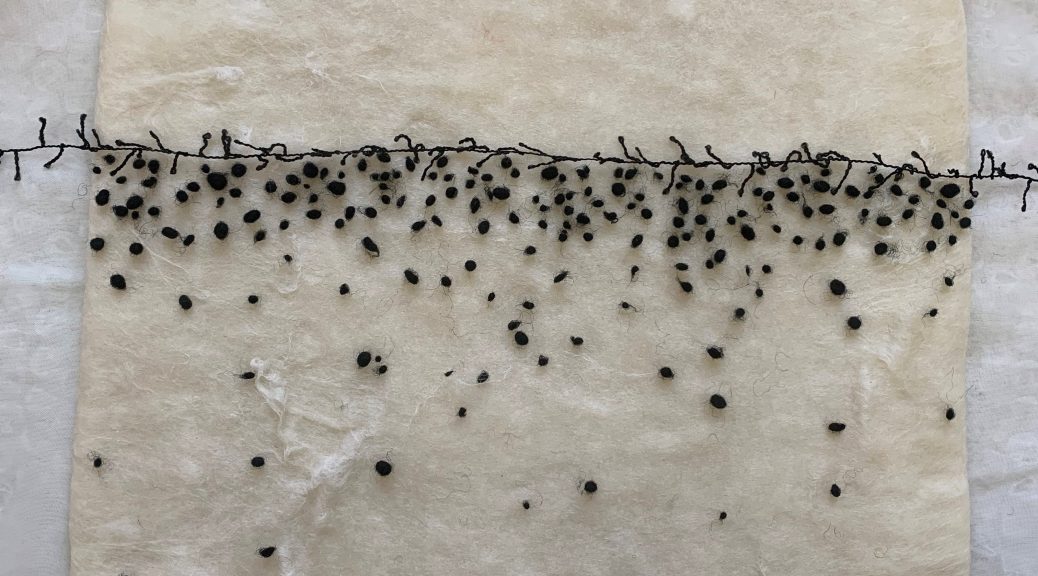
I laid 4 layers of natural white merino over both sides of the resist then ran a single strip of the yarn around.  I then added single black nepps below the yarn line, more densely near the yarn and just a few further down the shape. This seemed like a good idea but it took absolutely ages to separate out individual nepps, pick out only round ones and of a similar size, and then place them where I wanted them to sit.  One of those decisions you regret before you’re half-way through but can’t bear not to finish as you’ve already invested so much time in it!

Anyway, here’s the finished vase.  Actually, I’m pleased with the pattern, although I’d intended the yarn to sit a bit further up the flask. I’d not properly taken into account how much of the felt would be underneath.

I thought I’d find some more old 3 necked lab flasks. Having consulted both EBay and Google it rapidly became clear that they are not to be had.  I have not found a single similar 3 neck flask (there are new ones which are much thinner and tend to have domed bases, no good for vases).  The nearest I could find was a similar heavy glass 2 necked flask which is on EBay for £40.  £40!  I now feel I can’t sell my vase as I don’t want someone to buy it for the flask and rip off the felt! So, that one is staying with me, at least for the time being.

And finally we come back to the pre-mixed fibre I mentioned (labelled ‘carded’).  If you’re ever lucky enough to visit World of Wool in Yorkshire, you’ll see they have two huge skip-type bins full of ends of lines and wooly remnants (one with coloured fibres and one just cream /white). There’s a low fixed-price per weight for the content of each bin and you can ferret out all sorts of hidden gems. I can spend a long time almost falling into those bins. This mystery fibre-mix was one such find.

I thought I’d make a vase using that plus a piece of a pink silk scarf I’d just found in a charity shop.  That day, alas, I was not wearing my sensible head and didn’t think to make a sample: partly because I didn’t have a lot of the fibre and partly, well, because I just didn’t think about it.

I laid out 2 layers of a matching pre-dyed merino, 2 layers of the mystery fibre and a strip of silk and set about felting.  Fairly soon my error became clear.  The mystery fibre was not felting at all.  I persisted.  It still didn’t felt.  I persisted.  And persisted.  In the end it did felt, presumably with help from the 2 inner layers of merino.  It shrank more than I’d expected and the fibre hadn’t been all that keen on pushing through the silk, which means the silk ruching is rather loose in places. But it’s fixed completely round the edges and anyway, I like a bit of loose ruching.

So, here are my recent adventures in vase-making, with a little diversion via a plant pot.  I hope you’ve enjoyed them. Do you have a favourite?

Fleece Challenge

Fleece Challenge

Back at the beginning of the Century, when I was a fairly new member of the Dorset Guild of Weavers Spinners & Dyers, and an enthusiastic entrant for challenges, the Association of Guilds of Weavers Spinners & Dyers (referred to by older members as “National”) via it’s quarterly magazine “The Journal” decided to run a Rare Breed Challenge.

National would provide a quantity of raw (unprocessed) fleece to any member of a Guild who entered with the intention that the member would process the fleece and send in a report for publication in the Journal. I thought that I should have a go.

The piece of fleece that arrived in October 2001 weighed 5¼  oz (145 gr.) before washing.  The staple was 4” long with a pronounced crimp, and it was quite oily. 

Staple

I placed the whole sample in my “patent fleece washer” (about which more sometime in the future) and left it to soak in plain rainwater for two days. The garden benefitted from the mucky water afterwards.
The fleece was drained but not dried, and then given two further long soaks in rainwater and Fairy liquid. A final overnight soak in rainwater and Woolite was followed by two rinses in rainwater (it must have been a wet autumn). The fleece was drained again and then spread out on a rack in the airing cupboard to finish drying.

Raw Fleece, as it arrived
Washed Fleece

I was surprised to find that almost all of the lanoline had been removed from the fleece, despite the fact that the rainwater had not been heated at any time. However, as this was the first time that I had washed fleece, I should possibly have expected this result. Because the fleece was so dry, I added a smidgin of Johnson’s Baby Oil as I carded it. At least to begin with – until I got fed up with the smell and added some lavender oil.

I decided to make a shawl or stole, because the fibres felt a little too scratchy for a scarf or anything which would be close to the skin. I did not think that there would be sufficient yarn to make a garment to be worn on top of other clothes. I felt that a fine yarn to make into a lacy article would be best – it would go further than a thicker yarn and, with care, be “light and airy”.

I wanted to spin much more finely than I have done in the past and had read somewhere that thin rolags would be better for fine spinning. So when carding, I separated each bat into two layers (one from one carder and one from the other) and formed the rolags round a knitting needle to make long thin rolags.

Carding the fleece.
“Pencil” Rolags

I had also heard that it would be easier to spin finely if I padded out my bobbins. (You can tell that I’m mainly self taught from watching others spin or reading books, as I don’t know the mechanics behind these theories – but I’m was learning.) I used foam pipe insulation around the spindle of my bobbins and this worked very well.

It appeared to be quite easy to spin finely, at least for the first two bobbins. After that I was using the rolags from the bottom of the pile. They had suffered from compression and were more difficult to spin without too many slubs appearing. I plied the first two bobbins and took off the resulting two-ply yarn onto my niddy noddy. This is a very handy size. It was made for me by my brother-in-law and each full round measures a yard. I was therefore easily able to calculate that the length of my first skein was 118 yards. I set the ply by dipping the skein in cold (tap) water and Fairy liquid.

When it had dried I found that, despite having been spun semi-worsted, the yarn was quite fluffy. I felt that this would result in a blurring of most pattern stitches and decided therefore to try Broomstick crochet. I made a sample (a very rare occurrence for me) and found that, if I combined Broomstick with Tunisian crochet, I could make quite an attractive triangular shawl.

In case you are not conversant with Tunisian Crochet, let me give you a brief lesson. The hook used for these stitches is crossed between a knitting needle and a standard crochet hook – i.e. a knitting needle with a hook at the opposite end to the knob. (It is also possible to get a double (hooked) ended Tunisian hook for more complicated work). Each row is worked in two halves – a forward and a return row. Tunisian Simple stitch forward row is in fact unfinished Double (Single in US) Crochet. The final loop of each stitch is left on the hook so that at the end of the row you have a hook full of stitches, as in knitting. The return row is made by chaining off the stitches so that you end up with just one loop on the hook and are ready to start the next row.

According to Muriel Kent (author of Exciting Crochet – a Course in Broomstick & Tunisian Crochet) Tunisian Crochet is known as Afghan Crochet in North America and has also been called Russian Stitch. She reports that it is a very old craft, older than both knitting and ordinary crochet, and that an example had been found in an Egyptian tomb.
Broomstick crochet (or Witchcraft Lace!) is thought to have originated in North America, the principle being to make loops of a regular size by placing them onto a Broomstick – or very thick knitting needle – and to remove them in regular groups with double (single) crochet.

As I had not yet spun up all the prepared fleece, I had no idea how much yarn I would have in total. Also as time was now getting on, I thought I had better start on the shawl straight away, rather than wait until I had completed the spinning and plying. The safest way to cope with not knowing how much yarn I would finish up with was to start at the point and to increase at either end of the rows as I went along. Then, if I started to run out of yarn, I could avoid more easily ending up with an odd shape.

In the end the stitches I used were not quite those in the sample.  I have used “Tunisian Broomstick” rather than Tunisian and Broomstick.  After forming the Broomstick loops on a 20 mm Broomstick pin, I took them off in groups of six using a 4½ mm Tunisian crochet hook.  Instead of finishing each double crochet in the usual way, I left the last loop on the hook, Tunisian fashion, and then chained them all off. The next row was Tunisian treble (double treble?) stitch, and the increase was carried out at each end of this row – doubling the 12 stitches above the first and last “fan” of Broomstick stitches. This was done by passing he hook through the stitch on the previous row for one stitch, and then between that stitch and the next on the previous row for the new stitch, six times, increasing the stitches on the hook by twelve in total. These three rows form the pattern and give a right angled triangle.

Starting the Shawl
Tunisian Broomstick

I did not get the shawl finished before I had to send in the report, so there was no photo of it, but I note that I did enter it in our Guild Special Exhibition in 2002 which formed part of the Dorset Arts & Crafts Exhibition that year.

The Wool is Here!

The Wool is Here!

I needed to order some wool and Jan need some wool, in the hopes of being able to teach again. And… Well….who doesn’t need more wool.  I order a large amount when I order. I was aiming for 20 kg. The shipping gets cheaper if you order more. I picked out what I wanted and Jan picked out what she wanted. We took several days to do this. And then having reached 20kg I realized I had not added in the 5 kg of Corriedale I wanted. Well, that means I need to get 40kg as I am in the next shipping bracket. Add some wool I had only been thinking about and some more dyed fibre and then ask a few others I know with week will power, that might want several kgs of wool, not little retail amounts, I made it up to 40kg.  Hit the order button and hear my bank account shriek. LOL, my spell checker wants to change shriek to shrink. Now we wait. a few days later it was in Indianapolis Indiana in the USA, then Montreal Quebec, then Ottawa Ontario.  whoops, then Indianapolis again.   That does seem right… It’s not, here it is on my doorstep. Yay, wait a min there is only one box.

Her it is Jan took these on Saturday when she dropped by to pick you her goodie order. She was busy doing flax and wouldn’t make it to the market. You can see it is not a square box.

I kept checking but the FedEx site just kept saying it was in transit in Indianapolis. Then the site tried to tell me I had no packages so I called them and after a bit convinced the automated system that I was stupid and needed to speak to a human. He had a hard time finding it but said it was waiting for customs clearance. Hmm, I wonder if they will open it or x-ray it. It was there for several days. And then, at last, it arrived

Well, that’s odd that isn’t a white World of Wool box. I bet they opened it and couldn’t get it back in the box. LOL on them. I have had this happen before but it came with the top open and lots of customs tape over the top to keep everything from falling out. It was quite funny.

The first to open was the white box.


I dug down in the white box and it seems to be the batts and prefelt.


I dug down into the second box about halfway. I put it all back in. I don’t have room to let it expand right now. I have to keep my table clear for baking tomorrow. My table does double duty. It has to be cleaned to do felt and then cleaned to do tarts. I have a rolling stone but I need the room for the tart trays.

As you can see it is not packed to the top so I do think it was repacked into a larger box at customs.

I am pretty sure the white you can see inside is the Corriedale. and partway down I found the packing slip and the nice thankyou postcard you always get in these orders. They are usually on the top.

It all went back in the FedEx box but not into the WOW box

The FedEx still shows the parcel as pending with no delivery estimate. I think their site is broken but if they want to deliver more wool I will be happy to take it.

Monday is a holiday and we will don our masks and meet on Jan’s lawn to sort out all the wool parcels. She is in about the middle of where we all live.  I am sure Jan will take lots of pictures of the happy wool gathering.