Fun with Foils

Fun with Foils

Like many of you, I belong to some textile groups that would normally meet in person but this year have needed to find alternative ways to work together. One such group is the Farnborough Embroiderer’s Guild (EG). This EG group is quite unusual in that rather than inviting speakers to talk about their practice, we all take it in turns to teach each other new skills. Three months ago we started meeting via Zoom and I have to confess in some ways I actually prefer it! We aren’t a large group but when we meet in person I often end up only talking to the 2-3 people I am sat nearest to, on Zoom the whole group shares the same conversation which is nice and feels very inclusive. The other advantage is the lack of commute, for me, this means I get to eat before we gather and I can have a glass of wine while we play together 🙂

Last month Sue took us through a technique to create foiled pictures; I don’t know about you but I can’t resist a bit of bling! As we are approaching holiday season it also feels very appropriate to share this with you now, I think it would make some wonderful textile Christmas cards and gifts. I hope you enjoy it and feel inspired to have a go!

Although I have played with foils before it was only as decorative finishing touches never as the basis to create a whole textile picture. Even so, I still managed to make every mistake in the book but was pleased to find foils are remarkably accommodating, if you make a mistake, it can (mostly) be rectified with layering more foil over the top.

Unfortunately it did not occur to me to take photos of the process until I was half way through my picture, I apologise for the lack of photos covering the initial stages of the process. The first few photos are where I went back and reapplied the bondaweb on the beak as my initial application had not transferred completely.

This was the reference photo I used for inspiration:

Some useful tips before you start:

  • set your iron on a low to medium (1 to 2 dots) setting without steam
  • always use a sheet of baking parchment to protect your iron
  • work on an ironing board

1: Cut a piece of medium weight, iron-fusible interfacing / fabric stabiliser slightly smaller than the background fabric and iron it to the back of your fabric. We used black cotton velvet but most non-synthetic fabrics will work (synthetic fabrics are best avoided for this technique as they might melt when heat is applied).

2: Draw out your design with a pencil on the paper side of a sheet of bondaweb. If you aren’t confident drawing freehand, you can trace the design from a printed image. Cut out your design, either as one solid shape or in sections if you plan to create a stained glass effect. For the hummingbird I cut out the whole bird as a single piece.

3: Transfer the bondaweb design onto your backing fabric.

If you are using the stained glass technique you might want to transfer one piece at a time, foil it then apply the next bondaweb shape.

4: Once cooled, carefully peel off the paper backing from the bondaweb.

5: Lay a piece of foil (coloured side facing you) over the exposed bondaweb and cover this with a piece of baking parchment, using the tip or edge of your iron, apply gentle pressure to the areas where you would like that coloured foil to appear.

Allow the piece too cool before peeling back the foil backing.

Tip: you can cut out pieces of baking parchment paper to mask off areas where you do not want that particular colour to appear.

If there are areas where the bondaweb has not transferred so well, or you have already applied several layers foils and want to lay a different colour over the top you can reapply the bondaweb but cutting a shape to match the area, I did this for the edge of breast where I wanted the purple to form a solid line:

If you want a sharp edge in a specific shape, it is also possible to cut the foil to match the shape you desire:

6: Continue adding different coloured foils to your design. If using cotton velvet for the backing it is possible to build up layers of different coloured foils without applying more bondaweb.

Tip: keep the scraps of partially used foils, they can be used to overlay different colours on top of each other very pretty marbled colours.

It is possible to “draw” lines of foil using just the tip or edge of your iron, I used this technique to create the feathers on the wings:

It is not very easy to capture foils in a photo, especially the holographic ones so I shot a short video that I hope shows all the different colours more effectively:

Our group met again last night to add some embroidery to our designs, this is how far I managed to travel in the couple of hours we had together.

…and a little sneak peek of my most recent foiled “painting”.

Have you tried making foiled paintings?

Year 2 Flax Study Group, The Violent bit’s at the end!

Year 2 Flax Study Group, The Violent bit’s at the end!

A review of year 2 so far

This year the flax study group planted the seed we had harvested from last year. We had enough to double our planting and had 2 rows planted this year. We had 2 covid-modified weeding parties at 4 to 6 inches of growth but without the wonderful cake to celebrate successful weeding!

 1-2

The first part of the summer was very dry and hot so the flax was ready earlier than anticipated. We left the harvested bundles of Flax resting against the garden fence to dry.

 3-5

Then the weather turned and it rained and rained and rained. (I should not have been trying to wash those fleeces in the side yard! See the blog post about sentient weather.) The flax started its retting while it tried to dry. Once it had finally dried enough, we were back out (August 29th) to extract seed from stock. The seeds this year are MUCH smaller than last years, and lighter in weight. The seed pods were definitely ready to pick but the dry weather was hard on the plants (shorter in stature and smaller seeds). We used a number of seed extraction methods.  The double rakes were great and the pillowcases and rolling pins were effective too. Unfortunately, winnowing (using the wind to seperate chaff from seed) was not working, not much wind and the seed was as light as the chaff) we had the best success with Henrys Sieves from the grain silos. (Brilliant idea Henry!!)

6-13

Next the Flax, now de-seeded, went to the spa. (large trough of water with therapeutic cinderblocks to hold it under!) With the retting complete, we were ready to move on to the violent part of the process; Brakes, Skutching and the lovely Hackles! We set a date in November that we hoped most of us would be available to meet again at Cathy Louises’ coverall barn (the part the cows don’t live in! They are very cute cows but I don’t want to have to share the flax with them)

 14 supervisors

Now that we are all caught up again, let’s get to the best part of Flax processing; the vicious violent bits!

11/07/2020 Covid canceled our Guild sale but that leaves the Saturday free to start in on the flax. We met at the coverall barn on a fabulously wonderful un-fall-like day. It was so nice we worked in front of the barn, enjoying mild weather, the sun and no rain!

  15-16

Step 1 Braking;

The first step was braking the flax stocks to loosen and start the removal of the outer stock covering (the boon) from the long inner fibres which will become the linen. Bernadette, Ann and Cathy Louise experimented with hand braking before sending it to the brake but that was not as helpful as we had hoped.  If you did not have access to a flax brake this may be an option for you but it would take a lot of working the stocks to loosen the boon.

 17-18

Glenn and Gord were our main brakers this year. Glenn’s knee has been bothering him (postal work has not been diminished by Covid) so he quickly gave up on standing and has perfected the seated braking position.

 19-20

We had a couple of flax videos posted on our OVWSG flax study group Facebook page they were unfortunately in German (about Hackling) and in Russian about braking. From the video, Glenn modified his technique on the second Saturday to add scraping movements to the end of the braking. This seemed to make the next step a little easier.

  21-22

The technique seems to be to hold the root end, start at the tip (where the seeds were) and brake towards the roots flipping which side of the bundle is facing up. This first pass was done vigorously. Then work from the tip towards roots a little at a time still flipping the bundle but scraping gently each section as it is finished. Then flip and work the roots, which often broke off.

  23 the fibre is handed off to the next step

Step 2 Skutching;

As we got going, we had two primary brakers and 2-3 skutchers and the rest of us were on Hackle duty or taking photos. Skutching is a percussive movement hitting or flicking the stocks to loosen and remove as much of the outer layer as possible. The Skutching team were finding that splitting the bundle (by gently tugging on the ends) then reorienting the stocks parallel and continuing to skutch was effective.

  24-29

   30 fibre is sent to the next step

There was an intermittent breeze that kept depositing fibre into the shrubberies. (Sort of like pre-Christmas tinsel) I am sure the birds were sorry we didn’t do this part in the spring.

 31-33 Early Christmas tincil

Step 3 Hackles!!

The next step is my favourite part, the Hackles. They’re like a very sharp multi-pitch Viking comb that is clamped to the table. The flax is dragged through the top of the sharp pointy bloodletting teeth, removing even more of the boon. I watched the German video about Hackles, it was highly informative even with my only random words of German. He definitely was adamant about the angle, I think? I tried to mimic his diagonal pull through with change of direction on exiting the hackles. I also tried the flipping one side up then the other for each pass. This left the flax quite clean.

   34-36

   37-43

The hackling starts through the coarsest teeth then moves to finer and finer. Each step removes more boon. I was able to take out a few stubborn bits by flicking at them with a fingernail. We also were drafting off the hackles as the tow built up in it. The remnants still trapped in the comb, we bagged to process with the drum carder next week.

 44 some of the line

Just so you don’t think we were horribly overworked, we did break for Pizza

  45-46

We did quite well today but only got about half way through the harvest, well we did double the planting we did this year! So far, the flax is short but very fine. We bagged the tow for next week and made little stricks of the line. We did do a lot of work but it doesn’t show from the pile remaining!

   47-50

Some of the flax has a distinct hue of green.  The rest looks very familiar.

   51-52

11/14/2020  Day 2, similar in process to day 1 but with less sun or good temperatures.

It was much colder today, still no fluffy solid rain or serious cloud dandruff, yet (Yeah!!) so we moved into the coverall to work. The hacklers were by the barn door, while it provided great light there was a cool breeze. We continued to work on the braking and finished it off, leaving one bundle to compare with last years. We continued working on the skutching and hackling and added making batts with the tow.

  53-61

Our tow team today was Deborah and Cathy Louise.

       62-66

Deborah and Cathy Louise worked together to make batts of the tow.  We tried one pass but decided to try a second pass which was markedly improved.  They tried a third pass, but it was deemed very similar to the second pass. We found the waste from the drum carder to be very soft and have kept it.   We tried hand combing it with small 2 pitch hand combs with a good test result. We will collect the carding waste and comb it later.  Using the drum carder caused a lot of the chaff/boon to drop out underneath it.

    67-68 first and second pass

    69-70 Second and third pass

  71-72 Drum carder waste combed

We compared last year’s plant after retting to this year and saw a difference in height and this year’s plants are much finer in the stock. They were planted about 2 weeks earlier, but also harvested earlier than last year. We did not harvest too soon since the plants had flowered and were producing seeds so it was the correct time to harvest. It was extremely dry this summer until we harvested then it rained, a lot!

   73-75

We got most of the skutching finished today too.

 76

We bagged up the batts of tow we created today. We will be weighing the amounts of line and tow we have created likely next week.

 77

We will be back to work for our last day of processing this year next Saturday. There is a bit more to hackle then all the tow to process. When we are done, we will weigh out the tow and line and see what our yield was this year. Although the flax was definitely reduced in height the fineness of the fiber is spectacular, even the tow is soft and quite nice. I am looking forward to getting one of the flax wheels upstairs and put to work spinning part of this year’s harvest.

   78- 79

The spot we had the flax growing this summer is turned for winter and garlic has been planted there. It has been an amazing experience working with the flax team. Next year is a bit up in the air, we will hope to be changing planting locations or we may wind up taking a summer off.


The cowl is finished

The cowl is finished

I did finally get the cowl finished. It turned out just as I had hoped.  I took it up to a flax processing day to show everyone and Jan took some nice pictures of it for me I think they show it off very well.

If you remember this was the inspiration for this cowl. I liked the way the two points overlap.

This is the silk lap side out.

This is the filk fabric side out.

And finally, this is me wearing it. It’s not a great shot of me but it does show how the cowl fits. I plan to use it this winter. My neck is always cold but this will not be bulky under my coat.

I hope you like it and it was worth the wait to finaly see it done.

Holiday Decorations – Fourth Quarter Challenge

Holiday Decorations – Fourth Quarter Challenge

I have been thinking about what holiday decorations that I wanted to make for the Fourth Quarter Challenge. I wanted to do something simple and decided to try creating an ornament with prefelt. I don’t usually use prefelt in creating my designs so I thought I would give it a try. I decided on a snowman design.

I had commercial prefelt in white and black but none in red. So I created a piece of red prefelt as the first step from mixed 56’s hand dyed fiber.

Next I needed a circle of red prefelt from the background. I wanted my finished ornament to be around 5″ diameter so I used this approximately 7″ container to cut around. I used a craft blade and essentially just scored around the container and then finished cutting the circle out with scissors.

I had enough red prefelt for 7 circles. I hadn’t really planned on making multiples but what the heck, I might else well make more, right?

Next I cut out two circles in white prefelt, two black hat shapes and a black circle to go behind the red circle. I decided that my red prefelt wasn’t going to be heavy enough with just one layer. I used black instead of white because I like a deeper red better than I like a pink. I didn’t have enough red prefelt for two layers. Now on to felting.

I had hoped with two layers of white prefelt that I wouldn’t get a lot of fiber migration. No such luck. I did shave a bit off the surface of the white so it wouldn’t look so hairy and that helped. I only felted this one just to see how it would come out. Next time, I think I will cover with a light plastic to try and prevent any movement of red and black fibers into the white. This one was rubbed with my hand so I think that I got a bit of movement of fiber as well as migration through.

Now on to more decoration. I stitched a small piece of sari ribbon on to the hat for a band. The sari ribbon adds a bit of shine. Then I hand stitched the facial features. Now I have to decide if the ornament needs further backing, if it needs an edging treatment and how to hang it. What would you suggest?

More dyeing shenanigans (with a twist)

More dyeing shenanigans (with a twist)

The last time I wrote, I talked about dyeing yarn. As an indie dyer, my job is to create colourful yarn that someone else will turn into something beautiful. That’s pretty much the norm.

Now, what if I turned that regular idea around and dyed the finished item instead? What would happen? Let’s find out!

I had some very lovely 4-ply yarn at hand, plus some mohair lace that was just coarse enough to be uncomfortable if used alone. Paired together they would make the perfect DK weight yarn for a cardigan I wanted to knit.


Fast forward 2 or 3 days, and here’s the finished cardigan, minus the buttons.

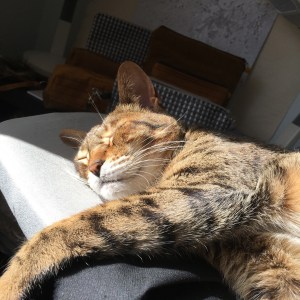
Let the experiment begin! I wanted a red base. I had to add that to the dye bath first. It looks very much like a murder scene, so let me tone it down by inserting a cute photo of my cat Marshmallow next to it.


Since I wanted the red to be soaked up slowly and evenly, I started with cool water and no acid for binding. This will ensure the colour is seeped up gradually and has time to get to the whole garment. I then added the wet cardigan, turned on the heat to medium-low and kept an eye on it.

After 15 minutes, the water was warm and I could see that the red was all over the cardigan. Time to add citric acid gradually. Then turn up the heat, simmer for 10 more minutes, turn it off and wait for the water to clear up and cool completely.

A good sign that you’ve used the right amount of dye and acid is that the water clears up completely once cooled. This is also a great sign of minimal bleeding in future washes, the bane of any dyer.
(If your water isn’t clear, try adding more acid and simmering for another 15 minutes. Let the water cool completely and see if things aren’t better.)

I really liked this colour, but a rule of thumb is, if it looks perfect under water, it’s too light when dry. I also wanted a bit more dimension to the red, so some dark grey was needed.
I didn’t want this new colour to soak up evenly, so I didn’t remove the cardigan from the bath water as I added the new dye, and I kept the same acidic, fast-absorption water from before.

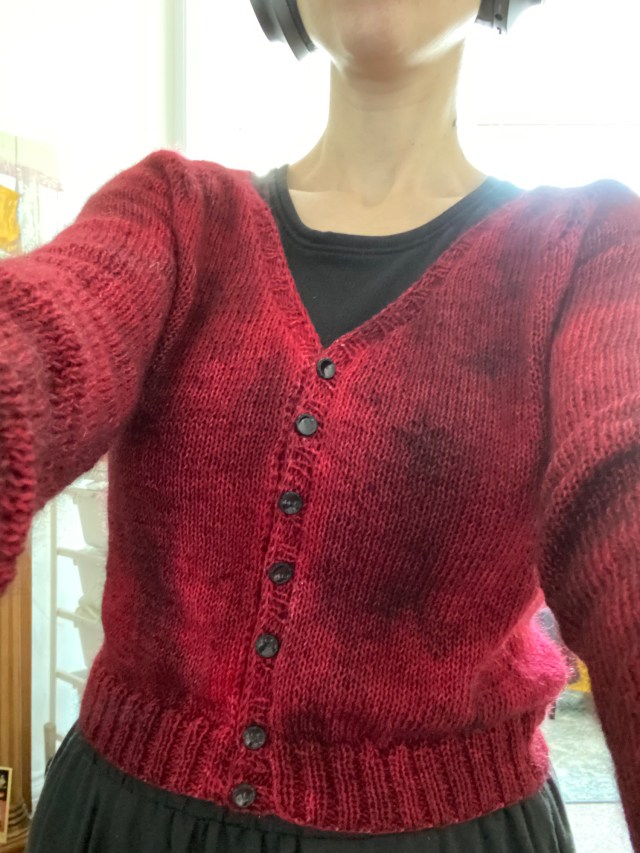
And here she is afterwards in all her glory!

I know the “scruffy look” might not be everyone’s cup of tea but I love it. It looks like a long-worn cardi, something my nan might have passed on to me. The vintage buttons complete the look.

Now, the important question: is the end result the same as dyeing the yarn in the skein? The answer is a resounding No. Depending on how tight you knit, you might end up with a lot of areas that the dye won’t get to because the stitches act as a resist. You can see lighter areas in the photo below, something I fully expected, even though I’m a fairly lose knitter. I actually like this feature because it’s very different from what you normally see.

I had never done anything like this before, and you might be horrified to know that after this, I’ve knit a shawl and now have a second cardigan on the needles, and both will receive the same after-completion dye treatment…

I wore it for the first time yesterday (at the time of writing) and it kept me warm all afternoon indoors.

I hope you enjoyed this experiment. Let me know if you’ve ever tried anything like this before, and what the outcome was! If not, what dyeing shenanigans have you been up to or would like to try?

Stay safe and enjoy the rest of your day.


A Long Wait for a Large Loom Part 3

A Long Wait for a Large Loom Part 3

In part 1 we saw the history of the guilds’ old 90 and 100 inch loom. In part 2 we chatted about the arrival and unpacking of the new 100 inch loom. Now lets take a peek at the reference binders related to the old looms and consider continuing that tradion.

My hope is that today’s guild members, as they chose a topic, whether it’s a coverlet or blanket or something else to try out the new loom, they look back to the weavers from earlier in the guild’s history. Like these earlier weavers they record their projects and designs, take photos of their weaving so we can get a glimpse of them as well as what they are creating.

In the past the guild weavers have sporadically documented their projects both with the 90 inch and 100-inch loom. I (in my capacity as one of the guild librarians) would like to see a new binder documenting the projects which our modern weaving teams will make with this new loom.

94  The 90” loom Samples 1 May 1973 to 1 May 1974

95 – 101 sample pages from the 90” loom sample binder

  102 OVWSG 100” Loom Samples Aug 1982 to Oct 1983

103- 110 sample pages from the 100” loom sample binder

111 OVWSG 100” loom Samples  1987 to 1992 (while the loom was in Donna G’s Basement. Donna also taught the beginner and intermediate weaving at that time with table looms)

112-121 sample pages from the 100” loom sample binder

We have some sample binders in the reference section of the library, including guild projects, workshops and individual members weaving careers.  It would be nice to have sample binders from Spinners, Basket makers, Dyers and Felters too. Keeping records in a sample binder is a way to keep track of your work and experimentation. Your collected projects will give inspiration to yourself or others.  Try to make your sample binder in a way that will keep your samples safe from damage. (Use acid-free materials if you can get your hands on them, sew in your samples if possible rather than tape or staples) and always take lots of photos as you work to include to show the process you went through to make it!

Weavers have the advantage of pre-made sheets (available from guilds or online) that save the draft or pattern of the weaving as well as noting yarns, yardage calculations and notes. i would like to see a similar collection of information for the other fiber arts. Spinners can keeps notes of what fibers were used, where they were obtained, what spinning techniques were used and what the end use for the yarn will be. For Felters, what fibers and their sources, weight of the fibers used,  techniques used, amount of shrinkage when fiber was sampled, note on how the project was made. Photos would be useful to document your project (felt sculptures don’t fit in binders).

Figure out the information that would be useful to have for each project you create. You may want to include not only the date started and finished, but keep track of the hours worked on each project. Or you may be more interested in what fibers are used or what mix of fibers were used and in what amounts. If you have demo-ed you may recall getting asked common questions, how long did that take, where did you get the idea, where did you get the fibers, how heavy is it, how did you make it do that? theses questions mite help direct you in what to include in your binder.

If you make a binder documenting your work it will both keep a record of your artistic career, showing your progress, and looking back through it may inspire new work.   I hope you will consider sharing it with other fiber artists too. If you show them yours, they may show you theirs!

122 Part of the Reference Section of the Guild Library
I hope the saga of the large loom has inspired you even if you do not go out and get one yourself!  If you are suddenly yearning to weave a coverlet or a lovely warm blanket check with your local guild and see if they have a 100” loom you could use.


Who could resist

Who could resist

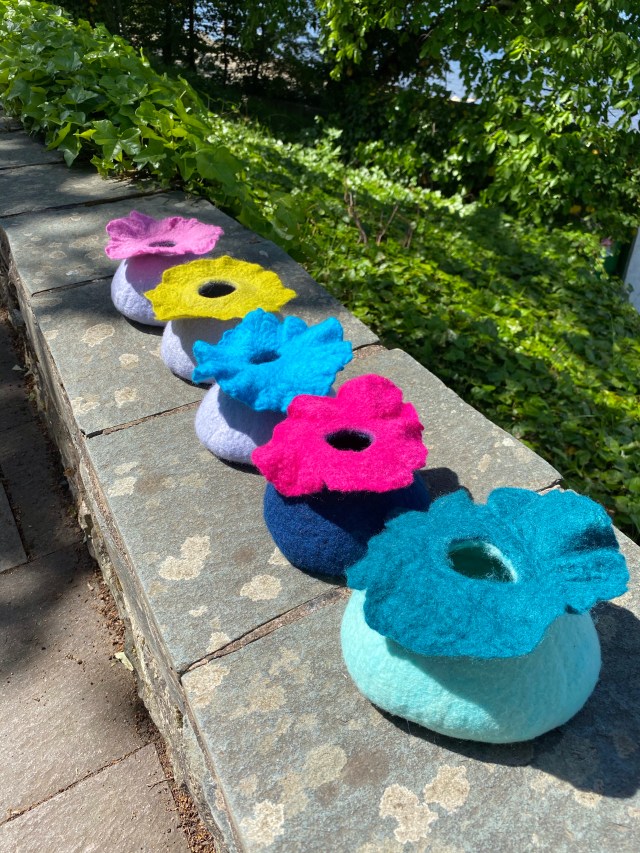
My name is Janet Bayar, I’m 60 years young and live in the lake District Cumbria. 2018 January I attended a day felting course,a Christmas present from me to my daughter, with my daughter and now I am hooked. I have created art all my life but feel that now I have found “the one”. I am excited for the journey ahead. Apart from the day course I am self taught and live by the “what if” mantra.

When taking part in the beginner wet felting day like many I couldn’t get my head around how you could make this fibre and flat felt into a 3 d item. With patient guidance from my daughter , who has a degree in art , I mastered the craft of felt vessels. My mind then went to , well if you can have one resist why not more and thus the journey began.

I am often asked , what do I mean by a resist. A resist is something that stops wool fibres from felting together. In vessels it could be a simple piece of plastic sheet , in shobori it could be a button or marble. Something that stops the fibres of the wool knitting. Recently I began thinking about using the same techniques I have used in vessels but adapting them to 2 d pictures. I first laid down a base of Marino topps then used herdwick in various shades sandwiching between three different sizes of circular plastic. After wet rubbing until I knew the fibres were well felted I cut out the plastic

Shaping the piece was next. I have mainly used the ever forgiving Marino in the past and wasn’t ready for the harsh corse herdwick and must admit ended up skinning the side of my hand rubbing the fibres into shape. In the end I put on disposable gloves and used bubble wrap to creat the shape.

I loved the process so much I then went on to experiment more.

This shows the piece with only one resist cut out. You can see where the other resists are positioned.

I will now develop these. I always treat the felting pieces as the base of my canvas. Sometimes I go into a project with a concept of where I am going it sometimes the piece takes me by the hand and leads.

In this case my sample piece is developing. It’s early stages yet but I know where I am going but will post how it develops to the final outcome.

Slow Stitch Update

Slow Stitch Update

It’s been over a month since I last posted about my Autumn Nuno slow stitch piece. Here is where I was at the end of September.

I kept working on the negative space between the foreground trees. I was using a grey green thread and it definitely needs more darkness in between the tree trunks but I will have to add a darker thread for that. I am still mulling over what will be on the left hand side in the foreground. It’s kind of amorphous at the moment.

Once I finished the negative space between the trees, I decided that I needed to add some of the grey green into the mid ground/background area. It also helped to “cut” the overpowering sense of red and red orange there. Next up was to add “leaves” to the foreground trees. I decided to use a different stitch to highlight them a bit more. I will be adding a great many more of the leaves in a variety of yellows and yellow oranges.

The photo on the left shows where I am as of today. The photo on the right shows the beginning of the leaves being added with detached chain stitch. I still have a long way to go on completing this piece but I am happy with the progression.


Challenge – make an item for your home for the festive season

Challenge – make an item for your home for the festive season

This  is my version of a commonplace Christmas decoration – it’s not an original idea but it’s unique because I’ve made all the bits. I used fibre in the form of fabric, yarn and merino wool tops.

My colour palette was inspired by the winter sky – blue, white, yellow, pink and grey.

I cut a suitable branch from my garden then coloured it with dark blue acrylic paint (photo below shows the branch before painting)…

…then I rummaged around in the glass recycling bin for a suitable bottle to put it in.

To make the cracker, I used a piece of cardboard tube rolled up in fabric (you can see the white tube through the fabric in the middle) …

…then tied either side of the tube with sewing thread.  The ends were trimmed with pinking shears and the cracker was finished with some narrow organza ribbon.

I knitted a stocking using a  free pattern for mini knitted socks  then stuffed it with some merino wool fibres.  I like this pattern because it’s knitted on two needles, not the usual four, so it’s very easy.

The snowgirl was made from 3 large white felted beads and some floral wire (see how to make felt beads ) and how to make a felt bead snowman).

Her hat is made from a rectangle of knitting drawn up along one long side, seamed, then a small pompom added made from the same wool.


Her scarf is a simple knitted i-cord.  Here is a video – how to make an icord

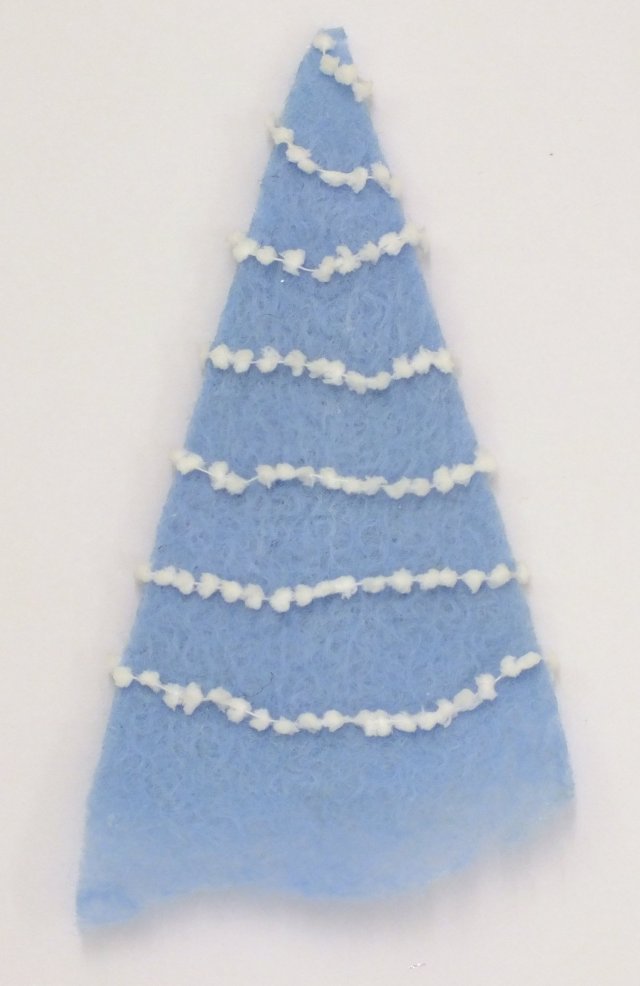
The tree is a scrap of blue felt, cut to shape, then decorated with fancy yarn.

The star is cut from a scrap of thick felt – yellow on one side and pink on the other.  I applied PVA glue to the edges to stiffen it.


I made 5 snowflakes but each is unique – that’s another way of saying that I made several mistakes because I was watching a film whilst crocheting and not paying enough attention!

I made 15 large felt beads in winter sky colours – but I only used 12.  As I was hanging everything onto the branch I reached a point where I realised I had enough and I had to stop.  The photo below shows them drying on a rack.

Everything was hung onto the branch using thin, yellow coloured wire.

This was a really easy, fun Christmas decoration to make and the variations are countless.  I hope you enjoy making something for your own home, and if you want to share photos please post them here fourth quarter challenge 2020


A Long Wait for a Large Loom  Part 2

A Long Wait for a Large Loom  Part 2

(A long wait for a large loom  Part 1 https://feltingandfiberstudio.com/2020/10/25/a-long-wait-for-a-large-loom/)

The guild both Ann and I belong to had an old 100″  loom at the end of its life. With the greatly appreciated grant assist, we were able to order a new loom that will be much easier for our ageing membership to use. We had our grant request approved so put in our order with Leclerc Looms. We dispersed parts of the old loom, put in a new floor in the classroom and awaited the new looms arrival…..

Unbeknownst to us, other guilds seem to have had the same grant idea! So, the loom that should have been ready for us in a few months, was suddenly delayed, then delayed again. There was a backlog of orders at Leclerc looms for 100-inch looms!  Then Covid 19 hit and there seemed to also be a shortage of wood (looking at the packing crates I can believe that!) so 18 months since we placed our order and a couple of grant extensions, our new loom arrived.

Long heavy wooden crates arrived and had to be carried up the stairs (there is a turn in the stairs too) since the 100” loom crates would not fit in the elevator.  All the crates and boxes were transported up to the classroom (which is down a long hall from the stairs with a couple more corners just to make it a bit more challenging). That was enough of an accomplishment for the day and a different unboxing date was decided on.

  41 – 42 A long way to carry all the heavy boxes up from downstairs

The evening they selected coincided with the day I would be doing the library book exchange, Oct 7th.  The guild library during covid has been doing book requests and drive by pick up /drop offs at the side door  for our members. It’s a bit more work for the librarians, but it is allowing the members to use the library again.  I was finishing with the library and started packing up, as the team of unboxers arrived.
43-45 yes there is candy involved in the library book exchanged!

   46- 47 I locked up the library, took the camera and headed for the classroom.

Upstairs in the Classroom, unboxing was already underway! Since we could not all be there to experience the extreme excitement of seeing the 100” loom unboxing I took photos and posted them on our guild face book group page.

48- 51  The Unboxing had begun!

I tried to capture some of the wonder of what is this? Where will this go? Is that a tensioning device for the bobbin rack? OOOH, a counter!!!! What are those extra beams for, are they just deflectors? OOOH, sectional bits and extenders!!!!

52-57 OOH!!

That is one big loom!!! In pieces it looks a lot bigger than 100 inches worth!!!

58 – 62 BIG!!!

63 There was ergonomic unboxing while sitting on a chair.
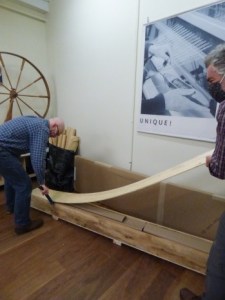
The last long wooden box was the one with the reeds, leash sticks and rods.

64-68 the last wooden crate

You can see the unboxing of the treadles and here is a close up of the treadles.

  69-73 that box was the treadles!

You can see the bobbin rack also still wrapped up. This will be a useful addition to the 100 inch since with a sectional beam you will not need as big a team to warp this large loom! I spotted the tension box, a counter and I think a tensioner for the bobbin rack too (COOL! My 60 inch sectional didn’t have one of those!).

74-75 Bobbin rack!!

The loom parts were well packed! The packing crates look like long window boxes!

76-77 well packed

The assembly of this loom will be like a giant 3d jigsaw puzzle! I hope photos will be added as this part is started. This next step might take a number of sessions more to complete. I will check next time I’m in to work on the library to see the progress.

78

After seeing pictures of the 100-inch loom and the fun that the next assembly project will be, I bet you are glad that felting is just vast quantities of wool, soap, pool noodles, bubble wrap, needles, wire and odd bits of equipment that were not originally intended for felting. (ok, that can take up the same space as the big loom but the wool is lighter to move!!)


Next trip into the guild library to do a book check, pull a couple of magazines and get photos of a couple of reference books, I also went up to see if the 3d puzzle was underway. Yes! It was almost complete!

It looks so shiny and new with its bubble wrap still on the beams! (those extra pieces I wasn’t sure how they would fit turned out to be a rotating breast and cloth beams.) I look forward to seeing if the rotational aspect will improve take up of the cloth or warping the loom.


79-81 the 3D “Kebec II Loom Counter-balance with Pulleys”

The extenders and the sectional parts still need to be added to the back beam but that isn’t too big a job. The bobbin rack is still to be assembled too. But the new loom is almost ready for its first weavers!

82-84 Sectional pices yet to be attached.

85-91Loom close ups

92 – 93 the New loom even makes the Guild’s Grate Wheel look smaller!

Since the new loom is now here, it’s time to start thinking about what exciting things it will be making; Blankets, coverlets, catalogue, curtains, Icelandic blankets?

My hope is that today’s guild members, as they chose a topic, whether it’s a coverlet or blanket or something else to try out the new loom, they look back to the weavers from earlier in the guild’s history. Like these earlier weavers they record their projects and designs, take photos of their weaving so we can get a glimpse of them as well as what they are creating.

Weavers have kept samples binders of there projects with notes on drafts, samples of warp and weft yarn and a sample of the woven cloth. Sometimes there are notes about the designing the project or inspiration that they used. Some have photos of the weaving in progress, finishing, equipment and weavers involved in the project. Sample binders can be a history of a weavers life or inspire other weavers.

We have a few sample binders of previous 90 and 100 inch loom projects in the guild Library.  I will show you a few next week.  Since these binders are very helpful to weavers; the Spinners, Dyers, Basket makers and Felters may want to make there own versions of sample binders!  Have fun and keep felting!

94  The 90” loom Samples 1 May 1973 to 1 May 1974