4th Quarter Challenge: the Making of Elf Boots.

4th Quarter Challenge: the Making of Elf Boots.

Recently Karen Lane did a post on Christmas ornaments.  fourth-quarter-challenge

I thought the elf boots she made were so cute I would have a go at making some for our tree too.

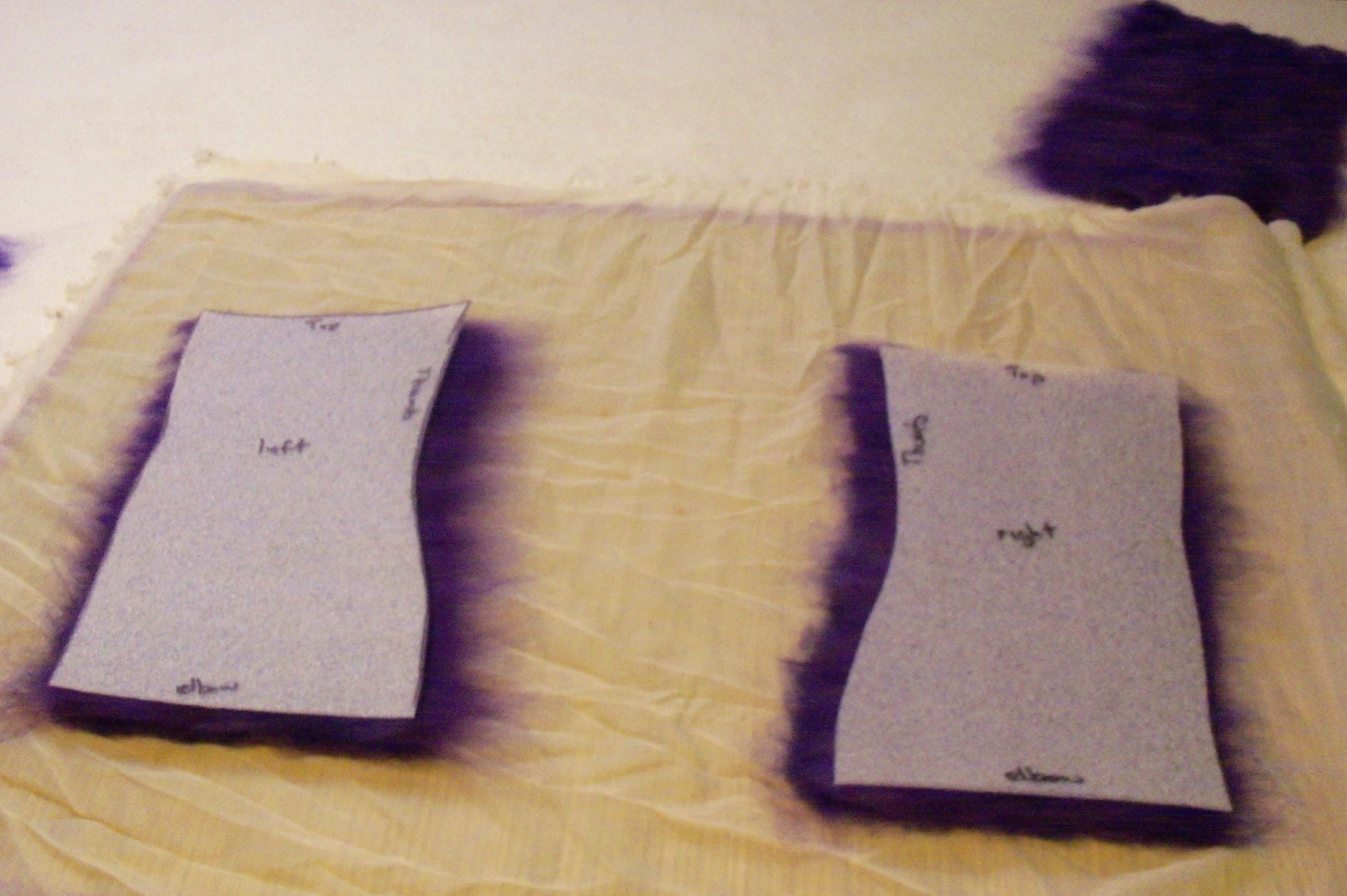
I drew one out the size I wanted then scaled it up.

I traced it. I like this underlay. You can see through it to trace things out. I have some blue stuff that’s opake and I have to cut things out to trace around or work it out, right on the underlay with a marker.

Then I have some “sheep” wool in a batt that was a nice gree so I laid it out wet it and started the rubbing.

I did some rolling with a mini pool noodle and some shelf liner. when it was ready I cut them apart.

I worked them one at a time. you can see the difference between the start and finished.

I have some gold Beada tinsel, non-tarnishing that was probably bought in 1960. It is a thin cord. I used it to make the laces.

having success I decided to make some more. Now, you would think after all this time and the fact that I warn my students about directional shrinkage, I would have known better than to lay the wool (merino top) across the boots because it would be easier to wrap it around. Needless to say, the foot part is much thinner. So perhaps they belong to some clown elves.

This slideshow requires JavaScript.

I think I will try it again. They are fiddly to finish but I enjoy having something to do with my hands watching BritBox shows in the evening.

Have you done anything for the 4th quarter challenge? We would love to see them. You can post them over on the forum. https://feltandfiberstudio.proboards.com/thread/4214/2020-fourth-quarter-challenge

Felt Samples Notebook

Felt Samples Notebook

Recently, Jan posted about the documentation being done in her guild about weaving. When I commented that I had created a felt sample notebook while writing the book The Complete Photo Guide to Felting, Jan asked that I share the notebook. So here it is!

I want to thank all the people and companies that donated to this effort as I had asked for samples of different breeds of wool, other fiber that felts and different embellishments. That’s how I got a wider selection of fiber. For each sample, I documented the type of fiber, the type of processing (batt, roving, raw wool etc.), how long it took to felt, the amount of shrinkage and any comments about the felt that I thought were good to remember. Each sample started with the same size layout and were all felted in the same way. I guess I should have documented exactly what I did but this was in 2011 and now I can’t remember exactly how they were felted or fulled.

I put all the samples on black construction paper with a small piece of double stick tape and a label beside each piece. These were put into plastic sleeves and stored in a large loose leaf notebook. You can easily slip the pages out of the sleeve to be able to touch the samples and look more closely. Most of the felt samples (without embellishments) are the natural color of the fiber. You can click on any of the photos to get a closer look and be able to read my documentation about each fiber.

Pelsull/C1 Blend and Dorset

Blue Faced Leicester and Corriedale

Falkland and Finn

Gotland and Icelandic

Merino and Norwegian C1

Pelsull and Polwarth

Romney and Wensleydale

Alpaca and Angora Goat

Angora Rabbit (smaller sample due to limited amount of fiber) and Bison Down

Camel and Cashmere

Llama and Yak Down

The second part of the notebook is about embellishments. I used a merino wool and applied the embellishments to the surface. I didn’t do much documentation on these except to state what the embellishment fiber is.

Silk Top and Silk Cap

Silk Throwsters Waste and Silk Hankie

Silk Carrier Rods and Silk Noil

Rainbow Nylon and Angelina Fiber

Fake Cashmere and Tencel (viscose)

Banana Fiber and Sea Cell Fiber

Flax and Wool Nepps

Wool Slubs and Wool Locks (flat on surface)

Wool Locks (ends loose) and Pre Yarn

Specialty/Novelty Yarns and Cotton Fiber

Soy Bean Fiber

I have always been an advocate of doing samples before starting a project. I think it really saves effort, time and money so that you have an idea how something will work before doing a larger project. Do you make samples? Do you document the results? We’d love for you to share your sample process over on the forum.

If you have any questions about the samples above or about using a specific fiber, feel free to ask in the comments below.


Felting Beaches

Felting Beaches

In my last blog I looked at different ways I’ve tried to represent sea and water in wet felted pictures.

Felting Sea Patterns

Looking back at this link, I realise I sold the sea picture I used as the blog header this week. Happy times! A couple of people asked in the comments if I’d also show how I’ve made beaches, so here we go.

The beaches where I live are mainly pebbles, but there are sandy beaches a little to the east and I’ve used both types of beach in my pictures.

Whitstable West Beach: the pebble beach at the bottom of my road

Here’s a picture of two Sanderlings at Minnis Bay: a lovely sandy beach with chalk rocks embedded in places in the sand.  I’m starting with this as it was an early picture and the first time I thought of using a blue cobweb felt overlay to represent a wet beach reflecting the sky. It’s a technique I like and use quite a lot.

Layout for and final picture “2 Sanderlings, Minnis Bay”

There’s a pewter-coloured base for the sand and light prefelted sections and silk fabric pieces for the chalk with a bit of darker shading around them

Here’s another Sanderlings picture, also at Minnis Bay. This time I’ve used a few different sandy shades to add the idea of shade and texture in the sand.

3 Sanderlings, Minnis Bay

Pebble and shell beaches are more common in my pictures as this is what I see when I walk near home. There are quite a lot of variables in how I create them. Some choices are for ‘artistic’ reasons (how do I want this to look and feel?), some for experimental reasons (what would happen if?) and some are entirely pragmatic (what suitable bits of prefelt and felt offcuts do I have kicking around at the moment?).

This is a Big Wave picture that is now owned by a friend of mine. Here I have cut up felt and pre-felt into pebble shapes and put them on a base of several layers of sandy coloured wool tops. I then laid a bit of blue cobweb prefelt and silk over the pebbles nearest to the wave to give the impression of the remains of a previous wave over the pebbles before wet felting everything together

This is a similar picture where I’ve added more patterned silk scraps (recycled charity shop scarves) which are topped with wisps of wool to help them felt in.

Here I’ve taken a different approach. Whitstable is on the north Kent coast of the UK. It’s famous for oysters and has a very long history of oyster catching and farming. Empty oyster shells are piled up on the beach next to a local restaurant to be reused for farmed oysters. When it’s quiet, turnstones pick over the shells, ferreting out bits of left-behind oyster. I love the turnstones! You can see one in action in this video and hopefully see where they get their name from.

Turnstone picking over the oyster shells

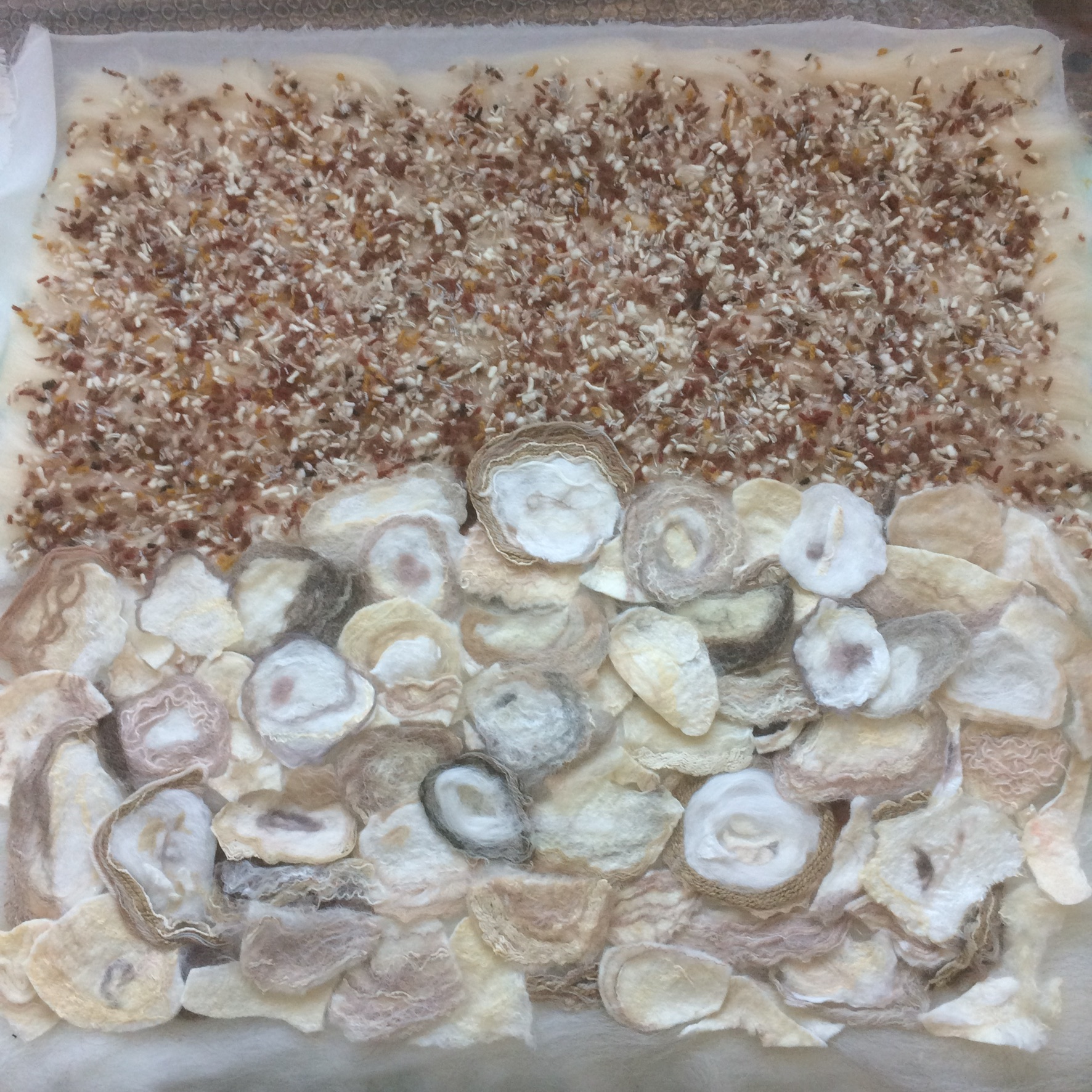
I’ve made a few turnstone pictures. In this one I prefelted lots of oyster shells for the foreground then snipped up loads of different coloured tapestry wool for the beach as I wanted a more distant background impression rather than individual pebbles. The tapestry wool is all from charity shops: I really like recycling old and second hand materials.

It took a surprisingly long time to snip all that wool into a large plastic washing up bowl ready to mix it up and lay it out on top of sandy wool layers. It also made a bit of a mess as the felting threw up lots of loose wool strands because the fibres were very short.

“Turnstone Dining at the Royal Native Oyster Stores”

Another experimental approach was a picture I made earlier this year using pieces of recycled silk (cut from charity shop scarves, of course) on top of a couple of layers of wool tops with some wisps of wool on top for colour and to help attach the silk. This gives a different feel – more impressionistic – but still (I hope!) the impression of a pebble beach.

This penguin picture was a commission. Unusually I was working from someone else’s photo rather than my own observations and pictures. By necessity the felt picture is similar to the original photo (though I had to give the penguin on the right a proper head!). I custom made various sheets of light grey pebbly prefelt which I cut up to make this beach as there’s quite a lot of it so I couldn’t just rely on scraps.

And finally, I think this is my favourite beach so far (maybe apart from the oyster shells). It includes several of the techniques I’ve described. I pre-made some shell shapes and used prefelt pieces for pebbles. There’s lots of silk too – I think I may have put down a whole sheet of silk on top of wool layers then added the rest on top of the silk. This gorgeous ringed plover was standing on a shingle spit that juts into the sea just along from my house and I felt this was a good representation of that particular terrain.

Do you have a favourite? Or anything you don’t think really worked? I’d love to hear your views.

Hair to dye for the Mer’s.

Hair to dye for the Mer’s.

Hair to dye for the Mer’s.

After a long pause from felting to work on the Guild Library survey (why did no one tell me data analysis was so much fun?) with interruptions to torture incent unsuspecting flax plants, I am now back to working on the Mer’s.  Shark Boy is coming along nicely but seems to be missing something… hair!! They will all need hair, but I want it to work with their tail colours too.

Well, I should have some locks or at least some bits of fleece that might work for long hair, because what Mer would not want long hair? All that floating along behind them in the water, looking flowy, and lustrous. Gorgeous tresses, getting in their eyes when they are hunting. ok maybe a braid might be better or another somewhat controlled hairstyle but long, defiantly.

I am imagining picking up bits of colour from the body may be a base of black or dark gray with streaks and accents of some of the body tones. Since Hair should be different than skin, I want to use a different fibre than the Corriedale I have used for the body. Something with a bit more body, (without the use of styling products or heavy conditioners).

In 2019 I picked up a couple of “Coarse” fleeces from the Wool Growers Co-op. Both are quite soft but are more towards a wavy hair than a fluffy crimpy type of sheep. Both are off white to light gray. I also have a reddish-brown Shetland fleece that might be interesting overdyed. I collected a sandwich zip lock bag of each from my stash and turned to the problem of changing their colour.

I need hair dye! Well, I have threatened my hair with that if it didn’t do something interesting as it’s progressing back to the “blond” I was born with. (Ann says it’s a shade of light gray, I claimed it’s just transforming to blond a very light shade of blond that I hope one day will be white) so I don’t have any hair die and none in greens and blues. Humm.
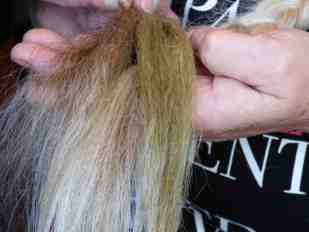
 1 I don’t have any hair die

I do have some old Ritz dies in the basement but they are for dyeing medieval gowns so a bit too much for small samples of fleece. I have heard rumours that you can use food colouring to dye with. Yep, checked youtube, they seem to show only dyeing yarn but it should work with what you make yarn with! Ok, check the kitchen, no food colouring.  I have a plan! Ask Glenn to pick some up on his way back from work! Thanks, Glenn.

So I had collected samples of the two coarse fleeces and a bit from one of the Icelandic. My final fibre to add was horsehair to give a bit more body. I have some dark and light tail hair but unfortunately, it was clumped together and tangled. I was able to extract some and got them laying parallel, held together with a bulldog clip.

Now what do I cook all this in. it’s a bit small for even my smallest pot. Hummm. I am not using the plastic organizer trays I was using for saucers on some of the outdoor plants. I wonder if they would go in the microwave? They don’t say that they don’t go in the microwave!

 2-3 Plan B

I am likely too impatient but I soaked the fibres in warm water and vinegar to prep them for dying. I realized I could fit most of my samples in one organizer and left one sample in the other.  I let it soak until the fibre seemed quite saturated and removed some of the excess water.

  4-6 Soaking in water and vinegar

When I could not stand the wait any longer, I dripped in drops of strait blue die on one end of the containers.
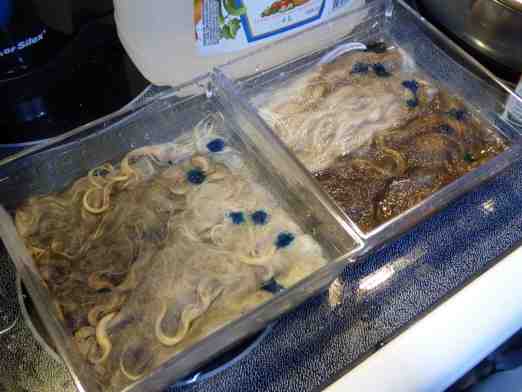
 7 Dye just sitting there

Well, that was disappointing. They just sat there, maybe I took out too much water. I think it needs a poke to inspire the die to migrate a bit. (One of the YouTube videos poked at their skeins in the dye bath) where did I put the spare take out wooden chopsticks? Found them! Why are they with the plastic straws? (maybe filed by the similarity of shape?) Poke, poke, stab, poke and the die is migrating along the top. Ok, let’s add some green and see if we can get a bit of migration and mingling. This is starting to sound quite social. I should put out cookies and make drinks! Again, green drips just sat there. Maybe a bit more water, AH! Yes, now it’s mingling better. More poking but not stirring and I have a nice blue-green, not the Prussian blue I was hoping for but it’s not the right base blue I suspect.

8-9 Poked with chopsticks then tipped the container to migrate the dye

Next, I dripped in some yellow to both samples and worked that in with more poking. Finally, I tipped the containers and got the unattached die to migrate towards the undyed parts. I assessed how it looked and deemed the blue was not quite what I wanted. Maybe a bit of red to get the blue a bit more towards purple would be better?  Let’s try that on the samples with the darker one. A few drops! Oh, my! Red is an aggressive colour! Well, I’m not sure you would call that blue but it is investing. Let’s see what it looks like when it’s dry.

10 3 drops of red

11-13 Heating it up, then letting it cool

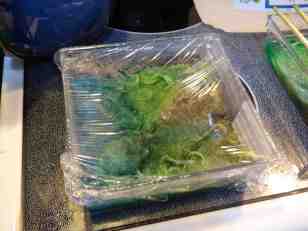
Now on to the microwave, let’s guess a minute at a time. Two minutes total gave a nice hot dyebath but still a lot of suspended die. I cooked both for 2 minutes covered with cling wrap and remembered to take the mettle bulldog clip off the horsehair before I stuck it in the microwave. Now let it sit covered until it cools down on the stove and see if I have suspended dye left in the wool.

 14 one leaked but it did seem to have survived the microwave

Usually, I am much better at this patents thing, maybe I will go make some oolong tea. In addition, one of the last of the season’s butter tarts made by Ann. She is amazing and her butter tarts are Really good!

15-16 Oolong with one of the last tarts of 2020.

17 Cooling fibre on the stove

Enjoyed the Butter tart, drank most of the tea and worked on the computer….. Then went to drain and rinse the wool samples. Looking good!! I added some soap and re-rinsed, seems to have mostly stopped leaking blue.

18-19 Rinsing in the sink

So a light squeeze and draped over a chopstick and paper towel to dry.

  20-21 set out to dry

Went back to the computer (played Rune scape) then back to the kitchen to check on the wool and start dinner (miso and ginger soup with shitake mushrooms, onion and noodles). The wool seems to have left a few spots on the paper towel but is looking very colourful.

22 a bit of staining on the underside of the paper towel

  23-24 dyeing made me hunger for dinner
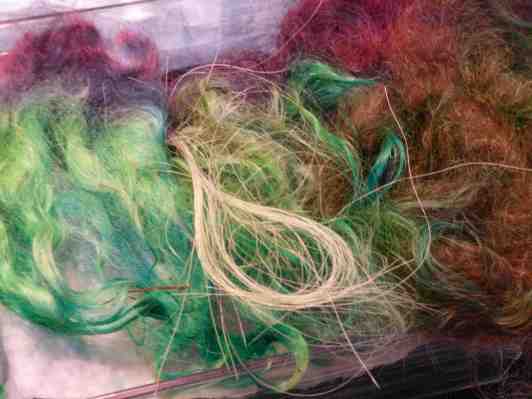
  25-26 Dry and ready to use

It was interesting to see how little die the white horse tail hairs picked up. I may get better results by letting them simmer overnight in a die bath but there is a bit of colour and they may still work.

It has been years since I got a chance to dye anything and this was a lot of fun. I will have to keep an eye out for variegated grey fleeces in 2021 and consider doing some dyeing outdoors next spring. (Glenn does have that second forge but it might make the dye bath a bit too hot. So maybe I can use the barbeque.)  Have fun and happy felting!

27 now on to more butter tarts!

Time for a New Hat.

Time for a New Hat.

I don’t know whats happened to my last year’s hat. It is probably at the back bottom of the deep shelf in my hall closet. I don’t feel like cleaning that out so I am taking it as a sign I should make myself a new hat.  I think I will make it to go with my new cowl. https://feltingandfiberstudio.com/2020/11/16/the-cowl-is-finished/

I know it will be a purple wool base and have the orange/gold silk lap on it. I am not sure about the leaves. I am thinking of several possibilities for the hat.

You will have to excuse the very crude drawings but my drawing ability is very small.

The first option has a brim like this hat. The brim folds up twice but stands away from the hat. I was thinking of putting the silk fibre on the inside so it would show when rolled up.

The second thought was to elongate the brim on one side so that I could cut it and make a rosette on one side but still have the other side just folded up.

The third option is to make it with a normal turned up brim and the elongated part for a rosette. In the picture, I did it so it would have a very turned up brim but maybe a regular slight turn up would be better with the rosette.

Forth option( not pictured) is to just do a normal brim with some silk on the underside.

The leaves. I am not really sure they wouldn’t make the hat too busy. Maybe I could felt a couple by themselves and add some vanes on the sewing machine and then tuck them in behind the rosette.

Then there is doing a swirl or rings with shaping on the crown.

So many options, now tell me your thoughts on this hat. I am open to suggestions.


Holiday Card Exchange

Holiday Card Exchange

Each year on the forum, we have a holiday card exchange. It’s always lots of fun to see all the different cards created and to receive one in the mail. If you’d like to see other cards, you can see them here. Make sure to scroll down and then look at all the pages in this thread to see the ones posted so far. 

I was getting a bit concerned about the card that I sent to Janet in Canada. I sent it out on November 4th and she didn’t receive it until November 27th. That is one of the reasons that we have people send their cards early so it has more time to arrive safely during the busy holiday season. But at last, she got it! So now I can tell you how I made the card.

Here’s the layout. I used a piece of white prefelt for the background and then added short fiber merino in blue green for the sky. I left patches very thin to make it look more snowy. I used “white” mixed 56’s for the snow but it wasn’t very white so I added a bit of white cashmere fiber that I have been saving. It was very white. Then I added silk noil to create a more snow like effect on the ground and in the sky. Finally over top of this, I added white prefelt tree trunks. I started with only one layer of prefelt but decided to add another layer over the trunks in the sky section as I felt that the blue green was going to bleed through too much.

Here it is after felting. I liked how the tree trunks overlapped on the top so I left them for awhile.

Next up was to add a little free motion machine stitching. I used an off white thread to give a slight shadow and more texture on the trunks. It’s kind of hard to see here but you can click on the photo to enlarge it.

Then I added a dark grey thread to give the characteristic birch tree look. I don’t use black for this because it feels much too stark. I think the grey looks more natural. Then I had to decide whether to crop or leave it as is. I finally decided on the cropping because it was just slightly too big to fit on my 5″ x 7″ card. I trimmed it up with a rotary cutter and attached it to a greeting card to send to Janet.

So here it is. I do think it looks very wintery which was the goal. I am going to have to make some more of these to sell as small art pieces.

And this is the wonderful card that I received from Janet. This is Janet’s first attempt at making a fiber/felt card and didn’t she do an awesome job? Thanks Janet for this beautiful card.

Fourth Quarter Challenge

Fourth Quarter Challenge

Although I don’t normally make a big deal out of Christmas the one thing I’ve always enjoyed, and can’t imagine not doing, is decorating my tree. The bigger the tree the better….in fact if it doesn’t touch the ceiling it isn’t up to the job! At this point I will come clean and admit that, as the trees got bigger and bigger, I made the shift from real trees to an 8 foot artificial one. I can hear the groans from those who wouldn’t dream of buying artificial, that used to be me, but it is what it is!

Most of my tree decorations have been homemade or received as gifts with some of the quirkiest, and most meaningful, coming from my Aunty Das who sadly isn’t with us any more. These lovely wooden decorations were gifted from Das to my partner who’s hobby is flying.

And these are a few I’ve made in the past…..

These rosette paper baubles took hours to make and won’t be repeated! The dark one is 17cm diameter and was made from black and white photos cut from magazines, the other two are 11cm and made from an old book.

With a big tree there’s always room for more baubles and with the fourth quarter challenge being Christmas Decorations it was the perfect excuse to make more. I found some 10cm and 8cm polystyrene balls locally and covered the large ones with four coordinating cream/black fabrics and the small ones with four green/red fabrics.

Some of the balls have been cut into eight segments and others have had extra horizontal cuts to create a patchwork effect.
I’ve found a stash of old baubles in the loft and these are getting a makeover this year, drawing on them with the hot glue gun and then covering them with Matt emulsion.

One of the first wet felting workshops I attended was run by Robyn Smith who taught how to make these gorgeous fairy boots…..I’ve made them as gifts every Christmas since then. With more time on my hands this year, and prompted by the Challenge, I’ve made myself some plus a few extras to sell.

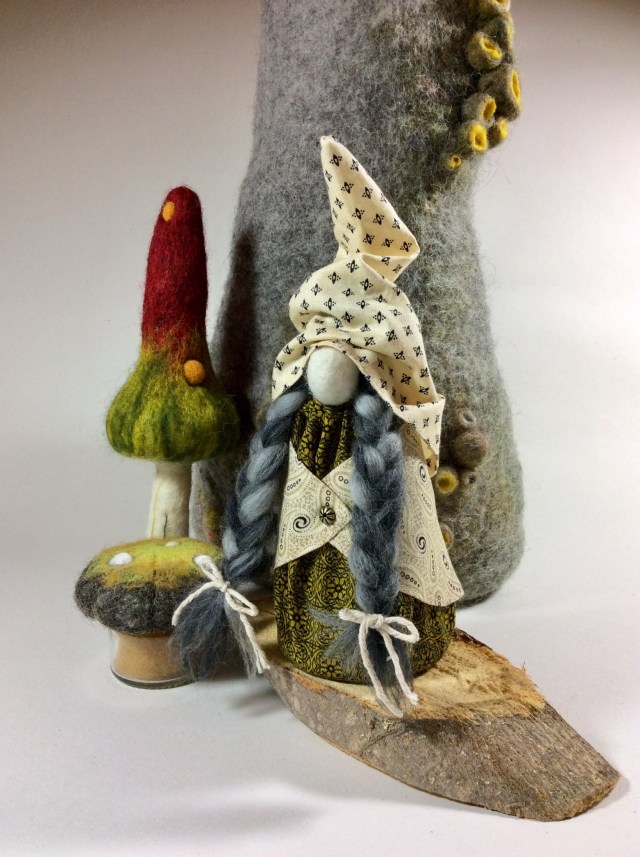
As it’s the season to be jolly, and gnomes have always made me smile, I’ve had a go at making some of those too. The Scandinavian gnome is typically associated with the Winer Solstice and Christmas season so I thought I’d have a go at making my version of a Scandi gnome.

The gnomes came about by accident really. Spurred on by the challenge I’d ordered some 14cm high polystyrene cones online (by this time we were in lockdown) with the intention of making Christmas Tree shaped table decorations. When they arrived every one of the ten cones was damaged.

Rather than send them back, the challenge now was, what could I make with them that didn’t need to be a perfect cone shape? That’s when the gnomes came to mind….the wonky cones would make the perfect base!

Originally I thought about making flat felt for their clothes but then decided to use the same cream/black fabrics I had used for the large baubles, plus a few others. Being in lockdown and wanting to get straight on with them I searched around for something to make the beards out of and found an old cardigan at the back of my wardrobe that had a faux fur collar…..needless to say it doesn’t any more! The first beard I cut didn’t look right. With trial and error I’ve discovered that the way to cut faux fur is by working from the back and only cutting the backing fabric, not the fur itself, using a scalpel blade. That way you get a nice shaggy beard.

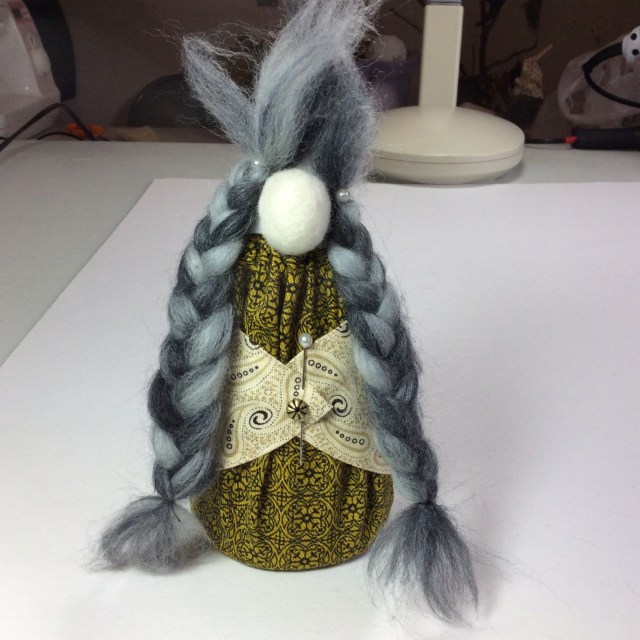
The females have Merino wool plaits and both sexes have felted button noses. I’ve machine sewn their outfits but if you were making these with children they could be made just with the glue gun for a quicker finish.

The clothes are simply a triangle for the hat, a semicircle for the jacket and a circle for the dress and/or gents undergarment.

The dress circle is simply hand stitched around the circumference, put on the cone and then pulled tight and the thread knotted. The front of the dress is then pulled up to approx 10cm from the base and hot glued in position.

I decided to use a belt and braces method to attach the nose as I was afraid it might get knocked off (really??) It’s been hand stitched to a strip of white fabric and that in turn is glued onto the cone. Thinking about it now, was this over engineered? Definitely!

The waistcoat was finished with a metal bead and the Merino fibre plaits attached either side of the nose using hot glue. The oversized hat has been glued in several places to create the sloppy look. To finish them off I’ve stood each gnome on a slice of wood.

I’ve had fun making these and I’m keeping a male and female on a shelf in my studio because I can’t look at them without smiling! Besides, a gnome isn’t just for Christmas!

Whatever you get up to over the Christmas period have fun and stay safe!

Finishing the Flax  2020 Flax study group

Finishing the Flax  2020 Flax study group

I promise we are almost done, but I suspect you wanted to see the culmination shots from this year’s harvest!

This year we had planted two rows of flax, which did not look too excessive until we started to harvest it. Even with the flax being shorter this year, we still doubled the number of stocks we were dealing with. So, it took 3 Saturdays to finish the processing of the line this time. We did not finish all the tow into batts, there is a small bag of hackle waste left. This year we kept the best feeling drum carder waste to try combing the tow into top.

We were chilly but from Cathy Louise’s research, we needed dry, low humidity conditions for the final part of the process. Other than Remembrance Day on the 11th, which often rains, it is usually dry and cold in November here. Thus, we waited to work on it.  Sure enough, day 3 was about 4 degrees Celsius, which was quite nice in the sun but quickly lost its illusion of warmth when the sun hid out behind clouds.

Day 3  the plan – get the last of the Line through the hackles and finish tow from the hackle waste with drum carders.  We had Ann’s drum carder with the blue metal base from last week and Glenn had pulled out my two. One is chain driven; the other is belt driven. One is a bit coarser than the other but both are in the medium range.

 1 all 3 drum carders to finish the tow

To work on the line we had a coarse, medium and fine set of homemade hackles using nails. They had a hardwood base that had been predrilled before the nails were added. We also had an antique one that was between the medium and fine ones. The old one had blacksmith-made nails that tapered and had tin on the base.

 2 all the hackles

3-6  The New Hackles


7-11 the old hackles

While we worked, we compared last year’s line to this year’s. The colour is different and this years is finer (last years is in the plastic bag).


12- 19 working on the line and tow

The team worked hard until lunch arrived (more pizza). Glenn joined us after stopping at the farmers market to pick up butter tarts from Ann, it was very busy so he was running late and just in time for pizza.

 20  in the foreground; Cheese and mushroom pizza, mid-ground; flax going from the course to the medium hackles and in the background; the hackle waste to go to the drum carder.

The Cow supervisors were enjoying the weather and just generally looking cute decoratively draping themselves around the field beside the coverall barn.

 21 the Supervisors taking a break

Back to work finishing the last bit of line and deciding to leave the last of the hackle waste.


22-24 the last of the line

It was time to clean up the drum carders then gather and weigh the culmination of our summer’s work. Henry had brought the air compressor over to help clean the drum carders. It was a brilliant idea.  I do not think my carders have ever been so clean.


25- 27 Cleaning the Drum carders

Now it was time for the bagging and weighing. Cathy Louse had brought a scale and I had one of my wool washing buckets which we used to contain the fibre on the scale.  As Cathy Louse weighed it, Glenn wrote it down on the bag and Ruthann kept notes on the totals.


28-30  doing the math

We divided the line into 8 sections of 33 grams, bagged and labelled it.

31-34 Line bagged and ready to go

When the line was divided, we moved on to the batts of tow.


35-37 bagging the batts of tow

That left a bag of waste from the hackles that could be drum carded later and two bags of the waste from the drum carder. This we had set aside to try combing it since the test sample looked like it had potential.

Now for the Totals you have been waiting for!

Ruthanne said we got 271 grams of line, 556 of carded tow, 130 grams of uncarded tow and 573 grams of carder waste that we can try to comb and see what we get.

Cathy Louise and Henry calculated that we got 1530g of useable fibre from 400 square feet. Henry did the math and figured if we had done a full acre we would have had 29.52 Kg of line per acre and Carded tow 76.5Kg per acre.  If we tried an acre we would have to add Sundays as well as Saturdays or we would be working at it all winter! We would likely improve with all the practice but it’s still a lot of work!

We had a larger team than the final processing day. Some wanted to experience what it was like to process flax trying some or all of the steps. some were interested in the fibre to try spinning while others were not. It was a wonderful experience to be able to participate in.  It was especially welcome to look forward to seeing friends during the fibre work parties, especially during covid!  Thank you again to Cathy Louise and Henry for giving up a section of their Market garden, doing the ground prep and planting and the aromatic section of retting that we missed.  Thank you also to all the other members of the Flax Study Group 2020.

 38 the team for the final processing, Glenn taking the picture this time!

Fingerless Mitts or maybe they are Gauntlets or Wrist warmers

Fingerless Mitts or maybe they are Gauntlets or Wrist warmers

I am super busy getting ready for our last farmers market of the year. We sold so many meat pies I will be frantically trying to make as many as possible for this Saturday. I thought you might like this fingerless mitts post I did a few years ago.


I decided I want to sell some fingerless mitts this fall. Or maybe they are gauntlets or wrist warmers? Does anyone know what the difference is?

First I have to make a pair of resists. I traced my arm from knuckles to almost my elbow.  then measured around my arm to see how much I had to add for depth. then I figured on 30% shrinkage.

fingerless mitt resist

Naturally, I picked purple wool. I used about 60 grams for the pair. mostly because that is what was in the ball of wool I grabbed.

100_7131


fingerless mitts ready to felt

Here they are finished

fingerless mitt finnished

They turned out fine and they fit me and my much thinner daughter so sizing is good.  I may add some stitching and beading.  I think they are a little heavy or thick. I was going to put a thumb hole in but I think it would be uncomfortable with the thickness. Next time I think I will use 40 grams of wool and see how that goes.  I may try making the part over the hand pointed too. I think it would look nice.