Wooden handled 3-needle holders, part 1 while i wait, consider needle holders

Wooden handled 3-needle holders, part 1 while i wait, consider needle holders

Wooden handled 3-needle holder  Part 1 while I wait lets consider needle holders (this may be of more interest to newer Needle felters)

For the armature study group, I wanted to find as many examples of different gauges of (mostly Aluminum) armature wire as I could. I found only a few gauges locally, so went online to find more.  I spotted a few on Etsy and a couple in US stores but found the widest selection from China.  The last option (China) had the best prices but had the longest shipping time.  Ann had shopped there for various small wet felting items and had some suggestions. Similar to E-Bay, check the sellers’ record, read the reviews, check for free shipping and similar listings by other sellers and watch for the price to drop. Similar to early E-Bay, some sellers at Ali-express are selling Overruns (working items) others are selling seconds (substandard, not all there or not working) so watch closely for the comments.

 1  a few of the wire gauge samples

While I was shopping, I spotted a wooden needle holder with 3 needles I had not seen before. The design looked good, the reviews were mostly good with the worst being that needles had broken in shipping (so poorly packaged). Seeing as I have a good supply of needles and would really like a couple of the 3-needle holders, this did not deter me so I put in 3 separate orders and then waited.

While we wait, let’s have a look at a couple of questions and look at a few of the needle holders I have collected.

Now, why would I want a 3-needle holder?  I have a similar wooden handed 8-needle version as well as the fake clover tool with the needle guard that holds 7 needles and the metal 20 needle holder from The Woolery.  Or you can use the lower-tech – elastic wrapped around 2 or 3 needles and skip the handle altogether. The holder is there to make the needles easier to handle and work in a hopefully ergonomic and comfortable way. Both the multi-needle wooden handles and the plastic fake clover tool are comfortable for me to hold. I have two types of single needle wooden holders that I have not used often because I find the off center placement of the needle disconcerting. (I know if I would only use it a bit more I would get used to it.) The single needle skinny handled one (Ann got a couple of those) is not comfortable but the single needle slightly thicker handle is a big improvement. I may try to add a foam collar to both of them to make the grip more comfortable.  Foam callers are used on pens or pencils to make arthritic fingers feel more comfortable when writing or for the very young learning to write. You can find them under a google search for “pencil grips” in case you got the skinny wooden holders (there are a couple of different sizes for primary and regular pencils).

2  This I spotted at <store.schoolspecialty.com>. Dollarama and Dollar Tree used to carry something similar so check there too.

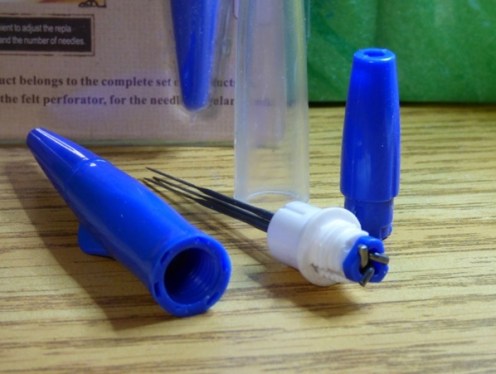
I already have 2 types of plastic 3 needle holders that look similar to each other.  Both have a handle that is a bit bigger than a good quality pen and it is reasonably comfortable to hold. Unfortunately one has a design flaw. I should tell you quickly about it while we wait for the new wooden ones to arrive.

 3  Blue 3 needle holder (2 similar designs)

Since they are using the same packaging with a squirrel on it, let’s call the closer one with the see through arrow (A) and the one behind it with the Fin on the handle (F).

 4-5 A the hole in the handle

Option A.  I have bought a few of style A and have had poor results with them. Along with a few odd breaks (the cover broke off and now that one can’t be opened.) It is also very challenging to change needles with the small holes you need to fit the needles through at the end of the cover. The reason that I am running with 2 needles in both of these is because it is so hard to change the needles.

   6-9 F handle with a fin on it

Option F. this is the one with the fin on the handle. Other than a jammed-on needle cover (which I eventually got off) these have all worked. With the open end of the needle cover, it makes it much easier to change the needles.

      10-14 Fake Clover tool

I have purchased a number of the 7-needle fake clover tools.  Many have been assembled incorrectly or have been miss printed so the red dots that should indicate locked or unlocked guard position is backwards. Once you know that your holder is lying about being locked, you can just disbelieve it which makes it safer. After you safety check it,  it’s wonderful for picture felting in 2D and some 3D work too.

15       20 needle holder (the Weapon)

Let’s take a look at one more holder. This time the 20 needle holder from the Woolery. It’s made of aluminum which is more durable than the plastic ones. With aluminum, it’s important to not over tighten it or it may stick. I have 2 pieces of shelf liner stored with it just in case it is sticking. It is a bit heavier than the plastic or wooden ones but is not unreasonably weighty.

 16   the weapon unleashed!

All three of these tools have a maximum number of needles they can hold but as you can see I often load less. Again looking at the previous examples you can see the spacing of the needles varies between the holders too.

Why might this spacing matter to you?  Well, the spacing of the needle and the gauge chosen will affect the ease of penetration as the needles are impacting the fibre. There is an increase in resistance after a short amount of poking in the same spot when needles are closer together. If you need to still increase the density of the area then shifting to a finer gauge needle or switching to a wider spacing of the gauge you were using will let you keep working in that area.

17  20 holder with 12 needles loaded

As an example I have the 20-needle holder, It looks very scary when all needles are loaded. I was starting the background of a felted landscape and wanted to lay in a quick background. I usually use my 10-needle bar tool (also from the Woolery) but could not remember where I had put it. So I pulled out “the Weapon”! After a couple of pokes, there was too much resistance to continue. All 20 needles were trying to affect the wool beneath them and were quickly causing the entanglement to a point that it was difficult to push the needles into the fibre. Instead of swapping out needles to a finer gauge, I cut down the numbers of needles used going from 20 to 12, which worked very well. This allowed for more space between the needles and less likelihood of adjacent needles trying to work with the same fibre at the same time.

I started to review the mechanics, origins and variations available of felting needles.  This started looking a bit more like a book again.  (I am trying to be a bit less verbose, it’s not working.) So to review, the notches or barbs, on the edges of the needle will grab fibres as it enters the felt dragging the fibres with the needle as it continues into the felt. As you remove the needle, the fibre stays in the felt where it was pushed by the notches. The only exception is a reverse needle which pulls fibre from within the felt as the needle is removed (the notches are in the reverse direction).

After watching videos on the GroZ-Breckert (German felting needle manufacturer) website, I have a hypothesis for what my fingers are feeling (palpating) as the needle enters the fibre and makes the entanglement that is felt. We know a notch will catch fibre adjacent to it. With more notches, (3 per side rather than 1 or 2) or more sides, (a star rather than a triangle) you will affect more fibres in the adjacent area and create greater surface displacement (make a dent). Usually, you will reach a point where you feel resistance to the insertion of the needle. When you have adjacent needles working in one spot (affecting the same set of fibres) you also notice this resistance. The variables will be gauge of needles, style of needle and number of barbs per side as well as the length and type of fibre.  (I bet someone has a formula for that!)  As the adjacent needles are repeatedly inserted into a spot, you are likely to feel the resistance increase. This will be quicker with longer fibres, top, than with short disorganized fibres, roving or batts). My suspicion is that the adjacent needles are starting to try to interact with the same single strand of fibre. This will resist being pushed farther into the web of felting since you are pushing on 2 ends of the same fibre. Shorter fibre staple lengths will take a lot longer to get this effect than longer staple length fibre. NB: when working with dry short fibre, particularly wools, please wear a mask. No one wants to get wool lung. It’s kind of a career-ender. I wish I had a microscope to see if my hypothesis and what my fingers seem to be feeling is correct.

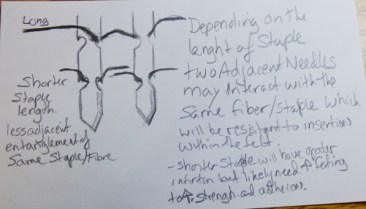
18-19 very poor sketch of the notches interacting with fibres (i am out of practice!)

I suspect my previous career and working with so many armatures made me sensitive to the feeling of the needle as it moves through the wool.  If you too have been noticing this feeling of resistance and tension in the wool but have not yet achieved the density you had desired in your felting project, there may be a few things to consider.

To counteract this resistance:

  • spreading the space between needles (having many different holders with different spacing’s is quicker to grab and keep working than taking needles out  to space them.)
  • working with fewer needles (just because the tool will hold 20 needles doesn’t mean it has to hold all 20),
  • shifting to finer needles as an increase in tension is noticed,
  • not working in one spot but trying to work across a larger section.
  • Using an ergonomically comfortable handle will keep you from using a killing grip on your needles and will hopefully let you enjoy felting longer (doesn’t solve the problem of resistance but it is helpful to consider). You can also use different handles for different gauges to make them easy to identify.


Over the years I have collected various styles, sizes and types of needle holders to have a variety of spacing and number of needles. As well as to show students what options are available.

My one cautionary tale is one of my oldest holders made from a wooden round cabinet doorknob and a small block of wood with holes for the needle to pass through. The screw that connects the two pieces is on the outside of the part that holds the needles.  You need a long screwdriver to undo it and your hand is just above the points of the needles. Don’t slip off the screw!! It is much more dangerous an arrangement than necessary!!! (Don’t buy one of those If you ever find one.  it’s not worth the danger changing needles will eventually be.

20   Some of my collection of needles and holders, there are quite a few more with my class stuff.

Now getting back to those wooden 3 needle holders I ordered from china… i will tell you that they have now all arrived (that’s the good news!) I will tell you about the bad news next post.

Have fun and Keep felting!!

My Wool Order Arrived Last Week.

My Wool Order Arrived Last Week.

I was excited to get my World of Wool order last week. As you can see they are taped, strapped and wrapped in plastic.


Box one is bulging. I wonder if sitting on boxes while they are taped closed is in someone’s Job description.

Despite the bulging, there are only 4 things in this box. This first is Batts. They are packed 5 /kg and take up more room because of that.

These bottom two are sari silk


On to the bigger box

All sorts of goodies. I bought some sample packs as you can see. I will keep one and sell the rest.

The second layer, some shetland for Jan, some peacock, to share with Jan and more sari silk


More sample packs


I took some pictures of the sample packs


Glitzy

And Constellation

The sari silk is what got me started ordering. They had it all back in stock so I could get the colours I wanted.


It is always exciting to see everything come out of the boxes. I sorted Jan’s wool. That’s the Peacock blend on top. It is very sparkly, we shared that one.

I am spinning the peacock right now. It looks really nice on my spindle.

And Bernadettes wool

Glitzy: merino colours (70%) with a touch of trilobal rainbow nylon (30%)


Merino wool tops (70%) and extra bleached tussah silk (30%)

And last but not least the sari silk blends, out of their bags.

This slideshow requires JavaScript.

I will divide all the silk up into 25gram and 50 gram balls to sell. The bag is what I will keep. I just have to work out a price.

Next is taking more pictures. I need to take the mixed bags out to get better pictures and I need to work out prices. I plan to take individual pictures of the silk balls and number them. They are all different. I hope to sell it all locally so I don’t have to work out shipping.

Natural Dyeing Session

Natural Dyeing Session

It has been wonderful to get back together with my local artist group. We have all been completely vaccinated and have started our monthly meetings again. It is good to get out of the house, share our work and try out a few new techniques.

We recently tried some natural dyeing. Paula had a bunch of natural dyes and some earth pigments. This post is definitely not meant to be a tutorial because we didn’t follow any instructions, didn’t use any mordants and really just winged it. So the thread that I dyed is definitely not wash fast, color fast, light fast etc. I’m sure that there are specific ways we should have used each dye but we were just playing around.

Paula mixed up the various powders with water as well as coffee, tea, beets and avocado pits and skins. No mordants were added and we didn’t soak the fabric or thread beforehand except to get it wet. Before we arrived, she put some small strips of cotton fabric and some cheesecloth in the dyes to show us what the colors should look like.

So here are Paula’s control samples. If you click on the photo, you should be able to read the headings to see which colors are what. As you can see, some of the dyes worked better than others. But it was good to see what we could expect. Thanks Paula!

Then we put our threads in the different colors and left it for several hours. After that, we removed the threads, squeezed them out and put them in baggies to take home.

I did rinse the threads lightly when I got home. Except the indigo ones which I rinsed and rinsed and rinsed with little success in getting rid of the fugitive dye. I was pretty impressed with the colors that we achieved with so little effort. This is the 6 stranded DMC cotton. I didn’t keep track of the different dyes as it didn’t really matter to me and I wasn’t planning on repeating the process. The light blue one is Butterfly Pea and any of the really dark blue ones are indigo.

Here’s 8 Perle cotton.

And 12 Perle Cotton.

These are crochet cottons. I decided to try these as they are a similar weight to the 12 Perle cotton but significantly less expensive. I haven’t tried stitching with them yet. The really light one on the bottom left is dyed in beet. It definitely doesn’t dye very well without any mordants.

I also had this cotton yarn meant for weaving on hand so I dyed some of it too. It’s good for couching or laid work.

Here is the lace weight wool. The green in the upper right is from Matcha tea. It’s a lovely soft green. I’m always surprised how the wool and the cotton dyes so differently. I know that it does as I have dyed loads of threads but somehow it surprises me every time. 😉

I did dye one piece of fabric which is hemp canvas. I dunked it in the indigo and pulled it straight out. The indigo was very strong as you can tell from the darkness of the thread dyed in the indigo. We had a great time and I ended up with some fun colors.

Happy Independence Day to those readers in the US.

2021 Third Quarter Challenge

2021 Third Quarter Challenge

The third quarter challenge is to felt, spin, weave, knit, crochet or sew something inspired by the 1950’s.

There was a global economic boom in the 1950’s, and in 1957 Britain’s prime minister, Harold Macmillan, is famous for saying “You will see a state of prosperity such as we have never had in my lifetime … most of our people have never had it so good.”

Could you be inspired by ‘Fairy-Tales’?

In 1950 Walt Disney released the cartoon film ‘Cinderella’ – some cute mice and birds stitched her dress.

Walt Disney released 3 more fairy tale films in the 50’s: ‘Alice in Wonderland’, ‘Peter Pan’ and ‘Sleeping Beauty’.

In 1953, Her Majesty Queen Elizabeth was taken to her coronation in the Gold State Coach – it weighs over 4 tons!  The photo below is quite recent but it shows the splendour and fairy-tale quality of the coach.

In 1955 Walt Disney opened ‘Disneyland’ where children of all ages could enjoy a magic kingdom.  Below is the ‘Fairy-Tale Castle’.

‘Balmoral’ is a real-life castle in Scotland, privately owned by Her Majesty Queen Elizabeth, but it does have a fairy-tale look doesn’t it?

Hands up anyone old enough to remember how children played in the 50’s?

Before the electronic age, play was simple.  Go-karts and bikes made from bits and pieces found abandoned, ball games, hula hoop, hopscotch and skipping.

Some toys that were introduced in the 1950’s are still around today – humming tops, frisbees, slinkies and Mr Potato Head.

So all of you who didn’t put your hands up just now, have you seen photos of how the grown-ups in your family dressed in the 50’s?

Maybe this is the fashion that people aspired to…….

….. but the ‘best going-out’ clothes for many people in England in 1959 looked like this.  A day out on a coach was a special occasion and worthy of a photo!  Can you spot Lyn?


There was an explosion of colourful, wonderful art in the 50’s.

Yayoi Kusama, a Japanese artist, produced these works between 1953-58.


David Hockney produced a varied style of paintings in the 50’s…


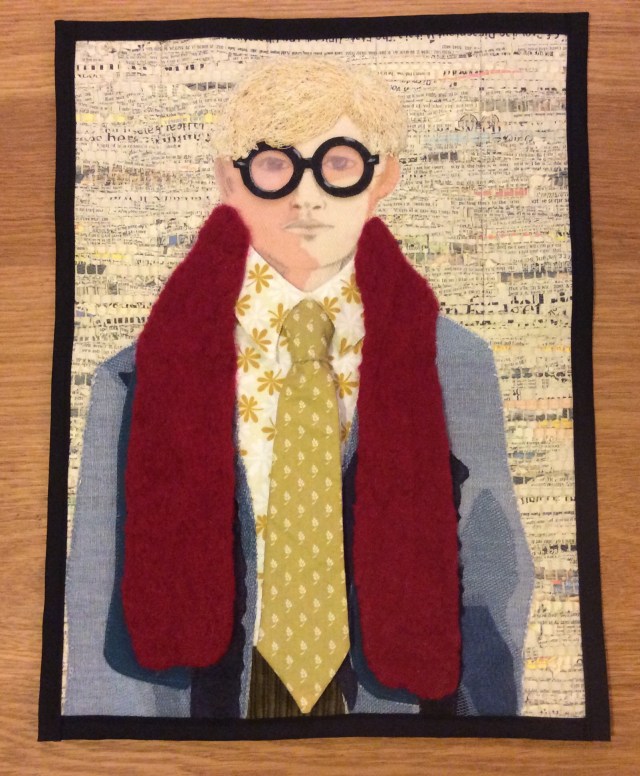
… and Karen Lane (lincsinstitches.com) showed her wonderful mixed media quilt on The Felting and Fiber Forum.  It was based on a 1954 self-portrait painted by Hockney.

The 1950’s was an exciting decade for space exploration.  ‘Sputnik 1’ was launched in 1957. It was a polished metal sphere 58 cm (23 in) in diameter with four external radio antennas to broadcast radio pulses.

Of course there was a whole lot more going on in the years 1950-1959 than we’ve mentioned above, and we hope that you can find something that piques your curiosity/interest and inspires you to create something.  Please share your makes by posting a photo on THE FELTING AND FIBER FORUM in ‘Studio Challenges’.


Silk Thrums – what DO you do with them??

Silk Thrums – what DO you do with them??

Silk thrums are gorgeous, jewel-like bits of temptation, rich in colour, shiny and sparkly, promising all sorts of lovely uses that will amaze everyone. Or not. Silk thrums are one part of the left overs from the sari silk industry. This is what can’t be woven on the loom and has to be cut off. I would like to see how saris are woven to understand the way the wastage is generated, it still puzzles me, but silk thrums are available in vast quantities to crafters all over the world. The problem with sari silk, and its a huge problem, is how the silk is dyed. There do not appear to be industry standards for colour fastness. Silk is a tricky fiber on a good day, so if dyers can’t determine dye acidity, water temperature, water hardness, or can’t properly degum the silk, the dye will run. I decided to try to use this characteristic of sari thrums to an advantage to see if there could be any benefit to be had.

I took a brilliant red thrum, trimmed the ribbon end and trimmed some silk fibers. The ribbon was soaked in hot water to leech out the dye. The colour saturation was evident as soon as the ribbon was in the jar. The water was totally red, but there is no way to do any metrics on this because the original silk was dyed with an unknown quantity of dye. All this is just a “see if this works” experiment. I snipped a tiny quantity of silk fiber, set it aside to mix with the wool roving I had chosen for dying.

I spun the rest of the silk threads into a single ply yarn. I’m taking a liberty in calling this a single ply, it is in fact a multiple thread yarn. The sari silk is made up of extremely fine thread. I respun those into a single thread with added twist. I can’t show them to you because my camera just can’t pickup the delicacy of those threads.

It was difficult to spin at first, because the fibers are nearly 36 inches long and tended to get tangled. I’ll try a different method next time, but it is possible to spin this into a reasonably nice yarn. The single yarn is plied against some of the merino top that is the basis of the dye bath test. I’ll use this later as part of the dye test.

When I plied the single merino wool with the single red silk they worked well together This is the most durable, hard to break fiber I have ever handled. Silk really is amazing.

I presoaked the remaining merino, drained, opened it along a mid-seam, sprinkled the snipped silk threads all along the centre. I then rolled the merino into a tube and wrapped it with the ribbon from the soak jar. This was set in an acid bath and topped up with the dye water from the soak jar. I use an oven to dye my wool. I cooked this for about two hours at 100C/220F. I expected a more vibrant red, not the pale orange, but this is an experiment, so expectations have to go on the back burner.


How Do I Finish These?

How Do I Finish These?

One of my latest projects has been playing with Inktense pencils and pans. I used a 12” x 12” stencil that I had purchased from The Crafters Workshop to begin the outline for my buildings piece.

https://www.tcwstencils.com/search?type=product&q=city+building+stencil.

I traced the stencil onto a commercial cotton that had a pattern of newsprint on it. It was fun to give it some texture.

I don’t know how any of you work, but I’m not too good with planning my whole projects out from start to finish so I didn’t really worry about how I wanted to finish this piece while I was working on it. After I finished it, I decided that I wanted to put a border on it and incorporate stitched figures of people into the border. I decided at first that I liked the blueish space on the sides and the bottom and began auditioning border fabric with the idea of leaving that area as inner border.

Here are the little blocks of stitched figures that I hand stitched, and I washed over them using a watered down Inktense solution of Navy Blue with a bit of Payne’s Grey added to it. These were initially about 4 inches.

I tried a couple different fabrics and placements of the figures blocks.


I decided that I didn’t like the blue border all the way around it so I cropped off the two sides and the bottom and tried it with a darker inner border.

So far I’ve not been happy with any of my choices but I definitely like the blue outline being removed. But now the wash on the figures wasn’t blending, much too blueish. So after doing a bit of testing, I put a brown Inktense wash over the figures. They are darker in this photo because they are still wet.

Once I washed over them, it also changed the whole mood of the buildings and I basically had to start auditioning a whole new color palette. A big sigh was going on in my studio when I got to this point. What have I done??

AND THEN I decided that the little figures just weren’t going to work at all for me. I felt they detracted too much from the buildings.


So when I found the blue grey hand dyed fabric, I thought that one would do it. Sometimes simple is better! It kind of reminds me of when I’d stay in a hotel in the city and look out the window at the buildings across the way when the sun was shining on them.

Now what do I do with all those stitched figures?

I decided I would put them on the back of the building quilt. But when I got the back put together, I thought it could be a quilt on its own. It was too sad to think of them on the back where no one would ever see them. Especially after all the work I had put into stitching them all!

But it needed more work to be a quilt on its own. I took the whole piece apart and started over. I ended up cutting the figure blocks down to a finished 3″ square so I lost most of the white edges. A sad loss, but necessary so I could make both quilts the same size.

I have a lot of fabric, but do you think I could find anything to go with this weird blue/brown wash I had put over the figures?? I wanted to put the tree fabric in to give the feel of being in a park. But it also added to the weirdness of the colors.

It took me several days to get both of these little 18” x 18” pieces done. I’m happy with the finished pieces now but it was a rather agonizing process to get to that point. I have to admit I did learn a lot while going through it! Learning is good!

I call the building piece “Summer in the City” and the figures piece “Winter in the Park”.

Will I plan how I will finish my pieces better in the future? I doubt it. But now I have plans to create Spring and Fall quilts to go with these two using the Inktense pencils and I look forward to doing that and seeing what I learn from them.

Happy Creating!

Tesi Vaara

Canadian Arcott Ram #2 Part 2

Canadian Arcott Ram #2 Part 2

In an earlier post we found out that 3 breeds of sheep were created by Agriculture Canada mixing existing breeds to create a sheep that would give; multiple births, fast-growing lambs and ewe’s with good mothering instincts. At first, their goal was to make a breed of sheep for research purposes but as the project continued they developed into 3 separate breeds; the Rideau Arcott, the Outaouais Arcott and the Canadian Arcott.   Since they have been bred mostly for their meat, the fleeces around here are variable often strikingly different between individuals in the same flock. The Rideau Arcott’s fleeces I have worked with before, on my highly technical scale, have ranged from OOOOH! all the way to Ick!

This being the first Canadian Arcott fleeces I have worked with I am testing their qualities and seeing what they may be best for. If you find a Canadian Arcott, it will likely be more lustrous than the Rideau Arcotts, and less variability between individual fleeces. (This is a strong rumour and your Canadian may vary a bit from the breed standard. It’s always best to look at each fleece as an individual)

Last post I tested Ram #2 (it’s ram number two because he was the second one out of the bag.) His ewes are employed as lawn maintenance specialists at a local solar farm.

We found that the fleece worked well with both combing and carding preparations producing a niece yarn from each. I had kept the combing waste and had carded up extra fibre to try the next set of experiments with it. So let’s see what I found out next!!

Comb waist needle felting test

Let’s see what the comb waist is like for felting (I have had very good results from some of Bernadette’s Combing waste fibre for both core and outer layers) she has very good fibre so even the waste is good!!

Ram 2, even in this relatively clean section I have sampled, had some VM (Vegetable Matter) which the combs separated brilliantly. This meant my sample section had VM amongst the fibre short bits and naps. This will be a good test of some of the lesser quality fibre from this fleece.

33 test with comb wast

This is not as fast to needle felt as a Shetland but it has springiness and lustre. For an understructure that needs to be relatively firm but have some give that springs back, it might be perfect. (A belly perhaps?)

34 close up of needle felted ball-ish shape.

I was using a courser needle I think it was one of the T-36’s for this sample. It created a slightly dented surface but if I had switched to a T-40 or paid more attention to how I was poking, I think it would have been able to make it a bit smoother but it was quite acceptable for an underlayer. I did notice a bit of a very fine halo that is more visible in the shadowed areas.

_________________________________________________________

Wet Felting with Carded wool

Now the last consideration, can it be wet felted. I have a feeling it may not be good since it shows signs of stubbornness with the lovely fine crimp. But let’s see.  There is always hope until it is crushed mercilessly.


So let’s try the carded fibre and layout a sample. To give it the best chance for felting I laid thin wispy layers in alternating directions North /south then east /west. I repeated until I had a puffy pile about an inch thick.

35 approximately 2.5 inches square

I had received a number of small bubble wrap bags with the larger needle felting tools (the 3 needle holders were all very poorly packed and had no bubble wrap)


36 bubble wrap bag that needle felting tool cam in.

I found one of the smaller pouches and placed the layered fleece inside with the bubble facing in. now to add soap and water. Hmm, maybe I better try and start it first in my hand then put it into the bubble wrap.

First, this wool is not a sponge. I used a lot of soap and warm water to wet the fibres, some of which collected in the bottom of the bubble wrap bag. I also discovered bubbles do not make good waterproof bags, they drip. So I put it into an extra-large sandwich bag to contain the wetness.

37 Ooops this bag leaks in the corners!!! need better waterproofing!!!

38 XL sandwich bag!! that will make felting safe!!

I started with gentle caresses across the bubble wrap then moved to gently rubbing it between my hands. I focused on working in both vertical and horizontal directions. The wool has spread out but doesn’t feel like it’s grabbing yet. Let me find a video to watch and I will keep going.

39-40 taking a quick peek

41 cant see what I’m doing too many bubbles!!!

As the soap built up I went and rinsed some of it out.

42 43  There does seem to be adhesion! But let’s see if I can get a bit more. I put it back into the bubble wrap bag and put that into the sandwich bag.  Now, to add more enthusiasm to the rubbing!

44 Now off for a rinse and see what we have and is it felt?

45 Drying, look how thin it is. There was some shrinkage as well as some migration at the edges.

46 Yes, that is defiantly felt! with the lateral migration, it is very thin.

47 no longer the about 2.5inch square I started with.

47 it certainly isn’t an inch thick anymore!

Ann wanted to know “Did it shrink at all? When I have felted some of the “nonfelting” wool before it didn’t shrink. It did stick together but as you say, you could pull it apart. It would make good sheets of batting to go in a quilt

I don’t think it would be a good one for quilting it flattened too much. I think it may have shrunk but it also spread so I think it spread about an inch but it is also a lot thinner than it started. It did shrink if you consider it vertically even with the displacement into extra width.

This might be effective when mixed with some more enthusiastically felting sheep and then used for a super thin light summer scarf or shawl.  It may be a good base to build up from. I may have to do another sample to see how it reacts with different sheep and other fibre

it is softer in texture than the spun yarn. I could probably tear it apart if I really tugged a bit.  It is holding to the pinch test but again if I was more aggressive I could likely pull off the uppermost layer.  So a bit more aggressive felting might have helped its cohesiveness. Even with that stated it is at the stage that it is definitely felt and not fibre. It kind of reminds me of cookie dough that looked thick as it went in the oven but when cooked spread into a puddle

I think this would not be a top choice for most wet felting projects but some of its properties may be useful. I think this may be more of a fleece to look at for weaving. Its low elasticity would defiantly be a plus when making a warp!

PS just got my second covid shot yesterday and it may be bright and sunny out but I think it’s time for bed. this time I got the Phyzer version and it’s much nicer than the AZ (i feel like I was kicked in the arm by a small mule then climbed a large mountain.) if I can avoid getting covid it will all be worth it!! have fun felting and I will chat more when I wake up.


Glorious Devon Part 2

Glorious Devon Part 2

At the end of Part 1 I mentioned that I had made a tracing of the basic position of the main features of the picture, with the intention of using that to mark the important features onto the background by stitching.

These pictures show the tracing, and part of the initial background marking.

This picture shows all the marking out I have done at this stage, as I like to work these pictures from the far distance first and work towards the foreground, so that I have a better chance of getting perspective and depth right. The tracing is still intact as I have just released it from the backing by running a needle along the line of the stitches, cutting though the tracing paper without (so far) tearing it.

You may note that the tracing does not show the horse. I made a separate tracing of that, so that I can place it correctly when the picture is sufficiently advanced and so that I get the size right.

The next step is my palette of felt “paints” Having collected from my stash of merino tops those colours that I thought might be useful, and using my dog comb-carders, I started to blend various colours to create those I would need for the hill in the far background.

However as I was doing it in the evening, using my daylight lamp, I found that it is not really “daylight”, just bright. When looked at in the real daylight it was clear that most of the colours are wrong. After I had used them to fill in the far distant hills, I saw that they looked even more like sky than in the original photo. So I enlarged that section of the original photo and used that to recreate the palette.

The hills still look a bit on the blue side in this picture, but not as blue as I had needled into the picture. Also it is clear that in my picture I had not made the nearer hills misty enough. So I set to and removed all the colours I had added and did some more blending in the real daylight.  Here is what I managed to come up with by sitting beside the window while I was doing it.  It was a bit overcast  outside but I understand that that is the best light to work in if you haven’t got a north facing window.  Mine faces west and when the sun is shining in the afternoon I can’t see for squinting.

Here’s what I came up with. Much better.

I’m going to have to try to find replacements for the carders though, one of the handles has snapped off. My husband’s “patched” it with a bit of brass and some screws (he works in metal!) but it won’t last much longer. Mind you they don’t owe me anything, I bought them about 6 or 7 years ago and I only paid £1. each for them!

So now I have to go back to the picture and remove what I have done; and on Thursday, when my friend is reopening her workshop, I’ll have a full day to make a fresh start.  I can’t wait.

In fact I’ve just been to a second full day’s workshop so I’ve made fair progress.  I have added the Golden Mean lines so that I can make sure that I can show things that I want to emphasise where I want them to be “artistically”.

My last picture shows where I’ve got to todate. Watch this space!

Art Deco Lampshade (part 2)

Art Deco Lampshade (part 2)

Welcome to Part 2 of this experiment (Part 1 was featured on June 20th).  If you have not already done so, you may find it useful to read the first part and then reading this will, hopefully, make more sense to you.

My first attempt at this experiment was not a complete disaster.  I was happy with the way the expanded design had shrunk back to its original size.  You might remember that because the layout was only one way (top/bottom) and little merino fibre was used (20 grams), I was working off a shrinkage rate of 100% on the vertical and 30% on the horizontal.  The pattern maintained its geometric shape which was a real positive.  However I needed to solve three issues:

  1. How to control the amount of viscose I used on the design (the viscose used for the first experiment resulted in the piece weighing over 50 grams when my previous lampshades averaged 30 grams)
  2. I needed to see if I could find a quicker method to lay the thin black roving I used for the outlines.
  3. I wanted to see if I could control the amount of wool fibre which travelled through the viscose (while at the same time fully felting the shade down to its desired size.

Three issues to sort.  I set to work.

Issue #1 controlling the viscose weight:

I felt it would be good if I could weigh out the viscose before laying it down. This might have been a straightforward exercise if I was working in only one colour but, given there were six colours to consider, (all of which covered different area sizes) it would be a big challenge to divide out the weights per colour.  For example, if I added 2 grams of each colour to the design the larger areas would be more scantily covered and the denser smaller areas might not let the light through.  Time to sleep on it!  By morning I felt I had the solution.  I would use viscose paper.  Last February I was kindly invited to make a video tutorial for my national association, Feltmakers Ireland and as part of my preparation work and work for the tutorial I made the paper.

Next I needed to make some pattern pieces from my expanded design which I could use to cut out the viscose paper. The symmetrical design meant that I could limit my pattern pieces so I noted the number of cut outs I would need for each piece.  Also, I worked out my colour scheme as some of the pattern pieces fitted into different parts of the design but required different colours.  Lastly, I weighed all the cut out pieces and was happy that the overall weight of the shade would not exceed my previous ‘successful’ ones:


Issue #2 Black Roving:

Next, it was time to see if I could tackle the issue with the roving.  You might remember that it was laborious to lay in the first experiment as the strands at the edges tended to ramble once I sprayed them with water.  This time, I decided to dry roll the strips of roving prior to laying it down.  It did not take very long and was quite soothing to do.  By the way, the wooden tray you can see in the photo has a non slip surface (Ikea) which is great for carrying drinks and also provides enough friction to roll the fibre.  I love multipurpose tools! I did not over-roll the roving – I just tidied it as you can see in the photo.

Then, I started outlining the design using the method Ildi showed in her wonderful blog.  I found it a lot quicker to lay out and the design stayed in place.  That said, I will investigate the pencil roving to see if there are stockists in Europe.  I sprayed water on the roving as I worked which helped keep it in place.

Next, I filled in the colour using my cut out viscose paper, spraying it with water as I filled in each colour.

After this, I laid out the merino tops (20 grams).  I decided this time to use a white for the background.  The layout of the merino is identical to that described in Part 1.  The method used for bringing the piece to pre-felt stage is covered in Part 1 so I will just insert some photos here (apologies if the narrative looks a little fuzzy).  When it came to joining the sides, I added a little extra viscose paper to cover the split (plus a little of the black roving for the lines):


Issue # 3 the transfer of merino through the viscose:

Once it was ready to roll, I rolled the piece leaving the decorators plastic and the resist in place.  I determined this time that I would use rolling to get most of the shrinkage so I kept rolling it until I was happy that it was well on its way to the final size.  (Apologies, I lost count!).  Also I wanted to handle the outside as little as possible so, when I removed all the ‘protectors’ I used gloves to handle the piece.  Then I turned the piece inside out and continued rolling.


Next, keeping the gloves on I did a little kneading and throwing but it was a lot gentler than last time.  Also, the duration was quite short as I was quickly reaching the required shrinkage.  I kept the measuring tape close by and regularly checked:

I turned the piece and, with the right side showing, fully rinsed the piece and compared the sizing and pattern to the one made in Part 1.  I knew immediately that the shade required a little more work as the central design was still an oval and it needed to be a circle.  I sprinkled it with a little hot soapy water and continued rolling until it was the required dimensions.  Then I rinsed it again and ironed it, shaping it as I worked:


Thoughts on the result:

I am quite pleased with the finished lampshade.  The colours were dictated by the viscose paper I had to hand but the overall result is quite interesting.  The colours definitely come into their own when the light shines through (yes! It worked!) I had mixed various colours when making the paper so I wonder what would be the outcome if each ‘page’ was a solid colour.  The outlines were pretty structured and the lines remained straight.  Also, because I ‘protected’ the viscose and either kept it covered or wore gloves when working it (and, of course, rolled it a lot more) there was very little transfer of fibre through to the viscose.  Part 2 was a lot more successful than Part 1.

The biggest challenge now is how to photograph using my phone!  To be honest, I don’t think the photos do not do it justice.  So I took identical photos, with a flash so that the colours are visible and without the flash (which shows the light shining through the lamp).  Here is the finished piece:


Art Deco Lampshade (part 1)

Art Deco Lampshade (part 1)

The thinking cap went on in bed the other night over what to do for my current blog piece.  I wanted to link it through to Lyn’s Art Deco challenge.  Two words came to mind while lying in the semi darkness – Tiffany Lamps.    Straight away I saw a big problem – I had happened upon the wrong period.  That said, the idea of producing a lampshade stuck in my head so perhaps I should research designs from the art Deco period that might translate unto a lamp.

I already had a lamp in mind – one that is readily available to anyone who has an Ikea nearby.  So I chose the Grönö table lamp.  It’s cheap as chips and a constant at Ikea.  Its dimensions are height 22cm and the width on each side is 9.75cm totalling 39cm.  I intended to have my layout running in one direction only (top/bottom) and from previous experience (using a different set of materials that included scrim) I knew that I was working to c. 100% shrinkage in this direction with c. 30% shrinkage on the width.

First task was to decide on pattern.  I had two criteria:

  • Symmetry
  • Geometric shapes

I felt that the main challenge was to produce a pattern that would end up resembling what was in my mind’s eye given that I would have different shrinkage rates on the finished piece (north/south 100% east/west 30%).  So, I set about drawing up the pattern as it would look in the finished size and then ‘grew’ it according to the expected shrinkage.  Normally, when I am upsizing a pattern, it’s a straightforward job.  I pop my pattern piece on a larger piece of paper, find a centre point on the pattern and then, based on anticipated shrinkage, calculate and mark out my new pattern points to enlarge the pattern.  Then join the dots.

First thought that came to mind was Kiss (keep it simple silly). I wanted to work in geometric shapes – I felt it was going to be difficult enough to grow the pattern without making it impossible.


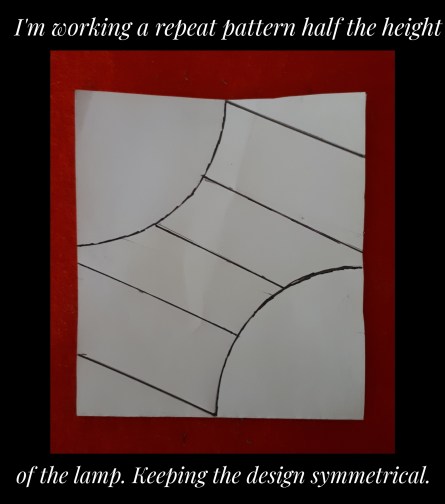
After a few disasters I designed my pattern by working on half the height of the lamp.   I settled on the following:

Choosing colour would be the easy part, it was now time to give this pattern a growth spurt!  The pattern is about to grow from (cm) 9.5×22 to 14.5×47.  Time to get out the calculator and put the thinking cap on….  The pattern doubled in height and grew by 30% in the width Here is the result:


When the two sides are joined together they match up perfectly (what a relief):

Time to start working on laying out the design.  I wanted to try out Ildi’s technique using viscose for the colour.  I was working from the outside of the design (laying out the pattern first). I had no pencil roving so had to improvise with my tops, sectioning off thin strands of the fibre.  Next I laid down my pattern and some light decorators plastic so that I could see through to the design.  I ‘drew’ the pattern with the black roving, spraying it with water so that it would stay in place.  I was a bit unhappy with the edge of the roving as it strayed into the area which would be filled with colour and I spent some time pushing it back into place (there has to be an easier way to do this).

When laying out the viscose, I ‘tangled’ it rather than laying it straight.  I wanted it to replace the bandage cotton I used in my earlier lampshade so I needed the fibre to run in all directions:

Here are pics of the colour building up on the design:

Next it was time to lay out the merino fibre.  I used 20g for this purpose and laid out one layer in a ‘top to bottom’ direction, wetting it down with soapy lukewarm water:

Once a skin had formed, I added a light resist which I doubled over, placing it on top of the merino.  I added some strands of dry merino to the section where the two sides would meet and then, using the light plastic decorators plastic, I folded my sides over to join the pattern:

I wanted to tidy up the joins a bit so I used some of the thin black roving on the lines and some viscose on where the colours came together:


I then covered the piece with the decorator’s plastic and rubbed it to seal the ends.  Once I was happy that they were sealed, I removed the pattern from under the piece and inserted bubble wrap. I prepared my pre-felt (I like my sander).  The doubled over light resist came in handy as I was able to rotate the piece as I felted it, making sure that it did not develop edges.    Then I started rolling the piece (about 400 times each top/bottom, bottom/top; 200 each times side to side).  As the piece began to shrink, the light resist folded on itself.   I removed the decorators plastic.  When I was happy that I could move onto the next step I removed the resist.


I added hot water and fulled the piece, kneading and throwing it until it reached the desired shrinkage, 100% top to bottom and 30% side to side.  Once rinsed I ironed and shaped it.  I noticed a lot of the merino had travelled through the viscose – more than usual.  So I shaved it back.


The end result was mixed.  I was happy that the design had stayed symmetrical and that the shrinkage had returned the oval to a circle which was great.  Unfortunately the result was too thick for the piece to be used as a light shade (so I will need to find a suitably sized vase).   I had used grey in previous lampshades so I was aware that it should work as I only used the normal amount 20g. Previously, my working lampshades weighed around 30g.  It became clear what the issue was.  This lampshade weighed over 50g – basically the light could not permeate the viscose!  Lesson learnt!  I needed to find a way to control my viscose lay down.  Also, I was a bit disappointed with the transfer through of the merino fibre to the front of the piece, something I needed to work on.  Also I needed to find a way to prepare the ‘pencil’ roving so that it would be quicker to lay out.  Despite this, I loved the overall colour combination and it had sheen when it dried.  So there were many plus points in this exercise.

In Part 2 (coming 22nd June) of this experiment I will show you how I sorted out my issues.  Now I’m off to find a suitable home for my first experiment.