I spun a single first, naturally. It took a little bit to get used to the silk. The silk is much harder to draft but mixed with the wool it wasn’t too bad. You have to accept you are not going to get a really smooth yarn. You are going to get a great texture.
Next, I did what is the most meditative part of spinning for me. I made a center-pull ball by hand. If you are in a hurry or you have lots to do then a ball winder is the way to go. But I really do enjoy this part. I use a little piece of painter’s tape to make sure I don’t lose the center yarn, while I am winding. Do you enjoy doing something that other people seem to dread doing?
Then the fastest part, plying.
It’s interesting that when it was a single I thought it was a bit dull and muddy but after plying it seems to be brighter and shinier. I really like it. It has lots of colour and so much texture. it will be great as an embellishment on my felt.
I haven’t decided if I will make it into a center-pull ball or a skein for storage.
I am feverishly working away trying to finish up some landscapes and get them to the framer. I suddenly realized that it’s November and I needed more work to sell for the holiday season. I have always had good intentions of finishing pieces, getting them sewn to the backing fabric and laced to a board when I complete the piece. But somehow, those good intentions are paving the road to procrastination. Here I am again, finishing all the landscapes at once.
I went to the fabric store and found some fat quarters that worked with the various colors. I then hand stitch the nuno piece down to the fabric and lace it around a piece of matte board. Here is “Twilight” on it’s backing board ready to be framed.
This one I chose black fabric for the matting and laced it on to the matte board with a very minimal edge. I only want a tiny bit of black to show. This one is called “Serviceberry” at the moment unless I come up with a better name.
Believe it or not, I have finally decided that my slow stitch project is complete. I stitched it down to some brown fabric but I haven’t gotten this one laced on to the matte board yet. This one is called Autumn Impressions.
For those of you who wanted to see what the original fabric looked like, here it is. Definitely a bit of a change!
The last one is the green nuno felt that I showed you recently. I finished stitching and decided it was complete. I have it on a dark green fabric background but haven’t stitched it down yet. Hopefully, I will get these finished up this week and get them to the framers by Friday. That’s the plan, anyways.
And here’s a close up of the bottom so you can see the stitching around the poppies. I still haven’t decided what to call this one yet. Several suggestions were made last time and I decided I had to research whether the plant I was thinking of was really Queen Anne’s Lace or whether it was Hemlock. It could be either. So then I kept thinking of titles such as Lethal Serenity, Poisonous or Peaceful?, Deadly Tranquility etc. So I will keep thinking on what it should be called as I finish stitching it down and lacing it.
In the late 60’s I was taught how to crochet by my Aunt Doris and I loved it. She showed me how to read a crochet pattern and the first thing I made was a green mini dress for myself.
At that time the ‘granny square’ became popular and I made a long, sleeveless jacket for my mum from brightly coloured squares edged with black.
So coming up with a challenge idea was easy for me. I had a search of the internet and found a free pattern by Michelle of The Snugglery (free pattern) The pattern is for a 60’s hippie-style top. Perfect.
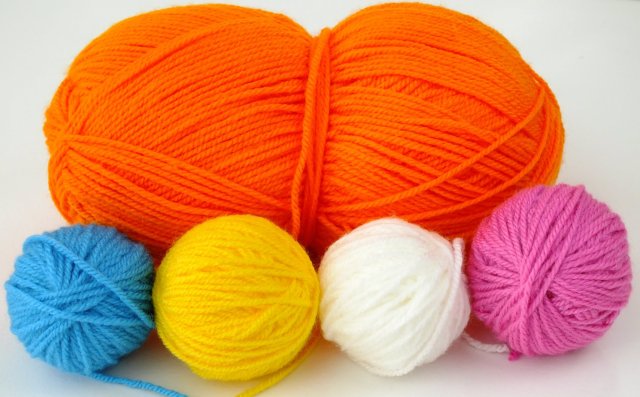
I auditioned my stash of yarns and picked out some bright ones that I thought went together well – orange was a very popular colour in the late 60’s.
I made 8 traditional granny squares to measure 16.5cm (6½”) each – all the same as the one shown below.
If you’d like to know how to crochet a traditional granny square, there are many free YouTube videos – here is a good one but be aware that US double crochet stitch is UK treble crochet stitch.
How frustrating is it when you come to a knot in the yarn?
Here is Michelle’s pattern showing how to join the squares….
… and here are my 8 granny squares stitched together but not yet joined to make one piece.
A fringe, made with 3 strands of yarn, is essential to the look of this top. I decided it would be easier to attach a fringe while the squares were flat on the table before joining them to make the top complete.
The thin straps were crocheted using 3 strands of yarn and a simple chain stitch.
Here’s how I kept the 3 yarns from tangling.
The finished top will be donated to a retro charity shop and I hope someone enjoys wearing it – even if it’s for fancy dress! Here’s the ‘flat’ shot …
… and after much persuasion, here’s Annie modelling it, but she refused to take her tee-shirt off!
Annie
I’ve had plans to make some more pods for a while now and as flowers were popular in designs in the 60’s I thought I’d make a floral one for the 4th quarter challenge.
Usually I put the design on the outside after the fibres are all laid down but this time I decided to do it in reverse. I think it would have worked well with a simpler design but it bent my brain trying to lay down felt flowers, yarn outlines and background fabrics in reverse!
In the end I laid out the design for the first side face up over a template circle so I’d only have to do the other side in reverse. It was quite complicated with having to wrap the design round the edges.
Then I put the resist on top and flipped it all over so that the design faced into the resist.
I laid down the first layer of fibres over the design then carried on making the pod in the usual way.
After I took the resist out I turned it inside out to reveal the design then carried on felting to shape the pod. I didn’t really think it through – maybe it would have been easier to just put the design on the outside. But it was fun to make. Although it’s not perfect it’s not wasted time – any time spent experimenting and making is time well spent if you ask me!
A few weeks ago our guild was offered the estate of one of our more noteworthy weavers. She had stipulated that all her weaving supplies and equipment were to be sold and a scholarship be set up to help educate and promote weaving. We were deeply saddened by the loss of this talented woman, who was also a great resource for our guild. Her generosity set a high bar for all of us. I did participate in the fundraising efforts and purchased a cotton warp to encourage me to get back into weaving.
There was only a small problem with the warp; it no longer had a cross. The cross in a warp helps prevent the threads from tangling. This was going to be a huge challenge but one I wanted to tackle along with two other learning challenges.
Because I am self-taught there are huge gaps missing in my weaving knowledge. Some are very basic techniques. I desperately wanted to learn how to make a weavers knot. This is a knot that almost everyone involved in fibre seems to know how to make. Not me. I wanted it to become muscle memory, so I wanted to make lots and lots of knots. Then when the need arises it will be so easy for me to just – poof – make this non-slip permanent tiny little fastener.
Now comes part two of my learning challenge – reusing a threaded warp. If a weaver is careful and doesn’t remove the remnants of threads from the loom, and if they are long enough, they can be used as a labour-saving tool when threading through the heddles. The heddles are the little eyes on the loom. Threading heddles is a bit like threading very big needles and I really don’t like doing it.
I had preserved the previous warp. I knew it was narrower than the cotton warp I wanted to add, but I didn’t know how many threads were in the cotton warp. There is only one way to find out, count them. There are 225 threads by the way.
So I estimated I would need to add three inches of cotton on either side of the existing warp.
Then came the knots. First I just did overhand knots, but I really didn’t like them. They were thick and didn’t look like they would pass through the reed with ease. Then I started working on the weavers’ knots. Online demos are really interesting, but by the time I got back to the loom I’d forgotten how the loops worked and which way the thread wrapped around and it was all very frustrating. Finally, after a bit of digging, I found a printable diagram and that worked like a charm. My biggest concern is that I may not have a true weavers knot. This works, so maybe it doesn’t matter.
weaver’s knotoverhand knot
I had to thread the cotton through the heddles and Because the cotton along the sides was going to be a little shorter than the wool cotton combination in the middle I added a bit of an extender, sorry I didn’t get a picture of that.
And then it was time to start gently getting everything through the reed and the heddles. This was all done very slowly and carefully so that none of the threads would break. The weaver’s knot worked like a charm. The overhand knot was a bit thick and need some gentle nudging to make it through, but all in all, it worked.
Once the cotton was safely warped on the back beam it was a matter of untangling the threads and winding, untangling and winding. At some point, I was very tempted to just chop it all off the loom and throw it out. It was really getting to be a terrible mess, so discouraging. Then I would look at the back of the loom and see how ordered it was. Everything was coming together as it should, everything was aligned and going onto the beam the way it was supposed to, so I would take a break and come back to it a little later.
And then fairly quickly it was all done. I was a little surprised and definitely delighted.
All this time I had no idea what I was going to do on this warp, not a clue. Maybe make a table runner or some cushion covers. I have some really nice linen to use, some great thick and thin cotton or wool. Then last night it came to me. This lovely textured cotton warp with all its thick bits and thin threads, its ideal length of 4.5 yards (4 m) precise width of 18 in (45cm), it’s ability to take colour like a sponge will be perfect for the recycled kimono project!! Can hardly wait to get started.
I am lucky enough to live in Sturminster Newton, Dorset, England (known affectionately by locals as Stur). One of our Town’s claims to fame is our Watermill. There has been a Watermill on the river Stour here for at least 1000 years. The original mill was a Grist Mill – that is for grinding corn, but in the early 1600s a Fulling (or Tucking) Mill was built adjacent to the Grist Mill. This was largely to facilitate the greater production of a fabric which had been produced in and around Stur since the 1570s. This fabric was called Swanskin. It was a tough, course white woollen fabric, made from locally spun and woven wool, which was then scoured, fulled and the surface teazed and fulled again. Fishermen working out of Newfoundland, many of whom were recruited from Stur, greatly prized the Swanskin for its all-weather, waterproof qualities, as did the British Army and Navy. Originally the fulling would have been done by fullers treading the fabric in troughs filled with all sorts of nasty stuff, including urine. Once the fulling mill was built this hard work was done mechanically. The woven fabric, in its troughs of nastiness, was hammered by large wooden stocks which were driven by gears from the waterwheel. Eventually the fulled cloth was hung out to dry along the river bank, stretched out on tenter frames by tenterhooks. A report about Manufacturing in Dorset dated around 1812 reads:
“There is a manufactory in the neighbourhood of Shaftesbury of a kind of flannel called swanskin, which is a coarse white woollen cloth, used for soldiers’ clothing, and made from 18d. to 2s. a yard; but this is of little consequence to Shaftesbury, the chief trade in this article being carried on at Sturminster Newton, where about 1200 people are employed in it, and where between 4000 and 5000 pieces, containing 35 yards in length, in a piece, yard wide, are annually made.
At present the woollen manufactures are almost confined to Sturminster and Lyme Regis, at which latter place broad-cloth and flannels are made in considerable quantities.
At Sturminster there are four or five clothiers, and about 300 weavers; sometimes 700 or 800 people are employed in the manufactory of Swansdown, (sic.) but the trade is not so considerable as was formerly the case.”
In early 2016 I was asked by the curator of our town’s Museum and Mill Society (now known as the Sturminster Newton Heritage Trust) if I could produce a sample of Swanskin for the Museum since it appears that there is no example of actual swanskin now in existence. As Swanskin was such an important part of the town’s history, the Museum wanted to create an exhibit for future reference. This I did, so far as I could, and I also wrote them a report on the process, which I repeat here – it was of course written for the edification of members of the general public, most of whom would not be conversant with spinning and weaving terms, so please don’t think I’m trying to “teach granny to suck eggs”.
“Swanskin – Experimental Archaeology
“In order to try to recreate the processes in the manufacture of Swanskin some research was carried out by Kathleen Sanderson (a member of the Dorset Guild of Weavers Spinners and Dyers). It appeared that the likely breed of sheep from which the fleece was obtained was the Portland. This breed was found in fact over much of Dorset in the 17th Century. “Kathleen found however that the fleece from today’s much improved breed of Portland sheep was finer and more delicate than would have been the case in 1600. She therefore blended Exmoor fleece with the Portland to obtain as near as possible the coarser, more hardwearing fibres originally used. Originally the wool would have been spun “in the grease” – that is still containing (inter alia) the natural lanolin. The resultant yarn would have been woven in this state so that the resultant cloth would have had to be washed and treated with fuller’s earth (scoured) to remove the oils and other detritus like plant material and insect life.
Spun and Plied Yarn, with fibres
“The sample shown was spun after scouring because this had been necessary to facilitate the blending of the two fleeces. The yarn was plied and then twill woven – that is instead of the basic over one, under one, over one – of plain weave, the weft was taken over two and under two on the first pass then over one under two over two on the next. This results in characteristic diagonal lines in the weave. “When “fulled” twill woven fabric becomes denser than would a fabric with plain weave.
“I wove the sample in this fashion on a frame loom. After the weaving, the sample was wetted and fuller’s earth rubbed into it on both sides, just to make sure that all the grease and oils had been removed. This was rinsed out, the sample soaped and rubbed by hand to start the felting or fulling process. “This process would have been carried out by “Fullers” or “Walkers” in the 11th and 12th centuries. Though they would have done it by treading or walking on the fabric in wooden troughs rather than using their hands. At Sturminster Fulling Mill swanskin was fulled at the Mill using water power to move fulling stocks. These hammered the fabric until it was fulled or felted sufficiently to make it water repellent. “The sample was fulled in a washing machine, first at a temperature of 40° with a very hard rubber ball acting as a fulling stock. This was repeated once more and then at a temperature of 90° until the sample was fully felted. When the sample was almost dry it was ironed with a steam iron on both sides and then fully dried. The original swanskin cloth would of course have been dried on tentering frames in the open air.
“Once the Sample was dry it was brushed with a flick carder (the modern equivalent of using a frame covered in teasels) on one side only in order to raise a nap on the fabric.”
The mill was open to the public again this year, after having had to be closed during lockdowns. It is possible that, during the first lockdown, some of you may have seen reports about the fact that the mill reverted to milling flour which was provided to local bakers. Many people over here took to making their own bread so that there was a general shortage of bread flour, and, since approaches were received from people from all over the globe trying to buy bread flour from our miller, I assume that this was the same almost everywhere.
I have added below some internet links about the Mill and our Society (Sorry – Trust!), and some of the news stories from last year – Google has lots more.
Oh and a couple of my felt paintings of the mill – adding a bit of artist’s licence!
I ordered some sari silk a while back as part of a larger order from World Of Wool. I am ordering wholesale so I ordered 1 kg of each of the colours I wanted. the first 2 look very similar here but the first has a lot of green and red and the second has quite a lot of black. I had expected the pink one to be much more purple. It is called Royal Robe. Every batch is different, so you are always taking a chance. It would be great if they took new pictures for each batch but I suppose that would be a big hasssle for them. And they do warn you so no complaining.
That is a lot of sari silk.
I did make up some small bags of it and sold them on the guild’s Facebook page. I will offer it again soon. I still have lots. I haven’t played with it much at all. So last weekend knowing it would be rainy at the market, so slow and I would be bored, I grabbed some of the silk and a spindle to try spinning it. I brought an older cheaper spindle because I knew I would probably be doing as much dropping as spinning. I was right. It is very short and very frustrating to try to spin, especially since I usually do more of a long draw. I tried for a while then gave up and plied the tiny amount I had spun.
Ta-Da…
I told you it was small. Here is a close up.
It is very pretty and shiny but I will not be spinning more this way.
Next was to try blending some with some wool.
I picked these two shades of merino. I think they are mallard and duck egg. They seem to be the same colour but have different saturations of the dye.
And these 3 sari silks to blend in. Looking now I see I picked the 3 primaries.
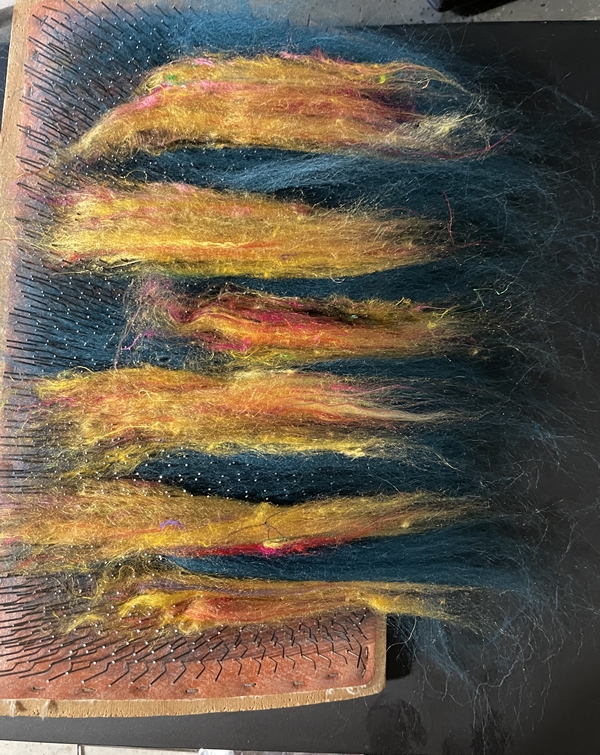
First I did the turquoise lagoon. I did a layer of the dark, then the light and then the sari silk. I carded it several times to blend it and then rolled it into a rollag
It is very subtle but I think it will add some shin and interest when I spin it.
Next, I did the Salsa, I did the same thing a layer of each of the wools and then some sari silk
And lastly the wildflower
Now I have to spin them up. They are not the neatest rollags but I think they will work. I will do some recarding if I have to but I hope I don’t have to.
I have been continuing with work on my green nuno landscape and thought you might like to see how I “play” with the design. I put on layers of sheer fabric, take them off, try another piece of fabric and keep working with the various bits of fabric until I get a composition that is effective.
I’m using a variety of fabric including nylon organza, silk organza and cheesecloth.
I put pieces on, take a look and then rearrange or take pieces off. Or move them around, add more pieces and so on, always stepping back and looking in between steps. What works, what doesn’t? You can see how sheer the nylon organza is, there is a piece on the top left side sticking off the edge on the right photo.
Sometimes it is hard to tell what changes and it’s a slow process but fun to see what happens.
Once I was happy with the composition, then I pinned pieces in place. I really should have taken the time to baste the pieces in place but I was feeling lazy. On the right photo, I have started to stitch the sheer fabric in place at the top. I didn’t want the stitching to really show that much, so there are tiny stitches in similar color/value thread to hold the sheer fabric down.
These last two photos are of the piece hanging on the design wall. This is really helpful for me, to see it hanging and to be able to back away from the piece and view it from a distance. I had stitched in the three orange flowers in the distance but they were really bugging me. The flowers were too big for the distant hills. They were the size of trees. So unstitching occurred and I removed the far flowers. I haven’t decided whether to add them back into the middle ground or not. The photo on the right is the amount of stitching I have completed now. Once I get all the rest stitched down, I will decide if it needs anything else. I also have to think of a better name than Green Nuno Felt Landscape. Any suggestions?
I just want to give you some background into this little story.
I was so fortunate when I got married all those years ago. Hubby came with a wonderful extended family. Lest I leave anyone with the impression of interference on any of their part, these were all formidable, strong women, born in the 1920s and 30s who were interesting and interested but never prying. Every single one of them was creative and all lived well into their 80s. Three are still with us and, despite the years, their characters have not changed. I feel privileged to have known them all for the greater part of my life.
So, back to my story. One of the aunts, Kathleen, passed a few years ago. In her working life she was the Head of an Arts and Crafts Department at College (adult) level. She was a great collector of beautiful objects and when she died she left me her collection of textiles. I used one of these to line the 1950’s style hat I featured in my last post (September 18th).
All the fabrics filled two cars so I decided to catalogue them when I got them home. I should mention here that my dining room was out of commission for some time while I carried out this task. I noted dimensions, cut a sample and categorised each piece. There were rich silks from her early travels in Asia, beautiful wools (Prato, Italy is embedded on the side on one piece), edgy cottons from the 60’s, fabrics with exclusive stand alone labels included on the selvages – all in all there were over 450 pieces, which I documented and stored in boxes. Realistically I knew I could never use them all so I shared with various sewing enthusiasts. My aim was purely to recoup the cost of all the storage boxes I had to buy so excited buyers got to enjoy top class coat weight 100% wool fabric for €15 (this was the maximum charged). In short, I shared some of the joy Kathleen gave me.
While sorting through all the fabrics I made two other amazing finds and it is one of these that I want to bring to you today. It was a sampler which my husband’s aunt no doubt picked up in an English or Scottish auction house at some stage in her life. I suspect it was an examination piece as the name on the side in perfect copperplate handwriting is ‘Edith M. S. Simpson No. 48’. The date, which is cross stitched into the top of the piece is 1900. The folder used to hold the pieces looks to be handmade – although a sewing machine has been used to bind the edges. Yellow silk has been hand sewn into the folder and acts as a backdrop for all the pieces. The samples are, in my mind, perfection. I hope Edith scored highly in her exam. I wonder what became of her. I hope she had a happy life but given the tumultuous events which would occur in the world throughout the following 20 years, I suspect she faced down many challenges and heartaches like many women of that era.
I hope you enjoy the photos and perhaps pause for a moment or two to think about Edith. Never in her wildest dreams would she have thought that all her painstakingly beautiful work would one day be shown to a worldwide audience.
With sincerest thanks to my husband Enda for the photography.
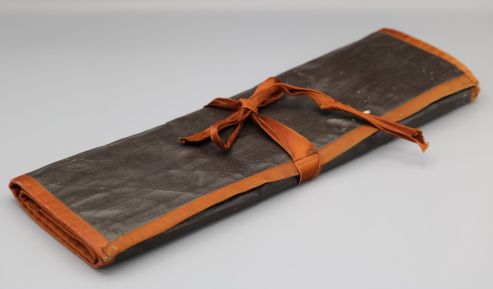
The closed pack. Still beautiful after 120 years.
For scale the complete pack is 22 inches by 15 inches (56 by 39cm)
The young lady herself – look at that copperplate handwriting
Inserting a patch and teeny tiny knitting. There are over 15 rows in the middle knitted sample and it measures only 1 inch square.
Cross stitching her initials, knitting on the round and a beautiful sock sample (heel) length 2 inches
More patching, on very fine wool this time. Look at the size of the cross stitches. Below decorative stitching gold and blue on linen.
More fine stitching (gold/blue) this time on fine wool. Gathering for a sleeve. A buttonhole the sample measure 3 by 1.5 inches.
Darning on fine knit:
Tiny gathers. I counted 66 gathers into the cuff:
I think this is a placket but happy to be corrected:
A patch. Look at the perfect matching:
A patch on fine wool. Look at the tiny cross stitches. There are also two rows of tiny running stitch around the triangle.
Not sure what the top piece is called. The bottom could be a decorative line of stitches for a collar:
A hand sewn French seam.
(Top) more fine gathering. Can you see the tiny little holes created by stitches in the bottom of the gathering?
When I’m felting scarves, I’m trying to play with colours in such a way as nature is changing around us. I love the colours of autumn, spring, summer and the innocence of white winter. It’s important for me that every part of the scarf, fiber, wool, silk and gauze, at the end of the felting process, become colourful art. For the base I usually use hand dyed gauze and silk, and on the top Australian merino wool and wool yarn. After I finish the design, I use the rolling technique. For me it’s a pleasure to felt scarves and I recommend that everyone try!
After I had written my last blog, I headed back to Oakville to help with my Mother-in-Law who has not been well. It was very busy with lots of appointments and I tried to work on a bit of felting in moments of quiet.
When you last saw the little dragon, I had augmented the wire on the legs, arms, hands and feet. Then started from the tail to add the under colour.
1, the tail from the last post
I was using a small amount of black, a bit of dark grey and larger amounts of Indigo. Since you don’t usually see solid colours in nature, I did not blend to a uniform new colour but left bits of each tone visible.
My goal was to give me a general base colour to work from and lay in the spinal fringe. I think I will be augmenting that with some silk but after I have created the wings.
2-3, adding the base layer of colour standing on my old laptop.
As I would go off to help with something then come back intermittently to work on the little guy, I discovered that blue cane dragons have an odd interest in Orange dark chocolate. He had obviously spotted it in the glass dish. I had used the box holding the delicious chocolate as a ruler while making partitions in lists. I just put it in the glass dish so it would not be lost in all the papers with notes on the table.
This slideshow requires JavaScript.
4 -9, the great Chocolate heist
His obvious joy at running off with the chocolate was quickly thwarted with the realization that I had not made fingers appropriate for extracting the chocolate out of the box!!
10 Not having teeth is also an issue.
11, so close but yet so far
I continued to work on the face adding an upper lip, background for the eye area and nostrils.
12, adding more detail to the face
My husband and I took a quick run to a couple of the local computer stores to look for a new laptop since I was to stay for a bit longer and he would be heading home. We found one and brought it back.
13-14, the new laptop
15, the new laptop has problems
Here he is checking out my new laptop. It was fabulous for about 4 days then developed strange pixelation problems in the screen…. It was such a nice clicky keyboard too!! Back to felting, You can see I am starting to add the colour in the mouth, but still no teeth. it may be safer if he doesn’t have teeth.
16 – 17, mouth colour added as well as fringe
You may have noticed the fringe, at the ankle and wrist/forearm, has been added. The next step was to start the wisps of grey in a tone similar to the mandible for the front of the neck, belly and under the tail.
18, adding the grey wisps
By this time one of my Brothers-in-law had arrived and it was time for me to head home for a bit. I will be focusing next on the wing membranes since I suspect that will determine some of the body highlights. However, that will be another post, since we will be heading back to southern Ontario Soon.
Is it October? It feels like the end of August in Southern Ontario. A couple of quick shots for you to enjoy and hopefully inspire new colour pallets, felt pictures, or sculptures.
This slideshow requires JavaScript.
19 – 22, End of August weather in October? A few shots from Oakville.
I hope you are also enjoying strangely nice weather for what the calendar clearly says is October. If you are having our normal October, it’s OK, you can keep it, we really don’t want it back!! Maybe I should try to quickly wash one more fleece before we wake up to snow?








 1, the tail from the last post
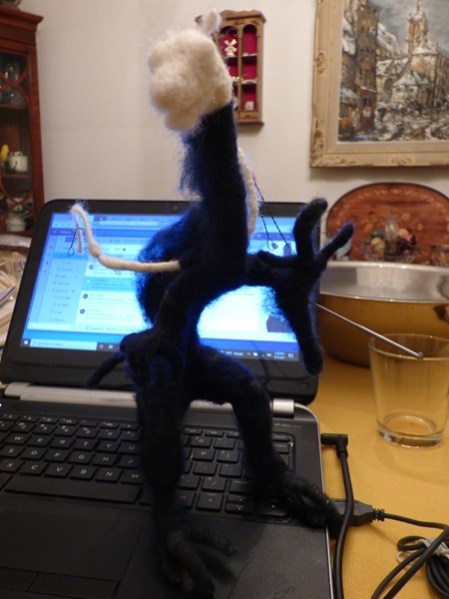 2-3, adding the base layer of colour standing on my old laptop.
 10 Not having teeth is also an issue.
 11, so close but yet so far
 12, adding more detail to the face
 13-14, the new laptop
 15, the new laptop has problems
 16 – 17, mouth colour added as well as fringe
 18, adding the grey wisps