the local Gaming/Felting Convention is back – blending skin tones for Mrs. Mer

the local Gaming/Felting Convention is back – blending skin tones for Mrs. Mer

A break from all the felting machines!

We had a great day on Easter Monday testing out the felting machines. We added Ann’s new purple one from Georgia to the mix.  But since we have had non-stop machine chatting I think we need a break from the sound of needles impaling wool at high velocities. So why don’t you join me for a day trip out to the Kanata Games Club one day spring Gaming (and felting) convention?  Mr. and Mrs. Mer came with me, in hope of adding more detail and some skin tone to Mrs. Mer.


The Kanata Games Club used the same Church as before. It’s built on a hill and has two large halls one on the lower level with big windows. This time they were only in the upper hall since this is the first big gaming event since the pandemic restrictions. We all wore masks (the church is still masking) except the Mer’s who didn’t have masks of the correct size. I may have to make them some. Or maybe their fishy-er parts keep them immune. Can fish get covid? (better not think about that or I will never get to tell you about the day.)

We arrived and as soon as I was settled, he quickly wandered off to one of the big tables. The big round tables were full of people with brightly coloured games with many interesting little pieces.  I found one of the smaller unoccupied tables by one of the windows.

1) Shortly after 9 am, I was happily left at a rectangular table with a Tim Hortons bagel and my felting supplies in a small clear plastic box. Mrs. Mer is reclining with bits hand blended skin tone.

I got comfortable for a nice long day of felting!

2) Mr Mer was there to supervise and cheer on the gaming. Mr Mer leans ageist a blue bag on the table in front are the small wool pad, the wrong beige, my phone and audio book, and my small clear plastic box of tools.2) Mr. Mer was there to supervise and cheer on the gaming. Mr. Mer leans ageist a blue bag on the table in front are the small wool pad, the wrong beige, my phone and audiobook, and my small clear plastic box of tools.

It quickly became apparent that while I had packed almost everything I needed, there were two small problems.  I realized I had brought a slightly different shade of base tone for her skin tone. Well, That can be fixed with a bit of extra blending.  The second problem resulted from the ongoing rebuilding of my office into a fibre studio, which is messing with my ability to know where everything is (specifically my mini carders AKA small pet brushes have disappeared)!!!  Oh well, I can blend a bit of this nice yellowy-ness with this tiny bit of raspberry red to the new base tone and that should be just about right. Without carders, I was blending tiny bits by hand which is slow when you are both sculpting more detail and putting on a colour layer. I am not a fast felter, I like to putter, consider, add a bit more wool, and eventually decide whatever I am making is complete.  But hand-carding all that I wanted to work on today would be a bit slow even for me!

3) Skin tone base colour from blending white (re-carded world of wool core wool), beige and amber Coriodale  and a bit of red I think may be merino.3) Skin tone base colour from blending white (re-carded world of wool core wool), beige and amber Coriodale,  and a bit of red I think maybe merino.

4) Not fully homogenous blends one with a stronger white and one with a stronger beige under tone.4) Not fully homogenous blends one with a stronger white and one with a stronger beige undertone.

I spent a long time hand-blending bits of skin tone for Mrs. Mer. I used white, beige, amber and raspberry tones. The world is not made up of flat uniform colours, so not blending to a uniform colour will provide a more natural looking tone. Today I wanted to improve Mrs. Mer’s head shape and extend her skin tone.

Hubby came to check on me at the end of his first game and I explained the lack of carders. Luckily the Dollarama was just a bit farther up the hill at the closest mall, a bit far to walk, (there was still snow) but a very fast drive.  He returned with a set of carders (pet brushes), a plug to charge my phone (it was dead again….) a couple of drinks and some candy(that will keep me felting!!).

5)  Dollarama $4.00 carders (pet brush) with safety tips.5)  Dollarama $4.00 carders (pet brush) with safety tips.

Recently at one of the local guilds socials, one of the pet brushes was being used to tease out the ends of locks. This is sometimes called flick carding. (Bernadette can show you how to properly flick card some time if you are at a social). The locks were not very long and there seemed to be a lot of poking of fingers as well as combing of fibre.  The Carders/pet brushes, that I had just been given, have little white plastic tips on each wire, safety tips!!! The packaging says the covered tips are to protect the delicate skin of your pet, while it also makes it much safer for your fingers if you are flick carding locks.

Like full-size wool carders, these pet brushes have little wires embedded into a backing.  some carders have wires that are quite stiff and some are more flexible. The same applies to pet brushes.  For comparison Cotton carders (like the name implies are used with cotton which has a very short staple length compared to wool) have shorter more closely spaced wires and tend to be longer rectangular shapes than wool carders.

If you buy two of the little pet brushes you can use them exactly like you would a set of wool carders. It takes a bit of practice to get the movement of the carders to blend and mix the fibres but it’s worth the practice.

6-7) Close up of teeth on the comb. note the bend about 2/3rds up the wire 6-7) Close up of teeth on the comb. note the bend about 2/3rds up the wire6-7) Close-up of teeth on the comb. note the bend about 2/3rds up the wire

You can see that one wire has lost its safety tip. it may have been missing when I took it out of the package and I just didn’t notice. I did not seem to lose any others while carding. I have heard of small pet brushes that had longer wires and larger safety tips that can come loose and disappear into the wool. So far this brand seems to not have that problem. (it will be worth keeping an eye on these to see if the tips stay attached over time.)

starting to blend first blend with constituent colours in background a darker blend with Mrs Mer in the background the two blends showing the lighter and darker vertions8-11) Examples of blending fibre to create skin colours

It’s nice to have a pallet of blended colours pre-made to pick from when you’re adding the top layer of colour. I am also doing a bit more detailed sculpture of her head and neck so a general mid-tone is also helpful.

12) MRS Mer laying on her back, double needles working along angle of the jaw (Mandible)12) MRS Mer laying on her back, double needles working along angle of the jaw (Mandible)

13) New muscle development below the oxiput and above upper traps.13) New muscle development below the occiput and above upper traps.

As with Mr. Mer, I was concerned with her ability to see where she was going when swimming. Unlike a full fish whose eyes would be looking forward and to the sides, her eyes in anatomical position would be looking at whatever is below her as she swam. This could allow for painfully swimming into things or being attacked by a bigger fish that she didn’t see coming. To alleviate this anatomical problem of blending fish and human anatomy I added an extra muscle on top of the upper traps to help her hold up her head for prolonged swimming. I will also beef up her erector spini in the back so she can also tip her torso up to reduce potential neck stain. The things you have to consider when felting are just amazing!!!

I worked along the underjaw and corrected some of the asymmetries in her skull.

14) attachment of SCM mucle scluping along jaw and adding skin colour.14) attachment of SCM (Sternocleidomastoid) muscle, sculpting along the jaw and adding skin colour.

15) gaming tables with people playing board games

The gaming continued around us, with players switching tables as one game ended and a new one began.  A few came over to see what I was working on, but most have seen me at previous felting/gaming events. Someday I am sure I will get to share my table with another felter!!

I took a break from her head and neck and worked a bit down her arms and started adding a bit of skin tone on one of her hands.

16) Mrs Mer through her arm into the air while trying to stay modest and warm with the other arm/hand (I need to make her a shirt soon)16) Mrs. Mer through her arm into the air while trying to stay modest and warm with the other arm/hand (I need to make her a shirt soon)

17) Mrs Mer’s waves goodby as its time to pack up.17) Mrs. Mer waves goodbye as it’s time to pack up.

I was in the middle of working on Mrs. Mer’s hand when Glenn’s last game ended.  So it was time to pack up after about 9 hours of fun felting. We both had lots of fun and hope there will be another Felting ….errr …. Gaming convention soon!

If you do a lot of 2D or 3D needle felting and enjoy working with blended colour you may find one of the types of carders handy. Depending on how much fibre you need to blend at a time will give you an idea of which type of carder may be best for you. (carders give you a woollen preparation for spinning while combs give you a worsted preparation)

Here is a quick reference chart showing the amount of fibre needed and tool options to achieve that amount.

Amount of fibre Tools to consider Notes, Pros/Cons
Smaller than a handful Hand blending -(if the staple length is longer than you want you can tare it or use scissors to shorten it)

Pros: free!, quick and easy to do for small amounts

Cons: can stress wrists and fingers pulling fibre apart as you blend it.

A Handful or a couple of handfuls Pet brushes used like wool mini-carders -like mini carders quality varies by manufacture. Some teeth are very stiff some are very flexible.

Pros: cost $2.50 to 10.00 each (cheap)

Cons: some are not well made and don’t hold up to stronger wools or heavy use.

A double handful Wool carders -designed to work with wool. Comes in various teeth counts (fine/Medium/course).

Pros: You can sometimes find a set secondhand from spinners.

Cons: new hand cards can be pricey but not as pricey as a drum carder.New Around $100.00 Canadian with shipping.

A larger amount (a batt) Drum carder -designed to work with wool. Comes in various teeth counts (fine/Medium/course).

Pros: can create larger amounts of blended fibre than a hand carder.reasonably easy to use,

Cons: a bit harder to clean for some. Even second-hand 150.00 to 350.00, new; high 200s to much more for larger or electric versions. The smaller ones are moveable/ sort of portable. The bigger ones are better left in a work area)


18) 3 full size hand carders, pet brush carders (my real mini carders will turn up as I keep shuffeling things) and small combs; a set of Rodger Hockins and one bee decapping comb in the interm location in my ofice/studio18) 3  full-size hand carders, pet brush carders (my real mini carders will turn up as I keep shuffling things) and small combs; a set of Rodger Hockins and one bee de-capping comb in the interim location in my office/studio

If you do a lot of 2D or 3D needle felting and enjoy working with blended colour you may find one of the types of carders handy. Depending on how much fibre you need to blend at a time will give you an idea of which type of carder may be best for you.

First Quarter Tree Finished and I Got Mail.

First Quarter Tree Finished and I Got Mail.

After some final fiddling with the width of the trunk and shadow and adding a little red bird for interest, I decided I am done with the winter tree.

Next is spring so I have to figure out what kind of tree I made. I wasn’t thinking of a particular tree when I started the experiment in making a tree. Here is the original tree experiment post. https://feltingandfiberstudio.com/2023/02/22/an-experiment-thinking-about-the-year-long-challenge/  After doing some picture searches I think it is most like an Oak tree. The other option was a Maple but the bark on a Maple is quite grey and Oaks have much more brown and textured bark. Naturally, neither of these makes the kind of flowers that pop into your head when you say tree in bloom. They make droopy green (sometimes red) tassels. Maples make maple keys and Oaks make acorns.  What kind of tree do you think it is?  I may decide it is a fantasy tree so I can make blossoms anyway. What do you think?


The other exciting thing Jan told you about too. I got my Package from Georgia (Russian Federation whether they like it or not).

Here are some unboxing pictures.


I was surprised it was all assembled. Jan had some assembly required with hers. The other fun thing is it is purple and has a cute little bee. It has 4 what look to be size 36 felting needles in it. It holds 4 of them.

Purple and a bee are all very well but how does it work? It took a little experimenting on how where to hold the machine in relation to the felt surface to get the best felting. It worked well but it is hard to engage all the barbs on such a long course needle. We decided to switch out my big needles for one of the smaller crown needles. This also helps with a comparison of Jan’s machine to mine as hers only holds one.  I like it. It is bigger than Jan’s and I like hers too.  I like the Chinese one the least. A lot of that is the way you hold it. It is a much slower machine and we all know that patience is not one of my stronger qualities. One thing I would recommend is that you get an awl or sewing stiletto or something similar to use to hold new fibres down so you are not getting your finger so close to the machine. Unless you have long talons like Jan for doing such things.


In this last picture, you can see how much ( the white fibres) gets punched through when you fully engage all the barbs of the large 36 triangle needles and how big the holes are even when you only engage the first barbs( yellow fibres).

You will get to hear about the rest of the testing later. Jan is making a chart and doing some analyzing of data. Better her than me. 🙂

Felted Garden Vase Cover

Felted Garden Vase Cover

Four Ravens Gallery in Missoula, MT (USA) is holding a garden themed exhibition in May. I have several pieces that will be included in the show. I decided to make another felted vase cover to fit a glass vase that is 4″ diameter and 6″ tall.

Layout of green wool (layer 1) on resist for a felted vase cover.

I wanted a mixture of greens but didn’t want to take the time to card a batt. So I laid out different colors of green wool for each layer. Here’s the first layer, so that’s the inside of the vase cover.

Layout of green wool (layer 2) on resist for a felted vase cover.

Then I added a second layer which is much more neutralized green.

Layout of green wool (layer 3) on resist for a felted vase cover.

The third layer was a mix of greens that I had hand carded and was left over from another project.

Layout of red, orange and yellow embellishments and wool (layer 4) on resist for a felted vase cover.

Then comes the fun layer. I added a variety of green wool, yellow silk noil, red mixed wool in tufts and burnt orange locks. There are also a couple of pieces of bright green cheesecloth under there somewhere. Then the felting and fulling process (no photos) happened.

And here’s the vase. The photos show it from different angles. In the center photo, you can just see a small piece of the bright green cheesecloth. It’s a bright and cheery piece and reminds me of spring in the garden. If you’re in the Missoula area, you should check out the gallery as there are some wonderful artists represented there.

A cushion cover

A cushion cover

I feel that you can never have too many cushion covers for cushions. They are such useful items of soft furnishings, and they can help brighten a room in no time.

My offering this month is a mixture of felt, thread and fabric waste, and free motion stitching to make a cushion cover. I wanted to give the impression of looking into a puddle with leaves floating on top.


This is the front and rear, before cushion cover making.


I used a variety of left over threads, pieces of felt, and fabric trimmings. I placed all of these on a piece of white fabric, and covered everything up with a piece of tulle. This was stitched down very securely, and it did begin to look as if it was a watery puddle.


I had some pieces of felt, left over from another project, and I cut some leaf shapes from this, and placed them over the stitched down tulle. I added some leaf veining as I arranged and stitched them down, in a fairly random placement on the surface.

I do think it turned out quite nicely. Then I had to choose some fabric to complete the cushion cover, in a colour to complement the orange leaves. I had found some purple fabric with a oil slick type pattern, in a charity shop last year, and as soon as I placed them side by side I knew it was a perfect match.


When I was in hospital, there was a good view of some trees from the window of my ward. This is a tree that I became fascinated with. I am still convinced that I can see Mr Mer sitting in the branches! Maybe it is just me!!


Bad “art”

Bad “art”

If you’re anything like me, you’ll find it very hard to stick to one hobby alone. After all, there are too many temptations out there, and each creative endeavour fuels the brain differently – it’s fun to discover new materials to play and interact with, and see what comes out of the experimentations.

I rediscovered the love of journaling last October, and have since then filled two notebooks of ramblings, ideas, memories and opinions. As I progressed in my writing however, I noticed I was also very attracted by the notion of doing something visually creative with paper and stationery.

Now, I must add a disclaimer here: I don’t think the pages I filled are special. They’re not particularly beautiful or unusual, and that’s definitely not a negative thing – I started doing collages simply for the joy of playing with images and colours, and these were the space for me to have some non-commercial, creative fun. It was my way of relaxing and letting go of expectations, of “what will others think of this,” of any idea that one’s creative endeavours must always be amazing. I just wanted to get messy with glue and glitter.

A closed notebook on a white wooden surface

This is the cover of my A5 size notebook. It’s decorated with some leftover fabric (featuring cats, obviously) and the artwork from a tin of… Sardines? Cod? I might add more stuff to it as I go along, since I don’t consider any of the pages here “finished.”

Side view of my notebook, with all the wavy and textured pages

This notebook came with different types of paper, so I play with it depending on the “canvas” I want. As you can see, the middle pages have been used the most, and apparently I’ve not much love for plain white paper.

Open notebook, showing two pages of a collage

I tend to go by colour and texture, more than whether the things make sense together. My brain seems to enjoy adding stuff to paper until it looks filled enough and has things to make the eye wander.

Another two pages of my collage notebook, on a white wooden surface

Fabric scraps and teabags are game. See the eye on the lower left corner? I stole that from my husband’s studio, he’d removed it from one of his paintings – does this count as artistic appropriation?

Two unrelated pages of my collage notebook open

Collages made using medical information leaflets and other bits and bobs

If you can’t read the weird Balzac quote above, it is as follows: “No man should marry until he has studied anatomy and dissected at least one woman.” What a weird fellow he was (and I hope no one followed his advice!)

Collage using glitter, ink and paper

Collage in oranges, yellows and reds

I say this again proudly: none of these collages are groundbreaking or particularly good. What they are, is FUN. I loved making them with no end game in mind, no agenda and, until I decided to share them here, I was perfectly convinced none would ever see the light of day. It’s very liberating to create with full freedom from our inner critic and, if you’ve never tried, I urge you to give it a go. It might even fuel your creativity for the more “serious” stuff you make.

How many hobbies do you have? Are they all fibre- or textile-related? Let me know what’s tickling your crafty mojo lately in the comments section.


First Tests of Ann’s and Jan’s New Felting Machines Part 3

First Tests of Ann’s and Jan’s New Felting Machines Part 3

Part 3:

This will be a “short post” since we have had a third machine to add to our investigation (which I hope will continue on next Monday).  Ann has received a package from Georgia, hopefully containing the Solar Bee she ordered. It is vary similar to the design of handle and motor placement of the Orange fly but instead of a single needle it can have up to 4 needles. We will let you know what we find out about it soon.

The continuing investigation into the first 2 electric felting machines (China and Ukraine)

A quick look at trying detail work on pre-felt:

I tried fine detail work on pre-felt with merino, first with the Orange Fly (Ukraine). I did not have trouble working along the edge of main branches but found that it felted much faster than I am use to. the increased speed of felting is especially noticeable when we tried felting the tiny branches. Although it worked well, I did not feel as confident in my control of wool moving, I suspect I just need more practice.

1- dry felting on dry pre-felt. creem prefelt, black winter bare tree, orange fly needle felting machene on foam mat with a cuple needles and a bit of black merino wool 1- dry felting on dry pre-felt.

Next I wanted to try a piece of pre-felt that had been wet felted by Ann. This was one of her tree prototypes that she did not use as her finished tree.

2-3 pre-felt with one of Ann’s wet felting tree tries. - During wet felting. 2-3 pre-felt with one of Ann’s wet felting tree tries.2-3 pre-felt with one of Ann’s wet felting tree tries.

   4-6  I wanted to try adding little cardinals (red birds) to the tree. adding red dots to tree branches to indicate cardnels (red birds) black tree branches on prefet with red dots, adding a bit more fiber suddenly got a lot bigger dot. 4-6  I wanted to try adding little cardinals (red birds) to the tree.

I found that the machine grabbed the fiber and pushed it with enthusiasm into the pre-felt. A bit more than I had expected.  Again I think more practice would improve the bird-ish-ness of my red blobs!

back of prefelt showing red wool penitration 7 the back of the pre-felt showing the red fibers pushed to the back.

 I also tried on the orange Fly on 2 more wet felted bases with good results and not as good results.

Our next test base was a felt Ann had made in two colours of brown.

It was about the thickness for a wet felted hat but could be a good surface for a picture.

The single needle of the orange fly did not have trouble embedding fiber into the felt.

adding blue fiber to solid wet felted wool on a wool pad back of wet felted wool pad showing penitration of fiber. adding blue fiber to solid wet felted wool on a wool pad adding blue fiber to solid wet felted wool on a wool pad. using orange felting machine on an angle.8-11 working on solid wool felt.

I found that I felt more fiber movement when I angled the needle insertion. This would allow more barbs to engage fiber without having to imbed the needle into the wool felting mat.  (Angling the needle reduces the depth of insertion while still allowing more barbs to grab and entangle fiber.)

Having only one needle should be slower when laying in a general background colour. But, it is still quite quick, and there was no stress on my wrists, fingers, elbow or shoulder.  Ann and I should try a race between the felting machines vs. the 10 needle bar tool, which I find very fast for laying in backgrounds. But speed is not the only factor that the machines address.

We also considered the mettle machine from china. As you remember the mettle machine did not like most of the felting surfaces as much as the orange fly did. We used the fake clover brush (driveway asphalt painting bush from the hardware store) which is what seemed to be its favorite surface so far in our investigations.

mettle machine felting into wet felted wool on bristal brush 12 Mettle machine felting into wet felted wool on the driveway brush

Wet felted (Fulled) knitting as a felting surface.

Ann had fulled a piece of knit sweater and brought a piece to try felting into. the orange fly did transfer the white fiber through the knitting successfully but it was a bit more resistant than the firm felt.  (It is quite firmly fulled knitting.)

felting into fulled knitting on wool pad back of fulled sweater showing wool penitration 13-14 Orange Fly felting fulled wool knitting on a wool pad

Next I tried the mettle machine on the same surface. I noticed one of the screws loosening so stopped and tightened it. I suspect that you may want to check all the screws occasionally just so you do not lose one.

  15 mettle machine felting into fulled sweater on wool mat, 16 one of the tiny screws had started to loosen.15-16  mettle machine felting into fulled sweater on wool mat, one of the tiny screws had started to loosen.

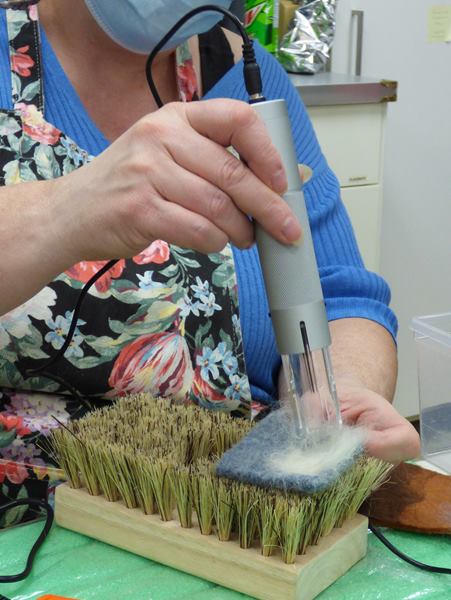
There is less resistance when using the driveway brush  as a work pad but there was still the most resistance when we were felting on the fulled sweeter. Running with 2 needles was also less resistance than running the machine with 4.

  17-19 checking work angle and comfort holding mettle machine

I again tried holding the machine vertically and on an angle.  Both were comfortable to hold and there was less vibration/resistance when using the brush with this machine.

I have been making a chart for the 3 machines so next we will investigate the machine from Georgia and fill in the rest of the chart. We will open the package and put it through its paces next Monday (which is a holiday) and hope to have some test results ready for the next blog post!

For working on wet felting the orange fly seems to be a bit more enthusiastic towards embedding fiber into the felt/fulled 2D picture ground .  I will not give up on the mettle machine, I suspect we have not found its forte yet. I want to look further at 3-D sculpture. i am a bit concerned with the machines hitting armature wires (I may have to find some safety goggles before I try that!)

Until we can find out what’s in Ann’s mysterious package, Have fun and keep felting!

20 the mysterious package arrives at Ann’s

Nuno Felt Scarf Class + Sheep

Nuno Felt Scarf Class + Sheep

I had another wonderful day teaching some ladies to nuno felt scarves.

I was busy ( talking) and didn’t take as many pictures as I would have liked at the beginning. So no pictures of the starting silk. I dye the blanks myself using the scrunch method of low-immersion MX dying. I learned how to form Paula Burches All about hand dyeing site. It is an amazing site. Don’t go unless you have some time to explore, there is so much information.  http://www.pburch.net/dyeing.shtml 

If you click any of the pictures they should open up larger in a new tab.

Back to the class, here are the layouts just before we wet them down.

pink and purple wool in the shape of a scarf, with an orange silk flower pink and purple wool in the shape of a scarf, with an orange silk flower. close up

Dark grey wool with silk hankies in various colours. In the shape of a scarf. Dark grey wool with silk hankies in various colours. In the shape of a scarf, close up

blue, grey and brown wool and silk in the shape of a scarf. blue, grey and brown wool and silk in the shape of a scarf, close up

pink and orange wool and silk in the shape of a scarf. pink and orange wool and silk in the shape of a scarf, close up

and then everyone got rubbing. This is the time it’s great to have a chatty group. It makes the work go faster. And I don’t have to do all the talking.

woman rubbing a wool scarf layout to make a felt scarfwoman rubbing a wool scarf layout to make a felt scarf

woman rubbing a wool scarf layout to make a felt scarfwoman rubbing a wool scarf layout to make a felt scarf


Sorry, no rolling pictures. The problem with a chatty group is I love to chat too and forget to take pictures.

But I do have some pictures of the finished scarves once all the fulling was done.

Finished pink and purple nuno felt scarf with an orange flowerFinished pink and purple nuno felt scarf with an orange flower. close up of flower end.

Finished grey, brown and beige nuno felt scarf with colourful accents.

Finished blue grey and brown nuno felt scarf Finished blue grey and brown nuno felt scarf up close

finished Pink and orange nuno felt scarf. finished Pink and orange nuno felt scarf close up

here’s a nice group shot from the end of the class.

Group of women holding nuno felt scarves


One of the ladies went home and dried her scarf so she could wear it right away. Doesn’t Kim look great? The colours really suit her.

Kim taking a selfie with her new scarf.

Denice also sent me a picture of hers when it was dry. I love the silk flowers.

nuno felts scrf on a hanger, dry

It was a fun day for everyone.

I taught a short sheep class the other day. They were young people so just one picture of the finished sheep.

4 multicoloured felted sheep

2023 SECOND QUARTER CHALLENGE

2023 SECOND QUARTER CHALLENGE

Calling all fibre lovers – knitters, weavers, stitchers, crocheters and felters – challenge yourself to make a table runner or mat.

Here are a few that we’ve made in the past 😊

This starry felt mat not only protects the hall table but it looks good too …

Felt Table Mat white stars on dark background

…and it looks just as pretty on the reverse!

reverse of felt table mat

Here’s a cobweb felt (merino wool and silk top) table runner that we nicknamed ‘Miss Havisham’ …

cobweb felt white merino and silk table runner

… and a 3D felt decorative table runner ‘Spring Flowers in the Snow’.

white felt table runner with 3d spring flowers in the snow

This plant pot mat, in the style of Clarice Cliff, was made for a previous challenge.

Felt pot plant mat in the style of Clarice Cliff

In the first quarter challenge, it was suggested that you find a tree you like and depict it as it awakens in spring with buds/new leaves/blossom – it could be realistic or representational.

If you’d like to continue with the tree challenge, then please do so!  Depict your tree in its next season.

Please post your entries in Studio Challenges here:

https://feltandfiberstudio.proboards.com/board/18/studio-challenges

Or if you are unable to upload a photo, use this link to post your photo

https://feltingandfiberstudio.com/community-photo-submissions/

then please tell us about your make in Studio Challenges on The Felting and Fiber Forum.

Winter Birch Landscape Completed

Winter Birch Landscape Completed

I have finally completed my winter birch landscape that I have been slowly working on. You can see the prior posts here if you missed them.  I had about determined to skip adding any extra snow in the foreground but then I decided I should try a sample of needle felting the snow.

Nuno Felted Background with Stitched Red Twig Dogwood and Needle Felted Snow Under Dogwood

And, surprise, surprise, it worked better than I thought it would. So I added a bit of snow and then needed to figure out the distant red twig dogwood bushes. (You can see the snow in the final photo.)

Sample of red twig dogwoods drawn with marker on to nuno felt background.

First I tried using a marker on my sample to see if I could get away with something easy. The thinner marker made a very light line and the heavier marker was too heavy. Plus, using a marker on nuno felt gives a very uneven line. On to the next idea.

Sample of needle felted wool thread compared to stitched wool thread.

Next, I tried needling the wool thread into the sample background. It didn’t feel like there was much difference between the stitched bushes in the foreground compared to the needled line on the top left.

I decided I would try a cotton machine thread (30 weight). The stem stitched sample on the left shows two different colors. The redder color is straight off the spool but I wanted the thread to be a bit darker and variegated. So I colored the thread by hand with a black marker. The photo on the right shows the thread before it was darkened (left side) and the thread on the right side of the photo has been darkened with a black permanent marker. It worked perfectly although it’s a little messy on the fingers.

Completed Nuno Felt Landscape Blue/White Background with Appliqued Birch Trees, Free Motion Stitched Branches and Hand Stitched Red Twig Dogwood Bushes.

So here’s the finished landscape. I used the machine thread for the distant red twig dogwoods and you can see the small amounts of snow that I added. I’m happy with it but I will put it on the design wall to look at to make sure it’s finished. Then I will need to choose a “matte” fabric and get it ready for framing. I’m thinking of calling the piece “Winter Color”. Or I could stick with “Winter Birch”. Which do you prefer?


What makes an Art Yarn Scarf into a Stole?

What makes an Art Yarn Scarf into a Stole?

I’ve been practicing my spinning skills for a while now, and although I have mastered the technique of spinning finer yarn, I have a true passion for the more bulky, art yarns.  I’m not a great knitter, I do occasionally enjoy crochet but I much prefer to weave.  When I first took up spinning, like everyone I found that my yarn loosely resembled an ‘art yarn’ more than a fine yarn. It lacked a sense of purpose and it didn’t have that look of “yes, I intended to make this”!  So my priority was to be able to spin an art yarn that looked like it was meant to be an art yarn!   However, at the same time, having read so many comments about people who can only spin fine yarn or art yarn I didn’t want to reach a point where I was only able to spin one or the other.  So I have tried really hard to chop and change my ideas, to try and avoid the pitfalls associated with spinning only one style of yarn.  I’ve also tried really hard to make an art yarn that looks like it is meant to be an art yarn.  I definitely think I am making some progress on this front.  Let me know what you think…


I started with a selection of merino wool top in various colours, including an orange, cerise pink and teal as a base for my art yarn.  I then decided to jazz it up with some beautiful turquoise bamboo, which I thought would add some sheen and lustre to the project.  Like all good art yarns, I wanted to add in some interest so decided I would use curly locks of various different colours.  Finally, to finish the interest side of things, I decided to include some recycled sari silk that was made up of different random colours.


To start off, I began to add the base merino to the carder.  Unfortunately, I have broken one of the belts on my carding machine – it’s the one that operates the smaller of the two drums.  But for this project, it didn’t really matter as I was not wanting a fully blended batt.  So I was able to add all of my fibre direct to the larger drum.  I did use my little packing brush to flatten it down as I went along.


You can see some of the recycled sari silk running through this photo.


In this photo, I’m adding sari silk again to the the mix.  It was helpful that it seemed to work using it like a bangle, wrapped around my wrist enabling me to place it where I wanted it.  If I hadn’t done it this way, it would have been hanging down and could easily have got caught up in the drum.


Once I’d finished carding a nice thickness of batt, it looked like this…


A completed wool batt   


I was happy with the way in which it turned out as I wanted to keep the definition and not have a muddy blend at the end of it.  But before I started making any more, I decided to spin it, just to check I was happy with the way in which the colours turned out.

These are some shots of the spun art yarn on the bobbin but only after I plyed it!  Unfortunately, I got slightly carried away because I was enjoying myself so much, I forgot to take any photos!  For the main art yarn, I spun this using a fine mohair yarn to core spin around.   I made a mixture of thick slubs and thinner spun yarn, so that when I came to plying I could make some nice twirly spirals to add interest.  When spinning the core yarn I also added in some random curly locks, which were all sorts of colours, that contrasted with the base colours I’d used in the batts.  I also added some extra sari silk into the spin at random points through the yarn when I felt it needed a bit of Va Va Voom!

I was quite pleased with the spin…but as I said, unfortunately I didn’t take any photos of the yarn before I began plying.  However, I did take a photo of one of the fat singles in teal.  I also spun some in orange but no photo sorry.

Fat single in teal
A fat single in teal merino. 

As you can see, there was quite a lot of twist in this as I was scared it would all fall apart when I was plying!


This was my first attempt at core spinning, so I was pleased to see it coming together as I intended.  I started plying the art core spun yarn with the fat single, and it looked promising…

As you can see, I'm using an Ashford Jumbo Bobbin with my Ashford Traditional Wheel.  

As you can see, I’m using an Ashford Jumbo Bobbin with my Ashford Traditional wheel.

I then transferred it to my niddy noddy.  I didn’t want to soak the yarn in case I damaged the slubby spirals, so decided to set it using a hand held steamer.  These are a few photos of the yarn on the niddy noddy.

  I tried to take different angles to show the range of effects.

All in all, I made two batts of art fibre, which were about 100g each that I used for the core spin.  I didn’t weigh the fat singles but by the end, I had four skeins of art yarn, weighing approximately 300g.

Looking at three of the skeins hanging up together, it looks quite ‘jewel’ like.  So pretty, I’m pleased with the colours…

These skeins look almost ‘jewel like’

I wanted to use my yarn to make a woven scarf.   However, I’m not confident enough in my home spun yarn yet to risk using it as a warp.  This was especially true as I was hoping to use this project for the blog.  I was mindful that the art yarn was going to be quite chunky.  I only had a 7.5  30/10 dent reed for my rigid heddle loom, which would have been much too small for the art yarn.  This was another reason I had to choose a different yarn for the warp.  Having used mohair in the core spinning, I toyed with the idea of using it as a warp.  However, I had read that mohair is very ‘sticky’ when used in weaving, so I did some research first before trying it.  I did find some advice that said you can use it, if you utilise a pick-up stick behind the heddle to help clear the shed.  The only way to know if it would work was to try it!  So, having looked at my reed, I decided that given the thickness of the art yarn I would only use every third reed.  That way, I envisaged that I would be able to space the warp out evenly when I when I separated each strand.  Also, it would allow more space for the art yarn to show in all its glory.

This is the warp before I started weaving.  As you can see, I decided to use three different colours of mohair, just to see what the effect would be…

  This photo show how fluffy that mohair  really is!

I started to weave with the art yarn, and to my surprise it was far easier to weave with than I had anticipated.  The ‘stickyness’ of the mohair really didn’t present any issues for me.   I think that because I had only warped every third reed, it didn’t have the impact it could have had, which was good.

I only took these two photos of the actual weaving process.  One thing that I discovered when doing this project, was that I don’t actually have the weaving loom that I thought I did.  When I first got this loom, as I always intended weaving with art yarn so I also purchased a freedom roller.  I didn’t want to have the restriction in length of weave that I would face when using really chunky art yarns.  Having never used the freedom roller before, I decided I would fit it onto the loom for this project as I really didn’t know how bulky the final weave was going to be.

However, when I got the freedom roller out and started looking at how it would fit on the loom, I soon realised that there was no way it was going to work!  I struggled to understand why, so I took some photographs of the freedom roller and my loom, and sought some advice on a Facebook weaving group.  It was only then, I discovered that my rigid heddle loom was in fact a samplet loom!!! I realised that what I thought I had ordered, was not in fact the loom I did order! School boy error on my part, as a complete novice!

In the end, all was good as it turned out, I didn’t need the freedom roller after all (she breathes a sigh of relief!).  When the project was finished, I removed it from the loom, and considered what to do with the ends.  The mohair was very thin and sparse, so would not make for a good fringe.  Having twirled the mohair into little tassels, I then decided to tie some additional curly locks to pad out the effect.

Here, you can see one end completed…

  When I tried on the scarf, I realised that I had made it a little too wide to make it into a comfortable scarf.  So it was at this point, I decided that rather than using it as a scarf, it would work better as a stole.  However, this now presented me with another need…

If I was going to use this as a stole, it would need to have some sort of decorative pin to hold it in place.  I didn’t want to have anything too colourful or fussy, as that would be lost in amongst the art yarn.  So I decided to make a wet felted butterfly, with wings that were primarily one colour, with some accents of a different shade.

Here is my blue butterfly…who does have an orange body, just to make the body stand out a little…. The wings and body are made from merino and the accents of paler blue, are made of the bamboo, which I fixed with wisps of the merino to felt them into place.  I decided  to leave the resist inside, just to provide a little more firmness to him.

  I did try to add some sequins as way of creating more sparkle, but as they were so small, I found them difficult to sew on (my fingers are not so nimble as they used to be!).  I tried gluing them in place, but that didn’t work either!  So in the end, I just left him as he was.  I do intend making him some antennae, but I haven’t had time to add those in yet.  He is attached to a large kilt pin, so he can be used to hold the stole in place.


I’m really happy with my first project, using my own spun yarn, hand woven, and completed with wet felted butterfly pin.  I’ve used three different skills in this project, and I’m really pleased with the end result.  I was surprised at how dense the weave turned out.  Having only used every third reed, I expected it to be much looser than it ended up.  Perhaps next time, I will try an even wider warp, using the whole loom and leaving a larger gap between the warp threads.  It’s all a learning curve, but for now, I am really pleased with the results.  It’s lovely and warm too!  I’m almost sad summer is on the way, but I’m sure I’ll get lots of use out of it next winter,