Upper Canada Village trip

Upper Canada Village trip

05-06-2023 Upper Canada Village trip after the morning shopping with Sharkboy and Glenn. (https://feltingandfiberstudio.com/2023/05/15/more-shopping-for-the-mers-again-looking-for-hair/)

When last we chatted we had left the fibre festival in Spencerville and headed a bit further south and east heading to Upper Canada Village (UCV).

The Village has an interesting history.  The plan was to make the St. Lawrence River deeper and thus navigable, to larger oceangoing ships, thus providing them access to the great lakes. Unfortunately, this would require the flooding of 10 small villages that had grown up along the river’s edge.  To save some of the historic architecture from these soon to be flooded areas, some of the buildings were moved to two new locations. Some went to Ault Park and over 40 structures went to Upper Canada Village, whose construction began in 1958. The buildings included several working mills (woollen mill, grist mill and sawmill) and trades buildings (blacksmith, tinsmith, cabinetmaker, cooper, bakery, cheese-maker) as well as a doctors home, chapel, livery stable, taverns/dining room, and two farm complex.  The village is set up to represent life in the 1860s.  There is a large team of costumed interpreters working at the village to help show you what the 1860s were like.

On the Saturday that we visited Up UCV had decreed free entrance to the village in celebration of the Coronation of King Charles, so it was very busy. We were lucky and found a good parking spot. I think shark-boy was miffed since he had not found locks to make his hair at the fibre festival, so he stayed in the car to sulk and we went off to have fun looking at everything without him.

1) this is the vew Just inside the village of Upper Canada, that is the sawmill over to the left.1) Just inside the village of Upper Canada, that is the sawmill over to the left.

I knew I had limited walking and didn’t want to tick off my back so we consulted the site map and made a plan. The Woolen Mill, the Blacksmith shop, the Weaving and spinning house, the dressmaker’s shop and the stables. I didn’t think I could make it to the farms to see the oxen and sheep.

2) The map of UCV showing the main spots we wanted to make sure to see. Woolen mill, Blacksmith shop, Weaving and spinning house, Dressmakers, Livery stable.2) The map of UCV showing the main spots we wanted to make sure to see.

Our first stop (not just because I really wanted to see it, but it was also the closest building), was the Woolen mill (Asselstine Woollen Factory). This was a two story building, with the downstairs levels accessible to a walker or wheelchair. Providing fibre UCV has its own flock of sheep, which they sheered and the fleeces used on site. I did not see the sheep, so was unable to ask the interpreters what breeds were prevalent in 1860s Canada.

 3) Large mounds of fleece (possibly raw behind the rope and washed closer to us), on what might be skirting tables 3) Large mounds of fleece (possibly raw behind the rope and washed closer to us), on what might be skirting tables

4) Washing tub were located on the other side of the room from the tables with fleece. 4) Washing tubs were located on the other side of the room from the tables with fleece.

Between the fleeces and the washing area was a stairway to the second floor. That just will not be happening today! So, I went around to the other side of the ground floor at the back of the building. We passed these fabulous kettles for dyeing fibre or spun yarn as we found the way in to see the rest of the lower level.

 5) dye kettles sitting upside down along the foundation of the woolen mill 5) dye kettles sitting upside down along the foundation of the woollen mill

At the back end of the lower level of the mill is an industrial water-driven loom, a fuller, and the intake of water to run all the machines.  (I understand on the next floor are the spinning and plying machines to create the yarn.)

6) Water powered industrial loom with fly shuttle located on the ground level of the mill6) Water powered industrial loom with a fly shuttle

7)   This is the fulling machine. Notice the rows of teasels to raze the fabrics nap. Teasels are the thisle like tops of a plant that have small babrs that bring up the nap in the fabric making it fuzzy 7)   This is the fulling machine. Notice the rows of teasels to raze the fabric’s nap.

  8) The teasel row close up. we see this plant along the highways in areas that had weaving mills (The Traffalger exit in Oakville was a good spot to find them)8) The teasel row close up

9) This blanket has been rubbed by the teasels, which brings up the nap or fuzziness.9) This blanket has been rubbed by the teasels, which brings up the nap or fuzziness.

 10) At the farthest end of the building was a display of dried teasels and oilcans. To the right, hidden behind the timbers, is the intake of water to power the mill.10) At the farthest end of the building was a display of dried teasels and oilcans. To the right, hidden behind the timbers, is the intake of water to power the mill.

11) The intake for water that runs the mill. I didn’t see anyone to ask how they kept the water from getting past the wood and flooding the  lower level of the mill. 11) The intake for the water that runs the mill. I didn’t see anyone to ask how they kept the water from getting past the wood and flooding the lower level of the mill.

12) All the machines are belt driven in the mill. shows one of the belts that would opperate the fuller if it were to be engaged.12) All the machines are belt driven in the mill.

While we were there admiring the equipment, the machinery started and the belts began to turn. Since the loom and fuller did not run, I suspect they were working on the spinning or plying machines upstairs. Also, likely, why we didn’t see any mill workers in the lower level.

13) Our second stop, the blacksmith shop this was a one storey building with a large opening on one side13) Our second stop, the blacksmith shop

Our next stop was at the village Blacksmith. He was in the process of repairing part of one of the wagon harness attachments. (I was a bit vague on how it would all go together once completed.)

14) Working over the anvil, the blacksmith is making the end of what seems to be pin with handle. This end will have a faceted face to add a bit more decoration as well as be functional. the blacksmith's head is down focusing on his work and the hamer. here is a relected glow from the hot iron14) Working over the anvil, the blacksmith is making the end of what seems to be a pin with a handle. This end will have a faceted face to add a bit more decoration as well as be functional.

15)  It was a well-equipped blacksmith shop, having 2 anvils (similar in weight to Glenn’s) 2 swage blocks, and there is a foot vice attached to the work table just left of the picture. a wider picture of the forge, bellows, anvils and other equipment. the blacksmith is working the leaver that operates the bellows15)  It was a well-equipped blacksmith shop, having 2 anvils (similar in weight to Glenn’s) 2 swage blocks, and there is a foot vice attached to the work table just left of the picture.

He used a piece of chalk on the floor to draw his pattern and get the correct proportions as well as explain to his audience what he was doing. It was like having a giant working blackboard at his feet. I wonder if we should draw on our work tables when we felt?

 16) When he had the pin end made he sketched out the handle that would be attached to the pin. the blacksmith is crouching while drawing on the floor. 16) When he had the pin end made he sketched out the handle that would be attached to the pin.

17) He used the pin to check the size of the handle to be added to the pull pin. He has already flattened one end of the bar and punched a hole through it (to attach it to the pin.) he is using the dawing to estamate the leng he will need to make the pull for the pin.17) He used the pin to check the size of the handle to be added to the pull pin. He has already flattened one end of the bar and punched a hole through it (to attach it to the pin.)

We saw him demonstrate upending, punch, drift as well as bending over the horn and a few other ways to reshape mettle. When Glenn was happy and had his fill, we wandered on to see the weaver’s house (McDiarmid house built in 1864).

18) McDiarmid house built in 1864, 2 story log hune house. there are simetrical windows on the ground floor and one above in peek directly above the door.18) McDiarmid house built in 1864, 2 story log hewn house.

This house has a handloom and a number of spinning wheels. We recognized Shirley, the spinner/weaver demonstrating here. She had a few die-stuffs on display, the most popular was the bug cochineal which makes a beautiful red colour.

19-20) Shirley talking to vistiors to the left of the image, waring an 1860's dress she is pointing out difernt samples of natural dies , spinning wheel in forground is a saxony style, there is a Great wheel behind it. 19-20) Shirley talking to vistiors waring 1960's dress and sitting at her saxony style wheel 19-20) Shirley talking to visitors

The 2 side rooms were set up as bedrooms. Each side room had 2 wheels (all different) as well as the 3 wheels in the main room. There is a large barn loom which presently does not have a warp on it. There was also a small tape loom on the far side of the room.

21) Tape loom, drop spindle and nitty notty in front are some of the natural die samples. 21) Tape loom, drop spindle and nitty noddy in front are some of the natural die samples.

As more people came in, we left Shirley to chat with them and headed off to find the dressmaker’s house.

22) this is one of the Views on the way to the house of the dressmaker. (Old farm building with log rail fence and man in 1860 attire in foreground.) We saw a number of different log rail fence styles and I wish I had taken the opportunity to catalog all the variations.22) this is one of the Views on the way to the house of the dressmaker. (Old farm building with log rail fence and man in 1860 attire in the foreground.) We saw a number of different log rail fence styles and I wish I had taken the opportunity to catalog all the variations.

23) The dressmaker’s stone two-story house and side yard those trees may be apple trees.23) The dressmaker’s stone two-story house and side yard those trees may be apple trees.

24) The dressmaker, with a display of some of her wares on the table before her. There are bonnets and a crinoline in the corner cabinet behind her.24) The dressmaker, with a display of some of her wares on the table before her. There are bonnets and a crinoline in the corner cabinet behind her.

25) This is a device that sets Crimp in fabric. It is usually used in pairs, one is heating while the other is in use.  It requires the fabric to be damp as it runs through to set the ridges.25) This is a device that sets Crimp in fabric. It is usually used in pairs, one is heating while the other is in use.  It requires the fabric to be damp as it runs through to set the ridges.

26) Dressmaker is holding a sample card showing Handmade Dorset buttons examples made over rings and one over a wooden base.26) Handmade Dorset buttons are examples made over rings and one over a wooden base.

27) Button hole scissors, Has a notch and screw between the grips, to set the length of hole required for the button. I might like buttons better if I had such high-tech scissors.27) Buttonhole scissors, Has a notch and screw between the grips, to set the length of hole required for the button. I might like buttons better if I had such high-tech scissors.

I enjoyed looking at pictures of the upper floor with the tricky turning staircase. I appreciated the inclusion of pictures so I didn’t have to try the stairs. It would not likely have gone well! with a new surge of visitors to her shop we made a retreat to allow them space and headed back towards the park entrance, and our final stop at the livery stables.

28) At the livery barn, the working UCV horses live for the summer. This one is being harnessed to pull a barge.28) At the livery barn, the working UCV horses live for the summer. This one is being harnessed to pull a barge.

UCV have a small herd of pure-bread Canadians. This breed was a popular working horse used for multiple types of farm jobs (Similar to the Morgan Horse in the states). This one is getting tack so he can go pull a barge along the edge of a channel. Other horses were pulling a wagon with seats today and often pull other carriages and delivery carts around the village. They also power a saw and till the fields of the main farm (the oxen, who are at the tenant farm, also can pull and plough but I did not see them today)

29) Another way to get to see the village is by wagon with seats pulled by horses. Two more of the villages Canadians are providing the horsepower.29) Another way to get to see the village is by wagon with seats pulled by horses. Two more of the villages Canadians are providing the horsepower.

30) As you can see Canadians are not huge horses being built more on the small but strong theme.30) As you can see Canadians are not huge horses being built more on the small but strong theme.

31) Here he is pulling the towrope while shewing off some Canada geese from the shoreline path.31) Here he is pulling the towrope while showing off, some Canada geese from the shoreline path.

I was told that not all of the village horses like to pull the barge but that this one does.

32) The barge with rudder in the back, filled with tourists the horse power is on the shore line with the tow rope. Across the river are some very not 1860’s houses on the American side of the water. I bet they have a fabulous view of the Canadians’ side and all the historical happenings.32) The barge with the rudder in the back is filled with tourists. The horsepower is on the shoreline with the tow rope. Across the river are some very not 1860s houses on the American side of the water. I bet they have a fabulous view of the Canadians’ side and all the historical happenings.

After a long walk through the park, we took a quick look through the gift shop and then back to the car.

33) Shark boy was studying the map but luckily does not have the appendages or height to operate the vehicle and leave without us.  Sharkboy is pointing at the way home, he seems to suggest takeing HWY 416 north.33) Shark boy was studying the map but luckily does not have the appendages or height to operate the vehicle and leave without us.  (There I finally have a felting-oriented picture!)

May 6th, was a great day, shopping in the morning, with lots more photos while visiting UCV in the afternoon. I was not as sore as I feared by the time I got home. But on the morning of Tuesday, May 9th, I got in the car to head into the guild, just to do some extra library work and maybe teach inkle weaving and got caught in a battle between my seatbelt and my jacket. There was a popping noise in my low back and a lot of pain but I did get the seat belt done up and made it down to the studio! I headed home early since the back just would not settle. I saw my doctor but when my back kept getting worse, not better, Glenn and I had a trip to the emergency room and got new drugs. After a week stuck in bed, I was ecstatic when I could get out of bed on my own and get as far as the bathroom (it’s a very small house that really isn’t as impressive an achievement as it sounds!)  I have missed being online for most of 2 weeks and have likely made too big a blog post again to make up for that! There is so much to catch up on! But I will try to take it slow and pace myself. (Being stuck in bed on heavy meds has given me a few felting ideas I would like to try! But not today.)

If you are ever in the southeast end of Ontario Canada, I hope you will take the opportunity to visit UCV (Take walking shoes and a good camera). It is a fabulous representation of the 1860s, it was both educational and fun. I hope I will be able to go again and see the farms that I missed on this visit! Then I will be able to tell you all about the sheep!!!

A sample of flowers and some lambs.

A sample of flowers and some lambs.

After thinking about the flowers for my branch (here’s the last post if you missed it https://feltingandfiberstudio.com/2023/05/13/tree-branch-progress-and-shopping/ I decided it would be better to do a sample so the colours could be seen better than in the pencil drawing.

I grabbed an offcut of a fulled sweater to use for the sample. It’s a bit lumpy but it should work for this.  I have already decided I wanted a purple background to the flowers like the hairiness you see around some flowers.

Fulled piece of grey sweater


I thought orange would be the best idea for the central stalk of the flower. I had a lighter and darker orange so I did some of each to see how it looked.


Then it was time to add flowers. Someone on the last blog post said to try gradient colours for the flowers. that sounded like a good idea. I am using embroidery floss the stuff that comes as 6 strands.  I started with a darker colour and smaller knots at the top. Then I added a lighter colour strand and made a little larger knots. Then just the light colour but more strands and bigger flowers.


It’s not the best knot-making. On some, I just couldn’t get the knots to line up in neat rows. It’s probably the stitches of the sweater, you can see it’s fulled up quite lumpy.  I am leaning toward pink. The yellow is nice too.


And now as promised some lamb pictures. We have 3 sets of twins and t singles so far.

Sheep moma and black and white lambs Moma and black twin lambs Momma sheep and black twinsSheep moma and black lamb

Sheep Moma and black lamb

Also last year you might remember that we had a bottle lamb named Storm.

Black bottle lamb in a box black bottle lamb outside in the grass

Here is what he looks like now. He is a messy eater as you can see.

1 year old Black sheep


Stitching on Spring Birch Landscape

Stitching on Spring Birch Landscape

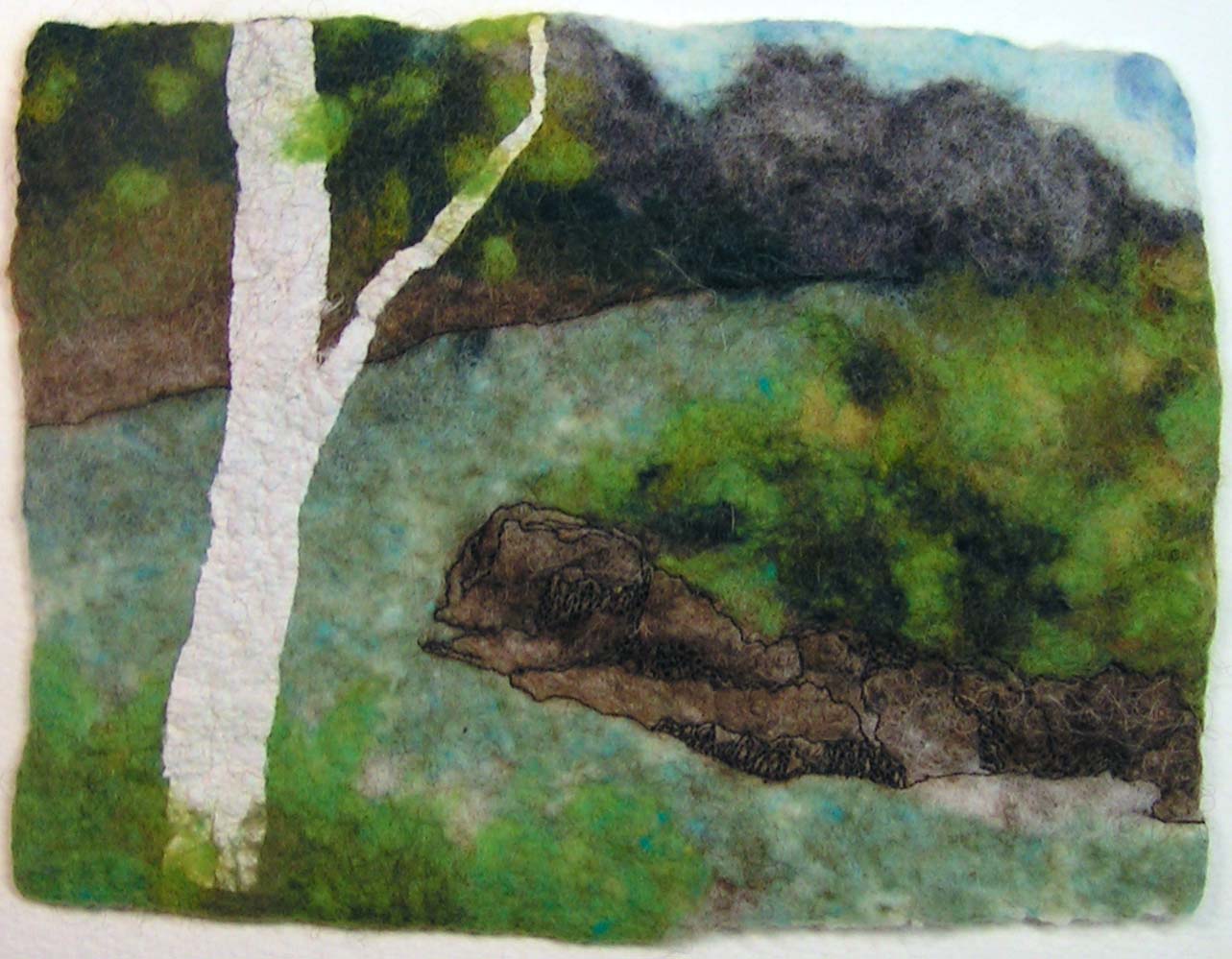
My spring birch landscape has been stitched and applied to a backing board so it’s ready to frame. I showed you the first stages of the landscape in this post if you missed it.

Felt landscape of spring birch with free motion machine stitching added.

I added free motion machine stitching to the distant shore. Whenever I start FME on a landscape, I always think that the first few areas where I have stitched look like it’s too much. But I keep going and usually, once more stitching is added, the initial lines don’t feel excessive.

Felt landscape of spring birch with free motion machine stitching added to rocks in foreground.

The next step was to stitch the rocks across from the tree. I considered adding some stitching into the foliage above the rocks but decided to leave it as is.

Felt landscape of spring birch with free motion machine stitching added to tree trunk and branches.

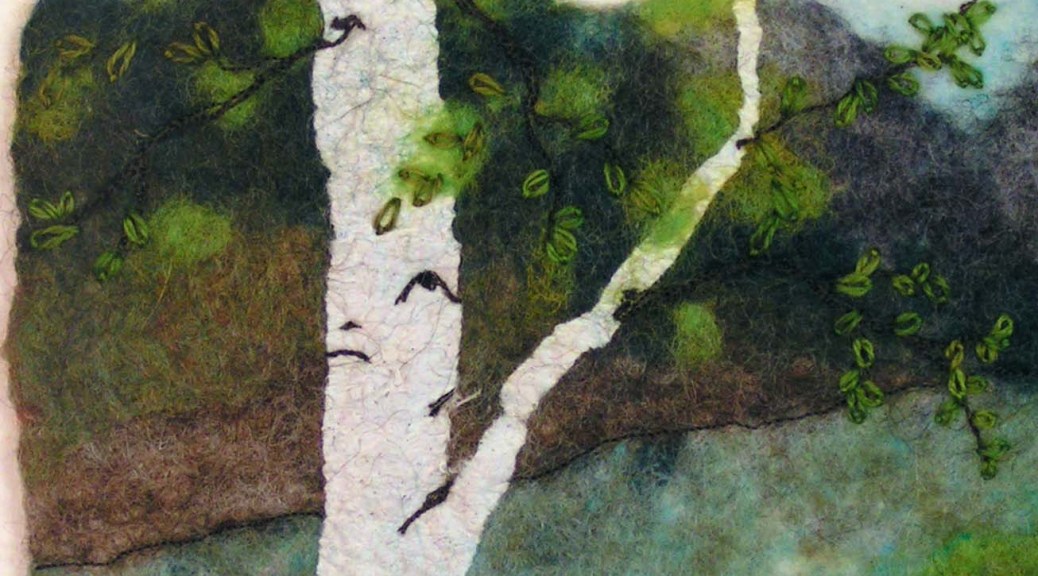
Then on to stitching the tree. I added the dark bits to the trunk and stitching through the felted paper was a breeze, no problems at all either by machine or by hand. The dark branches were added next and then decision time on how to add a few more leaves. I considered needle felting some smaller leaves on the dark branches but then decided I would hand stitch the leaves.

I then hand stitched leaves on to the dark branches using hand dyed lace weight wool thread and detached chain stitch. I added a few bits of grass at the bottom of the trunk as well.

Felt landscape of spring birch stitched to background fabric and wrapped/laced around board ready to frame.

The miracle is that I found a backing fabric, stitched the felt to that and then wrapped/laced the piece around matte board so it’s ready to frame. Since the piece is small (matte size 8″ x 10″), it went quickly and now I have two pieces ready to take to the framers. This piece counts for the year long tree challenge for spring. I have to think about the summer one as it wouldn’t really look different than spring, a few more leaves perhaps?

Nuno felt landscape of winter birch stitched to "matte" fabric and wrapped/laced around board.

The winter birch piece is also ready for framing. I used a darker gray hand dyed fabric for the winter birch as it felt “colder” that way. Now on to the next landscape as the gallery wants me to replace the one that sold last month. (Doing a little happy dance!)

This is the piece that sold called Remembrance. Yay!

‘Paisley’ Entrance Hall Table Mat

‘Paisley’ Entrance Hall Table Mat

Paisley Patterned felted mat for an entrance hall table

A colourful hall table mat can add a wonderful splash of colour to a neutral scheme – and be somewhere to throw your keys and display flowers from the garden!

To make the paisley mat I first made a paper template …

paper template

… then I made four layers of blue merino wool to make the base of the mat.

4 layers blue merino wool fibres

I changed my mind about the centre of the paisley pattern so I re-worked the template.

Altered paper template

Then I cut around every line on the template before placing it on the wetted down blue fibres.

Paper template placed onto wet merino wool fibres

I used very thin wool yarn to mark the lines on the template, working outwards from the circles and removing the paper as each line was finished.

I put down a fine circle of dry wool fibres then placed a circle of very open weave fabric on top of each one.

circles of dry merino wool fibres covered with circles of open weave fabric

I filled in the tear-drop shape with merino wool, did some outlining with thin black wool yarn, then added some white cotton nepps.

Tear drop shape made with loose merino wool fibres

I also placed white cotton nepps around the edge.  They are lovely but so hard to work with – a lot of patience is needed to persuade them to join with the wool fibres!

Layout complete

I rubbed, not rolled, this mat and after a while I decided that I didn’t like the edge so I trimmed it with a rotary cutter.  The edge healed during the last bit of agitating.

I rubbed mostly on the reverse side with the felt between two pieces of net and the bamboo providing gentle agitation on the underneath (as shown below).

reverse of felt sandwiched between two pieces of net

Finished size is 70 x 33cm (27½” x 13”).

Paisley Patterned felted mat for an entrance hall table

I find that my felt is not as smooth when I’ve rubbed it compared to when I roll it.  In retrospect I realise that I should have rolled the mat.

I’m happy to just agitate wool fibres by rubbing when the piece will be displayed as art work, but for anything else I think rolling produces a better finish.


Spinning with my new Autowind Flyer

Spinning with my new Autowind Flyer

I love to spin yarn.  It is my favourite craft and I generally find it very relaxing.  This year my husband got me this fabulous gift – a custom plate for my car.

Woman holding a license plate that says Spin Yarn
My birthday present this year.

Speaking of gifts… recently a friend offered me a tremendous gift of an autowind flyer from Level Wind Systems.  What a generous gift!  I got a flyer for my Majacraft Rose because that is my go to wheel.

2 Majacraft Rose spinning wheels
Majacraft Rose with bulky flyer on left and Majacraft Rose with Overdrive flyer on right

I actually like my Majacraft Rose so much that I have 2 of them, one where I can use the regular and jumbo bobbins, and a second that has a massive Overdrive bobbin and flyer on it.  The Overdrive wheel is great for plying and for spinning bulky yarns.


The autowind flyer has batteries inside the left flyer arm.  When you switch the unit on, the yarn guide slowly moves up and down the right arm.  This results in the yarn filling the bobbin much more evenly.

This is a photo of the same bobbin.  You can see how the singles form a nice rotating layer on the bobbin.

Spinning using the level wind flyer
Spinning with the level wind flyer

I have spun a few skeins now and have discovered a few things.  When I put the flyer on I need to tighten the flyer onto the mandrel of my Majacraft Rose.  However, when I tightened the flyer enough so that it works properly, it was also impinging on the bobbin which made spinning not very nice.  I had to really crank the brake and there was quite a bit of drag.  To fix this I dug out some Plumbers tape (also called thread seal tape) and wrapped it on the flyer mandrel.  Then I installed the flyer.  The tape helps the flyer make a nice snug connection but also leaves the bobbin free to spin.  This resulted in a much nicer spinning experience.

Thread seal tape
Thread seal tape
Wrapping the thread seal tape on the mandrel of my Majacraft Rose


Another thing I discovered after using the thread seal tape was that my bobbin was sitting back past where the flyer could nicely wind on the singles.  This resulted in an empty area at the rear of the bobbin.  The singles were collapsing into the empty area which was not very tidy and could lead to tangles later when plying off the bobbin.

First bobbin with singles not filling the rear of the bobbin properly
The singles are winding on, but the rear of the bobbin is partially empty and the singles are collapsing into the space.

To fix this problem when I started spinning the next bobbin I added a simple felt washer behind the bobbin.

Flyer showing a felt washer added behind the bobbin

My current project is a pound of dyed fiber from Adele Forward, an Indie Dyer in Dorset, Ontario, Canada.  Adele posts her dyed roving, locks and yarn on Facebook.  Have a look if you are interested in buying some delicious dyed fiber.

Pile of purple roving
Yummy Superwash Merino dyed by Adele Forward
Bag of fibre showing the label Adele Forward
These 1 pound lots come in nice big bags.


This is my progress after spinning 3 bobbins of the same fibre.  You can see bobbin #1 in the upper right (with the slightly empty section at the top/back of the bobbin), bobbin #2 in the upper left (which was spun with the felt washer) and bobbin #3 on the wheel (again spun with a felt washer in place).

Three bobbins spunI have now moved on to plying.  Because I have 3 bobbins of singles plying is a multi-day job.  It took me about 5 hours to fill the first jumbo bobbin with plied yarn. And here are the bobbins after plying up that first big bobbin. There is still lots of singles left to go into the second skein.

Plied yarn on jumbo bobbin with autowind flyer


Lazy kate showing 3 bobbins of singles


And here we are with the second bobbin done and all the yarn wound into skeins.

Bobbin of plied yarn
Second bobbin of plied yarn
Two skeins of purple plied yarn
Two skeins of purple plied yarn (First skein is on the right)


I have to say I love how quiet and helpful the autowind flyer is.  It is a fabulous tool and I am very appreciative of this awesome gift.


Starting on a needle felted bunting

Starting on a needle felted bunting

As you may have guessed, my family lives in London, United Kingdom at the moment, but English is not our mother-tongue. We happen to celebrate our birthdays all in UK, though, so during the years I managed to collect a few birthday party buntings here: of course, all of them celebrate “Happy Birthday!” in English and none in our language, Italian.  Also, I only have a short felt one and all the rest are plastic. I like the felted one a lot better than the plastic ones, it’s so much easier to store without worrying about creases, it is always in perfect shape and luxurious looking, even though it was not actually more expensive than the flimsy Lego themed one!

I decided to make us a new felted bunting with the Italian equivalent of “Happy Birthday!” written on it: as it will use Italian words, it will be longer than the English one, and I will be able to add more elements to make it longer still. It will be very colourful and it could be used for all our birthdays for years and years to come, and no more worries about creases and folds. It seemed a nice plan.

It is a fairly easy basic kind of felting project: one just needs to make as many flat triangles shapes as needed to spell the words and punctuation (in my case “Buon” and “Compleanno!”, so it’s 15), with one more for the space between the words, and as many more for decoration as one likes. On the triangles, you can needle felt the letters in contrasting colours.

Then, a satin ribbon will be passed through slits on the upper part of the triangles: this will mean that one will be able to adjust the length of the bunting to different size spaces. If you do not wish to have an adjustable bunting, you could make a felt cord of the desired length and attach the triangles to it at fixed intervals by needle felting or sewing them to the cord. And the bunting will be ready to go.

I wanted to go for needle felted triangles, although I guess it could be a much quicker job if you wanted to wet felt them : just wet felt different wool colours and cut them in triangles, then seal the edges with rubbing.

Well, I need the needle felting practice, so I took out my needle felting supplies and had a go at making a needle felted triangle shape.

Red merino wool laid out in a vague triangle shape on a foam mat
I laid out the wool on a vague triangle shape on my small foam mat
Needle felting supplies on a wooden table: there are some red merino wool, two wooden needle holders, a small plastic box of felting needles and two white finger protectors on a foam mat
My supplies for needle felting are laid out on my foam felting mat.
On the foreground, Kiki's hand is holding some needle felting needles in different colours. On the background there is red merino wool on a foam mat on a table.
I have different sized felting needles that are colour coded for ease.
Two wooden felting needle holders are on the foreground, and there is some red merino wool on a foam mat on the background
My two wooden needle holders, one can hold 6 needles and the other only 1 needle at a time: I enjoy the feel of the wood!

I needed a thicker needle for the first shaping stabs: that would be a 32 gouge, that is silver coloured in my set.

On the foreground a 32 G felting needle, on the background red merino wool.
My, it is quite thick, you can see the gouges quite clearly.
A 32G felting needle gets placed in a wooden needle holder
My one-place needle holder is quite easy to use: just insert the needle into the gouge of the inner bit, and push the inner bit+needle into the handle.
Kiki's thumb and index finger into finger protectors.
Donning my finger protectors that I bought at http://www.heidifeathers.com
Felting needle stabbing at red merino wool
Now I can start roughly shaping my wool!

Never mind the photo, that I was taking with my phone while moving the needle with my right hand: I actually started shaping my triangle by stabbing and shaping the edges of the triangle first, then moving towards the center.

I lifted the shape from the foam mat and stabbed a bit more on the other side as well, adding some more wool if I thought that some parts were uneven or not thick enough.

A vague triangle shape in red merino wool on a foam mat
It is taking shape nicely on a side, let’s see the other..
A red merino wool triangle shape a bit distorted on a foam mat
That is the fluffy B side: it needs working on.
Red merino wool being stabbed with a felting needle on a foam mat
I noticed some thin areas in the corner, so I added wool in.

Then, I saw that it was the time to change the needle to a thinner one.

A triangle shape of red merino wool prefelt on a foam mat
It is coming along well, but still a bit too fluffy: time to change needle.

I usually like to use a 38 gouge needle, colour coded red in my set, to do more detailed work when I am needle felting. Sometimes I pass through the 36 gouge needle (green one in my set)  before the 38 g, or use a 40 g needle (blue in my set) to finish, but in this case the job was fairly basic, and I did not want to change too many times.

A 38 gouge felting needle is shown on the foreground while prefelted wool is on the background
Choosing a 38G felting needle to go on with my project

After stabbing more, I felt that the shape was looking good. If you wanted it more regular, and were not lazy like me, you could make it more regular  than mine by starting at the beginning with a rectangle shape and then folding the rectangle in half diagonally into a triangle shape, and stabbing more. But if I have to make more than 15 triangle shapes I am not going to bother making them regular: I am just so lazy!

Triangle needle felted shape in red merino wool on a foam mat
My first triangle does not look too bad, although it is a bit irregular.

I guess one could stab on and make the shapes very firm, but I have no patience and was eager to go on (14 plus triangles to go, you know…), so I selected a bit of merino wool roving in teal for the first letter to add to my triangle shape. You do not need a big amount to complete one letter, you can use leftovers from other projects. I like to use carded merino slivers if I have them for small areas of flat needle felted decoration, I find that it is easier to shape them into small regular shapes.

Some teal merino wool roving on the foreground, a red triangle felt shape in the background
A small amount of merino wool roving is enough to shape the flat letter on the triangle shape.

I used the same red 38G needle to stab the teal wool on the triangle shape. It is not difficult to make the wisps of carded wool take the shape that you want, you just need to work on the surface, really, without stabbing too enthusiastically.

A felting needle stabs into some teal merino wool on a red prefelt
Stabbing the teal roving on the triangle shape to form the first letter.
A felting needle shaping the letter B in contrasting wool on a prefelt
The letter is getting shaped bit by bit.
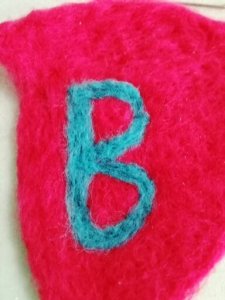
A triangle shaped element for a felted bunting, with the letter B on it
The first letter is done! B for Bravo!

I managed to finish my first letter quite quickly, but, guess what, I stopped there and never mustered the will to make all the other 14+ triangles! Well, the first birthday coming is not till ages….

P.S. the nail varnish was courtesy of my daughter, who wanted to play nail decorator that day!

more shopping for the Mer’s, again looking for Hair

more shopping for the Mer’s, again looking for Hair

As is the way with my life, I have had another change of plans.

My goal was to find hair for two more of the Mer family. My plan was to look for long locks at the fibre festival “For the love of Fibre”, in Spencerville and if that didn’t work out I would look at the Peterborough Weavers Guild fibre fest on the following weekend. We had also discovered that because of the Coronation Upper Canada Village would have free admission the same Saturday as the event in Spencerville (much closer to UCV than Ottawa.)

So part one of my plan was on May 6th to head to Spencerville. Then if I felt up to it, on to the Historical 1860s village at Upper Canada Village. I had a couple of friends who were working there last summer and have wanted to see it for quite a while. Let me show you how the first part of the plan went.

Last year “For the Love of Fibre” was the first post pandemic fiber festival that I got to attend. It was held in Johnstown, just a bit further south than this year. I am pretty sure I showed you that exciting.

May 6th arrived looking like it might be a sunny day with big puffy clouds to add to the photographic opportunities. We got up extra early to gather the couple of things we would need to bring. I had planned to bring Mrs Mer as well as her son Shark Boy to look for long locks for their hair. I discovered she was…. ummmm, busy canoodling (aggressive cuddling, enthusiastic hugging?) with her husband, so I just turned their project bag around and went to find her son. I picked up my camera and Shark Boy’s1q project bag and headed to the car.

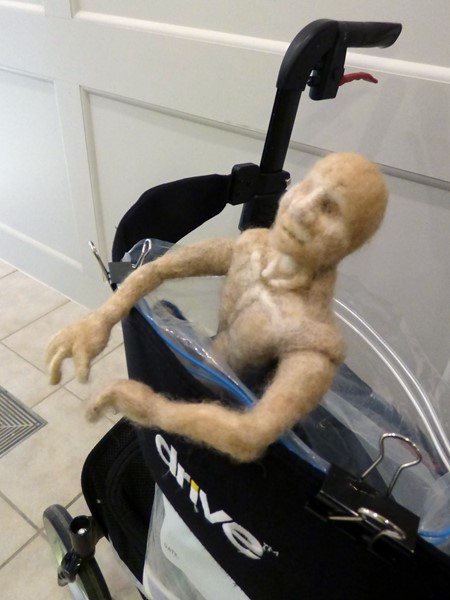
It was a nice drive down. The trees are in the budding to early leaf stage and I was suspecting we might see the first trillium as we headed south. We got there early, arriving just before Ann. She took a picture of us getting Shark Boy settled and us ready for shopping (Glenn brought a book). You can see how excited Sharkboy looks! It must be the thought of getting his hair. I think he has decided on a Mohawk with long hair down his back, sort of an extra-long mullet. I think the Mohawk is to complement his front Dorsal fin.

1) Sharkboy standing in his project beg attached to Jan’s black walker with her husband (and the back of my Grey Kea Soul, I am sure you were expecting I possessed a black soul!).1) Sharkboy standing in his project beg attached to Jan’s black walker with her husband (and the back of my Grey Kea Soul, I am sure you were expecting I possessed a black soul!).

There were 3 outside vendors, with the rest inside.

2) Stone Spindle Farm Booth; with alpaca yarn, fiber and hats. The vender is hanging up suit cages full of low-grade alpaca to provide the birds as nesting material.2) Stone Spindle Farm Booth; with alpaca yarn, fibre and hats. The vendor is hanging up suit cages full of low-grade alpaca to provide the birds as nesting material.

 I was admiring some indigo-dyed alpaca but wanted to wait until I found out if there were any locks inside. (OH the not-buying remorse I felt later!!! I do know who bought it and that it will be well enjoyed.)

3) baskets strewn artistically under a pule trees with an E-Bike near the front with panions baskets.3) baskets are strewn artistically under a few trees with an E-Bike near the front with pannier baskets.

Did you notice the cool bike baskets, some have lids.

Inside we found a few of our guild members had booths! I did a fast wheel around the venue looking for long locks but to no avail. Sorry, Sharkboy! We will have to try plan 2, next weekend. Even with not having the long locks I was looking for there was a good selection of vendors having Yarn, fibre, baskets, bags, and fibre tools. I didn’t get every booth but here are some of the highlights.

4) A quick over view of part of the venders.4) A quick overview of part of the vendors.

5) digging for colours in balls of hand died Super wash Marino fiber.5) digging for colours in balls of hand died Superwash Marino fibre.

6) More fiber from the Black Lamb booth.6) More fibre from the Black Lamb booth.

7) Beautiful project bags and peruses7) Beautiful project bags and purses

8) Moose hill woodworks had lots of fiber tools, all beautifully made. (Yes, I got another spindle of a type I didn’t have.)8) Moose Hill Woodworks had lots of fibre tools, all beautifully made. (Yes, I got another spindle of a type I didn’t have.)

9) Odd new spindle, I was trying it with some of the new extremely soft Finn wool I also purchased. The back of the tag says Yellow Birch, 1.3oz/39g9) Odd new spindle, I was trying it with some of the new extremely soft Finn wool I also purchased. The back of the tag says Yellow Birch, 1.3oz/39g

10) Beaux Arbres booth had basketry10) Beaux Arbres booth had basketry

11) This booth had fiber samples you could feel (the bags of them are behind the table.)11) This booth had fibre samples you could feel (the bags of them are behind the table.)

12) This is the side table of the same booth with the fiber. Check out her fine ponies!12) This is the side table of the same booth with the fibre. Check out her fine ponies!

 13) Fin roving it is actually semi-worsted the vender has her own mill!!! I have never felt such a soft finn sheep.13) Fin roving is actually semi-worsted the vendor has her own mill!!! I have never felt such a soft Finn sheep.

Ann investigated further and found out it was from a lamb. I only bot 2oz I should have bout more! Ann also got some to make her trees with.

14) This was an ingenious support spindle case.14) This was an ingenious support spindle case.

15) The booth the support spindle bag came from had more spindles and lots of rolages. 15) The booth the support spindle bag came from had more spindles and lots of rolags.

16) A couple booths had yarn for weaving and knitting.16) A couple of booths had yarn for weaving and knitting.

17) This Was Susan Allen’s Booth with weaving yarns, I think this was a Cotton or a Cottolin that Ann was looking at.17) This Was Susan Allen’s Booth with weaving yarns, I think this was a Cotton or a Cottolin that Ann was looking at.

18-19) Janet's Basketry, hand made basket with handwoven fabric presented in rolls18-19) Janet's Basketry, handwoven baskets one with antler in it.18-19) Janet’s Basketry

20) Janet’s booth, she is just finishing setup as the first customers arrive20) Janet’s booth, she is just finishing setup as the first customers arrive
 I wandered into Janet Whittam’s booth, she has a combination of weaving and basketry, and she also has beautiful woven jackets and wraps.

21) sharkboy standing in his project bag, attached to my walker.21) Shark Boy standing in his project bag, attached to my walker.

Even though he didn’t have any luck finding hair I think Shark Boy enjoyed his outing. It was still a worthwhile shopping trip with new fibre and spindle.

I was still feeling pretty good so we decided to head on to UCV, maybe it would cheer up Shark Boy! There is a mill, the blacksmith shop, the weaving house (with spinning) and the dressmaker’s house. We packed up the car and headed a bit further south and east arriving at a very busy Upper Canada village parking lot. We found a good parking spot in the mostly empty handicapped section (I was very glad for that parking permit by the time we made it back to the car!)

22) Sharkboy checks out the special parking for Mer-people (and those with walkers) as we arrive at UCV.22) Shark Boy checks out the special parking for Mer-people (and those with walkers) as we arrive at UCV.

Unfortunately, that change of plans thing I mentioned at the beginning happened Tuesday morning and is preventing me from telling you about the rest of my visit. As soon as I can I will tell you all about the fun we had visiting the village, and a bit of its background.

23) The entrance buildings of Upper Canada village.23) The entrance buildings of Upper Canada village.

Tree Branch Progress and Shopping.

Tree Branch Progress and Shopping.

I have moved forward a little on my tree limb. I decided to go with a grey sky as a background so that I had more choice with colour.

                          felted grey background for a picture

I added a branch in brown It isn’t as flat a brown as it looks in the picture but I think I need to add a different brown to it.  I will work on that.

                           felted branch picture

Then I sketched the branch to think about colours. I decided on an orange central vein. That is probably not the right name for it but it is what I can think of to call it. Then a purple fuzzy haze with flowers in it. and some idea of budding leaves.


So far people here like the pink ones. I am not sure. Which ones do you like?

After searching my stash for another brown to go with my branch I had nothing. So it was good timing that there was a fibre event near me called For the Love Of Fibre. This is its second year. https://www.facebook.com/groups/1167963160700589

I was looking for brown but it seems I turned the wrong way went in and ended up in Top of the Whorl Spindles https://www.facebook.com/katspindles She had no brown wool but she had these amazing sample boxes that are just the right size for me.

fall coloured rollags in a box         Fall coloured rollags in a box

spring coloured rollags in a box        spring coloured rollags

I wandered around and stopped at the Black Lamb https://theblacklamb.ca/   They have lots of wool but not the right brown so I got a piece of Black Felt (it’s more than prefelt but less than felt) It is thicker than the prefelt or felt you typically see. In the picture, it looks like there are lots of white hairs in it but that is just what it picked up in the stack of prefelt. I think if I run the lint roll over it, it will be good. They also gave me a size 40 spiral needle to try out.

black felt and felting needle

Then after doing a full circuit of the room just to the right of the entrance, there was Farfelu Fibreworks https://farfelufibreworks.ca/ and she had the perfect brown. It is a little darker than it appears in the picture but lighter than the pencil roving in the picture with it.

brown fin wool

It is Finnish wool so I was surprised at how soft it was. I asked her later and it is a lamb fleece.  I asked people at the guild social to guess what it was I got superfine merino, alpaca and angora as guesses. I will have to see how it wet felts as well as needle felting. I think I will be wanting more so naturally she lives on the other side of the province. Oh well, maybe we can get her to come for our guild Sale and Exhibition in November.


More Experimentation with Felting and Paper

More Experimentation with Felting and Paper

I have continued with my experimentations with mulberry paper and felting. My first post is here if you missed it.

Mulberry paper with embossed leaf laid out over green wool ready to felt.

I have had this mulberry paper with leaves embossed on it for quite a while. I loved the paper but never used it for anything. It is fairly thick and the embossed portions are really thick. The question was whether it would felt easily to the surface. I tore out a single leaf and placed it over a small torn piece of green, short fiber merino batt.

Mulberry paper with embossed leaf laid out over green wool wet down on felting surface.

The wool and paper were then wet down (sorry for the blurry photo) and I felted as I had on my previous paper samples, treating the paper as if it was fabric as in nuno felting. I wondered whether I would lose the embossed lines of the leaf, whether the paper thickness was too heavy to felt in easily and if it would felt differently than the thinner papers I had tried previously.

Mulberry paper with embossed leaf felted to green wool as a sample.

Here’s the end result. You can still see the leaf. It felted very easily and doesn’t seem much different than the thinner papers. I think if I had done a lot of wringing of the felt it would have distorted the leaf but I was careful to avoid fulling in that manner.

Hmmm… how can I use this leaf paper in a design? What would happen if I added ink or dye to the paper before felting? What if I dry brushed paint over the surface of the paper after felting? What else could I do to the surface to enhance the feel of leafiness? How would hand or machine stitching look on the surface? Will it be easy to stitch through? Any other experimental ideas for me? Obviously, more samples to follow.

Wool laid out for landscape with birch tree, river and distant trees and mountains. Birch tree from mulberry paper on the surface of layout.

Next on to experimenting with paper in my landscapes. This is the layout of wool and a paper birch tree. (This also works for my spring tree for our year long tree challenge.) The piece is pretty small and ended up about 7″ x 9″ after felting.

Wool wet down for landscape with birch tree, river and distant trees and mountains. Birch tree from mulberry paper on the surface of wool.

Here’s the piece after wetting down and curbing the edges a bit before felting. Again, I treated this gently to allow the paper to felt in.

Wet felted landscape with birch tree, river and distant trees and mountains. Birch tree from mulberry paper felted to the surface.

Here’s the piece after felting. I plan to add some free motion machine stitching to add more interest in the tree and more branches as well. I will probably add a few more leaves to the tree as well and perhaps a bit of detail to the rest of the landscape. The tree worked well and the paper really stands out to make the tree the focal point of the landscape. I definitely need to do more experiments with landscapes and paper. How else could I use the paper besides tree trunks? How would scraps of green paper felt in to make foliage? What would a variety of colors of paper layered over each other and then felted look like?

I love asking ‘what if’ and trying out these ideas, which lead to new ideas and further experimentation. I haven’t even begun to scrape the surface with how paper and felt can be used together. I would love to hear your ideas for experimentation so please leave a comment with your “what if’s”.


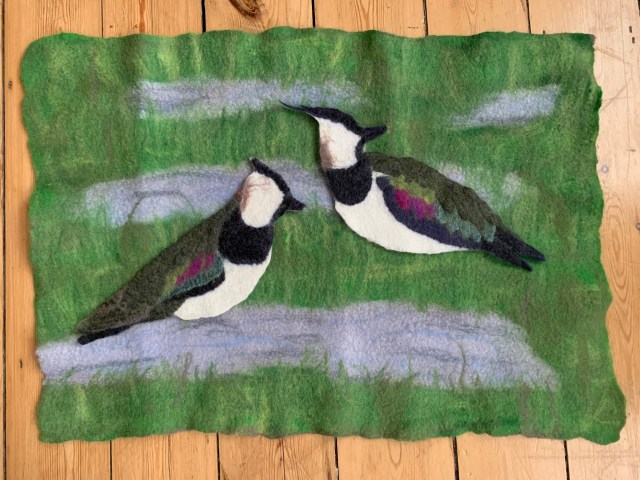
Lapwings Felt Picture

Lapwings Felt Picture

I’ve recently made a new felt picture of lapwings so I thought I’d show you how I went about it.

As you’ll know, if you’ve read my other blogs here, I live on the East Kent coast in the UK and am particularly fond of the local birds. I’ve seen some beautiful flocks of lapwings including at a small nature reserve just along the coast at Oare. I’ve not attempted lapwings before though they are really beautiful birds, so I thought I should have a go.

I’ve only seen lapwings in quite large flocks – I’ve never seen one on its own – so I thought I should have at least 2 birds in the picture. I did a quick sketch to help me decide on the size and stance of the birds

I started with the background. The birds at Oare were on the wet, grassy edges of a lake, very near the sea. Here’s the background laid out & ready to start felting.

I spent a while thinking about how to represent the lapwings’ lovely iridescent feathers and decided on lots of prefelt.

I had some blended greenish wool that was perfect for the main feathers though I had no idea where it came from or what it was. As I made some prefelt I tested out the shrinkage – mostly just to be sure it would felt rather than getting a specific shrinkage.

Then I set about prefelt for all the other lovely colours. The dark green sections are scraps of recycled silk from my favourite source: a charity shop scarf. The others are mixtures of different merino wool colours. I was particularly pleased with the dark section on the right which was a bottom layer of blue and top layer of charcoal grey. It was just the effect I was hoping for. With hindsight I should have used silk for the light green & pink / purple too as that would have given me more shine.

Here’s the prefelt cut up & arranged in a bird shape.

And here are the 2 birds once fully felted but still wet

And here I am deciding how to position the birds on their background.

I needle felted the birds into the background then added eyes, other face details, legs (using recycled tapestry wool) & head plumes. If you look closely you can see I also fiddled a little with the background: needling in extra strands of grass to soften the edges of the water.

The lapwings went straight into an exhibition with 4 other big pictures plus some smaller pieces at my local gallery: the wonderful Horsebridge Community Arts Centre in Whitstable. Here’s my display (not a great photo, sorry).

And I’ll finish with a quick shot of a beautiful painting I bought at that exhibition.  I’ve been looking for something to hang over my bed for ages and I thought this was perfect.

Painted by my friend, the artist Josephine Harvatt. The title “When you wake up it’s a new morning”  is particularly apt for over the bed. I love it. If you want to see more of Josephine’s beautiful work, here’s an Instagram link.

https://instagram.com/josephineharvatt?igshid=NTc4MTIwNjQ2YQ==