Second quarter challenge flowers finished

Second quarter challenge flowers finished

I have finished my flowers but I don’t think I am finished with the picture.

The last time I had gotten this far

felted flower back grounds


I started adding flowers, thinking that the branch end would be the last to open, I started with a darker colour and fewer threads to make buds. I made smallish french knots.

adding french knots to felted flowers


Next, I went to a lighter shade of pink and a few more strands for the next size-up flower buds

adding french knots to felted flowers adding french knots to felted flowers


For the next group, I used my final pink colour but added in a few strands of the darker colour. I should have probably used half and half because the darker pink didn’t show up as much as I hoped. I did these at home so you got 4 progress pictures.

2 colours of embroidery thread

adding french knots to felted flowers adding french knots to felted flowers adding french knots to felted flowers

Today while I was at the market, I finished, with the lighter pink being for the bigger flowers. I decided to try colonial knots instead of french knots. I am not sure I wrapped them all the right way band I added some extra wraps around the needle to bulk them up a bit.

adding french knots to felted flowers adding french knots to felted flowers

I liked the way they turned out. I am thinking maybe I should add a little bit of yellow to the middle of the bigger flowers to make them look more open. I also think adding some green flower buds might be a good idea too. So that is next, and hopefully, I will make it before the end of June.

And now just because they are cute, the 2 ducklings that visited our booth this morning. they belong to the Farm and were out for a walk with their youngest.

Two baby ducklings


In Memory – Marilyn aka Pandagirl

In Memory – Marilyn aka Pandagirl

It is with great sadness that I am writing this post. I was notified that Marilyn, aka Pandagirl, died from complications of a respiratory illness, while recently visiting her family in California. I emailed her husband Craig and expressed our condolences from The Felting and Fiber Studio. He kindly gave his permission for me to write a post in memory of Marilyn.

Marilyn joined The Felting and Fiber Studio forum in June of 2013, where she has written almost 5,000 posts. When one of our original members stepped down, Marilyn joined our team and posted to the website here for five years (March 2014 – April 2019). She had a background in marketing and wrote quite a few posts about how to market artwork and gave some great ideas on boosting small businesses like many of us run.

In Marilyn’s first post, she introduced herself and talked about her fascination with textures. I think a lot of fiber artists have that inclination to be a “hands on” type of person and Marilyn showed us many different fiber textures over the course of her posts.

Marilyn’s work ranged from Easter baskets, nuno felting, felt bags, dyeing, surface design, 3D pods, creating her own hand carded batts, and many felt pictures. She often made gifts for her family members and even one for her retiring physician (wine bottle cover above).

When I asked our other members about their memories of Marilyn, I heard over and over how kind and thoughtful she was. I have included their comments below, interspersed with photos of Marilyn’s work.

“I remember Marilyn from my first postings on the Forum, she was always very present and generous in her suggestions.” Caterina

“She will be missed. Marilyn always contributed to TFFS, either in her posts or with her thoughtful comments.” Antje
“It was only last week that I was wondering how Marilyn was.  Soon after I joined the Studio, I remember a post from her mentioning that she was not well.  Having delved into the archives from time to time, I have come across her posts and I remember that they were always very upbeat and interesting.” Ann B.
“Marilyn was an enthusiastic felter (one of her many talents) and she made beautiful items – many of which were gifts for her family in California. She was always cheerful and very encouraging in her comments on all members efforts. She will be sadly missed by many.” Lyn & Annie
“It was always lovely to see Marilyn at our gatherings, always cheerful and bright.   I briefly knew her through social media (Facebook).   She came across as a beautiful person with family at the centre of her universe.” Helene
“I’m heartbroken to hear that Marilyn passed away. She and I used to exchange emails occasionally, talking about our lives and exchanging news. She always had lovely photos of her grandchildren to share and made me feel a little like I was part of her family life. Marilyn was a lovely human being, always ready to help and always upbeat (even when her illness was taking its toll). I’ll miss her dearly. She’s actually the reason I started blogging with TFFS, so she could have some time off – so Marilyn is the reason I got closer to you wonderful people :)” Leonor
“I remember Marilyn as much for her encouragement as for her interesting and inspiring posts. When I first started felting and discovered this wonderful online community she was so supportive. No matter how crude my early attempts with fibre were Marilyn always responded with a positive comment and that encouraged me to continue trying!” Karen
“This is very sad news, Marilyn was such a lovely person, always cheerful, kind and generous, she will be sorely missed. She was the inspiration behind this watercolour sketch from 2018, may she always be happy and smiling.”  Teri
“She was always so positive and encouraging in her kind comments that I felt I got to know her a little as a kind, loving and generous person.” Lindsay W.
Marilyn will be missed by us all. If you have memories of Marilyn or wish to express your condolences to her family, please leave us a comment. If you would like to read more of Marilyn’s posts, use the search function on the right side bar using “Marilyn Aka Pandagirl” and her posts will come up.
A welcome return to in-person sessions and we were all scissor happy!

A welcome return to in-person sessions and we were all scissor happy!

A recent workshop saw a welcome return to my facilitating face to face felting sessions.

I was asked by our local felting guild, Feltmakers Ireland to run one of their Sunday Sessions.  These are social woolly gatherings.  They generally take place in the morning on the second Sunday of each month and last 2.5 hours.

I was given a free reign to present whatever topic took my fancy.  I thought a fun morning which I called ‘Demo and Do’ might fit the bill.  The topic was felt embellishments.  My idea was to demonstrate two basic techniques, then quickly show samples of how I had developed these techniques in my own practice to contextualise use, after which the members could have a go.

The first technique was ‘Cracked Mud’ which I learnt many years ago from the wonderful Lyda Rump.  This was quick and easy to learn so I allocated a smaller portion of the session to completing it. If you are unfamiliar with the technique, here are two of the samples I prepared for the session.  I used three colours, red, grey and black.  Alternating between the red and black (top and bottom layers) totally transformed the finished samples when I cut into them:

The second technique was the creation of a basic wet felted geode.  I was taught this technique by Marjolein Dallinga  at a superb workshop she gave when she travelled to Ireland many years ago. This technique was a bit more complex so the group spent longer working on it.  Again, so that you can have a visual on this, here are my samples.  I used the same colours as for the cracked mud technique samples.  The top of the photo shows some of the off cuts from the finished samples:


As time was short, I decided to make up packs which the participants could purchase if they did not wish to bring along the materials.  These packs comprised of a number of prefelts.  The cracked mud prefelts were industrial and the geode prefelts were handmade; three colours over six layers.  Each one was different (I bore easily so I wanted variety when I was making them).  Each square measured 20cm and weighed around 15 grams.  Here they are prior to wetting out:


And here they are after they had been lightly pre-felted.  They were all so colourful:

There was a lovely party atmosphere and altogether 20 worked on samples while 3 chose to observe.   Here are some photos from the morning.  Many thanks to Clodagh McDonagh of Feltmakers Ireland for taking these photos:


Just look at how focussed we all were! I promise there was a lot of laughter and misbehaviour  too!


A number of the participants were new to wet felting and luckily they all sat together so I was able to give them a bit more time and answer their questions following the demonstration.  I am very proud of them all as each one produced finished samples.


Here is a photo montage of the participants’ work.  Many of them brought their geode pieces home to finish but all of my ladies who were new to felting got theirs finished in time.  I am really proud of how hard they all worked.  I also prepared an electronic PDF of the technique for the participants which was sent to them later in the day.

It was a real treat to resume these activities and to meet up again with such a lovely group of women.

Have you ever gotten scissor happy with your felt!  Do you fancy sharing your results?  I would love to seem them. You can upload your photos here.

Thanks in advance and happy felting!

Craft Basket Makeovers – part 1

Craft Basket Makeovers – part 1

A good few years ago now, after I had acquired and learned how to use my spinning wheel, I was casting around for some means of storing the associated equipment in a reasonably respectable way.  The wheel and associated bits lived with us in our living room and needed to be tidy.

Quite by chance I came across a shop selling off cheaply a large deep cane laundry (I think) basket.  It was only going cheap because one of the handles was broken and it had no lid.  The much reduced price compensated for something which was no problem as far as I was concerned.

I used to work in Maidstone (Kent) and nearby there was a lovely shop called C&H Fabrics (sadly no more) which sold both dressmaking and curtain fabrics and haberdashery.  I could never bypass their remnant section – they almost always had something good and large enough to be really useful.  I managed to purchase several large pieces of curtain fabric of a design which was really “with it” at the time (most rarely  for me, I am usually following several years behind fashion fads).  This was during the time when Macramé made it’s first appearance and I was very “into” this.  So I removed the remaining cane handle and instead added two twisted cord macramé handles.

laundry basket without lid, with macramé handles, filled with spinning equipment


Then I set to and lined the whole of the basket using the curtain material, making sure that there were pockets around the sides of sufficient size to take threading hook, spare bobbins; flyer; carders; ball winder and my Neatsfoot oil – my wheel had a leather connection between the treadle and the footman – the bits that actually drive the wheel, and the neatsfoot oil is a good natural conditioner for leather and ok for oiling the metal parts.  The rest of the associated bits – fleece, box of carded rolags, tea towel used as a lap cover, cord for tying skeins and niddy noddy would just sit in the middle.

Now I needed a lid for the basket to keep the dust out (our bungalow was very dusty because part of it was still a building site).  So I cut two circles of the fabric and a circle of wadding.  I attached the wadding to the wrong side of one of the circles, by machine quilting around the pattern/motifs printed on the fabric. On the other circle, which would be the underside of the lid, I added a zipped pocket.  I then finished the lid by stitching the circles right sides together with another length of macraméd cord attached to one side.  Then, after turning the circles the right side out, and hand stitching the turning gap, I attached the other end of the cord to the basket. The lid sat on top of the basket with everything safely inside; well except for the niddy noddy which was too tall and had to stick out of the side, so it made do with a length of cord to attach it to the basket.  My brother in law had made the niddy noddy for me, having already made one for my sister.  It is purposely on the large side because each circle of a skein wound on it would be 1 yard long.  This made it easy to calculate the skein’s length.

Lined spinning basket with lid folded open to shop equipment in pockets
Finished basket open

Finished basket with closed lid to show quilting, with niddy noddy poking out of top.
Finished basket, closed.

The fitted out basket sat comfortably by my chair and spinning wheel while I was working at home, but was a bit big to take with me when I went to my spinning group each week. Luckily my sister, having visited the Willows and Wetland Centre on the Somerset Levels, gave me a large basket which she had bought there.  The Levels is a large flat low lying area where Withy Willows have been commercially grown for basket making for at least the last 200 years.  In fact willow baskets and other items have been made there since pre-Roman times.  If you are interested there is more information on the area here: Somerset Levels (As an aside, Glastonbury Abbey, also referred to in the link, used to own much of Sturminster Newton where I now live, despite Shaftesbury Abbey being much nearer to us and owning most of the rest of the surrounding land.)

But I digress.  The basket which my sister gave me was intended as a picnic basket.  It was short and wide and it’s carrying handles positioned so that it was carried flat.

picnic basket on lawn with handles up
See how the handles work to carry the basket flat?

It was just what I needed to carry tops (roving?) and spinning equipment when I was away from home.  Of course it needed to be fitted out with pockets to keep everything tidy and safe.  I had sufficient fabric left of the remnants used for the large basket to make them match.  I lined the base of the basket adding pockets at one end for flyer and bobbin, lap cover and oil.  I didn’t want to spoil the look by using the plastic box for my rolags and by then I had learned basket making courtesy of the WI.  So I made a basket to fit, lined it and made a lid with more of the fabric.  The lid of this little basket was quilted in the same way as the lid of the large basket, and also attached with macramé cords made from fine crochet cotton, with a wooden toggle closure.

small handmade cane basket with fabric lid attached by macramé cord with macramé and wooden bead closure
Rolag basket in the sun

By this time I was also “into” Tunisian Crochet. I had been making ordinary crochet items for as long as I could remember but fell for this new (to me) technique. So in addition to storage for threading hook, personal bits, glasses etc., I needed storage for at least one Tunisian crochet hook – this looks like a knitting needle, but instead of a point it has a hook. I also needed somewhere safe to put large sheets of paper patterns, as I tend to use diagram type patterns and they take up a lot of room. So I set-to to line the lid of the basket with just one layer of the fabric, but with pockets, short & fat and long & thin attached. I sewed this onto the inside of the lid but left one of the shorter ends unattached so that I could tuck paperwork etc., inside.

Open lined picnic basket showing lid lined and with pockets, and with rolag basket and other equipment in the basket.
All my equipment (almost) in the basket.

Incidentally, the sharp eyed amongst you may have noticed that odd bit of hooked wire tucked away in the longer tube/pocket and be wondering what it is.  It’s a do-it-yourself lazy kate – a device for assisting with plying yarns from one, two or more separate bobbins.  An old shoe box (or a basket) and this bit of wire are all you need, poke the wire through one end of the box, slot the bobbin(s) on and poke the wire through the other end of the box.  It’s not the best way to do it, but if you put some tension on the yarn by passing it from the bobbin around the wire once before taking it to the wheel for plying, it works.

Oh and a quick boast – can you see the handle of the threading hook poking out of one of the lid pockets?  The handle was actually a light pull which I had made while having a go at wood turning some years earlier, and the hook is only an unbent paperclip – but it works ok too.

So that was my basket set up and ready for journeys.  Oh yes, the niddy noddy.  That was too big again, so it had to sit on top.

Closed picnic basket with niddy noddy on top attached by cords but with handles down.
Basket with niddy noddy (but the handles are down so I’ll have to remove the niddy noddy, put the handles up and replace it because the right handle won’t go over the end of the niddy noddy – then I can pick up the basket.)

Eventually the cane hinges of the lid, and the cane closure wore out so they were replaced with macramé cords.

Some time before I moved from Kent to Dorset in 1999, I wrote an article about these baskets and submitted it, with photographs, to the Journal for Weavers Spinners & Dyers as I thought it might be of interest to them.  Apparently not though; I eventually received a letter returning the photos (but not the article, so I’ve had to rewrite it!) and saying “… the Editorial Committee … felt that the article was rather too indirectly concerned with weaving, spinning and dyeing ….”   Oh well!

Working on a new project, the design part

Working on a new project, the design part

Working on a new project, the design part

During my time stuck in bed last month, (literarily, not figuratively), I relented and agreed that my “Smart” phone was rather dim and it was probably time to upgrade to something that could at least text as well as make phone calls.  I am still of the opinion that if you are holding a cell phone and you want to communicate with me, why text the dyslexic when you could just phone? Ann mentioned there was a Motorola for sale at Costco and maybe my hubby should investigate it. I was mostly out of it so didn’t get to have much impute but getting the same brand as what I have had should make the transition easier…… that thot went not quite as I expected.

When I was able to get out of the house and into the car (as a passenger), Glenn took me to the phone store and we got them to set up the new phone. He offered to transfer data and apps, but when he looked at my old phone, he laughed and said I only had about 10 contacts and no apps so he suggested it would be good practice to enter them myself. He also said there are many YouTube videos that would explain apps to me. (I still feel mostly in the dark but may get this figured out. in the meantime, I can sometimes make phone calls!)

My old phone was 3×5.5” and fit nicely in a handwoven pouch. The new one is much longer and has more buttons on the side, which I keep accidentally pushing when I pick it up! (Ok this learning curve keeps getting steeper, I am not a total Luddite really!!!) With a new phone, I will need a new case and glass cover. Since I had No luck at the phone store, I went online to find the accessories to protect the new phone.

 1) New phone, Old Phone, and iPod 1) New phone, Old Phone, and IPod  comparing size. the new phone is about an inch taller than the old phone.comparing size.

I found the phone covers online and accidentally started to notice small interesting purses (presumably to put your phone in?). A few of which I would be interested in trying to make in felt. (See I did have a felt topic hidden in all this phone upgrade chatting). I happily browsed through a shark and a whale, then found dinosaurs!!! There was a triceratops, a Tyrannosaurus or Allosaurus (hard to tell which) and finally a stegosaurus but without the tail spikes. none are anatomically accurate but all were very cute. They seem a bit small and all are made from fake leather and some have mettle studs for decoration.

Of the water life, I think I would do a manta ray with an opening at the mouth. It would be safer than trying to stick my hand in a shark’s mouth to retrieve a phone.  My other option would be a blue whale since they have such a large mouth. They both eat krill so my fingers would be safe, which would make it easier to find the phone.

2) Manta and blue whale (clip art for reference)2) Manta and blue whale

I have a couple of the metal hardware for coin peruses that are too small or the wrong shape for this use, but the concept may work.

3) The 5 Kiss clasp clutch or purse hardware I already have. large half rectangle, 3 L shapes and a small half cercile3) The 5 Kiss clasp clutch or purse hardware I already have.

 Let me check online and see if I can find a couple of shapes that might work. And they are ordered, Arrival is expected in early July.  Kiss clasps come in lots of shapes. You will notice that the metal arms have small holes along their length. These are to sew in the fabric (in our case Felt) that will make the opening of the bag.
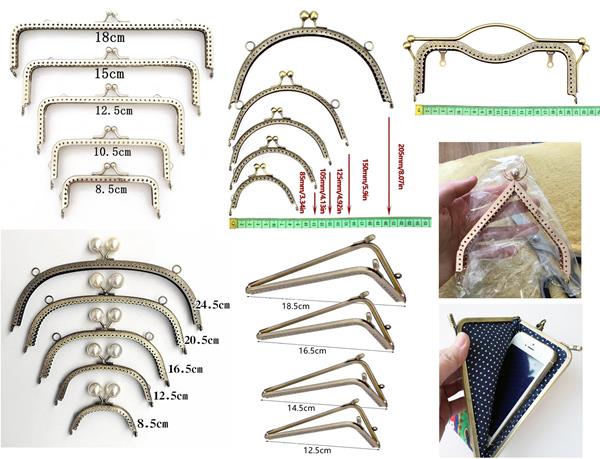
4) Some of the shapes and sizes of kiss clasps avalible on line 4) Some of the shapes and sizes of kiss clasps

They seem to be called kiss clasps and vary in size from one suited to a small coin purse to about 20.5cm. They come in various shapes, half circles, various arches (sort of flattened half circles), half squares and half rectangles and even L shapes (which I have 3 but won’t suit for this project).

I was also intrigued by the dinosaur bags (some are too small to fit a cell phone and maybe meant as a kid’s change purse so watch the sizes if you want to order one.)

5-6) fake Leather Dinosaur bags; Stegosaurus, Triceratops, and close ups of the bags T-Rex bag and close ups of the bags5-6) fake Leather Dinosaur bags; Stegosaurus, Triceratops, T-rex

Plotting and Planning

To create a phone-holding device, (purse), I have the option of working in either dry or wet felting or using some of each technique.

First thought: I am most comfortable with dry felting and could create a purse using needle felting techniques and a bit of sewing to add the cavity closures, but it would likely take even longer than working on the Mer’s. (I think I need something a bit quicker to finish).

Second thought: I could create a resist to wet felt over, making the main body and cavity for the phone holder. That would be quicker but adding appendages and spines might get tricky only using wet felting. I would still have to sew on the clasp or other closing method.

Stray thots that flit through while I am trying to concentrate on this wet Vs dry dilemma:  If I try a manta phone-holder I will want to have it hang curved ageist my hip or side. This may suggest a wire armature in the wings or at least the leading edge of the wings. I will also need a mouth opening large enough to stick my hand in to find the phone. If I go with the stegasorous I will want it to stand up on its own solid firm legs. I would also want the neck and tail (with spikes) to be bendable so I can again curve it as it hangs beside me. I would also want to make a more anatomically correct dinosaur or Sea creature. (Not pink! ok, we don’t know for sure they weren’t pink but I am extremely hopeful pink was not a common body colour for dinosaurs)

I could insert a stiff single wire like I did to augment Mr Mer’s lower back problem (the firmness of the felting overpowering the wire gauge I had originally used. So I augmented it by inserting arthroscopically Harrington rods of 10ga aluminium with sharpened tips.) The con to that option is that when the distance to be strengthened is lengthened then the likelihood of getting a straight insertion is much more challenging. I wonder if I could baste on the wire, then needle felt over top to cover the inclusion?

If I am going to think about wet felting I will need a few pieces of resist (floor underlayment). I don’t think I have any resist hanging around the house but I can find some at our local hardware store! So I was off to the local home depo. Oh, it only comes in BIG roles I guess I can now make a few options or one very big purse!
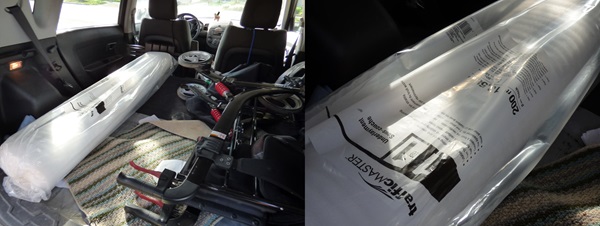
7) Flooring Underlayment, in back of my car with my walker. it comes in a large role, 2mm thick and 200sq feet.7) Flooring Underlayment comes in a large role, 2mm thick and 200sq feet.

The next thing to consider is the size and shape the resist should be to make the phone-holding opening. If I go with a manta, the actual resist can be much smaller than the wings and tail. I would also have to make an inset to the mouth to attach the kiss clasp too. My other option would be a zipper but it would put more strain on the mouth area so it would need to be very firmly felted. I could add a bit more strength if I used a bit of silk or gauze.

For a stegosaurus, I would need to add a belly between the legs. I think adding supplemental resists for the legs, which I could then backfill with firm felt should work. I want it to stand up if it was sitting on a flat surface. I would also have to add plates along either side of the spine and then spikes for the tail.

There are also the horrors of Math!  Estimating the shrinkage then expanding to make the template…. Math…. Ick.

Well, I may have circumvented part of the horrors of math by finding this site! it may be helpful to other math challenged felters.  Look about halfway down the page for “Wet Felting Wool Shrinkage Calculator”  https://www.abcrafty.com/wool-shrinkage-calculator/

My next step will be to make a mock-up of the potential resist shape, but while I await the arrival of the clasps I have a couple of other things to work on.  Bernadette had some locks that may work for Mrs. Mer’s hair and I guess that will also give me time to get a bit more work done in the garden. We had a break in the smoke and had a moment of sunshine this afternoon! (a wonderful change from the smoke and odd smells of the last few days so I wanted to share the sunshine with you.)

8) shots from my front garden, Chives& Taragon, Columbine, Alum, Black Iris, Snow peas with mint and basal, the front of the garden looking back towords the benches.8) shots from my front garden

Mark Making on Felt – Online Class Registration Opens

Mark Making on Felt – Online Class Registration Opens

Would you like to learn new methods of “mark making” on your felt? Are you looking for ways to create work that is uniquely your own? Are you wondering about surface design on felt? If you are looking for a new learning experience, please join me. Registration opens today for my online classes! The classes are listed below with a link to each class page.  You don’t need to be present at any certain time to participate in a class and you will receive PDF’s to keep with all the relevant information learned in the class.

Screen Printed Felt Journals by Ruth Lane

All four modules of my class, EMBELLISHING FELT WITH SURFACE DESIGN TECHNIQUES – A MIXED MEDIA APPROACH, will begin on June 23 and end on July 28. Registration opens today for these online classes. Click on the class link below to register for that particular class.

Nuno Felting with Paper Fabric Lamination

Experimental Screen Printing on Felt

Free Motion Machine Stitching on Felt

Printing, Stenciling, and Playing with Thickened Dye on Felt

Click on any of the links above to find out more about the class and to register and join in the fun.

Our Wet Felting for Beginners class is always available. You can start any time and follow along at your own pace. Register here.


Still working on flowers and lambs.

Still working on flowers and lambs.

I have started adding flowers to my branch. It is slow going as I am still fighting my cold but it is started, so that’s something.

I started adding the purple backgrounds for the flowers. I took a picture partway along.  I remembered to take pictures before finishing so everyone should clap…… or something. LOL

a felted tree branch with purple flowers

Taking the picture made me look at it more and wow, dead straight


A felted tree branch with more purple flowers

So I went back and poked them into a more organic shape.


a felted tree branch with purple flowers and orange stems.

Next was the stems and that’s as far as I got. I am not sure about the blank space bottom right. I can’t decide if I like it or not.

And just for fun, sheep and lambs. theses are bad sheep who escaped in the rain and decided to eat the grass between the two houses on the farm. They are not very good at being sneaky. This was a little earlier in the spring. They are out in the pasture during the day now.

Sheep grazing on grass.

And some cute Lambs


Black sheep and her twill white lambs. Black lamb looking through the fence

A Scrap Felt bowl

A Scrap Felt bowl

Click to access felt-scrap-bowl-tutorial.pdf

It has been a busy month for me, with family visits, and babysitting duties. With all that excitement I had totally forgotten that my scheduled post for the forum was due until the other day. What to do?

I have been wanting to try Ruth’s scrap felt tutorial for a little while, so I thought this is an ideal time to try my hand and make a bowl. The link for Ruth’s tutorial is above.

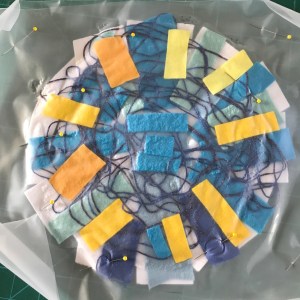
I have some pieces of commercial scrap felt in a variety of colours,  bought some time ago from a craft shop sale. I also have some small pieces of me made felt. Some glittery yarn was used. I found some Madeira Avalon water soluble firm stabilizer in a cupboard. I used a 12″square of the Avalon, or rather 2 squares of it, and sandwiched the felt pieces, and the glittery yarn in the middle. Ruth suggests to very lightly dampen the felt pieces to stop them moving about; I very lightly spritzed the arranged felt pieces before placing the water soluble Avalon on top. This definitely stopped the pieces moving. I placed a few pins around the edges to secure, and transferred to my sewing machine.


Stitching, was as Ruth suggests, in a circular pattern starting around the outside edge, and working towards the centre. Then further stitching in a spindle/spoke pattern to further secure all the pieces. All the pins are now removed and nothing is moving! Then I made some small circles all over the piece in a different thread colour.


Completed stitching, top and bottom.

The water soluble material was trimmed and I rinsed the piece in some hot water, for perhaps 20 – 30 seconds. Ruth suggests that some of the stabilizer should remain to help stiffen the bowl as it dries. I placed the felt over a glass dish to dry overnight.

I changed the dish to a tin of beans after an hour or so, and I think it will provide a  better final shape. I am really pleased with the outcome, so much so I made another bowl and that is drying just now. The second bowl is more ‘holey’ than the first, both are very firm, and wondering if I should have rinsed out more of the water soluble.

Photos of completed bowls, and holding some spools of thread (4 large, 7 small).


Thanks for the tutorial Ruth, I really enjoyed making them.


Getting brave with knitting (and a little bit of spinning)

Getting brave with knitting (and a little bit of spinning)

The knitting

I’m very glad to have finally regained my knitting mojo after such a long hiatus. Once the days started lengthening and getting slightly warmer, my brain seems to have understood it was time for my hands to get busy making again.

However, my attention span might have been left behind somewhere, for I ended up making a few mistakes that I missed until much later! I’m glad I did catch them though.

I was knitting a Poet jumper and the pattern has sections with seed stitch. Seed stitch is created by overlapping a purl stitch over a knit stitch in alternating rows/rounds, so that you get a sort of dotted pattern resembling… seeds (the name says it all, really).
Without noticing at the time, I repeated two exact rows and ended up with something… wrong that I couldn’t quite put my finger on. Once I spotted the issue however, there was no un-seeing it.

A section of my Poet jumper, showing a knitting mistake somewhere

Can you spot the mistake? I can see it from a distance… It’s a little below the middle.

A finger points at a knitting mistake on a Poet jumper
Putting my finger on it. See the two yarn-overs on top of each other on the right? One of them is the extra row I knit by mistake.

This put me in a conundrum: do I ignore the mistake and keep going, or do I frog the thing and correct it? I put it to social media, and the vast majority told me to leave it and continue. Naturally, this made me decide to frog it.

For the non-knitters: the term “frogging” is used because when you remove the needles from your work and pull the yarn back into the ball, you “rip it, rip it,” which sounds like “ribbit,” the sound frogs make.
(Don’t worry, I too was baffled when learning this.)

Completely removing the knitting needles from a project and effectively ridding the thing of its unravelling potential is daunting to me. When one does this, one also loses all useful markers set by the pattern creator, and I always fear I’ll forever miss my place and be unable to proceed… I took a deep breath, chose to trust myself and off the needles came. I stopped a couple of rounds before the offending mistake and opted to “tink” (that’s “knit” backwards – I know, I know…) until I’d corrected it. Phew.

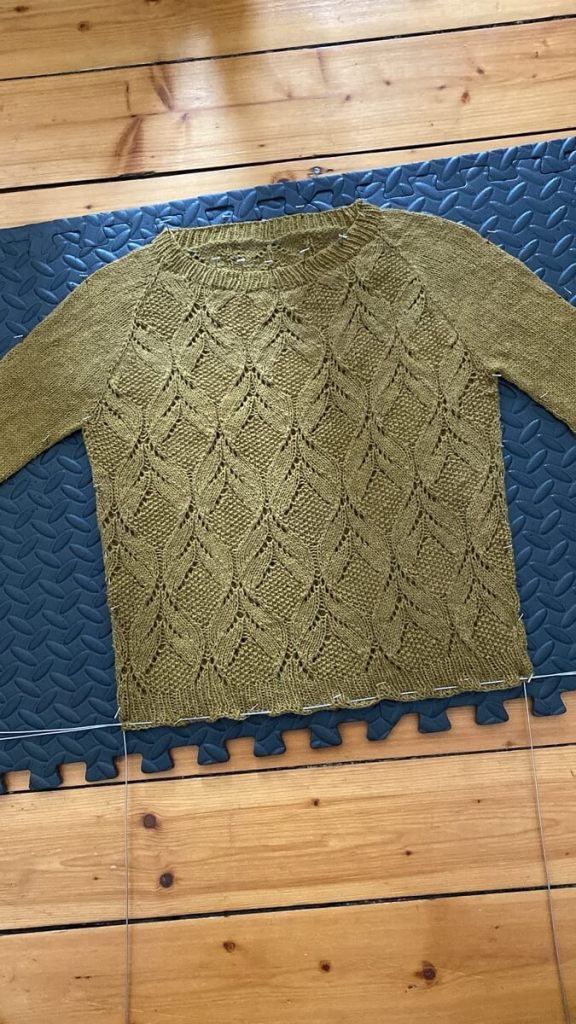
Here’s the jumper, all finished, after I was set back two whole days of knitting.

A knitted Poet jumper is blocking on wires and a blocking mat on the floor
Here is my Poet, blocking

You’d think my knitting snafus were over, but it seems I wasn’t done frogging… I started on my Ripple Halter and, a couple of inches before being finished, noticed I was one stitch off. Normally not a big problem, but this is a 2×2 ribbing which only remains correct if the right number of stitches are maintained, so I definitely had a problem.

I’d done it once, I’d do it again! Frog, frog.

Marshmallow the cat looks at my hand as my knitting project is frogged
Marshmallow offers her support…

This was also a scary one, because I had 8 markers I needed to put back in the correct place to be able to follow the pattern. I managed… somehow. Three more days of knitting, gone. It’s all part of the handmade process though, right?

The spinning

My spinning mojo has also returned. I wanted some textured art yarn and set about preparing the fibres to make it happen.

Once my Leicester Longwool locks were dry, it was time to spin.

Now I need to decide how to ply this. I think I might dye some wool top neon green, spin it  thin and use it to create a textured, thick and thin art yarn. What do you think? Also: am I mad for frogging days’ worth of knitting for what a lot of people deem “small mistakes”?

Ever wondered what the difference is between wool top and wool roving? I wrote a blog post on it on my own website and would love it if you’d read it. Thanks so much!

Lichen – Part 2 – Continued experiments put to work!

Lichen – Part 2 – Continued experiments put to work!

In my recent post (https://feltingandfiberstudio.com/2023/03/22/lichen-textiles-my-goal-part-1-experimenting/)  I made the statement….

‘Having admitted that I can’t do ‘loose’, I was born unquestionably inquisitive so my forté is experimenting. This seems to get around my inner critic & certainly fuels my more serious endeavours.’

In hindsight I should be more forthcoming and admit that I have an almost insatiable curiosity of the world around me – anyone who knows me will be nodding emphatically – as my curious child within has never stopped….’Why?’, ‘How?’, What happens if….?’, ‘Can I just ask?’ etc, etc.

The result – I’ve learned (sadly, age, now means I’m forgetting much of it!) and witnessed a lot, even wandering off in foreign lands (to the consternation of others, but fortunately to no harm!) and experiment endlessly….often tweaking the ‘rules’….🤪 no surprise!

So here I’ll show more of my lichen, Mottainai experimenting….

As I’ve said many times, I’m often to be found pondering….Mmmm, what happens if? Then of course I go down yet another rabbit hole….Is this a sign of a creative mind? – but I digress!….Playing with plastic milk bottles has been a typical example of not only disappearing into the rabbit hole (the point I was at in my last post!)….

….but of getting waylaid exploring it’s warren!

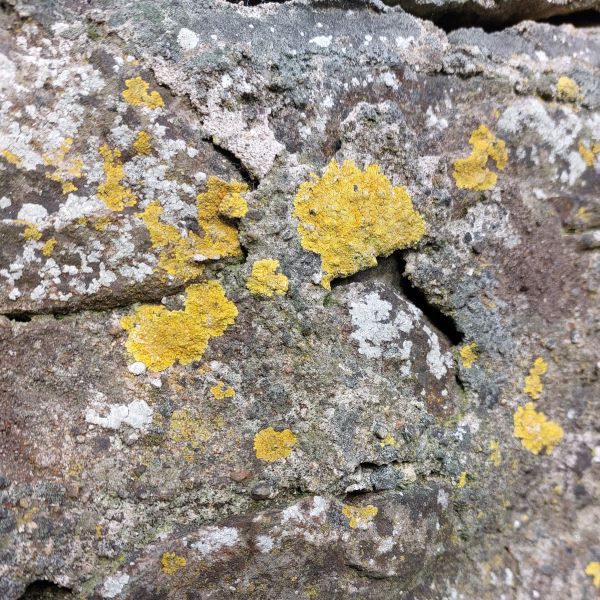
When I’m out and about I’m always stopping to take photos.

An aside – Six months ago I joined the ‘modern’ folk and got a replacement to my 12-year-old mobile phone (the salesman was almost hysterical with laughter as was I 🤣). It has been an exponential upward curve of learning (and still is)….BUT, having done my homework, it has given me a brilliant camera….yay…no more lugging a separate camera around!

Of the many genre of photos I take, Mother Nature always takes the biscuit! I see something, my mind races and then I’m off down another rabbit hole!

Many of my experiments are something I can do whilst TV chillin! The crochet rings above, whilst time consuming are effective & relatively easy. However not all experiments work well – crocheting over the commercial lace, another ‘what if?’, became a….’NEVER again’

Having now shown several of my experiments I can hear you shouting – ‘How are you going to use them?’

So in answer to that question, and before I send everyone to sleep, I’ll present one example of how I’ve pieced together a few of the 100s of elements to create a lichen inspired textile piece.

The finished work attached to the backing matt
The finished piece mounted proud of the backing matt

Creating this piece I re-purposed as much as I could including –

  • a surplus to requirements, circular piece of felt – I love circles.
  • some crocheted waste yarn that was left over after buying a commercial jumper from a charity shop for the sequin yarn that was fashionable a few years ago….it took me so long to unpick the jumper and separate the plain and sequined yarns! Next time I might just buy the expensive sequin yarn new!
  • Manipulated plastic food bags and crisp packets – all cleaned of course!
  • Viscose staple fibres from a community store (selling ‘waste’ products from industry)
  • Oh yes, even some felted dog hair!

All combined with machine stitching, hand embroidery (incl – colonial knot, my favourite knot, bullion & sorbello stitch) and some beading.

And finally….framed (I’m delighted to say I won a 2nd prize for textile work in an area competion), using an Ikea Sannahed 35x35cm frame.

Framed
Framed

A post script to make you smile – when you are on your own, with have no extra hands to help unwind a hank of yarn….

No extra hands - so use feet!
No extra hands! And a bemused furry canine!