
Using up supplies: investigating a new fibre
I was looking around my studio wondering what to write about in this blog. I was remembered Ruth Lane’s recent comment in her blog here about using up supplies. I have a carded batt of merino / A grade mulberry silk from World of Wool that’s been kicking around for a while. I can’t remember if I bought it for something specific that didn’t get made or if I bought it on spec. I was interested to find out how it felted and what I might do with it so I decided to make a small test vessel.
I cut out a circular resist using a small mat as a template then started laying out the fibre outwards towards the edge. Apologies that these pictures are mostly white on light colours – I was thinking more about the making than the photography. I laid the second layer in a circular pattern before flipping it over to smooth the overlap onto side 2. After 2 layers on the second side, I flipped back and laid 2 more layers on side 1, followed by 2 more on side 2.


After wetting it down I spent a lot of my time working the edge by pulling the voile over the edge so I wouldn’t get a ridge around the middle of the finished vessel. It felted quickly and I was soon able to start fulling – initially without removing the resist.


Once I’d cut out the resist I found, in my vast collection of miscellaneous wooden objects, that the handle of a wooden pestle (as in mortar & pestle) was the perfect size for getting inside the vessel and working it from the inside.
I spent a while fulling it as I wanted it to be smooth and very firm.


I packed the vessel with strips of recycled bubble wrap that I keep for this purpose – you can see it green inside. Looking at this green bubble wrap made me wonder if I could make a vessel with a coloured interior but retaining the pale colour outside. I thought maybe if I used silk rather than wool to add colour I’d get less colour transfer, so I thought I’d give it a go.
While pondering this, I decided to try using the same resist as the test vessel but to make 2 small bowls rather than one vessel: so, cutting it in two around the middle rather than making a hole at the top to remove the resist. I dipped into my big boxes full of second-hand silk scarves bought in charity shops and chose a plain turquoise and a patterned blue one.

I put a circle of silk on the resist and decided to run a small line of coloured merino tops around the edge: partly as I was interested to see how it would look and partly as I thought I might not know where to cut when I was ready to remove the resist and separate the little bowls – I’ve made that mistake before!
I put a circle of the blue patterned silk on the second side. The merino and silk fibre layout was the same as the previous vessel. This time I also remembered to do the circular layer first followed by the radiating layer – I’ve learned that one before and obviously temporarily forgot for the previous vessel. It makes following the resist with the circular layers much easier and I prefer to try not to overlap that layer if possible – again it reduces potential ridges and produces a better join if you only overlap the radiating layer, in my opinion. I’m sure some of you will disagree but that’s one of the many things I love about wet felting: with experience everyone works out the techniques and tools that work best for them.


I was interested that I could see quite a lot of the inner colour throughout. I quickly began to suspect this was more about the amount of dye bleeding from the turquoise silk as about seeing the silk through the wool. I was getting a lot of turquoise in the felting water.
Again, I fulled them thoroughly. During the fulling, I decided I liked the silk on the outside better than the inside so here they are, still wet.


And here are the 3 items. You can see how green the wool of the little bowls is compared with the vessel. I’m pleased with the bowls’ blue rims – I like this effect – but the vessel is my favourite. In each of the test pieces the fibre has felted beautifully: it’s very firm and extremely light – it has an almost papery quality about it that I find really appealing.


My imagination is now firing about what I could make next with this fibre. I have a dried poppy seed head sitting in a vase next to my desk. The felt reminded me of the texture and colour of the seed head. I’ve felted poppy seed heads before – one of my favourites. Another thing I have in the studio is some vintage cotton lace I was unable to resist when I saw it in a local second-hand shop.
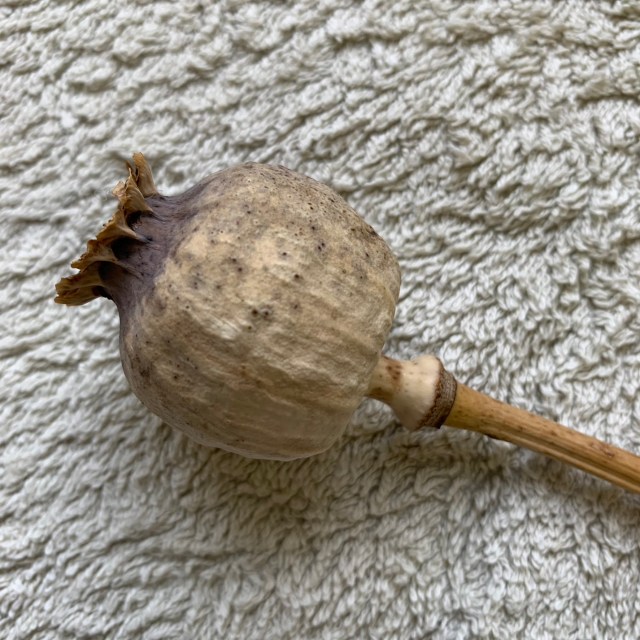

I thought maybe that the lace would add a subtle surface texture so why not have a try? This time I made a small square sample using just 2 layers of the wool / silk mix batt with strips of lace in parallel lines.


Although it’s subtle, I really like the effect. As you can see in the close up shot, the batt has quite a bit of vegetable matter which in this case adds some interesting specks, enhancing the natural look.
I was running out of time but decide to start the poppy seed head. The merino fibre length in the batt is very short which makes the layout quite slow but very precise. In the first photo you can just see the strands of lace which I’ve laid out on top of 4 layers on the under side and are waiting for me to finish the final 2 layers on the top side before bringing them over.


The second photo shows how far I got yesterday before I had to stop. This is a multi-resist piece that will take a while to make. I’ll show it finished in my next blog.
I enjoyed letting the fibre lead my imagination in what I might do next. I’ve done mostly production felting recently – making multiples of things for shops and sales – so it was great just to see where things led me and enjoy felt-making for the sheer fun of it. I’m looking forward to getting back into the studio soon to finish the poppy seed head.


 1)Chickadee feet, birds in progress for the 5 brothers from 2021
 2) Blue Jay steals Peanuts in Oakville
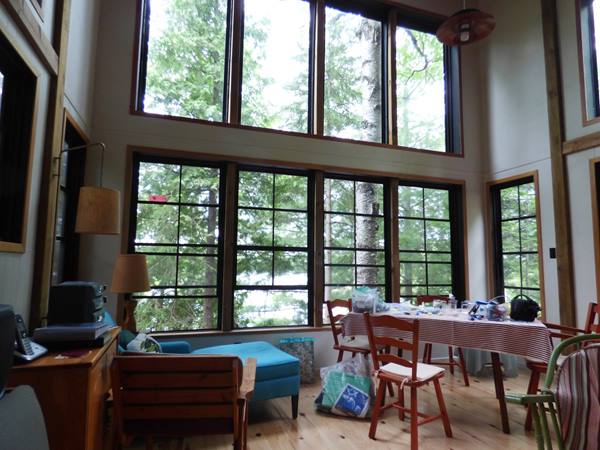 3)Wool expanding to fill the space provided (dining room table). Large windows showing trees and tiny glimpses of the lake, far below.
 4) I did leave my hubby a bit of space to read his book.
 5) Necking on the chaise longue
 9) Step 1 lay a whisp over the area to add a line and (poke/stab/impale) embedding the fibre in the general line-ish shape you want.
 10) Lift the fibre up (vertically) away from the felt.
 11) the excess fibre from the whisp has been cut away leaving a line embedded in the surface of the felt
 12) Once I was pleased with all the wings I added them to the little bird bodies.
 13) Here all the wings are on and looking good.
 14) Eldest Nephew of brother #4 joins the Mer’s admiring the lake (through the trees)
 15) I had just finished putting on the eyes and tucking each bird into his little box when the new members of the family arrived.
 16) New Nephew #1, New Ant!, New Nefue #2
 17) New Sister, New Nephew #2, New Youngest Uncle, New Nephew #1
 18) the Mer’s having fun at the cottage.
 19) Hubby taking a moment to relax and read his book.
 20) one last look before heading out and back to Ottawa.


 1 the Norfolk Latch that was being recreated, a rolled collar on round stalk (it will be part of the handle)
 2 brushing scale off the tenon of the handle created a spark, tongs in front of a lit coal forge.
 3 thick smoke hanging in the air from 10 coal forges starting up.
 4 very simple shape with legs the same length front and back.
 5 still simplified but more anatomically correct than the previous Stegosaurs.
 6 laying the phone over the two drawings from #4 and 5 to make sure the phone will fit.
 7 expanding the scrap paper so I can add a better angle and length of the tail and the tops of 2 plates.
 8 taped strip of paper to figure out the belly gusset of the dinosaur.
 9 estimating gusset for under tail, body, neck and head.
 10 Belly gusset fits nicely with the side.
 11 inside view with back and belly gussets in.
 12 adding width to the head and marked where a zipper would go if I choose to use one.
 13 The belly is attached at the belly and behind the legs but not on the neck and tail.
 14 the longest line through the body and the height through the front leg.
 15 1-inch graph added to the body.
 16 I have most of the body estimated adding half to each side. The graph is making it easier to scale up.
 17 This is what I had graphed out by the time Ann arrived. (there was a lot of measuring and adding while I was unsupervised.)
 18 Ann lay the paper mock-up on top of the resist