Bird Nesting Balls

Bird Nesting Balls

I was staring out my window watching a bird taking fiber from a nesting ball and thought this might be something worth writing about.  I have been running a multi-year experiment on the fiber preferences of my local birds.

Spring 2021

My experiment started in 2021 when I began spinning some llama I bought from a local farmer.  Though the fiber was dehaired, when I got into the bags I discovered quite a bit of VM (aka vegetable matter).

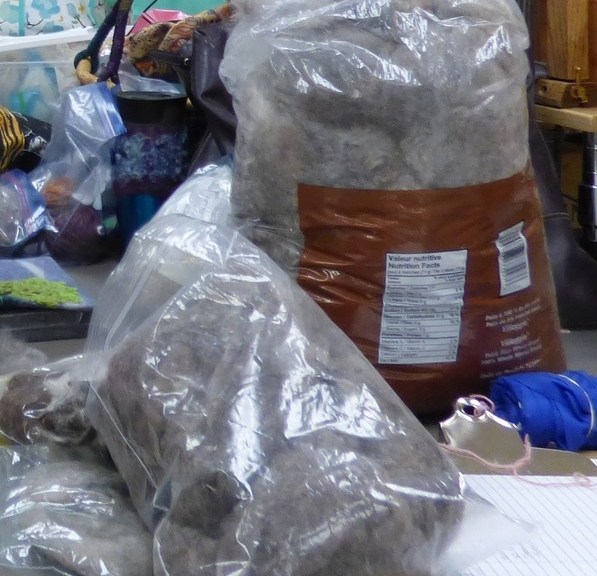
Two bags of grey llama fiber
200g of llama fiber
Raw llama fiber with VM


VM is something spinners hate because if it gets into the singles there will be prickly bits stuck in the yarn.  As a result, I ended up removing large sections of this fiber and putting it in the discard pile.  I started with 200g of fiber and at the end had 158g of plied yarn.  So quite a bit of fiber was passed over. 

However, I found this neat metal hanger and thought I’d try filling it with fiber and see what the birds thought of it.  It was spring and prime nest building season so it was worth a try.  The VM filled llama got stuffed into the blue hanger.  And as far as I could tell not much happened after that.  We did not notice the birds taking any of the fiber and it seemed to be a total bust.

llama fiber installed in blue hanging open feeder
Llama fiber installed in blue hanging open feeder
Closeup of llama fiber in feeder with VM showing


Spring 2022

One day we had our cat Jupiter groomed by Purrdy Paws Mobile Pet Grooming.  And as they were giving our cat back to me, they also handed me a pile of Jupiter’s fur.  (Side note, Jupiter went over the Rainbow bridge in fall 2022 so looking through our photos or him to select one for this blog has been lovely.)

Van with Purrdy Paws logo on the side
Purrdy Paws Mobile Cat Grooming Salon
Black cat after grooming with Lion cut
Jupiter after grooming sporting his Lion cut.


>


The blue hanger with the llama fiber was still on the feeder, and I added the handful of black cat fur to the top of the blue hanger.  I wasn’t expecting much of anything but it seemed like a good way to use that handful of cat fur.  What happened was that the birds, especially the chickadees, took the black cat fur away and continued to ignore the llama.  Hmmm…


Closeup of the bird feeders with black cat hair visible
Bird feeders and 2 pileated woodpeckers


Spring 2023

In May I went to a small fiber festival and a couple of my friends were selling nesting balls.  Given my failure with the llama I was not sure how things would go with the nesting balls but I decided to expand my experiment.  I purchased two nesting balls… one with Alpaca and another with wool and added them to our feeders.

Nesting ball with cream wool
Nesting ball with tan and cream alpaca fiber


We haven’t noticed much activity with the alpaca fiber, but the wool nesting ball has been a hit. We have seen both chickadees and goldfinches taking wool.  It is really fun to watch them work.


I suspect I will have to refill the wool nesting ball next year to supply the birds with the material they prefer.  I have also started collecting cat fur from our pet brushing efforts (we have 3 cats so collecting cat fur should be easy enough) and adding it to the blue hanger.   It will be interesting to see which fibre gets the most attention next year.

Handful of grey cat fur
Blue hanger with grey llama and black cat fur


2023 shopping trip to Twist Fiberfest. (cheap vicarious shopping!)

2023 shopping trip to Twist Fiberfest. (cheap vicarious shopping!)

Twist Festival August 10-13, 2023,  Complexe Whissell 530 Rue Charles Auguste Montreuil‎,Saint-André-Avellin, Quebec J0V 1W0

map to Twist from Ottawa 1) Map to get to Twist from Ottawa

About 2 weeks ago my trusty Sherpa, Shark Boy and I, jumped in the car early Saturday morning for about an hour and 20 minute drive (there’s a detour so it’s a bit longer this year), to Twist Fiber Festival in Quebec. Last year I went with Mr. Mer on a quest looking for his Hair, this year his son, Shark-Boy, is in want of hair! So far I have tracked down and purchased some locks that look like they may be good for highlights. I have also traded and been given some white locks that can be dyed to the colour he is looking for but let’s have one last look for long locks before we go questing for the perfect die colour. (I don’t think any of the home hair dye companies offer something tailored to the young teen Mer-person, but I guess I could investigate further. If not, I do have food colouring, cool-aid and some actual commercial dyes.)

We arrived, found the special parking, and unloaded my comfy walker which I will be sharing with young Master Mer today.

Shark Boy sits in his progect bag cliped to the back of my walker wating for twist to open lady with blue/gray purs in front of us is similer in colour to some of Sharkboys highlights in his shark parts 2) Waiting in line for Twist to open (Shark boy sitting in his project bag which has been bulldog clipped to the backrest of my walker. I think he is admiring the colour of the purse of the lady in front of us.)

labled diagram of site of twist fistival 3) Sight map sign.

Twist is held at the local community centre in Saint-André-Avellin. There is a large arena and gym space as well as 2 large, ok huge, tents outside. There are also workshops held on the Thursday to Sunday. I have taken some excellent felting and spinning workshops here in previous years. (Sculptural felting with Marjolein Dallinga and felted portraiture with Megan Cleland.)

We headed first to the arena to see the giant pile of bags of fibre (decreased by Friday shoppers) at the Black Lamb’s booth then started the search for long locks.

This slideshow requires JavaScript.

 4 -4.2) Awaiting the shopping hoards as Twist opens Saturday morning.

While looking through their fibres (and making the pile just a bit smaller), I spotted something as good as gold! 2 oak-handled Roger Hawkins mini combs!

Oak wooden handled mini combs made by Roger Hawkins 5) Two sets of Roger Hawkins Mini Combs. I have a set and they are fantastic. I was tempted to get a second pair but left them for others to enjoy too.

A quick circuit of the Arena did not look promising for Shark Boy’s hair. There was again a lot of yarn for the knitters. There seemed to be a few more booths with fibre than last year. there were also booths with tools and supplies for weaving, spinning, Knitting, and Sewing.

shark boy trying to flirt. 6) Shark boy had fun trying to flirt with other guild members we saw while shopping.          

This slideshow requires JavaScript.

7 -23)Slide show – first quick once around 

This slideshow requires JavaScript.

24-28) Slide show – first tour of the Gym

2 ladys in 1900's skert and shirts finger weaving Centure Flechay29) There was a display of Centure Flashay finger weaving

There was a booth selling circular sock knitting machines that had a display of old machines. Some of the old machines are works of art as well as functional tools.

This slideshow requires JavaScript.

 30-32Slide show – Circular knitting machine display

I checked in with my Sherpa before starting a more thorough look through the booths.  He was enjoying his book and I got a report from another guild member he had been spotted earlier having a nap and snoring happily.

Shark boy and my patent sherpa 33) Shark Boy and my patent Sherpa.

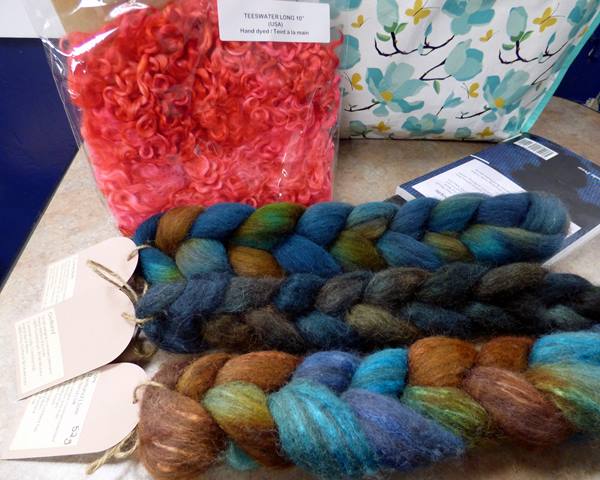
I had only a few items on my shopping list; Shark Boy’s hair, fork needles and some interesting fiber. I got into the booth with the books from the slide show above, it had been too crowded when I went past the first time and I could not see the back of the booth. Eureka!! Long locks!! And in colours Shark Boy might like! he had a hard time deciding on 2 of the packages. I also picked a bag of mixed colour locks and one in extremely bright red that may help Mrs. Mer later.
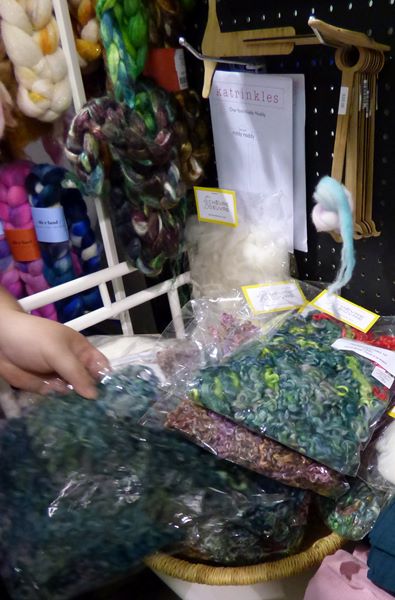
34-36) Happy Happy Mer shark!

Still no sign of a fork needle, unfortunately, two of the needle felting suppliers that are usually here, are not this year. I did find 10 spiral needles at the black lamb, and there were a couple of booths with a few other needles but they were not prominently located and I already had plenty of the gauges they had available.

On to the last item on my list, cool fibre. I had spotted some in a booth in the gym but wanted to look a bit more carefully through a couple in the arena booths too.

This slideshow requires JavaScript.

37- 39) Popular fibre booth

This booth was quite busy so it took a bit of patience to get in and see their braids and batts. But it was worth the effort and I found 3 braids that were particularly appealing.

Twist did not seem as busy as previous years but it was steady. There were also threats of heavy thunderstorms throughout the day but held off until the late afternoon. The vendors I talked to said it was busier on Friday for shoppers, but the sales were better so far on Saturday.

40) late Saturday afternoon at Twist.

One of the vendors had some very nice raw fleece. She had brought a picker with her and I cot her using it. I have an old Patrick Green picker that needs sanding and cleanup in the basement. I will show you when I get working on it. A picker is used to pick apart a fleece to prep it for carding. I did buy a bit of her fibre (unpicked) I will show you later.

This slideshow requires JavaScript.

41-41.1) Swing picker in use

Shark Boy and I had done a pretty good job with our shopping and it was time to check in with my patent Sherpa and see if he wanted to have a lunch break and to show him our finds.
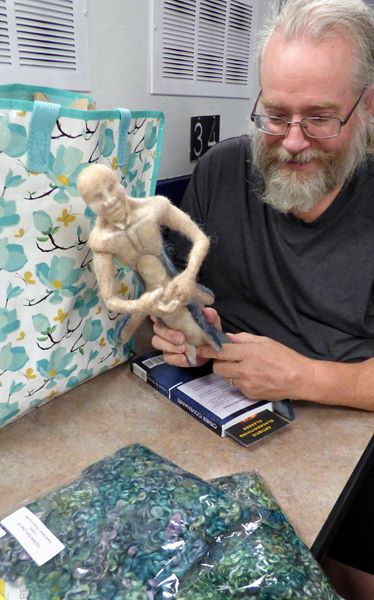
  42- 46) shopping acquisitions before lunch

Heading to the car we checked on the sheep herding displays but the sheep or dogs were on brake

47) Sheep herding on the brake

We headed out to the other end of town to the restaurant, La Toquade for their fabulous “Club Sandwich au confit de canard sur pain an apricot, raisin et tournesol” Yummm…Cumfy Duck!!!

Comfy Duck sandwitch with half side of fries and salid 48) I have been thinking about this sandwich since Twist 2019

Last year, coming out of covid shutdowns, the restaurant was having staffing difficulties and was only open for breakfast, we both were very happy to see that lunch and dinner had returned. While we waited for lunch to arrive I went through the photos I had taken so far at Twist,  there were a couple of things I wanted to go back and see if I could find.

A few last shots from 2023 Twist.

This slideshow requires JavaScript.

49- 53) A few more shots of booths at Twist 2023

The rest of this year’s Shopping;

This slideshow requires JavaScript.

54-56 ) little batt of expensive fibres

I picked up the small batt of super expensive fibres (try playing name that fibre before reading the 4 fibres in the batt),

Diz and Diz hook57) a diz and diz hook (I added the leash to the hook so it won’t wander off),

58-59) a heat shaping felt sheet,

This felt has an odd feeling closer to non-wool craft felts but much more substantial. (I will investigate that further at another time).

It was a long day of shopping, photography and fantastic food. Now that it was time to head home, the forecast rain finally arrived. Even Glenn bringing the umbrella in could not forestall the water any longer. We have had a lot of rain lately, a full sponge as it were, so what was not an extremely heavy rain was lingering on the road longer than usual. This gave the car the fun of trying to hydroplane on the road to the highway as well as on the highway. We stopped under a bridge, got out the GPS and fled the Highway to the slower driving back roads until the rain gave up. After we won the debate with the GPS who wanted us to take the ferry across the Ottawa River, we returned to the highway and safely made it home.

I hope you have enjoyed our shopping trip. I always enjoy seeing my fibre friends’ photos of festivals I can’t get to, it’s cheaper and lots of fun cheering on their shopping!


A cover for my visor mirror

A cover for my visor mirror

I bought a new to me car. The visor mirror cover was glued shut for some reason. When we tried to unstick it, it just came right off. Maybe it had fallen off so they glued it back on? I don’t know. The result is when I put the visor down I have the mirror. Even though you are not really looking at the mirror, it is distracting while driving. Must be because I am so beautiful I can’t resist looking at myself. LOL It is actually very hard to take a picture of a mirror and not be in the picture.

My thought is to make a felt cover for it and velcro it on to hide the mirror but I could still remove it if I needed the mirror.

I measured the mirror and a small amount around it to get the finished size I will need. I think I will add a little more.

Then I thought why not try Ildi’s method of felting with outlines and wet wool? I have some pencil roving and lots of wool and it’s a good sized to try it out. Here is a link to one of Ildi’s posts so you can see what I am talking about. https://feltingandfiberstudio.com/2022/06/27/felted-rug/

So far I have measured and done a couple of sketches of possible designs. these are smaller than they need to be but that is the size of the paper. I will have to find one of the larger sketchbooks to do a final design and then try to use the computer and the printer to enlarge it for shrinkage.

Aaaand, that is as far as I am. The plan is to have it for my next blog post, but we all know about the best laid plans of mice and men. I have my fingers crossed. It’s going to be a busy week.

Tree Specimen Book Continues

Tree Specimen Book Continues

I haven’t shown my tree specimen book since March. The main reason for this is because I got a bit discouraged. The book has plaster coated pages on canvas that were meant for sketches. But the pages are very rough so I needed to get more gesso to apply on top. I also decided to get some charcoal to use for a bit more “rough” sketching.  I got my supplies, painted all the canvas pages with gesso, let that dry for a while and then tried a sketch.

Handmade book open to a page with a sketch of a pine branch in charcoal.

The pages are still very rough and are difficult to sketch on. I was disappointed with my sketch and really didn’t enjoy the process. So that discouraged doing any more sketches. The book sat for quite a while with nothing added.


Then when I was painting other things, I had leftover paint. I hate to waste paint so I decided I would start painting the canvas pages. Then I could add more on top and there wouldn’t be that intimidating white page (that I didn’t like the feel when sketching).

Handmade book open to a page with a print of a tree and definition of tree collaged on top.

I showed you this one before but I added the definition of tree to the bottom. The fun thing about this book, is that you can keep adding as you go.

Handmade book open to a page with a print of a thicket of trees.

Here’s another print of a thicket of trees that I added.

Handmade book open to a page with a print of a tree stump and cut out leaves.

And this one is a print of a tree stump and some little blue leaves that I got from one of my friends. Thanks Christa!

So I haven’t given up on my book. I’m not sure it will ever be “finished”, but that’s OK. I will continue to add bits and bobs as time goes by.


Just Playin’

Just Playin’

The last twelve months have, as my Irish granny would have said ‘put manners on me’.  Cataracts, which were a ‘by the way’ diagnoses in my late 40s finally and quickly caught up with me.  Eight increments of sight deterioration over a three month period!  No more night driving, reading became a challenge and my creative curiosity disappeared.  And so, the waiting game began.  I am currently recovering from surgery on eye number 2.  What a difference it has made and while it will be some time before I get my new glasses, I can function without them for the first time ever! Also, life in all its facets is so beautifully colourful.

So why do I mention it in my post.  It feels awkward mentioning it as I am a very private person.  Awkward, but necessary.  Many of us go through times in life where we lose our creative mojo.  Initially, I found myself angst ridden and questioning my abilities.  The feeling never really went away but I had to find a way to go with the flow and tap away at bits and pieces for a while.

So now that the eyes are fixed I have started playing.  Nothing too serious (well except for my last piece but more of that later).  I am now a week and a half after the operation and here is what I have made over the past week.

Sample 1:

First up, a bit of a back story.  I have committed to a felt swap later in the year.  The theme is brooches so I thought I should start thinking about this.  I used to like felting with basic resist shapes and distorting them so I thought this might be a starting point for this experiment.

First of all, I cut a 15cm square resist and rounded the corners.  Then I covered both sides of the resist in eight thin layers.  I started and finished with a rich orange colour and sandwiched in between were two layers of mustard and two layers of green.  I used 16 micron merino which I purchased from Leiko Uchiyama https://www.leikofelt.com/merino/.  Leiko’s fibre is hand dyed and the colours are sublime.  She is based in Ireland and ships worldwide.

Sample 1 fibres laid out and wet down 8 thin layers

I made a prefelt in the usual way.  I wanted the prefelt to be strong so I kept working it until it started to distort the resist.

solid pre-felt shrinkage has started

Then I made a small incision on one side of the resist, extracted the resist and sewed the raw edges back together with some nylon thread:

Sample 1: repairing the hole which was cut to remove resist

Then it was time to play with the square shape.  I brought the edges of the square to the front of the piece and I started playing and shaping it.  Once I was happy with the shape I handsewed them to hold them in position. Then I worked hard at felting the edges together and to the flat back side of the piece.

Sample 1: working on manipulating the shape


Sample 1: working on a pleasing shape


Sample 1: Shape has been secured with stitching and fulling begins

Once it was felted, fulled and rinsed, I removed the threads and started cutting. Lots of cutting!

Sample is fully felted, stitches are removed and cutting has started


I got a bit scissor happy! I sliced through a little at a time

Here is the finished piece.  I have popped it on top of its original resist to give it perspective:

Sample 1 finished piece laid on original resist for size comparison

Here is a close up of the piece. The inch ruler underneath gives some perspective on size.   Do you think it would make a suitable brooch?

Sample 1: close up of finished piece

Sample 2

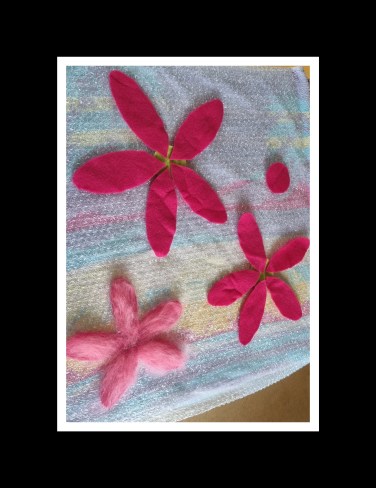
Next up, a flower.  This year sees the 20th anniversary of the founding of the Irish felting group Feltmakers Ireland, by our esteemed member and incredibly creative Elizabeth Bonnar.  There is a celebration planned for later in the year where members will focus on making pink flowers.  I thought I might take this down time to make at least one.  But I wanted to play and not produce my usual style of flower.   I wanted to make a three layered flower but I also wanted to do some free  motion embroidery on each petal.  I decided to make the three layers separate, felt them to my satisfaction then attack them with the sewing machine.  I cut out a template for the petals (small, medium, large) and then cut these shapes from prefelt as a foundation.  I laid different tints of pink merino  on top and finished it off with some tints of pink viscose.  Once this was wet felted and fulled, my work with the sewing machine began as I did free motion stitching on each petal.  After that, I needle felted the layers together and added a central yellow disk which I needle felted and then cut back the fibre until I was happy with the dome shape. Here are some photos I took of my progress.  I was really getting into it so forgot to take photos as I went along (maybe the mojo is returning):

Sample 2: prefelted flower petals and the start of the layering of the lighter colour pinks


Sample 2 is ready for wetting down


Sample 2 has now been fulled


Sample 2 dried and ready for free motion embroidery


Sample 2 with free motion embroidery completed


Sample 2 Layers are joined together and central disk has been needle felted into the flower


Sample 2: view of finished flower (still damp so not fully shaped).


Sample 2: view of finished flower (still damp so not fully shaped).


Sample 2: view of finished flower (still damp so not fully shaped).

Sample 3

My last piece this week is a personal piece I felt a compelling urge to complete.  When I left the hospital I was given instructions and bits and pieces to help the eyes heal.  Among these were non woven swabs which I found were really soft and well aerated.  I have no idea what they are made from but I reckoned they would work nicely on felt and I had lots left over.  So I made a bowl using two layers of undyed merino.  I wet this down, and then placed the non woven fabric on top, cut the pieces to size so that they fitted around the curves.  I then felted it in the normal way.  I cut a hole in the piece and removed the resist.  Then I sealed the raw edges.  When it came to fulling the pot I threw it quite energetically as I wanted to get additional texture on it.  Then I dried it.  There was nothing particularly spectacular about the result except that it was really soft and tactile.  I did not take any photos of this process as it was just the result of some personal urgency.   Using the 3cm hole at the back of the pot as an access point, I did some free motion embroidery stitching on my sewing machine.  It was as close as I will ever come to performing keyhole surgery!  It was challenging but I am pretty pleased with the result,  Again, the ruler at the bottom of the photo gives size perspective:

Sample three: small bowl covered with free motion machine embroidery


Sample 3 rear view featuring 3cm hole through which the embroidery was worked

Back to the question of creative block.  I don’t know if it is lifted but I think two things are helping me at the moment.  The first is making that commitment, whether it is to a person or a project, the second is keeping things small and manageable, that way I can handle complexities if a notion hits me on how I might enhance a piece.  Oh yes something else too, I have started to consciously seek not to be too precious about these pieces.  I have thrown paint and ink on pieces and woven stuff through them.  Not always producing happy little results (to paraphrase the artist, the late Bob Ross) but the process is freeing.


Have you had issues with creative block?  I appreciate that it is a personal journey to find what will work to free yourself up.  What may work for me may not necessarily work for someone else but if you would like to share your journey I would love to hear from you.  Together, we may be able to help others free themselves up and immerse themselves once again in this beautifully creative world we occupy.

hugs

Helene x

The Bull

The Bull

We have three public houses in Sturminster Newton (at one time there were 11 in our small market town!) and The Bull Tavern is one of the oldest. The building consists mainly of a 3 roomed 17th Century cottage with an attic room, built of old timber infilled with wattle and daub. Some additions were made in the 18th Century. Records show that the cottage was definitely an alehouse by the late 1700s. Apparently there was a slaughter house at the rear and a Pound where straying animals were kept until collected – upon payment of a fee of 1 shilling (which must have been a fortune when you consider that a married man’s weekly wages at the Town’s Workhouse were all of 9 shillings and a single man’s only 6). Part of the C18th additions was a stable block (which eventually became a skittle alley and later part of the restaurant of the pub). It is rumoured that the horses stabled there were used to help get carriages and carts up the adjoining steep hill leading to Sturminster Common and the small community of Broad Oak.

The building, known to Thomas Hardy (one of our famous inhabitants) as The Old Bull Inn,  is shown on the earliest known map of the area dated 1783, as being part of the Pitt-Rivers Estate.  You can learn more about the Pitt-Rivers family here: https://www.dorsetlife.co.uk/2012/04/sturminster-newton-and-the-pitt-rivers-family

About 18 months ago, after our then favourite landlords moved from the White Horse Inn in Hinton St Mary, the pub was closed for refurbishment. Hinton is a village about 1.25 miles away, where the Pitt-Rivers manor house is situated.  We used to walk there 3 times a week – our exercise with benefits – but since the benefits had disappeared we decided to patronise The Bull – for our exercise of course.  The only trouble with that was that it’s uphill on the way home whereas it was down hill from the White Horse.

During that time we had come to enjoy the chats with Marianne and Lance, the Bull’s managers.  Lance being the very good chef, and Marianne “Front of House”.  Early in January 2021, they announced that on Christmas Day they had got engaged.

One of my felt paintings – commissioned by a mutual friend –  had been given to the White Horse landlords as a wedding present a few years ago, and Graham, my husband, suggested that I do something similar as a wedding present for Lance and Marianne.

Felt picture of sepia tint image of old public house
My interpretation of an early image of The White Horse, Hinton St Mary

Although The Bull itself is a very interesting building, I wondered if I should do a picture of an actual bull for them. No date had been set for the wedding at that time, but I thought I should at least start collecting reference pictures, both of the pub itself, including some of their Pub sign and of some animals. I thought about breeds that might have been around in the 16th Century – White Park Cattle and black Gloucesters; and also looked at Herefords since that was the breed on the Pub sign.

image of Bull Tavern sign with hereford bull above image of the public house
The Bull Tavern and it’s sign

image of black bull with winners rosettes and image of large white bull
Gloucester and Park White Bulls

image of hereford bull head, image of bull grazing, image of bull in field
3 Hereford Bulls. I eventually picked the one at top left.

In the end I decided on a Hereford bull. After a lot of thought and manipulation of pictures, and also starting on a background field for the bull to stand in, I still could not come up with a layout that I was happy with. One idea was to surround the image of the bull with cameo pictures of nearby local landmarks – the water mill and the mediaeval bridge – with perhaps an image of the pub itself as well.

Then, just after Christmas 2022, Marianne said that they had set the date for the wedding – 10th June 2023.  Now I had to get my ideas together and get on with it.  The picture would need to be simplified if I was going to get it done and framed in time.

It was about then that my picture of the horse on the hillside in Devon was finished and it occurred to me that I could use a similar method of producing a figure with more depth.

image of felted horse on background of trees and stream
Detail from my Glorious Devon picture showing the horse added to the finished landscape.

  I finally decided upon a cameo type picture of the bull’s head and shoulders and I would use the background which I had made back at the beginning of this saga.  I would paint (with wool) the shoulders and neck and outline of the head on to a piece of flat wet felted core fibres.  With a separate face and ears, and a further separate set of horns and the nose on another piece.  I would cut all of the pieces from the backing when these were substantially finished.  I would fix the torso and neck onto the original background and layer on the face and ears, horns and nose, then I would do the final titivating and framing.  I made a start and here are the initial progress pictures:

This slideshow requires JavaScript.

As I said earlier, it was intended that this picture would be a wedding present for Lance and Marianne, but at the beginning of April this year, they told us that, because of various unforeseen difficulties arising out of successive pandemic lockdowns (which included them catching Covid between lockdowns so having to shut the pub again)  they had decided to give up the tenancy of the pub.  They had obtained a job, with accommodation, managing a Touring Caravan Park in Cornwall.  Marianne was leaving almost immediately and Lance would stay on for a couple of weeks, with his last trading day on the 19th April.  So the picture was going to have to be a leaving present.

That caused a bit of a panic at home as you can imagine, so I had to get my head down and finish it NOW!  These were the final steps;

This slideshow requires JavaScript.

I managed to finish the picture and, with Graham’s help, I mounted it in a deep box frame in time to hand it over to Lance on the 19th, when we went in for a final lunchtime meal.

So here’s the completed and framed picture – my entry for the 2023 Third Quarter Challenge – Something Special About Our Town.

image of felted bull head and torso on a field and sky landscape in wooden box frame
Finished and framed.

Dose the twisted needle twist as it goes into the wool?

Dose the twisted needle twist as it goes into the wool?

Recently I was asked more questions about needles. (I do love finding out about needles, how they are used in industry and how we use them by hand. I hope you still have a bit of curiosity about them too, after all my enthusiastic chatting!) To answer the second question, I still want to get my hands on a forked needle (how can I be fair in my investigation if I don’t actually get my hands on one?) A quick review, In industry there are two types of structuring needles. Structuring needles are not technically felting needles (since they don’t make the felt) but are used to create surface texture on non-woven material.  One is the Forked needle, and the other is a crown needle (which we have chatted about before. If you don’t remember that chat you will find it here; https://feltingandfiberstudio.com/2022/07/19/a-question-about-crown-felting-needles/)    Since I have not had success locally finding a fork needle, let’s turn to the other question about needles. It involved one of the Needles found in the group of needles which do make the industrial Felt.

Does the twisted (also called a spiral) needle twist as it goes into the wool?

Ok, this is a question about mechanics, and how the needle works.  So let’s review the parts of a triangle needle and compare that to the twisted / spiral needle.

diagram of parts of a regular felting needle and a spiral felting needle1)Parts of a regular felting needle and parts of a spiral needle

We can see that all the usual parts are present with a spiral / twisted needle. The difference is in the working part. you can see both clearly have a triangular cross section in the working part but the spiral/twisted needle has that triangular shape rotating in the cross section through the working part.

diagram of a twisted needle close up2) Twisted Needle showing close up of working part

Let’s have a quick review of what shapes are most common in the cross section of the felting needles most often used by hand needle felters. Our most common shape is the triangle, but the 3 and 4-sided stars are also quite available. While some are not as common, there is a spiral or twisted versions of each of the three main shapes.

Common Cross sections of working parts of main felting needles3) Common cross-sectional shapes of felting needles

Let’s go back and look specifically at the spiral or twisted shaped needle. If you look at the cross-section of the spiral at various spots, you can see that it is a triangle rotating around a central point.

4) Cross sections of a twisted needle across section of the working part   5) Looking from the tip up the needle through the segments shows how the tip of the triangle changes position up the length of the working section. (i have updated diagram 5 to more clearly show the location of each edge.)

As you know with all needles, the barb is located on the edge of the needle. With most needles, the barbs are located vertically, one above the other, along each edge. There will be one, two or three barbs per side depending on the specifications for that needle.

The exceptions, for vertically stacked barbs, at present are; the Crown needle (which only has one barb per edge), the fork needle (that has no barbs and a cylindrical shaft) and the spiral needle (whose barbs follow the curve of the needle’s edge).  The last exception to the vertical barb rule, is more of a technicality; the conical needles has barb aligned vertically but because of the taper in the working part, it will engage fibre laterally (we can chat about that further in another note. If you are curious?)

So as the spiral/twisted needle is inserted into our felt how is it engaging the fibre it catches in its barbs?  it is grabbing segmentally as each barb enters the web of fibre. It will create more of a circular Spiral of engagement rather than the three barb points a regular triangle needle will engage.

Here are two ways to visualize how the needle’s barbs are grabbing the fibres as they enter the web. As you know the barb will engage (grab) the fibres it encounters which will be at or close to the surface of the felt web of fibres. For clarity of the diagram, I have had the barbs that are deeper in the web engaging with fibre closer to the barb. If I had more correctly illustrated the crossing fibres, which the barbs are affecting, all the fibres would be at or near the surface layer(and the diagram would be a confusing-looking mess!)

diagram of how barbs on sides 1 to 3 interact with fibers as the needle is inserted6) How each barb distorts the web in a different position as the needle is inserted

I am hopeful you can see the spiral engagement of one edge, then the next, then the third. I have added colours (Red, Purple and black) to the edges to try to make it easier to see how the spiralling of the triangle shape interacts with the order of the barbs as they encounter the fibres.

Here is another way of looking at the order of engagement of the barbs around the centre of the needle.

Diagram the order of barb engagement as the needle is inserted into the felt7) The order of barb engagement


A few more particulars about Spiral Twisted needle

If you read the technical details on the Groz-Breckert site, (one of the needle manufacturers, this one headquartered in Germany) you can find that Spiral/twisted needles are available in:

  • gauges from 38G to 42G
  • Length of 3 or 2.5 inches
  • Usually has 2 barbs per side, but only one barb style is common
    • has a modified barb arrangement (spiral location around the needle)
    • the needle placement gives higher fibre engagement
    • the needle is a bit stronger from barb placement (in the felting machine, both the “machine direction” (8%) and to a lesser degree “cross direction”(4%).)  It may be a bit less prone to breakage with small vector changes if used by hand!  it would still be better to try to go out at the same angle that you inserted the needle.
    • it is listed as having more chance of splitting fibres when using microfibers (we should be ok we tend to take our frustrations out on natural fibres such as wool, silk, alpaca, dog or cat hair)
  • Fiber transport is listed as “Substantially Higher” for a twisted needle, rather than a regular (triangular) needle (of the same gauge and barb shape).
    • It can move about 10% more fibre than a standard felting needle with the same barb dimensions. (It is More Aggressive when compared to the same gauge and barb style of a standard needle)
  • Uses industrially are; Automotive sector (visible areas such as trunk lining and other non-woven surfaces) and Filtration fabrics.

Doer Needles from China sample of 38G Spiral needle8) Doer Industries (China) 38G-222 Triangular Spiral (they also have 40G-222 with the same barb spacing.)
Hand Needle Felting Uses;

  • Good fibre movement(more than a Triangle needle of the same gauge and barb type)
  • Good for compacting fibre or generalized initial sculpting. You may find it a bit aggressive for fine detail at larger gauges. Try a finer gauge if you find it more aggressive than you desire.
  • Used on a sharp angle (surface work), good for catching loose fibres that need embedding
  • Good with short fibres will grab and embed them quickly
  • If you require a 42G needle but don’t have the patents that such a fine gauge requires, a 42G Spiral needle may be for you. (it’s a little bit faster!)

Watch for;

  • May not be as effective when multiple needles of this type are used close together (held together with an elastic or some holders with close spacing) you may find with medium to longer fibres you are trying to engage the same fibre with adjacent needles

Let’s consider the question, “So, Dose the twisted needle twist as it goes into the wool?” What do you think so far?

I know you will remember that the needle itself is descending in a straight line, it is not moving other than in one vector (up and down in this depiction). There is no rotational component of insertion necessary. The movement of the needle descending into the fibre is creating the spiral engagement (grabbing) of the fibres. So technically, the needle is not turning in a spiral but the engagement of the fiber is interacting in a spiral. Each barb has not rotated but descending in a straight line. The fibre cot by the barb is also descending in a straight line, but as each barb above it engages fibre it will be grabbing a bit that is offset from the barb below it. This gives an illusion of spiralling while engaging a more even amount of fibre surrounding the needle than a regular triangular needle would (with barbs stacked vertically in 3 spots). So the answer would be “the needle no but the fibre looks like it is from the surface but is actually not.” Well, now you are likely disappointed after such a long explanation. But there is one more thing to consider.

That being said, it is possible to turn a needle as you insert it into the felt. Rotating the needle can be used to grab flyaway fibre, or catch something that is loose on the surface. It involves rolling the needle between the thumb and first finger. This is not a good long-term technique since it is engaging little muscles that get tired more quickly than larger muscles and can be strained easily when compared to larger muscle groups. Instead of spinning a triangle needle trying to grab fibre, you may find that a Spiral/Twisted needle is a bit easier to engage loose fibre.

I hope this gives you an overview of the spiral or twisted needles. Their a bit more aggressive than an equivalent triangular needle,  so they may be helpful for finer gauge work if you are not patent. I hope, if you get the opportunity, you will try them for 2D or 3D felting.

PS; the needles will work without having to know all the details of how they work, but knowing may give you creative ideas and inspire you to use them to solve challenges while you’re felting. Even better, I did not add any exam questions at the end!!!


Summer tree Finished.

Summer tree Finished.

Thankfully I have friends with grey wool. Jan and Bernadette found me some grey in many shades so I could complete my picture. I explained to both that I only needed a little bit, a handful would be more than was needed. I just needed it for a few rocks on my picture

Picture of wool

picture of me taking a picture
I didn’t take any progress pictures of the rocks. I was busy poking and talking.

And finally the finished picture, or so I thought. when you take a picture, you can see so much more sometimes. I really don’t like the roots over the rock. I had tried putting a rock in front of the tree but that looked worse. So, I will take the roots off and continue from there.

I managed to take the roots off and played with the rock some more and now I think it really is done.

Calling Down from the Branches

Calling Down from the Branches

This is the final installment of my large nuno felted autumn landscape, it is finally finished and I have even stretched it over stretcher bars so it is ready to go the framer next week. It is my entry for the 4th Quarter Challenge  of the year long tree challenge. I’m way ahead this time. Yay!

In my last post, I was trying to determine how to handle the ground and prevent the background trees from “floating”. I decided to try leaf litter on the ground. I used the same fabric and paper that I used for the leaves on the branches. You can see on the left hand photo the first attempt. I had some leaves that were already cut out but these were much too big. It made the ground move forward since the leaves were the same size as the foreground tree leaves. Not the look I wanted. So I cut the leaves into tiny pieces and scattered them about. I didn’t want to bore you with all of the time I took arranging the leaves. You can see the progression from left to right. I had taken over 10 photos of this progression but thought I would show the first, middle and last photos. Perhaps you can tell a difference that way! Once I had the leaves where I wanted them, I glued them down with an archival gel medium. I don’t usually use glue but these pieces were so small, I thought that was the best option.

Next up was to determine the color of the “matte”. This is the fabric that I stitch the nuno felt down on to hold it in place for framing. I decided to go with the darker grey fabric. Then I stitched along the edges of the nuno felt to hold it to the background fabric. Normally, I would then lace the fabric over matte board or foam core but this piece is big and I decided to use stretcher bars instead. The stretcher bar frame is 23″ x 34″. I wrapped the fabric around the stretcher bars and stapled it in place. The hardest part of that process is getting the nuno felt landscape in the right position since you staple from the back side.

Nuno Felted Landscape with Autumn Birch Trees and leaf litter on the ground.

Here’s the piece on the stretcher bars ready to be framed. I will use my usual slim black frame. Did anyone notice anything else that was changed at the very end? Calling Down from the Branches is now ready to go to the framers and then off to the gallery.

A new life for a coat.

A new life for a coat.

Another clothing post from me this time.

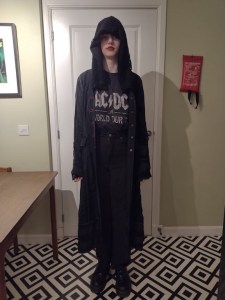
I found this coat in a charity shop. It is a long/mid calf length coat from a UK/British designer, the label has ‘Out of Exile’ on the tag inside the coat. I was not aware of this design label, but on checking with Mr Google, this brand does make desirable items of clothing and, are expensive to buy new. I paid £5. The coat had a good weight, and is probably a viscose mix fabric. Please excuse this photo, it is the only photo showing the coat length that I managed to keep on my phone. I probably need lessons in photographing black fabric!

This coat is destined for No 1 grand daughter – she loves dark/black clothes and loves a ‘Goth’ image. I showed the coat to my daughter and she liked it too, and agreed that grand daughter would love it.

When I inspected the coat, I could see very little damage. There was a little tear at the back, and the buttons were a little loose. The damage looked to be easily fixable. No 1 grand daughter loves a hood, so I did have to think about how to make and attach one, I do have a large hood on my raincoat, so I made a pattern from that.


To repair the tear at the back, I used a piece of ‘grunge’ red cotton fabric. I cut a diamond shape and stitched that to the coat using a blanket stitch also in red embroidery floss. The coat is unlined, so I used a little black interfacing at the back of the tear. I cut two more diamond shapes of the red fabric and attached one to each pocket flap using a blanket stitch. I loved the effect of the three patches on the coat.


The coat has beautiful black shiny oval shaped buttons, and all were intact – no marks or scratches seen. I restitched the buttons using the red embroidery floss, and then restitched the button holes using the same thread. I added some black stabiliser to the rear of the buttons for strength. There was a little weakness there, but no tears were visible.


Fabric for the hood was very troublesome to find. Who knew that there could be so many shades of black? Anyway, I did find some that I was happy with – a dress from the charity shop, that had a lace overlay. I used the lace to make a outer layer of the hood, same pattern as the hood. I am so very happy with the coat and it’s new look, even though the photos don’t do it justice. I managed to salvage enough lace to attach a little frill to the cuffs as a finishing touch.


I am sorry that some of my photos are not of better quality, the model was less than enthusiastic on the day, and occasionally she is just not keen on modelling clothes for her Mum.

I do love mending clothing, and trying to fix a problem area on an item of treasured clothing that has been well made, rather than consigning it to the waste bin. Thank you for reading.