Felting Alfresco (Outside! Its Summer!)
On to Pet Two. Part 1
So, this week the goal was to start on Mer-Pet number two. (Sharkette Needs a friend!)
As usual, I did some digging on the internet to find out about them. After a lot of browsing, looking at Spotted Eagle Rays, Bat Rays and Manta Rays I decided on Manta Rays. As I was Focusing on collecting many different views, I started to notice there were differences amongst the photos I was collecting. I think I need to look at words now too. <drat> While looking for pictures of what a female manta ray looks like I tripped over a post with cool facts about manta rays.
Cool Facts About Manta Rays:
The name “Manta” comes from the Spanish word “Mantilla” or cloak.
- Female manta have pelvic fins but no claspers (that’s a male thing). Females tend to be larger and generally more friendly towards divers than males.
- Manta can be identified by their splotch patterns on their bellies. Each is different.
- Manta and Mobula rays have the largest brains of all fish. They keep their brain warm by a counter-curent heat exchange system using their circulatory system. This keeps their temperature more even than most fish.
- They are smart and use coordinated and cooperative feeding. They are also social and curious about divers.
- Rays are in the same family as Sharks and Skates. In the ray family, (Myliobatidae), there are two species of Manta (Manta Birostris – Giant Oceanic and Manta Alfredi – Reef manta) and 9 species of Mobula devil rays. You can tell the two types of Manta apart by their coloration, location and size.
- Birostis (oceanic) has a ‘T’ pattern and there is a distinctive black/white division on their back and almost no spots on their bellies. Tending to be larger around 7m wide and are more solitary. They can stand colder temperatures and are seen most often off shore. Manta have evolved from sting rays but Manta Birostis is the one who has a vestigial sting on their tails.
- while Manta Alfredi (reef) have a ‘Y’ pattern fading into the black colouration on their backs and unique spot patterns on their ventral side. They tend to be smaller, around 5m wide and are found more frequently in schools around reefs and tropical islands.
- The Marquesas Islands are one of the few places in the world where you can find both species.
- I also found photos showing all black and all white manta as well as a definitely pinkish one. So we should keep watching and see if there is another subset of Manta are discovered.
Ok, time to get to work!
1-2 I brought out the implements, armature, fibre and photo reference.

3 Here is the armature I created for the back of the Manta Ray.
I reinforced the leading edge and front scoops (cephalic fins). The black wire running through the body is to help support the posterior aspect, back, of the body. There will be a separate section for the anterior body/mouth. I used fine floral wire to help stabilize the tail extension which like the rest of the body is 14-gauge aluminum – thankyou Dollarama!
I started at the proximal (nearer to the centre or midline of the body) point, attaching with a few quick stabs. Then wrapped fibre towards the distal (further from the centre of the body) end then back, securing it at both ends. As you can see, I was able to leave a loop at the end of the scoops. This gave a good location to secure the fibre at the distal end. (I promise there is no medical vocabulary exam hidden at the end of this post but I bet you would pass it if there was!)
4-6 Wrapping the wire securing at both ends
I added a base layer wrap to the armature to give a bit more support for the fibre that would be added later.
7-9 First layer of skin for the wings
I then began adding the dark split from a piece of the batt and then adding more to build up the midbody section.

10 Back or top of manta ray
 11 underside of manta ray
This brings us to the missing bits. We are missing the inner mouth structure, gills and the rest of the abdomen/body.
(Manta ray Undercarriage armature.)
So its time to create an armature for the mouth/abdomen.
 12 Armature for mouth gets measured
Glenn arrived home and I moved to working from the bench in the front garden. Glenn enjoyed one of the gravity chairs and was just falling asleep when we started to hear Harp music which seemed to be coming form the other side of the front hedge.
13-14 working in the front garden
 15 Yes that is definitely a harp being played next door!!!
Our neighbour was hosting his other neighbour on his bench with her Harp! (He likes his lovely green grass, unlike my front yard, which has almost no grass.)

16 What a wonderful way to felt, to live music! (Usually in the summer she plays harp at weddings. I hope she will be practicing in the front yard again soon!)
We use to have someone who played bagpipes at sunset from somewhere behind our yard. He or she was also vary good. i always hoped i would find them and be able to request Alice Cooper or a bit of really old Black Sabbath. in more normal years we would heading down to the Ottawa Bluesfest and watch live bands, mostly Alt rock, old rock, techno, industrial, prog-rock and yes even blues but only once or twice. i usually brought my drop spindle or one of the portable spinning wheels. It was fun to see bands we had never seen before and some we had. Muse, Alice Cooper and Gretta Van Fleet were particularly enjoyable!
this summer will make us appreciate all the things we use to enjoy once we get to do them again! so back to felting!!
Like this:
Like Loading...
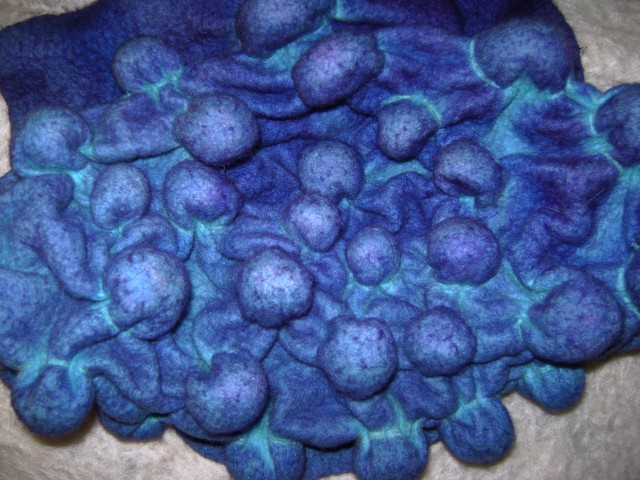
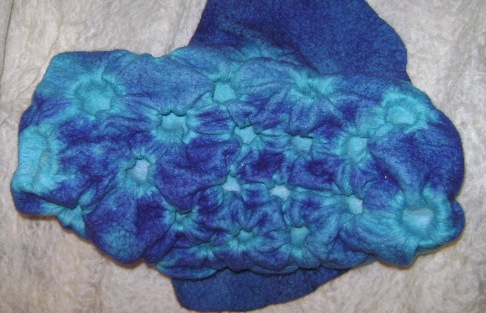


 1 Wool bomb?
 2 Due to the stress, I’m sure I also picked up two fleeces at the other end of the market, a Shropshire and a Canadian. Both were large Rams and were much softer than I expected. They are now waiting for the humidity to drop so I can skirt and wash them!


 11
11


