I picked a piece or felt I had and added the sky and snow backgrounds. I used 3 shades of natural white wool for the snow so that it wasn’t so flat. I used Merino, Corriedale and something strong and shiny. the shiny wool may have been BFL or even Mohair.
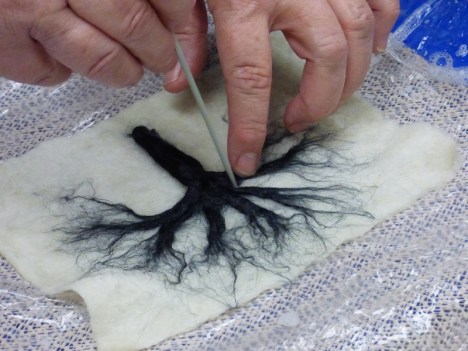
Then I started working on the tree. I worked on a separate surface so as not to disturb the background too much as it is only lightly needle felted. I decided to work in two layers for the tree so this is the darker back layer. I started by just fluffing it up and then using a knitting needle to move fibres around to get a better tree shape. then gave it a dry felting ( just flattening and wiggling it a bit so the fibres stick together) to move it onto the background.
I picked a redder brown for the second layer. I forgot to take a picture of it when it was separate. I must have been in the felting zone. I put the tree slightly off-center. I tried it in the middle and I didn’t like it.
Here’s a close-up so you can see the 2 layers
I poked the tree all over to tack it in place and started fiddling with the roots, so it won’t fall over in the wind.
and some more snow
And that was as far as I am right now. I will probably fiddle with it more before wet felting it and then fiddling more, of course. I am thinking of adding a shadow but not sure how to tackle it. I am not sure where the sun is. I may have to go out to the field and look at shadows.
Have you started your tree challenge or maybe you’re going with making something useful or both?
We would all like to see photos of challenge pieces and if you are unable to upload photos directly onto The Felting and Fiber Forum ‘studio challenges’ thread, then please use the link below.
I’ve recently finished a felted picture – mostly wet felted but with needle felted elements. ‘How long did it take to make that?’ I’m often asked when people see my work. I find it difficult to answer precisely. ‘Quite a long time’ isn’t very helpful so I usually say something like ‘About four days’. I don’t really know if that’s true. It’s my best guess. As the felt-makers among you will know, most people have no idea how much work can go into making felt, so as I was making my latest picture I thought I’d try to document the stages and see how long it all takes. That’s what I’m going to show you here, plus take you on a little visit to the town where I work.
I’ve already decided to make a picture of a turnstone feeding at the water’s edge so I set about making prefelt sheets for the pebbles. I live on the North Kent coast and love watching the local water birds: how they look, move and interact with their environment. It’s mostly pebble beach on the stretch of coast nearest to my home so pebbles are a good place to start.
First a piece of natural grey merino prefelt. Then a piece of mixed browns
It takes a surprisingly long time to cut all the pebble shapes
Here’s the grey cut up and an offcut of nuno prefelt which I’m gong to add into the mix.
And finally a sort of orange / yellow piece.
I use prefelts as they give the pebbles more definition than if I just add blobs of wool. I’d guess all of the above is about a day’s work.
Now I can start the layout. This is going to be quite a big picture so will take up pretty all the space on my standing work desk. Here’s the first layer – natural white merino.
The second layer starts off with pewter for the water. While I’m working on the water section I add some dark blue low lights.
After I complete the second layer with more natural white merino, I lay out different coloured wool on top of the pewter and dark blue. I’ve previously carded pewter wool with a variety of light blues and greens using large hand carders. I haven’t even thought about adding that time to my calculations. I use this for the top layer of the water, mostly covering the dark blue which I want to add depth without being too prominent.
Here you can see that I’ve also added all the cut up pebble shapes to the bottom of the picture, plus some scraps of silk cut from old scarves, leaving a white section where I will add the wave.
For the wave I’ve chosen mohair because it has a slight shine and I hope it will be wiggly when felted. Along with the mohair I add lots of silk hankies and wool locks: I’m trying to get lots of texture into this section.
There’s also a piece of sort of knitted yarn that I picked up in a charity shop a while age. It’s meant to be knitted into a scarf (according to the label) but I lay a line of it under the wave, hoping it will look like the foam from a previous wave. I also pop some offcuts into the wave for more texture. I finish by adding a few locks to the water to look like small cresting waves and I’m at the end of day 2.
A couple of days later I start the wetting down. Because it’s large, I decide to work in three sections, starting with the pebbles. I like to use voile netting over and under the wool – which you can see in this photo.
I spend a couple of hours prefelting the picture, working both sides. Here’s the back. I can see the pebble outlines pushing through the white so can be confident the layers are starting to felt together. At this point I decide to take a break and go for a wander outside.
I work in a small rented studio in the historic town of Faversham, about 8 miles from where I live, in Whitstable. The studio is in a former industrial building (originally a late-Victorian brewery bottling plant) which is now a lovely not-for-profit gallery, café and shop called Creek Creative Studios. It also includes 32 small studios filled with a good variety of busy individuals including painters, jewellers, potters and glass workers on the ground and lower ground floors; writers, illustrators, stringed instrument specialists, web designers and other small businesses on the upper floor.
Faversham is a gorgeous medieval market town so wandering about at lunchtime (and of course checking out the charity shops) is one of my favourite pastimes. It’s a lovely sunny day so I thought I’d share a few photos with you.
Top left is the historic market place with its stilted guildhall. Top right is the Shepherd Neame shop: there’s a long history of brewing here and Shepherd Neame is Britain’s oldest brewery. Some days it does mean the town is rather ‘aromatic’. Second right is the lovely Yarn Dispensary. Originally an apothecary, the building dates back to 1240 and has a beautiful, separately listed wooden apothecary interior. It also sells a delicious selection of yarns. Bottom left is an old pub; next is the old water pump in the marketplace and a couple of the other buildings that surround the market place. There’s still a market here 3 days a week plus regular monthly ‘best of Faversham’ and antiques markets at the weekends.
Back at the studio I spend the rest of the day rubbing and rolling the felt until it’s fairly firm. Because it’s a picture and going behind glass it won’t endure much wear and tear but I still like to ensure it’s properly fulled. End of day 3.
I leave the background to dry and return to it about 6 days later, as I start to think about the turnstone or turnstones. Working from my own photos, I roughly sketch a couple of birds and cut them out so I can see how they might look.
Although I like the 2 birds they are a bit small (the waves round here aren’t that big) so I decide to go for one pecking bird but bigger than the sketched one. First step is to make some prefelt for the feathers.
Here it is as I’m starting to wet it down (left) and as a light prefelt (right – apologies for the poor quality of the second photo)
I cut up the feather prefelt and lay out a general bird shape. At this stage I am leaving the head large and a bit vague. I’ve learned that it’s better to make it too big and cut it to size later rather than trying to get the exact size and shape and risk having to add more wool or felt.
Here’s the bird felted and with a lightly trimmed head. Sorry it’s not a great photo as it’s electric light and I’m casting a shadow but I hope you can see it well enough to get the overall idea.
From layout decisions to the felted bird has taken most of day 4.
The next stage is to needle felt the bird into the background and needle in the eye and legs as well as refining the beak. For the legs I used some of the orange-ish prefelt I made for pebbles, adding strands of wool on top.
Using a broken needle I pick at the wave to raise some of the texture from the silk hankies and wool locks. I’m not sure whether it’s visible in this photo but it does make a difference in the actual picture.
I didn’t take progress shots of the needle felting but I’d say it took a good half day. It’s difficult to know when to stop fiddling around with it and declare it finished.
So, here is the final picture before framing.
And a shot in its frame.
Frame size is 63 x 86 cm (approximately 25 x 34 inches)
I used an adhesive hook tape – like the hook side of Velcro – which I stick to the mount board. The hooks hold the felt in place without impacting the fabric.
So, it looks like my 4 day estimate was a bit low. Next time someone asks how long it took me to make this picture I could say ‘About 4 ½ days, oh, plus the carding, the nuno prefelt and the framing….’ . Maybe I’ll just settle for ‘About 5 days’.
Do you try to work out how long you spend making things or just go with the flow?
One of this year’s challenges is divided into the 4 seasons. A tree in each of the four seasons. Now I like evergreens so I could have cheated and made the same identical evergreen 4 times but thought that was a bit too easy. I had seen online someone say they had been shown how to do a tree by Andrea Hunter, Creating Felt Picturesblackwells.co.uk/bookshop/product/ It’s a great little book. What I saw was just a picture of the finished layout. I thought I can figure that out. That was months ago. On Monday I finally gave it a try.
Monday was a Holiday here, so I gathered up my supplies and headed into the guild to meet Jan. We were going to do our felting machine comparison so she could blog about it and I wanted to try making the tree.
I brought a new rolling mat I had just picked up because it had a nice little lip to help me keep things dry. I was not going to need a lot of water. I used some prefelt for the background and some black merino for the tree.
I decided to do the first one quickly and without any fiddling around. I just held the trunk portion firmly and fluffed out the rest. Part of what I wondered was: would the rolling cause movement that would make some thicker branches?
I think it would have been better if I had taken out the two blobs in the branches but I was quite pleased and if I would going to lay some green over it to make a summer tree it would have been fine.
Finished, wet
Finished dry
Next, I tried wetting the prefelt and the black wool to see if it would spread out any better but it was so terrible I just pulled it off and tossed it before I even started. It would make a good start for a flower.
I squeezed most of the water out of the prefelt and got some new black. I also grabbed a knitting needle to manipulate the wool. the wool picked up moisture from the wet prefelt and that made it easier to have the wool stay where I wanted it.
This is much better I fiddled around with making bigger branches and trying to make it look less like a small child drew it. I was quite happy with it and decided to add a little mixed brown wool for some texture and Jan suggested adding a thin haze of green to give it a spring haze look like just before the trees get their leaves.
I am quite happy with how it turned out. I like the way the thicker trunk area kept some of its 3dness( I am sure that’s not a real word) You know, they stick up a bit. The trunk needs work but I think this will work well for the challenge. Now I need to go shopping for some brown wool or I need to get on with some dying. I have almost nothing in the way of brown wool.
Finished, wet
Tree finished, dry
Oh, and since Jan is always posting pictures of me I thought I would share one of her in her octopus hat at the Chesterville Spin-In a few weeks ago.
This last Sunday I taught the felted lantern cover workshop that should have happened in December but was delayed. I was teaching at the guild I belong to, Ottawa Valley Weravers’ and Spinners’ Guild.
It was a half day class. the biggest challenge with the lantern covers is laying out the wool thin enough to let the light through but with enough wool to hang together. They don’t need to be strong because the lantern will give them structure. For this class, I provided a glass vase so everyone would be working to the same resist size. You can use a large pop bottle with the top cut off but I would add some weight to it to make it more stable.
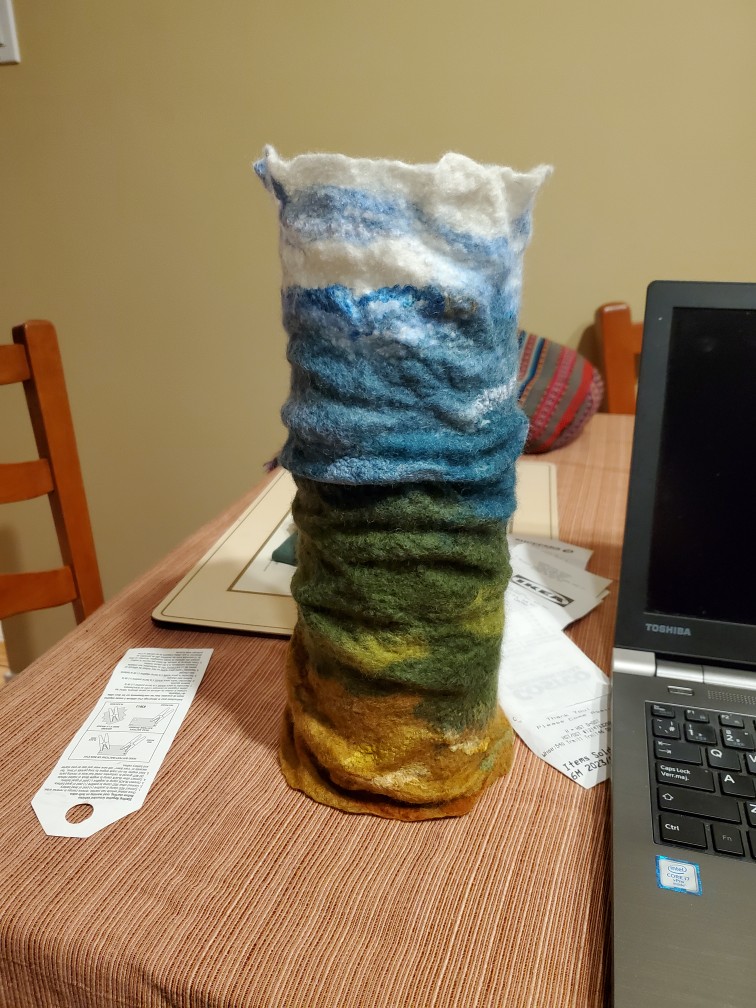
I had 5 ladies for this class. I showed them two examples of covers I made.
Everyone wanted the longer one so they could add wrinkles
I only just realized we ended up with just 2 colour palettes. the largest part of this class is taken up with layout and decoration. We discussed how you can add things to the inside of the cover that won’t show when it’s not lit up but will show as silhouettes blocking more light. A couple of people decided to give that a try.
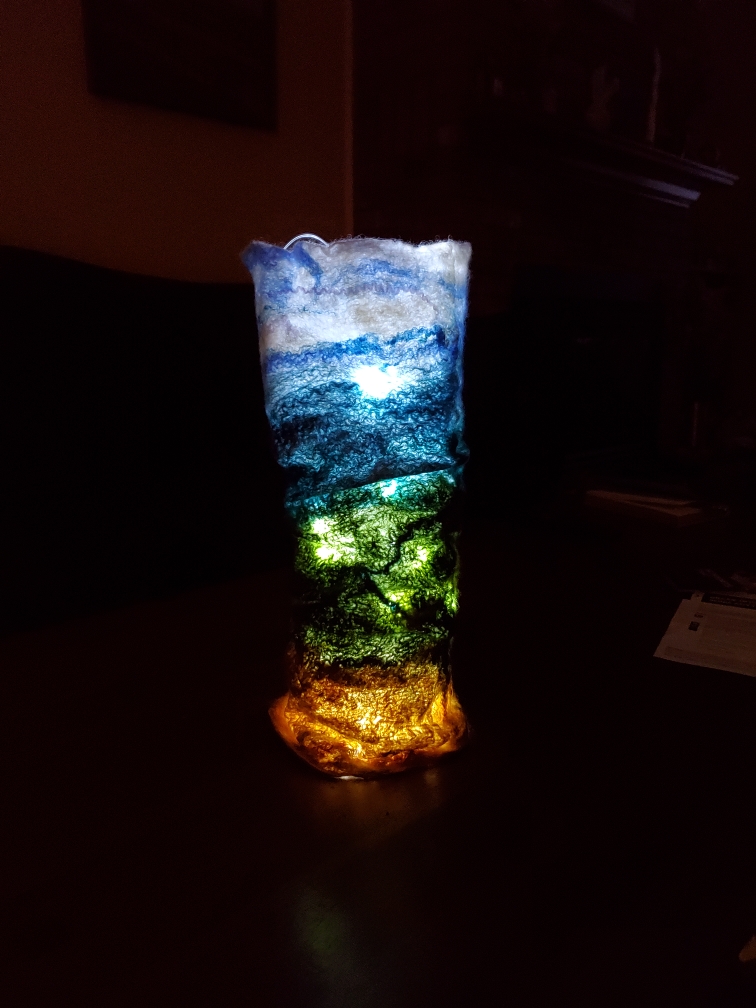
It is hard to see on the last one but she is adding white and blue silk hanky pieces to the wool. they disappear as soon as they get wet. They will show up again later. You can see them a little in the pictures below. I think everyone had a great afternoon.
Two of my students sent me pictures of their covers dry and lit.
Christine
Janet
I hope the others will send me pictures as well. One was very thin and delicate and I think it will look amazing lit up. If they send them I will add them here.
I did have someone ask why I like to make covers rather than making them with a bottom. There are 4 reasons, first making a nice flat bottom that will allow the vase to stand properly can be tricky. A cover that is self-supporting needs to be felted much more or be thicker to be stiff enough. Having an internal structure gives you something to put the lights in and attach the controller to. And lastly, the container inside allows you to add water if you would like to use it for flowers.
The last couple of weekends I have been teaching some workshops. Last Sunday was Nunofelt Scarves. This was originally scheduled for December. But I caught whatever nasty head cold was going around, it came with a very annoying cough. I did a test for Covid and it was negative.
Anyway, after a couple of years of no workshops and a delay, it was good to be able to teach people in person again. I am still rusty when it comes to taking pictures during class, so there are not very many of this one.
Yesterday I taught Wet Felt Birdfeeder/house.
This is the picture we use to advertise it.
Everyone in the class chose to do a feeder( larger opening) in a gourd shape.
I remembered to take a few more pictures but I still had a hard time remembering.
Laying out the base wool.
Decorating
The finished birdfeeders. I think some of the holes may need to be enlarged. They have balloons in them to hold the shape while they dry.
All in all, we had a great time on both days. It was so nice to teach again to interact and answer questions and see people be amazed when it really does work.
A wonderful 4-week holiday in Australia, Christmas markets and hosting lots of family visitors mean I’ve done very little news-worthy felt-making since my last Felting & Fiber Studio blog. ‘Production felting’ is my own term for making lots of similar things for shops and markets. I did a fair bit of this in November and December: mostly printed tea light holders, printed wool ‘pebbles’ and Christmas cards. These were my 2022 cards: handmade felt with hand-printing. I extracted the tree from a larger, royalty-free, public-domain image and added the heart before printing onto fine flat felt.
My 2022 handmade Christmas cards
I sold these through various outlets and sent a small number myself.
I’ve enjoyed making felt ‘pebbles’ for some years. Since learning to print on felt from Lindsey Tyson, I’ve been able to adapt photos of some of my Mum’s watercolour paintings to print onto the pebbles.
So, as I don’t have a lot of new stuff, I thought I’d contribute a few of my past makes and current thoughts as ideas for the first quarter and year-long challenges.
Alas, I left the base alone for a long time during a pandemic lockdown and it was attacked by moths. In a way, being eaten by moths was rather fitting: lifecycles in real life, but the moth holes meant I ended up cutting it up to make bookmarks (after some very hot washing). I did, however, recently sell the tree stump on its own and it now lives in Canada.
Pondering future projects for the tree challenge: I have a very tall, beautifully coloured ‘silver dollar’ eucalyptus tree in my garden.
The eucalyptus tree has potential for lot of other projects, including maybe using the leaves for eco printing onto felt. Eco printing is something I’d like to try, though whether I will get round to it remains to be seen. I don’t recommend any breath-holding for this.
Contemplating Caterina’s quarter-one challenge of making something practical that you can’t buy: one of my favourites is this case I made for my iPad mini. Nuno-felted with sections of recycled sheer silk scarf.
I know you can buy iPad cases but I like that this one is unique and fits perfectly without any fasteners. Because it’s an exact fit, the iPad stays put until you need it, then slides out easily. It’s getting rather battered now as I carry it around all the time so maybe it’s time to make a new one.
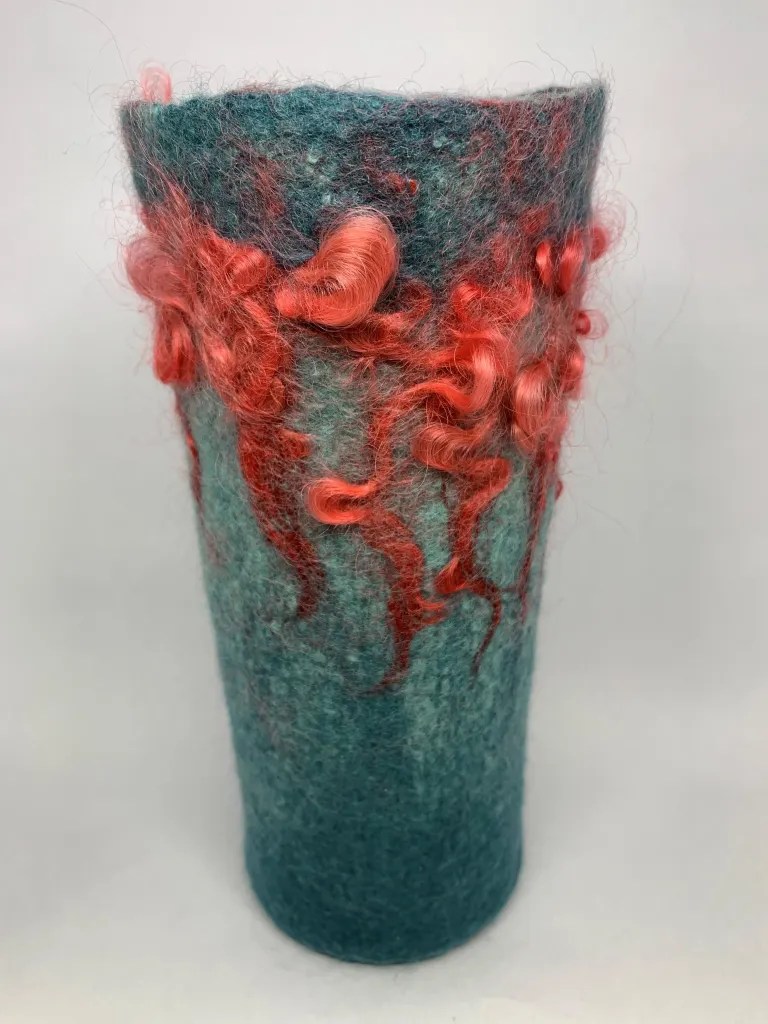
Felted vases and plant pots are also both unique and practical. Here are a few. I like that you can co-ordinate them to your décor, or to a specific plant or flower, or just go for colours and patterns you like.
And finally, here’s something that meets both last year’s challenge to complete some UFOs (un-finished objects) and this quarter’s challenge to make something that you can’t buy.
Here’s a pair of earrings that I started making a while ago using hand-dyed 14.5 micron Merino wool. I incorporated the earring post into the felt and some black sequin fabric inside using resists. These were inspired by the work of Aniko Boros and Judit Pocs.
The sequin section is more sparkly than in the photo
As you can see, I got quite a long way along, but while I finished fulling the one on the left, I stopped with the right-hand one in the pre-felt stage. I’m not completely sure why: probably it wasn’t quite what I had in mind. But it surely can’t take more than about an hour to finish that one, so I’m promising myself here that I will complete that second earring. The world will be minus one small UFO.
I hope I’ve given you a few ideas about different ways of taking on the challenges. How are people getting on with them? If you make something in response to these or any of our previous challenges, please do post your photos on the forum. We all love to see and be inspired by what other people are making.
I have been continuing to add more stitching and other bits to my mossy driftwood. You can see the progression from just felt to adding stitch in these two posts:
The moss has been getting filled in by hand stitching and adding the machine stitched moss I created. I am trying to decide how much more hand stitched moss to add. I think it needs more “trailing” knots in the “bare” felted areas. But I also need to add lichen in places but I haven’t created the lichen yet. I’m thinking I will try Tyvek lichen.
The next step was to create dead, desiccated leaves. I found a tutorial for making them out of tea leaves on Youtube. I had made them out of Lutradur before but not tea bags so I thought I would give it a go. I drink tea every morning so I started saving the old tea bags for this project. In the video, she used some type of stabilizer but I decided to try without one. I layered two flattened tea bags together and just started free motion machine stitching the veins. As you can see, you don’t want to stitch the outer edge of the leaf as it looks more natural without it. Then I cut them to shape with scissors.
The next step was to burn the edges and the holes. I found it was easier to get a more natural look when I was looking at photos of dead leaves. That way the leaves don’t all turn out the same. I used a wood burning tool for this operation (the video uses an incense stick). Obviously, you need to be careful when you’re burning things and it is pretty stinky too, you need ventilation. So I took mine to the stove and turned on the overhead fan to draw away the fumes. Plus the stove top is heat proof and won’t be burned or damaged.
So here’s the full piece with the leaves just placed on it. I will be stitching them down at some point to hold them in place.
Here’s a couple of close ups. You can click on the photos for a bigger view. I am happy with the progress and it is definitely looking very “forest floor”.
Last time I posted, I showed you a piece of driftwood that I had covered in green felt to represent moss. It definitely needed more work to achieve the natural look that I desired.
I took a small pair of sharp scissors and cut out some holes as well as making the ends not so uniform and straight. I then decided to use the left over cut out pieces as padding for stitching. I added the left over pieces in a couple of places and hand stitched them down.
I then decided to try adding more texture with needle felting. I had a pile of little wet felted scraps which you can see on the left and I needle felted those down. Then I added some wool from my carded batts that I had left over after wet felting. I needled those down but not too firmly. I still wanted the texture of moss, which you can see in the right photo.
Here’s what it looked like after I finished the lower layered bits. I left hanging threads as this will be the “grassy” looking bits sticking up between the moss.
Next was looking for different green threads. Here’s what I came up with. You can also just see on the left side that I found some of my photos of moss and printed those out for reference.
I then started adding some hand stitching. These are “wonky” French knots with hand dyed lace weight wool thread. This is going to take a while. I have another “slow” stitch project on my hands.
Next up was to try some machine stitching. I made a sandwich of the threads on the left between two layers of water soluble fabric. I then machine stitched a random branching pattern. The photo on the right shows the result after washing out the soluble fabric.
Here’s a small piece of the machine stitched moss by the French knot section. I haven’t stitched it in place as I think I will do more of the hand stitching first. I’m loving all the different greens as that is definitely what you find in nature. I will keep you updated on my progress.
I have had this idea on my to do list for a while so I was glad to give it a try. I have seen several different ideas of felting on a stick or piece of driftwood and wanted to give it a try. Then I am planning on adding further embroidery to give the “moss” more details.
I have a bunch of driftwood from my friend Deb so this is another way to use it. I pulled a bunch of different green wool from my stash and mixed it by hand. I suppose since this is all made from my stash, this qualifies for the 4th quarter challenge too!
I then used my hand carders to card the colors together but I didn’t want it to be a solid green. I just did a rough card to mix the greens slightly.
Then on to wrapping the wool around the end of the stick. I wrapped it diagonally with one layer, tacked it down with a bit of quick needle felting and then wrapped another layer in the opposite diagonal direction. I then began squeezing and rolling the stick around on a ridged surface before I wet it down getting some air out of the wool. I think if I had wet the stick first, that might have helped with wrapping the wool a bit tighter around the stick. I’ll try to keep that in my brain if I do this again.
Then I wet felted the wool by rubbing and then rolling the stick wrapped in a towel. I also did a bit of “bashing” the stick but had to be careful not to break off any of the wood bits. This is how it looks now. I am planning on adding a variety of hand stitching to give more texture. I also might cut back the felt in some areas to allow the wood to show through. I haven’t tried stitching on this type of surface so it might be a bit of challenge. But I’ll just give it a go and see how it turns out. Do you have any suggestions for particular stitches or how best to handle the stitching? I’d love to hear your thoughts.
I taught a new wet-felted bowl workshop recently so I decided I’d share my thoughts and ideas about developing and running that workshop in this blog.
I’ve taught a few different wet felting workshops over the years. I really prefer people to start with making good quality flat felt before moving on to other things, but sometimes I bow to the pressure to do something else. I try to remind myself that I’m not the felt police and neither can nor should be in charge of how other people choose to learn. (But, of course, there’s still a little bit of me that would like to be the felt police. If the vacancy comes up I will almost certainly apply!)
This time I decided to go even more 3D and do a basic bowl, working around a flat circular resist. I wanted the workshop to be suitable both for complete beginners and those with some felting experience who were interested in trying out a 3D make.
I dug about in the studio and in my photos to see if I could find some old bowl examples and came up with a few.
Bowls I’ve made in the past
I then walked my way through making a new sample bowl with a workshop hat on. By ‘workshop hat’ I mean focusing on what I think are the simplest techniques for inexperienced felt makers to achieve the best and most reliable results.
I decided on my layout: starting with a fanned-out layer from the centre then a second layer following the circumference of the circle. I intended the circular layer to overlap the edge as little as possible to reduce bulk in the middle, with the main overlap to connect the two sides on the ‘fanned’ layer.
I immediately realised I should have done the layers the other way around. It’s much easier to follow closely the edge of the circle if you can actually see it! I also realised it was better to start laying the wool around the edge and move inwards rather than starting at the centre and moving out.
I find it interesting how wearing a different ‘hat’ makes me think in a very different way from when I’m just making something myself. It’s a useful exercise.
I thought the sample bowl could demonstrate a couple of different surface design options so added some silk fabric, some locks and a little white wool to the grey area.
Sample bowl finished
It’s not the most beautiful bowl but it did its job. The collection of bowls then got me thinking about the size of opening. I like a small-holed bowl to look at but it’s not necessarily so useful and it is certainly harder to full, being difficult to work from the inside. I decided that participants could choose.
I gathered together a range of tools and smiled at the weird variety of odd things I own. This is only a small proportion.
Some of the ‘tools’ I use
Something these tools all have in common is that not one of them was designed for felt making. My most recent purchase was a job lot of 15 small plastic rattles bought second hand on eBay. Actually, these worked remarkably well, especially for the bowls with small openings, and the quantity would come in very handy if I was teaching a bigger group. That was £5.35 well spent.
The workshop venue was the Horsebridge Community Arts Centre in Whitstable. The Centre has a lovely workshop area: really light and spacious with good tables and lots of sinks. Ideal for our purposes. After welcoming the 4 participants and a short introductory chat I demonstrated the layout. Jenny, Suzanne, Jane & Ronn then chose their wools and set about their bowls.
I had decided to go for 2 layers of wool rather than 4 as I find most people lay the wool out quite thickly to start with. 2 participants had some felt making experience and 2 did not. All of them went for quite thick layers.
We wet the first 2 layers down before flipping to the other side as I find this helps to get the wool tight around the resist.
Next I showed them how to start to work the wet wool: paying lots of attention to the rim of the circle and encouraging the wool towards the centre to reduce the chance of creating an accidental ridge.
Once they’d reached the prefelt stage we did some rolling using just the bubble wrap and towel. Then they were ready to cut the opening & remove the resist. Jenny went for a small opening, Jane and Suzanne a slightly larger one, while Ronn had something more organic in mind. She made 6 cuts out from the centre to create a sort of flower / leaf shape that would hold a plant pot.
Plenty of chat, a little music and lots of elbow grease later ……..
….here are the ladies at the end of the day, delighted with their finished pieces.
And here’s a better view of their bowls (plus the one I’d made alongside them to demonstrate the different steps – 2nd left). I was very pleased not to see any accidental midriff ridges as I think a smooth transition between the two sides is one of the hardest things to achieve when starting to work with resists. The bowls were felted really well, which made my inner felt policewoman very happy, with just the plant pot holder needing a little more finishing at home to fit around its plant pot.
I always ask participants to complete a short feedback form at the end of the workshop. There’s a bit of admin then 3 boxes to complete: ‘what did you like about the workshop?‘; ‘what could be improved?’ and ‘any other comments?’.
I also make mental notes for myself along the same lines. So, here are my own observations
We had a really nice day. It was a lovely group with a friendly and relaxed atmosphere: everyone seemed to enjoy making their bowls. Judging by the feedback forms, people found me adaptable, clear, knowledgeable and helpful throughout the session so lots of positives there.
What could be improved?
The participants didn’t have any suggestion but for myself I thought the timing was a little generous. I’d allowed 6 ½ hours (including a lunch break). We finished slightly early so maybe 6 hours next time, though that may be different if there were more participants.
I realised I didn’t give enough thought to / instructions on the interior of the bowl design. Because my sample bowl had a small opening the interior isn’t visible so I forgot to think that bit through. In fact all the visible bowl middles were good but definitely more luck than judgement on my part.
My making a bowl alongside the participants worked OK but I had to work very quickly to get it to the next stage while spending most of my time helping and advising the others. It would have been simpler to have pre-prepared another bowl sample to pre-felt stage.
All in all a successful workshop with some notes for myself on how to improve a few things if I run it again. Hope you enjoyed your virtual visit to our bowl workshop.