Hi folks. It seems I am running behind as I didn’t know it was Tuesday already. So lots of pictures and not much text today.
My guild Sale and Exhibition is in a couple of weeks and I promised a door prize of a lantern. In reality, it is a glass vase with a cover and fairy lights inside. They are very pretty. You want them to look interesting when they are not lit as well as when they are lit.
So I started out to make a scene. I used bats to save layout time.
water
ground
sky
And then wrap it around
and then I decided it was still boring so I should add a little village.
I thought the white was too bright so I went will black. I want a hint of a village in the distance. I did one on each side.
In retrospect, I should have gone with white. There would probably have been enough migration of fibres to dull it down a bit. As was predictable if I had thought about it they disappeared. I will shave it later to see if I can get a hint of where they are and add them back. but it can wait as after felting I decided it was way too thick for a lantern. I am definitely out of practice felting. I do like the scrunched-up water and flared sky though.
Try again. this time I am using a nice blue merino top and some orange and gold silk lap. the silk should be interesting enough on its own.
A nice thin layout
and some lovely silk lap
and done, here they are together, silk never shows as nice as it is in a picture.
The light forme the fairy light shines through nicely even with the light on
Much better than the first one
so that’s my adventure in felting this week. I hope you like it, I hope the winner likes their prize.
September has been a busy and exciting month in contemporary textile art (specifically felting art) in Ireland so I thought I would feature what I got up to, I will call it my September Adventures.
Weather wise, the month started as we hoped it would continue (it didn’t by the way) with a return to fine warm weather – something we had not seen since last June. So I took the opportunity to visit our National Botanical Gardens (https://www.botanicgardens.ie/) which are situated on Dublin’s north side. The gardens (there’s free entry, if you ever visit Dublin, Ireland) opened in 1800 and are an oasis of calm with restored glass houses, magnificent specimens, bee hives and, of course, a tea room. There’s also a pedestrian access to the historical cemetery next door which I suspect is not seen too often. Glasnevin Cemetery also houses a genealogical archive for anyone wishing to trace their Irish ancestors (https://www.dctrust.ie/genealogy/home.html).
But, I digress. Let’s go back to the gardens. My visit coincided with their annual exhibition ‘Sculpture in Context’. The exhibits feature artworks in various media including ceramics, wood, metal. I decided to focus purely on the textile element of the exhibition and to photograph any pieces I came across as I wandered around. I was aware that some of the members of Feltmakers Ireland had pieces accepted for the exhibition; Clare Merry (http://www.merryland.ie/index.htm) an exceptional artist who quietly creates her pieces was featured. If you would like to see some of Clare’s work please check out her website, which, she tells me, is not really up to date, or Google her and feast over the images; Fiona Leech(https://www.instagram.com/feltathome/?hl=en) had three beautiful pots which were originally housed in the cactus house. Annoyingly two of the three pots were stolen within a matter of hours of their arrival and the remaining one was moved to a safer spot in the garden’s gallery. I thought I would show you the three pots as they were originally grouped together.
Fiona Leech’s three pots (source: Fiona’s Instagram page)
I searched but could not find Leiko Uchiyama’s beautiful work but here is a link to her website if you would like to check her out: https://www.leikofelt.com/my-felt-work/ I found two other exhibits from members of the guild. Their featured work while not through the medium of felt were equally stunning. Congratulations Mel Bradley (https://melbradleysilks.ie/) and Mette Sophie Roche (https://metteroche.com/)
I put together a slideshow of my textile finds in the gardens which I hope you enjoy.
Mette Sophie Roche; The vital matter of Fungi
Mette Sophie Roche; The vital matter of Fungi (detail)
Mette Sophie Roche; The vital matter of Fungi (detail)
Fiona Leech; Drought
Fiona Leech; Drought (detail)
Frances Crowe; Terrain
Frances Crowe; Terrain (detail)
Frances Crowe; Terrain (detail)
Claire Merry; Floral Path
Claire Merry; Floral Path
Ella Quinn; It’s nothing but a dead fish
Niamh O’Connell; Cocoon
Mel Bradley; Grasses
Mel Bradley; Grasses
We had our first meeting after summer in Feltmakers Ireland and as usual the committee put an incredible amount of preparatory work into making it successful. It was a busy morning as everyone beavered away felting flowers to create a tapestry as part of the 20th anniversary celebration for the guild. Much to everyone’s delight, the guild’s founder Elizabeth Bonnar joined us. I thought I would feature Elizabeth here as without her it is doubtful that there would be such a vibrant community of feltmakers today. Here she is with her granddaughter and with the committee.
Feltmakers Ireland founder Elizabeth Bonnar and her granddaughter
Feltmakers Ireland committee with founder Elizabeth Bonnar (3rd from left)
Here are some photos taken on the day.
Feltmakers hard at work
Breda and Elizabeth hard at work!
Lots of flowers were made that morning by members
Suzanne, Breda, Deirdre and Elizabeth catching up
The finished tapestry was revealed at Feltmakers Ireland ‘Bountiful’ juried exhibition which opened on 30th September.
Feltmakers Ireland members: The Floral Tapestry to celebrate 20 years.
The exhibition also saw the launch of the new book “Exploring Irish Wool for Feltmaking” The book is the product of a collaboration between many members of Feltmakers Ireland guild, sheep farmers, shepherds, shearers and suppliers and not forgetting the various washers and carders who took the raw fleeces, converting them into usable fibres for testing. I think this approach was quite unique and it will certainly be a worthwhile and useable addition to any textile maker’s reference library. Understandably it was a huge project so congratulations are due to all, especially Annika (Berglund), Breda (Fay) and Sinead (Doyle) who collated all of the findings into an invaluable resource on Irish wool. It’s so full of well written practical advice and it was made extra special by the presence of one of our Government Ministers, Pippa Hackett an ardent supporter of the project, who officially launched the book and the exhibition . Here is a quick look at the contents page to give you an idea of the scope of the book:
Exploring Irish Wool Contents page
An added bonus is that feltmakers/wool artists can now make direct contact with numerous artisanal suppliers so there is no excuse for any of us not buying closer to source and of course for anyone overseas who wishes to use Irish wool fibre in their work purchasing from source.
I hope you have enjoyed my September adventures. It has been an exciting month. Once again I would like to thank Feltmakers Ireland and their hard working committee who work tirelessly to maintain this vibrant community – it makes such a difference that, as textile artists, we can gather together and create regularly. I take my hat off to Elizabeth Bonnar and her decision to found Feltmakers Ireland twenty years ago; the catalyst for lifelong friendships, masterclasses, collaborations, exhibitions, networks and travel.
To complete September’s birthday celebrations, I thought I would produce a slideshow of the Bountiful exhibition which is running for the month of October in Phoenix Park, Dublin Ireland. I took photos on the day so I apologise where the light may be shining on the artwork. There are over 30 pieces of art and it will give you an indication of where Ireland’s vibrant felting community is at in its journey. I hope you enjoy it!
Annika Berglund: Variations on a Green Theme II
Astrid Tomrop-Hofman: Positive Vibes
Deirdre Crofts: A good Day’s Catch
Clare Brophy: Share the Bounty!
Helene Dooley: Visualizing the beauty of the Sunflower Field
As much as I enjoy felting and working with natural fibres I also love mixed media work and getting creative with heat manipulative, man made fabrics. It’s all the more enjoyable when you ask at the start of a class if anyone hasn’t worked with a heat tool or a soldering iron and you see the hands go up. You just know there are going to be some “ooohs and ahhhs” and huge smiles coming from excited students once they get melting their fabrics! Last week I was invited to teach a group at Stainfield Village Hall, just a half hour from home. The groups organiser, Clare, had attended my Layer, Stitch & Burn workshop a few months previous in Sleaford and had so much fun creating this sea shell inspired piece she asked me to repeat the class with her group.
This technique was developed by the Canadian mixed media textile artist Susan Lenz. It involves layering synthetic fabrics on a background of acrylic felt before adding free motion stitch using cotton, viscose or rayon threads. The last stage involves “melting” the background fabric with a heat gun to create a lace like effect as seen in Susan’s In Box and Stained Glass Series
You would imagine all acrylic felt would melt and therefore be suitable for this process but I’ve discovered the hard way that’s not the case! If you’re going to try this technique I would suggest testing your background felt before stitching as some simply discolours and singes rather than melting! Having been caught out once I now order a sample before purchasing by the metre. My latest supply came from Empress Mills and melts a treat! In the workshop, although everyone is given the option of working with simple geometric shapes, I like to encourage students to think outside the box (pun intended!) and create a piece that’s unique to them. In the past I’ve had ladies using fossils, gum nuts leaves and all sorts of other motifs as their starting point for a design as you can see from these three examples…..
Working with a more organic design is also great for those who haven’t done free motion before, or maybe are not as confident with it, as your stitching doesn’t have to be precise. In fact a “sketchy” approach, similar to the leaf design, looks great!
At Stainfield not everyone got finished on the day but I’ve been told that, at the groups meeting this week, not only did they finish off what they had started with me but most of the ladies also began working on a second piece! The size we worked to was approximately 23cm square so it fits the square IKEA box frame.
Another heat manipulative workshop I teach is the Lutradur Leaves. This Wednesday evening I loaded the car and drove up to East Ayton near Scarborough, a really beautiful part of the country, ahead of Wednesdays class for Anita Cassidy and the Textile Experimental Group. I knew we were going to get on like a house on fire when I heard the name of the group! The village hall was very light, airy and spacious, perfect for this type of class. The group were encouraged to bring some leaves to use as inspiration and I supplied sketches for those that wanted them. Everyone worked with a medium weight 70gsm Lutradur and once again the ladies produced some fabulous work which sits nicely with their current theme of “decay”.
Between my last post and classes starting up again after the Summer I’ve done a bit of dressmaking, or “top” making to be precise. I’ve got a very simple linen, sleeveless, dart-less, top that I really like and I decided to clone it, adding darts to make it more fitted. Not having made anything with darts before I figured YouTube would be a good move….and it was! I tried the pattern out with a very cheap floral fabric from Boyes. I think it’s viscose, it’s not silky but it shifted constantly while I was working with it so I’m amazed it turned out wearable! The “palm tree” fabric is 100% cotton and was so easy to use, it’s definitely the better of the two.
The following week I had to create a wet felted shoulder bag to promote a forthcoming workshop. In the past I’ve sometimes deliberately used colours that I’m not that keen on to ensure I keep a piece as a sample and not be tempted to use the item myself! This time I did the opposite and carded Dream and Granite Corriedale slivers from World of Wool’s Hefty Hues range to make a bag that won’t be living in a box until the workshop in the new year!
I’ll finish with a quick update on the Making Waves fish. Jane has made this fun Pink Punk fish complete with studs, chain and wire specs…..
…..and Pip has almost finished her Scorpion fish. I’m told there’s just a bit of needle felting detail to add. Producing work like this it’s easy to forget that neither of these ladies have been felting for long.
I haven’t managed to get to the Waltham meetings for quite a while so I’m looking forward to catching up next month and seeing what else the members have been up to.
This last weekend I taught a Felted Birdhouse Class. A group of ladies and one daughter. We were at one of the lady’s houses, working outside and the setting was lovely and the weather was very cooperative.
Here are all the embellishment fibres set up on the deck.
And here they all are working away on laying out the fibres for their birdhouses. although some wanted bird feeders and some thought a plant might go well in one. That is why it is only a sort of birdhouse class. everyone chose a gourd except we morphed one into a teardrop shape.
They had lots of fun deciding on embellishment fibres and adding them to their pieces
This one looks sort of dull but it is the green Merino and multi-coloured tribal nylon mix from the world of wool.
This one was all silk I think.
This one is sari silk waste
This was just the beginning it had lots of stuff on it in the end. You will see it later.
This one had lots of the sparkly triloble nylon.
Then of course there was the rubbing and rolling
And then the scrunching and throwing to get it well filled.
Here everyone is with their finished pieces. They have balloons inside to help them have a good shape when dry. You will notice one was cut in half to become 2 plant holders but the one half is looking very much like a hat.
I got sent a couple of pictures of what they looked like now they are dry. I was right it did look a lot like a hat. the class was Sunday and today is Tuesday( Wednesday when this goes up) so not much time for them to get me pictures. If I get more I will edit them in.
It was a fantastic warm September day and a great way to spend it.
Summer is a busy time for me for sales, exhibitions and other, non-fibre related things, so when I looked back at the actual felt-making I’ve done since my last blog here in June, I realised the answer was ‘none’! Oh dear, this could be a very short blog. One thing I have wrestled with for some time, though, is whether to sell photographic prints of my felt pictures.
I have slightly (OK, very) purist tendencies when it comes to felting and I’ve previously resisted the idea. Textiles are 3D and photographs are essentially 2D. I do sell photographs, but of my beautiful local area. I’ve always made an exception for greetings cards, and the number of people who’ve bought cards with photos of my felt pictures and told me they’re going to put them in a frame has finally worn the purist down.
I had an exhibition in a local gallery called ‘The Fishslab’ in early August. It’s a lovely gallery and, as the name suggests, used to be a fishmongers. It has a huge sloped marble slab in the window that was used to display and sell the fish while the marble kept it cool. The front window lifted up so customers could see the fish from the street and, presumably, buy them through the window. Here’s a photo standing outside the gallery from a previous exhibition where you can see the marble slab that is the base of the window display and the handles on the window.
So, I ordered 12 small prints of felted pictures I’ve previously sold, printed on foam board, and included them in my week in the gallery. The prints are 20 x 20 cm.
20 x 20 cm photos of felt pictures on foam board
Priced at £20, I sold 9 of the 12 in the week, so I had to conclude there’s an appetite for these. About the same time, the print company I use for my photos had a super-special offer on 60 x 60 cm photo canvas prints, so I ordered 5 of those featuring felt pictures as well.
I’ve just spent a week in the beach hut gallery I sometimes have my work in. So, I displayed the canvases, along with my felt pictures and photo canvases.
It was a quiet week and although there was a bit of interest, I didn’t sell any. One thing I did notice, though, was that people kept touching the canvases to see if they had a texture. Annoying, but interesting. Happily, I took a commission for a felt picture (I’ve blogged previously on my mixed feelings about this too, you can see the link here, if interested https://feltingandfiberstudio.com/2021/09/20/do-you-take-commissions/) so I didn’t mind the otherwise low sales but I’m still left feeing a bit uncomfortable about printing photos of textiles. I will see what happens in future sales / exhibitions.
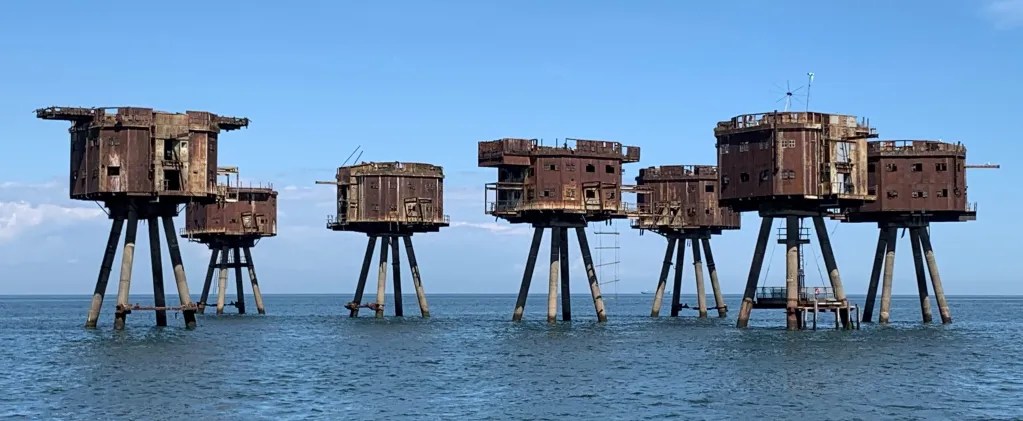
I’ll finish now with another of the many things I’ve been doing recently other than making felt. As I’ve mentioned more than once before, I am lucky enough to live in Whitstable, on the coast in south-east England. It’s a beautiful place and we get a lot of visitors on day-trips as well as longer vacations. There’s a Thames sailing barge called The Greta that in summer moors in the harbour where I often work. Built in 1892, she used to carry grain, malt and building products, and then beer, up the Thames estuary into London. She also took part in one of the most famous operations during World War 2 as a member of the makeshift flotilla that rescued thousands of troops during the evacuation of Dunkirk in 1940. Apparently, she’s the oldest active ‘little ship’ from that era. Anyway, some of my harbour colleagues go on an annual trip on the Greta to visit another World War 2 site, the Maunsell Forts, which are about 6 miles out to sea. These were part of a world war 2 sea-defence system designed to shoot down enemy aircraft that would fly up the Thames estuary from the coast to bomb London during the war. They were later used as a base for pirate radio stations broadcasting in the 1960s. Previously I’ve refused offers to join my friends on this trip as I’m a terrible sailor and believe I could feel nauseous in the bath. This year my desire to do the trip overcame my reservations and we set out on the calmest, most lovely day.
It was a fabulous day and I will definitely do the trip again. The final picture here shows the harbour village where I sell my work. I’ve never seen it from this angle before.
On Mondays, we have a social in the guild studio. I think some guilds call it open studio days. Because it is summer I usually go in around noon. I thought this would be a good time to do my visor cover. Jan can take some pictures too and all will be happy and bright. So naturally………
I packed my rolling mat, plastic, bucket, spray ball, rubbing tool, and wool but I forgot to ball of pencil roving. This is essential if I am going to try Ildie’s method of making the design with wet wool.
The forgotten ball
The best laid plans of mice and men often go awry. I am not a Mouse or a man so I had a look through the donated yarns and found one that was not too thin or tightly spun
This is as far as I got before I gave up. Yarn is not a good choice. It has too much structure so it doesn’t want to stay where you put it.
Besides learning that yarn is not good for this I also decided I had made the design too small. It will be very fiddly to add the colour.
Now I am back in the studio with all my supplies. All but one of the colours is Corriedale. One is Merino. the grey bat is unknown. I would say a medium wool and it is a short fiber. I sized my template for 30% shrinkage. you can get 30% out of most fibers. And why do a sample when you can live life dangerously?
The pencil roving was much easier to use to outline the designs. I wet it with soapy water and it stayed where I put it. The yarn had too many ideas of its own. I just did them freehand using the template to keep my design inside the lines.
This slideshow requires JavaScript.
Next was adding the colour. I got better as I went along. the first colours that have to be completely within the lines but right up to them is the hardest. When you add a colour next to another colour you can overlap and no one will see it. It will be between the other colour and the backing. Thinking upside down is a hard thing to do. you feel like you should say inside the lines. although I didn’t mess up the design lines I kept smudging the outside line. next time I will add them at the end.
This slideshow requires JavaScript.
I added the bat to the back. it was quite thin so I did 2 layers, one in each direction. and made nice straight lines, not that they will stay that way.
I rubbed this side first and then flipped it over. Doesn’t it look pretty all wet and bright under the plastic? Once I flipped it I was pleasantly surprised the sheep was on the right. Which, if you think about it, makes sense but when I was adding it I was thinking I wish I had left more space for it on the right. So that was a good thing.
I rubbed this longer than I usually do because I wanted the design to set well and stay put. I had no problem with it moving. boarder was another matter. it was constantly moving. I would lift the plastic and fix it. Then rub carefully and then it would move. In the end, I put it back where it should be and thought if it doesn’t stick, I will just needle felt it in place.
It moved a little while rolling but for the most part, it stayed put so I was quite happy. I rolled it a lot to get it to shrink. Whatever the bat is it makes a sturdy felt but does not shrink as much as Corriedale. I rinsed it with hot water and rolled it more, and more and when it wouldn’t budge anymore, I stopped. It got close but not quite there. I am sure it will still work but I haven’t checked yet.
It needs to be shaved to bring the colours back up and ironed to block it. I haven’t decided if I will add any stitching or beads. but I am out of time for now.
I bought a new to me car. The visor mirror cover was glued shut for some reason. When we tried to unstick it, it just came right off. Maybe it had fallen off so they glued it back on? I don’t know. The result is when I put the visor down I have the mirror. Even though you are not really looking at the mirror, it is distracting while driving. Must be because I am so beautiful I can’t resist looking at myself. LOL It is actually very hard to take a picture of a mirror and not be in the picture.
My thought is to make a felt cover for it and velcro it on to hide the mirror but I could still remove it if I needed the mirror.
I measured the mirror and a small amount around it to get the finished size I will need. I think I will add a little more.
Then I thought why not try Ildi’s method of felting with outlines and wet wool? I have some pencil roving and lots of wool and it’s a good sized to try it out. Here is a link to one of Ildi’s posts so you can see what I am talking about. https://feltingandfiberstudio.com/2022/06/27/felted-rug/
So far I have measured and done a couple of sketches of possible designs. these are smaller than they need to be but that is the size of the paper. I will have to find one of the larger sketchbooks to do a final design and then try to use the computer and the printer to enlarge it for shrinkage.
Aaaand, that is as far as I am. The plan is to have it for my next blog post, but we all know about the best laid plans of mice and men. I have my fingers crossed. It’s going to be a busy week.
We have three public houses in Sturminster Newton (at one time there were 11 in our small market town!) and The Bull Tavern is one of the oldest. The building consists mainly of a 3 roomed 17th Century cottage with an attic room, built of old timber infilled with wattle and daub. Some additions were made in the 18th Century. Records show that the cottage was definitely an alehouse by the late 1700s. Apparently there was a slaughter house at the rear and a Pound where straying animals were kept until collected – upon payment of a fee of 1 shilling (which must have been a fortune when you consider that a married man’s weekly wages at the Town’s Workhouse were all of 9 shillings and a single man’s only 6). Part of the C18th additions was a stable block (which eventually became a skittle alley and later part of the restaurant of the pub). It is rumoured that the horses stabled there were used to help get carriages and carts up the adjoining steep hill leading to Sturminster Common and the small community of Broad Oak.
About 18 months ago, after our then favourite landlords moved from the White Horse Inn in Hinton St Mary, the pub was closed for refurbishment. Hinton is a village about 1.25 miles away, where the Pitt-Rivers manor house is situated. We used to walk there 3 times a week – our exercise with benefits – but since the benefits had disappeared we decided to patronise The Bull – for our exercise of course. The only trouble with that was that it’s uphill on the way home whereas it was down hill from the White Horse.
During that time we had come to enjoy the chats with Marianne and Lance, the Bull’s managers. Lance being the very good chef, and Marianne “Front of House”. Early in January 2021, they announced that on Christmas Day they had got engaged.
One of my felt paintings – commissioned by a mutual friend – had been given to the White Horse landlords as a wedding present a few years ago, and Graham, my husband, suggested that I do something similar as a wedding present for Lance and Marianne.
My interpretation of an early image of The White Horse, Hinton St Mary
Although The Bull itself is a very interesting building, I wondered if I should do a picture of an actual bull for them. No date had been set for the wedding at that time, but I thought I should at least start collecting reference pictures, both of the pub itself, including some of their Pub sign and of some animals. I thought about breeds that might have been around in the 16th Century – White Park Cattle and black Gloucesters; and also looked at Herefords since that was the breed on the Pub sign.
The Bull Tavern and it’s sign
Gloucester and Park White Bulls
3 Hereford Bulls. I eventually picked the one at top left.
In the end I decided on a Hereford bull. After a lot of thought and manipulation of pictures, and also starting on a background field for the bull to stand in, I still could not come up with a layout that I was happy with. One idea was to surround the image of the bull with cameo pictures of nearby local landmarks – the water mill and the mediaeval bridge – with perhaps an image of the pub itself as well.
Initial composite picture
Second go at composite picture
Then, just after Christmas 2022, Marianne said that they had set the date for the wedding – 10th June 2023. Now I had to get my ideas together and get on with it. The picture would need to be simplified if I was going to get it done and framed in time.
It was about then that my picture of the horse on the hillside in Devon was finished and it occurred to me that I could use a similar method of producing a figure with more depth.
Detail from my Glorious Devon picture showing the horse added to the finished landscape.
I finally decided upon a cameo type picture of the bull’s head and shoulders and I would use the background which I had made back at the beginning of this saga. I would paint (with wool) the shoulders and neck and outline of the head on to a piece of flat wet felted core fibres. With a separate face and ears, and a further separate set of horns and the nose on another piece. I would cut all of the pieces from the backing when these were substantially finished. I would fix the torso and neck onto the original background and layer on the face and ears, horns and nose, then I would do the final titivating and framing. I made a start and here are the initial progress pictures:
This slideshow requires JavaScript.
As I said earlier, it was intended that this picture would be a wedding present for Lance and Marianne, but at the beginning of April this year, they told us that, because of various unforeseen difficulties arising out of successive pandemic lockdowns (which included them catching Covid between lockdowns so having to shut the pub again) they had decided to give up the tenancy of the pub. They had obtained a job, with accommodation, managing a Touring Caravan Park in Cornwall. Marianne was leaving almost immediately and Lance would stay on for a couple of weeks, with his last trading day on the 19th April. So the picture was going to have to be a leaving present.
That caused a bit of a panic at home as you can imagine, so I had to get my head down and finish it NOW! These were the final steps;
This slideshow requires JavaScript.
I managed to finish the picture and, with Graham’s help, I mounted it in a deep box frame in time to hand it over to Lance on the 19th, when we went in for a final lunchtime meal.
So here’s the completed and framed picture – my entry for the 2023 Third Quarter Challenge – Something Special About Our Town.
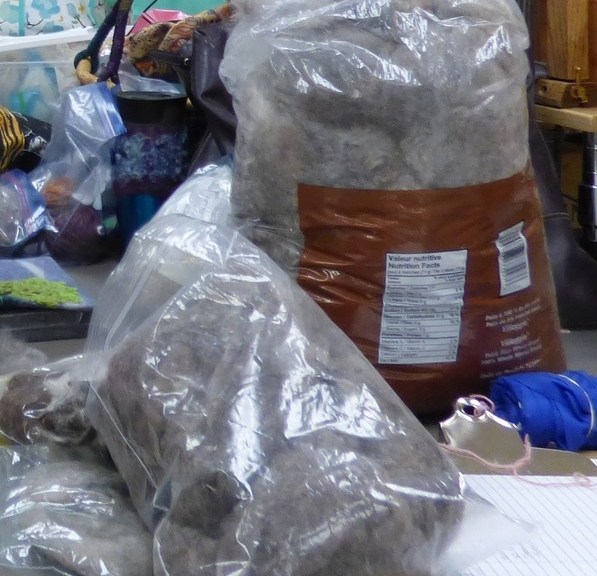
Thankfully I have friends with grey wool. Jan and Bernadette found me some grey in many shades so I could complete my picture. I explained to both that I only needed a little bit, a handful would be more than was needed. I just needed it for a few rocks on my picture
Picture of wool
picture of me taking a picture
I didn’t take any progress pictures of the rocks. I was busy poking and talking.
And finally the finished picture, or so I thought. when you take a picture, you can see so much more sometimes. I really don’t like the roots over the rock. I had tried putting a rock in front of the tree but that looked worse. So, I will take the roots off and continue from there.
I managed to take the roots off and played with the rock some more and now I think it really is done.
This is a guest post from Diane Coe, one of our readers, who recently submitted a photo for our 3rd Quarter Challenge. Thanks for sharing Diane!
My name is Diane Coe and I live in Featherston, New Zealand. I started being creative at a young age. Drawing, painting, and learning to knit from my Granny. I used to make tiny felt mice and exhibit them at a local annual art show as a young teen. Later on in life, in the 80s, I discovered Leadlight and produced for markets and made windows for houses. Then I progressed to Mosaics which I enjoyed for a while. I discovered a local felting group in 2014, and have been hooked ever since. Mainly I use wet felting with some needlefelt.
I was inspired to create Te Karanga Whakamutunga Ote Ruru (The Last Call of the Ruru (Morepork) from Maori Folklore, in which the Ruru is regarded as a guardian. With much of our planet being endangered, I wanted to portray the Ruru guarding the NZ Bush as a last call, as time is running out unless there is a change and more protection.
I wet felted the background and then needle felted, adding wool roving and balls of wool recycling from Op shops. The Kiwi is a scrap of possum fur. I spread out all my colours and fibres and picked up pieces to needlefelt as I went along, choosing what would work best for what I wanted to portray in each piece of the picture.
This close up photo shows more details of the intricate work.
There is hidden in the picture a Powelliphanta (native NZ giant snail). The piece took months to complete and is framed in native Totora farm posts.
This is the photo that I submitted of the piece for the Third Quarter Challenge. You can click on the photo to enlarge it.
Here I am in my studio, creating another landscape.
I have created other pictures like the portrait of my friends dog.
I have also entered recently a national competition in NZ called WoolOn, in which you can enter anything wool. It will be on the Catwalk and judged later in August 2003. Felting is a beautiful artform and a wonderful natural product. There is always so much to learn and create with.
Thanks so much Diane for telling us about your felting journey.
If you would like to submit a photo for one of our challenges, you can do so here. If you are interested in telling us more about yourself and your fiber art, we would love for you to write a guest post. Just fill out the Contact Us form to let us know of your interest.


 so that’s my adventure in felting this week. I hope you like it, I hope the winner likes their prize.