In my last post I was talking (among other things) about a 6-week residency I have in a local Michelin-starred restaurant that starts on 2 April. Here’s a link in case you missed it or want a reminder.
In this blog I’m offering a quick look at the pictures I’ve made (or am part-way through making) since then. I don’t have the space (or time!) to describe the making processes in a lot of detail but do ask questions in the comments section if you want to know more about something.
The restaurant owners suggested I’d need about 40 pictures to fill the 3+ rooms. I don’t have a lot of spare pictures kicking about – my felt picture making is usually fairly hand-to-mouth – so I really have my work cut out to make enough new work to fill the restaurant walls.
At the time of my last blog, I’d made 1 large and 3 smaller pictures. I then did a series of 4 slightly impressionistic ‘estuary water’ smaller pieces. I live on the north Kent coast of SE England and although it looks like ‘sea’, the stretch of water at the bottom of my road is technically the Thames estuary.
Top left to bottom right: Spring, Summer, Autumn & Winter
Spring is lightly pre-felted cobweb felts in blue and white laid on a pewter-coloured layer of wool that has a green layer underneath it.
For Summer I made some prefelts which I cut into shapes to try to give the impression of the shifting colours of calm water.
Dry layout for ‘Summer’; a combination of merino prefelt and tops
Autumn is altogether more turbulent with a lot of pewter-colour in the water. The estuary is often quite murky-looking. I’ve used either or angora or wool locks for the small wave crests.
And winter, like spring, is white and blue cobweb prefelt on a pewter background, but this time with more of the pewter showing and with pewter for both base layers, no green.
While rummaging through my extensive fibre collection, I came across a lovely hank of hand-dyed wool and silk fibres that I’d bought while on holiday in the USA. I decided to use this for a larger water picture.
Large sea pattern 2: final picture waiting to be framed, the layout and the fibre. The colour representation isn’t very good – the colours in the finished picture are warmer than they look in the photo.
I thought it was time to have a go at a larger bird picture. I’ve previously featured lapwings in a felt picture and thought I’d like to have another go at those. Lapwings are beautiful birds with iridescent feathers that appear to change colour depending on the light. I’d seen a large flock of them at a nearby nature reserve at Oare Marshes. Sorry the quality of these photos is poor, and you can’t see the birds’ colours, but I wanted to show you the lapwings I saw and what their environment looks like.
I started off with some nuno prefelt for lapwing 1 to try to capture that iridescence. These are mostly silk but the black is velvet devore, which I thought might work for the neck feathers. I laid out a bird-shape in white then cut the coloured prefelt to make wing feathers. While I was on a roll, I made another 2 lapwings, testing out different ways of trying to capture the birds’ colours.
Left to right: the layouts for lapwing 1, prefelt for lapwing 1, lapwing 3 and lapwing 2.
Here are the wet-felted bodies that I will needle felt into 2 backgrounds as I add the features: eyes, beaks and legs.
Top to bottom: lapwings 1, 3 and 2.
Oare Marshes is a fantastic place to see birds – with a great variety of migratory, overwintering and breeding wetland birds. However, as you can see in my photos, it’s not a conventionally ‘pretty’ place. I want to locate the birds properly so there’s a challenge in making a picture that is appealing while also being representative of the nature reserve.
This is the background for the solo lapwing (lapwing 2!). I’ve used 2 different sections of recycled silk scarves for the land section and merino wool for the water – with a few strips of one of the scarves to look like pebble and mud outcrops. Next comes the lapwing which will be needle felted into place and have its features added.
And here is the final picture
Lapwing, Oare Marshes
For the other two lapwings I decide to focus on the water rather than the land. Here’s the finished picture, with the lapwings needle felted into place.
I really love watching the birds that visit or live along the coast here. Oystercatchers are very distinctive black and white birds with bright orange eyes and beaks. This is the layout of a coastal background for an oystercatcher. The foreground is made from cut-up prefelt pieces that I’ve made, including some recycled silk fabric; the background is a piece of a beautiful charity shop silk scarf, and I used mostly kid mohair for the wave foam, with a few wool locks.
Here’s the oystercatcher’s body, needle felted into place, then given its eye, beak and legs. The beak is some orange felt I’ve made previously and the legs are recycled tapestry wool. I like how the kid mohair has a wiggly texture.
With an eye on getting the picture numbers up, I branched out a bit and decided to make some smaller monochrome pictures using a commercial merino and silk prefelt with a recycled wool scarf for the foreground. I then printed tree silhouettes onto them.
Once I’d pretty much used up the wool fabric, I tried out some pieces of monochrome silk. This is work in progress as I haven’t yet printed trees onto the other pieces. These aren’t my usual style but it’s good to mix things up a bit and they are comparatively quick to make. I may not put all of these into the restaurant but it’s good to have some options.
In the interest of continuing to mix things up, I then made a larger sea pattern, trying to capture the light and reflections that dance across the water.
And then, most recently, another big bird picture, this time of a curlew. Curlews are the largest European wading birds. They have long, curved beaks and very patterned feathers. Like oystercatchers, curlews can often be seen within a very short walk of my home. The best time to spot them, and lots of other birds, is as the tide starts to go out. They feed along the line of the retreating water. They have a very distinctive call and you can often hear them before seeing them. Unlike oystercatchers, curlews’ (and lapwings’) UK conservation status is ‘red’, which means they are either globally threatened, have a long historical UK population decline or there’s been at least a 50% decline in the UK breeding population over the last 25 years.
Here’s the final curlew picture: cut up prefelt for the pebbles; blue cobweb prefelt over a pewter background for the water; the bird wet felted separately then needle felted into place and given an eye, beak and legs. The beak is made from short lengths of variegated wool yarn and the legs from tapestry wool. The yarn, tapestry wool and silk fabric in the pebbles were all bought in charity shops. I really like the idea of recycling whenever I can, and it’s great that the charities benefit as well.
In the last couple of days I’ve been making 3D oyster and mussel shells. I haven’t decided exactly how I will use these yet, some kind of pictures.
Today I made a light background for one of the mussel shells. It’s still damp in this photo. I think the sea foam area will become lighter as it dries.
I’m still a long way from 40 pictures, although I did have a few already made before I started this picture-making marathon. Now I’ve more or less cleared my diary and I’ve got the rest of March to make more pictures, and to frame them all. I wonder what I’ll do with my spare time?!
I’d be really interested to know what you think so please do leave comments if you have them.
Sorry if this is popping up for you for the second time. I had to remove it last time because I posted on the wrong day. It seems I can’t read a calendar.
Last Saturday I taught a felted hat class. I had 6 students doing a variety of styles. I was sure I took more pictures but they are not on my camera so I must be doing something wrong. Thankfully, some of my students had pictures I could use. Thanks to all of you.
Let’s start with Dani’s hat. She wanted a cloche-style hat.
Then it was almost right but she wanted to flatten and shrink the crown. So, using her head ( it is your best hat block) we worked with the rubbing tool to get the hat to where she wanted it. She did do some more rubbing herself.
This is the finished hat. You can see she used a different colour inside.
Next is Leanard. Leonard wanted a Robin Hood hat. this is a hat that perches on top of your head rather than fitting down around your head.
Here is the layout
And the finished hat. I say finished, but Leonard is going to work on shrinking the length more.
Next is Christine. She wanted an oversized beret.
The finished hat. I think she was happy with it. What do you think? LOL
now we have Luna who wanted a witch hat. She picked a great deep purple for it.
This hat was a big layout so it took a little longer from start to finish and we ran out of time. Luna took it home for the final shrinkage and fulling of the brim to stiffen it.
Lastly, we have the 2 I don’t seem to have taken any progress picture of.
Barb’s Cloche hat. She used some silk hankies to decorate her hat they won’t show up well until it’s dry.
And Susan’s folded brim hat. The turquoise was such a good colour for her.
All in all, it was a really fun class with great results.
The guild I belong to is 75 years old this year. One thing we are doing to celebrate is a group tapestry. We have a picture of our Parlement Buildings in the autumn, divided it into 24 pieces and 24 members are doing one square each, in whatever technique they would like. The picture is heavily pixelated to blur it and make it easy for people to use different techniques.
They are due March 4 2024. I thought I better get started. I am the one organising it so I shouldn’t be late with my piece. I should credit Jan Scott here, it was her idea. I also have to credit her with great cunning as I am not sure how I ended up being the organiser.
Anyway, this is the square I have. It is off to the side of the picture. Because I have put off doing it, I was wondering why I didn’t pick just sky or trees for myself.
I had to go look to figure out what the dark piece sticking up was. I thought it might be a statue but seemed too tall. It is a pointed crenelation on the west block of the parliament. The building is hidden by trees and the angle of the shot. The pixelation and then enlarging added a white pixel where there shouldn’t be one.
I wanted to wet felt and nuno felt a piece so I started with some prefelt. A thicker piece of white with orange-yellow for the sky and green for the trees to start, then added some fibres
I realised this was going to end up too big so I moved everything in, then added the silk for foliage. I want them to have texture. I had to root through 3 large bins and a small bin to get all the colours I wanted. I do not know why no matter how much fabric you have it’s never the colour you need. I wet the background first and I wet the silk before putting it down. Wet silk stays where and how you put it.
This is what it looked like when I quit for dinner and the next morning dry. Everything looks so much darker when it’s wet.
The next morning I rinsed the soap out with hot water and started some hard fulling to get it shrunk to the right size.
ready for cutting
And finally the cutting. You can sort of see how much it shrank. The whole piece started out the same size as the red mat. the cut pic is 6.6 inches (16.75 cm) long and 6 inches (15.24 cm) high.
and the picture and the piece side by side. You can see one section of double layer silk didn’t stick down so I will fix that with a needle. I need to add in the crenellation as well with a needle.
With any luck by my next post, I should have it done.
And to lift everyone’s spirits and as proof spring will come here are early (sneaky ram) lambs born just a few days ago on a lovely warm and sunny day. they are not great pictures but the moms were sure I was a secret axe murderer or perhaps a wolf in people clothing and the lambs pick up on that and no one will give you a decent pose. and then add a very scary phone camera and there really is no hope. Good thing they are cute anyway.
Valentine’s Day is almost here, and many a lovesick young man or woman will be in agonies deciding whether to buy, or make, a love token or two for their heart’s desire. Or, will they wonder if all that effort infused with such emotion, will be appreciated or even reciprocated?
No? Yes? Too much drama? Stick with some tasty snacks, yummy chocolates and a lovely bottle of red to enjoy on my own? That will be me then!
Anyway.
I will join in, my grandchildren will have my love with these felt and fabric hearts filled with lavender from my garden, to place with their clothing in their wardrobe or chest of drawers. And as always grandchildren are my heart’s desire these days.
I have used some left over pieces of my flat felt, and some fabric that I have cut into heart shapes.
This is the front and reverse of each heart
Two fabric hearts, a lovely purple batik. This was a small piece of fabric picked up in a charity shop.
The hearts have been stitched these together using hand sewing, and decorated each with another smaller heart shape, mostly for interest.
I have a jar dried lavender left over from last summer, a couple of spoonfuls used to fill the heart shapes, and after filling the shapes, the opening has been securely stitched closed.
A little ribbon attached to the top and secured with a pretty button and these little hearts can be hung on a garment /clothes hanger if wished, or stored in a drawer. Either way the lavender fragrance will hopefully remind them of me.
This is the finished look of my felt and fabric hearts. I think they are pleasing to look at and they smell lovely too!
It is pleasing to see that my lavender shrubs are all putting on a fresh show of growth for the new year, and I can look forward to another crop of lavender for drying in the summer. Must remember to leave some for the bees though.
PS.
I seem to have got all my photo sizing mixed up this time, despite all best intentions of Ruth and Helene. I am sorry. I have a new phone too, mine had developed the battery life of a gnat, and had become very annoying. The new photos on my phone are not behaving on my laptop. Hopefully I will figure it out before my next post – fingers crossed!
Well, I must say this is the fastest I have ever done the challenge. In fact, I finished it before it was issued. It was a Christmas present for my hubby. My husband loves cast iron cookware. It does cook well and hold heat. He looks after them so I don’t have to worry about wrecking the seasoning by doing it wrong. The handles on the frying pans are hard to get a grip on when they are hot. Oven mitts always seem too big. we have some silicone ones but I always feel like the pan is trying to twist inside them. So this is where the felting comes in . I thought I would make some felt handle covers. wool is fire-resistant and a good insulator, so should work well
I measured the handles and then headed for the studio. I found a scrap of floor underlay for the resist and measured out 2 so I could do 2 at once.
Just about a perfect fit for my rolling mat.
I decided on a nice bright blue and added 4 layers of wool. I am not sure how much wool as it’s not a very large amount I just made sure both sides would have the same amount. Nothing beats guessing if it’s right. LOL
After both sides were wrapped around and wet I decided they were boring but being in a hurry ( leaving it too close to Christmas) I just added a strip of orange down the middle of both sides. I didn’t want there to be a right side up.
After wetting down it was on to felting: rub rub rub, roll, roll, roll.
I cut the handles in half so I had two the same size. Then a little more rolling and onto fulling. these are small and were coming together quickly so I fulled them in my hands by rolling them in a tube shape and in a ball.
One down and one to go
And they are now being used on the stove. they are nicly heat prove but not so thick you can’t get a good grip.
So how’s that for reading Lyn and Annie’s minds and being ready with my first post of the year? How about you? did you make someone something practical for Christmas or a birthday?
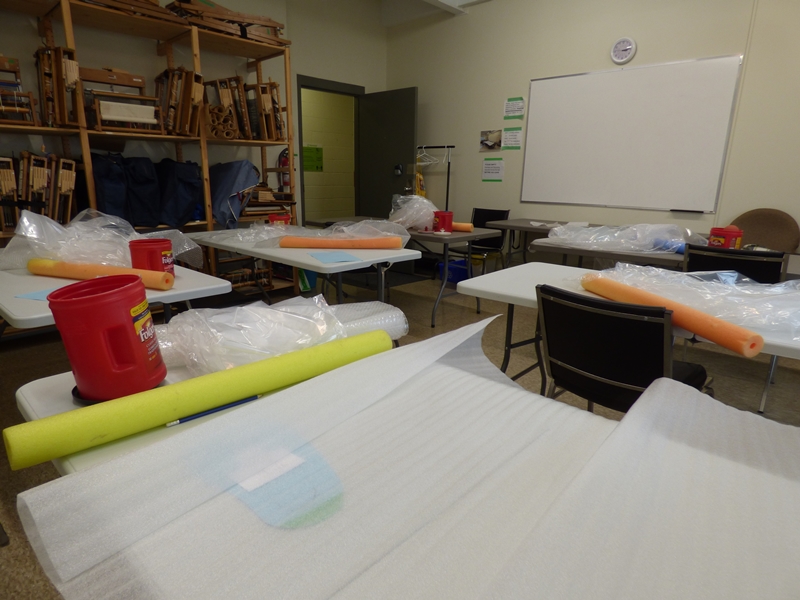
Not very long ago I taught a felt slipper workshop. There were 6 students including Jan. Here is the set-up in my guilds classroom It holds 6 tables reasonably well. You can see the table looms waiting for class on the left.
After we discussed the different styles of slippers, everyone traced their foot and sized up to make their template. We used floor underlay for the templates.
Everyone laid out both sides of their resist and got them nicely wrapped around
Then started embellishing them
Then it was time for felting. Start gently with some rubbing
Then rolling. No rolling pictures, you would think with everyone busy rolling I would have lots of time to take pictures but I guess I was too busy talking.
then more rubbing to heal the cut and on to fulling and shaping
And don’t forget to try them on to see where they need more work and in which directions. I brought new bread bags so they could try their slippers on without getting wet feet or socks.
Getting there
Here are some of the finished slippers.
Now you are probably thinking that at the top I said Jan was in the class but I haven’t seen her. Well, that is because Jan is the problem child of the class. She can’t just do what everyone else wants to do, and so she gets a section all of her own. Jan wants boot-style slippers. Ok, that’s no problem and you are wondering what’s the problem with that? Well, she wants really tall rear entry boot, style “slippers”.
I had her come to class early so we would have time to discuss the how of making rear entry extra tall slippers. She says they are slippers and not boots. You can see Jan’s diagram of what she wants in the first picture. I was explaining how the resists would work. This was best explained with a mini paper example.
Jan’s foot pattern and then her mane resist drawn out.
Jan started laying out wool about the same time as the others but she had much more wool and resist to cover.
she did a lot of rubbing but I didn’t get a picture of that and then she started rolling. By the end of class, the slippers had started to felt well but were not up to fulling yet. So now the next step is for her to visit me over the holidays and finish the slippers. I think this means I need to sweet-talk one of my men to bring the dryer into the studio. I am not sure where it got stored. I am sure letting the dryer do some of the manual work is a good idea. Maybe we can work on the dinosaur bag while it rolls around and around. These slippers should be good for sorting out what needs to be tweaked to make some more solid boots. These are Corriedale but we would both like to make some good boots out of Finnish wool. Have you made booths? What wool did you use?
As a measure of how much effort and concentration went into these, Jan only had about 20 or so pictures to share with me. All the pictures of Jan’s work are hers except the last one of Jan rolling.
As you’ve heard, here at the blog we did a Christmas card exchange. Well, not necessarily Christmas but I went with that theme.
I worked out my idea in my sketchbook and didn’t (I was sure I had) take a picture and now that pad has gone AWOL. It was simple trees. OK, I can use my computer to make a triangle by using the draw a shape thing in my wordprocessor program. No, problem. Now just drag it bigger to make the start size……nope triangles do not do that. I switched to publisher and with much fuss and bother and guidelines, I added the same amount to all sides and made a larger one.
I have already unpacked my stash of prefelt and put it into draws just like I was an organised, neat and tidy person. Well, that will last until I get everything else out of boxes and have to find a place for it all. Anyway, I got out the red and the white. seemed like appropriate colours. the red for the background and the white for the trees.
I wet the prefelt and shrunk it down to the size I wanted. checking against the picture I drew in my sketch pad.
then I cut the 2 sizes of trees the small ones will get needled onto the background and the big ones will be wet felted.
No jumping forward, I didn’t like the white trees but again I was sure I had taken some pictures here. Clearly, I was doing something wrong. I had my bag from the felted sheep glass handy and started adding curles. See the messy tendancies do come in handy sometimes. Now they are much better, textured, colourful and happy.
Here are the triangles ready for their turn felting
Again wite was do stark so I added some wool to them first. Blue, Green with sparkle and White with silk.
and all done and as shrunk as they can go.
I then added some curls as garland and embroidered some stars at the top so they look more like Christmas trees and not just random triangles. sorry no single picture of the green one.
For these trees, I added some pins and some gold string so they could be pinned or hung.
I thought about adding some baubles but |I thought they looked crowded on the small trees. They finished at about 2 inches I think.
Next, I pinned the trees to the card. I was going to send it this way but the packaging would have been too fat and turned it into a parcel and doubled the shipping. I took them off and put them into the envelope separately.
Usually, I make my cards postcard by ironing a print of the back of a paper postcard to it using fusible web. But I couldn’t find it. I printed out a card and tried to sew it onto the front of the card. I tried 3 times to do it and then gave up. I stuck some self-stick velcro dots onto the card and pressed the felt to it. No picture of that either as by then it was late and I wanted it in the envelope and ready to take with me to work the next day. It managed to fly over to the UK in record time and arrive safely at Lindsay’s house.
Lindsay kindly sent me a picture of what it looked like on the card.
This year, our merry (see what I did there?) group of crafters/blog writers decided to do a card swap among us. It didn’t really have to be Christmassy, it just needed to somewhat resemble a card.
The idea is to overthrow the ephemeral notion of a Seasons Greetings card on its head and make something with your own hands that a fellow crafter will appreciate and want to keep.
I was partnered with Hélène, felter extraordinaire, so I was naturally stressed out. I knew my card wouldn’t begin to compare with anything she created, but I put those pesky defeating voices aside and got to work.
It took me a few days to come up with a jolly (ha, again!, I crack myself up) theme for the time of year, and decided to join two strengths of mine: pattern search and knitting. Off to Ravelry I went browsing, and settled on Stay Cool by Drops Yarn.
First page results on Ravelry for the term “Snowflake.” Pretty, but not very card-like…
Stay Cool is meant to be a pot holder but I adapted it to be slightly longer on two sides and kept the back plain so I could attach it to cardboard. In hindsight, I could have knitted both sides in pattern, but at this point I was still a little fuzzy on my end goal. (Sorry, Hélène!)
I used my own hand spun yarn because I wanted the “card” to be as handmade and personal as I could possibly make it. If you want to get geeky with me with specs, I used white Shetland spun woollen from pencil roving for one yarn, and an Alpaca/Polwarth blend spun worsted for the brown.
Not unsurprisingly, the back came out “longer” than the front, despite having the same number of stitches. I should’ve predicted this because fair isle knitting constricts patterns a bit, but alas, I didn’t remember.
Now came the daunting part for me: wet felting. I wanted the end result to be a fuzzy and smaller version of the knit, so off I went to the kitchen sink armed with bubble wrap, soap and very hot water.
If you think this felted right away, you’d be wrong. Nothing happened for the longest time! In fact, I nearly despaired because my idea was to fuse the back to the front, and that never happened. Apparently, knitted jumpers accidentally machine washed only become tiny versions of themselves if you never intended for them to shrink – Sod’s law!
After what seemed like four years of wet felting, here’s what my snowflake looked like:
Hopefully it still looks like a snowflake to the untrained eye. I punched holes onto the thickest paper I could find and attached the wool to it with string, because I want Hélène to be able to take it out and use it as a coaster (or something else functional of her choice). This way she can always have a laugh every time she reaches for a hot drink and sees my meagre wet felting technique.
The ink I chose has gold shimmer in it, which I found quite Christmassy. I hope Hélène can forgive the “Xmas” instead of the word proper – I ran out of space.
(Aaand, a little confession: I cheated and sent my card swap partner something extra… ‘Tis the season, after all!)
That’s it from me. I have a newfound respect for anyone who takes the never-ending task of wet felting. What advice would you give me for future soapy endeavours?
It has been a busy few weeks getting everything ready for our Guild Sale. Now that’s done and over and I am sure Jan will show you lots of pictures. For me, I found the time to finish embellishing my visor mirror cover. For those that don’t remember the cover on the mirror of my car visor was broken when we bought it. When you flip the visor down while driving the mirror is there. It’s distracting. I decided it needed a cover. Nothing so simple as making a plain piece of felt to match the visor. That is much too easy. Here is a link to my last post showing how I created the cover. https://feltingandfiberstudio.com/2023/08/31/a-cover-for-my-visor-mirror-part-2/
I have continued on with my stitching. I wanted to use lots of different open background stitches. I didn’t want to cover up anything. I started working on the flower that looked like a superhero in flight.
I thought I better tackle the head next to stop it from looking like a person. I broke it into 2 areas. I think it worked well
Then I did this interesting stitch in the purple. Make 3 parallel lines and then come up in the middle go around all the threads and back down in the middle. I thought it was effective.
Then when I had just about finished everything else I decided to add 3 dots. I am not sure it looks like a flower but it looks a lot less like a superhero.
Next, it was this leaf. I thought I would do small stitches and go all the way around the middle but after a short distance, I didn’t like how the small stitches looked following the line exactly. I ripped them out.
I decided to use more threads and larger stitches and only follow one side.
And around the outside.
I liked it and I am getting very good at outline stitch. It was still a little plain so I added some colonial knots. Also in between I added some stitching to the small leaves. You can see a few in the picture.
I finished off this leaf and was thinking I was done, but…
My hubby said I needed to do the sheep and give him eyes and a nose. I had been going to leave him minimalist. It took 3 tries to get his eyes in the right place and the same size.
Now for the finished piece.
I had thought of cutting off the wonky outline but decided against it. Here it is installed. I used the hook side of some stick-on velcro dots, to attach it to the visor. It is a bit big but if it had been smaller the velcro dots wouldn’t have had a flat surface to stick to. Anyway, I like it and I will definitely do the wet wool technique again.