I had hoped to show you my finished Glorious Devon picture this post, but I’m afraid I’m not quite there yet so – (in the well known phrase from the kids’ TV show, Blue Peter) Here’s one I made earlier!
Just before our pantomime, The Little Mermaid, went into the first dress rehearsal, the wardrobe mistress asked me if I would have time to make a finalé crown for Maris. Maris was the sister of Neptune and Aunt of Serina, the little mermaid. It is our invariable custom choose specific colours for all the finalé costumes and this year they were to be predominantly royal blue with silver touches and for Maris’ crown I was asked to think of the effect that water makes when something is dropped into it from a height.
I had a look at Google Images for inspiration and collected together my materials ready to make a start. These consisted of a stainless steel headband, an empty plastic milk bottle, an empty Johnson’s Baby Shampoo bottle (the colourless ones they used before they changed the colour of the shampoo and thence the bottles) some royal blue organza, pale blue organza with silver/pearl embellishments, some silver lacy type fabric and some white/iridescent beads on wires that I had salvaged from old Christmas decorations (on the assumption that I’d find a use for them some day). You can see these in the pictures below (with substitute shampoo bottle as I’d cut up the original one before I remembered to take the photo). In the end I did not use the white braid that you can also see.
Materials
Salvaged Christmas Decorations
My idea was to make a double splash – a tall centre splash and a shorter outer splash. (I am pretty sure that I was not going to fall foul of any copyright since I don’t think there’s any such thing as a double splash.)
I cut the outer splash from the plastic milk bottle, stapling the pieces together; and the taller one from the empty shampoo bottle. As the shampoo bottle was not cylindrical, but flattened, I heated the cut out piece with my hair dryer and squeezed it until it became more cylindrical. Then I glued some of the royal blue organza onto it. I found this took quite some time to dry and fix itself so, as time was short, I painted both sides of the shorter piece with royal blue acrylic paint.
Outer Splash Unpainted
Inner Splash with Organza
Both Splashes Tried Out For Size
To represent sprayed water drops, I added some of the salvaged Christmas decorations to the outer splash, having first extended them by twisting two wires together. I used some silver glitter glue on fine wires to make similar “water drops” for the inner splash and added those. I also glued some of the embellished organza onto the outside of the tall splash. Then I fixed it inside the outer splash and stapled them together at the base. After cutting two slits in the lower edges of the crown through which the headband would fit, I covered the base inside and out with some of the silver lace type fabric to cover the staples and soften the edges a bit. I cut out some of the “wave” shapes from this fabric and glued them onto the outer splash.
Finally, I slid the crown onto the headband and it was finished.
FinishedCrown
Unfortunately, when I photographed the finished crown against a dark blue background, the silver came out gold in the picture – no doubt a trick of the light. The second picture was taken against a white background and some of the silver drops appeared black.
The wardrobe mistress was pleased with the crown, as was I, but I think it would have been better to have been much larger. It was a bit too dainty to be seen from the back of the auditorium.
Recently we have acquired a new bookcase for our living room. It was actually made to fit in the space between the front wall and the door of the room. However it has a sort of lip around the top, the corner of which was banged by the glass of the open door if we were not careful.
2 Views of the book case against the glass (with some of my menagerie in view on the book case)
Obviously we needed something to stop the door before it fully opened. After some thought I decided that it needed to be tall (so that we didn’t have to bend down too far to move it – the floor gets further away the older you get), but it needed to be thin too otherwise the door wouldn’t open far enough to let one of us safely into the room, especially with drinks in hand.
I wanted it to go with the colour of the carpet and I knew that I had somewhere in my stash a blue wool sweater that I had felted (on purpose) by putting it through the washing machine. I finally rooted it out and decided that I would use one of the sleeves, which had a pattern knitted into it.
The Other Sleeve – what’s left of it – the pattern looks a bit hazy but hang in there, you’ll see it later.
Initially I thought that I would make a tall thin pyramid shape to fit in the gap between the side of the book case and the door. I sewed up the cuff of the sleeve and, to make sure it didn’t keep falling over, I begged a piece of flat lead sheet from my husband which I fitted into the bottom of the stuffed sleeve, and then sewed up what had been the shoulder to make the base.
Well it was ok, but I thought it needed a bit more interest and decided to turn the door stop into a cat.
Out came the felting needles and my scoured merino, which I use as core fibres. Then for the “top coat” I sorted through the blues in my stash – normally jealously guarded because I don’t have a lot now as I use them for sky in my pictures – and found some which almost matched the main blue of the sleeve. Obviously he wasn’t going to be a realistic cat so I tried to “cartoonise” his features, and rather than give him needle felted eyes as I might normally do I fished out some bright orange glass eyes from another stash which would go well with his dark blue face. I used some of the blue to make a wet felt sheet, out of which I cut his ears.
Having made his head, I attached it to the tall thin pyramid. It’s sewn as well as needled on, but even so I was concerned that if he was picked up by his head it might come off. I made a piece of blue cord and attached that as a loop behind his head so that he might be moved safely. And here we have him.
Smiley Door Cat
Not long after this, we acquired a new pinky-grey bathroom carpet and also new pink and grey towels to replace very tired old red ones. Until then we had been using the bathroom scales as a door stop – that door will slam very hard if the wind gets up when the window is open. So now I decided that we would need another door cat.
When we got the new carpet we did not change the basic colour scheme as we didn’t want the hassle of changing the suite (vintage Pampas) or the tiles. The colour scheme is essentially derived from the tiles, which are pink and grey with some crimson detailing. Originally we had a red-ish carpet and red and dark grey towels, but when I bought those towels I could not get a bath mat to match, so I made one by stitching two red hand towels back to back.
Bathroom Tile
As the new carpet shed fibres quite a lot to begin with I thought of making the new door cat out of that fibre, but after a little more thought I realised that that would not be a good idea. We would keep falling over a camouflaged cat in the gloom of a late night visit!
So I thought I might find another felted sleeve, but couldn’t come up with something the right colour. Then, because we still had touches of red in the room, I decided that I would deconstruct the old red bath mat and use one of the pieces for the cat’s body. I had already given away the rest of the old towels to my friend for her dogs.
I felt that a “loaf cat” pose would be best, less likely to tip over if the wind caught the door, but I’d need too much lead sheet to make it a suitable weight. So I visited the garden and found a triangular(ish) shaped piece of rock, washed it and wrapped it in a couple of layers of non-woven cotton towels, secured with masking (painter’s) tape. I made myself a paper pattern of the body and cut out two body sides and a gusset for the base and chest. I cut out the pattern pieces from the towel and stitched it all up (first inserting the wrapped rock and stuffing it with polyester stuffing.
I had seen a cartoon of a smiling cat, which had enormous ears, which looked really cheeky. I thought I’d have a go at making one like that. I started with the core fibre again and got the head substantially how I’d like it and then thought about fibres for the coating.
Head ready to be covered in “Top Coat” (for some reason enlarged umpteen sizes)
I did not have exactly the right red, so had to blend a couple of pieces of pre-dyed merino tops which seemed to work ok. I did the same to make a pinky-grey blend for the chest, face and inside of the ears. I had decided that I would make the cat’s chest a similar colour to the carpet which meant that I had to make a wet felted sheet of the pinky-grey batt to cover the original red towelling. I cut the felt into the shape of the chest gusset, leaving enough for a pair of large ears.
I needled some of the red onto the back of the ears, and this resulted in a darker pink on the inside where the needles had pushed fibres right through, which was actually a benefit I think. I needled the blended red on to the back of the cat’s head and neck, and the pinky-grey onto the face, attached the ears and gave him a darker pink nose. I “shadowed” the smile and blinking eyes and I also gave him some laughter lines.
Nearly finished head, along with my felting cushion and a trapped needle holder
Then I stitched the head onto the neck, and the chest piece over his front, catching in the head at the neck. I covered the join with more needled fibres and, using another piece of towel, attached a handle to the back of his neck so that he could be moved without his head coming off.
Loving Blinks from the new Door Ward
My husband has already named him Yoda. We each confessed the other day that we both chat to him (in fact I pick him up and cuddle him too – he just fits into one arm)
What about the poor tatty sheep at the beginning of this post? Well, many years ago now, when I was a fairly new needle felter, I decided that I’d like to make myself a door stop for my bedroom door. I had acquired from our Guild a Jacob fleece, which, as it turned out, was ideal for needle felting. It certainly wasn’t a lot of good for wet felting – it wouldn’t, whatever I did to it. I suppose I must have had an old ram’s coarse and kempy fleece palmed off on me, when I was too naïve to know what I was getting – no wonder it was cheap!
Anyway, I got a body shaped pebble out of the garden, and washed it, wrapped it in some of the un- wetfelted fleece and started in with a No.36 felting needle (I only had 36 triangle and 38 star needles in those days- oh and a No.19 which was so thick it wouldn’t really go through anything I had with any ease). I bust quite a few needles before the pebble was covered. I added a neck to one end and then decided that my sheep would need eyes and a pair of horns. At that time I did not know that Jacob sheep often have 4 horns and wear them as if they had put them on in a hurry in the morning whilst still half asleep!
I made the horns and eyeballs using pipe cleaners and white Fimo polymer clay, baked and painted with acrylic paints. At that stage in my career I had not thought of using PVA glue on needled fleece to make horns. I needled a head shape around the horns and eyes, and then attached it to the neck. It did not occur to me to strengthen the neck with the ends of the pipe cleaners, I had cut these short and just put the horns on either end, and did the same with the eyes.
Well it all worked and for years he sat by my door, getting moved when necessary with my foot. Now he’s a sad old thing, but being sentimental I can’t bear to get rid of him, even though he’s lost a horn and is definitely the worse for wear. Perhaps I’ll give him a “makeover” sometime.
At the Waltham Textile group we normally have a biannual exhibition of our work but, due to Covid, it was cancelled in 2020 rescheduled for 2021 and then had to be cancelled again. It’s now been confirmed for August but in the meantime I’ve sold my main “Leaf” themed piece so recently made this mixed media “Monstera” to replace it.
I’m also thinking of submitting this piece for the 2022 IFA online exhibition which has the theme of Flora & Fauna. I’m waiting to hear if a mixed media piece will be accepted. I can’t imagine it being a problem but, if it is, I can simply crop one of the images to show the felted leaf.
I bought a 40cm x 80cm canvas with the intention of painting Monstera leaves on it and then adding a 3D Felted leaf. After drawing a template onto paper and offering it up to plan the layout I changed my mind about painting onto the canvas. It’s not something I’ve done before and the surface appeared to be a bit too textured for the look I wanted to create. Instead I sketched the leaves onto a piece of white cotton fabric, outlined them with an Inktense pencil and added a little shading. The aim was for very simple, very smooth, perfectly formed leaves looking more like curved metal than the foliage on my cheese plant. I think this was influenced by the very smooth metallic looking Tyvek seed pods I’ve been making lately. The Monstera in our lounge has been a bit neglected, to the point that I couldn’t bring myself to photograph it for this post!
I don’t consider myself a painter but I do like painting on to fabric. If you need to paint precise lines a good tip is to use aloe vera (by far the cheapest) or acrylic medium instead of water when applying acrylics on fabric. This keeps the paint where you want it to be and avoids it bleeding into other areas. I managed to get a tiny bit of black paint on the lower section of the fabric but stopped short of starting all over again when I realised the felted leaf would cover it up!
My paper template for the painted leaves was 13” x 18” so to make the felted leaf I multiplied by 1.4 enlarging it to 18.5” x 24” to allow for shrinkage. Layer one was a very yellowish green Merino (might have been lichen but not certain). Layer two was a combination of various shades of grey with the yellowish green running down the centre. This was topped with a layer of dark green Merino and Ireland Viscose all around the edge and snippets of gold Viscose down the centre. These images don’t give a true representation of colours but you get the gist.
After wetting out I measured the fibres and found they had spread to approx 20” x 27”. At the fulling stage, every now and then, I put the original template on top to check for size and ensure I was keeping to the right shape.
Once it had shrunk to the correct size it was left to dry. The next stage was to add wires to the back of the leaf so it could be shaped. This could possibly have been done with directional laying of the fibres and lots of fulling but I wanted the option of posing the leaf once it was attached to the canvas and wires are a good way of doing this.
The wires were spaced out and attached on the reverse using a zigzag stitch which also formed the veins on the front side. You can see that bright yellowish green colour on the reverse of the leaf. Once that was done it was just a matter of cutting into the felt to form the individual leaves and the characteristic little holes of the cheese plant.
After attaching to the canvas with a few strategic stitches the leaf was given its final shaping. It’s now hanging in the lounge above my cheese plant where it will stay until the exhibition…..although if I do get the chance to sell it I suppose there is still time to make another!!
I keep telling myself that I won’t “make” any Christmas gifts this year. It always takes more time than I expect but somehow, here I am again, making gifts. This post has very little fiber in it but there is some, I promise. As a maker, I know that I often venture into trying new things including new media outside of fiber art. I find that trying out a new media gives a new perspective to what I usually create.
My friend Deb is moving to Wisconsin and has been clearing out “stuff” in preparation for a spring move. She had boxes and boxes of driftwood that she had collected over the years and was going to take to the dump. Of course, I couldn’t let that happen so all the boxes of driftwood came home with me. And there I was looking at a source of free material with which to create gifts!
The first thought was to make trees out of the driftwood. All I needed to do was layout the right size pieces, drill holes in the center and thread a piece of heavy duty string through the holes. This is the layout for the first tree I created. You can see a couple of the boxes of the driftwood but that hardly gives you an idea of how much wood I had.
Here’s how the first tree turned out. I liked the look of it and so I decided to make more.
Here’s a few more that I got photos of. I ended up making nine trees total, five of which were mini trees. I still had tons more wood left.
My sister had requested a yard art armadillo, so that was next on my list. I looked through all the pieces and found what looked like parts of an armadillo. It’s amazing what the wood pieces start to look like in your mind’s eye once you start thinking of a variety of animals. So the photos above show the base that I glued and screwed together. I could have left him like that but I decided he needed some birch bark skin. I took a quick walk and found pieces of birch bark in the woods.
The birch bark was quite scrunched up and dirty. So I soaked it in water and then tied it around buckets to get it to be more circular. Sorry for the poor photo but hopefully, you get the idea.
I added the birch bark with a combination of glue and staples. It was pretty tricky and some cursing might have occurred.
Edgar was not sure about the new creature in my studio. Who is this? The only issue with this gift is that my sister lives thousands of miles from me and I didn’t want to try and ship this guy. I was sure that he would be “killed” by the shipping companies. Luckily, my sister is patient and we will take the armadillo to her on our next cross country trip.
And finally some fiber. I found this piece of driftwood that looked like a hat shape. I added a nose with glue and painted the wood. Then I glued down locks for the beard and pieces of felt for the brim and pompom on the hat. And there you have it, a Christmas gnome.
I made a total of three Christmas gnomes. I love how they each have their own personality. Do you make Christmas gifts? If so, we’d love to see what you have created. You can share with us over on the free forum.
I want to thank you all for being loyal readers and wish each of you a wonderful holiday season and a happy, creative new year in 2022.
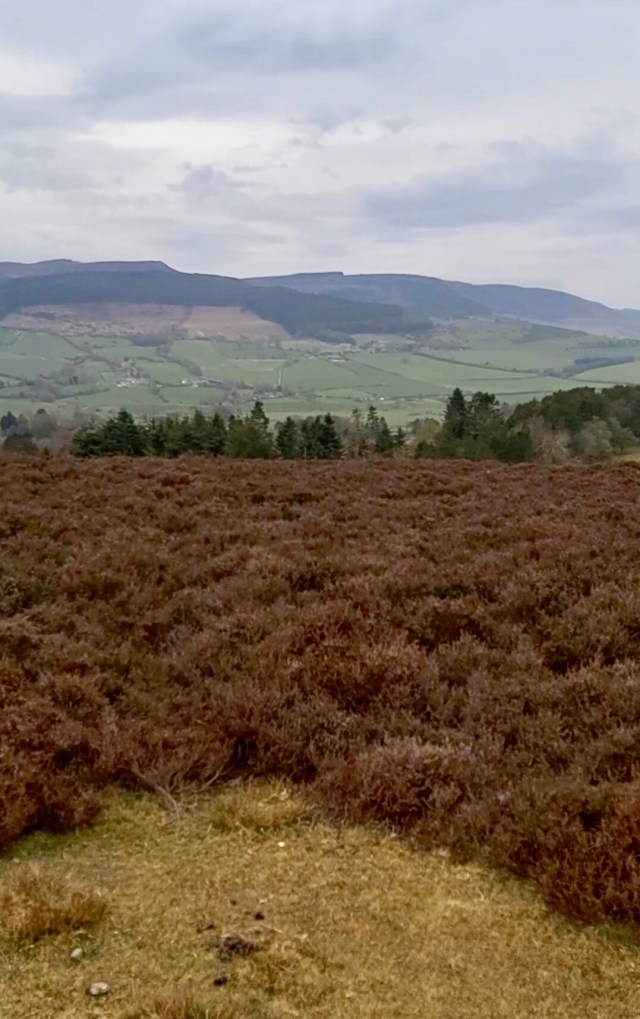
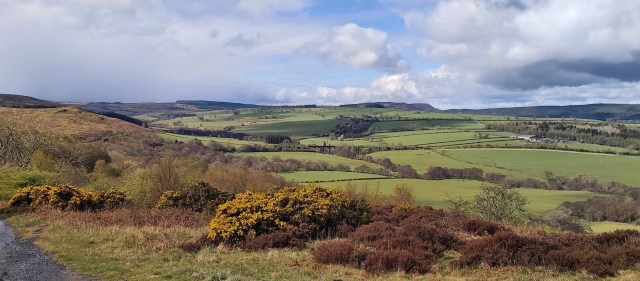
Two weeks ago I took advantage of Covid restrictions being lifted for self catering holidays in England and took off for a weeks holiday in one of my favourite UK destinations. Rothbury in Northumberland is a small, picturesque town nestled in the Coquet Valley.
Looking towards the town centre from south of the riverHeading downhill from my apartment into town
Unfortunately the weather forecast was looking bleak but I was going to make the most of it. I set off with my car packed with as much crafting gear as I could fit in i.e. fibre and felting equipment, fabric, sewing machine, etc, etc the plan being to have a relaxing break, do a little walking and create a piece of work inspired by the Northumbrian countryside. I would return home feeling refreshed, fit and with a finished piece of work…..if I only managed two out of those three (and I did) I wouldn’t have guessed which would have fallen by the wayside!
The view from the patio was pretty good.
Although there were occasional (very) heavy showers and lots of cloud the weather turned out be a bit better than I had expected so it made sense to pack a rucksack and walk during the day and leave the creative stuff to do in the evenings.
Rothbury is a great base for anyone who likes walking with beautiful scenery and lots of trails in the surrounding hills, forests and along the riverbank. Plus it’s only a forty-ish minute scenic drive to Beadnell on the coast, another favourite haunt, with almost deserted beach walks to Dunstanburgh castle heading south or Seahouses and Bamburgh Castle heading north.
Climbing the hill behind my accommodation gave stunning views of the Simonside Hills on the opposite side of the valley.Crossing the river and heading for the Simonside HillsA terrific downpour has just passed over!One of my favourite lunch stops on the riverbankHarbour at SeahousesPace Hill is a tiny spit of land jutting out into the sea just to the east of Seahouses Harbour.After clambering over the rocks I reached the curious stone construction which turned out to be a Grade II listed building dating back to 1886. It was built to store gunpowder used in blasting when the Long Pier and New Harbour were being built. On the horizon to the left you can just make out one of the Farne Islands.Lunch stop on the Harbour Wall on my way to Bamburgh CastleApproaching the imposing Bamburgh Castle from the south on an almost deserted beach.This is one of my favourite images of the castle and will definitely inspire a textile piece. I’m seeing the background and castle painted and the foreground grasses stitched.
I also came home with lots of dry stone wall images…..as if I don’t have enough already!!
Although I had every intention of being productive in the evenings the combination of loads of exercise, beautiful clean air, wine and a well stocked book shelf in my apartment, meant I didn’t get much creative work done at all while I was there! Who cares!! I had a terrific time and came home with a few of what I refer to as my ‘bacon rashers’ (lengths of abstract felted pieces, often with fabric included) in colours and textures inspired by my walks. Plus all the inspiration I needed to produce a large abstract mixed media piece based on the Northumbrian countryside including those beautiful rolling hills.
‘Bacon rashers’ formed from a variety of fibres and silk fabrics drying in the sunPinning together with sheer fabrics to try different layouts.
Since getting home the rashers, plus various other slivers of sheers and painted Lutradur, have been assembled onto a background of painted Lutradur measuring 110cm x 60cm and are now being stitched in position.
So far so good but the top left corner needs some thought.A few extra pieces of felt have been made to fill gaps while a fine tip soldering iron is used to cut the slivers of painted Lutradur.
Now I’m happy with the placement of all the pieces it’s just a matter of adding more free motion stitching until it tells me it’s done. Lastly I will make a wooden framework to mount it on and then it’s ready to include in the ”Final Show” (of the now defunct CCN group) Exhibition at the Sam Scorer Gallery in Lincoln from the 8th June.
It’s still a work in progress but the end is in sight!
Although I don’t normally make a big deal out of Christmas the one thing I’ve always enjoyed, and can’t imagine not doing, is decorating my tree. The bigger the tree the better….in fact if it doesn’t touch the ceiling it isn’t up to the job! At this point I will come clean and admit that, as the trees got bigger and bigger, I made the shift from real trees to an 8 foot artificial one. I can hear the groans from those who wouldn’t dream of buying artificial, that used to be me, but it is what it is!
Most of my tree decorations have been homemade or received as gifts with some of the quirkiest, and most meaningful, coming from my Aunty Das who sadly isn’t with us any more. These lovely wooden decorations were gifted from Das to my partner who’s hobby is flying.
And these are a few I’ve made in the past…..
These rosette paper baubles took hours to make and won’t be repeated! The dark one is 17cm diameter and was made from black and white photos cut from magazines, the other two are 11cm and made from an old book.
With a big tree there’s always room for more baubles and with the fourth quarter challenge being Christmas Decorations it was the perfect excuse to make more. I found some 10cm and 8cm polystyrene balls locally and covered the large ones with four coordinating cream/black fabrics and the small ones with four green/red fabrics.
Some of the balls have been cut into eight segments and others have had extra horizontal cuts to create a patchwork effect.I’ve found a stash of old baubles in the loft and these are getting a makeover this year, drawing on them with the hot glue gun and then covering them with Matt emulsion.
One of the first wet felting workshops I attended was run by Robyn Smith who taught how to make these gorgeous fairy boots…..I’ve made them as gifts every Christmas since then. With more time on my hands this year, and prompted by the Challenge, I’ve made myself some plus a few extras to sell.
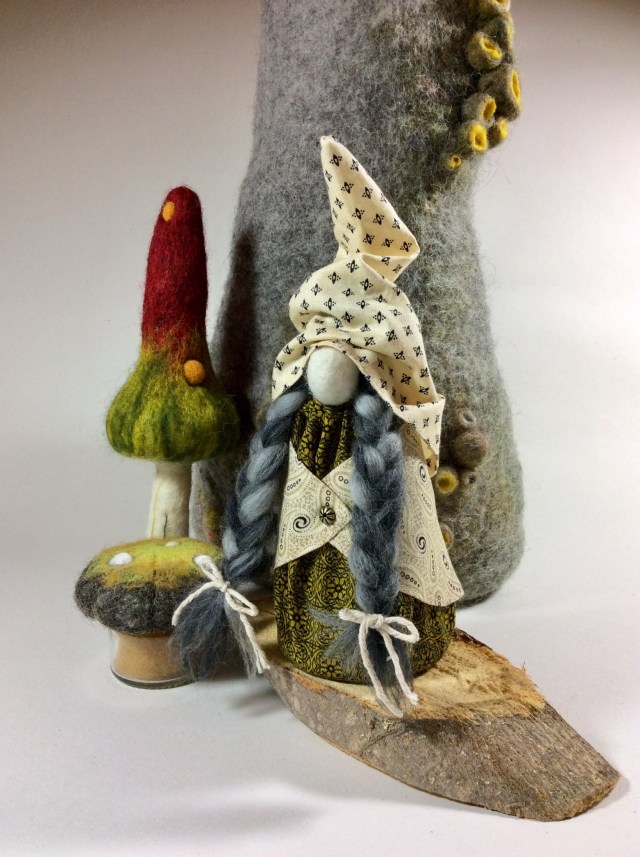
As it’s the season to be jolly, and gnomes have always made me smile, I’ve had a go at making some of those too. The Scandinavian gnome is typically associated with the Winer Solstice and Christmas season so I thought I’d have a go at making my version of a Scandi gnome.
The gnomes came about by accident really. Spurred on by the challenge I’d ordered some 14cm high polystyrene cones online (by this time we were in lockdown) with the intention of making Christmas Tree shaped table decorations. When they arrived every one of the ten cones was damaged.
Rather than send them back, the challenge now was, what could I make with them that didn’t need to be a perfect cone shape? That’s when the gnomes came to mind….the wonky cones would make the perfect base!
Originally I thought about making flat felt for their clothes but then decided to use the same cream/black fabrics I had used for the large baubles, plus a few others. Being in lockdown and wanting to get straight on with them I searched around for something to make the beards out of and found an old cardigan at the back of my wardrobe that had a faux fur collar…..needless to say it doesn’t any more! The first beard I cut didn’t look right. With trial and error I’ve discovered that the way to cut faux fur is by working from the back and only cutting the backing fabric, not the fur itself, using a scalpel blade. That way you get a nice shaggy beard.
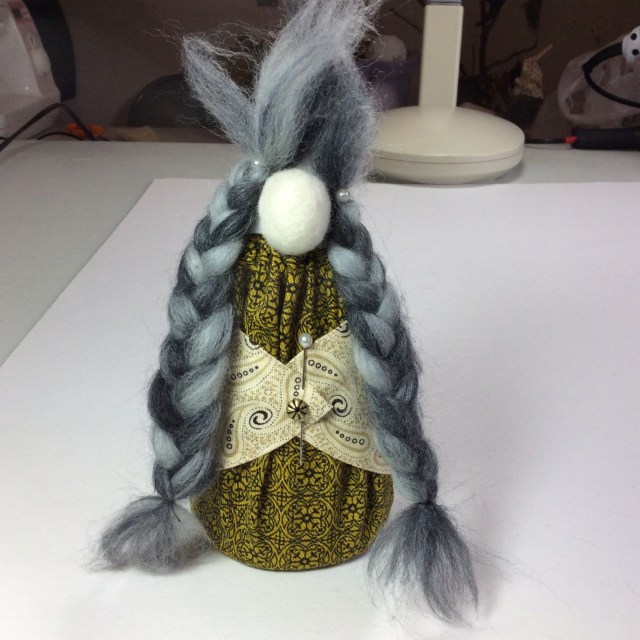
The females have Merino wool plaits and both sexes have felted button noses. I’ve machine sewn their outfits but if you were making these with children they could be made just with the glue gun for a quicker finish.
The clothes are simply a triangle for the hat, a semicircle for the jacket and a circle for the dress and/or gents undergarment.
The dress circle is simply hand stitched around the circumference, put on the cone and then pulled tight and the thread knotted. The front of the dress is then pulled up to approx 10cm from the base and hot glued in position.
I decided to use a belt and braces method to attach the nose as I was afraid it might get knocked off (really??) It’s been hand stitched to a strip of white fabric and that in turn is glued onto the cone. Thinking about it now, was this over engineered? Definitely!
The waistcoat was finished with a metal bead and the Merino fibre plaits attached either side of the nose using hot glue. The oversized hat has been glued in several places to create the sloppy look. To finish them off I’ve stood each gnome on a slice of wood.
I’ve had fun making these and I’m keeping a male and female on a shelf in my studio because I can’t look at them without smiling! Besides, a gnome isn’t just for Christmas!
Whatever you get up to over the Christmas period have fun and stay safe!
Last year I joined a group of creative ladies who meet once a month at Waltham Windmill. As well as working on our own projects we have a number of set “challenges” requiring us to work to a certain theme. This week I began one those challenges which is to produces three A4 size pieces of work using just three colours. Each piece is to have one predominant colour, plus a small amount of the other two. The format can be landscape or portrait but all three will be displayed together. The design, techniques and materials are entirely up to the individual.
My first thought was that I wanted my 3 pieces to be joined together and initially I was thinking along the lines of a leaf motif, using the veins to span the gaps between the work. The first design was for a very simple “spear” shaped leaf.
The second idea was to simplify it even more and loose the outline of the leaf. The background would possibly be heavyweight interfacing or Lutradur and the veins would be free motion stitched, spanning the gaps by stitching onto dissolvable fabric.
In the meantime I happened to take my dog for a walk in the woods at Hubbard’s Hills in Louth when I had a lightbulb moment! There were some wonderful exposed tree roots at the top of the hill and I suddenly saw these as being the joining element of my 3 x A4’s. The design now was for a “forest floor”.
I realised that I would need a sturdy backing so I’ve wet felted these using Bergschaf fibres and they will be individually mounted onto stiff card…..at least that’s the plan so far! There will be little background showing on pieces two and three but far more on piece one so I included some thick cords under that sheet of felt to indicate buried roots.
The tree roots above ground have an aluminium wire as their core, wrapped with wadding and strips of medium weight Lutradur before being painted grey.
I’ve started making the weeds using free motion stitch on dissolvable fabric but I will look at alternative materials, possibly Lutradur, to introduce different textures, create more bulk and not least to speed up the weed making process!
The fallen leaves at the base of the roots will be FM stitched on Lutradur. Once they’ve been cut out using a soldering iron and heat distressed to make them curl they will be painted in varying shades of gold.
I’ve managed to get a couple of other group members to send me images of their work in progress…..
Jacky approached the challenge by choosing blue, green and gold as her colours and using the “stack and whack” method to cut them up. After selecting her fabrics they were cut up quite randomly and then machined together in strips. The three sets were then layed on top of each other and sliced through again. The yellow and green shapes in the resulting strips made her think of plant pots and this led to her theme of “neglected pots and plants”. In this piece Jacky has added an appliqué cactus and free motion stitched the neglected straggly plants on the left. This one isn’t far off being finished but Ive been told the other two are still piles of fabric on the workroom table!
Carole has chosen to use a combination of plain and patterned fabrics in her chosen colour scheme of red, blue and yellow. Each of her A4’s feature a different piecing technique i.e. strips, curves and crazy patchwork. Again this is a work in progress but already you can see how individual members are putting their own mark on their work and how different everyone’s finished work is going to be. I will post images of the completed challenges next time.
This time I am going to show you about half of the rest of the show. It was a really big show. Some of the shots are not great but it was so crowded that there were a few that always had someone in front of them and I never got a picture. I made them into a slideshow so you wouldn’t have to scroll down to far.. If there is any artworks you would like the artist info on let me know I took a picture of all the cards that went with the artworks so I can get the info for you.
A friend of mine, Shirley, taught a dyeing class at the guild. After the yarns are dyed they cut the knots off to share them around the class. She saved me the knots.
The next thing I did was create a neutral background. I think the colour is called antique
Next I had fun picking the knots to use an lay them out in a spiral
I was quite pleased with the layout until I took a picture to show someone else. Then I thought that’s really boring. I went home and added some yarn and lots of little bits of throwsters waste. Throwsters waste is a by-product of reeling silk.
Here it is all wet down.
During the felting process one of the knots came undone. There was no way to tie it up again so I untied all the knots.
I really don’t like that. All the pattern is gone and you can’t see the background very well. Nothing ventured nothing gained so I decided to trim all the knots short. It still need ironing to block it out to 12×12 but I like it much better. Friends say it looks like a pond with flowers.