Browsed by
Tag: mixed media

The Fox

The Fox

You may recall that in a recent post I told you about the outsize flea I had been asked to make for the play “Flea the Pandemic”.  About a month ago the director of that play asked me to make a prop for one of the three one act plays he had written which SNADS have just performed under his direction.  He asked for a dead fox!

In fact the play called for a vixen which had been killed by hounds and he wanted it to be as gory as possible.

Once again I asked Mr Google for some assistance with basic reference images – of live foxes.  From these I determined the colours of fur fabric which I would need to use.

composite picture of a fox from all directions.
Reference photo – All round a Fox.

Having spoken to our wardrobe mistress and acquired some bits from our stash, I realised that I was going to have to get some paint as we didn’t have much in the way of correct colours.  I was able to obtain some “match pots” of acrylic decorating paint in tan, and dark greyish-brown together with a “fresh blood” red and a “drying blood” red.  I collected together other items which I usually find helpful in making props – some of my non-woven cotton cleaning cloths, empty milk bottles and other plastic vessels and a couple of plastic tubes of different diameters.

collection of materials for making fox carcase.
Collecting the materials and reference photos.

Mr Google next helped me with the size of a vixen carcase (though from whose website I cannot now remember) and the shape of a fox’s skull.

table of measurements and outline of fox to reference size of model.
Reference information re size of “carcase”.
fox scull side view
skull

The basic skull shape I made from some pieces from an opaque white milk bottle and masking tape.

Image of skull, white plastic milk bottle and partly constructed skull "armature"
Part made skull “armature”

I made an approximate size body using one of the non-woven cloths, which I stuffed with some recycled polyester stuffing and I covered that with fur fabric, but leaving the “belly” open.  I covered the skull with fur fabric using PVA glue and some strong thread, and stitched it to the body.  I added two back legs in fur fabric, one full length front leg and, as I was then running out of the fabric, a short one leaving the paw end open and painted red, inserting some more of the opaque white plastic cut into “shards” to represent a bloody shattered bone.

inner body of model fox
Basic body shape

I was lucky with the tail, as amongst the bits in the fur fabric stash there was a piece which was stitched  into a vague tail shape and it was darker and fluffier than the rest of the fur fabric I had found.  So I stuffed it and added a white tip to it.  I stitched that onto the fox’s rear end.

Long piece of dark red/brown long fur fabric and small piece of white fur fabric.
Tail Fabrics

I added some ears to the head, using scraps of the fur fabric stiffened with PVA and paint.  I didn’t bother adding teeth to the open mouth as the head was likely to be less visible to the audience.  I painted a black nose and black eye sockets.

I then had to brush over the rest of the light tan coloured head and body with a darker tan, which I had mixed from the new paint and some in my paint box, using the dry brush method, to represent something more fox-like.

Next came the gory bits.  I fashioned some organ shapes from the plastic bottles, and some entrails from some of the tubing and a couple of the milk bottle handles.

plastic tubing and pieces of plastic vessels painted to look like entrails and organs
Painted plastic organs and entrails

I noticed that a couple of the non-woven cloths which had been through the washing machine several times were beginning to break down.  Stretching them pulled the centre into holes which began to look a lot like caul fat.  So I cut some sections out and wrapped the “organs”.  This would make them more realistic although the full effect would be unlikely to be seen by the audience.

Then I got busy with the “blood”!   The paint covered the “organs” and the “entrails” quite well, although I later found that it would flake off the milk bottle handles and would need touching up. I also treated the open belly, the short front leg and the mouth with lots more “blood”.

The fox was to be fixed to a black board, which would hopefully blend into the black flooring that was to cover the shiny wood floor of the stage.  Once this had been delivered to me by the Producer, I stuck the body to the board with more PVA (what would we do without it?) and then arranged and stuck down the organs and entrails.

But something was wrong, it didn’t look right.  Then I realised that there wasn’t enough blood.  If the fox had been torn apart by hounds there would be blood everywhere.  So I got the paints out again and spread a good deal of it over the board and added lots more to the body.

model dead fox with entrails showing and one front leg short and showing bone. Blood everywhere.
Dead Fox

I have now seen the play and at the end the poor fox was accorded a solo spot on the stage.

The End.

Theatre Textiles – Act 2 Scene 2

Theatre Textiles – Act 2 Scene 2

This is a further Scene from my theme of costume and prop making for my local Amdram group, SNADS. The first one can be found here https://feltingandfiberstudio.com/2021/08/23/theatre-textiles-part-1/  followed by https://feltingandfiberstudio.com/2023/04/17/theatre-textiles-act-2-scene-1/

The next production for which I can remember making a costume was Sleeping Beauty in 2015.  I was asked to make the costume and do the makeup for Baskerville, the blood hound.  (You didn’t know that there was a dog in Sleeping Beauty did you? – How else did anyone find her inside all those brambles?)

After looking up some reference pictures (including one of Sir Clement Freud and his pet) I decided that the face would be part mask and part makeup.

Man - Sir Clement Freud and 2 bloodhounds
Sir Clement Freud and his look alike pet and another bloodhound – my reference images for Baskerville

The costume was in the main made from an old poly-cotton sheet which was a sort of mid brown colour with the odd dark brown markings in acrylic paint, and included a hood from which the long ears hung either side of the face. The mask was wet and needle felt, which covered the actor’s forehead, cheeks and nose, leaving large eyeholes.  This so that there was room for the eye makeup which revealed dropped lower eyelids.  The forehead had bloodhound-like skin folds, and the muzzle had my usual needle felted nose painted with Artist’s Gesso and then with black enamel.  The actor’s chin was visible beneath the mask so was made up to match it.

Boy on hands and knees dressed and made up to look like a bloodhound
Baskerville the Bloodhound

The next panto we did was Alice in Wonderland and I got roped into making bits for various animal costumes.  Unfortunately I don’t have any progress pictures and most of  the pictures I do have have been extracted from the DVD we had made of the show, so they are not of the best.  Hopefully they will give you a flavour of the costumes.

First there was the Cheshire Cat.  As with Baskerville, the cat’s body was made from an old cotton sheet, this time “dyed” ginger-ish with acrylic paint and with stripes added roughly following tabby cat images from Mr. Google (what would we do without him).

image of grey tabby cat face and brown tabby cat back
Reference images for tabby cat markings

The head and mask were also made from the same fabric and from felt.  The only photos I have of the Cat are of it inside a “tree”.  They aren’t very clear because the hole in the tree is faced with gauze so that you could only see through it when what was behind it was lit from that side.  This was so that the cat could slowly disappear as the light faded, leaving only a grin visible.

actor dressed and made up as Cheshire Cat and seen inside tree set.
Cheshire Cat inside it’s tree
actor dressed and made up to look like a grinning cat inside a tree set
more grins
Cheshire cat grin inside the tree set with 2 actors, (Dame and Joker) on stage
And just the grin, with Alice, the Dame (Alice’s nurse) and Joker (Queen of Hearts’ Jester)

Next there was the March Hare whose ears I had made from felt and attached to a felted hood; and the actor also used the muzzle with two front teeth that I made for her, also in felt.  Unfortunately it looks as if whoever did her makeup didn’t match the face colour to the mask so the Hare looks a bit odd.  This could be because the actor had a couple of other, bigger, parts in the panto, so her makeup needed to fit all three parts as far as possible.  I had made the mask so that it could be removed with the hood and that adds to the odd look I think.

Head and shoulders of actor playing Mad March Hare with felt ears and muzzle with 2 front teeth
March Hare with ears and teeth
actors dressed as Mad Hatter, Dormouse and Mad March Hare
The Mad Hatter, Dormouse (without his teapot) and March Hare in the final walk down.

The next and most testing task was the Hookah-smoking caterpillar and the subsequent butterfly which emerged from it. The script called for the actual metamorphosis to happen on stage, which was really going to pose a bit of a problem.  If this was going to work it would be necessary for the caterpillar costume to be worn over that of the butterfly.

In the story, the caterpillar sits on top of a large toadstool.   Usually depicted as a fly agaric mushroom – the one having a red cap with white spots.  This in fact is my scenery-making friend’s signature image and there are always some of these mushrooms somewhere about the stage in all our pantos (did you spot them at the bottom of the Cheshire Cat’s tree?)  Before the mushroom was made I asked that the back be cut away to enable the actor to be able to stand up against and behind its (chunky) stem.   I had decided that the caterpillar costume would be mainly affixed to the top of the mushroom and the head and “torso” would fit over that part of the actor which appeared above the mushroom.  The costume would have to be open down the back so that the butterfly could immerge from the caterpillar by stepping down and backwards.  I would need to make the butterfly costume first so that I would be able to fit the head and torso of the caterpillar costume over it with sufficient “ease” to enable her to get out of the caterpillar without assistance.

Again Mr Google helped me with reference pictures of a swallowtail butterfly, which I had chosen because of the lovely shape of its wings, and it’s caterpillar.

2 images - a green and black caterpillar and a swallowtail butterfly displaying its wings
Reference images for the caterpillar and it’s butterfly

I wanted the costumes to be as naturalistic as possible, which meant finding a way of making enormous butterfly eyes, remembering that the actor would need to be able to see through them.  I was sure that I had seen some half globes in clear plastic covering a large sweet, and after lots of buying and tasting (!) I found some, though I cannot now remember what the sweets were.  I made a mask which held these over the actor’s eyes and side of her head and which also covered the top and back of her head but left her nose and mouth free.  From the images on the DVD, it seems that I covered the globes in some way since it is not possible to see the actor’s eyes through them.  I can’t now remember what it was I used, but it must have been transparent at close quarters because the actor was able to dance around the stage without falling over the “little butterflies” which were dancing with her.

I made up the lower part of the face and I seem to remember making “mouth parts” and a version of the curled tube the butterfly uses to suck up nectar. These were attached to the mask between the bottom of the eyes.

head and shoulders of actor dressed as butterfly to give more detail of the head.
A very hazy image of the butterfly’s head (it looks as if she’s managed to dent one of the eyes, but I doubt that would have been visible from the auditorium.)

The butterfly’s wings, were painted white organza which had wire along the top edge.  I couldn’t add wire in the usual way the whole way round the edge of the wings because they would have to be squashed and held behind the actor’s back whilst she was still a caterpillar.  So we clad the actor’s arms and hands in black and she used her hands and arms to open and “flap” the wings.  This meant that the verisimilitude of the butterfly costume ended there – only one pair of legs instead of three.  I could have made some “pretend” legs to attach to the actor’s chest, but they would be likely to get hooked up inside the caterpillar costume and make metamorphosis difficult!

I made the caterpillar costume out of various bits of cotton fabric which I painted, and because the butterfly mask was quite large, the caterpillar had to be very large too.  The head of the real caterpillar is as wide as it’s body, which made that a bit easier.   I made it to fit right over the butterfly head and shoulders, with the actor’s black covered arms poking through as the first of the caterpillar’s six legs.  This was so that she could use the mouthpiece to smoke from the hookah which was sitting on a little green hump beside the mushroom.

Actor dressed as caterpillar with it's tail on top of fly agaric mushroom
Hookah-smoking caterpillar. You can possibly just see that the mouthpiece of the hookah is clutched in one tiny “hand”.
image of back of actor dressed as butterfly showing spread wings with empty caterpillar costume on top of mushroom and with Dame and Joker in background
The emerged butterfly showing off her wings. The empty caterpillar on the fly agaric mushroom is no longer smoking its Hookah and Nursie and Joker are seeing the little butterflies off stage.

Our next panto was Ali Baba.  I didn’t have to make any of the costumes for this.  I played the front half of Kamil, the clever camel, and when I wasn’t doing that, made up one of a trio of revolting looking gossipy women.

This was followed by “A Right Pantomime”, written by two of our members – “a comic conflation of almost every pantomime story you can think of.…”  I played one of Snow White’s dwarves (I can’t remember how many we were, but I don’t think there were seven of us) but wasn’t involved with more than helping with scenery.

I will end this Scene here, and yes I know that we still haven’t reached the Panto in which the Wicked Queen in the title image appears, but maybe next time.


FANTASTIC FUNGI

FANTASTIC FUNGI

I don’t know if any of you are fantasy fiction fiends.  Some years ago now I read the first of a trilogy by Alan Dean Foster, called Spell Singer.  It was about a man in the 1960/70s who managed to slip through time/space to a different dimension of our world in which animals wore clothes and talked (including Mudge, the man-sized otter with a foul mouth!)  So why am I mentioning this?  Well part of the story took place in a marshy area inhabited by a lot of very depressed mushrooms and toadstools with faces, which moaned and groaned and exuded misery, which was catching!

My mind immediately trotted down the rabbit hole of needle felting mushrooms – with faces.  Mushrooms and toadstools of different varieties would have different temperaments and expressions.  I thought of the white spotted red capped Fly Agaric; plain red capped Gomphidus Roseus (with a name like that they would definitely look odd); white button mushrooms; brown chestnut mushrooms; large flat horse mushrooms; fairy ring toadstools and, eventually, bracket fungi.

So I was off.

I decided that the bases of the fungi with stalks would represent a piece of turf, probably woodland or scrub.  I had purchased, a few years earlier, some fibres sold for lining hanging flower baskets.  It never got used for that because the bulk of it consisted of sheep’s wool, and I considered that it would be wasted if used for it’s original purpose.  From the look of it, and of the quantity of “foreign matter” caught up in it, it was the sweepings from a mill floor or even a shearing shed.  (I think that this was a good way of using up what would otherwise be wasted.  Unfortunately I don’t think it’s available now.)

All the material was roughly dyed green but luckily so patchy was the dyeing that it was not a flat uniform colour.  The different thicknesses of the fibres, the kemp  and the vegetable matter all seem to have picked up different shades and tints of green.  Just what I needed.

To save on this precious material, I used some scrappy scoured merino bits as a base for the underside of the grassy humps I was making, and then topped them with the basket fibres, and needled the lot together.  I was delighted to find that, even close up, the result did look like a bit of scrubland grass.

In each case my fungi were to have faces and, hopefully, characters.  I thought that as they were all wearing hats/caps, I’d place the faces at the join of the gills and the top of the stalk.  I also decided that, rather than just a single lonely fungus,  I’d make families.

4 felted Gomphidus Roseus mushrooms with bright red caps and daft faces
Gormless Gomphidus Roseus mushrooms
3 Fly Agaric mushrooms. Red caps with white spots and faces with blue eyes
Fly Agaric Mushroom family – Granddad, Mum and Dad with baby
4 felted large flat mushrooms with hairy brown caps and black gills, with faces
Hairy Horse Mushrooms

The horse mushrooms are hairy, not because they were horse mushrooms but because I used some Herdwick fleece for the caps and didn’t know about shaving in those days.

In the end, the button mushrooms and the chestnut mushrooms not actually having any gills on view, I placed their faces on the top of their caps.  I also gave the chestnut mushrooms Fymo eyes – little painted and varnished balls on each end of a piece of wire.

3 large button mushrooms and one small mushroom with bright blue eyes
Buttons family
3 Chestnut Button Mushrooms with surprised blue eyes in the top of their caps with 2 baby buttons
Chestnuts. Looks like the Dad on the left has 2 wives and children – naughty!

The fragile, skinny fairy ring toadstools were to sit together in a circle, as they do, on a larger piece of grass with so much magic erupting from it that it became visible.  This was represented by whisps of iridescent trilobal fibre (of which I have lots.)  There was also magic appearing on the tops of their caps.  These were made from scraps left over from a large piece of white merino felt in which a large quantity of the iridescent trilobal was embedded.  (More about this felt at some time in a future post.)

Ring of tall thin white and iridescent toadstools facing inwards, with iridescent fibres in the centre of the ring
Magic Fairy Ring Toadstools – chatting. What about I wonder?

These were the main families I made, but in the end I did make quite a few solitary mushrooms and toadstools (perhaps that’s why they were so melancholy?)

It was while I was making the Horse Mushrooms, which have black gills and therefore black faces, that I started to think about bracket fungi and Welsh male voice choirs.  I can hear you saying “why?”  It was the black faces.  I am half Welsh. My mother’s family come from a South Wales mining valley, Ogmore Vale, and all my Welsh uncles were miners (hence the black faces), and they were all singers.  (I even got to go down a pit on a rare holiday to stay with the family when I was about 7 or 8 – and I cried for the poor ponies down there even though they were well looked after).  Anyway Welsh miners were magic to me, and having been thinking about magic since I made the fairy ring toadstools, I wanted to create a magical tree stump on which to grow a male voice choir of bracket fungi.

The inside of the tree stump was made up of part of a Jacob fleece which had absolutely refused to felt, and subsequently ended up in the cats’ bed – disappearing over time bit by bit into the middle of other needle felted items.  I covered the stump in more of the basket fibres to represent a rotting, moss covered piece of wood. Thanks to the unevenness of the core Jacob I was able to easily create a surface with the ridges and dips usually found on oak trunks.  There were also what looked like various entrances to the hollow centre of the stump.  I lined these with black or dark grey fibres to give them depth and added some mixed brown and iridescent fibres to represent magic escaping from the stump.  In two of these I also added a pair of (Fymo) eyes peering out at the world.

close up of tree trunk showing bracket fungi on left and 2 holes with eyes peering out
All that can be seen of the internal inhabitants

I added a sort of representation of tree age rings on the top of the stump, but also allowed the hole in the middle of it to remain and added a lot more escaping magic fibres.

Close up of felted tree stump showing top - tree rings and "overflowing magic".
Overflowing Magic

I made a lot of bracket fungi, both representing individual singers (baritones and basses – big and bigger ones)

close up of several bracket fungi with faces, large ones to the front, smaller towards the back
The basses and the baritones
close up of one large bracket fungus with face, blue eyes, large nose and open mouth showing toungue
Big Bass himself

And Tenors, since they were smaller, in groups of three.

close up of tree trunk showing 4 bracket fungi each with 3 faces
Some of the tenors

I know I researched a type of bracket fungus and was able to give them black “faces” on the undersides and brown tops with pale margins.  However I cannot remember what they were, nor can I find my reference pictures.  They may have been polypores of some sort.

Having made a batch of the “choir members” I needled them on to the stump, adding faces  with  singing mouths.  I attached the stump to an artist’s canvas board, 20” x 16”, which I had covered with a piece of cotton patchwork fabric, coloured in various greens, to represent the surrounding trees.  Originally I wanted to add a “dead man’s fingers” fungus, which could be conducting the choir, but at that time I had not heard of using an armature and it wouldn’t stand up on its own, so I gave up that idea.

A felted tree stump with bracket fungi with faces on a green background
The finished Tree Stump

My husband thought that the mushrooms would sell like hot cakes, but unfortunately I think I only sold one family.  I ended up giving the rest away, apart from the tree stump which I have retrieved from the attic.  I’d like to hang it on a wall in my workshop – if I can ever find a space large enough for it – if I can I might have another go at the dead man’s fingers.

Bags of Inspiration

Bags of Inspiration

Having just read Kiki’s tutorial  https://feltingandfiberstudio.com/2023/11/19/left-overs-yessss/ on using up prefelt scraps, it occurs to me that I may not have mentioned something we used to do at our Guild (Dorset Guild of Weavers Spinners & Dyers) mainly to raise funds for the Guild but also for fun.

When I attended the Stitch and Creative Crafts Show at the Bath and West Showground in Shepton Mallet (Somerset, UK) back in 2010  – I saw a stand selling (for £8.00 each) bags containing 35gr of silk fibres, yarns, fabrics scraps, carrier rods and cocoons in various colours, left over from old projects which, when put together, made a fascinating collection for future projects.  So fascinating that I bought three of them.

They must have made quite a bit of profit on them because they appeared mainly to be the “waste” from artwork.

At that time (when I was part of the sub-committee organising the Guild’s Exhibition and Sale of Work) we were looking for a Guild Project which could be part of the exhibition or something hopefully to help raise some funds.  Well, I thought, our weavers must have lots of off-cuts of hand woven fabric, not to mention warp ends.  Then there were the spinners who would have odd bits of spun and unspun fibres of all types and colours.  We also had members who were dressmakers, beaders and embroiderers, and a soft furnisher, who were bound to have the odd bits and pieces that they didn’t really need.  So, with the blessing of the committee,  I put it to the members in the next newsletter that if they would donate to the Guild any odd bits of fibres, yarns, threads, warp ends, bits of fabric, beads, button, feathers, felt, cords, braids, tassels, sequins, sequin waste, ribbons, silk flowers and any other bits and pieces they could think of, we could make up some “Bags of Inspiration” and sell them to members of the public at our open days and outside demonstrations.  (I don’t know about in the rest of the world, but in the UK the word “bags” means “lots of” as well as “containers”, so the punning name “Bags of Inspiration” seemed apt.)

We used A4 sized polythene bags (which I was able to buy quite cheaply from our local green grocer) with an A4 sheet of card inside for stiffening, and I made up some stickers with the Guild’s logo on and a brief description of the contents, and posters also giving details of the contents.

Image of a poster detailing contents of a Bag of Inspiration
Bag of Inspiration Poster

We arranged a few bag making days at a pub in the village where our then President lived.  She had persuaded them to let us use their skittle alley at no charge, and we had a great deal of fun making up the bags and tucking in to “refreshments” from the bar and kitchen.

The members who came to these, brought with them all sorts of goodies which we spread out on tables, so that we could make collections of pieces which seemed to go with each other.  Those who didn’t think that their colour theory was good enough, could pick out a picture from a selection of magazines and have a go at matching colours from this  It was amazing how compulsive making the bags became.  You could pick up a piece of fabric that looked so dull and dreary and be amazed how it perked up and positively shone with life when paired with different fabrics, yarns, trimmings etc.  You just couldn’t stop picking up likely bits.  The difficulty was keeping the weight of each bag between 80gr and 100gr, so we quite often ended up making up at least 2 bags with similar contents.

image of tools and accessories for making up Bags
Equipment & Extra “Bits” for making up Bags
Prospective contents of a Bag of Inspiration - fabrics, yarns, fibres etc.
Prospective contents of at least one Bag of Inspiration

We put a price of £3.50 on each bag and they went like hot cakes – we sold out on their first appearance at our exhibition and sale of work.  Embroiderers and mixed media artists in particular liked them.

After a couple of years, we didn’t get so many volunteers to make up bags but we still had mountains of “stuff”.  So we added another string for our open days – Pick and Mix Your Own.  I had remembered that Woolworths (now there’s a blast from the past) used to have a counter full of different sweets and you could take a bowl and pick and mix what you wanted, and in the process buying a lot more than you would have if just buying a ready filled bag.

Boxes of different sweets to be picked and mixed
Pick and Mix Sweets.

It worked with our stuff too.  We gave the visitors the polythene bags and they could wade through all the bits and pieces picking what they needed, and we weighed them when they’d finished, charging £3.50 for 100gr.

We had had a lot of fibres donated so we started making up what are now called Art Batts and selling them as “Batts of Inspirations”, but because we were mainly selling these to Guild spinners and felt makers, they didn’t do quite so well as they were mainly able to make their own.

In all we made around £1000.00 for the Guild in the four years we were doing this.  Eventually though the members got fed up with spending time on making up the bags and the whole thing was shelved, as the Guild seemed to be relatively well off at the time.

Some time after that I took the idea back to myself and I was making up Batts to sell at Guild meetings, using luxury fibres as well as merino and synthetic fibres.  I made up some bands to fix around the Batts detailing the various fibres included in each.

This slideshow requires JavaScript.

I was also making up and selling Bags, mainly at a Needlework Festival in Dorset where most of the vendors were selling materials and equipment for crafters, as well as various craft fairs and so on.

This slideshow requires JavaScript.

I was getting the odd question like “they’re lovely but what do you do with them?” and  “can you make a bag out of what’s in here?”  So I made a sign from images of items that I’d made myself over the years and that helped.

Image of items made with contents of Bags of Inspiration
Some of the things I’ve made with the contents of BoI over the years

However, once Covid started causing problems, my selling opportunities dried up.  I had been intending to try selling Bags and Batts via my website, but it was very difficult and too time consuming to photograph the Bags so that the contents were visible, because of reflections on the polythene bags.  So that sort of died a death too and I’ve now shelved that project, and am using the bits and pieces I’ve collected over the years on theatrical costumes and props.

Perhaps some of our readers’ organisations, like Ann & Jan’s OVWSG, might use this idea to raise funds?

Local Heraldry

Local Heraldry

Ever since I had visited Kew Gardens as a child and seen the statues of the Queen’s Beasts lined up outside the great Palm House, I have been fascinated with heraldic animals and heraldry generally.  [https://www.kew.org/read-and-watch/the-queens-beasts]

When we moved to Sturminster Newton, every day I came home over the mediaeval bridge I saw the Town’s Coat of Arms.  We have a large (about 10ft high) coloured display of these Arms marking the entrance to the town.

In 2007, when I’d reached the age of 60 and reduced my working days to just 3 days a week, I was looking for something to keep me occupied.  By that time, I had met our Town Crier, who when not Crying worked in a local store.  Kevin Knapp was a popular figure, regularly opening events and leading processions in the town.  He had also won numerous Crying competitions.

2 images of Kevin Knapp. On left he's leading the Town's 2008 Remembrance Parade. On Right he is posing in front of the Sturminster Newton Mill
Town Crier Kevin Knap – Left: Leading the Town’s 2008 Remembrance Parade. Right displaying his costume in front of Sturminster Newton Mill

Having inspected Kevin’s Crying uniform, I realised that he had lots of different badges, most relating to awards he had won but also the County Arms, but not the Town’s.  I thought that this could be a project to keep me busy, having consulted Kevin who said he’d be pleased if I could make a badge of the Arms for him.

After a visit to the Town Council offices, where I had discovered that the original Letters Patent – the deed granting the right to use the Arms – were held, I asked the Council formally for permission to photograph the Deed and to make the badge for Kevin. Once I had received permission, I went, with my husband, to the Offices and we photographed the Deed. That wasn’t easy as the Deed was housed in a purpose made, glazed, cabinet which hung on the wall in the Council Chamber. Eventually we managed to get a reasonably clear picture without too many reflections on the glass.

Image shows hand written Deed - Letters Patent - with images of the granted Arms and Badge painted on it
The original Letters Patent showing the Arms granted top left and the Bull’s Head badge bottom centre. The other Arms shown are those of the three Heralds who made the Grant.

The Letters Patent, couched in the archaic style of the Norman French which characterised early English deeds (though thankfully not totally in that actual language) was dated 1st September 1961. It evidenced that three English Kings of Arms – Garter Principal King of Arms,  Clarenceux King of Arms and Norroy & Ulster King of Arms. authorised by the Duke of Norfolk – Earl Marshal and Hereditary Marshal of England – granted to the then Sturminster Rural District Council “such Armorial Assigns and in the same Patent such Device or Badge as may be proper to be borne and used by the Sturminster Rural District Council and by its successors constituting each for the time being the local authority for such place and district on Seals or otherwise according to the Laws of Arms” (note the lack of punctuation – typical of legal documents in this country even today); hence the right of Sturminster Newton Town Council to use the Arms and also the Bull’s Head Badge. The Badge’s primary use would be to mark the Council’s property (including, some 800 odd years ago, it’s serfs, servants and men at arms!)

Image of a Bull's Head within a ring with "sun's rays" around the outside, all in Gold with black outline
The Bull’s Head Badge painted on the Letters Patent

The actual words of the Letters Patent describing exactly what was granted are: “Vert [green] a Saltire [diagonal cross on a shield] Wavy Argent [silver] between in pale [one above the other] two Crosses Moline [having jagged ends] and in fess [horizontally] two Garbs [sheaves of corn] Or [gold] And for the Crest [device sitting on a helmet] Out of a Coronet composed of four Ears of Wheat and four sprigs of Oak fructed [with fruits] set upon a Rim Or [gold] a Mount Sable [black] thereon an Heraldic Panther statant [standing on all 4 feet] guardant [shown full face] proper [lifelike colours(!)] Mantled [with cloth on helmet] Vert [green] Doubled Argent [on the reverse silver/white]” and the “Device or Badge”: “Within an Annulet [hollow roundel] Reyonnée [with sun’s rays] Or [gold] a Bull’s head caboshed [without a neck] Gold”. The Arms and the Badge were also drawn on the Deed for further reference.

Having got all this information from the Deed I started to prepare a working drawing indicating what stitches, yarns and cords I would be using.

A drawing of the Coat of Arms in outline with lists of goldwork stitches and indications of where these are to be placed
Working Drawing – you may be able to decipher my scrawl of what I was intending to do at that stage.

In doing so, I realised that the Heraldic Panther was a very odd creature: it appeared to have orange flames coming out of its ears and mouth and it was spotted – red, blue and green spots!

drawing of heraldic Panther, yellow body & face, with large blue red and green spots on the body and flames coming from ears and mouth
The Heraldic Panther painted on the Letters Patent

So I headed to the library to see if they had any reference books which might throw some light on this.  Luckily there were several in the catalogue, but none at our local branch, so I would have to wait for one to arrive.  When It did I was able to find that the flames were a mistake made by the artists painting the arms on early Letters Patent.  In the book there is a reference to the Garter King of Arms writing in the early 17th century regarding the Heraldic Panther: “this beast … is admired of all other beasts for the beauty of his skyn being spotted of variable colours; and beloved … for the sweetness of his breath that streameth forth of his nostrils and ears like smoke, wch our paynters mistaking corruptly do make fire.” Further reading indicated that the origin of the panther was likely to have been a cheetah, hence the (guessed at coloured) spots.  You will note that I was down another rabbit hole!

Well our panther was shown on the Arms as having flames coming from his ears and mouth, so that’s how I’d got to depict him.  It was also then that I realised that the Arms as granted were not exactly the same as the Arms currently used by the Council.

You will see that in the current version of the arms, the Bull’s Head Badge appears five times on the mantle, which has been altered to enable the badges to fit. (The mantle represents the cloth which the Crusaders wore over their helmets to ward off the rays of the sun)

Apparently the then Sturminster R.D.C. decided to use it to decorate the actual Arms instead of to mark it’s property (and/or servants!)

After some manipulation of the photograph of the Deed I managed to get a reasonably clear image of the Arms and could make a tracing to use to transfer the design to the background I had prepared

During the time that I’d been waiting for the book, I contemplated the fact that the actual badge would be very much smaller than the original tracing and I’d be lucky to be able to carry out all the various stitches I’d originally envisaged, and I wondered if I might make some of the badge in felt.  I needed to make a “sketch”.  Using a piece of old blanket as a base, I transferred the design and filled in some of it in needle felt.  I thought that this would work.

image of partial needle felted coat of arms
The partially needle felted “sketch” of the Arms

It would certainly make life a bit easier as I was not very experienced in gold work and doubted that I could do a good enough job in the smaller scale. As it was I managed to lose the “jagged” ends of the two gold crosses and the Saltire was not really “wavy”. It was supposed to be a nod to the river Stour, which divides Sturminster from Newton (which despite it’s name is in general the older part of the town).

In the end I felted the Helm, with the gold Rim and the Panther. I also padded the sheaves of corn. Here’s a progress picture and another with felting needle which will give you an idea of the actual size of the whole thing.

Once I was reasonably happy with the shape of the helm, I painted it with artists’ gesso and then (when it was dry) sanded it as smooth as I could get it.  Then I painted it with some of my husband’s metallic enamel paint to represent steel. (Can you imagine what a squire’s life must have been like sanding and polishing a suit of armour and weapons made of steel to get rid of and keep it free of rust? – no stainless in those days.)

It did take some time to complete the badge – some 4 years in fact although I wasn’t actually working on it all the time.

Image of finished Coat of Arms with full coloured green satin stitch, silver and gold work.
The finished Badge

Oh I nearly forgot – the motto “Quis Metuit?” means Who’s Affeared?  It is apparently used by many local authorities – I’m not sure why though and, for once, the question defeated Mr Google.

The Town Council, in the form of it’s Leader, formally presented the badge to Kevin on 30th November 2011.

Image of three people - Left Charles Fraser, the Author and Kevin Knapp, he being presented with the completed badge.
L – R: Charles Fraser, Town Council Leader; Me; Kevin Knap at the presentation of the Badge. The picture above my head shows Sturminster Newton Station as it was in the days of the Somerset and Dorset Joint Railway.

Kevin decided that rather than attach the badge to his coat, he would affix it to the back of the roll containing his Cry so that it would be visible when he was reading from it.

Sadly Kevin died on 9th October 2018.  His wife donated his costumes (which she herself had made) to the town’s Museum.  I’m not sure what happened to the Badge though as the Museum doesn’t have it.  The position of Town Crier remains vacant.  If you are interested, I’ve found an obituary for Kevin published by the Bournemouth Echo.  https://www.bournemouthecho.co.uk/news/16998263.kevin-knapp-died-earlier-month/


Making Waves Update

Making Waves Update

In my last post I mentioned a few of the projects I was working on with the “Making Waves” theme, along with other members of the Waltham Windmill Textile Group. I’d begun work on a 50cm x 90cm felted wallhanging inspired by the markings on large stone slabs on the beach at Seahouses in Northumberland.

Having recently bought myself a drum carder I carded a variety of left over bits of fibre, mainly blues, greens, yellows and neutrals, to make my background and laid them out with off cuts of hand dyed silk fabric, scrim and large nepps. On the left is how it looked after felting and on the right is where it’s at right now. I’ve added synthetic sheers, machine wrapped cords, hand and free motion stitch and in some areas I’ve heavily machine stitched to push them back and encourage the adjacent areas to stand out. The original bottom left section wasn’t working with those silk circles so they were pulled off and replaced with some stiffened, rust dyed fabric circles, recycled from another piece of work. I’m calling it Going With The Flow because a) it’s inspired by a trip to the beach b) it has flowing lines and c) like most of my work its design wasn’t preplanned. It’s evolving as I work on it, adding bits in and taking bits off until it feels right. It’s got a way to go yet before I can call it done.

One of the other challenges within the Making Waves theme is to make a 3D fish and my immediate thought was to create what many would regard as an ugly fish but which I prefer to think of as a fish with shedloads of character……..one that would get noticed amongst a group of pretty fish!

Having typed  “ugly fish” into Google I lost many hours over the next few weeks looking at images and some incredible videos of life deep in the depths of the oceans. Each new search revealed yet another fascinating species of fish, some quite honestly didn’t look real while some, like the Tasseled Scorpionfish were strangely beautiful. One of the weirdest I discovered has to be the Red Lipped Batfish. If ever there was proof we descended from the oceans this red lipped, whiskered fish that “walks” on its specially adapted fins has to be it! 

Last month the Waltham group had a day making felted fish, some are finished, others are still work in progress.

Lucy made a wonderful wet felted Puffer Fish adding recycled plastics, including pipette tips, wine bottle netting and glass beads with recycling symbols underneath, to highlight the plight of our oceans.

Sue is very new to wet felting but she’s taken to it like a fish to water (couldn’t resist!) and has made “Angry Fish”. I think he looks more sulky than angry but he’s terrific!

Barbara’s felted fish is still work in progress but looking great, as is her sketch book and fabric fish purse!

Originally I had intended to wet felt my ugly fish but, after all those hours of studying them and getting excited about what I was going to make, for some reason when I took out my carded Corriedale fibres I found myself felting a cartoon version of an Angelfish…….I didn’t see that coming! Her name is TroutPout and she’s approximately 33cm x 36cm excluding her fins.

I’ve been enjoying teaching 3D Seed Pod workshops recently using wire wrapped with Tyvek fabric so decided to make my Anglerfish from wire rather than fibre. It was only when I’d got the 60cm x 33cm framework made that I sat back and realised I’d gone past the stage where I had meant to start adding my fabric! Time for plan B…..maybe I could use wire mesh to give it “body”?

I looked for some online but hesitated as I wasn’t sure how flexible or suitable the mesh would be. Having put the fish to one side, a few days later I joined the Lincolnshire Textile group and at my first meeting I was offered a piece of silver coloured Sinamay. Sinamay is one of the most popular hat-making foundations. It’s woven from the processed stalks of the abaca tree, a type of banana native to the Philippines. I couldn’t believe my luck……..being silver coloured this off cut looked like wire mesh but wasn’t and if I sprayed it lightly with water I could easily shape it to fit and stitch it with aluminium wire to my framework. So this is how far I’ve got. I’m going to add a few more wire spirals and do something more interesting with the eyes. He should have menacing teeth but I might not go that far!

Another feature of next years Making Waves exhibition will be an Octopus’s Garden so once the fish are done it’s straight on to making lots of coral and a few Octopus. I’m loving this theme and could quite happily continue with it way beyond our event next year…….it has to be the most interesting and enjoyable we’ve had so far!

Making Waves

Making Waves

One of the things I’ve noticed from being at felting workshops is how predictable we tend to be when it comes to choosing our colour schemes. Whether we’re making a wearable, a bag, a vessel, etc whatever it is the majority of us will reflect that colour back in what we are wearing or the accessories we carry on that day. Before a class begins we can mostly tell at a glance who will be working with reds, who with greens, who with neutrals, etc, etc.

Personally I’ve always been drawn to neutrals, working with fibres in various shades of grey and beige with a small amount of accent colour, usually yellow or green. Unsurprising then that my wardrobe also tends to be filled with neutral colours. So what happened when the Waltham Windmill group launched their latest theme “Making Waves”? I could have followed the theme while sticking with my neutral pallet but for some reason I found myself wanting to work with blues, and not just as an accent but as the main colour. What I hadn’t realised until this last week is that blue hasn’t just found it’s way in to my studio but, without making the connection, it’s also started appearing in my wardrobe and I really hadn’t seen that coming!

Within the groups theme we have free reign to make whatever we want plus we’ve agreed a number of specific items we will each make, one of them is a jelly fish. Having done a bit of research into the many and varied species of jelly fish I came across the spotted Blue Jellyfish which is native to UK waters. My first thought was to create a “wet look” using Merino fibre covered with lots of viscose which would create a sheen and then I would free motion stitch the spots. That was quickly replaced with the idea of making my fish from sheer fabrics…..I seem to have accumulated lots of sheers and only ever use tiny amounts so this would be a perfect opportunity to use up some of my stash. After rummaging through a huge sack of fabrics, almost losing hope of ever finding the colour I needed, I came across a small piece of blue and another of turquoise, just enough to do the job…..so much for stash busting!!

The remnants of fabric, and the size of my embroidery hoop, determined the size of my jelly fish. I’d got some of the wash away stabiliser left over from a project I did a few years ago so that would be useful for stiffening and shaping the jelly fish.

I had enough blue fabric to cut out two circles plus one slightly larger from the turquoise. I also added a small white circle of fabric underneath thinking it would highlight the spotty area. Next I cut up some scraps of felt for the spots and arranged them on the blue discs before covering with the turquoise sheer. This sandwich was then put in the hoop and I machine stitched around the spots…..or at least that was my intention! Unfortunately I struggled to see where some of the felt was so it’s a bit hit and miss but it was near enough!

After removing it from the hoop I washed out some of the stabiliser retaining a good bit of the glue on the fabric to enable me to shape it over a plastic bowl. I didn’t think to photograph the drying stage so the next image shows it dry with the unattached tentacles cut from tulle and sheers.

The final step was to wet felt a blue “inner”, with additional thin felt tentacles, sew the fabric tentacles inside it and insert into its casing.

The finished spotted blue jelly fish.

I’m quite pleased with the finished result and this particular area of the exhibition should be interesting as we’ve used lots of different styles and techniques between us.

Another piece I’ve made for the theme is a felted sculpture inspired by a spiked shell, I’ve simplified the shell shape, lengthened the spikes and it’s currently hanging on my wall but it doesn’t feel finished. I think it maybe needs more colour variation and possibly a few embroidered barnacles…..what do you think?

Speaking of which, I’ve always had a fascination for Barnacles and can’t resist collecting them when I find them on stones and shells. These marine crustaceans are related to the crab and lobster and tend to live in shallow and tidal waters, typically in erosive settings.

There are around 1,000 different species and, as adults, typical barnacles are covered with calcareous plates and are cemented, head down, to rocks, shells, pilings, ships’ hulls, driftwood, or seaweed, or to the bodies of larger sea creatures, from clams to whales.

They feed by reaching into the water column with eight pairs of thoracic limbs called cirri which are long and feathery. The cirri extend to filter food, such as plankton, from the water and move it towards the mouth as you can see in this video. (Follow the link and scroll down to Ecology)

Barnacles on rusty metal

I’ve always liked this photo of barnacles on a rusty piece of metal which was taken on a visit to Ullapool harbour so I’m experimenting with different fabrics, including cotton and Tyvek, to make a barnacle inspired wall hanging. So far I’m leaning towards the Tyvek fabric.

Tyvek fabric barnacles

Something else I think will lend itself to the theme is dendritic printing. I love the vein like patterns, very reminiscent of coral, which can be created by pressing acrylic paint between two sheets of glass or plastic and then printing with it. I’ve been trying this out on different surfaces including paper, Lutradur, chiffon and cotton.

The most surprising result was a the print on felt, I was amazed at the clarity of it and I can see this being developed further with added stitching.

Working on ideas for felted sea anemones

There are so many possibilities within this theme that my mind is working overtime and I’ve a few other projects on the go right now. One of them is this small 20cm dia embroidery being worked on an eco print cotton fabric……note the lack of blue!

Another is a 95cm x 54cm background I made a couple of days ago throwing everything I had to hand in to the mix! There’s Bergschaf, Merino, Viscose, Silk, chiffon, synthetic net, slubs, knitting yarn, etc. I see this being an ongoing project for quite a while….something I can build on, picking up and putting down over time, adding stitch and texture until it feels finished.

At our next meeting, this coming Friday, several of us will be creating wet felted fish which we are all excited about. I will show you how those turned out and give an update on the other projects in my next post. Now………where did I put my blue cardigan?

Handmade Book

Handmade Book

I told you in my last post that I had created a handmade book from deconstructed screen printed fabric and paper at our retreat. We followed this free tutorial by Jeanne Oliver. She has lots of free content on her site and some wonderful online classes. This is the book I created.

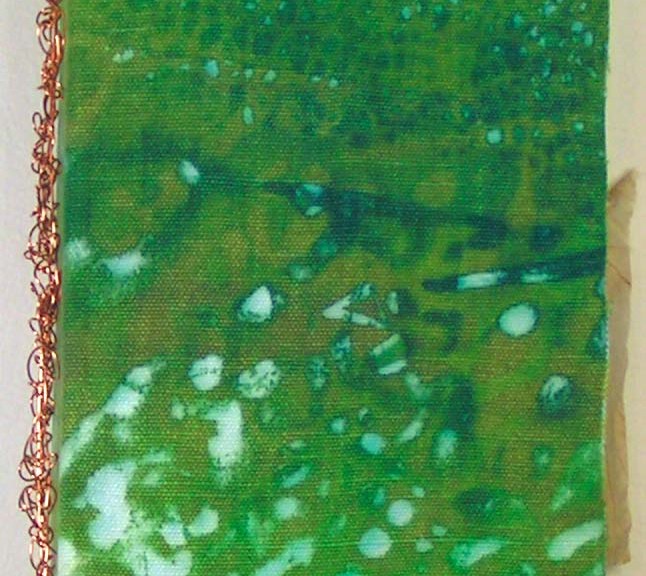
Here’s the book from the front. I used hemp canvas fabric that I had screen printed. The cover was constructed from the hemp canvas, book board and deconstructed screen printed paper.


The book was bound with pamphlet stitch and copper wire. I have created many books with pamphlet stitch but had never used wire. It was a bit tricky but I like the result, plus it’s very sturdy.

Here are the inside front cover (L) and inside back cover (R). I really love the organic feel of the screen printing. I made three signatures and used plaster on canvas pages plus additional pages of various papers and a bit of fabric. The main pages were created with canvas, plaster and gesso.

I didn’t take photos of all the page spreads but wanted to show a range of what was included in the book. The brown paper on the left is a “faux rice paper” that I made with tissue paper, walnut ink and matte medium. The photo on the right shows the inside of the copper wire binding.

These next photos shows a variety of papers that I used in addition to the plaster and canvas pages. Some were painted, some eco printed and I used some specialty rice papers as well.

Here are a few more page spreads. Besides paper, I also added in some hand dyed canvas as well. The book is fun in itself and could probably be left as is. But I want to make it into a book about the forest with sketches, additional ephemera related to trees and whatever else reminds me of the forest. So I will be working on this slowly and adding bits and pieces to it over time.

These are a few of the types of things that I might add. Paula kindly gave me the pieces with definitions and the labels. She has loads of ephemera and is very generous. Thanks Paula! You could easily make this type of book with felt as the cover fabric. I would love to see your results if you give it a try. You can submit photos of your work here and we will post them.

A Crown for Maris

A Crown for Maris

I had hoped to show you my finished Glorious Devon picture this post, but I’m afraid I’m not quite there yet so – (in the well known phrase from the kids’ TV show, Blue Peter) Here’s one I made earlier!

Just before our pantomime, The Little Mermaid, went into the first dress rehearsal, the wardrobe mistress asked me if I would have time to make a finalé crown for Maris.  Maris was the sister of Neptune and Aunt of Serina, the little mermaid.  It is our invariable custom choose specific colours for all the finalé costumes and this year they were to be predominantly royal blue with silver touches and for Maris’ crown I was asked to think of the effect that water makes when something is dropped into it from a height.

I had a look at Google Images for inspiration and collected together my materials ready to make a start.  These consisted of a stainless steel headband, an empty plastic milk bottle, an empty Johnson’s Baby Shampoo bottle (the colourless ones they used before they changed the colour of the shampoo and thence the bottles) some royal blue organza, pale blue organza with silver/pearl embellishments, some silver lacy type fabric and some white/iridescent beads on wires that I had salvaged from old Christmas decorations (on the assumption that I’d find a use for them some day).  You can see these in the pictures below (with substitute shampoo bottle as I’d cut up the original one before I remembered to take the photo).  In the end I did not use the white braid that you can also see.

Materials
Salvaged Christmas Decorations

My idea was to make a double splash – a tall centre splash and a shorter outer splash. (I am pretty sure that I was not going to fall foul of any copyright since I don’t think there’s any such thing as a double splash.)

I cut the outer splash from the plastic milk bottle, stapling the pieces together; and the taller one from the empty shampoo bottle.  As the shampoo bottle was not cylindrical, but flattened, I heated the cut out piece with my hair dryer and squeezed it until it became more cylindrical.  Then I glued some of the royal blue organza onto it.  I found this took quite some time to dry and fix itself so, as time was short, I painted both sides of the shorter piece with royal blue acrylic paint.

Outer Splash Unpainted
Inner Splash with Organza
Both Splashes Tried Out For Size

To represent sprayed water drops, I added some of the salvaged Christmas decorations to the outer splash, having first extended them by twisting two wires together. I used some silver glitter glue on fine wires to make similar “water drops” for the inner splash and added those. I also glued some of the embellished organza onto the outside of the tall splash. Then I fixed it inside the outer splash and stapled them together at the base. After cutting two slits in the lower edges of the crown through which the headband would fit, I covered the base inside and out with some of the silver lace type fabric to cover the staples and soften the edges a bit. I cut out some of the “wave” shapes from this fabric and glued them onto the outer splash.

Finally, I slid the crown onto the headband and it was finished.

Finished Crown

Unfortunately, when I photographed the finished crown against a dark blue background, the silver came out gold in the picture – no doubt a trick of the light.  The second picture was taken against a white background and some of the silver drops appeared black.

The wardrobe mistress was pleased with the crown, as was I, but I think it would have been better to have been much larger.  It was a bit too dainty to be seen from the back of the auditorium.

Maris – 1st Dress Rehearsal – No Makeup

We Need a New Door Stop

We Need a New Door Stop

Recently we have acquired a new bookcase for our living room.  It was actually made to fit in the space between the front wall and the door of the room.  However it has a sort of lip around the top, the corner of which was banged by the glass of the open door if we were not careful.

2 Views of the book case against the glass (with some of my menagerie in view on the book case)

Obviously we needed something to stop the door before it fully opened. After some thought I decided that it needed to be tall (so that we didn’t have to bend down too far to move it – the floor gets further away the older you get), but it needed to be thin too otherwise the door wouldn’t open far enough to let one of us safely into the room, especially with drinks in hand.

I wanted it to go with the colour of the carpet and I knew that I had somewhere in my stash a blue wool sweater that I had felted (on purpose) by putting it through the washing machine. I finally rooted it out and decided that I would use one of the sleeves, which had a pattern knitted into it.

The Other Sleeve – what’s left of it – the pattern looks a bit hazy but hang in there, you’ll see it later.

Initially I thought that I would make a tall thin pyramid shape to fit in the gap between the side of the book case and the door. I sewed up the cuff of the sleeve and, to make sure it didn’t keep falling over, I begged a piece of flat lead sheet from my husband which I fitted into the bottom of the stuffed sleeve, and then sewed up what had been the shoulder to make the base. 

Well it was ok, but I thought it needed a bit more interest and decided to turn the door stop into a cat.

Out came the felting needles and my scoured merino, which I use as core fibres. Then for the “top coat” I sorted through the blues in my stash – normally jealously guarded because I don’t have a lot now as I use them for sky in my pictures – and found some which almost matched the main blue of the sleeve. Obviously he wasn’t going to be a realistic cat so I tried to “cartoonise” his features, and rather than give him needle felted eyes as I might normally do I fished out some bright orange glass eyes from another stash which would go well with his dark blue face. I used some of the blue to make a wet felt sheet, out of which I cut his ears.

Having made his head, I attached it to the tall thin pyramid. It’s sewn as well as needled on, but even so I was concerned that if he was picked up by his head it might come off. I made a piece of blue cord and attached that as a loop behind his head so that he might be moved safely. And here we have him.

Smiley Door Cat

Not long after this, we acquired a new pinky-grey bathroom carpet and also new pink and grey towels to replace very tired old red ones. Until then we had been using the bathroom scales as a door stop – that door will slam very hard if the wind gets up when the window is open. So now I decided that we would need another door cat.

When we got the new carpet we did not change the basic colour scheme as we didn’t want the hassle of changing the suite (vintage Pampas) or the tiles. The colour scheme is essentially derived from the tiles, which are pink and grey with some crimson detailing. Originally we had a red-ish carpet and red and dark grey towels, but when I bought those towels I could not get a bath mat to match, so I made one by stitching two red hand towels back to back.

Bathroom Tile

As the new carpet shed fibres quite a lot to begin with I thought of making the new door cat out of that fibre, but after a little more thought I realised that that would not be a good idea. We would keep falling over a camouflaged cat in the gloom of a late night visit!

So I thought I might find another felted sleeve, but couldn’t come up with something the right colour. Then, because we still had touches of red in the room, I decided that I would deconstruct the old red bath mat and use one of the pieces for the cat’s body. I had already given away the rest of the old towels to my friend for her dogs.

I felt that a “loaf cat” pose would be best, less likely to tip over if the wind caught the door, but I’d need too much lead sheet to make it a suitable weight. So I visited the garden and found a triangular(ish) shaped piece of rock, washed it and wrapped it in a couple of layers of non-woven cotton towels, secured with masking (painter’s) tape. I made myself a paper pattern of the body and cut out two body sides and a gusset for the base and chest. I cut out the pattern pieces from the towel and stitched it all up (first inserting the wrapped rock and stuffing it with polyester stuffing.

I had seen a cartoon of a smiling cat, which had enormous ears, which looked really cheeky. I thought I’d have a go at making one like that. I started with the core fibre again and got the head substantially how I’d like it and then thought about fibres for the coating.

Head ready to be covered in “Top Coat” (for some reason enlarged umpteen sizes)

I did not have exactly the right red, so had to blend a couple of pieces of pre-dyed merino tops which seemed to work ok. I did the same to make a pinky-grey blend for the chest, face and inside of the ears. I had decided that I would make the cat’s chest a similar colour to the carpet which meant that I had to make a wet felted sheet of the pinky-grey batt to cover the original red towelling. I cut the felt into the shape of the chest gusset, leaving enough for a pair of large ears.

I needled some of the red onto the back of the ears, and this resulted in a darker pink on the inside where the needles had pushed fibres right through, which was actually a benefit I think. I needled the blended red on to the back of the cat’s head and neck, and the pinky-grey onto the face, attached the ears and gave him a darker pink nose. I “shadowed” the smile and blinking eyes and I also gave him some laughter lines.

Nearly finished head, along with my felting cushion and a trapped needle holder

Then I stitched the head onto the neck, and the chest piece over his front, catching in the head at the neck.  I covered the join with more needled fibres and, using another piece of towel, attached a handle to the back of his neck so that he could be moved without his head coming off.

Loving Blinks from the new Door Ward

My husband has already named him Yoda.  We each confessed the other day that we both chat to him (in fact I pick him up and cuddle him too – he just fits into one arm)

What about the poor tatty sheep at the beginning of this post? Well, many years ago now, when I was a fairly new needle felter, I decided that I’d like to make myself a door stop for my bedroom door. I had acquired from our Guild a Jacob fleece, which, as it turned out, was ideal for needle felting. It certainly wasn’t a lot of good for wet felting – it wouldn’t, whatever I did to it. I suppose I must have had an old ram’s coarse and kempy fleece palmed off on me, when I was too naïve to know what I was getting – no wonder it was cheap!

Anyway, I got a body shaped pebble out of the garden, and washed it, wrapped it in some of the un- wetfelted fleece and started in with a No.36 felting needle (I only had 36 triangle and 38 star needles in those days- oh and a No.19 which was so thick it wouldn’t really go through anything I had with any ease). I bust quite a few needles before the pebble was covered. I added a neck to one end and then decided that my sheep would need eyes and a pair of horns. At that time I did not know that Jacob sheep often have 4 horns and wear them as if they had put them on in a hurry in the morning whilst still half asleep!

I made the horns and eyeballs using pipe cleaners and white Fimo polymer clay, baked and painted with acrylic paints. At that stage in my career I had not thought of using PVA glue on needled fleece to make horns. I needled a head shape around the horns and eyes, and then attached it to the neck. It did not occur to me to strengthen the neck with the ends of the pipe cleaners, I had cut these short and just put the horns on either end, and did the same with the eyes.

Well it all worked and for years he sat by my door, getting moved when necessary with my foot.  Now he’s a sad old thing, but being sentimental I can’t bear to get rid of him, even though he’s lost a horn and is definitely the worse for wear.  Perhaps I’ll give him a “makeover” sometime.

Poor Old Jacob, grown old and infirm in service