Browsed by
Tag: embroidery

The Codification of Stitch

The Codification of Stitch

One of the UK’s major textile events, the Knitting and Stitching Show, is held annually in November in the Harrogate Convention Centre. It’s packed with “must have” products and showcases inspiring work by a wide variety of textile artists. Within the show there is a dedicated exhibition area called the Graduate Showcase, which highlights outstanding textile art from recent UK BA undergraduate courses. This initiative, run in partnership with the Embroiderers’ Guild, provides a platform for emerging talent in the textile art world and it was here last November that I first saw the work of Charlotte Farrant.
Charlotte hadn’t originally planned a career in textile design, in fact growing up she had formed a fascination for mechanics and saw herself becoming a mechanical engineer. At some point Charlotte discovered she also had a love of embroidery and enrolled in the Royal School of Needlework, graduating with a first class degree. 

Charlottes “Codification of Stitch” is an innovative coded embroidery system developed by the textile artist herself and it is used to form hidden messages within the garments she designs, transforming textiles into wearable narratives. Specific embroidery stitches represent letters, forming hidden messages amongst the exquisite, decorative Goldwork, Blackwork, Whitework and Raised Work.
 
It was her fabulous “coded” Ann Lister black coat that first caught my attention on her stand at the show. In 2025, in collaboration with the Anne Lister project, Charlotte designed a range of costumes re-imagining the BBC cast of Gentleman Jack and bringing them in to the 21st century.
 
I hadn’t heard of Ann Lister but I’m guessing plenty of you will have, especially if you’ve seen her life story as portrayed by Suranne Jones in the BBCs series Gentleman Jack. This woman was an ardent diarist and from 1896 to 1840 she wrote a five million word diary, approximately one sixth of which was written in code. She combined the Greek alphabet, zodiac, punctuation, and mathematical symbols allowing her to document, but also conceal, the most private aspects of her life. It’s fitting that this beautiful coat should also conceal its message which is a quote from Ann in August 1823. It reads “I am not made like any other I have seen, I dare believe myself to be different from any other who exist.”
Ann Lister Coat
 
Sampler for coat

Another “Ann Lister” inspired piece on Charlottes stand was a waistcoat inspired by the diarists love of nature and the coded message on this garment reads “We are not alive if we’re not taking the odd risk now and again.” 

Ann Lister Waistcoat
Detail of waistcoat

There was also a selection of beautiful intricately stitched, coded brooches on display, each with a printed label providing its deciphered message.

Check out Charlottes website charlottefarrantembroidery.com where you can see her portfolio of designs as well as her shop selling Coded embroidery kits, brooches and many other embroidered coded art works.

Throughout history textiles have been used not only for protection and comfort but also to communicate our personal values and identity. Long before the written word came in to use Ancient civilisations would use specific colours and symbols to convey their environment, spiritual believes and culture. In this way meaning could be woven, felted or stitched into rugs, blankets, clothing, etc. delivering visual messages that could be easily read by the people around them. Examples include the felted rugs created by ancient nomadic tribes which would embody powerful symbols across different cultures signifying the wish for good health, long life, prosperity, etc.

Examples of just a few of the Symbols used in Middle Eastern rug making.

On the other hand, hidden “coded” messages in textiles have been used for a very different, but very important role in history. While imprisoned Mary Queen of Scots embedded complex and personal symbols within her embroideries to express her frustrations, assert her claim to the English throne, and comment on her unjust captivity. This panel depicts a grapevine and a hand holding a pruning knife. It references Mary’s claim to the throne, suggesting the need to cut away the fruitless branch of the Tudor tree represented by the childless and ‘illegitimate’ Elizabeth. The point is driven home by the Latin motto ‘Virescit Vulnere Virtus’ (virtue flourishes by wounding). (source:vam.ac.uk)

Embroidery also enabled Mary to communicate with her supporters by sending coded messages hidden in her needlework. 

In the realm of espionage, traditional handicraft skills were to take on an even more covert dimension during the World Wars when prisoners, spies and resistance members used embroidery to pass on information under the noses of their enemies. After all, who would suspect that something as innocent as an embroidery or tapestry could offer any threat from the enemy? Morse code and binary code were easily represented using a combination of long and short stitches, or French knots and seed stitches, and these would go undetected when hidden amongst other decorative stitches. Other methods required the person receiving the work to “undo” the embroidery as messages were hidden in the padding of trapunto or concealed beneath a second layer of embroidery. 

Knitting was another innocent looking but very useful craft when it came to espionage. Morse Code knitters employed single purl stitches for dots and sequences of three purl stitches for dashes. Their sequences translated into short and long coded signals. Some knitters used knots to conceal Morse code by tying specific configurations to represent dots and dashes, or varying the distances between their knots. These encoded messages could then be discreetly passed across enemy lines or integrated into knitted items such as hats and scarves to be decoded by the recipient. Written messages were also known to have been passed on, hidden in balls of wool!
This practise wasn’t exclusive to the allies. Using a system similar to Morse, German agents based in the UK also passed encoded messages using knotted yarn which was then knitted in to garments. 

Although an extremely dangerous occupation it’s said that the practise of covert knitting became so prevalent during WWII, some countries actually banned the posting of knitting patterns aboard, fearing they may carry coded information to the enemy. 
During times of war, a knitter was often more than just a creator of warm garments; they were also keen observers and messengers, their needles clicking away as they kept watch. (Source: Timoneillstudios.com)

Image Source: ww2wrecks.com

I will leave you with an embroidery created by one Major Alexis Casdagli. Alexis was captured and spent four years in a German POW camp where he passed the time in the innocent pursuit of cross stitch. He also set up a stitch school, teaching other POWs to embroider. Of the many embroideries he made this piece was so admired by his captors that they proudly hung it in the castle where he was being held and subsequently had it displayed in three other camps.

The prisoners must have found it very amusing that the guards had no idea of the defiant message hiding in the Morse dots and dashes stitched around the borders which read “God Save The King” and “Fxxx Hitler”. Fortunately it was never deciphered during those four years and so the embroidery, and the Major survived the war. He told his son on his return that the Red Cross saved his life but embroidery saved his sanity! 


Hand Stitching on Paper

Hand Stitching on Paper

Our group meeting this month was inspired by some Instagram tutorials that we saw by Neha Sachan. Here’s her Instagram if you want to see the videos we followed.

We started with white or painted heavy watercolor paper cut into approximately 5″ x  7″ pieces. I had collected a variety of twigs and sticks. Everyone chose their twigs and our friend Deb had donated some dried grapevines that were such fun shapes we had to use some of those too.  Then on to punching holes into the paper and stitching. It’s really fun and relaxing to sit and stitch with a group of friends.

Louise stitching back stitch through previously stitched fly stitch with small branch couched on paper.

Here’s Louise doing a bit of stitching. She’s doing backstitch in between her fly stitches.

Louise's branch with lichen couched down and fly stitch leaves.

Here’s Louise’s finished piece. I love the lichen that’s growing on the branch.

Louise's grapevine stitched down to blue watercolor paper and seed pod attached with stitching..

Here’s Louise’s other stitched down vine. The seed pod was a separate piece that she added as it seemed to fit perfectly. Not much stitching here besides couching down the various pieces.

Sally's two stitched pieces on paper. Top paper with branch couched down, fly stitch and back stitch. Bottom paper with larch branch couched down.

Here are Sally’s two pieces. She hadn’t finished the bottom piece but had attached a twig from a Tamarack/Larch tree.


Paula's grape vine couched down with back stitched branches and one branch with French knots.

This is the beginnings of Paula’s piece. She has since added a bunch more French knots but I don’t have the finished picture.

Close up of Paula's French knots

Here’s a closer view of the French knots.

Here’s photos of my piece with the twig, fly stitch and back stitch. I made it into a greeting card. I tried to send it in the mail but got it back as it was “unmachinable”. I had to add more postage to get it sent. Always fun at the USPS.

Ruth's grapevines couched to watercolor paper painted blue with "cotton" bolls.

Here’s my final piece with grape vine and little balls of wool stitched down.

We had a great time stitching together and once you have the holes punched in the paper, this is pretty simple. We have decided that this coming year, we will be working on creating a fabric book. We will be doing quite a few dyeing and surface design techniques to create our book pages. Our next meeting, we will be clamp dyeing on felt.

FELT SWAPPING

FELT SWAPPING

The International Feltmakers Association has been running an annual Felt Swap – setting a theme and linking members who’ve elected to join the challenge with a “swap partner” from somewhere in the world – since 2020.  I spotted the invitation to join in the 2025 swap on one of the regular emailed Newsletters and decided to have a go.  I started to write this post about the entry and remembered that I’d entered the first Swap and had posted about it.  However, when I trawled back through my posts to find the link for you, I found that I hadn’t actually written the post, let alone published it.  So we’d better start there.

The subject of that challenge was “Light”.  I thought a lot about this as it seemed such a wide subject and I didn’t know where to go with it.

To begin with I listed as many things as I could think of that could have anything at all to do with light and came up with: Light bulbs;   Bright light – dazzling – blurred;   Rainbow;   Prisms and light splitting;   Dark area with light coming in from one side;  Sun beams from behind clouds;   Fire light;   Moon light;   Lighthouse;   Northern Lights.

Clouds and especially stormy skies fascinate me and I thought that I could do something with this idea.  Initially I went for a sun low on the horizon just showing through some dark clouds but with rays going upwards behind the clouds.  For some reason this was not a success so was abandoned.

Then we had a thunderstorm and I had a lightbulb moment!  So I looked through some of Mr Google’s images just to remind myself what forked lightning looked like and then went for a storm over the sea, and used this image for reference.

dark sea, dark stormy clouds with forked lightning running from clouds to sea
Lightning at Sea

I have a collection of fibres, yarns and fabrics in my “stormy” project sack – too big to call a bag – and my first thought was to use some of those in the picture I had in mind.  I had already made a mixed media image of a storm at sea using various textiles and fibres and thought of doing something similar.

Mixed media picture of stormy clouds, rough sea, rocks, spray and wind tossed seagulls
Storm at the Coast

So I looked out some of the fabrics and yarns and other bits and pieces to see what I might use.

But in the end I decided that I wouldn’t use these for a couple of reasons: 1. this was supposed to be a “felt” swap; and 2. using the mixed media would possibly need a larger picture than I was making – we were limited to A5 size – 5.8 x 8.3 inches (sorry I don’t work in “the foreign” if I can help it).  I did use my stormy fibres though.

I was reasonably happy with the picture after it had dried, but decided to do a bit of tidying up and embellishing with some needle felting.

This is the final result

completed felt picture of storm at sea with dark clouds and forked lightning running down into the sea
The swap picture of LIGHTning


My swap partner, from Denmark,  sent me a felt bag, which was really good.  I didn’t want it to get dirty or damaged before I was able to use it and show it off so I wrapped it up and put it in a safe place.  So safe that …..!

Anyway, back to this year’s swap.  The theme for this one is “Inspired by an Artist”.

Again this was a very wide subject, first choose your favourite artist then find a piece of their work that sparks an idea.  I don’t actually have a “favourite” artist, I love the work of many: Constable; Canaletto; Turner; Rowland Hilder; William Morris and most of the Arts and Crafts artists and architects; Rennie Mackintosh….  I could fill up the page with names.  I trawled through works by most of these, bearing in mind the maximum size of the piece I was to make (8″ x 8″) the while.  In the end I decided that I would go with Charles Rennie Mackintosh.

I searched google and found several stained glass windows, one wall carving and a draft fabric design that I liked.

In the end though, I decided to go with a section of the last one, which I squared up and manipulated to make it the right shape and size.  The window is typical of the Art Nouveau period and “attributed to Mackintosh”.  I could not find out if it is actually his design but it is certainly very like his work.

I picked the centre of the window to work on and the enlarged and reshaped (slightly) design was printed off in greyscale and laminated.  I would be able to use the laminated design as a base on which to lay out the fibres.

a monochrome image of the window section covered in polythene sheet and the original image in colour
All ready to lay out the fibres

While I was looking through my stash for suitable fibres and pre-felts for the project I  happened to glance at the design which was inverted.  I immediately saw a face with an extremely runny nose!

the monochrome image rotated 15 80 degrees
This was when I spotted the runny nose!

Nevertheless I thought it would be fun to use the design of the face, since we were to produce something “inspired by” a favourite artist, rather than copy what s/he had produced.  This would allow me to get rid of the runny nose and I also wanted to change the colour scheme.

I had decided to use a piece of pre-felt which I had bought from Wingham Woolwork some years ago, especially as it was slightly moth eaten and I could use what I might otherwise have to throw away.  This was a lovely strong purple colour so I decided that my colour palette should be purple, turquoise and orange.

various fibres, yarns in purple, orange and turquoise, and an orange chiffon scarf
Picking colours and materials

The basic design was laid out in reverse, that is with turquoise knitting/felting yarn “face down” on  the design, with some fillings-in of orange fibres on top and two squares of turquoise where the “eyes” would be.  The purple pre-felt backing was placed on top of that and the whole wet felted.  Unfortunately this resulted in the straight lines becoming distinctly wavy – a good job this wasn’t a straight copy of the original!

After the piece was rinsed, dried and ironed, the remainder of the design was added by needle felting (which, together with the shrinkage during wet felting, had effectively removed the moth holes) and finally some simple embroidery stitches.

The piece has been mounted on foam board for stability.

finished face - orange eyebrows, nose and eyes with turquoise moustache, and facial features on a purple background
Finally – the Swap piece

This is the piece I received from my Canadian (Calgary) swap mate.  It is inspired by “Violet Poppies” by Emile Nolde https://arthur.io/art/emil-nolde/violet-poppy

Isn’t it gorgeous?

3 felted poppies with dark leaves on a yellow felted background, displayed in a circular embroidery frame
Swap piece received from Canada

Bags of Inspiration

Bags of Inspiration

Having just read Kiki’s tutorial  https://feltingandfiberstudio.com/2023/11/19/left-overs-yessss/ on using up prefelt scraps, it occurs to me that I may not have mentioned something we used to do at our Guild (Dorset Guild of Weavers Spinners & Dyers) mainly to raise funds for the Guild but also for fun.

When I attended the Stitch and Creative Crafts Show at the Bath and West Showground in Shepton Mallet (Somerset, UK) back in 2010  – I saw a stand selling (for £8.00 each) bags containing 35gr of silk fibres, yarns, fabrics scraps, carrier rods and cocoons in various colours, left over from old projects which, when put together, made a fascinating collection for future projects.  So fascinating that I bought three of them.

They must have made quite a bit of profit on them because they appeared mainly to be the “waste” from artwork.

At that time (when I was part of the sub-committee organising the Guild’s Exhibition and Sale of Work) we were looking for a Guild Project which could be part of the exhibition or something hopefully to help raise some funds.  Well, I thought, our weavers must have lots of off-cuts of hand woven fabric, not to mention warp ends.  Then there were the spinners who would have odd bits of spun and unspun fibres of all types and colours.  We also had members who were dressmakers, beaders and embroiderers, and a soft furnisher, who were bound to have the odd bits and pieces that they didn’t really need.  So, with the blessing of the committee,  I put it to the members in the next newsletter that if they would donate to the Guild any odd bits of fibres, yarns, threads, warp ends, bits of fabric, beads, button, feathers, felt, cords, braids, tassels, sequins, sequin waste, ribbons, silk flowers and any other bits and pieces they could think of, we could make up some “Bags of Inspiration” and sell them to members of the public at our open days and outside demonstrations.  (I don’t know about in the rest of the world, but in the UK the word “bags” means “lots of” as well as “containers”, so the punning name “Bags of Inspiration” seemed apt.)

We used A4 sized polythene bags (which I was able to buy quite cheaply from our local green grocer) with an A4 sheet of card inside for stiffening, and I made up some stickers with the Guild’s logo on and a brief description of the contents, and posters also giving details of the contents.

Image of a poster detailing contents of a Bag of Inspiration
Bag of Inspiration Poster

We arranged a few bag making days at a pub in the village where our then President lived.  She had persuaded them to let us use their skittle alley at no charge, and we had a great deal of fun making up the bags and tucking in to “refreshments” from the bar and kitchen.

The members who came to these, brought with them all sorts of goodies which we spread out on tables, so that we could make collections of pieces which seemed to go with each other.  Those who didn’t think that their colour theory was good enough, could pick out a picture from a selection of magazines and have a go at matching colours from this  It was amazing how compulsive making the bags became.  You could pick up a piece of fabric that looked so dull and dreary and be amazed how it perked up and positively shone with life when paired with different fabrics, yarns, trimmings etc.  You just couldn’t stop picking up likely bits.  The difficulty was keeping the weight of each bag between 80gr and 100gr, so we quite often ended up making up at least 2 bags with similar contents.

image of tools and accessories for making up Bags
Equipment & Extra “Bits” for making up Bags

Prospective contents of a Bag of Inspiration - fabrics, yarns, fibres etc.
Prospective contents of at least one Bag of Inspiration

We put a price of £3.50 on each bag and they went like hot cakes – we sold out on their first appearance at our exhibition and sale of work.  Embroiderers and mixed media artists in particular liked them.

After a couple of years, we didn’t get so many volunteers to make up bags but we still had mountains of “stuff”.  So we added another string for our open days – Pick and Mix Your Own.  I had remembered that Woolworths (now there’s a blast from the past) used to have a counter full of different sweets and you could take a bowl and pick and mix what you wanted, and in the process buying a lot more than you would have if just buying a ready filled bag.

Boxes of different sweets to be picked and mixed
Pick and Mix Sweets.

It worked with our stuff too.  We gave the visitors the polythene bags and they could wade through all the bits and pieces picking what they needed, and we weighed them when they’d finished, charging £3.50 for 100gr.

We had had a lot of fibres donated so we started making up what are now called Art Batts and selling them as “Batts of Inspirations”, but because we were mainly selling these to Guild spinners and felt makers, they didn’t do quite so well as they were mainly able to make their own.

In all we made around £1000.00 for the Guild in the four years we were doing this.  Eventually though the members got fed up with spending time on making up the bags and the whole thing was shelved, as the Guild seemed to be relatively well off at the time.

Some time after that I took the idea back to myself and I was making up Batts to sell at Guild meetings, using luxury fibres as well as merino and synthetic fibres.  I made up some bands to fix around the Batts detailing the various fibres included in each.

This slideshow requires JavaScript.

I was also making up and selling Bags, mainly at a Needlework Festival in Dorset where most of the vendors were selling materials and equipment for crafters, as well as various craft fairs and so on.

This slideshow requires JavaScript.

I was getting the odd question like “they’re lovely but what do you do with them?” and  “can you make a bag out of what’s in here?”  So I made a sign from images of items that I’d made myself over the years and that helped.

Image of items made with contents of Bags of Inspiration
Some of the things I’ve made with the contents of BoI over the years

However, once Covid started causing problems, my selling opportunities dried up.  I had been intending to try selling Bags and Batts via my website, but it was very difficult and too time consuming to photograph the Bags so that the contents were visible, because of reflections on the polythene bags.  So that sort of died a death too and I’ve now shelved that project, and am using the bits and pieces I’ve collected over the years on theatrical costumes and props.

Perhaps some of our readers’ organisations, like Ann & Jan’s OVWSG, might use this idea to raise funds?

Local Heraldry

Local Heraldry

Ever since I had visited Kew Gardens as a child and seen the statues of the Queen’s Beasts lined up outside the great Palm House, I have been fascinated with heraldic animals and heraldry generally.  [https://www.kew.org/read-and-watch/the-queens-beasts]

When we moved to Sturminster Newton, every day I came home over the mediaeval bridge I saw the Town’s Coat of Arms.  We have a large (about 10ft high) coloured display of these Arms marking the entrance to the town.

In 2007, when I’d reached the age of 60 and reduced my working days to just 3 days a week, I was looking for something to keep me occupied.  By that time, I had met our Town Crier, who when not Crying worked in a local store.  Kevin Knapp was a popular figure, regularly opening events and leading processions in the town.  He had also won numerous Crying competitions.

2 images of Kevin Knapp. On left he's leading the Town's 2008 Remembrance Parade. On Right he is posing in front of the Sturminster Newton Mill
Town Crier Kevin Knap – Left: Leading the Town’s 2008 Remembrance Parade. Right displaying his costume in front of Sturminster Newton Mill

Having inspected Kevin’s Crying uniform, I realised that he had lots of different badges, most relating to awards he had won but also the County Arms, but not the Town’s.  I thought that this could be a project to keep me busy, having consulted Kevin who said he’d be pleased if I could make a badge of the Arms for him.

After a visit to the Town Council offices, where I had discovered that the original Letters Patent – the deed granting the right to use the Arms – were held, I asked the Council formally for permission to photograph the Deed and to make the badge for Kevin. Once I had received permission, I went, with my husband, to the Offices and we photographed the Deed. That wasn’t easy as the Deed was housed in a purpose made, glazed, cabinet which hung on the wall in the Council Chamber. Eventually we managed to get a reasonably clear picture without too many reflections on the glass.

Image shows hand written Deed - Letters Patent - with images of the granted Arms and Badge painted on it
The original Letters Patent showing the Arms granted top left and the Bull’s Head badge bottom centre. The other Arms shown are those of the three Heralds who made the Grant.

The Letters Patent, couched in the archaic style of the Norman French which characterised early English deeds (though thankfully not totally in that actual language) was dated 1st September 1961. It evidenced that three English Kings of Arms – Garter Principal King of Arms,  Clarenceux King of Arms and Norroy & Ulster King of Arms. authorised by the Duke of Norfolk – Earl Marshal and Hereditary Marshal of England – granted to the then Sturminster Rural District Council “such Armorial Assigns and in the same Patent such Device or Badge as may be proper to be borne and used by the Sturminster Rural District Council and by its successors constituting each for the time being the local authority for such place and district on Seals or otherwise according to the Laws of Arms” (note the lack of punctuation – typical of legal documents in this country even today); hence the right of Sturminster Newton Town Council to use the Arms and also the Bull’s Head Badge. The Badge’s primary use would be to mark the Council’s property (including, some 800 odd years ago, it’s serfs, servants and men at arms!)

Image of a Bull's Head within a ring with "sun's rays" around the outside, all in Gold with black outline
The Bull’s Head Badge painted on the Letters Patent

The actual words of the Letters Patent describing exactly what was granted are: “Vert [green] a Saltire [diagonal cross on a shield] Wavy Argent [silver] between in pale [one above the other] two Crosses Moline [having jagged ends] and in fess [horizontally] two Garbs [sheaves of corn] Or [gold] And for the Crest [device sitting on a helmet] Out of a Coronet composed of four Ears of Wheat and four sprigs of Oak fructed [with fruits] set upon a Rim Or [gold] a Mount Sable [black] thereon an Heraldic Panther statant [standing on all 4 feet] guardant [shown full face] proper [lifelike colours(!)] Mantled [with cloth on helmet] Vert [green] Doubled Argent [on the reverse silver/white]” and the “Device or Badge”: “Within an Annulet [hollow roundel] Reyonnée [with sun’s rays] Or [gold] a Bull’s head caboshed [without a neck] Gold”. The Arms and the Badge were also drawn on the Deed for further reference.

Having got all this information from the Deed I started to prepare a working drawing indicating what stitches, yarns and cords I would be using.

A drawing of the Coat of Arms in outline with lists of goldwork stitches and indications of where these are to be placed
Working Drawing – you may be able to decipher my scrawl of what I was intending to do at that stage.

In doing so, I realised that the Heraldic Panther was a very odd creature: it appeared to have orange flames coming out of its ears and mouth and it was spotted – red, blue and green spots!

drawing of heraldic Panther, yellow body & face, with large blue red and green spots on the body and flames coming from ears and mouth
The Heraldic Panther painted on the Letters Patent

So I headed to the library to see if they had any reference books which might throw some light on this.  Luckily there were several in the catalogue, but none at our local branch, so I would have to wait for one to arrive.  When It did I was able to find that the flames were a mistake made by the artists painting the arms on early Letters Patent.  In the book there is a reference to the Garter King of Arms writing in the early 17th century regarding the Heraldic Panther: “this beast … is admired of all other beasts for the beauty of his skyn being spotted of variable colours; and beloved … for the sweetness of his breath that streameth forth of his nostrils and ears like smoke, wch our paynters mistaking corruptly do make fire.” Further reading indicated that the origin of the panther was likely to have been a cheetah, hence the (guessed at coloured) spots.  You will note that I was down another rabbit hole!

Well our panther was shown on the Arms as having flames coming from his ears and mouth, so that’s how I’d got to depict him.  It was also then that I realised that the Arms as granted were not exactly the same as the Arms currently used by the Council.

You will see that in the current version of the arms, the Bull’s Head Badge appears five times on the mantle, which has been altered to enable the badges to fit. (The mantle represents the cloth which the Crusaders wore over their helmets to ward off the rays of the sun)

Apparently the then Sturminster R.D.C. decided to use it to decorate the actual Arms instead of to mark it’s property (and/or servants!)

After some manipulation of the photograph of the Deed I managed to get a reasonably clear image of the Arms and could make a tracing to use to transfer the design to the background I had prepared

During the time that I’d been waiting for the book, I contemplated the fact that the actual badge would be very much smaller than the original tracing and I’d be lucky to be able to carry out all the various stitches I’d originally envisaged, and I wondered if I might make some of the badge in felt.  I needed to make a “sketch”.  Using a piece of old blanket as a base, I transferred the design and filled in some of it in needle felt.  I thought that this would work.

image of partial needle felted coat of arms
The partially needle felted “sketch” of the Arms

It would certainly make life a bit easier as I was not very experienced in gold work and doubted that I could do a good enough job in the smaller scale. As it was I managed to lose the “jagged” ends of the two gold crosses and the Saltire was not really “wavy”. It was supposed to be a nod to the river Stour, which divides Sturminster from Newton (which despite it’s name is in general the older part of the town).

In the end I felted the Helm, with the gold Rim and the Panther. I also padded the sheaves of corn. Here’s a progress picture and another with felting needle which will give you an idea of the actual size of the whole thing.

Once I was reasonably happy with the shape of the helm, I painted it with artists’ gesso and then (when it was dry) sanded it as smooth as I could get it.  Then I painted it with some of my husband’s metallic enamel paint to represent steel. (Can you imagine what a squire’s life must have been like sanding and polishing a suit of armour and weapons made of steel to get rid of and keep it free of rust? – no stainless in those days.)

It did take some time to complete the badge – some 4 years in fact although I wasn’t actually working on it all the time.

Image of finished Coat of Arms with full coloured green satin stitch, silver and gold work.
The finished Badge

Oh I nearly forgot – the motto “Quis Metuit?” means Who’s Affeared?  It is apparently used by many local authorities – I’m not sure why though and, for once, the question defeated Mr Google.

The Town Council, in the form of it’s Leader, formally presented the badge to Kevin on 30th November 2011.

Image of three people - Left Charles Fraser, the Author and Kevin Knapp, he being presented with the completed badge.
L – R: Charles Fraser, Town Council Leader; Me; Kevin Knap at the presentation of the Badge. The picture above my head shows Sturminster Newton Station as it was in the days of the Somerset and Dorset Joint Railway.

Kevin decided that rather than attach the badge to his coat, he would affix it to the back of the roll containing his Cry so that it would be visible when he was reading from it.

Sadly Kevin died on 9th October 2018.  His wife donated his costumes (which she herself had made) to the town’s Museum.  I’m not sure what happened to the Badge though as the Museum doesn’t have it.  The position of Town Crier remains vacant.  If you are interested, I’ve found an obituary for Kevin published by the Bournemouth Echo.  https://www.bournemouthecho.co.uk/news/16998263.kevin-knapp-died-earlier-month/


A little slow stitching

A little slow stitching

I like slow stitching. Just stitching for fun and to relax. No big purpose or major projects. Just do it as you feel like it. This suits me as I am not a great stitcher and I can pick it up and put it down without any guilt. I belong to a group on Facebook and some people are amazing artists and some just do random stitching on a piece of cloth and everything in between.

I decided I wanted t make some snowflakes and at least one tree. I had seen an interesting one in my Pinterest suggestions. To this end, I took the ripped-up sheet out of the donations box. You know what they say if you want to know what you intended for something just give it away and next week you will know what you needed it for. I was lucky that we are very slow with these things and they hadn’t made it to their destination. I am still not sure what the original idea was for these wide strips of sheet.

One piece was a little grubby looking so I chose it for the proof of concept (practice) piece. I have a nice small free-standing embroidery hoop I got at a garage sale (I think). It means it’s hands-free and can sit beside my chair and the hoop doesn’t go missing.


Snowflakes. I drew 3 stars onto the cloth to use as patterns. I used some thick gold polyester thread from Gutermann.

PATERN FOR SNOWFLAKES gold thread spokes for stitching snowflakes Finished gold stitched snowflake

That was easy enough so I moved on to some clean fabric

I drew the stars a little bigger and I did gold again

Patterns for snowflakes gold snowflake partially donegold snowflake finished

Then I moved on to what would be the problem thread. It is something I picked up because it was shiny but it has no markings it is just on a plane cardboard tube.  It’s a copper/bronze kind of colour and it is terrible to work with. it seems to be a wrapped thread and it kept breaking. There are a lot more knots in the back of this one. and there was a lot more cursing with the rethreading of the needle. I would have liked to add more to this but I was done with the thread.

bronze stitched snow flake


Next was some nice silvery embroidery thread. DMC rayon S712. I used 3 strands. It was very nice to use.

silver stitched snowflake


And here they are together

3 stitched snow flakes together

I switched back to the practice cloth to work on the tree. this is the trunk( obviously) I tried to do varying lengths of stitches to help it look more like bark. It is very hard to deliberately make random stitch lengths.

brown stitched tree trunk brown stitched treetrunk close up


This is what the back looks like where the backstitching is. I think I like it better for bark. The problem is I am having a hard time wrapping my head around doing backstitch upside down. It probably has another name with you do it that way.

back side of stitched tree trunk backside of stitched tree trunk, close up

Next is the evergreen bows. I will see how that goes. As I said it’s slow stitching.

More Stitches

More Stitches

I have now worked my way through the stitch dictionary at  http://www.embroidery.rocksea.org/reference/picture-dictionary/

It took a while but I worked my way through all the stitch families. I did get lazy near the end and I didn’t do all the wrapped stitches. It seems if you wrap another thread around through your stitching it gets a new name. If you weave it through it gets a new name. If you leave loops when you do it another new name.

I discovered that some stitches just didn’t work well with crochet cotton. I am using #8 mercerized and for some stitches it was to slippery and the stitch didn’t lie properly. I think it would have worked better with yarn. Some stitches were to small when pulled tight making it really hard to see the detail of the stitch. Some stitches looked messy when she did them and worse when I did them. Have a look at the top right sample.

These are the 2 pens I have been using to make lines. 

and the marks they make

They are both permanent. I like the silver one better. It is a liquid but it stays put and would be fine to use if the line will not show after. The gold one seemed to get wider after a while. I am going to keep an eye out for the washable and air erase pens. One of the books I got said the was a pen that disappeared when heat was applied. I will keep an eye out for that too. Next I think I will try drawing on some water-soluble fabric  and I might try some tear away. I think once I have an outline done I could fill it in ok.

And on another topic of my life; we had our first farmers market day of the year last week and it went well. I hope I can get back into the routine of baking (and then cleaning up) for the market so I have some time left for felting.


Latest Makes

Latest Makes

I got a really cool embroidered cushion cover years ago (probably over 15, thinking about it) and the back kept splitting at the seams. I mended it a few times, but it was past repair so when I went to the fabric shop recently I had a look for some fabric to replace it. I found a really nice abstract plant/paint splash design, though that’s not so obvious from the small cushion back:

It doesn’t exactly match the front, but now I have a reversible cover! This is the front:

We had a ‘play day’ at the well being centre the week before easter. I’m sure I work better the less thought I put into something! I just grabbed a couple of colours of Merino and a few wool ‘kebab’ tubes from the bag someone else had got out. I honestly don’t think I could have made a nicer piece if I’d planned it!

This week most of us did some form of nuno felting. A couple of us did a bit of ‘extreme nuno’, laying out various fabrics, then 4 really fine layers of Merino, and bingo-wing-busting amounts of rubbing until our pieces are roughly a quarter of the starting size! I need to stop using so much blue, it is a nightmare to photograph, but this is my finished piece:

I loved the ripples on this red fabric:

I can never resist using a bit of scrim and synthetic chiffon for these pieces:

This was from some fabric donated by Judith or maybe Terri, a nice shiny piece of viscose:

I’m not sure what this fabric is, one of our members brings us lots of offcuts to use. I like the way it just crumpled:

And this is the back, there was quite a bit of texture, but I liked how there was a lot of definition from a piece of organza which had kind of bent out of shape:

If you missed it, Ann’s 2nd Quarter Surface Design Challenge is Nuno Felting, so have a look here and join in 🙂

Pandagirl’s Year End Round Up 2017

Pandagirl’s Year End Round Up 2017

I’m always amazed at what I accomplished at the end of year. This year I took a few classes in order to expand my creativity in addition to experimenting on  my own. I also tried to use up more materials and finish some UFOs.

Here is a bedside case for odds and ends made with some merino inside and unknown fiber batt with silk embellishment.

Experimenting with different types of yarn to make a table runner.

Our First Quarter Challenge – Fauvism.

Weaving then felting.

A Valentine gift for granddaughter Lisa.


Teri Berry’s Snail hat class.


Finishing and hanging an eco print.                                                  Crochet around wire bowl.


Framing the felted weaving.

I did a lot of experimenting with crochet stitches.


Practicing for Ruth’s Free Motion Embroidery class.

Crochet hats for my granddaughter and her new premature brother Ken.

A dimensional potholder.

Learning more crochet stitches.

Making a crochet hook case from a crochet sample.

A bowl for the Second quarter Challenge – Celtic

Using yarn on a resist for a vase cover.

Adding dimension to the hummingbird/tiger lily picture.

Crocheting scrubbies.

Felt and crochet earrings.


Crochet beaded bowl with stiffener.

A Pumpkin for Ken.

The Third Quarter Challenge – Edo Period; felt and hand embroidery Sakura.

Ribbon embroidery and framing.


Playing with thickened dye for Ruth’s class on felt.


Finishing  a case from UFO pile and FME Butterfly


Maneki-Neko for Third Quarter Challenge Edo Period.

Framing the Rooster.

More stencil play with acrylic and thickened dye.

The Fourth Quarter Challenge — Suprematist

Penguin’s Poinsettia Holiday card.

A couple of scarves for my daughter in laws parents in Japan where it’s as cold as Chicago.


I want to let everyone know I am taking a leave of absence to focus on my health and family.  I will be around just not posting weekly.  We have a lot of talented artists that will be filling in starting with Tracey Thompson next week.

I want to thank everyone for helping out to give me this time.   If you or someone you know has something to share — it doesn’t have to be felt but anything fiber related including paper, please contact me or one of the other moderators on the forum and we’ll get you on the schedule.

I hope everyone has a Happy, Healthy and Prosperous New Year!  Happy Creating in 2018!

Odds and Ends

Odds and Ends

This past weekend, my husband and I drove up to Wisconsin for a weekend away.  I had hoped we’d see plenty of fabulous fall colors I could share.  Unfortunately, Wisconsin is suffering from the same drought we have here in Illinois and we arrived a week earlier than the peak.  Many of their trees have lost their leaves already, like ours here. But here is one fallish pic entering Wisconsin.

I haven’t been too productive this week.  But I do have a few projects I have put finishing touches on and haven’t shared.

I signed up for Ruth’s Printing and Stenciling on Felt class, so I managed to make a couple of handmade prefelts to play with.  I have plenty of commercial.  The purple was some unknown fiber batt. I decided to use a silk hankie to give it a little sparkle, but it didn’t.

The turquoise is commercial prefelt with some throwsters waste which isn’t very evident.

I think I will be able to use both sides just to experiment. I like the sides without the silk better.

I also made a thicker light blue batt with some mulberry silk.

I have no idea what I’ll be printing on any of these and have gathered a bunch of samples and other UFOs to experiment on.

Here is a failed coaster that had gold fabric felted in that I did a little free motion practice on.

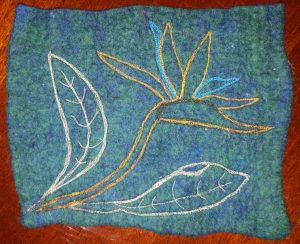
A while back I had felted a bunch of samples from scarves.  I couldn’t find the post with the original scarves. One of them had dots which I wasn’t crazy about. I had done both sides and didn’t care for the inside either.  However, after felting the dots weren’t obvious, they looked more like flowers.  I made it into a little case and did a little embroidery on with with some silver floss for a little bling.

  The back:

The front has a little bit of black organic edging.

Nothing exciting this week, but I got to re-purpose a few things.