Fabric Collage Play

Fabric Collage Play

I’ve been trying to get a better understanding of the logic of the collage process. I’ve been taking some collage classes on the internet that use mainly paper materials. One thing I immediately discovered was that I had very little stash and you need to have a stash. So, I took more internet classes on how to build a stash, again with paper. I really liked one class where the instructor made her stash per each project and in this way, she could have plenty available in whatever colorway she was selecting to work in. This made sense to me even though I can see the value in collecting other ephemera as they appear in front of me.  I used to toss all my fabric selvedges, but now they have become precious to me. One thing I began to understand is that collage work isn’t usually done in one sitting, it’s based on using layers to build up to your finished project. But pretty much anything goes. You can use any type of supplies you have on hand. Of course, after taking several internet classes I now have even more supplies, more ephemera and more storage boxes to try to keep all this new medium sorted! You all know how that goes, don’t you??


My local quilt guild started a monthly 12” x 12” quilt challenge with the first ones due Sept 1st. I decided I would try my hand at one of the challenges which was to use black and white and a bright color (red was my choice). And I was going to try to use my newly acquired collage techniques. So, I began building a stash using black and white and red fabrics and making marks on them. 99% of the fabric I used is Robert Kaufman’s Radiance which is a silk/cotton blend. I used Golden Acrylic paints with my stamps, a toilet paper roll to make the circles, and various brushes. I especially liked the fan brush used in #3 and #4. I also wanted to focus on some stamps I had made of my Green Man faces that I have in my garden.


The following are a couple of not so good photos I took of my very first attempt at fabric collage. I had spent a few days building up my fabric collage materials and I was very excited to start doing something with them, so I cut a bunch of the new elements out and plopped them down on my 12” square. Hmmmmm, something wasn’t working with it.   While trying to figure out what was wrong with my first attempt, I remembered that part about collage making being done in layers. You can’t just plop things down and expect them to immediately work! Back to the drawing board. I needed to get some paint onto the fabric as my first layer. THEN I could start building my collage as it began to speak to me. At least these photos give you a good visual of all the stamps I used. I still laugh when I look at these very first attempts.


Here is my first attempt after I got some paint down. Each of the following 4 quilts have 4 or 5 layers of marks on them. I think this one is pretty wild but I couldn’t bring myself to do anything to it to calm it down. It kind of grows on me the more I look at it. I think I was trying to hide the Green Man in this one by covering him up with white paint.

Here is my second attempt. This one is a bit more subdued but still pretty wild. The Green Man is pretty prominent in this one. He thinks he is the center of the universe!


Here is the third attempt. There is red stitching but not much. I made all the stamps I am using when I took Art and Design Level 3 from Gail Harker Creative Studies https://gailcreativestudies.com/. The little 1” size stamps are great for these size collages.

And here is the fourth one in the series. I like how the Green Man blends in this one.

It was great fun to play with these. I learned quite a bit and intend on creating more fabric collages in the future. The little 12″ x 12″ sizes work well for practicing.

Happy Creating!
Tesi Vaara

The Coronation of King Teddy

The Coronation of King Teddy

THIRD QUARTER CHALLENGE

For my 1950’s inspired picture, I drew on memorable things from my early childhood.

I was born in this house in 1953 – but of course there wasn’t a tv aerial or satellite dish on it then.

And here I am with my mum and my nan, in their 1950’s coats, outside the back door.

My strongest memory in that house is of playing with my teddy bear.  It was cold one day so I sat him in front of an open fire and scorched his fur.  No problem. I played hairdressers and cut it all off – even the fur that wasn’t scorched.  My dad took one look and said we should call him Fred Bear (threadbare).

Apart from my arrival into this world, the biggest event in 1953 was the coronation of Queen Elizabeth.  She wore a crown and carried an orb and sceptre to symbolise her monarchy and power.

Had I been a little older at that time I might have had a play-time coronation for my teddy.

Teddy is long gone but I can make a felted picture of what might have been using my memories of my early childhood in the 50’s.

So, to make a 50’s play-time coronation I would need:

A Throne (chamber pot).  Our toilet was outside so for night-time there were chamber pots under the beds – they were called ‘gazunders’ – and anyone sitting on a pot was said to be ‘on the throne’.

A Crown (paper hat). Any kind of celebration involved the wearing of a tissue paper hat in the shape of a crown.  I decided to make it candy-striped because I fondly remember the candy-striped flannelette sheets that were so cosy in the winter.

An Orb (large marble).  I played marbles with my brother and we both loved ‘king marbles’ as they were much bigger than the others.

A Sceptre (a knitting needle). Mum taught me to knit before I could read.  I had a lovely pair of brightly coloured needles with large round ends.

Righto, first job was to make some pre-felt.

After I’d made all the pre-felt, I realised that I had forgotten about teddy’s brown pads on his hands and feet.  Doh!  Off we go again.

I made the background from 3 layers of turquoise and 1 blue blended layer.

I cut out shapes from the pre-felt for the teddy, the chamber pot, the paper crown and the king marble then I laid them onto the background.  Here it is netted, wetted and soaped up.

When it was felted and dry I got to work with needle felting.

At this point I need to apologise.  I had planned to take photos of all the stages of needle felting but I became so engrossed that I forgot!

So, here’s the finished piece – teddy in all his regal splendour!


Fall Online Classes Open for Registration

Fall Online Classes Open for Registration

The fall series of online courses are open for registration.  The registration for the 4 modules of Embellishing Felt with Surface Design Techniques – A Mixed Media Approach opens today, August 27 for a class start date of September 10, 2021. Click on any of the links about the courses to learn more. The courses are four weeks of PDF and video information and two extra weeks of instructor support for only $45.00 US for each module. You don’t have to be present at any certain time during the course.

Here is a video that I made about the first module of my online courses, Nuno Felting with Paper Fabric Lamination.

The second module is Experimental Screen Printing on Felt. Screen printing is loads of fun and you can obtain a huge variety of results with the techniques you will learn in this class.

Or you might want to try the third module which is Printing, Stenciling and Playing with Thickened Dye on Felt. You will learn how to make stencils and stamps as well as the use of thickened dye to decorate the surface of your felt and make your own unique designs.

The fourth module is Free Motion Machine Stitching on Felt. Have you always wanted to add machine stitching to your felt but didn’t know how? This course takes you through the basics of machine stitching on felt and works through to more complex techniques of using your sewing machine to embellish felt.

If you are interested in any of these online classes, please click on the links above for further information about the classes and scroll down to the bottom of the page to register. You will also find the supply lists of what you will need for each class on the linked pages.

Our Wet Felting for Beginners online class is available any time. You will have unlimited access with this class. So if you’d like to know more about the basics of felting including laying out the wool, embellishments, shrinkage and a variety of felting methods this is the class for you. You can sign up any time at the link above.

Felted Hat Wedding Shower.

Felted Hat Wedding Shower.

Last weekend I got to teach a workshop for the first time since covid hit. I have really missed teaching. I was contacted to teach a wet felted hat class for a bride-to-be. She wanted to do something different than the traditional bridal shower.  Everyone was vaccinated and we all wore our masks. It was a lot of fun.

Everyone picked their colours from The Olive Sparrow (https://www.etsy.com/ca/market/the_olive_sparrow) and I ordered them in. I have to say the wool arrived quickly and nicely packaged with labels. I point this out because I have ordered from other places and received a mixed bag of fibres and I was left to sort out what the colours were and prep it for class.  All the embellishment fibres were from my own stash.

Everyone picked the style they wanted from the hat samples I brought. Then they grabbed their wool and we started. I like to do 3 layers for hats. With the most shrinkage being around and with the resist we used it leaves room at the top for shaping.

once the first side was laid out it was time to embellish. picking out the fibres and seeing how they look is always lots of fun.

Don’t forget to take a picture so you can embellish the other side.

Then the hard work begins rubbing and rolling.

After much rubbing and rolling, it was time to remove the resist.

and now they try them on and wonder how they are ever going to make them fit.

Much more rolling and fulling later the hats are shaped and ready to take home and dry. Sorry I got no pictures of that part.

All in all, it was good to teach again and the ladies were great to work with. I think we all had a lot of fun. I need to thank Sabrina( the gracious hostess) for her pictures of the day or they would be sparse. I think she is happy with her hat. 🙂


Theatre Textiles Part 1

Theatre Textiles Part 1

After I had retired from full time work in 2006 I was finally able to join SNADS – our local amateur dramatic society. I live in a small market town in Dorset and SNADS was the main source of entertainment for our area at that time (as it had been since 1930, although newspaper archives indicate that it was around at least as early as 1883). I had seen most of the productions which they had put on since we moved there in 1999 and longed to join in, not only on stage, but behind the scenes. During any one year there are at least 4 productions – Pantomime in February, Spring Play in May, a Variety Show/Revue in the summer and the Autumn play in early October, and as soon as that was over, the round started again with preparations for the following year’s Panto.

We had a fantastic wardrobe mistress, but she needed help with costumes, especially at Panto time as there was so much to do.

My first foray into costume was to make a full head cat mask for the summer review. Two of our members were to sing Rossini’s Cat Duet and the director decided that it would be fun to have a disreputable tom cat watching them from the side-lines. I had recently learned to wet felt 3D items using a resist, so I made the mask from wet felted pieces and needle felted details. I didn’t want the actor’s eyes to show through and anyway, I needed to give the cat it’s proper “slit” irises. So I stitched into the eye holes a piece of doubled yellow organza and just painted the vertical slit. (It is quite possible to see what’s going on through organza if it is held close to your face.) How to give him a proper nose? I needled the correct shaped nose on the mask, then I painted on some artist’s gesso, let it dry and added some more. Gesso is textured so it was necessary to file the nose to make it a bit smoother, also the gesso is white, so I painted the nose with black enamel paint which I nicked from my husband’s paint store (he’s a model maker). After a couple of coats of that, Tom had a shiny(ish) black nose. Add some “bitten” ears and “wonky” whiskers and he was nearly done. The cat’s mouth was open – it allowed the actor to breathe and gave Tom naughty grin. Finally I gave him a pink tongue and white tips to his ears.

Disreputable Tom Cat

The next production that I was involved in was the pantomime Cinderella, written and directed by one of our members. I was asked by the wardrobe mistress if I would dress both the Fairy (“Fairy Nuff”) and Buttons’ dog, Beau. The director wasn’t quite clear about what kind of dog Beau should be, except that he was to be comic. So I did a sort of 3D needle felt sketch of the dog’s head as I saw it – black and white with one ear cocked.

“Sketch” for Buttons’ Dog

However I’d got it wrong – Beau was to be a black poodle. 

After some discussion with the wardrobe mistress, we decided that the actor would wear a black polo necked top, thick black tights and black gloves. I managed to find a piece of curly black faux fur to make a short jacket, with enough left over to make pompon for the top of the head and the end of the tail, the long dangly ears and wrist and ankle rings to simulate the correct style poodle cut. I was to make a full head mask. For this I made a wet felt hood using a resist and a further piece of flat felt incorporating some of the curly faux fur trimmed from the bought fabric. A lot of that moulted out though because it was nylon or polyester and very slippery. Enough was fixed in however to give the right effect.

I made a needle felted muzzle – again with the mouth open to reveal the red tongue and white teeth, and to allow the actor to breathe.  The nose I made in the same way as for the tom cat – shaped with the felting needle, gessoed and painted.  The muzzle was attached to the hood/face with stitching and felting needles.  Some of the flat felt was cut to represent the dog’s lips and attached by stitching and needle felting to the muzzle.  The “Disney-esque” eyes were again painted organza and were stitched on the inside of the mask. 

The ears and head pompon were also stitched on.  I added a piece of brown fabric and a belt buckle around the dog’s throat to simulate a collar and allow the mask to be firmly secured over the actor’s polo necked top.  I have worn this costume myself a couple of times in subsequent Carnival processions – great fun.

Beau

Since the actress cast for the part of Fairy Nuff had a figure which could easily cope with a glamourous costume, for the base I was given a basque that fitted her. She was to appear out of a compost heap at the edge of the stage, so I set to and made lots of autumn coloured leaf shapes – mainly oak – out of different brown bronze and gold metallic organzas. I sandwiched sparkly bits between layers of organza. I machined stitched around the edges and along the veins of each leaf and then cut out the shapes with a soldering iron. This sealed the edges and prevented fraying. Then, with the basque on a dressmaker’s dummy I attached large pieces of bronze organza for the tail, and then added the strategically placed leaves.

The wings were made from two lengths of flat wire (originally from a pop-up fabric laundry container) covered with more organza, this time creamy white but with sparkles and sequins added. These were attached to the back of the costume by stitching the wire to the shoulder straps of the basque and covering the join with some dark bronze/gold chiffon.

The crown was made from bronze Christmas decorations (that year bronze was in fashion over here – UK). I used bronze plastic icicles, some foil stars and some more organza leaves attached to a head band. I can’t remember what the wand tip was made from – possibly a bunch of tinsel.

I actually got a speaking part in this Panto – only a couple of lines but a step up from what I’d had before.
I don’t have a proper photo, this was before my husband had a digital camera, however I’ve managed to extract a clip from the video we had made of the show. It’s a bit fuzzy if enlarged but I think you can get the gist. I’m in the gold dress with my exclusive “Toilet Duck” perfume, and my punchline? “It drives the men Quackers!”

Guests at the Ball with “perfume”!

After this show, we had one final “adult” Revue and then we moved to where we are now based. Try this link it should show you the hall we left, Sturminster Hall, and eventually the Community and Arts building, The Exchange, which is now our home. https://stur-exchange.co.uk/about/
Unfortunately it seems that a second link, on the above page, may not yet be working – this is a new website in the process of being fully set up so here’s the brochure which was produced the year after it opened.

The Exchange Brochure 2008

The staircase balustrade is wrought iron made by a local craftsman and represents the river Stour which runs through our town. All the Rooms in The Exchange are named after rivers and streams running close by, and it is just beginning to open again to live theatre as well as community groups.

We at SNADS started off our return with an Adult Cabaret a couple of weeks ago, for once without a male Balloon Dance or a ladies Fan Dance, but there was a Pole Dance!

More about my exploits with SNADS (including an explanation of the picture of the wicked queen) later. Watch this space.

Recycling and Upcycling silk kimono

Recycling and Upcycling silk kimono

A few blogs ago Welshfelters posted about upcycling/recycling a chinese lantern. That got me thinking about the project I’ve been plonking away on for ages now – recycling silk. I really love silk in almost all its forms, not too crazy about silk noil, but everything else is just lovely, the texture, the colours, the gloss, the sound. I have ASMR, so even thinking about silk gives me a case of the shivers.

When one of our guild members was down sizing and offered some used kimono for sale at an excellent price, I was first in line and happily took home a box of bright red, blue, brown, and orange silky bits. The construction of these kimono was amazing, all hand sewn, all exquisitely designed and all in deplorable condition. The fabric has deteriorated along the fold lines and has some tears, so re-purposing is one of the best options for most of the fabric. Hand washing and disassembly followed, along with a bit of ironing, just to make life a little easier when cutting time came.

A few years ago another friend had gifted me fabric cutters; Bliss and Frazer. They are both vintage models and well loved. When they first came into my care, I really had no immediate purpose for them but knew that ‘someday’ they would be put to good use. Along with recycling fabric, good tools also need to be kept in useful condition, so they went for a spa treatment to a talented gentleman who fixed a damaged bearing, sharpened the blades, retooled the wheel plate and generally got them both up and running optimally.

Silk is brutal on fabric cutters.

The wheel is starting to show signs of wear after cutting silk

The blade is showing signs of becoming dull, so I will probably switch to a rotary blade and ruler, which seems to work just fine. The rotary cutter has the added benefit of replacement blades that can be recycled and replaced as needed. I’ll save the fabric cutters for wool and cotton. Using the ruler and rotary cutter to cut width doesn’t yield consistent results, or as consistent as the fabric cutter, but with silk I don’t think that’s a significant issue. There are a couple of ways I can make the strips of cut silk into a single piece of ‘yarn’.

I can spin it together and then hold it together a little more with a ply of silk thrums thread.

I can do a splice and spin it as a single which allows for the little tails to become a design element in the yarn.

This is the tails and tops method of joining

or I can just weave it in as a rag technique and alternate with the silk thrums. In the end, I’m going to call it art yarn and who will challenge the inconsistency of the yarn!

All fabric that is used in our daily lives will wear out, but when it comes to a fiber that is so costly to make, so valuable and lovely I want to put the extra effort into keeping it out of the rag bag for as long as possible. Most, if not all fabrics can be given a second life before they can be purposed as rags. The ingenuity of our predecessors was impressive and there is no reason not to emulate them. Sheets, curtains, judo gis, towels, suits can all be remade into carpets, place-mats, cushion covers, dish rags, clothing material, blankets, quilts, scarves, the list goes on a long as your imagination permits. And yes rags, that’s a valid repurpose.

My plan for these red and orange silk kimonos and the red silk thrums is to weave material for a medium weight jacket for the winter. Something very simple in design, similar to a kimono but without any fitting or lining. My cousin in Japan is hunting an obi or two for me to use as trim. Hopefully this will be functional and attractive once I can solve the problem of the silk bleeding like crazy. But that is a challenge for another day.

Silk thrums easily dye wool and are difficult to control. Silk kimono also run their colour.


Not all the kimono could be cut, at least not by me.  This is going to be a project for another day.


It’s good to bend rules now and again (Part 1)!

It’s good to bend rules now and again (Part 1)!

I placed my annual order of goodies from DHG Italy in June.  I just love the process of opening the big box and checking off all the colourful goodies housed within.  Anyway, as I am creating some pieces for upcoming exhibitions, I included some industrial felt in the order which, according to the DHG website the industrial felt is made of  90% wool (Australian and South American) and 10% polyester.  – my plan was to use it to cover the canvas frames and mount my pieces on these.  I’m pleased with the way these have worked out so happy days!  I bought the industrial felt in two colours – black and a dark blue 2mm thickness. In the end I mounted all the pieces on the black felt and I had the blue felt left over.   So I thought I would experiment with it.    I wanted to see if I could make a hat with it.

Now, I have wet felted many a hat in my day, laying down the fibres around a resist and I really enjoy this whole process.  That said, I will readily admit here, I am not a milliner.  So the only ‘proper’ equipment I had to  work on was a hat mould which I bought from Hat Shapers last year.  The mould is sturdy and plastic and well priced.  It is designed for shaping and blocking felt hats.  One disadvantage is that hats cannot be pinned while shaping.  But I like a challenge so I gathered up other bits and pieces from the garage including a piece of MDF (to act as a base), a hammer and some lightweight nails to pin the felt in place.

The first task was to measure the mould adding in an allowance for pinning to the base and cut the felt.

When I found that the mould needed to be secured to the base as it was moving around – it was time to search out the Blu tack.  I placed tiny bits around the base and it worked a treat!

Next I submerged the felt in warm water.  It became quite malleable and a lot softer once it was wetted so I was pretty pleased with this.


I wrung the felt to take the excess water out of it and started working it on the mould. The first task was to stretch the felt over the crown.  I was a little nervous doing this as I thought that it might tear when  I put pressure on it.  My fears were needless as it took on the shape of the crown very easily.  I secured the crown initially with elastic and then with a piece of bias binding tying it tightly around the base of the crown:

Next, it was time to tackle the rim.  I thought this could be a bit problematic, given the amount of excess material (visible in the photo).  It was time to reach for the steam iron (steam on maximum!) and get to work.  As I steamed and stretched the felt, I ‘pinned’ it to the MDF base with the small nails.  Miraculously my own (thumb) nail is still intact, given the hammer size:

I had a little visitor who decided upon investigation that there really was nothing of interest (the dog biscuits are kept in the kitchen).  So having popped his head around the corner, he went back to sleep.

I continued steaming, stretching and pinning the felt to the base.  I was a little concerned that I might be stretching the felt too thin for it to work as a hat as there appeared to be a good bit of excess around the base.  As this was purely an experiment I decided to keep going.  I left the final shape to dry, adjusting the nails where there was too much slack in the felt:

Once dry, I decided to add a stiffener.  I used Hi-Tack Fabric Stiffener diluted 50/50 with water.  I used a large household paintbrush to apply the liquid and shot steam onto the hat to help it permeate the felt.  I let this dry and repeated the process:

Once dry, I cut the hat off the base using a craft blade.  I felt that this would give a cleaner edge than using my scissors:

The fact that I was cutting into one of the returns on the hard plastic mould helped this process and soon the hat was free of the mould:


I found that the brim needed to be stabilized and I did not want to lose any of the depth by turning under a hem.  So I decided to cut out a length of trim from the felt, fold it in half and sew it around the rim.  Doing this made the brim a lot sturdier.  I also cut out and secured a length of felt around the base of the crown:

Result:  to be perfectly honest, I did not expect it to turn out as well as it did.  The felt is sturdy.  It is not as soft as I would achieve with merino wool but having said that it is not so hard that it would be an irritation to wear.  Adding the binding to the brim stabilized it.  All in all, I feel that it was a success.

Sincere thanks to my daughter Katie who took time out from her ‘day job’ (Climate Scientist) to model this for me.

Following this make, I decided to check out the industrial felt on the DHG site more fully.  The site states that “This felt can be used as a traditional felt (cut, sewn, glued) but also by exploiting its thermoformability.”   By the sound of things what I have achieved with it is not listed among the recommendations.  But the word ‘thermoformability’ caught my eye. mmmmmm … I wonder what it means.   It was time to put the thinking cap back on.    The results of my next experiment will be posted on 18th September.

Surface Control – looking at Hair Spray and styling gel, initial investigation.

Surface Control – looking at Hair Spray and styling gel, initial investigation.

Like Ann, I have been having a  busy time since the last post. I was all set to head to Oakville then my trip was postponed to next week. So I am packed, but still need to find the camping cots we bought years ago to sleep on. They are nowhere to be found so we went out to Canadian Tire and bought a new one. I have been refining my notes on the chickadee as I made another armature. (well you just saw that so I don’t think you will be much interested in seeing a second bird so much like the one Mom got and liked! But I fear Ann’s Cookies may have been more appreciated!) The bird is now living in her living room by the window. I did have something I wanted to investigate further and now might be the right time to get part one started. This will have a time component so I will not make a full report now.

Surface Control – looking at Hair Spray and styling gel, initial investigation.

Last week I was wondering about how to reduce the flyaway fuzziness of Mom’s Chickadee. I eventually took matters in hand with a pair of fine sharp pointed scissors. This did quite a respectable job, but I had considered other options. Spray fixatives were used with pastels at school and being cheap art students we often bot inexpensive hair spray rather than proper artist fixative.  Will hair spray work on wool? Let’s Investigate!!

When considering fixatives/ hair spray there are a number of factors to investigate.

  • Does it hold the fuzz in check when initially applied (I was using the product instruction for distance for spraying.)
  • Dose the hold lasts more than a few hours or days?
  • Does it discolour the wool?
  • Are there any other changes in the wool that is noticeable at the time of spraying, or over time?

Off to the Dollerama to find cheap hairspray!  On previous visits, I had seen hair spray and hair gel (Glenn uses it to keep his hair neatly in a ponytail for work.) I found two hairsprays that looked interesting.

 1 the subjects of investigation.

 The “Blue sample” was Finesse – Superior hold Firm Unscented Hairspray, it boasted a weightless, dry finish.  The instructions are shake can then hold 20-30 cm away from hair (in my case wool)

The “Pink Sample” Was Salon Selective all day Volumizing Stay Put, Extreme Hold, enriched with argan oil from Morocco. ( I have no idea what that is but it sounds impressive!) The instructions are to shake the can and hold 20 to 25 cm away from hair/wool.

The “Black Sample” was AXE Styling Adrenaline Spiked-Up Look Extreme Hold Gel. Instructions, use a fingertip amount mix vigorously then style through hair.

The “None Sample” was Core wool from World of Wool in the UK,  just the wool covered by a piece of card stock to keep the sun off.

What I have learned so far: hairsprays have long names and seem slightly pompous in their extremeness. (No Hair products were harmed in this experiment and all hairspray will go to Glenn at the completion of this investigation.)


Next, I made the test felt pieces using the World of wool Core wool that I had hand carded. I made a sample 7 inches long and about 3 inches wide. I used a bit of light blue merino yarn to mark off the sections.

 2 making the needle felted wool sample

3 dividing the sample into sections for each application and a control or None section.

I masked off the sections that were not getting the spray treatment to reduce cross-contamination of the samples.

 4 Prep to spray the blue sample

 5 Blue spay applied

 6 parted off the excess and tried to compress the wool. Wax paper may have been a better choice, next time!

The Blue sample is unscented (mostly) and it gave a good light coverage at 30cm.

Next cover that sample and on the pink spray.

 7 pink sample was much wetter than the blue spray.

This gave a lot more wetness both on the surface and into the wool but it was also held at the suggested 20-25cm for this product.

Next up was the black sample

 8 I borrowed Glenn’s hair gel from the bathroom.

For this one, since I had to apply it to the surface I made little finger circles on the top half and stroked the felt in one direction on the bottom. It took a couple of fingers’ worth of gel to get the surfaced covered. The circular motions loosened up a few strands of wool but seemed to have stuck the surface down. It remained damp long after both Blue and Pink were dry.

 9 On the back of each sample I sewed on a tag saying which sample it was.

Then I covered the thin “None” sample on the right so it would not be in the sun.

10 the sample

Hum, maybe I should change that to half in the sun half out of the sun so we can see if the plain wool will change colour in the light…. Give me a moment I will fix that.

11 the upgraded sample

OK, now we can check if wool left in a window will change colour in the sun. (It may lighten I suspect, but let’s see if my hypothesis is correct.)

12  L to R; Pink, Blue and Black

Sample fuzz check at application Will the  hold last Is there any discolouration  at the application Is there any discolouration  over time other changes noticeable when applied or over time
None 4th fuzziest N/A N/A N/A N/A
Black Least fuzzy * see other Slightly shiny or more reflective Surface is compacted more than other samples also has the firmest surface
Blue Second least fuzzy Not noticeable Closest to None sample
Pink 3rd fuzziest Not noticeable 2nd firmest surface

13 table

Now we have gathered all the data to begin this experiment. We will have to return to this in a few weeks or a couple of months and see if we can see a change. By then I may have finally cleaned up my desk again, how does it get so messy?

Next week I will be off in Oakville likely working on the project I have started for Glenn. He has had only had one picture felted for him so far so I think he needs a sculpture. Here is the fabric that I hope will be part of his accessories (the sculpture, not Glenn).

14 it’s not the plaid I was looking for but it may work.

Have fun and keep felting!


Not much progress yet

Not much progress yet

It has been a very busy week and I am afraid I do not have much to report.

I added a few rocks to the picture and I built up the bottom edge to be more feeling of depth. it looks a little better in person but not sure if it was worth the effort, but maybe.

I still have to add a thread or fine yarn element. I thought a few dandelions around the rocks would work. I found a nice dark green variegated thread that Jan had picked up for me.

This is a needle felted picture it is squishy, not flat and “solid” like when I wet felt a picture and then add definition or extras with a needle. I think it may make things difficult.  I made a few stitches, making sure to keep them loose because I don’t want the flowers quilted into the picture. As you can see in my mind these are large rocks, good for sitting on and watching the sea.

That did not work. It still looks quilted and I think the thread is too thin. they may have looked better with flower tops but still like they are in the rock rather than beside the rock.  At least they were easy to take out.

Fine yarn is next up. Fine is a relative term, right? Yes, I am sure it is. This doesn’t have a label but I am sure it’s a Briggs and Little sport single.


I will try this next but I think it may be too thick. If this doesn’t work I will look for some green embroider floss. I am sure I have some. If that doesn’t work I may try to think of some stumpwork maybe, something else  I could do separately with thread and then attach to the picture or maybe embrace the squishyness and quilt a simple flower or bird outline, large to cover the whole thing. Or maybe add some fabric like Ruth did and stitch on that.

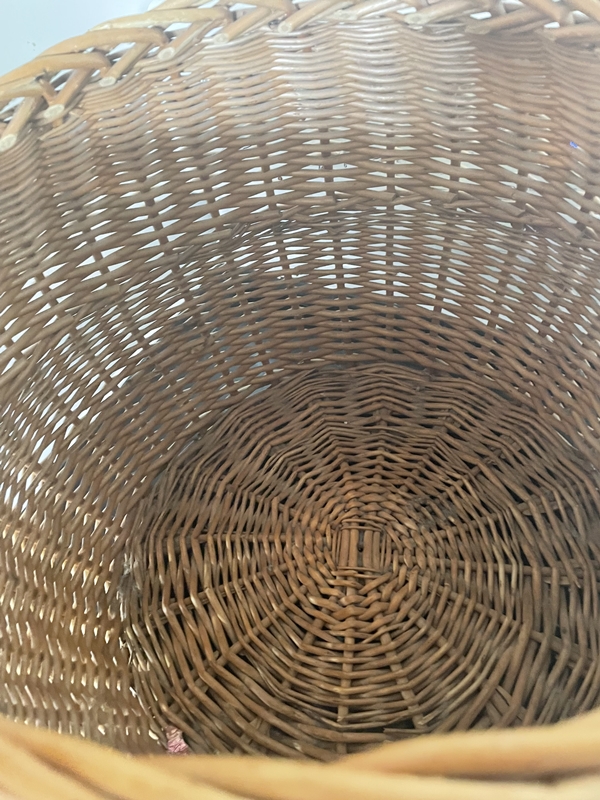
And one more thing, to make Jan and Bernadette jealous.  My mom bought me a basket.

My husband said, “we don’t have a cobra.” I have a feeling he wants it to stay that way. LOL


Service Berries Appliqued Nuno Felt

Service Berries Appliqued Nuno Felt

I showed you earlier the nuno backgrounds that I had created. I decided to try using the idea of the layered photos that I created in Photoshop Elements.

So instead of going with what the background suggested (pine trees), I thought I would try some fused machine applique over the nuno felt.

I printed out my service berry photo and got out my light box, tracing paper and a pencil. I completely ignored the background in the photo and just concentrated on the branch with berries and leaves. I simplified the design as I went.

Here’s the traced design that I came up with for my applique. Now I needed to choose a piece of fabric, get out my fusible (Wonder Under) and transfer the design to the fabric.

Here’s the piece of fabric that I chose on top of the nuno felt. The photo is not the best as the nuno felt looks black. I fused the Wonder Under to the back of the green fabric with my iron. It’s easy to do but if you haven’t used fusible before, make sure to read the instruction of the type that you have. All of them are a bit different.

Once I had the fusible in place, I transferred the pattern to the paper on the back of the fabric. I had to remember that the pattern would be reversed when cut out and applied to the background. I used the tracing paper to do this by flipping my drawing over on to the fusible paper and drawing on the backside of the tracing paper to transfer the pencil line. This works best if you enhance the original pencil line with a softer lead pencil, I used a 7B. Once the pattern was transferred, I cut it out with a pair of short, sharp scissors. I left the paper in place until after everything was cut out.

Then I applied the cut out fabric to the background by ironing it in place. The fusible melts and holds the fabric in place so that it’s easy to stitch down and add details.

Before I started stitching, I decided to add a little thickened water color to get a bit more definition and shading in the leaves and berries. Then on to the sewing machine.

Here it is after stitching (free motion) on the machine. I used three different greens and a couple of reddish brown threads. It’s hard to get an accurate color representation in the photos as the dark red seems to throw the camera off very easily. This was a fun project and different than most of my other nuno landscapes. Now to figure out what to do with the other backgrounds. More to come!