Clamp Dyeing Fabric

Clamp Dyeing Fabric

I am happy to report that our floor is finished and we finally have all of our furniture back. I am still unpacking and rearranging but we are definitely near the end of this mammoth project. I’m happy with the new floor and perhaps at some point, I will completely forget the experience of having it done.

New floor at Ruth's house with painted and caulked trim and painted doors.

My local art group had another get together in the midst of the floor redo and we did some clamp dyeing. I didn’t take any process photos but I do have some of the finished pieces.

Assortment of clamp dyed fabric drying on patio table.

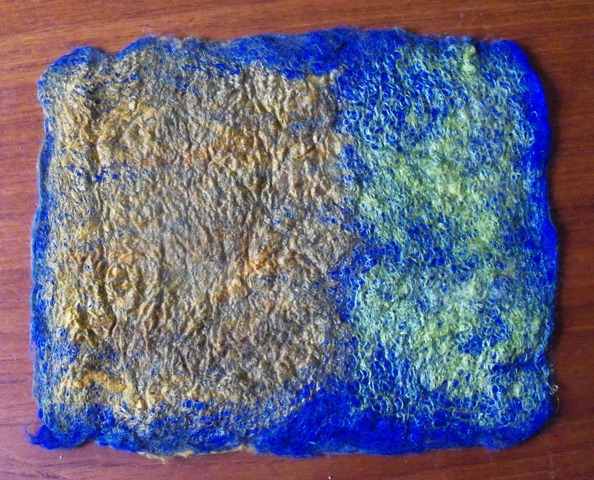
We had five pots of acid dye on the stove including bright yellow, yellow ochre, brick red, dark turquoise and purple. You can fold your fabric however you want or not, and then you clamp different objects to the fabric to create a resist for the dye. You put the clamped fabric into the lightest dye pot first. Then you can unclamp, reclamp in a different pattern and put it into a different color. You work from lighter colors to darker colors. You can dip the fabric partially or put it into soak. The variation are endless.

We used a variety of fabric too. The wool we were using was a very thick, hairy wool blanket. It really had to be clamped tightly and the results weren’t as crisp as thinner fabric.

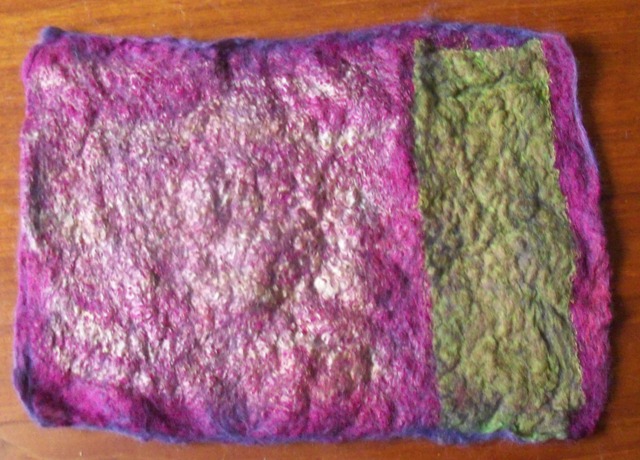
These pieces are cotton velveteen which actually worked really well with the acid dyes. You can see that the thinner fabric took the dye differently.

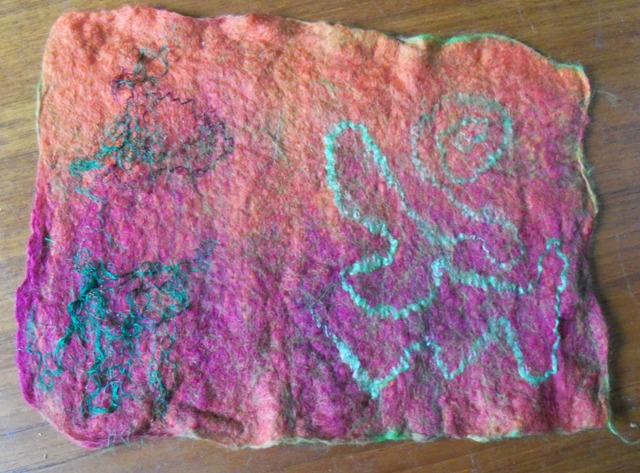
Green and yellow clamp dyed fabric created with metal bird sculpture

This piece was done with two metal bird shapes that are the same. They were clamped to the folded fabric on either side.

Multi colored clamp dyed Kraftex

This is a piece of Kraftex that was folded and clamped, then dipped into various colors.

Green, blue, red, and yellow clamp dyed silk fabric

This is a piece of silk that was folded up tightly and clamped and then dipped into various colors of dye.

Two pieces of wool blanket that has been clamp dyed

Here’s a few more pieces of wool blanket.

Birdie supervising the fabric drying process

And Birdie was supervising the drying process on the porch!

We’re planning on using these fabric pieces to create fabric books. We will be working all year on creating the fabric, then the different pages with other techniques and then putting the books together.

Autumn Leaves Display, Pumpkin Tea Cosy and Stars for Christmas

Autumn Leaves Display, Pumpkin Tea Cosy and Stars for Christmas

Lyn

I’d originally planned to make an autumn leaf garland, so I made a large piece of felt patterned only on one side as all the leaves would face the same way. It comprised three fine layers of green merino wool fibres topped with one layer of autumn colour merino wool fibres and ‘bits’ of fabric and nepps. Dry layout with close up shown below.

dry layout of merino wool and fabric scraps and nepps

close up photo of dry layout ready to make felt

I made a cardboard leaf template to enable me to cut out 30 leaves.

30 leaves cut from felt

The leaves were stabilised all around the cut edges with watered down PVA, 50/50.  When they were dry I stitched a wire stem to each leaf held in place with thread.

felt leaf with wire and stitching

pile of felt leaves

When Annie and I saw the pile of leaves looking as if they had just fallen off a tree, we both thought they would make a lovely seasonal display for a cold fireplace or a large sideboard.  Annie had the perfect colour and shape jug (it was in use in Annie’s house with a display of dahlias but they were nearly finished so reluctantly they got discarded before their time) then Annie went twig hunting in her garden.  After much snipping and choosing and changing our minds, we ended up with this.

jug filled with twigs

Then came the fiddly job of attaching the leaves … without disturbing the arrangement of the twigs and the leaves already in place … not easy … my swear jar is almost full.

vase filled with twigs that are hung with felt leaves

Annie

felted tea cosy in the shape of a pumpkin

Making a tea cosy has been on my project list for a long time.  In my imagination it has been many themes over time as the seasons and celebrations come and go and none of them have come to be, but suddenly the time was right and my tea cosy has been born as a pumpkin!

It was reasonably quick to make and was a bit of experimental fun.  I am surprised it turned out as well as it did!

I made a couple of samples that helped me test some fabrics (which if I’m honest were going to be a garland but I ran out of steam and moved on to the tea cosy!).  The samples were small at 11cm wide and 18cm wide, see below.

felt samples to test colours

I decided the tea cosy had way more chance of getting finished if I kept it really simple. So I just made two separate sides and stitched them together, adding in a stalky handle at the top, rather than a more complicated and time consuming seamless 3D form.

I was also going to embellish it with a “carved” face but decided against it to give it more year round appeal.

I started with the handle as that seemed most fun as I had not tried a curly cord before.  The cord needed a flat end to be stitched into the seam.  It was not very technical.  I got a small piece of green prefelt then wrapped loose green fibres around it then added a tapered amount on the top that I would make into a cord and then let it dry twisted around a paintbrush.  It worked surprisingly well.  I made it far too big forgetting that the felt of the pumpkins would shrink, but I just cut the end off to make it shorter.

felt cord wrapped around a paintbrush to make it curly

I had planned to make some prefelt to lay on to the flat sides to enhance the creases and shaping but then I changed my mind and just reshaped the fibres I had laid out into two pumpkin shapes.  I used a paper template and reversed it for one side so that I could keep the pumpkin sides roughly the same size and shape during felting.  To give a little extra firmness I added a thin rope of fibres around the outline.

pumpkin felt layout

I added fabric scraps and knobbly yarns to give an abstract pumpkin look to the skin.  There were so many interesting pumpkins in all shapes, sizes, colours and textures at our local garden centre so I made my own variety taking inspiration from several different ones.

real pumpkin and felt pumpkin


2 pieces pumpkin felt with stalk

I decided to stitch it together right sides out to keep some of the uneven edge, rather than sewing and turning.  And no it’s not lined, life is too short for that!

completed tea cosy

Lyn

To make a star garland I made a large piece of multi-coloured, merino wool felt.  It was liberally topped with silk fibres in green, red, gold and pink but disappointingly they mostly sank into the wool fibres during felting instead of shining brightly on the top!  Dry layout photos below.

dry layout multi coloured merino wool

dry layout silk on top of merino wool

When the felt was dry, 11 star shapes were cut out – 1 large, 4 medium and 6 small – then the edges were stabilised with pva/water mix (50/50).

Simple hand stitching was added using a very fine, sparkly gold Madeira thread.  The thread is very thin so 4 strands were used at a time – yes – it was often a tangle nightmare!

Madeira gold sparkly thread

Small star brads were easy to push into the felt.

gold star brads

Here is a close-up of 3 stars – the large star is 17.5cm (7”) wide.

3 felt stars with embroidery and brads

The garland was strung with Madeira metallic effect yarn.  It’s very strong but lightweight and has no stretch.

Madeira metallic effect yarn gold

The star garland has a ‘wing span’ of 180cm (6 feet) so I was unable to pull the camera far enough away to get it all in and the detail would have been lost – so I spread it out on my craft table and photographed it in two halves!

There are 11 stars – the centre star is in both photos.

Right half

star garland right half

Left half

left half of star garland


Felting Glasses Cases

Felting Glasses Cases

Although a recent eye test showed I didn’t need a new prescription, I decided to buy some new glasses anyway to give me more colour/style choices and also hopefully reduce the time I spend trying to find my glasses.  I have a place at home where they’re supposed to live but I often thoughtlessly plonk them down somewhere and then get cross with myself as I play hunt the glasses. 

On seeing my new glasses’ accompanying dull acrylic felt cases, I decided to make some wet felted wool cases of my own, either for myself, or to sell or give as gifts. 

I want the cases to fit snugly, so that the glasses don’t slip out but also don’t need any kind of closure fastening: a simple wet felted sleeve. I like the simplicity of this idea and also the challenge of working them to exactly the right size.

While on holiday recently, I bought a carded (mostly) Wensleydale wool batt from a farmers’ market in Ithaca, New York, that I thought might be suitable and I was looking forward to trying it out.

Here’s some of the batt, the work of Windsong Farm in Burdett NY www.windsongfarm.com

I like a sturdy glasses case as it has to withstand being bashed about in my capacious handbag, so I decided on 4 layers of wool: two natural white merino tops and two of the Wensleydale batt – which includes quite a lot of locks.

I calculated a generous size for the case and multiplied the finished dimensions by 1.7 to give me a nice firm felt.

And here it is dry: side 1, side 2 and end-on to show how thick the felt is.

I was happy with the result, though because of the thickness and shrinkage it took quite a long time to felt it fully. 

My second case I decided to treat more like a seascape picture. First, I rounded the corners on one end of the resist to give the case a more rounded bottom. I laid out two layers of wool: pewter for the top half that would become the sea and white for the lower half, that would become the beach. 

I laid two layers of blues with white angora highlights over the pewter section to form the sea, and  two more white layers topped with a strip of very sheer recycled spotted silk scarf which I hoped would look like pebbles for the beach.

I then ran a line of kid mohair top along the length of the case where the sea meets the beach to form a wave. I find this type of mohair felts with a nice wiggle that suggests a breaking wave.

Joining the silk so as not to leave a gap or have a bulky overlap was a bit fiddly but I find it works most easily with a very sheer silk. It’s interesting how dominant the wave looks in the photo because of the curvature of the sides.

The finished seascape case

Once that was done, it occurred to me that perhaps people view their glasses cases more in portrait mode than landscape?  I decided case 3 would be less ‘landscape’! I also started to think more about how people use glasses cases. I’m sure some, like me, have them rattling around in a large bag.  But I suppose some people want to put them in a pocket, so may want something a little thinner?

As I was rummaging in one of the giant boxes of charity shop silk scarves I’ve collected for nuno felting, I found a very sheer small orange scarf with wonky purple circles that I thought I’d try for case number 3. I laid out 4 very fine layers of orange merino tops (to reduce the overall thickness).

My plan was for the orange of the silk to merge with the orange of the wool so that the circles were more prominent than their background. I added three pieces silk to each side of the case.

4 thin layers, of merino, 3 wonky silk circles per side laid out then prefelted ready to full

I’m still felting these very firmly.  You can see the shrinkage when comparing the finished case to its resist. I’m not completely sure why, but I’m getting more shrinkage in the width than the length.  Probably it’s because it’s easier to roll it in that direction, using my hands and various thicknesses of pool noodle inside the case during fulling.  Whatever the reason, it’s nice and firm so I can afford to chop a bit off the length of the resist.

Left – finished & dry; top right – testing the fit; bottom right – showing the shrinkage

For case 4 I decide to go thinner still (I’m thinking of someone putting their glasses in a jacket breast pocket) so switch to 2 layers of wool – this time a natural marled grey merino – which I think looks quite pebble-like.  I added a little white wool to the surface to enhance the pebble look. 

I forgot to take progress shots but here is the finished case.

It is definitely thinner and a little softer, though it’s still felted very firmly. 

Now I’m starting to think about the time these cases are taking to felt.  I have a week in a gallery in December and will also be offering some things for sale in two other galleries that that have a local handmade artesan ‘market’ throughout December. I could sell some cases as they might make nice gifts, but I’m not sure how much people will be willing to pay for a glasses case.

Cases are generally supplied free when you buy glasses and I know most people have no idea how long something like this takes to make. There’s not a whole lot I can do but I thought that making two at once may reduce the making time a little. 

So, cases 5 and 6 will be twins.  I cut a new double-length resist and laid out some natural marled grey Corriedale wool.

I like the white veining on the merino ‘pebble’ case but it’s fairly subtle so I add more of it to these ones.

Top: double-size resist with wool laid out and wetted tightly round the resist. Middle: case 5 (rounded bottom). Bottom: case 6 (rounded both ends)

I keep twin one (case 5) the same as the previous cases, with a rounded bottom and flat top, and cut a rounded top of twin two (case 6) to make it overall more symmetrical.  Actually, I really like the symmetry of this rounded one, but realise that the top is a bit more flimsy than previous cases: presumably because I’m overlapping more wool at the ends of the resist than in the middle, where I have cut these two apart. 

Because I prefer the single to the twin cases, I decide to make the next pair alongside each other but separate.

I have some lightly prefelted ‘pebbles’ that I made earlier, so set these out on the bottom halves of two resists (on two layers of merino wool) with 4 layers of blue & green merino wool and strands of white angora on the top half to create the idea of sea.

Left – layout; right – prefelted

I soon abandoned working on  both at the same time as the pebbles were a bit tricky to felt round so many corners so I worked on the two separately

Comparing the finished one with the wetted out one, you can see that I lost quite a bit of  the pebble definition but I’m still fairly happy with them and they are very sturdy. Indeed, when dry and lightly shaved you can see more of the pebbles, in particular the nuno elements.

I have some Corriedale wool that I dyed ages ago (to make this bag)….

….so for the next pair I go for a blue, green, purple colour fade.

This time I use just 2 layers of wool and they are (not surprisingly) considerably thinner and slightly smaller than the previous pair. They are also much quicker to produce as the layout is fairly simple.

Finished: cases 7 & 8 colour-fade hand-dyed Corriedale

For number 9 I try lightly prefelting 2 mussel shells (one for each side) which I felt into a sandy-coloured background.

Left & middle – layouts side 1 & 2. Right – nearly finished case

I only made this yesterday and it’s still a bit damp. The finished image isn’t a great photo as I’ve taken it in domestic electric light but it gives you the overall impression.

And finally, another recycled scarf but this one is white dots on a red background from a fairly open-weave wool fabric.

To get round the fiddliness of joining / overlapping fabric on this size and shape of resist, I cut out two sections of the scarf and laid one on each side, with gaps along all the sides.

Here’s the layout and here’s a photo of the finished glasses case. I only made this today so it’s very wet. I’m hoping the dots will be a little clearer when it’s dry.

So, what have I learned from all this? Well, I’ve enjoyed playing with all the different layouts. I drew up a list of ideas and I haven’t even completed half of them so there’s plenty more to play at when I have time. 

I think my favourite more complex ones are the combined pebbles & sea.  For the more simple layouts I like both the grey & white pebbles and the blue / green / purple hand-dyed Corriedale ones.  To sell the glasses cases I will have to focus on the simple ones as the more complex layouts take way too much time to make. I’ve already made a couple more of the grey & white pebble ones and will probably make a few more simple brightly coloured ones before I move onto other things. I’m not sure yet which ones I will keep or give as gifts. Do you have a favourite? Or any you don’t like?

Merrickville Ont. Canada, New Fiber Festival -Fiber by the locks

Merrickville Ont. Canada, New Fiber Festival -Fiber by the locks

On Sunday, October 19th 2025, we had a new small fiber sale happening in Merrickville Ontario.  It was a lovely sunny day so perfect for a drive south of the city.

poster of silliwet of a sheep for the Fiber byt the locks sale1.1)poster of new fiber festival

Merrickville is a small town along the Rideau cannel at one of the many locks.  The town has many beautiful stone houses and buildings.  We arrived early and found a good parking spot, so let’s walk over to the locks and take a look around.

map showing the Pew building and Merrickville locks photomaps showing locations of Ottawa to Merickville and the area around the event beside the locks1.2) map showing the Pew building and Merrickville locks.

The pews is the building we were going to on the maps it’s the little red dot. It is also beside the locks and across from the blockhouse (where the guns and soldiers were, in case we were invaded by Americans in 1812). It was a lovely warm not-fall day for October, the leaves were turning and the water was still, giving beautiful reflections of the fall colour. (I was not the only photographer out and we had lens envy chats!)

the Merrickville lockstation with trees changeing colour, red and yellows1.3) the Merrickville lockstation

the Canal locks at Merrickville reflection of fall trees in still water1.4)the Canal locks at Merrickville

the Canal locks at Merrickville looking down the lock trees refecting into still water1.5)the Canal locks at Merrickville

the Canal blockhouse at Merrickville, the military would be stationed here to protect the cannel from American incursions.  I is now a musem1.6)the Canal blockhouse at Merrickville, the military would be stationed here to protect the cannel from American incursions.  I is now a museum.

the Arron Merrick Building (Side) stone block 3 story building with lots of windows1.7) the Arron Merrick Building (Side)

the Arron Merrick Building (front) decoration serounding door way cascading leaves in fall colours with window box of white flowers in front.1.8) the Arron Merrick Building (front)

Its now time to head back to the Pews (formerly a United Church of Canada building, from the 1890’s)

former church now called the Pews. truncated nave with cross esction and tower inset into one corner adjacent to crossing sections. the church is stone blocks. vewed from a lwer angle looking upword agaenst a very blue sky1.9) former church now called the Pews.

The upper part where the church was is still filled with pews and is often used for concerts. The lower hall is accessible from the back of the building. That is where we are heading next, if I can pull you away from enjoying the fall colour.

It’s a small hall, full of 4 foot tables, so it’s a bit snug, but that is more for us to look at. The vendors are just doing the last of their set up (we will wait in the back corner, out of the way, till its time to shop).  One of the vendors just pointed out a doorway with a ramp to another lower section, we can look at that afterwards.

the lower hall filed with 4 ft booths,very full this shows the center booths.2.1) most of the vendor tables in the hall there are a couple more to the left out of frame and at least one more to the right.

Shall we have a quick look around?

2 photos showing a booth with coats and a booth with yarn 2 photos showing a clsoe up of mini tapestrie landscapes and the other photo is of a coil basket 2 Photos; Sewing bags and knit things including a Hat on a manikin head 2 Photos; White Knit? Pumkins and crochet rugs 2 photos: knit hats and jacket and Yarn in skains 2 photos: wool cloth and yarn in many colours and yarn and knit socks and scarf 2 photos of braided yarn in many colours 2 photoss Mohair for sale and locks with wated doll in green outfit2.2-2.9) booths in the main lower hall

The second part of the lower level was accessible through a doorway and a small ramp. This was less finished and more basement-like. It also had an exterior door for accessibility from the outside. The booth sizes were bigger in this back section. There were two felters, which you may be interested in.

2 photos second hall basement: clothing and Upholstery Shop 2 photos second hall basement: Embroidery and anteques table display and close up of back of merorrors 2 photos second hall basement: Felting booth figures photo second hall basement: Felting booth Pictues landscape and Santa photo second hall basement: Edge of felting booth and Husband reading photo second hall basement: second felting booth this one has framed pictures.3.1-3.6) photos second hall basement

We had a thorough look through the event then went up the street to Alpaca tracks in hope of a butterscotch colour of alpaca fiber for a friend’s project. What they had, was not really what I was hoping for, but the store was interesting. Unfortunately, the fiber for sale is upstairs, and I was not feeling up to stairs by that point. So, I will show you a couple quick shots of the ground floor.

Outside and ramp into stone house that has been converted into a store (Alpaca tracks)4.1) the store Alpaca Tracks T(h)read Lightly

2 Photos one of felt flower with yellow center and wall hanging of alpaca 2 photos of displays Mettle frog with umbrella in front of felted mellons and wooden pumkins with cutting bords and scarves in the back ground 2 photos one of window vew with felted sunflowers and one of small wooden cut work candel holders 2 photos, one of Felt orniments including felt dodo bird and small alpaca made of leather.4.2-4.5) displays within the store that cot my eye
It was a store full of cool things to look at, much seemed to be made by local artists. Since I could not find the colour of fiber I was looking for I will have to look in Toronto later in the week.


I hope your virtual shopping money has not been badly depleted!! There is still the OVWSG guild sale to tell you about.  If you were in Ottawa the first weekend in November, I hope you dropped by (you might turn up in a blog post!) if you missed it, you can always plan ahead and be there next year!  But, if i am doing this in order, we need to have a quick chat about; reflections in glass, the ongoing Mer project, and a Visit to the Olive Sparrow (where there were lots of options of fiber!) before we can get to the guild sale.

PS the sneaky comment button is still hiding at the top of the page if you would like to chat!

Making Bubbles

Making Bubbles

This is an old post from several years ago of some fun bubbles I did with a friend. I thought you might like to see it again. This last weekend was our guild sale, and I have nothing to show you felt wise. Jan has so many pictures of the sale to show you, I will leave that post to her. I have such fond memories of this friend and our felt journey.

A while back, I went to a felting friend’s for a few days of fun.  She showed me how to make bubbles and cut them open to great effect. Here are the pictures of what I did.

First of course, I laid out some wool to felt. But these are samples, so plain felt won’t do. I added silk threads, a silk square, some silk roving and other wools to see how it would all go. This is the underside.

This is what the top side looks like

Then, of course, there was the usual rolling and fulling.

rolling rolling rolling

Here they are all finished and ready for the marbles.

The next step is to put marbles in while it is still damp. You pull the felt tightly around the marble and secure it with an elastic, and now it looks like a bubble. We used the elastics they use to put braids in horses’ tails and manes because they are small, stretchy,  strong and cheap.  You put in as many as you like and whatever sizes you like. You can also use felt balls. The felt balls are good if you want to leave them uncut. Marbles are too heavy for that.

Here they are all tied up.

Felt with marbles tied in to make bubbles

Here they are cut.  I cut the tops off, I cut x’s and star patterns, and some I turned inside out. If you cut more off, you see more of the inside, and you can stretch them flatter, too.

Bubbles cut open

You can see how the underside becomes the inside of the bubbles. These samples started out about 6×8 inches, and the finished pieces are about 1.5 by 2.5 inches. They take up a lot of room. I only have 2 of them left; my friend’s dog ate one. I think I will glue them to some leather and make brooches out of them. They are lots of fun to do. I made some wrist cuffs with this method, and I will blog about them next week.

Marketplace Mondays Recap

Marketplace Mondays Recap

I am still in the midst of my house/floor redo and I’m missing all my furniture and applicances. The floor is complete but the company that is supposed to bring my stuff back has failed miserably. I almost forgot to post at all, so I thought I would do a recap post of Markeplace Mondays that I did over ten years ago. Hopefully, there will still be some useful information for people.

Introduction to Marketplace Mondays

Memorable Products

Cohesive Line

Diversify Products

Product Presentation

Hang Tags

Business Cards

Silent Sales People

Complementary Displays

Booth Displays

Approaching Sales Venues

Real Life Product Presentation

Approaching a Gallery Part Two

Pricing Part One

Pricing Part Two

Pricing Part Three

Finding Venues

Wholesale vs Retail

Wholesale Catalog

Selling on ETSY

One of a Kind Wholesale?

Production Calendar

Selling Wholesale and Retail

Finding Wholesale Shows

Artist Statement

Alternative Holiday Sales


Please remember that these posts were written in 2011-2012. Some of the information is probably out of date or maybe not even relevant. Hopefully, this will provide a list of  information and ideas that will improve the business/marketing side of your work. I owned a fine craft gallery for 20+ years so if you  have any specific questions, feel free to ask. The comment button is at the top of the page if you are not a subscriber or clicked over from a Facebook post.

Woodland Pictures and a Sunflower Wedding

Woodland Pictures and a Sunflower Wedding

This month Region 8 of the International Feltmakers held an Autumn Woodland themed wet felted picture workshop led by Susan Mulcock. As with many other regions we’ve been struggling with workshop numbers recently so it was great to receive so much interest in Susan’s class that we were able to fill two separate classes over the weekend. A big shout out has to go to IFA member Kerry Thomas who travelled 250 miles from Lockerbie in Scotland to join us on the Sunday.

We were encouraged to bring our own photos to use as inspiration and I chose one I’d taken while walking a local section of the Viking Way between Horncastle and Woodhall Spa. The Viking Way is a 149 mile long walking route through Lincolnshire, Leicestershire and Rutland. The route opened in 1976 and its name recognises the influence of the Norse invaders on the east of Britain. The route is clearly marked with the recognisable signage of a viking helmet on the yellow disc. 


Photo shows a wet felted Autumn Woodland themed picture. it was inspired by a stretch of the Viking Way near Horncastle in Lincolnshire.

I didn’t think to take photos of the process but this is my finished picture. Looking back at my original photo I think I must have been in a colourful mood when I was laying out my fibres! I’ve added some free motion stitch to help define the tree trunks and some of the finer branches but drew the line at adding hand embroidery. I feel I’d like to do some but I know that if I start I would have to add lots of it so I’ll live with it for now and maybe more stitching will be done at some point.

These are some of the wonderful pictures that were created over the weekend.

Something else I wanted to share with you, with permission from the bride, was my friend Sally’s wedding. Or rather the incredible textile/fibre creations that Sally produced for her wedding to fiance Chris. Sally joined the South Lincs Spinners, Weavers and Dyers three years ago where she learnt to spin and weave. She fell in love with both of these crafts and challenged herself to use them to create her own wedding outfit.

Chris’s mother is German and Sally has a thing for sunflowers so Sally aimed to combine both these themes for her big day. She began by purchasing green mulberry silk fibre from World of Wool which she spun. Next the spun fibre was woven and blocked before being cut out and sewn to create the beautiful bodice for her traditional German style dirndl outfit.

Extra fibre was spun and woven (just in case!) and this was used to make her usher, son Lewis, his waistcoat and to make the ring cushion. The gold apron features a white band made up of number of symbols, designed by Sally, that represent members of her family and these were crocheted using a fine thread to add a very personal detail to the outfit.

During our visit to Ampthill Fibre show this summer we saw a stall selling kits to create your own parasol. Sally bought a kit and had the fibre specially dyed to fit in with her sunflower colour scheme. She then crocheted her parasol cover and put the whole thing together to create a stunning accessory for her outfit.

Another beautiful touch was the wet felted Sunflower with Tyvek daisy’s that she made with me. It was attached it to her veil which in turn was lit from beneath with fairy lights.

At our Spinning meeting the month before the wedding we had a drop spindle demonstration and members that took part had the chance to spin a short length of fibre to take to Sally’s wedding. At the reception we took it in turns to add our yarn to a small piece of weaving which Sally and Chris will keep as a memento of their special day.

At the end of the ceremony I can imagine Sally breathing a huge sigh of relief that all her hard work had paid off and resulted in a day that was incredibly creative, unique and very much “Sally”!

Paper, Ink and Textiles….and….Pumpkins!

Paper, Ink and Textiles….and….Pumpkins!

This will be a brief post from me this time as I frantically prep for overseas adventures…

Early this month our textile group had a workshop entitled Paper, Ink and Textiles given by Justine Warner (www.justinewarnerartist.com). She is a familiar tutor to our group as we have previously (a few years ago) undertaken her workshop involving ties. In fact at one point, she was known as the ‘Tie Lady’ meaning that donated ties would appear in bags on her door step!

01 An example of Justine’s Tie creations


This workshop was a new venture for Justine who demonstrated her ‘accidental inked finding’ with us that she has now perfected into an abstract landscape form.

02 Justine’s new work on paper

With both tables and us protected against being possibly inked in the process, we followed Justine’s instructions to create coloured sheets of paper. The sheet sizes were ideal for long landscapes and initially we worked on inexpensive paper to get the hang of the technique. Then we were let loose on the thick watercolour paper.

03 Colouring our sheets of paper – quite a messy process!


04 Some of my papers drying

The timing was such, that we had all the messy work done before lunch, giving us time for our work to dry.

Recently, Ruth posted about hand stitching into paper, so it is quite a coincidence that I had been machine stitching into paper around the same time.

As you can imagine, machine stitching directly into watercolour paper is the perfect way to create perforated shapes that decide to separate! So, it is no surprise that we used an iron-on interfacing before starting our stitching.

Again, we were given clear instructions on how to create our ‘implied’ landscapes and how to use the various bits and pieces (fabric, wool tops, threads, metal leaf, netting etc) to enhance our work.

05 The beginnings of my stitched landscape

All too quickly the afternoon was over….time just evaporated! Sadly, this meant that no one piece of work was finished (so I have yet another WIP to complete!). The collective display was impressive, and each piece looked so different. Adding a simple paper ‘frame’ to view each, really turned the creations into stunning works.

06 Work by other members of our group

07 and more work

These are just a few of the pieces that I particularly liked from a workshop that I enjoyed and was all too short.


Switching tracks (all will be become clear, I Hope) –

On Saturday, five of us from our local group attended an NWR (National Womens Register, Formerly the National Housewives Register) national conference held at the Hopetown Museum, Darlington.

I digress, but wow what a place….Hopetown is an ambitious £37m rail history museum, finally open for the 200-year celebration of passenger rail travel (the first being from Hopetown in Darlington)….I will definitely be going back to fully explore the offerings for every age, ability and technical know-how (most of which are free).

After the morning speakers and lunch, it was time to disperse to our various chosen workshops. Solo, I joined the ‘craft’ workshop with its seasonal theme of pumpkins.

The tutor brought lots of furnishing fabric offcuts and gave us clear instructions to make a small or large pumpkin, and if we had time maybe two.

08 Pumpkin examples

09 Conference Pumpkin workshop

We all set to sewing, and there was much light chatter. When you are part of a group, either local or national, you are one amongst like-minded people, so I found it easy to chat with my neighbours sharing our supplies and stories.

10 The invisible person or ‘ghost’ (my opportunity to continue the Halloween theme) marks my position!

11 The finale ‘Group’ photo

12 My efforts

On this occasion, whilst I did bring home a big pumpkin WIP, I set to and completed it that same evening….woohoo, an achievement. Both now have a place on the table. Happy Halloween👻


I will be keeping my eyes wide open during my adventures, particularly for creations and inspiration of a textile nature, and hopefully I may get a different slant on something I know. If I do, I will report back!


Inspiration is all around us….I hope you see something every day that will make you pause and take note.


A Mer-person at Kanatacon gaming and felting convention; Saturday

A Mer-person at Kanatacon gaming and felting convention; Saturday

Surprise, it’s the continuing adventures of a Mer-person’s (and Jan’s) busy weekend. Last post, we made it through Friday at the Kanatacon. Let’s see what happens next. (I am sure you can already guess!)

Saturday Morning:

Glenn, the Mer and I hopped in the car early so we could line up for the sale. Unfortunately, by the time we reached Kanata, it was raining, so they kindly let us line up inside.  We were number 26 and 27 (the mer waited upstairs with the felting stuff since he wasn’t shopping). The instructions were that you could select up to 5 games, then go buy them. If you wanted to buy more, you went to the back of the line and went through again.

3 photos of games piled high on long rows of tables filling the room and people strarting to shop through them5.1) The first time through, a lot of games are already gone! I hope I can find the alpaca and lama games!! How many gamers in front of me are Fibre People?

Success!!! I have scored the Fibrr barring animals!!! I also found 2 card games with birds for one of my sisters in law ( they were sent to her, but I have not heard if she likes them yet).

boxes of games, lama alpaca cute monsters and cats on covers5.2) First round of shopping, I got both the lama and the Alpaca games!!! Plus 2 that had tempting descriptions, and the boxes looked interesting.

tables mostly full of gamers playing various games5.3) A quick look around, and there are still shoppers downstairs.

I took the elevator back upstairs, dropped off the games with Glenn and took a quick look around the convention before getting back to work. One of the tables near me was playing a board game about Rome. It is a visually stunning game with detailed buildings, cards with drawings, a colourful board and many tokens. It all fits in a very, very, big box.

4 photos of the game about rome with small buildings and monuments in close up5.4)A game about Rome, lots of buildings and monuments

This is where we are with this young Mer-person. We are now at the part I have most trepidations about, creating the bumps running down the fish’s back and sides. (Scutes -back and Denticles -sides)

Mer-boyfreind back facing towrds us, lying on reference photos of stergons6.1 )Saturday Morning, after the first round of game shopping.

After reviewing my reference photos, I decided on the lighter (“White”) sturgeon. With further inspection, I could see that the first few(4ish)points along the back were spaced a bit closer together, and the rest were farther apart. The number varied from 11-14 Dorsal scutes; I went with 12. To get the spacing, I used sewing pins.

2 photos showing pins used to space out the Scutes along the back6.2)pins used for spacing

I kept adjusting until the spacing seemed correct. Next was to add small amounts of wool to create the point of the Scute and to felt down the space on either side of the point. For the second one, I realised it worked better if I lowered the space between the points first and then made the point. It is more of a half cone on each side of the ridge. The body colour also accentuates the cone-like shape.

felting the first scute (bump) pins mark spots for more scutes6.3)working on the first cone link-shaped bump

A second shopping with dropped prices was announced, so back downstairs I went (ok, I did not do the stairs). I mostly wanted to see how much had gone and what was left. I was not very quick getting to the basement, the elevator needs a key, and it took a bit longer than the stairs. This meant I was at the end of the line in the hallway, which left me standing by the cashing out table at the back of the sales room!  So I got shots of the remains of the game piles and the fervour of reduced price shopping! It was actually calmer than some of the fibre festival shopping I have seen (Black Lambs’ bag of cashmere and silk mill ends comes to mind)

2 photos and insert of games piled on tables with people shopping 6.4) At 11 am, the second go through with reduced prices on most of the games started.

boxed games Gillotene, Patchwork, Code, Cards agenst humanity (family edition)6.5) I found a few more games that looked interesting, but most had no fibre theme.

The table beside where I was working had a game going; these were a pair of steampunk airships battling each other.  (The map and miniatures were very cool; the math to figure out if their various cannons and guns hit each other eluded me, but they seemed to be having lots of fun even with the math.) They spent over an hour chasing each other around the board, trying to blow each other’s airships up.

2 airships heading towords the other players 2 air ships. they are moving above a hex map of landscape and a bit of water.6.6) Steampunk airships battle over a landscape of hexes.

Switched to a new book;  Kristen Painter’s “Embrace the Suck: First Fangs Club, Book 5” (this one has some mobster-like vampires, and other supernatural naturals). Now time to get back to work.  I continued blocking in the general shape of each scute.

2 shots of the smaller superior scutes6.7)the smaller closer closer-spaced scutes

have all the scutes blocked in.6.8) Scutes are blocked in

With the scutes blocked in, it was time to turn and work on his upper human body. I need to firm up his arms. I brought the reference diagrams I was using for a minotaur project I was working on.

Mer with feling needle in his chest, sitting on little table, in back ground gameing contiues.7.1) Turning to the human parts, let’s firm up and define muscles 

Firming forearms is not as exciting as it sounds, so I took a break and I tried a bit of the skin tone on his head and some of the fish colour on the fins. I think the skin tone is close the fin colour will need more work.

Mer on table arms are firmer but still need more work.7.2) building up the definition of muscles and firming up the wool in the forearm 

I got a bit distracted listening to the new audio book and concentrating on the arm myology, so there are not a lot of progress shots.

I had a few of the gamers come over to see what I was working on this time. I did a few explanations of needle felting as I worked.

This is always a fun spot to felt and watch the gamers have fun. I should go with Glenn on their regular gaming night occasionally, too. (I might even try a game?)

I know that sometimes I am not a particularly fast felter, I am not in a rush, and I enjoy the process, and I felt quite firmly. So it may not look like I have accomplished much for two days of felting. Good thing the young Mer-person seems quite pleased!

Husband holding Mer-person, both looking happy.7.3) Glenn and the Mer in progress, both looked quite pleased with the weekend so far! (and it’s only Saturday!)

Dare I tell you what happened Sunday? How about we save that for later?

Do you have any sheep-related games in your collection?  Have you tried the Alpaca or Lama games?  Have fun and keep felting

A Mer-person at Kanatacon gaming and felting convention; Friday

A Mer-person at Kanatacon gaming and felting convention; Friday

What a busy seven days! No wonder I feel like falling over and having a nap on the floor (which is lying and saying it’s very comfy and I should fall for it!) Chunks of the last seven days were even fiber related!!! I will not overload you with all 7 days at once,  or even all 7 of them! But let’s start on Friday, Oct. 17, which was the day my last post went up, about squishy-fish-centres.

The Fish-person in question from the last blog (AKA The Mer-Boyfriend), and I, along with a green folding tote of fibre and needle felting tools, and a cloth bag of snacks and more fibre. We all got in the car and headed off to Kanata (Glenn will be joining us after work), to go to the Kanata Games Club’s annual 2-day fall convention. This is a popular convention and is at the church they have their regular gaming evening the rest of the year. This also explains why the convention starts on Friday, since someone else already has the church booked for Sunday activities.

By the time we got there, Gaming had already begun. From previous years, I knew that the few empty tables would soon be full of gamers. Good thing I brought my own chair (walker), and I had my little folding table still in the car from demoing earlier this summer. I had the same spot at the back of the hall by the coat racks as last year. I can watch the fun, but am out from underfoot and not too far from the bathroom!

picture of friday morning bordgameing, logo for kanata gameing convention, photo showing part of mettle table, and felting suplys with mer-man in progress1.1) little table and felting supplies for the next 2 days

signs saying which games were going to be play tested and demoed. second picture of seting up a new game1.2)  The temporarily empty 2 tables directly in front of me will be filled with Playtesting and new game demos’

I got myself sorted out, got my audio book playing (Wen Spencer’s “Black Tie and Tails: Black Wolves of Boston, Book 2” (mostly werewolves) I was almost finished that so soon continued with Dianne Freeman’s “A Daughter’s Guide to Mothers and Murder: A Countess of Harleigh Mystery, Book 8” (nothing supernatural in this one).

mer person, 2 braids of fiber simmiler to the photo reference of a white strugon.2.1) I consulted with the young Mer about his fishy-part’s colours. It’s a bit early to start adding the top layer, but I am putting off deciding how to approach the Scutes and Denticles.

I have had fun with variegated braids for landscapes, since you can pull out a bit of whichever tone you want. If you don’t like blending to get the colour you are looking for, this may be an option (but blending is not difficult and fun to do too).

one of the braids unbraded to show the colours sitting beside refrence photo2.2) Part of the braid undone so you can see the colour variations.

Since I can’t work on the final colours if I don’t have the under layers to the correct shape, I need to put away the fish colour and work on adding the fins.

mer-person on foam nealing pad, with punch tool and photo reference. showing v notch in dorsal fin starting2.3) Adding the Dorsal fin, it has a “V” notch on the back part of the fin and is thicker at the leading edge.

wrapped wier and adding fiber over wrapped tail wiers. mer person's tail is on foam mat curved bladed sissors, punch tool and fiber sitting on top of it. reference pictures are sitting adjacent.2.4) starting the Heterocercal and Caudal tail fin

showing the building up of the fiber along the upper front endge of the tail fin. ref. photo is shown to comparie to tail2.5) There is a thicker area along the top edge of the heteroceral tail fin

As I was working, the convention continued around us. There was lots of cheering as well as quieter playing.  I am not sure which game this was; it caught my attention due to all the various game pieces.

hand moving game pices on game bord.2.6) I am not sure which game this was, but all the odd playing pieces caught my attention.

close up of fins in progress a bit more progresson fins this photo shows full mer-person2.7-2.8) the tail, Pelvic, and Anal fins have been blocked in, but the shape is not correct yet.

If you were curious as to how I am making fins.

To give each fin structure and poseability, I used floral wire.  To give it extra support, I added a couple of supports for the dorsal fin and a lower wire for the caudal section of the tail fin.

There are two choices: the wire can be part of the armature, or added as a supplemental element (not attached). I used both methods this time. The Pectoral fins were added to the armature when I reached the hips as I wrapped the first layer of core wool. I twisted the wire around the central aluminium wire armature, then out to the sides. I then kept wrapping wool below the wire along the fish body. The two parts of the tail are also directly attached to the main armature.

pictures showing the floral wire attached to the main armature3.1) fins that are part of the main armature, Pectoral and Heterocercal tail and caudal fin


The second option is to insert the appendage without attaching it to an armature. This is often done with individual bird legs if you are not making a full armature. For the birds, you can insert the straight wire and use a drop of glue to help secure it until you build up the fibre to support the wire. You can also insert a wire with a curve or loop to make it harder to pull out after more fibre is added around it. I used a single wire for the anal fin that went through the core wool, then the wire was twisted back upon itself.

A single wire can be used to create a single fin, as I did with the Dorsal fin, which went through the fibre in 2 spots, leaving a loop in the centre and one longer and one shorter wire on either side of the centre loop. I again estimated the length for the three sections of wire and twisted them.  When you are (prototyping), ok, guessing the lengths you will need after the rest of the core wool has been added. You can come up a bit short. I suspect the anathetic was hanging out in the measuring and estimating section of my brain. You may notice the change in plan as we get further into the project.

photo and exlanitory diagram showing the pathway of the wire in the core wool. more fiber will be added after wier is inserted.3.2) single wire insertion to create a secure Dorsal fin. (More fibre will be added to the core wool after the wire has been added.)

I this case, for the pelvic fins (there are two fins, one on either side of the abdomen), I ran the wire through the core wool at the level I wanted the fins to start, estimated the length, making a bend in the wire, then twisted it (this will both strengthen and shorten the wire). Then built up the core wool fibre of the fish body to further secure the wire.

Pelvic fin wires inserted through wrapped wool. the wire is then folded back to the estimated length. shows twised Pelive fin wires.3.3- 3.4) Pelvic fins are a pair of fins on the underside of the fish before the single anal fin.

It is easier to hide the wire and attach the fibre for the fin if I first cover the supplementary support wires with wool. So, like wrapping tiny toes and other fine appendages, start with a thin, narrow piece of fibre (or roving), you can always add more, but it’s a pain when you have added too much.

I secured the fibre that I will be wrapping around the supplement wire to the body at the base of the wire. Once secure, I will wrap the length of the wire. When the fin wire is wrapped, I added a thin layer of fibre over the wrapped wire, and tacked it into the fibre that wrapped the wire. I folded the fibres over the leading edge with the wire and then used the punch tool with fine (40-42g) needles to secure it to itself and compact the fin. I expanded the fin area with more thin layers of fibre and secured them with the punch tool.  I am keeping the fins thin, since fins are thin and I will be adding more fibre when I add the surface colour. If you wanted to do even thinner fins, you may choose to build this underlayer with your finished colours. I used the final outer fibre with Mrs. Mer’s fins, which are white and relatively thin (butterfly Koi).

felted fin resting on foam mat with punch tool sitting beside3.5 ) using the fake clover punch tool to flatten the fins at his hips.

Tip: support your fin on your work surface edge and use the punch tool to flatten the felt as much as you can. Pieces of pool noodle can be helpful to support parts of your work as you needle felt an appendage. Sara has a mini version of her stabit rice and burlap pad that can be used in the same way.

Tip: We are felters, we are not spinners who shun scissors as the work of the devil, and would never cut their spinning fibre. If you get the fin to the thinness you want and the general shape, you can use scissors to correct the shape. Remember to check that the cut edge is solidly felted.

In the evening, there was an announcement that we could go downstairs to view the games that would be on sale tomorrow morning. Luckily, there is a small elevator, close to where I was working, so I could check out the sale too. After looking through the extensive piles for games with sheep themes, we did not have luck with sheep, but I did find one game focusing on alpacas and one about llamas. If I get them tomorrow, I will take them to the next long weekend social and see if we can play them.

two shots of the gient game sale with insert of alpca and lama games.4.1) previewing the room full of games for sale.

It was getting close to 10 pm, Glenn had fun with the games he had played, and I had a good day of felting and audiobooks. It was time to head home. We will have to get up early if we hope to get such exciting games with fibre bearing animals! (I promise not to leave you in suspense for long!)

PS the comment button is at the top of the page, if you would like to use it.