Making a Pin Cushion

Making a Pin Cushion

For Christmas this year my granddaughter gave me a small bowl. Her mother says she saw it and was excited and adamant that I would love it. We have no idea why. She is right I do like it but maybe not for the reasons she thinks. I love it because it’s from her and because she is so sure I would. I do not think she knows what Lord of the Rings or Hobbits are.

I wanted to think of some way to use it that wasn’t just popping it in with the other bowls in the cupboard. I decided on a 3D scene to use as a pin cushion. And what else could I make for the scene but a hobbit house?  I started with a dryer ball to save time filling it and some green/brown mixed roving to make the top and the hill.

I had to make a hill for the hobbit to live in. I made the hill with the same green brown wool. For the front of the house where the door will go, I used much more of the brown/burnt grass colour. Then at our last meeting as part of the felting machine test, which you will start to hear about in Jan’s next post, I used Jan’s needle felting machine to attach the front of the hobbit house to the hill

This is as far as I have made it. I need to make the door and attach it, then the hill is ready to attach to the wool base in the bowl. Now I have to decide if I am happy with the green “grass” I think it may need a little bit of brighter green.

I suppose I should go do some research online to see the colours that are used. So far I was just going with the picture on the bowl. It’s a slow project but it is coming along. Slow and steady wins the race….right?

Tree Specimen Book Update

Tree Specimen Book Update

If you missed my other posts about this mixed media handmade book you can find post #1 here, post #2 and post #3. It’s a work in progress that I’m taking slowly, adding bits and pieces as I get inspired.

Handmade book open to one page with eco printed background and print of aspen branch with leaves and catkins.

As I was getting ready for my upcoming Level 4 Art and Design class which will involve printmaking, I was going through my stamps and also some previously printed papers that I haven’t used. I thought they would make a good addition to the book. This is a print of an aspen branch with leaves and catkins. I added the black outline with a felt pen. The aspen branch is printed on the back of an eco print.

Handmade book open to one page with brown painted background page and black print of weeping birch on multi colored paper.

I found a print of a weeping birch which I added to this painted brown paper page.

Handmade book showing one page with painted green background and glued cut out of aspen branch from multi colored paper.

While I was looking through my prints, I found a cutout of another aspen branch. I’m not sure what I made it for but thought it was perfect for this green painted page. I might add a few more details into the leaves with colored pencil. I’m not sure yet.

Handmade book open to center page spread with inked background page of orange and green.

The back of the green painted paper above, was white. I added some ink in orange, green and brown around the edges so the white wouldn’t show around the print I planned to add there. This is the center of the book.

Handmade book open to center page spread with inked background page of orange and green covered partially by printed autumn leaves.

Here is is with the print I added. I also finally bought some gesso and added it to all the white pages. Now I can do some painting or sketching on those pages with more ease.

Handmade book open to one page with brown wrinkled paper background and black and gree print of leaves hanging down.

Here’s the last print I added. I have more prints, but for now, I think I have added enough. This book has a lot of pages and I have a long way to go to get it completely filled. I think I will start sketching on the white pages next.

Collage of felted lotus pod created in online class by Glady Paulus.

And for those of you who think I haven’t done any felting for a long time, here’s a felted lotus pod that I created for an online class I took with Gladys Paulus. The class was marvelous and if you get a chance, it’s well worth taking.

Also, registration is open for Helene Dooley’s Hanging Felted Spiral online class. Click on the link and scroll down to the bottom of the page to register. This is a great class to learn more about complex three dimensional felting. You need to be an intermediate felt maker who has worked with resists and three dimensional felting. The class is online and can be accessed throughout the class period at any time. You don’t need to be online at any certain time. So join Helene to create wonderful felted spirals!


My ‘Tree in the Spring’ depicted in felt

My ‘Tree in the Spring’ depicted in felt

I have an ‘Amelanchier Canadensis’ in my garden.  Every March its red/brown branches are covered in a mass of white, star-shaped flowers that slowly give way to bronze coloured leaves that gradually turn spring green.

I would love to show you a photo of it in full flower in my garden, but I don’t have one yet!  So on 20th Feb I took this photo to show the red/brown branches with the promise of flowers next month.

Amelanchier Canadensis in bud

So, how can I show this tree, in full flower, in felt for the First Quarter Challenge?

As usual, the thinking time of this project outweighed the doing time but I eventually settled on depicting part of a branch rather than the whole tree.

I planned to wet-felt a background, wet felt the flowers, then needle felt the whole thing together to (hopefully) achieve a 3D effect and I wanted the background to be a blurry representation of the garden behind the branch – as in the photo above.

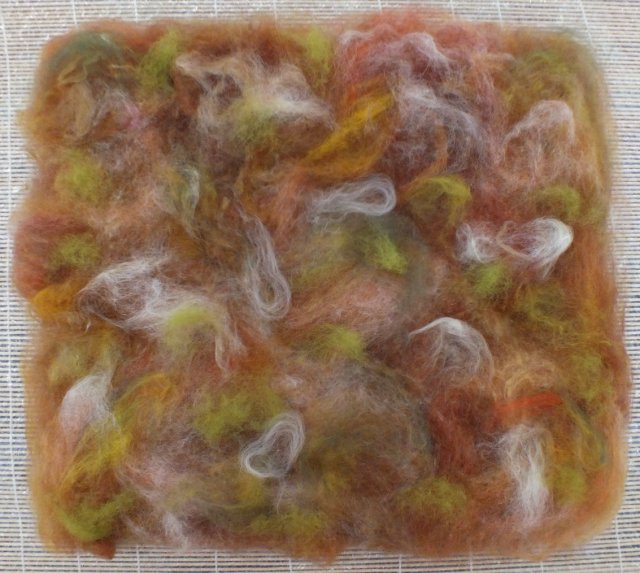
So I put down three layers of bronze coloured Merino wool fibres (as a nod to the colour of the leaves to come) then topped them with a layer of ‘winter-into-spring garden colours’.  This is the dry layout.

dry wool fibres to form a background
Dry wool fibres to form a background

After felting, and while it was drying, I sent a photo to my daughter, Annie, and asked if I had it wrong – did it look like a doormat?

She makes me laugh a lot, just look at her reply …

joke made about layout
Joke made about layout

So here’s the dry background – the under layers of bronze came through much stronger than I thought they would, but I decided to go with it.

background when dry
Background when dry

I wet-felted the flowers – some buds, some semi-open and three flowers fully out.

flower shapes felted in white
Flower shapes felted in white

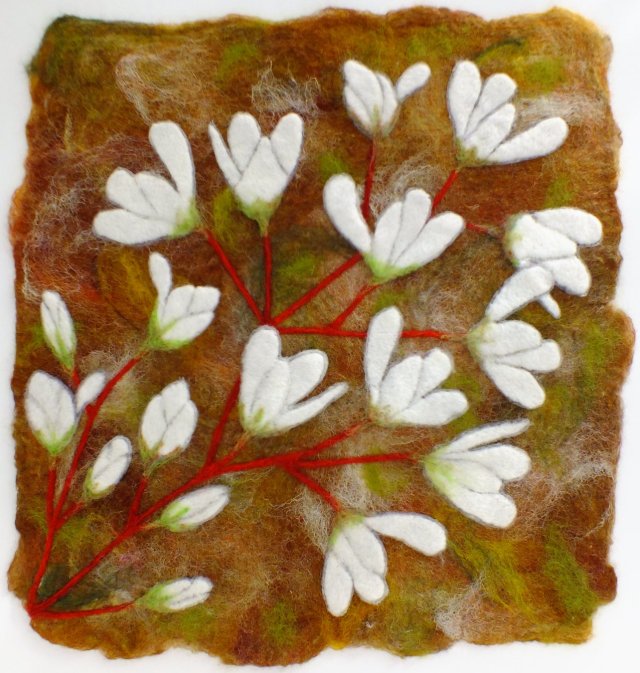
I then set to with the felting needle.  I formed the branches with red Merino wool fibres and attached the white flower shapes.  I used grey Merino wool fibres to detail the flowers and outline them, then green/red Merino wool fibres to make the bit where the branch joins the flower.

Needle felting the branches and flowers


Adding more white blossom

To finish I added three fully opened flowers.  I tried to needle-felt some yellow and green nepps into the centres but it was very tricky and difficult, so they are only loosely held in place but as this piece is just for me I think that’s ok.  The finished piece measures 46 x 46cm (18″x18″)

Amelanchier blossom depicted in felt

Have you had a go at this quarter’s challenge?  If you missed the announcement, please see here First Quarter Challenge

Maintaining my Antique Wool Winder

Maintaining my Antique Wool Winder

A few years ago I adopted this Antique Skein Winder at one of our guild sales.  Originally there would have been a mechanism that would count the rotations and pop once a full skein was reached.  But that part of the tool is broken on this one.  However, it is still quite usable for winding up skeins of yarn.

I noticed that mine was looking quite dusty and the wood was quite dry.  Winter in Ontario can be quite cold and dry so this is no great surprise that my skein winder was looking a bit tired.

Dusty Antique wool winder with dry wood
Antique wool winder before cleaning

I dug out my bag of wood cleaners and assessed the problem.  I decided to use the Home Hardware Outdoor Furniture Wax.

Wood cleaners and conditioners

Before I started to use the wax I wiped down the skein winder with a damp rag to remove the surface dust.  Then I added a dollop of furniture wax and started rubbing it in.  This wax is nice to use because it is very wet and easy to spread around.  I also find it very nourishing to the wood.

Wood skein winder with a splat of wax polish on it
Splat of wax polish

When the whole skein winder was waxed the wood grain was showing really nicely and the whole thing looked amazing.  It didn’t take long to clean and maintain my skein winder and it was very satisfying to do because the results are so impressive.  Having tools that work properly is wonderful.  Having tools that are also beautiful makes them even more enjoyable to use.

Clean wooden skein winder

I do a lot of spinning and therefore this tool gets used all the time.  I went to the Chesterville Spin In on Feb 4th and bough this lovely braid of Superwash Merino combed top from Karberry Farm.

Braid of wool roving in blue, rust and white
Braid of Superwash Merino Combed top from Karberry Farm

After I spun it up I decided to take a few photos showing my skein winder in action.  To get started I move my spinning wheel off to the left and release the brake tension on the bobbin.

Majacraft Rose Spinning wheel on left and Antique skein winder on right
Majacraft Rose Spinning wheel (left) and Skein Winder (right)

Next I attach the end of the yarn to one of the arms of the skein winder and start winding.  (I use an elastic hair tie on the arm of the winder and simply tuck the end of the yarn under the elastic to secure it, and then I start winding.)  The yarn flows off the bobbin on the spinning wheel and onto the skein winder.  I do hold the yarn as I am winding so that it winds on evenly and with a bit of tension.

Yarn being wound off the spinning wheel bobbin and onto the skein winder
Winding yarn off the spinning wheel bobbin and onto the skein winder

After I have wound up the yarn onto the skein winder I have a nice neat bundle of yarn.  (In this next photo you can see where I attached the initial tail of the yarn using a hair elastic on the left arm of the skein winder.)

Top view of skein winder with yarn wound onto it
Skein winder with yarn wound onto it

Next I use scrap yarn to tie four figure eight ties on the skein, spacing them out around the skein.

Figure eiight tie on the skein using scrap yarn
Figure eight tie on the skein using scrap yarn

I also like to secure both ends of the yarn into the nearest figure eight tie.  I take the yarn end, flip it over the nearest figure eight knot, and then tie a light knot.  This allows me to always find one of the ends of the skein later because I know it will be in one of the four figure eight ties.

Yarn tail flipped over the figure eight tie and knotted lightly

Once the four ties are knotted and the ends of the skein are secured, it is time to remove the skein from the yarn winder.

Front view of yarn winder with skein of yarn on it with four yarn ties

My winder has six arms.  One of the arms has a neat elbow joint that has can be bent.  When I bend the arm to the side this releases the tension on the skein, making it easier to remove the skein off the winder.

Front view of yarn winder with one arm bent to assist with taking the skein off the yarn winder
Elbow joint bent to assist with taking the skein off the winder

After removing from the winder I twist the skein into a neat bundle for storage.  This skein of chain plied yarn will go in the pile of recent handspun waiting to be washed.  After it is washed and dry it will be ready for longterm storage or for use.

Twisted skein of yarn sitting on the base of the yarn winder
Twisted skein of yarn


And just for fun, I’m going to end this post by including the before and after photos side by side.  I love how it went from drab to fabulous with a tiny bit of elbow grease.  This handsome Antique skein winder deserved the TLC.

Dusty Antique wool winder with dry wood
Antique wool winder before cleaning
Clean wooden skein winder


2D felted landscape workshop

2D felted landscape workshop

Saturday, Feb 11th, 2023, was the date scheduled for the next 2D felted landscape workshop at the local guild. Before Xmas we had a lot of workshops have to reschedule. Either the weather was against us, or the instructor or the students had caught the flu going through town. (Technically that is better than covid but it still sounded awful.)

In the aftermath of the sudden arrival of winter the weekend before, I had been left fighting Glenn’s generosity (he gave me his cold). I had noticed I was feeling better each day from about Wednesday so by Saturday I was pretty optimistic that I had defeated most of it and would be able to teach. (I had been avoiding Glenn but it is a small house.) I had spent the week slowly gathering supplies, sorting out all the things the students would need and had Glenn do a run to Dollerama for the missing items.

Saturday morning started very early, Glenn loaded the supplies, samples and many bags of different fibre. When everything was in the car, there was still room in the front seats for both of us.  Seeing out the back is not that important, I have side mirrors! So, off we went to the studio to set up before the workshop.

 1) small grey 4 door Kea Soul with Glenn bringing in as much as he could carry each trip. The parking space is still covered in snow and the Dairy Queen on the other side of the street is not yet open. 1) small grey 4-door Kea Soul with Glenn bringing in as much as he could carry each trip. The parking space is still covered in snow and the Dairy Queen on the other side of the street is not yet open.
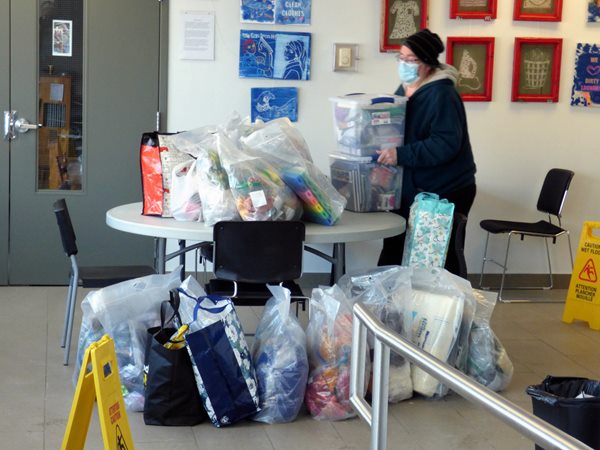
2)  clustered around or on the table outside the studio; 12 giant zip lock bags, 4 large bags, one file holding plastic box, and Glenn placing the last 2 mid-size clear ruff totes on round plastic topped table. There are “caution wet floor” signs in the foreground and off to one side.2)  clustered around or on the table outside the studio; 12 giant zip lock bags, 4 large bags, one file-holding plastic box, and Glenn placing the last 2 mid-size clear ruff totes on a round plastic-topped table. There are “caution wet floor” signs in the foreground and off to one side.

Glenn unloaded the car and set up the extra tables in the studio so I could set out the student’s supplies and set up the examples.

3) Class room set up with each students notes, foam pad, frame, needles set out at there place. To the right are examples of my work (including the Mr. and Mrs. Mer to show 3D Dry Felting). In the background, Glenn is reading and you can see a smaller table full of other supplies we will need as well as a 5 foot table overflowing with bags of wool. (There are a couple bags sitting on my walker).3) Classroom set up with each student’s notes, foam pad, frame, and needles set out at their place. To the right are examples of my work (including the Mr. and Mrs. Mer to show 3D Dry Felting). In the background, Glenn is reading and you can see a smaller table full of other supplies we will need as well as a 5-foot table overflowing with bags of wool. (There are a couple of bags sitting on my walker).

4) Close up of examples of 2D and 3D needle felting and 3 books (Art in Felt and Stitch, Jaana Mattson's Landscapes in Wool: The Art of Needle Felting and Painting With Wool Landscapes) I had brought for the students to look at.4) Close up of examples of 2D and 3D needle felting and 3 books (Art in Felt and Stitch, Jaana Mattson’s Landscapes in Wool: The Art of Needle Felting and Painting With Wool Landscapes) I had brought for the students to look at.

In the student’s notes, I gave them a list of books that may be of interest if they enjoyed 2D picture felting.

  • Painting With Wool Landscapes by Bethany Harris
  • Creating Felt Pictures by Andrea Hunter
  • The Art of Moy Mackay by Moy MacKay
  • Art in Felt and Stitch Felting Book by Moy MacKay
  • Jaana Mattson’s Landscapes in Wool: The Art of Needle Felting  by Jaana Mattson
  • The Art of Felt Felting Book by Loumange Francoise Tellier (inspirational)

5) Three bins and a bag of other things the students might need or could try. Fake clover tools, bags of scissors, extra needles, pins, small pet brushes that work like mini carders, and a bag of permanent markers are arrayed on the table. There are also a couple more small samples of felting and using different types of backing or ground felt.5) Three bins and a bag of other things the students might need or could try. Fake clover tools, bags of scissors, extra needles, pins, small pet brushes that work like mini carders, and a bag of permanent markers are arrayed on the table. There are also a couple more small samples of felting and using different types of backing or ground felt.

6) 13? Bags of wool on a five foot table over flowing with one on the floor and two bags on my walker.6) 13? Bags of wool on a five-foot table overflowing with one on the floor and two bags on my walker.

7) Well-padded rolling desk chair with green and black pillow sits behind a folding table with all the students’ supplies.7) Well-padded rolling desk chair with a green and black pillow sits behind a folding table with all the students’ supplies.

I found out that one of my students had hurt her back and was not sure if she could make it or how long she would be able to felt, so had one of the comfy chairs and pillow ready for her arrival.

8) A close up of one of the students workshop supplies, with various candy and chocolates for stamina (keep watching the pictures and you will see more of the candy selection).8) A close-up of one of the student’s workshop supplies, with various candies and chocolates for stamina (keep watching the pictures and you will see more of the candy selection).

Most of the students had chosen an image from a selection I had sent earlier in the week. We wound up with two students working on the tree in winter with a fence and two on an ocean image. Since I had not heard from all the students I thought I better bring all the colour options so I would be ready for whatever they wanted to try. We had two missing students, one was a booking error that had been corrected but was not on my list, and the other was actually missing. ( I found out when I got home that she had not felt well and had tested positive for covid that morning!)

I had set out the student’s supplies; Name tag (rectangle thick wool felt): (safety pin & sew-on pin, sock yarn, piece of scrap paper and Marker).  Foam Kneeling pad, 1 sheet of 100% wool felt (enough for two 5×7 pictures), 1 sheet of acrylic craft felt, I sheet of card stock (to make a window mat), a Plastic ruler, a Wooden Frame with a mat from Dollarama, XXL Project bag, bag for the needle, 21 pages notes and Felting needles.

  • 2x  T36-333 needles (Blue)
  • 2x  T38-333 needles (PINK)
  • 2x  T42-222 needles (Turquoise)
  • 1x Crown 40-111 needles (Orange)
  • 1x Reverse 40-222  needles (Green)

We started with a name tag; making your name in yarn to practice eye-hand coordination and get used to the needles.   I usually review what’s in the notes, the basics of history of landscape, mentioning the golden mean and the rule of 3’s for photography,  a review of perspective, some of the techniques that apply to pastels, acrylics and watercolours that can be used with wool.  As well as blending fibres by hand or by hand cards to get the colours you want. I also chatted briefly about ways to transfer images to the felt.

I didn’t go into as much detail as I usually do since I was starting to feel a bit more brain-stuffed up than I had been when I arrived and started to set up.  I was sure I was feeling better, but this cold seems to keep trying to sneak back and hit you again. Even so, the students did very well. Maybe not overloading them with info helped.

This time everyone wanted to use the “lightbox” (or window) method so I reminded them that the template version, which is good for thicker felt bases or dark-coloured base felt, was in their note if they needed to use it in the future.

9) Student with ocean view with lots of blues teals light teals, grey and white wool strewn around. There are is also a package of rockets candy rolls in the foreground9) Student with ocean view with lots of blues teals light teals, grey and white wool strewn around. There are is also a package of rockets candy rolls in the foreground

For each image I had two copies of the original image (in case they chose the template method), a colour blocked version and a colour saturation image to show hidden colours they may want to consider.  I can do this with Microsoft Word 2010. (Sometimes things work and upgrade then lose the effects you want.)

10) The second Ocean image again has fiber strewn around it. In the foreground, my male cardinal on a branch, using the template method for transfer. Like Watercolour painting, layers of thin colour for the back ground and a thicker more like acrylic approach to the bird.10) The second Ocean image again has fibre strewn around it. In the foreground, my male cardinal on a branch, using the template method for transfer. Like Watercolour painting, layers of thin colour for the background and a thicker more like acrylic approach to the bird.

Normally each student has chosen a different image, this time one of the ocean images was popular and the tree in winter with a fence and hill had found favour with the other 2 students.

11)student working on background behind the tree first. This time the fiber is a mix of white, grey, green-grey, light blue and brown with gray. In the foreground there is the green handle of the clover tool rake (originally designed to clean a clover brush) but works very well to hold down the wool as you felt, it keeps your fingers away from the pointy end and less bloodshed.11) Student working on their background behind the tree first. This time the fibre is a mix of white, grey, green-grey, light blue and brown with gray. In the foreground there is the green handle of the clover tool rake (originally designed to clean a clover brush) but works very well to hold down the wool as you felt, it keeps your fingers away from the pointy end and less bloodshed.

12) The second tree image is having its fence added. in the foreground are a works in progress of a night winter tree and on the cheap Dollar Tree craft felt a pair of sheep (you can just see the eye) a pair of hand carders sitting on a copy of the students 21 pages of notes. Next to that is a brass nautical caliper, a wooden frame with an XXL project bag and a box of mini boxes of smarties (candy coated chocolates).12) The second tree image is having its fence added. in the foreground are works in progress of a night winter tree and on the cheap Dollar Tree craft felt a pair of sheep (you can just see the eye) and a pair of hand carders sitting on a copy of the student’s 21 pages of notes. Next to that is a brass nautical calliper, a wooden frame with an XXL project bag and a box of mini boxes of smarties (candy-coated chocolates).

Winter trees were also popular.  I reminded the class that they could play God and move, remove or change trees, clouds or anything else that offended them. It was their landscape and they could adjust it so it would suit their liking.

I talked about how to think like a watercolour painting with washes and layers of thin wisps of fibre building up to a final image (not the fastest way to work but it can be very effective as in the fox who still needs to have whiskers added and I’m at about 30 hours). I also mentioned that after laying in the trunk and main branches, wisps of fibre worked well to create a hallow of tiny branches for the winter tree.

13) The first tree picture, Using a 5x7 opening to check the framing of the image. Behind the image and card stock mat is the foam kneeling pad that we were using as a felting surface.13) The first tree picture, Using a 5×7 opening to check the framing of the image. Behind the image and card stock mat is the foam kneeling pad that we were using as a felting surface.

Using a mat or just a card stock stand-in for a mat will give your eye and brain another view of the image you have been working on.

14) The second tree picture, held up to getting a quick check for position in the mat.14) The second tree picture, held up to get a quick check for position in the mat.

Both trees look great and are their own tree, even having used the same inspiration to start with. The same individual personality happened with the stormy sky ocean picture.

15) a vary active roiling sky with sea and beach underneath, there is a seagull added to the right side. 15) a very active roiling sky with sea and beach underneath, there is a seagull added to the right side.

16) a turbulent sky and sea with a beach in the foreground.16) a turbulent sky and sea with a beach in the foreground.

Both have great movement in their pictures, again when using the same image each saw and focused on different aspects of the image.

I have found sometimes after working on an image for a while I need to take a break. I will put it aside and come back to consider it again later. I may decide “yes I am happy” and the picture is done or I may decide it needs a bit of fibre added here or there to complete it. Sometimes using a card stalk mat will help me consider the image, looking at the picture in a mirror or turning the image and the felt picture upside down will help you see what you are looking at, rather than what your brain says it thinks it is looking at. (It makes it easier to see the negative space and compare the image with the picture you are making).

I hope they had fun and I hope that this opened up a new expression of creativity with wool.

The class finished up early but they also took a much shorter lunch than the last class. I had given each student a project bag (giant XXL zip lock bag) to store their extra wool, felt samples and needles in. They had the leftover fibre from their first picture and a couple selected a second image to try. A different water picture and a sheep in a field of snow.  it was impressive how far along they got in an hour on their second images.

17) An hour in on a second image of a sheep in a snowfield and snowy sky, sitting in a card stalk mat17) An hour in on a second image of a sheep in a snowfield and snowy sky, sitting in a card stalk mat

I seem to have missed getting a shot of the other ocean image! I was really only working at about 90% efficiency. It took me about an hour to pack up the workshop supplies and Glenn loaded them back into the car. Then put away the extra tables (I think tomorrow is a spinning workshop and they will need the space).

There is a very good restaurant across the street from the building the guild is in, I think I get a happy Sherpa by making sure I linger in the parking lot while he runs over and orders dinner. It was very good, the car smelt like hot pizza all the way home.

An Experiment-thinking about the year long challenge

An Experiment-thinking about the year long challenge

One of this year’s challenges is divided into the 4 seasons. A tree in each of the four seasons. Now I like evergreens so I could have cheated and made the same identical evergreen 4 times but thought that was a bit too easy. I had seen online someone say they had been shown how to do a tree by Andrea Hunter, Creating Felt Picturesblackwells.co.uk/bookshop/product/ It’s a great little book.  What I saw was just a picture of the finished layout. I thought I can figure that out. That was months ago. On Monday I finally gave it a try.

Monday was a Holiday here, so I gathered up my supplies and headed into the guild to meet Jan. We were going to do our felting machine comparison so she could blog about it and I wanted to try making the tree.

I brought a new rolling mat I had just picked up because it had a nice little lip to help me keep things dry. I was not going to need a lot of water. I used some prefelt for the background and some black merino for the tree.

I decided to do the first one quickly and without any fiddling around. I just held the trunk portion firmly and fluffed out the rest. Part of what I wondered was: would the rolling cause movement that would make some thicker branches?


I think it would have been better if I had taken out the two blobs in the branches but I was quite pleased and if I would going to lay some green over it to make a summer tree it would have been fine.

tree finished still wet
Finished, wet
Tree finished , dry
Finished dry

Next, I tried wetting the prefelt and the black wool to see if it would spread out any better but it was so terrible I just pulled it off and tossed it before I even started. It would make a good start for a flower.

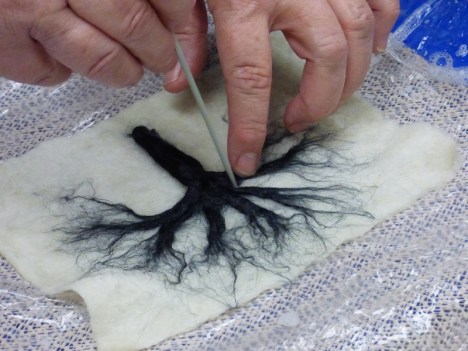
I squeezed most of the water out of the prefelt and got some new black. I also grabbed a knitting needle to manipulate the wool. the wool picked up moisture from the wet prefelt and that made it easier to have the wool stay where I wanted it.

manipulating wool with a knitting needle manipuating wet wool into branches

This is much better I fiddled around with making bigger branches and trying to make it look less like a small child drew it. I was quite happy with it and decided to add a little mixed brown wool for some texture and Jan suggested adding a thin haze of green to give it a spring haze look like just before the trees get their leaves.


I am quite happy with how it turned out. I like the way the thicker trunk area kept some of its 3dness( I am sure that’s not a real word) You know, they stick up a bit. The trunk needs work but I think this will work well for the challenge. Now I need to go shopping for some brown wool or I need to get on with some dying. I have almost nothing in the way of brown wool.

Tree finished , wet
Finished, wet
Tree finished, wet
Tree finished, dry

Oh, and since Jan is always posting pictures of me I thought I would share one of her in her octopus hat at the Chesterville Spin-In a few weeks ago.

Jan wearing her octopus hat at her sale table at the Chesterville Spin-in
Jan at her sale table at the Chesterville Spin-in


Winter Birch Continued

Winter Birch Continued

Blue and white nuno felted background with tulle pine tree shapes on the left and birch trees cut from silk paper on the right.

Here’s where I was with Winter Birch the last time I wrote about the project. I was trying to decide how to represent the pine trees in the distance. This is black tulle burned with a heat tool to represent the trees.

Tulle pine trees created by burning with a heat tool in greens and navy blue.

I made more tulle trees in the same manner with dark green and navy blue tulle. In theory, it seemed like a good idea to overlay these over the black tulle trees. But then when I did that, the trees were just a mish mash and you couldn’t really see them. So I decided to just use the black ones.


Nuno Felted background with silk paper applique birch trees over tulle pine trees. Audition of how pine trees will look in the distance.

Here are the black trees with the birch in place before I stitched them down.

Nuno Felted background with tulle pine trees hand stitched in place with feather stitch. Close up.

I hand stitched them down with a dark variegated thread and used feather stitch. It added a little bit of green but nothing you could see from a distance.

Nuno Felted background with handstitched silk paper applique birch tree over tulle pine trees.

Then I moved on to the birch trees on the left that are in the background. I hand appliqued the silk paper birch trunk in place and then free motion machine stitched the branches. I want the branches to overlap and not appear all on one “level” so that is why I am stitching each trunk and branches separately.

Here is the progression of the stitching on the background birch trees. This always takes longer than I think it should. But I did like alternating between hand and machine stitching.

Nuno Felted background with four handstitched silk paper applique birch trees on the left over tulle pine trees. Auditions of foreground birch trees overlapping other trees in the distance.

Here I am auditioning the foreground trees over what I have stitched so far. I think I will probably stitch down the background birches on the right side first but I do like to see how the overlapping trees affects the piece. I am also trying to decide if I should attempt adding more snow to the picture. What do you think?

Cybersecurity, Cash and this Quarter’s Challenge

Cybersecurity, Cash and this Quarter’s Challenge

Just before Christmas an article on the news caught my attention.  An expert in cybersecurity was warning the public about a scam.  Apparently thieves can hang out in public spaces armed with bank card readers.  As they pass through crowds the readers are searching for unprotected cards (credit or debit) which when detected are automatically scanned.  The cards are debited with small random amounts and when the transaction appears on statements the victim tends to ignore them, thinking they had perhaps one more coffee which they forgot about or alternatively that the theft is too small to report to the financial institution.  He mentioned that lots of money is stolen this way and the thieves are never caught.  Asked whether there are ways of safeguarding an individual’s cards, he mentioned that there were special wallets available (I checked these out and they are very expensive) or as a cheap alternative, placing aluminium (aluminum) foil around the card will work.  In the interests of science and before I started this post, I had my son check this out and yes, it does work.  When Carlene proposed this quarter’s challenge, and having recoiled at the price of the special wallet, I decided it was time to put my thinking cap on and come up with an alternative which could be made from scraps of fabric and a few extras.  I thought I would share the outcome and also a photographic guide on how to make one if you would like to.

The project is made up of two halves

  • first of all, make the card pockets for inside the wallet.  There are two sets of pockets, each containing space for 3 cards.  The cards slip into the pockets with the short side facing out, the card is unlikely to easily slip out that way. The two pockets are then lined so that you have space to keep your paper money (bills) when the wallet is fully constructed.
  • then the front section is made. This is where the aluminium foil is placed and attached to the inside lining of the front section with two sided stabilizer.  A front cover is then cut out, hems turned and sewn to both the inside lining and the card pockets.

Here is what is needed for this project:

For the pocket:

  • piece of cotton fabric measuring 60cm by 16cm
  • matching or coordinating fabric for the back of the pocket approximately 24cm by 20cm
  • light weight iron on interfacing (one sided)

For the cover:

  • lining material approximately 20cm by 18cm
  • piece of aluminium foil 20cm by 18cm
  • Double sided stabiliser 20cm by 18cm or slightly smaller (to avoid marking your ironing board and iron.
  • Cover fabric of your choice

Tools:

  • Fabric scissors,
  • Other scissors for cutting up the foil
  • Small clamps (or small pegs will work too)
  • Iron and Ironing Board
  • Ruler
  • Card (bank or ID card) for measuring depth of pockets
  • tailors chalk
  • sewing machine with matching thread and heavy duty needle.

Tip: I kept all my fabrics light to medium weight so that the machine could handle the thick layers at the final stage of sewing.

Here are step by step photos for putting the wallet together.  I am presenting each photo separately so apologies for this rather long post (there are lots of photos but I think each one is important).   Each photo has some instructions/clarifications.  If you decide to make the wallet, please check out the photos and let me know if anything needs further clarification before you start the project.


Three fabrics were chosen, a vintage floral cotton in black green and orange from House of Fraser, a green cotton for the lining and a black cotton for the credit card pockets

Black cotton fabric with a white line drawn through it


black rectangular fabric with a white line drawn in the middle

A light white iron on stabilizer is attached to the inside of the black fabric to stiffen it before it is folded

2cm measurement drawn on black fabric, ruler to left

1cm mark in white tailors chalk sits below the previous measurement of 2cm on black fabric

Card used to measure space on black fabric, pin indicated the bottom of the card pocket

The first fold has been made in the credit card pocket and the original centre mark which is white is used to check the alignment of the fold. Ruler to the right confirms alignment

First fold as been made in the card pocket using pin as a guide to the pocket bottom


Black fabric, first fold is made for the card. 1cm mark made under the fold to show where the second fold will end


Stitching along the top of the folds on the black fabric, credit card used to check the depth of the pocket

The folds in the black fabric are secured with stitching around the whole pocket


The black credit card pockets are cut down the centre one will be for the right side of the wallet and the other will sit on the left side, fabric scissors to the bottom of the photo

Black fabric has been pinned with clips onto the pocket, right sides together


Sewing machine is stitching the folded pocket to the lining, right sides together

Sewing machine needle is sewing the edge of the black fabric to the right side of the credit card pockets


Black fabric 2 sets of three credit card pockets machined stitched and secured to the wallet lining

Both credit card pockets are identical in size, black fabric, three credit card pockets on each and now fully lined with black fabric

Green cotton for the lining, interlined with double sided stabiliser, pinned together scissors resting on top

Green lining on top, aluminium foil on bottom fused together with stabiliser

Two black pockets are placed on top of the green cotton lining which is backed by the fused aluminium foil. Ruler gives indication of final dimension of the wallet

Wallet size has been marked onto the green lining with white tailor's chalk, material is being cut through with scissors

Black credit card pockets have been clipped to the green wallet lining before sewing

Photo of the front and back of the wallet construction, one side shows the aluminium backing which has been sewn into, the other shows the black credit card pockets and the green lining

A vintage flower fabric, predominant colours black green and orange sourced from House of Fraser has been cut to fit the front of the wallet, allowance has been made for hemming so that the fabric is now bigger than the wallet

the wallet is being machine stitched, the hem of the vintage fabric from House of Fraser is being secured to the inside of the wallet

A view of the interior of the wallet, cards are placed in the black fabric pockets, paper cash is secured between the black pockets and the green lining of the wallet and the hem of the vintage fabric is also visible

A view of the front of the finished walled, vintage House of Fraser cotton fabric in black green and orange


I thought it might be fun to make a second wallet and to wet felt a cover for it.  I basically followed the instructions for the interior of the wallet except this time I hemmed the internal fabric (the red fabric) and used this to secure the pockets.  I wet felted a rectangle using merino wool, loose weave cotton, and batting and shrunk it to fit the wallet.  Once this was dry and ironed I did some random stitching all over it with red cotton thread.  I then sewed the two pieces together.  Here are some photos of the result:

The wallet cover – photo was taken at an angle so it looks a bit wonky.  You may need to focus in on the stitching if you want to see the various patterns.

black wet felted wallet cover with white designs randomly stitched with red cotton thread back and front

The front of the wallet:


black wet felted wallet cover with white designs randomly stitched with red cotton thread - front view

Finally, the inside of the wallet.  I decided to have a bit of fun and colour co-ordinate it!

wallet interior made to coordinate with felted cover. Pockets are black and the main fabric is red


GLORIOUS DEVON – IT’S FINISHED! (Almost)

GLORIOUS DEVON – IT’S FINISHED! (Almost)

At the end of the third post https://feltingandfiberstudio.com/2022/08/20/glorious-devon-part-3/ regarding this picture, I left you with an image showing you where I had got to when I had to stop because of a very painful shoulder. This is the image:

 pile of blended fibres in different colours, part of the original photograph, part of the felt painting, the felting cushion, the needle felted horse, a pair of scissors and a pair of glasses
At the End of Part 3

After some months during which the pain moved from my shoulder down my arm and into my wrist, I became pain free (relatively) and was able to finish the picture.  Here are the final steps which I took to achieve that.

You may recall from Part 3 that I had decided that the horse, which was the focus of the picture, would be created separately from the picture and added at the end; and that I had got to the stage where I was about to do that.  So now I needed to position the horse on the picture.  After trying a couple of slightly different spots, I finally decided where I wanted it to be on the picture.

the felt painting with horse in position held by a felting needle; mini carder full of green fibres on left.
Initial Placement of Horse

Here you will see the horse sort of held in place with a few swift jabs with a needle.  I have moved his tail so that it doesn’t get in the way while I am fixing him down.  I needled the surplus felt at the end of his feet and muzzle into the picture and then covered the white felt with more of the green mixture.  I also needled the lower parts of his legs.  Then I needed to sew the main part of the body to the picture – to avoid him falling out of it.  I used the linen thread that I had previously attached to the back of the body.

Image of the back of the picture with linen thread protruding from it.
Securing the Horse – view from the back

And this is a close up of the horse fixed in place .

Close up image of the horse attached to the picture.
Horse in Place

It was about now that I remembered that the original picture showed a pied wagtail in it near the horse, and that I had wanted to include one if I could.  So I looked up some reference pictures and saved three as they showed me the size that I would need to make the bird in the picture.

Composite picture of the images of pied wagtails with horse.
Reference Pics – Pied Wagtail

And here’s a close up of Willy Wagtail.

Iimage of corner of felt painting with wagtail near horse’s nose.
Pied Wagtail in Place

And that was it, done.  That is, I managed to stop myself “titivating” after I had tidied up some of the background.  I straightened the horse’s ears and smoothed his tail to allow for the appearance of it being stirred by a breeze, and mounted it. 

Completed felt painting mounted on dark green mount board.
Finished and Mounted Picture

Unfortunately, despite umpteen attempts under different lighting, the photograph shows the mount board as blue rather than green, although strangely it doesn’t seem to make much difference to the colours in the picture.

I took the mounted picture along to our local camera shop – which also does bespoke framing – to have the picture properly framed.  The horse, added on top of the bas relief picture meant that they would need to use a deep box frame, but they were to get some samples for me to choose from.  Unfortunately they didn’t, they went ahead with what they had, which resulted in the horse being pressed up against the glass (and I had made it clear that I did not want that to happen).  They had also sealed the frame so that I couldn’t get at the picture (which I had also insisted should not happen because I would need to make sure that the tail and ears were positioned correctly before it was finally sealed).  I found this very disappointing and I was not prepared to accept it, so the picture was removed from the frame and returned to me, along with my deposit.

The picture spent the Christmas and New year holidays sitting in our living room beside my other pictures, while we decided on the next step.  At the time of writing this, I have just returned from taking the picture to a “proper” picture framer. Having spent some time with them deciding on the change of mount board to a forest green colour and choosing a frame which would compliment the picture,  I am fully confident that the result will be just as I want it, and worth the higher cost.

I had hoped that by the time this post was to be published I would be able to add an image of the framed picture, but unfortunately it is not yet ready for me to pick up. I will however put up an image in the 2023 First Quarter challenge section – I have been working on this since late 2020/early 2021 so it must have been a UFO!

Now I can get on with the next picture.


Super cold morning for a spin-in, in Chesterville Ont. Canada

Super cold morning for a spin-in, in Chesterville Ont. Canada

February 04, 2023, around 6:30am-ish, it was -33c this morning and the car was not inclined to leave the driveway. It probably was afraid I would want to drive further north! It took a while to get Glenn’s car started but with a boost, she was persuaded that it would be good to go to the Chesterville Spin-in today, (not tomorrow). Chesterville is a small town almost an hour south of Ottawa and might be warmer! We should not complain, this is the first cold snap we have had and it is February.

Glenn still has his cold so he was not up to going. (It was just a really bad cold, the un-rapid test confirmed it is not covid).  Ann McElroy volunteered to be Glenn who was going to do the adding up of prices and figuring out change. I always avoid self-checkouts.  Since I was not deemed worthy (OK I also have dyscalculia) to be a cashier when I was young, so why would I want to be one without getting paid now that I am old? Ann offered to do the math parts, which I appreciated immensely.  With the car delaying me, she got there well before I did and had explained to the organizers and other vendors she would be playing the part of “Glenn” today. She said she was asked if this meant she would be sitting in the corner reading a book and then falling asleep possibly snoring. She just laughed. (This is a common event at fibre activities, Glenn is very supportive of my interests, but tends to nap at most of them, I do have many pictures to prove it.)

1) 2018 Wheels on Fire Spin-in (with a small bag of patato chips)1) 2018 Wheels on Fire Spin-in

2018 Peterborough Fiber festival2) 2018 Peterborough Fiber festival

Handmade Sign for the Chesterville spin in with drawing of fiber baring animals.3) Handmade Sign for the Chesterville spin-in with a drawing of fiber bearing animals.

A few of the vendors and some of the participants could not make it this year. There were lots of non-starting cars, and frozen pipes due to the sudden cold snap. Considering this is February, it is a bit of a late start to winter cold so we should not complain too much!  By the time I arrived, there was a bit of reorganizing the vender spots and we had been upgraded to a prime location! We were the first booth you saw as you walked past the organizer’s table.

looking from the back of the table towards the front door.4) looking from the back of the table towards the front door.

This is the first time I have been a vendor. We got the table set up (it’s sort of like doing a demo set up but Ann has more experience at selling setups.) there were a few things I either forgot (business cards) or could not find (my sharpie for last-minute price signs).

table of felting needles and suply with samples of needle felting Felting needle holders, 1 needle, 3 needle and 7 needle holders Glenn's oriface hooks and slaying hooks sheep head magnet pins with sample of 2D felting of a Ram and Friend5-8) my first felting supply table with blacksmith-made hooks.

I had examples of 2D felting (the ram with a friend), sheep broaches, felting needles and holders, a spot to try out the needles and Glenn’s blacksmith-made orifice (for spinning) and Slaying (for weaving) Hooks.

Mr. Mer from the back, Mrs. Mer under body and fins (Mer people) Mr. Mer from the side Mr Mer From the front at spin in.9-11) Mr. and Mrs. Mer were there as examples of 3D needle felting.
I was pretty sure there would only be a limited number of people interested in felting supplies at a spin-in but it would be fun and there was more interest than I had expected. I sold some needles, a couple of holders, a sheep magnet broach and an orifice hook.

We were beside Wendo Van Essen, a local felter with a hilarious sense of humour.

Ann spent a lot of the time chatting with her.

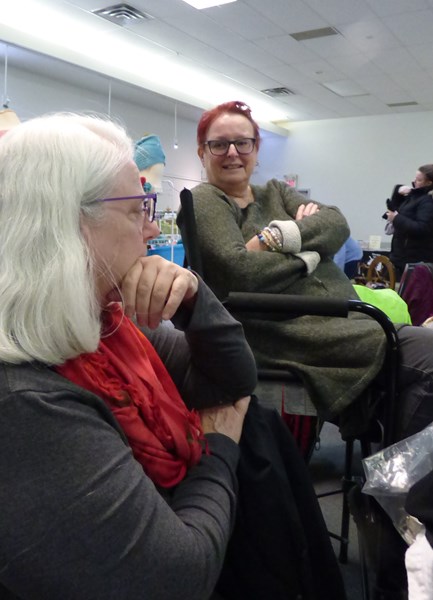
Wendo and her pincushions Wendo having a good chat.12-13) Wendo and her pincushions and Ann and Wendo having a good chat.

Chesterville legion Hall overview shot of the event (composite of 3 photos)14) Chesterville Legion Hall overview shot of the event (composite of 3 photos)

The event was held at the local legion hall. The space was divided into about 2/3 vendors and 1/3 spinners this year. The weather defiantly put a damper on some of the spinners travelling but it was still a busy event. The organizers had arranged for Coffee, tea and a selection of homemade cakes and cookies! The Cranberry cake was particularly good and I was sorely tempted to go back for a second piece. I did find the last molasses cookie too.

the legion bar had 2 bunt cakes and a few plates of cookies on it.15) the legion bar had 2 bunt cakes and a few plates of cookies on it.

  This is a Lendrum folding wheel, made by Gord Lendum, in Odesa Ont. Canadian16) This is a Lendrum folding wheel, made by Gord Lendum, in Odesa Ont. Canadian  There were even a couple wheels for sale as well as Angora. There were even a couple wheels for sale as well as Angora.17-18) There were even a couple of wheels for sale, as well as Angora.

There was a good selection of yarn and fibre to add to our fibre hordes. Let me show you some of the other shopping opportunities.

This slideshow requires JavaScript.

19 -34) Slide show of Various booths at the spin-in selling yarn, baskets, fibre, weaving and spinning tools, felting, needles, and blacksmith-made tools.

At the end of the day, Ann helped me pack up and get everything back into the car.  It had warmed up to a balmy -19c, I had the heat blasting in the car but just could not get warmed through. I went to bed early and woke up with Glenn’s cold! (There are better things to share, I was glad I had worn a mask all day at the spin-in I don’t want to share this stupid cold with anyone.)

I hope you have enjoyed a trip to the Chesterville spin-in. it’s a wonderful opportunity to expand your fibre hoard, as well as chat with lots of fibre friends. Visiting vicariously is also cheaper than attending in person!

I hope you will have the opportunity to attend a fibre festival or local Spin-In or Felt-In soon, both are wonderful ways to have something to look forward to, and then enjoy, which will hopefully make winter feel a little shorter.

Have a wonderful Valentine’s day I hope it brings chocolate and time to felt, spin, weave or enjoy some fibre prep!


PS. The computer ate my homework and I had to re-rite my post so I hope I didn’t forget anything the second time! (stupid computer)