Another Art Retreat

Another Art Retreat

My last post was about an art retreat and normally, I would just have one a year to tell you about.  But this year, I had two only weeks apart. This is the annual retreat that my small art group does in late summer/early fall at the Kiwanis Lodge on Little Bitterroot Lake.

Landscape of Little Bitterroot Lake with pine trees in foreground and mountains in background on a cloudy day.

This is the view off the deck of the lodge. The weather was a bit cool and rainy but so much better than smoky skies from wildfires.

This year we decided to play around with making our own natural inks, printing and painting with the inks and then doing some bookmaking.

Before anyone points out that many of these types of ink are fugitive and might not last, we realize that. We were just playing around to see what happens and what colors we could get as a result. No “serious” artwork is being made from these inks.

We started by grinding up Haskap berries (Fly Honeysuckle) with a bit of water and straining the result. That is the bright red color on one of the acrylic printing plates in the foreground of the left hand photo. We also ground up beets, grass and kale and tried grinding choke cherries. The choke cherries were a disaster but Sally tried boiling them after she got home and got much better results than the fresh berries.

So Paula had gotten all of us some acrylic printing plates which we covered with ink and then let dry. We left watercolor paper in a baggie with water to get damp overnight and then printed the next morning. The two photos on the left show different prints and the photo on the right was painting haskap berry ink on to a page and soaking three squares of felt in the ink and laying these down on the paper. The ink changed colors depending on oxidization and what paper it was applied to.

Make Ink book by Jason Logan.

This is the book we referred to for various recipes and what mordants or modifiers to use with different foraged materials.

Drawing organic lines with oak gall ink on to previously printed watercolor paper.

I also added further ink (oak gall with ferrous sulfate) to one of my prints with my new fountain pens. I wanted to get used to using the fountain pens so this was good practice.

We then set about making a bunch of inks including hibiscus, acorn caps, acorn caps with ferrous sulfate, oak gall with ferrous sulfate, avocado, turmeric, blue pea flower and walnut ink. Paula also brought copper ink which takes several weeks to make but is the most beautiful blue. We put these in small individual jars with a whole clove to keep the ink from molding. These are now stored in the refrigerator in hopes of keeping them good a bit longer. These should be used fairly quickly. Paula had some that she had stored in the fridge for 6 months or so and they were mostly dull and brown and had lost their original color.

We then set about making little samples of the colors from these various inks. And then you can start adding the different inks together and see how they mix on the page. Such fun!

Table set up with blue pea flower dyes and various modifiers.

Our next set of experiments were with blue pea flower. Apparently, you can buy this as a tea. All you do is steep the blue pea flowers and then add different modifiers. The modifiers that we used were baking powder, baking soda, vinegar, cream of tartar and vinegar. The modifiers change the color of the ink.

Sampling of blue pea flower ink with a variety of modifiers.

Here is some lovely sampling of the different colors that you can get from the blue pea flower inks. They range from green to blue green to blue to purple.

Here are a couple of landscapes that I painted with blue pea flower dye. I love how they mix on the paper and the variations that you get.

You can also paint your paper with blue pea flower ink and then drop dry modifiers on top such as baking powder or baking soda. You really get some interesting effects with that.

Shibori tissue paper dyed with inks glued to watercolor papers to create bookmarks.

We did put some ink on shibori folded tissue paper that could then be overlaid on previously inked watercolor paper and glued down to make bookmarks.

Paper coasters with natural dyed organic patterns.

Paula supplied us with white paper coasters and we played with ink on those too. The left is a combination of walnut ink, acorn caps and oak gall. The right is blue pea flower and hibiscus with baking soda dropped on top while still wet.

Here a three of the books that I created at the retreat. The middle one was using a bit too thin paper which had not been ironed so it is a little sad. But I learned how to fold the triangular pages which was fun. I was using papers that I had previously printed with deconstructed screen printing.

I took my tree specimen book with me and painted one of the plastered pages with oak gall. The photo on the left shows that page which was interesting. The photo on the right is Sally’s book where she has collage parts of the page and added oak gall ink to as well.

We had the best time and thanks to Paula for most of our supplies. We also want to thank the Kalispell Kiwanis Club for letting us stay at the lodge each year!

Question: What needle is that? (Part 2)

Question: What needle is that? (Part 2)

When last we left off we had considered where we get our needles and the pros and cons of buying from the manufacturers or the resellers. We also reviewed the parts of a felting needle and the gauges we usually use (there are more gauges and shapes that we don’t tend to use too.)

Keeping track of your Needle Gauges

Usually there are a few ways to do something and you can decide which way works best for you. I do only have a few absolute rules about needles, here are two that I find useful;

  • -the sharp end goes in the felt and not in your fingers (this reduces the use of bandaids)
  • -an unmarked needle that has left the box (or original packaging) does not return to the box (It keeps the needles in the needles boxes from getting mixed so I am sure of what is in each box).

Now, let’s look at a few options on how to keep them organized once they have left their needle box or packaging.

Option 1 (one supplier or being extremely organized)

If you acquire only one colour system (use only one suppliers) or if you carefully kept track of each needle, use one gauge at a time, then return it back to its original packaging when you are finish using it, you will always know what needle you are using.  If this is working for you don’t change, unless it’s driving you mad. If this obsessive-tidy-neatness-technique dose not sound like you, we need a few other options. (I am not in this category)

Op.1 one supplier or

extremely organized

Pro Con
 For one supplier, It is easy to keep track of what needle is what gauge as soon as you learn the colour system your vender uses. You only have one place to buy needles!!! This can limit acquisition opportunities. (NO!!!!)

You have to be very organized, if you are working with more than one colour system.

Ann’s Option (2):

Re-colour to your own colour code. There are a number of ways to do this, the most common I have seen is Cheap Nail Polish (another reason to visit the dollar store). You may try warm (Red is a 32gauge) to cool colours (46Gauge is an Ice Blue). Or you could just go for odd colours that are on sail. Just keep track of what gauge is what.  Some of the holders do not suggest using painted or coloured needles with them.  If your favorite holder is one that does not like painted needles, leaving the needles un-coloured and just labeling the holder, may be the way to go.

Another ways to colour needles would be a spray paint for mettle like Tremclad or similar products. (Cover the working part and tips of the needles when you spray or you will reduce the effectiveness of the barbs.)

I have also seen a product described as “Tool Dip” used to coat the shank of the needle up to the crank. It was described as being more comfortable to hold than the thin needle on its own.

For my students I have used coloured kids hair elastics from the dollar store augmented by ones I have found on line. The best ones I have found were small circular ones that seem similar to the more expensive ones used to make bracelets. There are also hair elastics that are more plastic and less rubber that are larger but tend to brake quickly.(Try to avoid those.)  7 boxes of 500 needles each, with note stateing designation and colour of elastic that gauge/shape7) colours of elastics that go with each needle box I have presently.


Option 2 Re-colour

Pro Con
You chose the colour system o   Some colours chip, rub or flake off, leaving you guessing again, what the gauge is.

o   You need to acquire the colours of paint or dip and also have the mess and time of labeling each needle.

o   May not fit in all the holders after the colour is added.

o   Elastics will eventually brake and you are left with an unmarked needle (unless you can identify it by its lacking from the ones that remain.)

Option 3.1 (Grouping on work surface)

If you have Lots of unlabeled, unmarked or randomly coloured needles stuck into something waiting to be used (Yes that sounds like me.) I often use two similar working methods to keep my needles sorted when using them. On both my foam (pool noodle foam kneeling pad) and the thick wool pad, I keep track of my needles by where their located on the pad.  From left to right I have them grouped in course, medium, fine and extra fine if I have one.

sheep wispers in progress, working on pool noodle foam pad. the top end of the foam pad showing the parking sopts at the top for the various gauges of needles8-9) Working on the whispering sheep. Foam kneeling pad from dollerama. Keep working needles grouped by gauge in the top portion of the mat.  

If you have trouble remembering where each group is located, draw, sew or otherwise indicate the parking spots for your needles. Usually at the top of the mat is best, since it is not in the working area, you are less likely to accidently brake the needle by knocking it with your hand as you work. Try to be attentive to what your working style is and adjust the location to best suit you. (NB: if you have the pink, blue or red pen tool, which holds 1 to 3 needles. try not to stick them into the foam it is very easy to nock into them. Since they are taller than the average needle, they can easily snap when nocked by your hand or forearm). (Well, if you have an accident, at least that would mean you might be able to go shopping again!!)

For the firm felt pads similar to those sold as quilters ironing pads (.5inch thick) some are very firmly felted and can be resistant to needle penetration.  If you have one of the extra firm options please see “Option 3.2 (Adjacent storage)” for some suggestions.

When I am working, the needles are stuck in across the top of the working surface. For storage in my foam pad (foam like pool noodles), I again group the needles but move them to the top edge of the pad. Don’t leave them in the end of the pad when you resume working.  You can hit one of the stored needles and break one or the other, or both.

diagram looking from the top of the foam pad, with the needles in both a working and storage location.10) Diagrams showing the top end of a foam pad. The needles are first shown on the top for working (grouped by gauge), then the end of the pad for storage and travel. (Push the needles in so they don’t catch and brake during storage or travel. Remember to move them all back to the top surface when you want to resume work.)

option Pro Con
Op.3.1 Grouping on work surface Needles are close to hand

Works well on larger and softer work surfaces

–        Needles are safer if stored deeply in the end of a foam pad for storage or transport. (storing at the end doesn’t work for all surfaces)

Storing needles in the work surface Can accidentally brake needles off in the pad if not careful.

–         If needles are forgotten in the end of the foam pad, needles can be broken when work resumes.

–        Before you dispose of degraded foam, check for needles stored in it.

–        Not good for thin hard or side-less pads.(some have slopes rather than sides)

Option 3.2 (Adjacent storage)

When I am using my 6” x 6” wool pad, there is often no space on the pad to hold and store needles.  When I can’t store them on the pad, I have used half a foam pool noodle (on sale in the fall when outdoor water activities become chilly and challenging).  Again, pull out your permanent marker, and label where you will put each gauge or grouping (course (32g) / medium (36g-38g)/ fine (40g-42g)/ ex-fine (46g)).  if you need to, add a spot just past “course” for reverse needles.  That will help keep you from grabbing them by accident, (which could happen if you were storing them just by gauge).

half a pool noodle labled in sections to store needles by gauge11) Half a pool noodle derived in sections labeled by gauge.

If you want to upgrade the look of your studio or work space,(pool noodle may not be the accent you had in mind for your desk?- they do come in other colours and shapes and you can use English spelling instead of mine.) I have seen and admired very cute tea cups filled with wool that can also hold needles like a pincushion. I would suggest if you only use one tea cup, using sections of different colour wool to suggest where to store each gauge or using a needle and thread to mark out the parking spots. If you have a bigger work surface, maybe a selection of tea cups, one for each gauge and for specialty needles would work.

option Pro Con
Op.3.2 Adjacent Needle Holder Using an adjacent space allows more workspace on your pad or work surface. Not attached to work so may get separated (mysteriously wander off).

Option 4: Use a needle holder and label the holder.

I have a number of different needle holders.  The holders I have can hold from a single needle up to one that will hold 20 needles. They make work faster and most are more comfortable than holding a single needle.  Getting a collection of some of your favorite holders/handles shapes allows labeling each holder with the gauge in them. If you keep the needles not yet in use separately stored and labeled, then you can be sure to switch out the occasional broken needles with the correct one.  I know my fake clover tool has T-42 222’s. If I can find the 10 needles I just bought (found them!), the Twisted/Spirals 40g’s, I can label the other punch tool so I will visually know which is which.


If you securely use painters tape on the holder, than mark the tape, you can change both the tape/designation and set of needle you are using until you have enough holders for each gauge/shape you would like to have in them. The multi tools with closer needle spacing work best with fine gauge needles, whereas the wider spaced multi tools can accommodate courser needles. Remember if your holder can hold 7 needle, you don’t have to put all 7 needles in.


A selection of differnt needle holders, from sigle needle holder to the 20 needle holder.12) a selection of needle felting holders, there are examples of holders that can hold as few as one needle to one holder that can hold 20 needles.

Ergonomics

Ergonomically speaking the single needle used directly in your fingers can become uncomfortable with extended use (muscle cramps and spasms can occur). Some felters will find it uncomfortable much faster than others will, especially those with finger and joint conditions such as arthritis.  Recently a larger version of the single offset wooden holder has become available which is, for most people, more comfortable than the thinner version.  If you do not find the pen shaped tools comfortable, then try the more nob shaped ones. The Nob shaped handles come in a couple sizes but usually have the ability to hold more than one needle, you can always decide to have only one needle seated if you need more control.

To reduce the likelihood of injuries, you can try to use larger muscle groups (larger muscles fatigue slower than smaller ones). Keep changing which joints are doing the primary work (shoulder, elbow, wrist, fingers). Take brakes; drinking tea or water will have the bladder help remind you to take a break.  Slow down on the enthusiasm of both the rate and depth of stabbing the wool (remember working depth –the fiber is moved by the barbs so the depth of the barb is important.  Do not go deeper than you need to accomplish what you are doing.  Adding an appendage requires greater depth than blending a surface colour. A door mirror can be helpful if it is propped so you can glance at it intermittently as you work. Check if your shoulders are elevated or curled forward (protracted). When you are focused on felting you can forget about posture!

option Pro Con
Labeling holders You know what needles are in use as long as you


Ergonomics – most holders are more comfortable than holding a single bare needle and reduces hand cramping and muscle fatigue.

You need holders for each gauge and shape of needle you have purchased.  (Some of the holders are quite pricy)


Not all shapes are comfortable in all hands it may take a few options to find the ones that work for you.

Comparison set of needles.

A few of our local resellers have “sample or variety packs”. These are a group of needles in a variety of gauges and sometimes shapes. If you have an example of the main gauges you can compare the size of the working part from a needle you know the size of to one you are unsure of.  With spinning, there is a tool that allows you to check the size of yarn and the angle of twist. For knitting, there is a tool with different sizes of holes to determine unlabeled knitting needle gauges.  We don’t have a similar one yet for felting needles, hummm…. Let me think about that. If I could find my wire pulling plate that may be worth trying. (If only I could remember where what safe spot I put it in is… Drat oh well it might even be too fine!)

selections of labled needles from 3 different venders13) A set of needles from one of the china Resellers, Fibercraft has a larger sample pack but i didn’t find mine this is a smaller sample pack of star needles, Olive Sparrow has a set of needles in different gauges, and shapes.

Looking at the needles

I have a good ring light with a magnifying lens in the center. I purchased it for pulling guard hairs out of Quiviot fiber. It would also be helpful for those who are not as short sighted as I am, to look more carefully at their needles. Don’t just look at the gauge, sometimes there is an obvious difference between needles such as the 38g is a 333 barb needle the 40’s have the 222 barbs. While the 42 is a spiral 222 and the 46 is a crown needle so 111 barb designation. If you had a set like this, you could see the difference between gauges just by the barb number and working part shape.  There are also different barb spacing, so that may give you a clue as to which needle you are looking at. This requires you either, have the original specifications, or you made yourself a note when you bought them.

needles i have purchused but have not yet uised. they are in plastic tubes with screw top lids. there is a small lump of wool roveing at the bottom to keep the tips from dulling.14) Plastic vials with screw top lids. Add wool to the bottom so the needles don’t bang their tips on the end of the vile and dull.

Feel or palpate the needle (carefully)

You are likely also able to trust your fingers and carefully feel the working part of a known and unknown gauge needle. Palpation is a skill that gets better with practice but you can probably already tell the difference between course, medium, fine and extra fine. It is defiantly more of a challenge to separate the two fine gauges (40 and 42).  It’s also helpful to use the feeling (or end feel) as the needle goes into the felt. 42’s should feel smoother, and effect less fiber migration than the 40g, which is technically courser.  Palpation/Feel can mislead you on determining gauge; read the * in the “Con” column in the next table.

Another option is using a caliper tool

I bought a caliper tool for assessing armature wire as well as a couple metal plate wire gauges. (There are a couple of systems to size wire using the plates so it gets confusing. There is math involved when you look up how to use the info from a caliper with a wire gauge chart. Most of the charts I was looking at for armature wire didn’t get to the higher numbered gauges (40-46) which would cover our needles. If you have digital calipers that are fine enough to measure and compare to a labeled needle, with the unlabeled, then this is another option to sort our needles.  If you don’t find a fine measurement caliper already in your studio or workshop and suddenly want to acquire one, I found calipers on sail at Princess auto. One of the groups using them are sheet metal workers, to gauge sheets of metal (seems reasonable). You may have a friend who has one, check and see if you can borrow it to see if it would work for you.

Digital callaper in padded plastic box with instructions.15) Digital Caliper from Princess Auto

Ultimately, I can work just fine not knowing the gauge of a needle.  I can choose a needle by comparison of how they feel in use.  Is it moving the amount of fiber I want it to? if not, I will switch to the other one. That said, knowing what gauge you are handling is preferable since it can increase the speed of felting (no searching and testing needles each time you need to change gauges). It also lets you quickly replace a broken needle, ether in a tool or a loose one you were using. (This requires you to store spare needles safely, and labeled with some basic info; Designation: (ideally gauge, shape, barb number, length), the source so you can reorder when needed (their web address or store name), cost per needle or per group when purchased (it’s not necessary but it’s helpful to tack).

option Pro Con
2 groups of needles

-ones that are in use

-ones you have purchased and have not yet been pulled out to use. Labeled Gauge/Shape/# of barbs and where you got them (so you can get more)

You can compare the needle in use against the known gauges you have purchased.

Makes re-ordering easy

-Requires keeping track of your needle inventory

-Requires you write notes about each needle type (kept with the needle), where you got it and price.

-Requires that you find a storage option, that will be safe from humidity and prevent needle damage.

Look at the needle You may be able to sort some needles by shape or barb number if you remember their gauge. Memory….it can be a fickle thing…..
Feel / Palpation You can often tell from the feel of the working part or the way the needle enters the felt if one needle is finer or courser than another even if they look very similar. * You can get stuck looking at two T-40g needles that just have different barb number or spacing and not be sure if they are truly the same or different. (You may be feeling the difference in drag by the change in barb number or barb shape rather than the gauge itself.)
Wire Tools to assess the gauge Cool there is a tool that may help!!!

Digital calipers (can get expensive), see if you can borrow a pair if you are determined to use them to match mystery needles to labeled ones.

-Drat the plate versions I have don’t go fine enough for our needles!!!

-the really fancy fine calipers are not cheap, so look at the sale priced ones or “student quality” rather than Professional as long as they go fine enough (46ga).

I hope this gives you a few more strategies to sort out Mystery Unlabeled Needles or even better, Fabulous free gifts of needle from friends! I am sure you have tried or thought of most of them, but I hope I have something new for you to try too. Have I totally missed a brilliant solution that you use? Please let us know! It’s great to share ideas rather than having to find the same solutions independently. Let’s not have to reinvent Animal husbandry and selective breeding for fine fiber!!

Have a fabulous last long weekend of the summer, and the fall fiber festivals are just around the corner!!

my small clear box of tools, has multi tools, sizers and other usefull tools. the other needles are in another box if not in the foam or wool pad.16) My small travel box of tools I have the single needles ether in a second small box or in the work mat depending on what work surface I want to take with me.(yes the Smarties are candy coated chocolate and I am sure are valuable indispensable inspirational tools.)

Bringing up the colour

Bringing up the colour

It was back to school week so I was busier than usual. re-adjusting times and schedules.

Last time I showed you the finished visor. It had a lot of fulling and it was nice and sturdy. When the piece is well fulled, you often end up with a dull picture. This is caused by the backing fibres migrating through the coloured fibres. Sometimes they end up dull or fuzzy looking.

When I make pictures that will be mounted or framed I fix this by not fully very much as the picture will not be handled much and it will have the matting to help support it. for something that will be handled or used more light felting won’t help so it’s time to break out the the razor and shave it.

I get them at the dollar store. notice I did not pay the pink tax for my razor, I buy the cheapest ones they have regardless of the colour. It’s a pretty simple thing to do and it makes quite a difference. I hope the pictures show it well enough. It is hard to pick up with the camera. I tried to do one half at a time for you.


and lastly, the sheep, I think it shows the difference very well.

I shaved the rest of the piece as well. This is the pile of fluff.

Here are the before and after pictures


Before Shaving


After shaving

I think I still want to add some stitching I am just not sure what. outlining seems redundant. Maybe I will add some leaves scattered about. and I don’t know about eyes for the sheep. Curved lines make it a bit cute and like it is sleeping and round makes it look odd. Sitting here looking at the flower, I can see something else now, how about you?

Salt Spring Island Retreat

Salt Spring Island Retreat

I recently went on a trip to Salt Spring Island, BC, Canada with a group of my friends from my Level 3 Stitch Class. What an enjoyable visit we had!

We drove up from Anacortes, WA to the Vancouver Tsawwassen ferry and then ferried over to Salt Spring Island.

We stayed at Catherine’s sister Fran’s, who kindly hosted us at her house/farm. It was a gorgeous property on the water, with a working farm/orchard.

The first day we went to the farmers and craft market. I took a bunch of photos of colorful produce as you can see above. We also visited the town of Ganges and went to a few galleries and shops.

Next up was a walk on the beach which was rocky but Edgar had a blast. There were four dogs during our stay and I think Edgar thought he was in heaven. He played and explored and had an absolutely wonderful time.

Then we started making baskets. Fran is a wonderful basket maker who supplied us with everything we needed and taught us how to make a simple basket. We thought it would take two days but it actually took three. I haven’t made a basket before and I think this will be my last one.

Here we are working away on our baskets. You can tell by my face that I am having a great time – ha ha! We also made a basket for one of our classmates who could not come to the retreat. That’s the basket I am working on in the bottom right photo.

Here is the result of our basket making. We all have a finished basket and they are pretty colorful too. Group of women sitting at dining table folding small books.

We also had a short session of folding small books with pockets.

Sunset over the water from deck.

We had a wonderful time together, great meals and Fran was so welcoming! Thanks for everything Fran and Catherine!


Prints of textiles?

Prints of textiles?

Summer is a busy time for me for sales, exhibitions and other, non-fibre related things, so when I looked back at the actual felt-making I’ve done since my last blog here in June, I realised the answer was ‘none’! Oh dear, this could be a very short blog. One thing I have wrestled with for some time, though, is whether to sell photographic prints of my felt pictures.

I have slightly (OK, very) purist tendencies when it comes to felting and I’ve previously resisted the idea. Textiles are 3D and photographs are essentially 2D. I do sell photographs, but of my beautiful local area. I’ve always made an exception for greetings cards, and the number of people who’ve bought cards with photos of my felt pictures and told me they’re going to put them in a frame has finally worn the purist down.

I had an exhibition in a local gallery called ‘The Fishslab’ in early August. It’s a lovely gallery and, as the name suggests, used to be a fishmongers. It has a huge sloped marble slab in the window that was used to display and sell the fish while the marble kept it cool. The front window lifted up so customers could see the fish from the street and, presumably, buy them through the window. Here’s a photo standing outside the gallery from a previous exhibition where you can see the marble slab that is the base of the window display and the handles on the window.

So, I ordered 12 small prints of felted pictures I’ve previously sold, printed on foam board, and included them in my week in the gallery. The prints are 20 x 20 cm.

20 x 20 cm photos of felt pictures on foam board

Priced at £20, I sold 9 of the 12 in the week, so I had to conclude there’s an appetite for these. About the same time, the print company I use for my photos had a super-special offer on 60 x 60 cm photo canvas prints, so I ordered 5 of those featuring felt pictures as well.

I’ve just spent a week in the beach hut gallery I sometimes have my work in. So, I displayed the canvases, along with my felt pictures and photo canvases.

It was a quiet week and although there was a bit of interest, I didn’t sell any. One thing I did notice, though, was that people kept touching the canvases to see if they had a texture. Annoying, but interesting. Happily, I took a commission for a felt picture (I’ve blogged previously on my mixed feelings about this too, you can see the link here, if interested https://feltingandfiberstudio.com/2021/09/20/do-you-take-commissions/) so I didn’t mind the otherwise low sales but I’m still left feeing a bit uncomfortable about printing photos of textiles. I will see what happens in future sales / exhibitions.

I’ll finish now with another of the many things I’ve been doing recently other than making felt. As I’ve mentioned more than once before, I am lucky enough to live in Whitstable, on the coast in south-east England. It’s a beautiful place and we get a lot of visitors on day-trips as well as longer vacations. There’s a Thames sailing barge called The Greta that in summer moors in the harbour where I often work. Built in 1892, she used to carry grain, malt and building products, and then beer, up the Thames estuary into London. She also took part in one of the most famous operations during World War 2 as a member of the makeshift flotilla that rescued thousands of troops during the evacuation of Dunkirk in 1940. Apparently, she’s the oldest active ‘little ship’ from that era. Anyway, some of my harbour colleagues go on an annual trip on the Greta to visit another World War 2 site, the Maunsell Forts, which are about 6 miles out to sea. These were part of a world war 2 sea-defence system designed to shoot down enemy aircraft that would fly up the Thames estuary from the coast to bomb London during the war. They were later used as a base for pirate radio stations broadcasting in the 1960s. Previously I’ve refused offers to join my friends on this trip as I’m a terrible sailor and believe I could feel nauseous in the bath. This year my desire to do the trip overcame my reservations and we set out on the calmest, most lovely day.

It was a fabulous day and I will definitely do the trip again. The final picture here shows the harbour village where I sell my work. I’ve never seen it from this angle before.

Retreating Beautifully

Retreating Beautifully

My first group were felting novices, learning to felt a vessel over a flat resist. They were all super-creative and keen, producing some outstanding vessels that I hope they are all proudly displaying.

The second and third events were at the Auckland Creative Fibre Retreats. These are amazing weekends away where 20-30 fibre enthusiasts converge at a retreat centre to focus on all things fibre while a wonderful team from the centre look after us, feeding us and keeping us supplied with tea, coffee and hot chocolate.

These retreats are great opportunities to learn new skills, share ideas and teach (if you want to). I offered to teach felted soaps and it was a huge hit, with each person producing at least 2 beautiful soaps.

In return Shaz (in the green sweater) taught us a cable / crepe-style plying technique. This is the first stage:

And the finished yarn:

I am the first to admit this skein is a tad garish, however, Shaz also shared some gorgeous versions she had made with less contrasting colours. This is definitely a technique I would like to try again in different colour ways and with finer, more evenly spun yarn – this yarn was a bit rushed as we were all trying to finish the hank before dinner!

I also managed to finish / make progress on a couple of crochet projects at the retreats. This poncho is a brioche crochet project I started in 2021, the pattern I was following required quite a lot of focus so this project only saw the light of day when I knew I wouldn’t be multi-tasking, hence it took so long to complete.

I also made some good headway on a brioche cushion cover I started in August. I’m not following a pattern for this one, just making it up as I go. This is using some hand-spun yarn that I dyed before plying it a few months ago. The colours are brighter IRL and it reminds me of light coming through a stained glass window.

The retreats definitely aren’t all work, knowing you have comfy bed to fall into and don’t need to drive home, most of us arrived well supplied with chocolate, wine and other beverages…. (don’t be fooled by the oranges, they were just for show! 🙂 )

An awesome time was had by all!

If you ever find yourself near south Auckland I enthusiastically recommend a visit to the Franklin Arts Centre in Pukekohe, they have 2 excellent exhibition spaces and run a varied program of affordable arts and crafts courses from their workshop.

Question: What needle is that? (Part 1)

Question: What needle is that? (Part 1)

I had another question about needles. This time it’s about keeping track of your needles.  On a positive note, if you have this problem you have enough needles to get them confused, Congratulations!!  For those of you who only have a few needles and don’t have the problem of keeping track of them, I should give you the opportunity to expand your collection and be part of this discussion!


Where we get our needles:

If you are not buying from one of the various original manufacturers of industrial needles (Groz-Beckert and others) you are likely dealing with a reseller of smaller quantities of needles.  Let’s start by looking at the options for needle acquisition.

Manufacturers;

If you prefer to go to the source you will get the best price per needle but do you really need 500 to 1000 (minimum order) of the same needle? (The shipping cost for a box or two of needles can be quite painful too!) If you are teaching, and supplying your students their needles for class, as well as doing your own felting projects, then you may go through 500 needles over a not unreasonable length of time. If you are only buying for yourself, I hope you are not breaking needles in quantities that make the purchase of 500 needles a financially good idea. (If you decrease your rate of insertion (speed) and are attentive to entering and exiting the felt at the same angle, it will save you a lot of needles, and will likely require fewer bandages!) (Also, I have a blog post I’m working on about safety implements for those who are either over enthusiastic in their stabbing or are still practising/perfecting their eye-hand coordination. My hand-eye coordination occasionally still goes wrong too!)

Felting Needles set in needle bed (in industrial needle felting macheen)  1) Groz-Beckert – needle board

Original manufacturers sell their needles mainly to people buying multiple boxes of 1000 to fit in their large industrial machines, used to make non-woven fabric.  New needles are needed when the barbs become worn or a new type of product is required. (Different needle shapes and gauges make different types of non-woven fabric and can run the web through the machine at different speeds. Groz-Beckert has more than 2,000 needle options when you look at all the variables.) As you can see from the picture above these needles are not colour-coded since they have to fit into the needle bed extremely precisely.  They have all their identification information on the end of their shipping/storage box.

This slideshow requires JavaScript.

   2-4) Doer Needle boxes and Open box showing 100 needles wrapped in wax paper

One advantage of buying from one of the manufacturers will be, that you will hopefully have the entire needle code. This will give you more information about the needle and make it easier to get replacements when you are running low. The needles in the boxes above are from the Doer company and are wrapped in wax paper in groups of 100 needles all stored in a secure plastic box.

There is, unfortunately for us, a new trend with some manufacturers offering “added security” to their industrial customers. Instead of the helpful needle designation, they are adding “customer codes”. This is to cut down on industrial spying and fit with customers’ warehouse codes, which reduces getting mixed needles in the bed. Yes even in industry they can grab the wrong box of needles! “If needle types are mixed up and placed in a needle board, this can have a major impact on the end product. In a worst-case scenario, this can lead to instant needle breakage due to the needles being overloaded. The result is machine downtime, additional set-up time for equipping the needle boards, and scrap material, leading to increased costs.” Unfortunately, their solution may lead to less information for our resellers.

Buying from the manufacturer Pros: Cons:
Price; per unit cost is cheaper than resellers’ prices Price; minimum number of needles is usually 500 to 1000 of one needle size and style per box.  Also, a box and shipping can be quite pricy.
Information on needle specifications is usually on the storage box. For added security, ageist industrial spying some companies are dropping the standard “15x18x40x3 R222 G…” for “individualization” of package labels with no needle designations.
Companies not selling over-runs (from industrial orders) can sell you exactly the specifications you want, (overall length, working part shape,  gauge, barb type and spacing, and point type). Not all the manufacturers are interested in selling in “smaller quantities”, most have a 1 box minimum of each needle type purchased.
Keeping an eye on advances in the industry via the company’s websites, technical information or newsletters can keep you up-to-date with advances such as new coatings to prolong the working life of barbs or increases in the run speed of the machines. These innovations might be helpful to us if the needles have better flexibility while in use. Not everyone is excited about modification in barbs or reading technical papers.

Re-seller:

a selection of needles offered by various resellers. showing that there is no comom colour sekeem to indicate the type of needle 5) Sample of some of the resellers, note that the colour systems are different for each re-seller.

 Many of the resellers of needles will colour code the crank of the needle to match their colour key of gauges and shapes. “Harrah, problem solved we can all have chocolate now to celebrate!”….. Not so fast, they are not all using the same colour key!!! So if you have more than one reseller you are dealing with, you need to know if this gold one is from Seller A or if the gold needle is from Seller B (or C or D or E….)? Unless you have only one source, you again can confuse what needle you are about to use.

Where can we find resellers?

Look for needles at Local stores, Fiber festivals and online at Amazon, Etsy, out of China and Mr. Google can help too.  Try to support local stores so we can keep having local stores, if you can’t find what you’re looking for then check farther afield.

Most of the resellers are felters and understand the needles they are selling. They can tell you about the uses of different gauges and the differences between different shapes of the working part.  Some can even explain the basic concepts of how the spacing and type of barb can change the enthusiasm of fibre moved by that needle.

Pros Cons
Re-Sellers Are usually colour-coded There is no consistency to the colours used between most vendors.
Most have a selection of the available gauges and working  part shapes May not have the number of barbs or the shape or gauge you wanted.
You can usually buy single or small quantities The cost is more per needle than buying a box of 500 or 1000
Cheap “Bulk Needles” sold in lots of 25, 50 or 100 Mostly don’t list gauge, actual length or number of barbs(“S, M, L”)
May not know the exact specification of the needle, other than the gauge so hard to get exactly the same needle.
A Gift Fabulous Free Needle(s)! My not come with gauge (S.M.& L)

Might forget the gauge in the excitement of new needles

Now we have had a brief overview of where we get needles (and have given everyone a chance to get too many to keep track of), we can return to our question, Which needle is this?


The Needle:

parts of a felting needle labled.(6) parts of a felting needle

Let’s consider the needle. By now, we are reasonably familiar with the parts of a needle. There is a wide variation in needles used in the industry, with over 2 thousand options from GB alone.  The most obvious difference is overall length. The most common Needles (Triangles) come in needle lengths: 2.5”, 3”, 3.5”, 4”, 4.5”, 5” (most needles we see are either 3” or 3.5”, occasionally a 2.5” turns up.) so that may not be too helpful for us. If you have the option to have different lengths for different gauges that may be helpful but most of us already have lots of needles and almost all of them are the same length.

Let’s look at the shape of the working part, where the barbs are located.  We can group our needles by shape reasonably easily. (Triangular, twisted/spiral, Star ether quod or tri, crown and the less common to uncommon; Conical needle, Teardrop, Vario barb and fork.) Unfortunately, the way we use them is by gauge, working from larger diameter-courser gauges to smaller-finer gauges, which is much trickier to guess by eye. While a 32g is drastically different when compared to a 42g, sorting a bunch of 40g’s from the 42g’s or 38g’s is much more challenging.

Let’s do a quick review of gauges (you can skip to the end if you have this memorized!)

  • Courser needles (32g and some people also list 36g)
    • for courser fibre,
    • move fibre more quickly,
    • good for building the under-layers of sculptures and used for adding appendages/parts.
  • Medium Needles (36g to 38g)
    • For medium fibre,
    • Not as aggressive fibre movement as the course needles,
    • Good for under layers of colour for a picture or more fine-tuning the shapes of a sculpture
  • Fine needles (40 to 42g)
    • For fine fibres
    • For the final layer or finishing work in both sculpture and pictures
    • Moves less fiber but creates less resistance and leaves less dent entering the felt
  • Extremely fine (46g)
    • For fine fibres
    • For the final layer or finishing work in both sculpture and pictures
    • Moves the least fibre, but creates the least resistance and leaves less dent entering the felt

Other needles that may be in your collection;

  • Reverse (36 to 42g) barbs pull fibre as the needle is extracted. Good for blending and for pulling up under-layer colours to create a nap on the surface.
  • Crown needles are easy to pick out with only one barb per side very close to the tip. They are excellent for shallow surface work or working on something very thin (pestle or wing membranes).

You may notice some resellers are less knowledgeable about what they are selling than others. I have found sellers, mostly on Amazon and from China, that describe their needles as “small, medium and large” which describes the length of the needle rather than the gauge. The ones I have seen with this listing have all been Triangle-shaped. Unless you are looking for an unidentified gauge it’s likely better to look at the ones that give you more information.

Part 2 will continue  on September 12 with  Keeping track of your Needle Gauges

Have a fabulous last long weekend of the summer, and the fall fibre festivals are just around the corner!! (except for those of you who are just about to come out of winter and begin  spring!!)

A cover for my visor mirror part 2

A cover for my visor mirror part 2

On Mondays, we have a social in the guild studio. I think some guilds call it open studio days. Because it is summer I usually go in around noon. I thought this would be a good time to do my visor cover. Jan can take some pictures too and all will be happy and bright. So naturally………

I packed my rolling mat, plastic, bucket, spray ball, rubbing tool, and wool but I forgot to ball of pencil roving. This is essential if I am going to try Ildie’s method of making the design with wet wool.

ball of brown pencil roving
The forgotten ball

The best laid plans of mice and men often go awry. I am not a Mouse or a man so I had a look through the donated yarns and found one that was not too thin or tightly spun

This is as far as I got before I gave up. Yarn is not a good choice. It has too much structure so it doesn’t want to stay where you put it.

Besides learning that yarn is not good for this I also decided I had made the design too small. It will be very fiddly to add the colour.

Now I am back in the studio with all my supplies.  All but one of the colours is Corriedale. One is Merino. the grey bat is unknown. I would say a medium wool and it is a short fiber. I sized my template for 30% shrinkage. you can get 30% out of most fibers. And why do a sample when you can live life dangerously?


The pencil roving was much easier to use to outline the designs. I wet it with soapy water and it stayed where I put it. The yarn had too many ideas of its own. I just did them freehand using the template to keep my design inside the lines.

This slideshow requires JavaScript.


Next was adding the colour. I got better as I went along. the first colours that have to be completely within the lines but right up to them is the hardest. When you add a colour next to another colour you can overlap and no one will see it. It will be between the other colour and the backing. Thinking upside down is a hard thing to do. you feel like you should say inside the lines. although I didn’t mess up the design lines I kept smudging the outside line. next time I will add them at the end.

This slideshow requires JavaScript.


I added the bat to the back. it was quite thin so I did 2 layers, one in each direction. and made nice straight lines, not that they will stay that way.


I rubbed this side first and then flipped it over. Doesn’t it look pretty all wet and bright under the plastic?  Once I flipped it I was pleasantly surprised the sheep was on the right. Which, if you think about it, makes sense but when I was adding it I was thinking I wish I had left more space for it on the right. So that was a good thing.

I rubbed this longer than I usually do because I wanted the design to set well and stay put. I had no problem with it moving. boarder was another matter. it was constantly moving. I would lift the plastic and fix it. Then rub carefully and then it would move. In the end, I put it back where it should be and thought if it doesn’t stick, I will just needle felt it in place.

It moved a little while rolling but for the most part, it stayed put so I was quite happy. I rolled it a lot to get it to shrink. Whatever the bat is it makes a sturdy felt but does not shrink as much as Corriedale. I rinsed it with hot water and rolled it more, and more and when it wouldn’t budge anymore, I stopped. It got close but not quite there. I am sure it will still work but I haven’t checked yet.

It needs to be shaved to bring the colours back up and ironed to block it. I haven’t decided if I will add any stitching or beads. but I am out of time for now.


Thick with Green

Thick with Green

I have been busy trying to get pieces ready to go to the framers and I also needed to create my tree piece for the 3rd Quarter challenge, summer trees. Here’s the piece I created called Thick with Green. I am sorry about the quality of most of these photos. Somehow, many are blurry but at least the final few photos came out OK, my apologies.

Sketchbook Page with Painted Birch Trees in Summer

I was thinking about a thicket of birch trees from a distance with green leaves. The sketchbook page above was created in one of my art and design classes. I used this as inspiration.

For the background, I used a piece of nuno felt. The silk is on the back this time. I had some white yarn that I decided to couch down to make distant tree trunks.

Then being inspired by the leaves Ann M. used on her summer tree, I decided to try some variegated green cheesecloth. I tore it into pieces and stretched it to give a more organic feel. Then I hand stitched it in place. The stitching disappears into the cheesecloth.

Nuno Felt Green and Blue Background with Birch Tree Trunks.

Then I added more tree trunks. This time I twisted two pieces of the yarn together and couched them in place.

Nuno Felt Green and Blue Background with Birch Tree Trunks and Stitched Pieces of Cheesecloth for Leaves.

More cheesecloth was stitched down on top of these tree trunks. Now what to do with the ground? I feel like I am always saying that about my landscapes. I never seem to plan the ground very well in advance. I don’t do much needle felting but I decided in this case, it would work the best. I felt like stitching would be too detailed since this was supposed to be a more distant landscape.

Nuno Felt Green and Blue Background with Birch Tree Trunks and Stitched Pieces of Cheesecloth for Leaves, Grass Needle Felted at Base of Trees.

Here’s the grass added with a variety of green roving and needle felted in place.

Nuno Felt Landscape with Summer Birch Trees on Green Matte Ready to Frame.

Then I found I already had some green fabric that would work for the “matte”. I stitched the nuno landscape down and laced it around card. This piece ended up to be 8″ x 12″ and it’s ready to frame. Now to take all the pieces to be framed and then send them off to the gallery. Check, another task off my list.

Q3 challenge – Annie’s New Forest and Lyn’s Southampton

Q3 challenge – Annie’s New Forest and Lyn’s Southampton

Annie

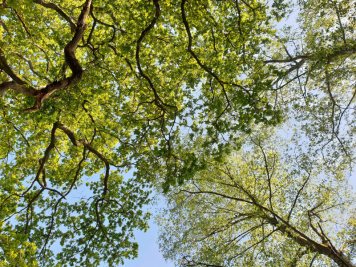
For my Q3 idea I thought that now I’m surrounded by the New Forest in my new home that the ever popular and endless material of the subject of trees would be fitting!

I plan to make many tree inspired pictures but here is my first felted tree canopy experiment, made from layers of scraps of open weave fabrics, prefelts, nepps, yarns and random things from the felting confetti box …  it was fun to make….just playing, adding layers, seeing what appeared!

It’s now sat in the pile of contemplation awaiting its fate.  Possibly the scissors or paint or stitch, who knows!

It’s approx 62 x 62cm.  It’s a bit thicker than I was initially thinking I might make, but I will make a lighter weight version too. I’ve got a list of ideas on the subject, and more brewing…

Here it is along with a couple of my inspiration photos.

Wet Felted Tree Canopy

Tree canopy on a sunny day     Tree canopy on a sunny day

I’ve started another piece, this time in a wide composition.  Already I have strayed from the canopy theme and moved to trunks, but I’ll be back!…..

Here it is in progress (still lots of work to do) plus some inspiration pics…

Tree Woods in progress    Tree Woods in progress

Forest Trees    Forest Trees

A huge joy of the New Forest are the free roaming animals namely the horses, ponies, pigs, cows, deer and the ever so cute donkeys!   Since tourists were interfering with the animals by petting them and feeding them new rules have finally come into place to ban touching or feeding them with a fine if you do.  You are allowed to photograph though as long as you don’t get in their way, quite rightly it’s their forest and right of way.  One day I might be adventurous enough to make a fluffy donkey picture, until then enjoy these photos, how cute!

donkey     Donkey and foal

Lyn

Sometime between the 11th and 13th centuries Southampton became a walled city. The walls, including 29 towers and 8 gates, stretched for one and a quarter miles.

13 of the towers and 6 gates are still standing, making them some of the most complete medieval town walls in the country.  ‘Walking the Walls’ tours are popular with visitors.

I made this representation by wet felt and stitching.

felt and stitch picture

The main entrance to the old city, the Bargate, was built around 1180 and has served as a prison and a guildhall – it still stands today in the city centre.  Left to right: the north side of the Bargate, the south side of the Bargate and the stonework you can see if you walk through the Bargate – photo credits: Wikipedia.

Bargate     Bargate    stonework Bargate inside

There are many old buildings in the city.  Tudor House, in Blue Anchor Lane, was built between 1491 and 1518 and has been preserved as a museum.  St Michael’s Church was founded by Norman settlers circa 1070.  The church has been added to, bit by bit over the centuries, and it’s in regular use today.  Photo credit: Historic Southampton.

Tudor House and St Michaels Church

This monument to Sir Richard Lyster, once resident of Tudor House, is dated 1567 and is inside St Michaels Church.  Photo credit: Hampshire Field Club and Archaeological Society.

Lyster monument

Southampton’s history can be traced back to Roman times, but today it’s a modern, sprawling city and home to approx 250,000 people. It’s the busiest cruise terminal and second largest container port in the UK.  Photo credit: Wave Radio News.

Port Southampton

We hope you’ve liked our potted views of where we live  🙂