Sea Patterns and Acorns

Sea Patterns and Acorns

Sea Patterns

I was recently showing some felt pictures in my little harbour hut gallery in Whitstable. 

Hut 23, Whitstable Harbour Market

I had two sea pattern pictures and someone was very taken with them, but neither of them was exactly what he wanted.  He liked the overall ‘troubled sea’ impression of Sea Pattern (on the left), and the ‘frilly bits’ top and bottom, but he preferred the size in the frame of Summer Sea (on the right).

After some discussion he (Peter, we were on first name terms by this time) decided he liked the idea of commissioning a picture from me.  Now, I’ve written once before about my qualms about taking commissions, link below if you want to take a look.

The long and short of it is that I find it very difficult to know what someone else sees in a picture, which means it’s difficult to be confident I can produce what’s in their head.  Even aside from whether I can translate what’s in my own head into felt.  My conclusion when I was writing previously was that I would take a commission for a picture I’d happily make anyway, on the understanding that if the person didn’t like it, I’d take it into my stock and they wouldn’t have to buy it. So, for example, I’d happily do a picture of a local coastal bird in its environment, but I’d be reluctant to take on anything I didn’t have a feel for and/ or wouldn’t want to make or offer more widely.

This commission fit my criteria so I asked Peter to describe in some detail what he liked about his favoured picture compared with the other one.  He liked the less calm, more turbulent feel of the winter sea pattern. I agreed to take the commission and took a 50% deposit as I think it shows good will on both sides.

These pictures are made by creating two lightly felted cobweb felt pre-felts (one in white and one in blue) then laying them onto a (predominantly pewter-coloured) background and felting them together.  I’ve developed this technique over a number of years.  They’re quite difficult to control but I enjoy the results.

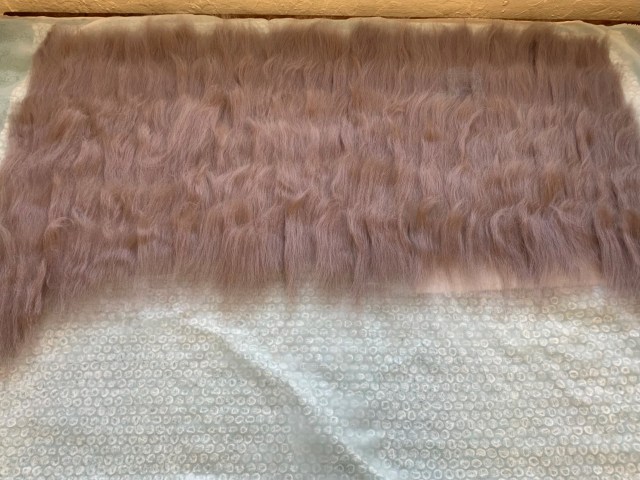
When it came to making Peter’s picture, I first made some blue cobweb pre-felt.  I laid out two layers of a pewter-coloured merino wool background with a few greenish wisps on the surface for a bit of extra colour.  I then put the wet blue cobweb pre-felt on top.  I say pre-felt but it’s very lightly felted – only one step beyond wet wool – so I can pull it about to fit where I want it to go. That’s one of the things that makes it difficult to control.
First layer being laid out
Base layers with blue cobweb overlay

Rather than making new white cobweb pre-felt I used some I’d made previously – which is where I think I went wrong.  I realised in laying it out I didn’t have quite as much as I’d have liked. The client wanted some turmoil, which I interpret as a lot of white, and I was in danger of making a picture more similar to the summer sea pattern.

Final layout

Indeed, although I like the resulting picture – which I’m calling Autumn Sea – I decided it wouldn’t do for the commission so I had another go.

Finished picture – Autumn Sea

I do sometimes get carried away with what I like or am interested in trying and forget what I’m supposed to be doing

This time I would include more white, so I made a new batches of both white and blue cobweb pre-felt.

Laying out wool for blue cobweb felt

Here you can see the dry background: pewter with some wisps of green and blue.

Dry base layout: pewter with blue and green

And here it’s laid out with first the blue and then the white cobweb added, waiting to be felted.

Picture laid out ready for wet felting

And finally here’s the finished picture

I sent Peter a couple of photos, fingers crossed, but reminding him that I’d return his deposit if he wasn’t happy. Fortunately, he liked it and asked if he could name it.  So, it’s called ‘Upon Reflection’ and it’s waiting for me to frame it so Peter can arrange to pick it up. 

Acorns

As a small aside, last month I participated in something called ‘East Kent Open Houses’.  People in this area open their homes or studios for 3 weekends in October to show their art.  I have two friends (Sue, a potter and Irene, a glass fuser) who I often exhibit with so we decided we’d show our work together in Sue’s lovely conservatory. Here’s a link to a video on Instagram if you’re interested in seeing what it looked like.  The potter is @suemortonceramics and the glass fuser is @irenesouthonglass.

https://gbr01.safelinks.protection.outlook.com/?url=https%3A%2F%2Fwww.instagram.com%2Freel%2FCyYOt1isWm_%2F%3Figshid%3DMzRlODBiNWFlZA%3D%3D&data=057C01%7C%7C70becf05589c404a8d9608dbdef23c61%7C84df9e7fe9f640afb435aaaaaaaaaaaa%7C1%7C0%7C638348904270177421%7CUnknown%7CTWFpbGZsb3d8eyJWIjoiMC4wLjAwMDAiLCJQIjoiV2luMzIiLCJBTiI6Ik1haWwiLCJXVCI6Mn0%3D%7C3000%7C%7C%7C&sdata=MJKi64pzispuI75cYcO9V3NkcQBcpqQFxXep0%2BtVqZw%3D&reserved=0

We shared the stewarding which meant I had quite a few hours with nothing specific to do other than sit in the lovely conservatory and wait for visitors.  I’m way behind getting anything made for the upcoming seasonal markets so I thought I’d make some acorn tree decorations. I first made these a few years ago when I’d visited a park that had a gorgeous oak tree with large acorn caps.  I’d picked them up without knowing that I’d go on to making felt acorns for them.  So, I popped into the studio and grabbed my needle felting gear along with a few different wools as I thought I’d experiment to see how much they varied.

I tried 4 different wools: merino tops/rovings, merino & silk batt, Cheviot carded sliver & merino & silk pre-felt. The first ones I fully needle felted.  They all felted well. 

Felted acorn shapes along with natural acorn caps

You can’t see a lot of difference in the photos and indeed there wasn’t a lot of difference. As the Cheviot carded sliver was by far the cheapest of the wools and produced good results, I decided to go with those.  I also decided I got the best results if I knotted the end, lightly needled them into shape until they held their form then wet felted them.

Needle then wet felting gave the smoothest finish and was also quicker than the fully needle-felted ones. Ultimately, I think I just like wet felting more than needle felting.  I’ve glued on the natural dried acorn caps and a hanger, so these went off yesterday to a pre-Christmas fair of cards and decorations at Creek Creative Studios in Faversham, Kent. More info on their website https://creek-creative.org/

Felted acorn tree decorations on a stand ready for sale

And finally – an exciting challenge for 2024

There’s a fantastic Michelin-starred restaurant near where I live called The Sportsman. Looking on their website they say they took over The Sportsman in 1999 with the intention of serving good food in relaxed and informal surroundings.  It’s a good description. A link to their website, if you want to know more. http://www.thesportsmanseasalter.co.uk/

It’s not a ‘posh’ place. More like an old pub in a beautiful slightly out-of-the-way spot by the sea.  As well as serving fabulous food, they also display local artwork on their walls. I contacted them a short while ago to see if they were interested in a display of my artwork.  I sent some photos and they invited me to bring some work with me and come along for a chat.  Happily, they liked what they saw and have booked me in for 6 weeks from 1 April next year. All very exciting but I hadn’t realised quite how much space I’d have to fill.  They casually estimated about 35 to 40 pictures should do it.  Gulp.  So, I now know what I’ll be doing in January, February and March…..

The Wool Revolution

The Wool Revolution

As avid wool enthusiasts (including a few shepherds) most of us are all too well aware that the cost of shearing a flock of sheep is rarely ever covered by the sale of the fleece. In fact the financial return on many fleeces is so poor, I know many farmers end up composting what should be a valuable and eco-friendly product.

Woven and felted wall hangings

Part of the problem is that many of these under-valued fleeces are typically at the coarser end of the spectrum, shorn from sheep bred for the meat industry. In some cases the situation is further compounded by farmers deliberately selecting sheep with coarser wools for their breeding program because their logic dictates, coarser wool = a heavier fleece per sheep and since wool is sold by weight, a heavier fleece = more $$$.

If, like me you make mostly wearables from wool, you probably see the fault in that logic, I know I value the lower micron wools far more, cheerfully paying a premium for them because they are less “scratchy”. However, this doesn’t mean there isn’t a place for the coarser wools too and as felt-makers and spinners perhaps we should not be so quick to dismiss them….

These coarser wools, also known as “strong wool”, have traditionally been used for various industrial applications that require padding that is fire resistant, for home insulation products, even the pads that piano hammers rest on.

In previous decades, one of the largest buyers of strong wools used to be the carpet industry, unfortunately the move towards synthetic carpets has seen the use of strong wools for carpets go into a steep decline. Currently there is a drive in New Zealand to support rural schools to replace their flooring with wool carpets, rather than the imported nylon carpet tiles the government wants them to use.

Large felted wall hanging

I fist met Liz Mitchell MNZM when she joined the Auckland Fun Felters (AFF), just a month or two after I did. Already a wool enthusiast, she was on a mission to discover new ways to use this fabulous, natural material and her enthusiastic interest quickly evolved into a dedicated promotion of strong wool.

Felt illuminated

Liz has had a very interesting textile career, as a fashion designer, with her own label, she was primarily focussed on hand-made couture and in 2005 was awarded the New Zealand Order of Merit for services to the fashion industry and to this day she is one of the best known names in New Zealand fashion.

A series of large wet-felted vessels

In recent years Liz has expanded her repertoire to include working with architects and interior designers to use strong wools, still in their natural colours, for a mixture of wall hangings, rugs and soft furnishings. Her diversification from haute couture to interior design is beautifully documented in her current exhibition, “This Raw Material” on show at the Corban Estate Arts Centre in West Auckland.

This exhibition is open until 9 December 2023 and is well worth a visit, I particularly enjoyed the interactive room where you are encouraged to touch, feel, sit on and even smell the pieces. When was the last time you went an art exhibition where they encouraged you to sniff the exhibits?!! 🙂

Biker jacket and hot pants – Agate wool Jacquard

We were all very proud to hear Liz has secured a grant to set up a “Wool and Natural Fibres Textile Hub” in Auckland, which will serve as a hub for wool research, education and creative exploration. An endeavour I am very keen to support. She has also set up a Wool Revolution PledgeMe to raise funds to support the new Hub.

Winter White Wedding Dress – NZ wool felt
Detail on Wedding Dress
75th Anniversary Moose bag -Needle felting on a ground fabric

75th Anniversary Moose bag -Needle felting on a ground fabric

History

For the last few years at least, you have occasionally, through the blog posts, been invited along to see what the local weaving and spinning guild is up to.  There are a few of us, on this blog, who are members of the Ottawa Valley Weavers and Spinners Guild.  (The guild goes beyond spinning and weaving, having also a number of felters, dyers, and other fibre arts). The Guild was started in 1949 by a group of local weavers after returning from a conference out of town. By the time I joined, over 30 years ago, the weavers had already been joined by spinners (and changed their name from OVWG to OVWSG).

I am sure you noticed that 2024 will be our 75th Guild Anniversary. There are a number of projects planned to help celebrate this momentous occasion.  (The compiled list of suggestions was quite long and the planning committee narrowed it down to 5 projects, there may be more!) Today I want to show you one of them.

One of the suggestions was a project bag to commemorate the occasion. We wanted a bag that was reasonably sturdy, big enough in size to hold a project and it would need to have a graphic and text element that would allow its use, even after the event.  Bernadette took over the quest for a bag to be printed on. I pulled out a lot of the ideas I had been working on for logo and bag options the last time I was asked to work on ideas.  I also did graphics for a few other ideas from members. One was Glenn’s moose antlers as a skein winder idea. I found a free clip art silhouette of a moose which was a bit pixilated and needed to be redrawn, but it would work as a prototype.   I added the yarn to the antlers and it was added to the other images up for selection.  It was the only funny one.  Although,  the octopus trying to weave spin and do fibre prep was funny too, but it was a bit too cluttered as an image. (I still liked it! maybe for a future bag?)

Glenn’s Moose idea was eventually selected, and suitable bags were found and printed.

2 large 1 small box 1) Three boxes containing the new bags arrived in the studio

The bags arrived mid-week. I found them when I arrived to work on the library and was asked to unbox and take photos of the contents.  So, I took pictures of the unboxing to let the rest of the guild enjoy the anticipation of discovering what was in the boxes.

This slideshow requires JavaScript.

2-11) the unboxing

A few close-ups;

This slideshow requires JavaScript.

12-14)close up of bag details

Part of the idea of the project bags was for those who purchased them to make them their own, by embellishing them. It could be as simple as sewing on some yarn through the red screen printed yarn on the bag. The weavers may want to make a scarf to add to the moose.  Or it could be more elaborate, adding a background to the image.

I would like to show you what I did. You probably remember how I have trouble keeping 2-D images not wandering into 3-D places.  First, let me mention this is a mid-weight canvas cloth and that I have not tried felting on this type of fabric before. I guessed on gauge and pulled out two T-38 333 needles, in case I broke one. (Which I did not, but I did manage to misplace one of them…. Maybe I should go find some footwear?) Next, where did I put my embroidery frames? I haven’t used them for a while…. Ah in the bedroom? I started with one of the middle-sized ones that fit the head and antlers.

15) Moose on bag set into 7-inch embroidery frame.

16) bag of unknown fibre, labelled with a warning it might be superwash. The (7) boxes of needles are in the background.

Now it is time to add wool. I found a mystery bag of charcoal fibre, which may be super-wash merino wool. Laying over the pre-printed shape I started to add the fiber.

17) starting to add wool to the ground fabric

The angle of the needle is perpendicular to the fabric.  I am felting into a very old block of foam that is 7”x 6” and 3 inches thick.

This slideshow requires JavaScript.

18-19) You can see there is good adhesion of the wool to the ground fabric.

Time to add the antlers, The bag said  “Finn sheep, roving – semi wersted”. I got it early this summer and it was 6.00/oz. the antlers I wanted to keep more 2-D so I could augment them with yarn later.

20-21) Inside and outside of the bag, the moose is already starting to turn a bit 3-D

I found it easy to follow the edge of the antlers and moose.  The wool is still adhering well to the ground fabric.

Once I had a base of felt established I started to create a more 3-D element, unfortunately having chosen the black fibre it is not as easy to see the contours.

22) Adding ear

I created an ear (I am pretty sure this is supper wash, it took a while to felt the ear) and added it.

23) 3-D view

I had now reached the edge of the hoop and needed to move it to continue working. I decided I did not want to put the areas I had already worked on under the edge of the hoop. So, I would have to locate the bigger hoop I was sure I had. There is a really big one in the basement near the furnace, but that would be too big to fit the bag… Ah, I found it in a different spot in the bedroom… why are most of my embroidery hoops in the bedroom? I have moved them to the office.

24-25) After some tugging and adjusting I got one side of the bag into the 14” hoop.

26) adding wool to the legs

I had to decide which legs were on which side of the silhouette. You could just leave the back-side legs wool-less. I didn’t investigate the gate of a moose, so hopefully I have selected the correct legs on the correct sides.

I continued to add wool but worked at a more shallow angle now and did not feel the needle entering the ground fabric. I added more wool to the back edge of the mandible, the withers, the back edge of the belly, the shoulder and hip.

27)3-D-ish

I am pleased with the moose and antlers, but I need to add an eye. I wanted a blue eye (I did not research so I don’t know what colour  Moose eyes should be. Yet!)

 28) added eye

It was not as visible as I had hoped. So added a bit of light bage (maori) fibre to the underside of the eye. That helped, I also loosened the thread that held the blue bead and it looks better.

Next, we need to add the yarn to the antler skainwinder. First I added threads for the back of the wrapping. (I did not wrap them but sewed them back and forth between the antler prongs. Sneaky)  Then I added the top of the wrapping. I used two shades of blue to add more interest. The careful application of blue has covered up the red from the original silk screen. If there is gaping I may try couching the strands in place.

29-30) close up of added yarn to the antler

Overall, I am quite pleased and hope this will inspire more moose embellishment! The project bags will go on sale at the Guild sale Nov 4-5th (2023) which is for me tomorrow (for you it would be today!)


Getting ready for the sale

Getting ready for the sale

So this week is the week before the sale I posted a few days ago. Jan, Carleen, Bernadette and I are all very involved in the planning and running of the sale. We are running around getting the organising done and trying to get our stuff ready too. Bernadett has a booth with another friend, she has to fill. The other 3 of us are in the co-op booth. It’s a booth for guild members who don’t have enough stuff to get a whole booth to themselves.

I have 3 things to put in the booth. Felted soap.

I have bags of sari silk in several colours

And lastly some spinning kits. I have only 6 of those the wooden wheels I use for them were back-ordered.

So now I am down to making signs and making sure I haven’t forgotten to do something critical to the sale. The weather has turned cold so that should help people start thinking about buying Christmas presents. Fingers crossed for a great sale for everyone.


Slow Progress on Forest Floor

Slow Progress on Forest Floor

I have made a bit of slow progress on my forest floor piece. If you missed my first post, you can see the beginnings here.

Nuno felt background with small stitch samples of running stitch and wrapped cords.

The next step was to do a bit of stitch sampling on the tree trunks. I had been making some wrapped cords that I thought might look nice stitched down to give tree trunk texture but they were too large a scale for the size of the trunks as you can see on the left side. Then I started searching for a stitch that I thought would look nice as texture on the bark. After looking at some complex stitches, I suddenly remembered the KISS principle (keep it simple …). So I decided to try running stitch. It is a much better scale and simple to stitch, the winner!

So I stitched on both trunks. The left photo was taking a look at how they were going to be on the background. I decided they still needed more stitching and added a bit more running stitch. I used a lightweight wool thread as I didn’t want to have a contrast from the wool trunk to a shinier thread such as cotton or silk.

Nuno felted background with stitched felt stumps, felt rocks and cheesecloth moss.

Now on to adding more of the foreground elements. Keeping in mind that I want to highlight the streak of “sunshine” from back left to right foreground, I placed three pieces of felt cut into perhaps rock shapes as well as adding some “moss” with cheesecloth. This is how far I have gotten. I think the rocks need some stitching to add a bit more shadow/darker values. That’s the next thing to sample.


Guild Sale and Exhibition this Weekend.

Guild Sale and Exhibition this Weekend.

Taking place in Ottawa Ontario Canada. If you’re in the area I hope you can join us.

Tools for Pricing

Tools for Pricing

The Guild show is looming and a real challenge is to price the final product. Producing everything is usually accomplished slowly, over several months; it accumulates in boxes and bags, then suddenly you realize the shows are upon you and you now have to price ALL this material! There are lots of discussions on-line and at meetings about competitive pricing in the arts and crafts community. We don’t want to undersell ourselves or price ourselves out of the market. We don’t want to be ‘greedy’ or foolishly inexpensive. Hand spun yarn is very fiber dense, very heavy when compared to factory spun yarn. So a hand knit scarf of hand spun yarn is going to weight more than one from commercial yarn. The benchmarks don’t apply.

But first you have to have a price, for that you need to measure and weight your products. The decision on what to charge is really difficult, but I search on-ine for hand-spun yarn of similar grist, similar fiber content, weight, etc, etc and see if I’m comfortable charging a similar price.

I was fortunate to find a tiny scale that weights from 1000g to .01g. It can be re-calibrated if I have a true weight of 1000g. I’ll look into getting one later this year. This is the only scale I’ve found that can weigh minuscule amounts of silk and cashmere.

The scale weighs in both metric and imperial on the fly, I just have to change the configuration.

So I don’t have to change the position of the fiber and can write the weight on the label right away.

Second I have a voice response computer to convert from imperial to metric and do math so I can keep working with labelling. Google is my friend.

And third, I have a yarn measuring device to measure the length of a specific diameter of yarn. This is the best thing to come my way in ages.

I can set the wraps/inch, mount the skein on the umbrella swift, start winding the yarn onto the niddy noddy and when I’m done the yarn measuring device shows how many yards or meters I have. When I want to convert to meters or yards, I use the voice activation on my computer to do the switch and its all done.

This skein is 20 wraps per inch

There is a plastic card included with the yarn measurer to check the wraps so you can set the device

The viewing screen is very clear and very easy to use.

Admittedly neither the scale nor the yarn measuring device perfectly accurate, the client gets more from both and that’s fine with me.

But the bottom line is to find what both you and the market will bear. We are in a unique position to negotiate with clients who come to our booths, to explain our products and discuss their needs. Pricing is more flexible at the guild sale and if this year looks like its a tough one for clients we can choose to be more willing to negotiate, or not. I will be more confident with my pricing decision once I get to the sale.

Structuring Needle – Forks, lets investigate

Structuring Needle – Forks, lets investigate

Today I wanted to have a chat again about needles. After searching “locally” (ok I looked within a couple hours driving distance) with no luck, I looked online and have got my hands on 5 at 42g needles that are new to me. Before we get into checking them out with fibre, I think we should have a quick review of the two main categories of felting needles as they are used in Industry.

5 felting needles with pastic case and card with gauge by colour list 1) A new needle style to add to my needle collection. (Unlike Pokémon you don’t need to catch them all, but it’s fun to try. I do want to acquire an example of each variation of shape. If I can I may try to track down some of the different barb types and placements to compare.)

Felting needles

From previous posts, I am sure you will remember there are two types of needles. The first group that creates the felt, which is quite reasonably called “Felting needles”.  (This group encompass most of the needles in industry and are the ones we use most.) These needles are set in the needle beds of the felting machines and are repeatedly inserted into the non-woven web of fibre to create the felt. In industry, this is all very fast-moving and noisy, for us it is less noisy and hopefully more carefully considered  insertion of a needle into fibre (ok, stabbing!)   In industry, the different working part shapes, as well as barb type and spacing and even the tip chosen will affect the type of felt produced. Some of the factors that the different needles can affect are the tensile strength, uniformity, low damage to fibre within the web and carrier material (ground fabric as well as longevity of the needles in the machines.  With the variations of gauge, working shape, barb shape and location as well as tip types, the needle manufacturer Groz-Beckert (Germany) says it has thousands of different felting needles to choose from.

Structuring needle

The second type of needles, “structuring needles”, are used after the felt has been made by the “felting needles”. Groz-Beckert describes their purpose as “structuring previously bonded nonwoven fabric”.  This means they will be adding a surface texture (velvety, ribbed or grainy) or pattern (geometric or linear) to the nonwoven fabric (felt).  They do this in a different machine than the one that made the felt. The structure machine usually has a brush conveyer, which holds the fibres in place during the needle insertion process so the velours fabric does not distort the uniform loops. This may be where the concept for the clover brush tool came from. It allows the crown needles to make a loop structure.

diagram of Crown needle in structuring machine. 2) Crown needle interacting with felt on brush conveyor surface creating loops   Watch the video here; https://www.youtube.com/watch?v=aWE4tvHF0xU

diagram of fork needle in structuring machine. 3) Fork Needle interacting with non-woven fabric   Watch the video here;  https://www.youtube.com/watch?v=LU7tZSy9vOE

There are two Structuring needles in Industry, the Crown and Fork needles. when they are used together they will “produce very dense velour fabrics with a uniform surface quality.” Structuring needles make products for the automotive industry, such as floor coverings, foot mats, rear shelves, door and luggage-compartment panels, and headliners.

Crown Needle

The first I have discussed previously is the Crown needle. It has a triangular working shape and has one barb per side located close to the tip. In industry a bed of crown needles, with their shallow barb placement, creates an even and uniform engagement with the fibre, resulting in a homogeneous surface. They are intended to pierce the felt and push a bit of fibre (loop) to the opposite side the needle entered from,  producing the textural element. This is not the way we usually use them, but may be helpful when pushing a colour from one side of a thin structure to another.  Since we are using the needles by hand we can adjust the angle of penetration (shallow) as well as the depth of insertion (just enough to engage the barbs) to isolate the entanglement (felting and insertion of fibre) to one side of a very thin structure. As an example do you remember the iris flower peddles I made?  I was able to add blue to a white petal. Where I wanted I could keep the blue from showing on the other side.

Ann showing thinness of iris petals before assembly felted Iris in sunlight showing how thin petals are and how colour is different on each side of petal4 -4.1) Iris petal, and finished Iris

This is also helpful if you are making ears that have a different colour on the inside and outside of the ear. (As found on mice and other cool creatures)

Although the Crown needle is considered a structuring needle, it is still useful as a speciality needle and worth having in your collection for the occasional time it will be just right. (Now I am thinking about Porridge!)

Fork Needle

The second type of structuring needle is called a Fork it again is used after the felting needles have created the nonwoven fabric. In this case, Fork needles are used, in industry,  to create what is described as “grainy structure”. Fork needles are manufactured in gauges 17–43(Groz-Beckert), although we tend to use a smaller range of gauges in our felting needles.  Online I was able to find Fork needles in gauges 38 to 42, most were on Etsy but I did also check other spots.  Heidifeathers had the good price when I considered the shipping,  but at the time only had them in the extra fine 42 gauge. I would have liked to have found a course one to photograph so you could see the working end clearly.

Fork needles are not like other felting needles. Let us compare and see what makes them so strange.

diagram comparing a felting needle with a fork needle.5) Comparing a Felting needle with a fork-structuring needle

I am sure you will have noticed 2 changes in the Fork needle. First, the point has been replaced by the fork and second that there are no barbs. The working area is smooth and cylindrical. GB said this would give better strength and less breakage but for hand felting the finer gages should still be used carefully to ensure less breakage. You will probably notice that the fork is directional. It is not the same on all sides.

So far, this doesn’t sound too promising for most needle felters. So who is buying these needles (other than industry)?  There are doll makers who make life-like “Reborn” dolls. They need the needle to make a hole, grab a hair then force it into the vinyl head, (Sounds painful). They are using Crown, Triangle and Fork needles. Some of their resellers have renamed the needles; Crowns are now Ultras, Triangles are Regulars and forks are just forks. (poor things,  not getting a fancy second name.)   Fork needles have a notch in the pointed end and have to be aligned correctly with the hair to grab it. For micro-rooting technique, the forked needle at the correct gauge for the fibre being rooted will tend to grab only one hair per insertion. Different gauges or an increased number of barbs for the crown to triangle needles will determine how many hairs you grab as well as the size of the hair.

Doll makers are using either Human hair ranging from 40 to 80 microns, or Mohair and wool ranging from 18 to 39 microns diameter. As we know from needle felting, the depth of the barb determines what size of fibre a needle can grab. The finer the needle, the smaller the barb depth, so, a fine needle had trouble grabbing a fibre that is larger than the depth of its barb. Remember that feeling of “I’m not getting anywhere with this felting needle”, try going to a larger gauge needle so the barb will also be bigger and can grab the fibre more effectively.

Doer Fork Needle, showing forked tip6) Doer 42g Forked needle. This will be similar to the ones I purchased online.

Here is another view of the working end of the Fork needle from the Doer needle company.


diagram showing forked tip and sizes of various gauges of fork needles.7) more info from the working end of the Fork needle, from the Doer Needle manufacturers

So far, we know that the fork needle is a structuring needle, used to create texture on a non-woven fabric (felt). It is a directional notch at the end of the needle. The doll makers have suggested that it will require a specific orientation of the needle to engage the fibre if the fibres are all running in the same direction, as you would see in combed top (or rooting hair). Fibre engagement due to needle orientation should be a little less important if you are using carded roving or batts due to the disorganized nature of the fibre alignment in a carded format some of which should align with the fork orientation. The gauge and thus size of the fork will determine the number of and the size of the fiber it will hold and then transfer into the felt or for the Doll makers the doll’s head. (see table on the diagram above)

Next week will be very busy (but also fun) leading up to the local Weavers and Spinners Guild Show (OVWSG) so I am not sure if I will get a chance to do the hands-on investigation of the fork needles before the next blog post, but I will try.  I am particularly curious about the descriptions of orientation to engage fibre but also about the security of the embedded fibre.  I hope you will share your experience if you have had a chance to try these odd needles. If, as I suspect I am run off my feet next week, I may give you a quick tour of the sale for those who can’t make it to Ottawa!


A lantern for a door prize

A lantern for a door prize

Hi folks. It seems I am running behind as I didn’t know it was Tuesday already. So lots of pictures and not much text today.

My guild Sale and Exhibition is in a couple of weeks and I promised a door prize of a lantern. In reality, it is a glass vase with a cover and fairy lights inside. They are very pretty. You want them to look interesting when they are not lit as well as when they are lit.

So I started out to make a scene. I used bats to save layout time.

water

ground

sky


And then wrap it around

and then I decided it was still boring so I should add a little village.

I thought the white was too bright so I went will black. I want a hint of a village in the distance. I did one on each side.

In retrospect, I should have gone with white. There would probably have been enough migration of fibres to dull it down a bit. As was predictable if I had thought about it they disappeared. I will shave it later to see if I can get a hint of where they are and add them back. but it can wait as after felting I decided it was way too thick for a lantern. I am definitely out of practice felting. I do like the scrunched-up water and flared sky though.

Try again. this time I am using a nice blue merino top and some orange and gold silk lap. the silk should be interesting enough on its own.

A nice thin layout

and some lovely silk lap

and done, here they are together, silk never shows as nice as it is in a picture.

The light forme the fairy light shines through nicely even with the light on


Much better than the first one

so that’s my adventure in felting this week. I hope you like it, I hope the winner likes their prize.

Book Folding Party

Book Folding Party

My local group of artists has started back onto our regular schedule of monthly meetings. This month, we folded books. In the past we have created lots of paper with various methods of surface design, so one of our goals this year is to use paper from our stash.

Supplies laid out for bookmaking

We have been working through this book to learn more about folded book techniques. This shows the supplies and tools that we used to create the books.

Thanks Paula for hosting and here we are getting ready to start. We have our cups of tea and snacks too! And we have already chatted and had show and tell before we start our project for the month.

This time, we were folding a set of “tree fold” pages with a “diagonal pocket” cover.

Four Books Created at our Art Group Meeting

Here are the four books that we made. There are a couple of pieces of double stick tape on the tree fold pages but the cover holds together with just the folds. We then used pamphlet stitch to attach the pages to the cover.

Here is a little closer look at the books.

Top View of Hand Folded Book Showing Inside "Tree" Pages

And an inside view from the top of my book. The pages form a tree shape with graduated branch pages. My book was made from paper given to me by my friend Nanci. She has had this paper for over 30 years and she said it was probably closer to 40. So I used vintage hand made paper to create my book.

Selfie of four friends on a walk after our art group meeting.

After our book making session, we went for a short walk. Here’s the group in front of a small pond.

I have really been enjoying creating different book forms. It’s interesting to see how each book comes together. It’s similar to origami but with a variety of sizes of sheets of paper to create different books. I’m sure we will be creating more books this year as there are quite a few in the book that we haven’t tried yet.