Making a Gift for a New Grandma

Making a Gift for a New Grandma

As you may be aware my daughter in law Mari  is due to have a baby girl any day.  While we wait for the “phone call,” I decided to make her mother a small cosmetic case/clutch.  This is her first grandchild and she has traveled from Japan to be with her daughter and my son for the big event.

I made a template allowing for a 30% shrinkage rate.  I had planned to use some prefelt and merino, but I realized I was almost out of black merino.  So, I substituted some black Corriedale for a middle layer.  The bottom half of the resist was 9″ x 11″ (23 cm x 28 cm).

2015-03-05 13.50.09

The inside layer was a turquoise merino.

2015-03-03 12.02.44

2015-03-03 12.20.59

The second layer was the Corriedale batt and the last layer was a black prefelt.  Then I laid out the embellishments.  As usual, I was so engrossed in the process I forgot to take pictures.  The embellishments were 100% Peruvian thick and thin hand dyed wool yarn, a turquoise and metallic silver mohair yarn, silk hankies and green and turquoise throwsters waste.  The template for the flap was not used as a resist, but as a pattern for the shape and size of the flap.

2015-03-04 13.54.10

2015-03-04 11.45.10

Once I was finished felting and fulling, I shaped the bottom and sides using an ice cream scoop. The shrinkage was less than I expected.  But it was well fulled so I was satisfied. The finished size was 8″ x 7″ high (20 cm x 18 cm)

2015-03-05 11.24.43 2015-03-05 13.30.51

I used the yarn to put on her initials — ST on the flap and embellished it with a silver button and will either use a velcro or magnetic closure.

2015-03-12 11.32.24

I was pleased with the outcome.  It is sturdy, yet not heavy or bulky.

More New Wool

More New Wool

I got some wool tops listed as ‘Arctic Fox’, no other info about what the wool breed might be, just that it is 25 micron. It feels really soft, a lot like Bluefaced Leicester, and it felted really nicely too:

OLYMPUS DIGITAL CAMERAThough it’s soft and felts like a fine wool, it does have some wiry bits:

OLYMPUS DIGITAL CAMERAI tried a variety of fibres it, along the top is Soy top, below that is black Bamboo top (L) and Milk Protein (R), then some Hemp fibre, and at the bottom is Viscose top:

OLYMPUS DIGITAL CAMERAInterestingly it made the soy look like hemp or flax, which it only usually does with a coarser or curlier wool:

OLYMPUS DIGITAL CAMERAThis is a closer picture of the Bamboo and Milk:

OLYMPUS DIGITAL CAMERAHemp and Viscose:

OLYMPUS DIGITAL CAMERAAnother wool I tried was Skudden or Skudde. I couldn’t find any info on it in English, but there’s a Facebook group with cute lambs: https://www.facebook.com/groups/Skudden It isn’t in the Fleece and Fiber Sourcebook, but apparently it is in the Northern European short-tailed family. I used this straight off the batt without carding it first, so it’s a bit uneven:

OLYMPUS DIGITAL CAMERAIt felted immediately, it was like it was felted as soon as it was all wet and soapy. It is weirdly hairy though. I was using new netting and thought frayed fibres had come off and got all over the felt. This photo is actually in focus, but the hairiness makes it look like it isn’t. I used black nylon tops, which are actually very black:

OLYMPUS DIGITAL CAMERAThis is a close up of the hairy corner:

OLYMPUS DIGITAL CAMERAClose up of the left side:

OLYMPUS DIGITAL CAMERAFurther up, it looks like diagrams of cell walls:

OLYMPUS DIGITAL CAMERAIt’s different to any other wool  I have, it’s unusual, but I like it.

Doing some Dyeing

Doing some Dyeing

I realised I was running out of brighter colours.  I got the dye pot out from under the snow drift it had become to fix the problem. . I like to dye outside but it much to cold so It was in the kitchen. I was nice and used citric acid instead of vinegar in my dye water. I am not a pro at this. I do not measure as I don’t care if I can get the exact colour again. I like that my dye jobs are many times not an eve solid colour. I will recard it and it will have more life and not be so flat.

I started with yellow. I wanted a nice bright sunny yellow. It bled a lot when it was done.

yellow bleeding

After many rinses it was still bleeding. So I recooked it with more acid, that worked.

Here is some purple in the pot and you can see the dye take up was good.

IMG_2430

and this is all the wool done, some nice bright spring colours.

dyed wool

I have finally taken my own advice and got some PH strips. I always tell people having trouble with dye take up or bleeding to make sure the PH is right. Now I just need to find some tome to do some more dyeing so I can try them out.

Taking a Few Days Off

Taking a Few Days Off

I don’t usually write posts that aren’t fiber related here. But I had company all week and mostly we skied all week long. I took a couple of days off and we had a blast.

Howie and DennisHere is Howie and Dennis (my husband). Howie is in orange.

Janine and Ruth

And this is Janine and I. I’m in black.

Howie and Janine Skiing

I was wearing a small camera on my chest and it takes really wide-angle shots. So everything looks a bit curved. Howie and Janine are starting down the hill.

On the lift

And here we are getting on the lift. I forgot to turn the camera off but I really liked this shot.

Going Down the Front SideAnd here’s the crew in front of me starting down the front side of the mountain.

The Four Friends

Here we are at the end of the day in front of the Big Mountain Club. We had a blast. I also filmed a short video with the camera which you can see I’m wearing in the photo above. Hope you enjoy it but if you get motion sickness you might not want to watch it.

Learning to Use a Drum Carder to Make Batts

Learning to Use a Drum Carder to Make Batts

Our guest artist today is Cathy Wycliff aka Luvswool.

After several months of taking a hiatus from felting–due to a work project and family health issues–I was starving to get back into it.

Fortunately, Marilyn suggested a lesson in carding batts. I don’t own a carder and my experience with blending fibers has been minimal, that is, using my dog brushes to blend a few bits of wool roving. Last Friday, Marilyn came over with two carders: a Louet Junior with a very coarse cloth (40 tpi?), and a standard Brother with fine (120 tpi) cloth.

I felt more comfortable beginning with the Louet, and grabbed some neutrals to begin the carding process. I used these fibers with no particular plan for my first batt: Mystery fiber chunks and fibers, possibly some Finn hand-spun; hand-dyed vintage yarn (early 80s); small amount of Domestic 56s and Navajo churro–all in various neutral shades, mostly gray.

IMG_0404IMG_0401


IMG_0395 IMG_0394

Then it was time to move on to the Brother for some finer carding. This time I went for color: Indigo-dyed Domestic 56s, dark blue Merino, hand-dyed mulberry silk, white Tencel, green mystery fiber, possibly Corriedale. The machine was a bit more sensitive, and so the fibers needed to be fed more carefully onto the drum.

IMG_0389IMG_0396 IMG_0400 IMG_0399

I tried the Brother once again, using slightly different fibers and colors: Hand-dyed Indigo Domestic 56s, dark blue Merino, white Tencel, unknown white fiber (possibly cotton), and Milk protein. Marilyn suggested we make two passes through with the fibers.

IMG_0398 IMG_0397

Some things that surprised me about the carding experience: it took a lot of time and was more difficult than I imagined; the fibers don’t necessarily cooperate, in that bits get caught on the smaller drum; and finally, it’s probably a good idea to have a plan of what you want to make with the batts before you begin. This was an experience I really enjoyed and I have made a couple more batts with the Louet coarse carder, which Marilyn generously has loaned me. The neutrals below were passed through three times.

IMG_0406 IMG_0405 IMG_0412 IMG_0410


More mystery fibers in green and yellow.


Thanks Cathy for sharing your first experience with carding batts.  Do you still have carder envy?  Personally, I am happy to have the carders.  They have come in handy more than once.  I love making batts just for fun.  I don’t always have a use for them and often give them away.  Its always a creative learning experience!


Fox Sheep Wool

Fox Sheep Wool

I ordered a lot of ‘new to me’ wool from wollknoll recently. I still haven’t had chance to open all the bags and look at them, but I did get a chance to look at a few the other day and make some batts. One of them was listed as ‘Fox Sheep wool‘. I’m guessing it is ‘Coburg Fox Sheep‘. I ordered this as ‘fleece’, which comes as pieces of a carded batt. This what mine looked like:

OLYMPUS DIGITAL CAMERAThis is a close up:

OLYMPUS DIGITAL CAMERAAnd this is what it looked like after I made a batt:

OLYMPUS DIGITAL CAMERAI made a sample about 10 x 10″ and added some black viscope tops:

OLYMPUS DIGITAL CAMERAOn the top half I added fluffed/mussed up viscose in various thicknesses and also laid it criss-cross in a couple of places:

OLYMPUS DIGITAL CAMERAOn the bottom half, I fanned out the viscose tops:

OLYMPUS DIGITAL CAMERAThis is a close up of the middle on the bottom:

OLYMPUS DIGITAL CAMERAAnd this is the middle of the top:

OLYMPUS DIGITAL CAMERAWhenever I’ve used black viscose it reminds me of ‘bubble painting’ – mixing washing up liquid with kids’ ready mix paint and bubbling it up with straws- but these middle parts remind me of seaweed 🙂 This is a close up of a part where I lay the viscose criss cross:

OLYMPUS DIGITAL CAMERAThis is what the whole piece looks like on the back:

OLYMPUS DIGITAL CAMERAI suppose a good description of it would be spongey, but it really looks ‘frothy’ to me!

OLYMPUS DIGITAL CAMERAThe staple length was really short and being so springy, it wasn’t easy to get a nice even felt with just a couple of layers as you can see when I hold it up to the window:

OLYMPUS DIGITAL CAMERA

Carding My Green Leftovers Together

Carding My Green Leftovers Together

When I have a lot of little bits I like to card them together. First I pull them all into small lengths. This pictures make the wool look very blue. I think maybe because the table is very yellow.

wool ready to card

I mixed up the colours in a big tub

IMG_2403 web IMG_2404 web

IMG_2405web

Next I feed it through the carder

first time trough the carder

This is what it looks like as it comes off onto the storage drum. This is what the batt looks like. It is about 7 feet long and 18 inches wide.

IMG_2409 web I want to blend it more so I peel of thin layers of the batt and feed it back through the carder.

IMG_2410 weband at the other end

second time through the carder You can see, at the top of the picture, how thin the web of wool is as comes off the carder to form the batt.

IMG_2424 web This is probably the closes to the real colour. It is more green but it is very blue green.

IMG_2420 webHere is a close up you can see some of the different colours. and how the wool is not as aligned as top but not as mixed as a bat made from wool that hasn’t been processed.

There is always some wool left on the drum take off drum and I let the carder run to clean out the last of the colour and get what looks like a rolag  as well. I ran it through the carder in a narrow stip.

IMG_2414 we IMG_2415 web

IMG_2421

I think I like the first time through the carder better than the second time through. I think it will make a nice hat. The small amount I will probably spin at a demo this summer.

Playing with Color Mixing

Playing with Color Mixing

I finally had a little time to play with color mixing wool. I don’t usually buy commercially dyed wool but I had some on hand that Patti from Dream Felt had given me when I was writing The Complete Photo Guide to Felting. The wool is Norwegian C1 batts and I had a variety of colors. One of the reasons that I like to dye my own wool is that much of the commercial wool is very saturated in color and therefore really bright. Most of my inspiration is from nature, I don’t see those saturated colors in my landscapes, trees, rocks, lichen etc. A lot of my inspiration is in colors that aren’t as bright and many varieties of one color such as a multitude of greens.

Mixing Color - Three Primaries

So these are the three “primary” colors I started with. I didn’t have a really true red, more of a magenta leaning towards red violet. The blue choices were either this slightly grayed blue or a blue leaning very much to the green side. So these are the colors I chose to mix a color wheel. I used an equal amount of each color and mixed them by hand and carding with hand carders.

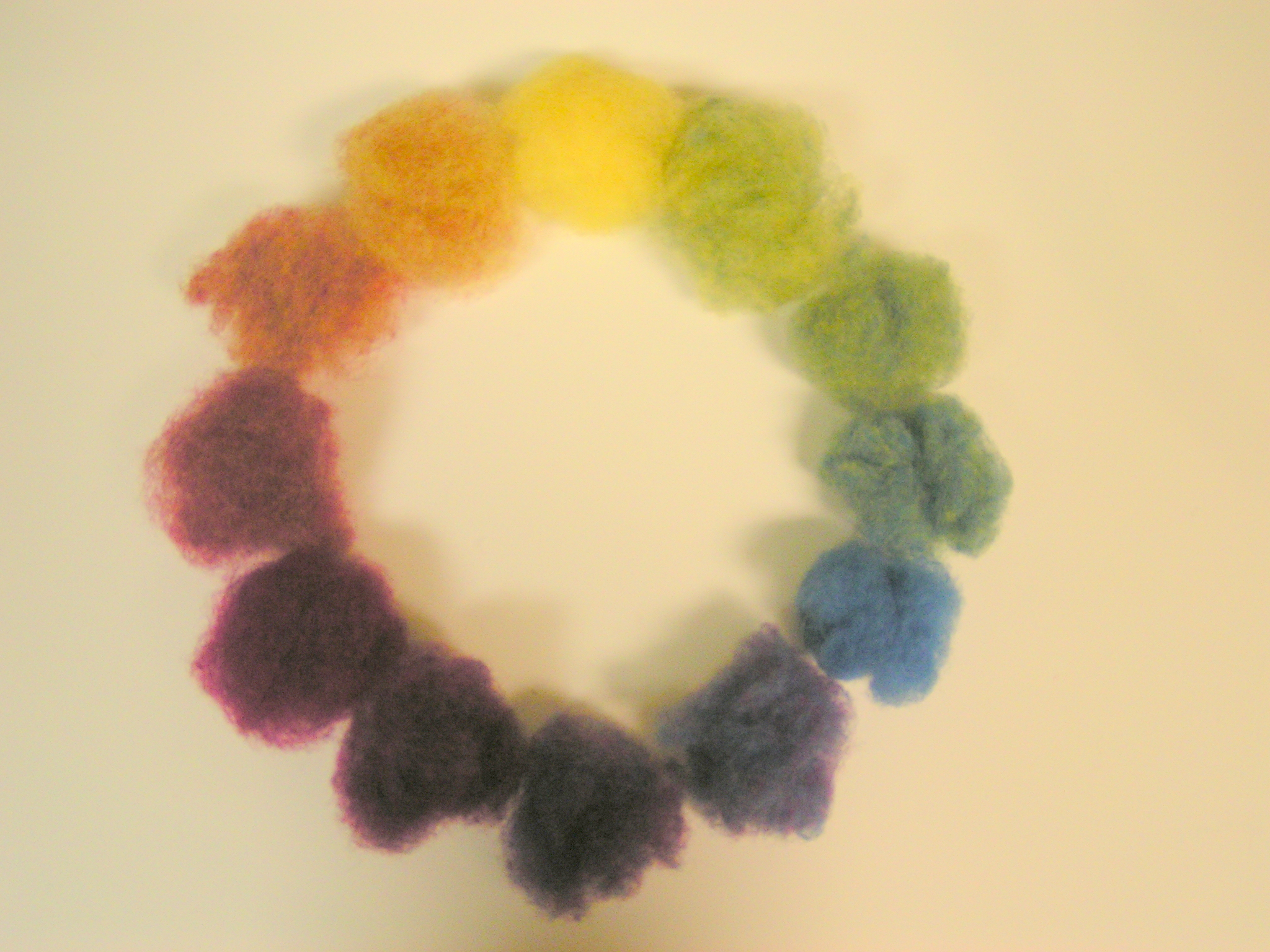
Mixing Color - Color Wheel

Here is the resultant color wheel. Up close, you can still see the individual fiber colors but because your eyes tend to mix the colors, from a distance it looks more like a solid color.

Mixing Color - Close Up Color Wheel

If you look at the yellow-green, you can still see some blue bits in it. Norwegian C1 is a fairly short fiber with what seemed like little neps mixed in. So the colors didn’t blend together all that easily.

Mixing Color Two Different Greens from Different Blues

I wasn’t all that happy with the greens in my color wheel. So I thought I would try the blue that was almost blue-green and mix that with the yellow. You can see the two different blues on the top row. The two greens that resulted are below the blues.

Two Different Greens

Compared together, the green on the right looks more of a true middle range green to me. What about you?

Mixing Color - Light Green and Red/Magenta

I didn’t have any black or white to make tints and shades, so I thought I would try to “neutralize” some colors using their complement (the color on the opposite side of the color wheel). Here I started with light green and a bit of magenta. I used much less magenta than green.

Mixing Color - Mixed Light Green and Magenta

And here is the result on the left compared to the original green on the right. Do you think this would work in a landscape for spring trees? Would it look more natural than the solid light green on the right?

Mixing Color - Pink and Dark Olive Green

Then I thought I would try mixing the pink with a little dark olive-green. You can see I didn’t use very much.

Mixing Color - Mixed Pink and Dark Olive Green

And here is the new pink on the right compared to the original pink on the left. Which pink do you think would make a more natural skin tone?

Mixing Color - Blue and Orange

Next was orange and blue. I used a small amount of blue to mix into the orange.

Mixing Color - Mixed Blue and Orange

And here are the results with the mixed on the left and the original orange on the right. One of the things I have learned from reading books about painting is that if you want to paint a shadow, you should mix some of the original color of what is making the shadow with its complement. That gives you a darker, more neutral color of the original color for the shadow instead of using grey or black to make a shadow. So for example if you were making a wool painting with pumpkins and had used the orange on the right for the pumpkin, do you think the color on the left would make a nice shadow on the side of the pumpkin that was away from the light?

Mixing Color - Yellow and Purple

Here I mixed yellow with a light purple. Just a little purple into the yellow to get the color on the top left. Many times when you look at something, say a banana, your mind tells you that it’s yellow. Is a banana truly the color on the top right? Or perhaps it is a more neutral color like the one on the left. If you take a piece of paper and cut a square hole out of the middle, put the paper over the banana to isolate the color, then place your wool next to the open hole in the paper to compare colors, you will probably find that the banana is not as yellow as you think it might be. Different parts of the banana when isolated will be different yellows.

Mixing Color - Magenta and Dark Olive Green

Next I wanted to see if I could make a brown or grey by mixing two complements in equal amounts. So I tried the magenta and dark olive-green.

Mixing Color - Magenta and Dark Olive Green

Here’s the result. What color do you see in the middle? Brown?

I had fun mixing colors and hope you can see why it might be useful to know what wool colors look like when mixed together. I’m sure I must not be the only one that didn’t have the exact color that I needed when making a project. But if you know how to mix color, you can create the color you need by mixing the colors you do have to make an entirely new color.

Have you tried anything for the 1st quarter color challenge? We’d love to see what you’ve done over on the forum.


From Raw Fleece to Carded Batts of Wool

From Raw Fleece to Carded Batts of Wool

Our guest author/artist today is Zara Tuulikki Rooke.  She generously offered to take us through the process of preparing fibers from her own sheep to use for felting.

As I enjoy felting, I feel very fortunate to also be able to keep a couple of sheep. My four ewes are crossbreeds, from traditional Swedish breeds including the more well-known Gotland, and the perhaps internationally less well-known Rya and Finull. In any case, they do have really nice locks.

Photo 1

In Sweden, the common recommendation (with exceptions for certain breeds) is to shear the sheep both in the spring (to remove the thick winter fleece before they have their lambs and before the summer) and in the autumn (when they return to the barn and start spending more time indoors). The summer fleece (sheared in the autumn) is considered to be of higher quality. It has been grown while the sheep have been out grazing nutritious green grass, and not full of hay and straw like the winter fleece. Below is a photo of their summer fleece, sheared last autumn. The lighter, brown tips are from bleaching by the sun (and probably some dirt as they are unwashed).

Photo 2

My ram is from an old breed called Åsen. His fleece is straighter, without real locks. This breed can have a variety of fleece characteristics and different colours in patches on the same individual animal. My neighbour also has a ram of the same breed, and the darker fleece (black-brown-grey) on the photo below is from one of her lambs.

Photo 3

In addition, I also buy raw fleeces from pure Gotland sheep from a farm in a neighbouring village. The photo below shows some of the variation you can get between individuals, both in colour and in the size and shape of the locks. The lambs are born black, but later the wool turns grey and the once black tips are bleached by the sun. Or rather, they grown an increasing proportion of white hairs – there are no grey hairs, just different proportions of white or black hairs making the fleece look grey.

Photo 4

To a felter, this abundance of raw fleeces must seem like an ideal situation. And I certainly think it is. But, the process of turning raw fleece into carded wool is quite time-consuming. And that is what this post is really about.

After shearing, the fleece needs to be skirted and sorted, to take away wool that is too short, dirty or tangled. The short wool can either be from the head or legs of the sheep, or the result of what we call double-shearing (i.e. shearing a patch a second time to even it out). You usually also need to remove a fair amount of grass seeds and other vegetable matter that gets stuck in the fleece. That can take a lot of time, but it helps to do the sorting on some kind of wire mesh that allows small bits to fall through.

Then comes the washing. I try to get as much washing as I can done outdoors in the autumn, after shearing, up until the temperatures drop below freezing (in the North of Sweden that can be quite early in the season). I leave the wool to soak overnight in net-baskets in an old bathtub filled with cold water. The next day, the water will be really brown, but that just shows how much dirt you can actually clean out from a raw fleece with just cold water. I change the water at least twice after that, allowing the wool to soak for at least a few hours between changes, until the water no longer looks dirty. In my opinion, washing the wool in just cold water is sufficient if I am going to use the wool for wet-felting. During felting it will anyhow get washed again with hot water and soap.

Photo 5

During the winter, I do the washing in my bathtub indoors (which prevents anyone in the family taking a shower/bath for 24 hours), and then I usually use lukewarm water. If the wool is very dirty, I also add some washing powder (the type used for knitted wool items). The main rules when washing, to avoid felting the wool in the process, it to avoid too hot water, or quick changes in water temperature, and to disturb the wool as little as possible.

After washing comes drying. The net-baskets are easy to just lift out of the water and then I usually hang them up for a while to drip off a bit. If I am washing a smaller amount of wool, I often use one of those contraptions meant for spinning water from salad. Then I lay it out to dry, on a wire mesh or on towels on a clothes drying rack. Drying takes time, usually several days. It helps to turn the wool over each day and fluff it up a bit each time. It may seem dry on the surface, but wool has an incredible capacity for retaining moisture.
Finally, you have your washed and dried wool, ready for carding. However, some locks do need to be teased first. This means pulling apart the locks/fibres – and you will probably find even more grass seeds now. The photo shows washed locks, before and after teasing. It´s an extra step in the process, but if the locks are tangled in the tips, teasing really does facilitate the carding.

Photo 6

I own a drum-carder, which really does save time compared to using hand-carders. The wool is feed in under the small drum, which in turn feeds it onto the larger drum, as you turn the handle. After two or three runs through the drum-carder, you can finally lift off a batt of lovely, fluffy, carded wool. Then you can start felting!

Photo 7

It does take a lot of time and effort, and I do swear about grass seeds through the whole process, but each step also has its own charm. I often find it very relaxing to sort, tease and card wool. It provides an opportunity to really feel and look at the locks – and to plan what to do with them. And at the end of the day, when I look at my washed locks and carded batts of wool, I feel really wealthy. Perhaps, in part, because I know how much time and effort has been invested into those locks and batts of wool.

Thank you  Zara for such a wonderful tutorial with exceptional pictures to show us the whole  process from fleece to wool batts!

Lincoln, Soy, Bamboo and Knitting

Lincoln, Soy, Bamboo and Knitting

This is the back of a piece of felt I made from Lincoln wool tops:

OLYMPUS DIGITAL CAMERAI love the way the characteristics of the different breeds reappear with felting, when they’re not very evident from the wool tops. And you get such gorgeous edges with the curly breeds. On the front, I used a blend of Soy top and black bamboo tops. I just blended the tops by hand and laid them on the top:

OLYMPUS DIGITAL CAMERAThe shape, texture and colours reminded me of finding oyster shells on the beach. This is the bottom left corner:

OLYMPUS DIGITAL CAMERAThis is a close up of the texture:

OLYMPUS DIGITAL CAMERAAnd a close up of the back:

OLYMPUS DIGITAL CAMERAI still haven’t had chance to even look at the wool I ordered from Wollknoll because I’ve had builders in … for fibre addicts in the UK who don’t already know, the Euro is really low against the Pound at the moment (about 73p to €1) so have a look at their site, 100g of wool is starting around 72p… don’t be alarmed at their prices though, they’re usually given per kilo! I did manage to sneak a ball of rainbow Merino out of the box though and do a little bit of spinning, I also used the tufts I’d used for my colour wheel a while ago. I left it on the spindle for a couple of days then knitted a square from it:

OLYMPUS DIGITAL CAMERAHere’s a close up

OLYMPUS DIGITAL CAMERAAnd because I love them, a supermacro:

OLYMPUS DIGITAL CAMERAI’m not convinced I’m casting off properly though, all my squares look like they’re one stitch too short!