All Sewn Up

All Sewn Up

I showed you various stages of these pomegranates here and here. I had quite a bit of waiting time in the last couple of weeks so I finished stitching, adding some leaves and adding a bit more stitching to the pomegranates.

Tracing of Pomegranates

The first thing I had to do was figure out where I wanted the leaves to go. So I took a couple of pieces of tracing paper, traced the pomegranates and drew in some leaves. I did have a photo of what pomegranate leaves looked like to help me with my leaf shapes.

Printed and Stitched Pomegranates

And here is the finished piece. The piece is done mainly with stem stitch and all the thread is wool. I  stitched 3 times around some of the pomegranates to make them more prominent.

Hand Stitched Pomegranates by Ruth Lane

I didn’t add any more of the seed stitches in the middle.

Close Up of Pomegranate Stitching

You can see that the pomegranate on the left in the foreground has a thicker outline. That is actually 3 rows of stem stitch next to each other. The green wool thread was some that I dyed with natural dyes a couple of years ago. And I didn’t try to transfer the leaf design on to the wool, I just looked at my pattern and stitched it by eye. I have never found a really good way to transfer a pattern on to wool and it didn’t matter if the leaves were exactly the same as my sketch.

Now I just have to figure out how to finish the piece. The wool is cut unevenly on the left side and some of the sides were already blanket stitched. What do you think? How would you finish it?


Wooly Fun

Wooly Fun

Recently, my husband and I spent ten days in Florida with our youngest son and his family.  When we first arrived, I told our five year old grandson that I brought some wool to play with.  It was a busy ten days. On the last day he reminded me we were going to “make some wool stuff.”  His three year old brother was taking a nap so this was a good time.

Knowing the kids love bright colors, I brought a variety of merino colors to play with.  Luke chose orange, white, blue, teal and red to make a snake.  He helped me lay out the colors on a piece of bubble wrap.   He was fascinated when I mixed some soapy water — he didn’t want me to use dish soap, he was intrigued with the pieces of olive oil soap I brought.

When we finished laying out the two layers of wool, I covered it with a piece of netting and he proceeded to add soapy water with a sponge.  I had him do some rubbing before he began rolling between two pieces of bubble wrap.

2015-05-31 13.54.28

Sorry about the quality of the pics, this was a quick action packed process by an determined little boy.

We rolled it up at prefelt stage and rolled again in bubble wrap until it was hard enough.

2015-05-31 13.56.59

2015-05-31 14.00.52

2015-05-31 14.12.38

I laid it out on the porch to dry (with 90 degree weather it didn’t take long.)  Then I stitched on the eyes.

When Josh got up from his nap he went outside to play.  Within minutes he walked in with the snake in hand asking “why isn’t the snake moving!” I’m glad it was a wooly snake and not a real one!

2015-05-31 15.24.41

Since Josh didn’t have a chance to make his own, I made one for him when I got home using his favorite color green for the head.

2015-06-02 11.14.06 2015-06-10 10.04.00What wooly things have you made lately?


Abstract Art

Abstract Art

Before I discovered wet felting, I used to do a lot of painting. This is one of my favourite acrylics from 2007:

OLYMPUS DIGITAL CAMERAI decided to try and do a wet felted version of it. I did a couple of layers of Merino tops in a simplified palette of colours, then used some bamboo skewers to split the painting and felt piece into quarters as a guide for adding more detail for the 3rd layer.

OLYMPUS DIGITAL CAMERAI had pretty much all my colours of Merino out for this.

OLYMPUS DIGITAL CAMERAThis is the finished layout:

OLYMPUS DIGITAL CAMERAAll the wool put away and ‘tidy’ 🙂

OLYMPUS DIGITAL CAMERAI took it outside to felt it:

OLYMPUS DIGITAL CAMERAI had an audience:

OLYMPUS DIGITAL CAMERAI put it on the washing line to dry. I usually stand the painting up on its end (right end), and while I was felting, some of the wool must have gotten nudged and I started to neaten it up, but thought it would look quite cool and like it was dripping if I left the wavy edges. They neatened themselves up a bit while I was fulling though, but still looks pretty good.

OLYMPUS DIGITAL CAMERAFinished piece:

OLYMPUS DIGITAL CAMERADetail:

OLYMPUS DIGITAL CAMERA

Dyeing Some Silk and Some Farm Life.

Dyeing Some Silk and Some Farm Life.

I have a couple of ladies coming for a class in nuno felt at the end of the month so dyed a few pieces of silk to add to what I have so they have a nice variety to choose form. I am using the low water immersion method form Paula Burch’s site. http://www.pburch.net/dyeing/lowwaterimmersion.shtml  I made collages of the dyeing. You stuff the silk tightly into a jar and then add some dye. The pictures are the dye with the stir sticks so you can see the colours and then of the first dye poured over, then the second so you can see what it looks like. They have to sit for an hour then you add the sodium carbonate.

peach and fire red
peach and fire red
pink and turquiose
pink and turquiose
emerald and black
Bright green and brazil nut

This is them hanging to dry.

scarves drying

And then dry. You can see that the colours are better when they are dry but I am still not happy with the emerald an black far right.

silk dry

I also wanted to share some farm life, not sheep I am afraid. These are my chickens getting to look at their new outside pen and true to there name they are chicken to come out. With some time and coaxing they did make it outside.

chickens going outsidechickens going outside 2

We also got some new baby chickens and turkeys. They come in boxes delivered to the local farm Co-op. The boxes are divided into 4 inside so they don’t over crowd each other to much. There are 2 boxes of chicks and one of turkeys

chichens in boxes

These are the turkeys, they are about a week old and have started to get feathers.

turkeys

These are the chickens, they are day olds. My son is taking them out of their box.

colin and chickens

They are very cute little yellow fluff balls with legs when they arrive.

2nd Quarter Color Challenge

2nd Quarter Color Challenge

I have been thinking about Ann’s 2nd quarter challenge for a while now but didn’t have much time to get anything done. But I finally did it. I used the Color Adobe site to create a palette from a photo. It allows you to use a color wheel or a photo. The other thing I liked about it was that it had several choices of palettes from a photo plus you could create a custom one. I used a photo that I took in Mexico.

Colorful Mexican Wall

The photo above show what the screen looks like with my photo, where the colors were taken and then the palette below. The problem I have with these programs is that the colors of what I saw are nowhere near this palette. The colors were bright green, orange and a cornflower blue. I think the camera changes the colors and then the palette takes that several steps further. So that what I saw in Mexico has little to do with the palette that the computer generates.

Bright Mexican Wall

But it’s an interesting process. So the first photo was the “colorful” palette and this one is the “bright” palette.

Muted Mexican Wall

Here’s the “muted” palette.

Deep Mexican Wall

This one is “deep”

Dark Mexican Wall

This one is the “dark” palette.

Custom Mexican Wall

And then you can move the little circles around to find the colors you want. At least this has a little bit of “orange” in it. I decided I would use the “dark” palette to make a wall hanging in felt.

Here are the colors I chose from that palette. Obviously, these colors are not quite the same as the palette. But I used what I had.


I had a piece of pre-felt left over from the Monet challenge last year and used that at the top of the piece. Then I created this piece based on my morning walks and all the wildflowers I see.

Layout Wet Down

This is what it looked like after wetting it down.

Montana Wildflower Wall Hanging

And here is the piece after felting. I really like how it turned out but again, I don’t think it has any relation to the photo I chose.

Close Up Felted Wall Hanging

Here’s a detail photo. I think I will add some hand stitching. Have you tried to use a computer generated color palette for inspiration? It is an interesting process and I do like how the color scheme worked. I wouldn’t probably has used the pinky-peach color but I do think it goes well with the color scheme.

Don’t forget that there is still time to sign up for our online course Wet Felting for Beginners starting June 19th. Just go here to sign up. 

Featuring Tips on Beading from Artist Mary Stori

Featuring Tips on Beading from Artist Mary Stori

Mary  Stori is  a new forum member, but has extensive experience in quiltmaking and fiber art.  She introduced herself to us in January as “‘ a wanna be felter living outside of Asheville, NC.  For the past 25+ years I’ve traveled the national and international quilting circuit as an author, lecturer, workshop leader, cruise host…..bla, bla, bla.  The focus of my work began with wearable art, fine hand quilting, whimsical and highly embellished quilts.”

She attended a class with Chad Alice Hagen a few years ago and is now “hooked.” Her focus went from quilts to felt.  But one thing hasn’t changed — her love of embellishments, particularly beading which she has authored several books on. So, with her permission I have put together some of her tips from her blog on beading.

Storage

I’m often asked how I organize my beads……this method works well for me.

First of all……you won’t use them if you can’t find them, so take the time to gather them from all your hiding places, organize them, and then put them in a convenient place…no matter how many or few you have.

A location away from sunlight, heat, and excess moisture is best.

bead storage 1

Because there are no closets in my studio, my teaching materials are stored in a large walk in closet in a guest room nearby. The bulk of my workshops in recent years have focused on beading techniques or projects that incorporate beads. Therefore, I purchase a LOT of beads in bulk from a distributor for my classes. They generally come as strung kilos, which I repackage into kits and store in boxes and plastic bins.

Above is my own personal stash…… One entire side of the closet is fitted from floor to ceiling with shelves…and almost all are used to store my embellishments. I could consolidate them if the space was needed for other things, but as it is now, I’m easily able to walk in and quickly find what I’m looking for without having to dig through dozens of items stacked on top of each other.

floss cases2

I like to use plastic fishing tackle boxes, or embroidery floss containers. Beads are stored by style and color in see-thru plastic tubes or small bags. Here you see some seed beads.

hardware storage unit 3

Besides using beads, I utilize many other embellishments, trinkets, charms, buttons, found objects into my work. This unit has plastic pull out containers with large divided sections which are more suitable for these items. It too goes on my shelves in the closet.

slide.012 4

If tubes or small bags aren’t handy for you….try storing beads in small containers such as film canisters, pill bottles, or metal breath mint cases. If you glue a bead to the lid….you’ll always be able to quickly know what’s inside!

slide.016 5

Another big key to beading……is making your environment comfortable during the task. A table top or floor model Ott light will save on eye strain. As will a pair of ‘cheater glasses’. I always tell my students that one of the biggest secrets to successful beading is ‘spacing’….and the ability to see the bead and to judge the placement of the needle into the fabric is vital.

slide.017 6

Self-explanatory!

Bead Test

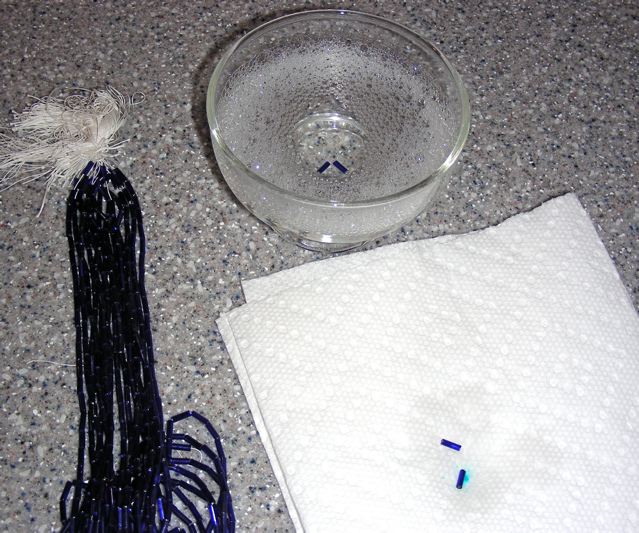
Many people are unaware that beads may not necessarily be colorfast. For instance, this beautiful blue bugle bead below may appear as if it’s blue glass. Not so……it’s clear glass that has been dyed or painted blue. Often the color remains secure on the bead, other times not. So…..if you think there’s a possibility that your project will be washed, become damp, or even require high steam for pressing…..take a few minutes and test your beads for colorfastness.

Most of the time, there isn’t a problem, but for that heirloom project….you’d be devastated if during a final steam pressing, the bead color ran into your fabric. The pricier beads may be just at risk as the less expensive ones…..you can’t tell by looking.

Here’s how to test:

– Fill a shallow dish with hot sudsy water….drop in a few beads….let it sit for 15 mins.
– Remove them…rinse and let dry on a paper towel.

Note….sometimes color will be visible in the water, other times….the color will slowly eek out as it dries. As you can see….this blue bead has run…..red is another color I check carefully.

Don’t let this scare you…….we are all aware that colorfastness can be an issue with fabrics……now you know that beads carry the same risk. Even if the bead color doesn’t run….sometimes the fancy coatings……that make a bead’s surface shimmer with various affects, (like rainbow) can dissipate……and the bead will lose its luster.

I’ve tested very, very few beads that I decided not to use……or that I’ve used with caution……beading is worth any effort….hopefully with this hint….all your projects will continue to shine brightly!
bead test

Beading Tip

I’m a stickler for good quality construction…..for me it’s not all about fast, rather…it’s about great design that has been executed to the best of my ability. If precautions aren’t taken, beading can cause fabrics to distort. Therefore, I ALWAYS secure my work in a Q-snap frame.  The only exception is when I’m beading the bindings/edges of my quilts.

DSCN2315

Q-snap frames are simply PVC tubes which come in a variety of sizes. This one is 11″ x 11″, my choice for smaller projects. The work is attached using clips that snap over the frame. Though you could use a round embroidery hoop…..I don’t because it pulls the fabric diagonally which can stretch the bias. I’ve found it’s best to keep the fabric ON GRAIN by using a square or rectangular frame when beading.

As for felt, unless the felt is super thick and sturdy, I always secure fabric (of any kind) in a Q-snap frame for beading and embroidery. However, I generally avoid using the plastic clips…….instead I attach the material using muslin sleeves or pin the fabric around the frame to avoid damage to the fabric and beads. There’s nothing more unattractive than distorted, stretched out wool!!!

DSCN2314

However, as the beading design develops, requiring repositioning of the fabric, I avoid using the clips in places where they could damage the beads. Instead, if the piece is large enough as it is in this sample, I wrap the excess snugly around the frame, and secure the layers together using straight pins or by thread basting. This keeps the fabric on grain, and well stabilized to assure good thread and fabric tension.

DSCN2313

My ‘artist’ inspired piece is now in the beading phase…. The piece is attached to an 11″x17″ Q-snap frame…note I used 1 clip at the top, where it didn’t interfere with the beads.

I also want to mention that I’m beading through 2 layers only…..the quilt top which has been stabilized with batting. This approach will hide and protect the threads once the backing is added later.

You can find more information on Mary’s website and blog.  She’s also the author of “Beading Basics,” “All-in-One Beading Buddy,” & DVD – “Mary Stori Teaches You Beading on Fabric” & “Embellishing With Felted Wool”

web: www.marystori.com
Blog: www.marystori.blogspot.com

Thanks Mary for sharing some of your beading tips with us!

Pencil Roving Mats

Pencil Roving Mats

I recently got some Pencil Roving when I did a World of Wool order. I liked the look of it, but couldn’t decide on which colour, so I decided to get a 500g bag of Pencil Roving waste. I expected more than 4 colours, but it still worked out cheaper. I wanted to see how well it worked layered, so I decided to make a ‘woven’ mat/coaster type thing. I started off with a 10 x 10 inch template:

OLYMPUS DIGITAL CAMERA

Then I cut the pencil roving a bit smaller, 10 strands of each colour:

OLYMPUS DIGITAL CAMERAI laid the strands across the template:

OLYMPUS DIGITAL CAMERAI then held the bottom of the strands down with a ruler and flipped back alternate ones:

OLYMPUS DIGITAL CAMERAI laid the strands across the columns and then flipped back the other strands:

OLYMPUS DIGITAL CAMERAI used a plastic knife to push the strands in to place.

OLYMPUS DIGITAL CAMERAThis is how it looked when it was finished:

OLYMPUS DIGITAL CAMERAI didn’t think it looked its best, so I took off a few of the strands at the ends:

OLYMPUS DIGITAL CAMERAI added a couple of layers of Merino tops, then felted it and fulled it quite firmly. It was about 7.5 x 7.5 inches afterwards:

OLYMPUS DIGITAL CAMERAI also made another mat with pencil roving, I used up some of the spare lengths left over from the other mat, and added rows and columns. This one ended up slightly wider as there wasn’t as much roving going across as there was top to bottom:

OLYMPUS DIGITAL CAMERAI thought they turned out really well 🙂


Prep and Finishing

Prep and Finishing

This last little week hasn’t been a felting week its been a preparation and finishing week with an emphasis on preparation. I carded up all my dyed balls of merino. You can see all my sheep on the top shelf.

caded wool on drum carded wool on shelf


I added the sheep to my little bag, it needs to be reblocked from having little balls of wool in it and hanging out in my purse for a few weeks until I got round to doing the sheep

sheep bag


and doing some doodling in my sketch book, I would like to do more felt art work.

sketch collage

The other thing is I have been  thinking or things that might sell in the summer. I made some felt laundry balls and some tea cozies and bags that might go well in the summer. What do you make for warm weather sales?


Guest Post – A Trip to Peru

Guest Post – A Trip to Peru

The post today is from one of our forum members, Elizabeth Sutherland, who recently took a trip to Peru.  I hope you enjoy this virtual trip!

Our Peru trip started with a week cruising on the Amazon, followed by a week of visiting Incan ruins at Macchu Pichu and the Sacred Valley of Cusco. The Amazon cruise was on a very nice riverboat – good beds, good food, good baths.

photo by Elizabeth Sutherland

We (my husband Doug and I) were accompanied by only 15 other travelers on a 29-passenger boat.

photo by Elizabeth Sutherland

Each day we took 2-3 excursions by small launches to view the wildlife. We had some phenomenal local guides who could spot a gnat on a mosquito because they knew where to look. They had also been guides for scientists and amazed me with their understanding and use of scientific terms and explanations.

It was the end of the rainy season so the rivers and side creeks were very flooded. We were sad that we couldn’t walk in the jungle, but the guides said that the animals were more closely congregated and we’d see more. One morning they fed us breakfast on the small boats. Another day we visited a local village (they rotate among them) where we delivered school supplies and sang songs with the children.

photo by Elizabeth Sutherland

The women there were rolling & twisting palm fibers into string that they would then use to sew into bags, plates, and fanciful creatures for us to buy. It wasn’t weaving or crocheting or knitting, but they used a needle to form the bags. I didn’t ask what dyes they used for the fibers, but many of the colors did not look natural.

We had an excursion into a local market and saw lots of fruits, grains, potatoes, and fish for sale. One afternoon the guides gave us a demonstration of the local fruits. I must say that most of them were not very tasty and had little edible flesh. One afternoon we also fished in one of the creeks. We mainly caught piranha, which the chefs cooked up for us. It tasted like dark meat chicken with a little fishy overtone. We also had a chance to kayak for a few hours up a side channel.

We had happy hour every night, accompanied by a band formed from the boat crew, variously called the Chunky Monkeys, Dung Beetles of LiverPoop and Amazonian Rat Pack. They layed a selection of Peruvian music as well as classic rock tunes arranged for pan flutes. They also got most of us to try a few salsa steps.

photo by Elizabeth Sutherland

Most of the animals we saw were birds and monkeys, but we were able to take one walk through the forest and see snakes, arthropods, and frogs. I was a bit frustrated as a horticulturalist since I wanted to know more about the flora I was seeing. We didn’t see any orchids on the Amazon, but a few bromeliads blooming. The pink and gray river dolphins were very good at eluding the photographers, but were quite active. Our trip was topped off with a float plane ride to see the Amazon from above.

After the wonderful week on the Amazon we returned to Lima and dropped off most of our fellow travelers. One couple stayed with us to travel to Cusco and Macchu Pichu, and we picked up another couple and our guide for the rest of our tour. I had been working out on stairs to prepare for the trip, but there was no way to prepare for the 11,150-foot altitude (3,400 M) of Cusco (Dallas is only 500 feet). I could feel it as soon as I got off the plane, but as long as I took it easy I was OK. They had coca everything for sale – tea, cookies, gum, candy. I’m not sure if it helped or not, but I tried most of it.

photo by Elizabeth Sutherland

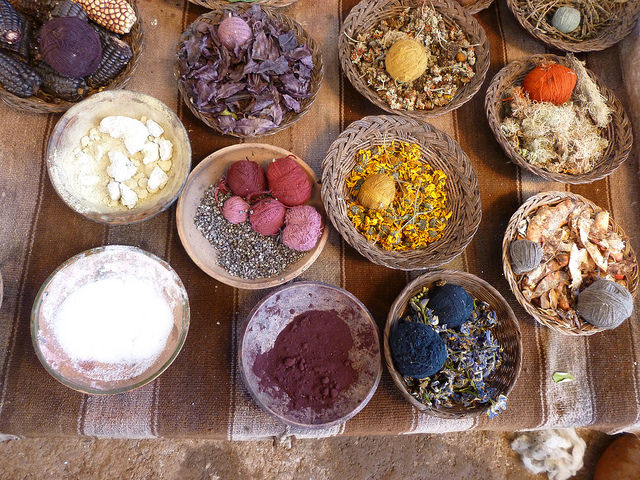
What really helped was the trip to The Center for Traditional Textiles of Cusco where we had the raw fiber to finished product demonstration that I had been hoping for. I was fascinated at the range of dyes they could get from the traditional plants. Their products were beautiful and very intricate. They said that it used 500 warp strands and took over a week to weave. I think the altitude was getting to me because I only purchased a little fiber instead of asking for a bale! I did purchase beautiful poncho (S/500 = $155) and some other souvenirs. They were very interested in the nuno scarf that I brought along. They had a few alpaca there, as well as guinea pigs (dinner?) and some other traditional food – dried beans & quinoa, potatoes.

We went to another small market and saw more varieties of potatoes, including naturally freeze-dried potatoes that could be rehydrated and eaten 20 years later We also purchased some coca and chewed on it like natives (or not – yuck!). We ate lunch at a lovely buffet where we could taste many of the local foods. They also had llamas, alpacas, & a couple of vicuna. Sadly, none would let me close enough to pull of the scissors for fiber samples. Macchu Pichu was the next day. It is lower than Cusco, at 7,972 ft (2,430 m), so we had a night to acclimate a bit.

Our day at Macchu Pichu started off beautifully. I was able to take some post-card quality photos. We hiked along the Inca Trail up to the Inca Bridge; we were not allowed past it. The trail was not too dicey; the guide took suitable breathing breaks. The scenery was beautiful. As usual, I wish I knew more about the flora in the area.

Nights were at the Inkaterra Lodge – a beautiful property that I wish I could call home. If you didn’t like the color green, then you were out of luck. Even though orchid blooming season was past, there were plenty of beauties to look at. The staff regularly ‘baited’ trees with bananas to attract birds, as well as keeping the humming-bird feeders well-stocked.

After Macchu Pichu we returned to Cusco via Ollantaytambo and Saqsaywaman, two more amazing ruins. Our guide for this part of the trip was just as knowledgeable as our Amazon guides. I regret not taking more notes, but I enjoyed all of it. We saw where the quarry for the stones at Saqsaywaman was across the river and up at the top of a mountain. These multi-ton stones were moved by a civilization that had not invented the wheel yet. Amazing what a LOT of person-power could do. At Ollantaytambo the granaries also were across the river and up the mountainside. I guess the women couldn’t send their husbands out for a cup of quinoa very easily.

photo by Elizabeth Sutherland

From Cusco we flew back to Lima and modern-day civilization. I was sad to say goodbye to Peru, but looking forward to my own bed and getting back to family, friends, fiber, and furry cats.


Stepping Out of My Comfort Zone

Stepping Out of My Comfort Zone

Lately, I’ve tried to step out of my comfort zone with color and fiber and try some new things.

While this first example doesn’t look like it’s outside of my usual color palette, I did use some silk for nuno on this clutch and some coarser fibers like Corriedale that I made for my daughter in law.  The nuno is not as noticeable as I’d like, but I think it still adds a nice texture to it.

2015-04-13 11.21.45 2015-04-13 11.22.27 2015-04-13 11.22.42

Revisiting pods, I decided to really jump out of my comfort zone and use bold primaries on a black background. (It is a bit like some of Pollack style pictures I did for last year’s challenge.)

2015-04-14 16.28.52 2015-04-15 12.33.13 2015-04-15 12.33.19


Another project I’ve worked on was  hand dyed silk I made a while back.  I decided I didn’t want a long scarf so I cut the piece in half.  I used very little wool wisps on one side.  The joke was on me when I was finished felting.  It could be a scarf for a doll!  It had been a while since I did nuno and evidently forgot about the big shrinkage rate for silk gauze.  I do like it though.  I think I could wear it as a collar if not a scarf.

2015-05-11 15.36.46 2015-05-11 15.37.52


Most recently, I decided to play with some neutrals and coarser wools.  Cathy (Luvswool) was nice enough to give me some of the Domestic 56  wool she had dyed in Arkansas with plants. I really liked the colors. I made a batt with cream and brown Corriedale and another with some of the  hand dyed Domestic 56 for added color. I used a resist open at the top and bottom. The cream and brown became my inner layer.

2015-05-09 14.21.55 2015-05-09 14.11.55


I really liked the subtle colors against the neutrals.  The coarser fibers also added to the texture for a natural open look.

2015-05-13 15.27 2015-05-13 15.28


Having progressed through these projects, I have a whole new outlook on textures and colors that I hope to incorporate into my future art.

What have you done outside your comfort zone lately?