1st quarter jewellery challenge

1st quarter jewellery challenge

This is the last of my contributions to this quarter’s challenge. I am looking forward to finding out what the next quarter’s challenge is.

Last time I showed you my circles of silk and wool to be made into flowers.

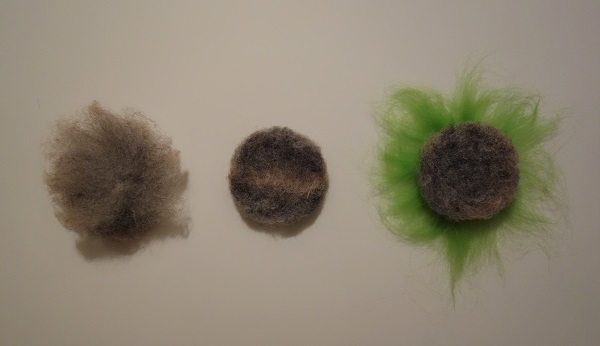
First, I rubbed and rolled them until they were well felted.  Then I folded them into a cone and started rolling in my hands and pulling on the point. That resulted in this:

Next, I cut some leaves from the flat green piece and needled them onto the flowers.

This slideshow requires JavaScript.

I thought they need some stamen. I used locks. These are Wensleydale cross locks I bought already dyed. The first few I made, I didn’t like. The stamens were too long and they looked more like some sort of horror movie flower monster that was sticking out their tongues.

I shortened them. I think I need to dye some locks yellow for the rest. I should have time as we are all staying home.

I will add pins, probably safety pins, to these. Then they can go on a hat or coat or anything really.

I haven’t found good broach pins yet. The ones in local stores all seem to fall apart after a few uses.  I had a link to a supplier but there was no way to tell which ones were good and which ones were not. I will have to order samples maybe.

I was surprised while editing the flowers on how hairy they look. You don’t really notice them in person. The camera really picks them up. The other interesting thing I discovered was that the lid of my new laptop is great for taking pictures. It is flat black and doesn’t reflect the light.


Refugees for 25 Million Stitches Project….Guest Blogger: Penny Peters

Refugees for 25 Million Stitches Project….Guest Blogger: Penny Peters

I thought you might all like to see an update on the 25 Million Stitches project that I shared before. https://feltingandfiberstudio.com/2020/02/08/25-million-stitches/

Penny has been stitching away and has posted about her progress. Thanks for sharing Penny. She hasn’t finished the piece as she is still working on the background. She said she would share again when the piece is completed.

Felted Jewelery for the First Quarter Challenge 2020

Felted Jewelery for the First Quarter Challenge 2020

This is a guest post by Lyn and Annie who were unable to post today but will be back soon.

Annie decided to make a lariat as she’d never felted one before … she likes a challenge… it’s 350 cm (138′) long!

You can wrap it round and round your neck loosely and you can leave the ends hanging
or tie them or just tuck them in. You can see in the layout close-up below that Annie has used wool fibres, yarns, fabric and threads.

It was quite a work-out to get it all felted bit by bit.

And here it is – still wet from felting.

The close-up below, of the dry lariat, shows the vibrant colours and textures achieved.

Annie was pleased with the lariat but she already has ideas for the next time: it could
have added wrapped threads; tied on fabrics; stitched on beads, both little glass or
bigger felted beads…

Jan needle-felted a beautiful dragonfly for the challenge and that inspired
me to attempt a wet felted dragonfly.

I shaped some dry wool fibres (a mix of merino and corriedale) to form the body then
wet felted it by rolling on a bamboo mat until it was very firm. I also made a small piece
of bright white cobweb felt then stiffened it with a 50/50 mix of PVA and water.

When the cobweb felt was dry, I used a fine marker pen to draw the wings on it – I used
a free clip art picture as a guide – then cut them out. I was disappointed to find that
although I’d used a stiffener, the wings were just a little floppy and actually were far too
delicate to make a brooch.

I spent hours trying to think of a remedy and I attempted to make a frame from very
thin silver beading wire. I won’t go into detail but suffice it to say that my swear box is
very heavy and my floor is littered with bits of wire.

So I rummaged through my stash trying to find an answer and I came across a piece of
thin, clear plastic. Ta Dah! I used clear PVA to stick the wings to it, let it dry, then
carefully cut around the edge. The wings still look delicate but they’re not.

I held the finished dragonfly up to the window, against a cloudy sky, to show the
difference between the solid body and the translucent wings.

It’s not quite finished yet, I need to get a slim brooch pin that I can stitch, or maybe
hot-glue, to the underneath.

There are many simple ways to use felt beads to make jewelery – this hair comb was
easy to make. I gathered together a plain hair comb, a hot glue gun and some mini wet
felted beads.

I made each bead by rolling a few merino wool fibres between my fingers, then when I
had a good bead shape I dipped it in soapy water then hardened it by rolling it firmly on
my kitchen worktop.

I wondered what to write here then decided that the photos say it all.

We hope that you’ve enjoyed this challenge and we’ll be announcing the second quarter challenge on April 2nd.


Needle Felted Landscape Workshop Feb. 2020 part 2

Needle Felted Landscape Workshop Feb. 2020 part 2

When we were last chatting about the workshop we had got the students to the point where the image had been transferred to the felt and they were beginning to work on it.

As with other painting mediums, I had them work from the background towards the foreground. This is common in pastel, and often seen in Oil or Watercolour painting. You can lay-in the required colour by hand blending your fibre then checking it against your reference photo.  The students discovered that very little fibre could affect a significant colour change in the resulting blended fibre.


This slideshow requires JavaScript.

7-10) laying in the background then working forward.

One student using her own picture decided that the figure in the foreground was unnecessary for her landscape and after much debating removed him.


This slideshow requires JavaScript.

11-12) Re-editing image and checking with phone

Kim’s lighthouse image was mostly blues and a bit more challenging. It was a photo taken at dusk, so the colours become more subdued.


This slideshow requires JavaScript.

13-17) the progression of the light house

One student chose the round hay bales picture I had also done.


This slideshow requires JavaScript.

18-22) Winter hay bales progress as more detail is added

Another chose the sheep in a snowstorm shot. It was vary painterly! The sheep are suggestions hidden behind the grasses amongst the snow.


This slideshow requires JavaScript.

23-25) sheep in snow behind branches

The alpaca picture was coming along nicely.  When I checked again it had suddenly gone from 5×7 to the full size of the frame without the mat! (That is twice the felting space of the other pictures.) I like the tree details she was developing.

This slideshow requires JavaScript.

26-27 Alpaca in progress and finished

The students did very well with their pictures and even had time for a relaxing lunch break! It was fun to see them putting the frames on their pieces, which always makes it more of an artistic statement rather than just bits of fluffs of wool.


This slideshow requires JavaScript.

28-34) the students framing their finished paintings!

One student was having so much fun she started her second picture on the remaining half of the wool felt.

35

35) One student was starting another picture at the end of the workshop

This was a fun workshop to teach and the students seem to have had fun too. I still have 3 workshops full of 3D felted sheep coming up this spring. They will be scheduled when we have a classroom available and I am back to fully healthy again.  (ok March has got to be an improvement on January and February Right?) I hope you avoid the flu, both the imported and domestic varieties and instead have lots of fun felting!

This and that.

This and that.

I haven’t done much this week but I did decide to do some stitching on one of the circles I made earlier for the jewelry challenge. Seeing Antje’s post reminded me I had made a few stitching blanks. this one is just over 2.5 inches/7cm. I don’t think mine is quite as artistic but it was fun to do with the bright threads.

Next, I thought I would like to do something a little more 3D. I have a box of stretched silk hankies and bits of silk hankies left over from other felting.

I stretched out some circles from bits to make the flower bases.

And a bigger blog of pieces for leaves.

I added some wool.

And then some more silk hanky bits.

I rubbed them all and then I decided to roll them up and pop them in the dryer while I made a few small landscape blanks for stitching. I cut out some prefelt and added the sky and grass. They went into the dryer too and then it was time to feed the bottle lambs and head of to work.

Next week is our school break so I am hoping to get some felting time in.

Resht Applique Complete

Resht Applique Complete

Last week I showed you the beginnings of an applique sample. I guess I wasn’t the only one that had never heard of Resht work. Always good to learn something new, isn’t it?

So I started with chain stitching the central flower parts down. I didn’t follow the example exactly but it is similar to the inspiration photo. I had drawn the stitch lines on the background out in advance but didn’t adhere to the drawing exactly. This actually stitches pretty quickly as the chain stitch is easy and stitching through handmade felt is wonderful. I’m not sure why I’m surprised each time I stitch a lot on a piece of felt. It is so nice to hand stitch. I have a tendency to be a bit minimalist so I might have stopped here but the sample was pretty heavily stitched so I decided I would add more.

So on to what I’m calling the drop shadow stitching. I added the dark blue violet chain stitch using a Sulky #12 machine thread. It worked great. Slightly lighter weight than the perle cotton #12. I was really surprised at the impact the dark thread made. Again, I shouldn’t have been surprised because it did need some darker values in the composition. I also added a regular blanket stitch around the leaves with a red violet thread. This pulled the red violet from the central flower out into more of the background.

Then I decided that I needed some yellow orange in the flower. So I added just a little bit of that and decided it was complete. I actually could keep adding more stitching but I didn’t want to overdo it.

I will definitely be cropping off the edges so here’s how it will look cropped. And I thought you’d like to see the surface from a side view. It was a fun piece to try and again reminded me why I like to stitch on felt.


Meeting the challenge & fibre fellowship

Meeting the challenge & fibre fellowship

Our first quarter challenge is to create a piece of jewellery. Unlike some, I do like jewellery and have an eclectic taste from traditional to contemporary….sadly I can’t encash any and make my fortune!!!  These days, I no longer have the need to wear jewellery on a daily basis, so I rarely buy anything; if I do, it has to meet my criteria – does it fit my taste, and pocket, and will I enjoy wearing it many times – however last November I saw a brooch cum necklace and allowed myself a birthday treat.

I have enjoyed wearing this necklace and had an ‘ah ha’ moment – an extension of something I have been undertaking for a while – to explain….

Way back when, I went to our local annual sheep fair and, wanting some grey wool fibres, bought a beautifully coloured fleece ranging from pale silver/dark grey with cream/fawn tips – a Coloured Ryeland. At this point I didn’t have the knowledge I have now (I can hear your cries from here!) but learnt very quickly that this wool is ‘extremely’ hard to wet felt. So over the years I have been using bits of the fleece for various projects, mostly as core wool; the fibres are very course and springy but needlefelt well.

Needing a small portable ‘fiddle’ project for much time spent in waiting rooms, I have been making embroidered felt beads and ‘acorns’ etc for nearly 2 years. I won’t re-invent the wheel, describing the process of embroidering the beads, as Rosiepink has a great tutorial – https://rosiepink.typepad.co.uk/rosiepink/2019/04/how-to-do-simple-embroidery-on-felt-beads.html

I’ve been twisting then needlefelting the Ryeland locks to make a ball then adding Merino wool etc as a top layer (this uses fewer expensive fibres – I’m frugal by nature!) before wet felting several balls/beads at a time – the more the better which I roll under a metal tray.

Some of the many felt balls/acorns awaiting embroidery – definitely a conversation starter in waiting rooms or conferences.

Then the ‘ah ha’ moment came and I repeated the process but as a flat disc. Deciding how thick and the diameter of the core before adding the top layer, has been one of experimentation, but I final got there.

The top layer of wool I have been needle-felting to the core (to ensure firm attachment), before adding any decoration, then wet felting as normal.

Once dry I have had the perfect ‘fiddle’ project, ideal for chilling in front of the TV. I digress here but….when I was about 12, a teacher walking from the back of the class forward, unexpectedly stopped adjacent to me and asked me a question. I replied with the right answer. She never stopped me doodling designs on paper ever again! The decades have definitely elapsed, but I still need to keep my fingers busy!

Work in progress

The delight of embroidering onto felt is that it is easy to hide the thread tails (great for a neatnik) and anything goes so to speak….such as utilising some of my many beads, and threads.

These embroidered discs still need a brooch back attaching to them, then they will be perfect for a pendant necklace, wearing as a brooch or pinning to a scarf etc. I’m now hunting for suitable cords to complete the necklaces for stock.

My fiddle project had a recent trip to Scotland where I met with a fellow Felting and Fiber Studio (I must not say FFS!!!) author Leonor.

Realising that she had moved to within 25 miles of our family destination I made tentative contact. I was delighted with her invite to visit that followed. What I thought would be maybe 2 hours of chatting turned into intense conversation and howls of laughter….that was just us….our menfolk were having an equally absorbing time with art as their topic….5 hours just evaporated as did the generation gap, only further commitments parted us all.

The sharing of ideas and knowledge underpins the FFS (sorry Leonor!) fellowship and promotes friendship across the miles. We definitely will be closing those miles again in the near future, in the meantime we are making do with emails.

BTW I can confirm that the final layout, from Leonor’s post – https://feltingandfiberstudio.com/2020/02/06/studio-space-final-layout/ – was not!

It had evolved again and is a wonderful light filled space of which I’m very envious.

Have you met the first quarter challenge yet? If so please share your work with us on the forum.

Needle Felted Landscape Workshop Feb. 2020 Part 1

Needle Felted Landscape Workshop Feb. 2020 Part 1

On the last day in February, I ran the Needle Felted landscape workshop for the Ottawa guild. We had six students sign up but one had to stay home to attend a first time mom who was expecting twins. The impending mom, being a sheep, was not as forthcoming in accurately indicating her due date and did not actually go into labour during the workshop but I am sure she would have them if he had joined his wife and left the sheep alone.

I brought a good amount of my fibre stash (I have been collecting fibre focusing on the landscape workshop and the sheep workshop). By the time Glenn got the car loaded, I had a full car of fibre and supplies to the point I could not see out the back window! Ok, it’s a  Kia Soul so not a huge car but that was a lot of wool!

1

1)    This is the foyer at Hartwood house. The studio is on the other side, through the double doors that Glenn is moving my stuff towards.

I had intended to get a picture of the room once I got it set up but I got distracted by one of the students arriving early and then I forgot. I had set out all the items the students were getting with their workshop.

Which included

  • 23 pages of notes plus an appendix of photo options,
  • the foam kneeling pad that is made of a pool noodle like foam,
  • 4 types of felt, (for a name tag, a large piece of good wool felt half of which was to be used for the project, a cheaper lower percentage wool felt and an acrylic felt to compare to).
  • different Needles, (including a finer spiral)
  • Permanent markers,
  • a test tube with a lid to keep the needles,
  • elastics,
  • pins,
  • hard ruler (not a tape measure),
  • paper to make a template for the mat,
  • 3 sizes of finger protectors (wooden)
  • Wooden frame with mat and glass
  • Fine particulate mask (no one wants to get wool lung!)


I had also brought Sock yarn to make their names and Lots of wool to select colours from!

To borrow I had extra scissors and a 7 needle holders tool with a guard (it’s the fake clover tool from somewhere in China).

I had them start with making a name tag allowing them a chance to try out the needles and work on eye-hand coordination. They wrote their name in yarn on a piece of felt from an accidentally felted duvet. Only one bandaid was needed so the practice was helpful.

23

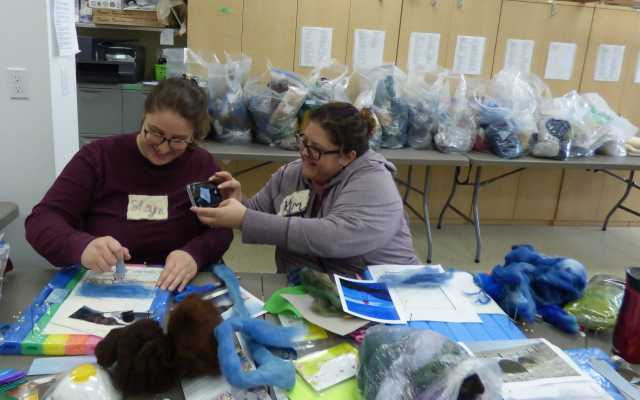
2-3) Nametags – note the bags of wool in the background of the second photo

Next, they were on to choosing a picture from the ones I had pulled or three had brought one of their own.  Two of my adventurous students had painted before and the other one had done a number of other types of felting so I felt they might be up to a bit more challenging subjects.

4

4) Using the phone to see details of the image and checking the pictures as they progress.

I had asked the students to bring a camera, an eye pad or a phone with a good camera function so they could check their work as they progressed. One had her Lama picture on her phone and could zoom in and look at details which was also an excellent use of technology. The phone works similarly to looking at your drawing in a mirror. It allows you to see proportions and negative space more clearly.

Transferring the chosen image to the felt

I discussed the lightbox or window method of tracing. This works well on thin light coloured felt or pre-felt but not as well on thicker or darker felts. If you are using a window, it works best on sunny days (sunny days can be scarce in winter). This transfer method was used in the workshops I have attended.

I also mentioned the grid method to scale a drawing while transferring it to your work surface. It is a lot slower but can produce an extremely good underdrawing. I suggested they check out their notes for other methods like the projector, Lucy and camera obscura.

I wanted to give them another option if they did not like to draw freehand or using a lightbox.  I explained the template method of transferring an image, which requires scaling your image by photocopier or by computer and printer to make your image the size you would like to work with. Make a border on your felt, the outside size of your picture. Then divide your picture into basic tonal areas again working from the background to the foreground. It can be handy to put your image in Microsoft word then adjust the image with “Artistic Effects” look at “cut out” to give tonal blocking. While you are in Microsoft, you can check under “colour saturation” to see what hidden colours are in your image.

This is the point that you move trees or tilt hills to suit your wants. You are God of your landscape! If you want to have a tree lose or gain a bit of weight, you can decree it!


5

5) Freehand drawing and the use of a paper mat

One student went with the freehand method. She referred to her phone to get the detail in her picture. I had a number of different colours of permanent markers.  We were using permanent markers since I have used quilting makers in a workshop I had taken that did not stay on the felt but appeared as a blue smear on my arm from finger to elbow as I worked on my piece. (The options of various colours of permanent markers are nice since they stay where you put them and they will be hidden under the fibre you are adding.)

I had them make a paper mat the size of their picture, 5×7. This lets them check to see if their picture was getting bigger or smaller as they worked. Checking your image with your paper mat will save you money by ensuring that your image will fit in your mat and frame when it is done.

6

6) Template method of transfer and using the phone to check the progress

Continued in part 2 scheduled  for March 15th 2020 (lots more pictures to come in part 2!!)

Rock Wall Picture Part 2

Rock Wall Picture Part 2

I had a whole day of no work and no grandchildren last week so I got my picture done. Although this is a good thing, I discovered all those little people’s interruptions are actually good. I rather overdid it with the needling and have aggravated my tendonitis again. I need a better needling pad. the one I have is quite dense. It’s good for travelling as it’s light and it does last well but it is too dense to be poking into all day. I know not to poke way into the foam but when you’re doing a picture you always seem to go into it a little.  I got several suggestions for alternatives. Jan had a nicer kneeling pad that I will look for not so dense but still lightweight. upholstery foam is popular and a new one to me was rice in a cloth bag. I may try this for home. I think it would be heavy to carry around. What do you use?

On to the picture.

When I put the rock shapes in I wasn’t very happy that the stuck up a lot from the wall so I wet felted it again. It looked much better, more subtle.

Before wet felting

After wet felting


After wet felting-close

Next for the wall was some moss and some shadows


Adding moss

Next was some shadow to the bottom of the rocks and to the gate.

Adding shadows -close

I added some sheep, I know you are all so surprised. I added the trees to the place markers and some vegetation to the foreground.


Sheep trees and vegetation

That looks ok but it is kind of bare on the top left and the vegetation is a little boring so I added some more trees, another sheep( you can’t have enough sheep) and some french knots for flowers on the vegetation.

Finished

Vegetation close

Vegetation close 2

I hope to get a better picture of the finished piece. The camera really doesn’t like the fuzzy white. the piece is 7 inches by 9 inches. It should have been 8 x 10 but when I refelted it I shrank more. it hadn’t originally been very felted because it’s a picture and didn’t need to be. Oh well, I will get a frame and Jan will help me cut a mat to the right size.

Resht Applique Sample

Resht Applique Sample

I am taking a two year course from the Gail Harker Creative Studies Center, Advanced Studies in Experimental Stitch.

Part of my homework for the second session is looking up different forms of applique and doing a few samples of different applique techniques. One of the suggestions on our list was Resht work. Having never heard of this one, I decided to see what it entailed. I found several wonderful examples and learned that it was a Persian technique that used mainly chain stitch to attach cut felt pieces to a background, sometimes felt and sometimes wool cloth. That sounded like a perfect reason to make some felt and give this technique a try.

I printed out one of the examples that I had found. This one was on 1860-1960 One Hundred Years of Fashion and Accessories. I picked out some short fiber merino batt in similar colors to create my background and the pieces that I would cut and applique.

Here’s the felt pieces I created. I didn’t worry much about the edges as I was going to cut them anyways. I did want fairly thin felt as it gets a bit thick to stitch when layered. I did great with this except for the yellow orange piece. It was a bit thick.

Next I worked out a simpler design in the size that I needed. The final piece will be 7″ x 7″.

I traced the main design on tissue paper and cut out that as patterns to cut the felt. Originally, I thought I would overlap the pieces. But once I had them cut, I decided that would be too thick. I didn’t make any pattern for the yellow orange leaves. I just cut those free hand.

Here are the pieces all cut out and pinned on to the background. Now I needed some threads for the chain stitching.

Here are some of the hand dyed thread choices. Now on to chain stitching. I will show you the results in my next post.