Browsed by
Category: Wool

Repairing my fingerless gloves

Repairing my fingerless gloves

After having a green Christmas, winter has arrived in Canada at last.  In the past week Ottawa has received a few dumps of snow.  There is definitely an Arctic chill in the air.  As a result I have been firing up the wood stove and layering up to try and keep warm.  One of my favourite winter indoor accessories are these Possum Merino fingerless gloves.  I have a couple pairs of these and sadly at some point some hungry moths have eaten some holes into this pair.

Pair of fingerless mitts with holes in them from moth damage
Fingerless mitt with moth hole
Moth hole in cuff of the mitt
Fingerless mitt with moth hole
Moth hole in the glove


Fingerless mitt with moth hole
Moth hole in the glove

A few years ago I repaired my husband’s fingerless gloves by darning them with embroidery thread. The repairs were functional but overall I was unhappy with the results. This time around I wanted to try a felted repair. Unfortunately I could not find my felting needles. I am sure they are safely stored somewhere in my house.

Felting needles

Luckily I was able to purchase a few needles from Jan.

Next I needed to find some wool. I picked out this lovely Gotland fleece from Dover Farm Canada.

Grey gotland locks from Dover Farm Canada.
Using my hand carders to card some grey gotland wool

I quickly carded up a few locks using my hand cards.

I now had a mass of loose wool to use for my felt repairs.

Small pile of carded wool

Patch 1 before fixing (hole visible)

With my tools gathered it was time to start work. I placed the glove onto a piece of foam (pool noodle). Then added some wool and started poking away with the felting needle.

And here is the first hole after repairing it with wool. The felting needle shows where the hole was. Now I have a nice solid glove again.

Patch 1 after fixing. No more hole. The felting needle shows where the patch is.
Patch 1 on the inside of the mitt.

Here I have turned the glove inside out and I’m showing you the back of the repair. You can see the grey fuzz of the new patch of wool.

After I completed the first hole, the new few were quite easy to do. I will include a few more before and after photos below.

Patch 2 being started. The hand shows the small amount of wool used for the repair.

Starting patch 2. In my hand is the small bit of wool I will use for the repair.

Patch #2 after fixing. No more hole. Yeah!

Patch 2 after fixing. No more hole. The felting needle shows where the patch is.
Patch 3 before starting.

Hole#3 before fixing.

Patch #3 repair in progress.

Patch 3 repair in progress. The needle shows where the work is being done.
Patch 3 after fixing. No more hole. The felting needle shows where the patch is.

Patch #3 after a bit of poking.

Patch #3 on the inside of the glove.

Patch 3 after fixing showing the inside of the mitt.
Patch3 after fixing. This shows the inside of the mitt and how fluffy the new wool patch is.

Patch #3 from the side. This shows how fuzzy the inside of the mitt after adding the felted repair.

It only took me a couple of minutes to repair my gloves. Gathering the supplies (felting needles, wool and foam) took more work than the actual repair.

Fingerless gloves after repair. No more holes!

My fingerless gloves after being repaired. I fixed three moth holes and one thin spot that I found when checking over the mitts.

After the repair the gloves look a bit shabby.

Fingerless gloves after repair. No more holes!

But they feel comfortable.

I am delighted that my fingerless gloves are fixed and hope they give me many more years of service. I also hope the hungry moths stay far away. But if they don’t, at least I know I can fix any damage they do.

Samples for my Valentines class.

Samples for my Valentines class.

I was asked to give a Valentine-themed workshop, specifically hearts. No surprise there. This is a short evening class. I am teaching in person in Ottawa at my guild on Feb 7, 2024. https://www.ovwsg.com/events/event/2407-felted-hearts/I had no pictures to put with the workshop so I had to create something. I decided on heart-shaped baskets with rope handles.

I started by finding a heart shape on the internet and sizing it up to about 6 inches across. I decided to do one this size and one bigger to end up at 6 inches.


they will fit nicely onto my rolling mat. I need to keep an eye out for a bigger one of these. This one is supposed to be for drying dishes. It might do for one person for their lunch dishes.

I decided on one in red and one in this year’s Pantone colour of the year coral pink. The colour doesn’t show well wet but you will see it when it’s dry

Next was adding embellishments. Coral pink is one of my least favourite colours so I added some sari silk in the colour Salsa. It is primarily red with bits of other colour in it.

The red looked pretty plain so I added a pale pink heart

Next of course was all the rubbing and rolling and cutting it out and rubbing and rolling and fulling. The red one is now 6 inches across and the pink one is 4 inches across.


I rolled a couple of snakes for handles. The idea was to poke holes in the hearts to poke the snake ends through and tie a knot. the pink one was okay, but the red one wasn’t long enough so I just felted the ends in. Jan thinks they should have a bell on the tip but I am not sure. I think I will offer them to the student but I don’t think I will add them.

And here they are on Jan’s new photography backdrop which I am sure she will be telling you all about in a later post.

Tada!

I like the picture of the pink one best. The angle is good. The red one is more from over the top of the heart. The chocolate hugs are some Jan gave me as a librarian present. Perfect for a Valentine’s photo shoot.


Bags of Inspiration

Bags of Inspiration

Having just read Kiki’s tutorial  https://feltingandfiberstudio.com/2023/11/19/left-overs-yessss/ on using up prefelt scraps, it occurs to me that I may not have mentioned something we used to do at our Guild (Dorset Guild of Weavers Spinners & Dyers) mainly to raise funds for the Guild but also for fun.

When I attended the Stitch and Creative Crafts Show at the Bath and West Showground in Shepton Mallet (Somerset, UK) back in 2010  – I saw a stand selling (for £8.00 each) bags containing 35gr of silk fibres, yarns, fabrics scraps, carrier rods and cocoons in various colours, left over from old projects which, when put together, made a fascinating collection for future projects.  So fascinating that I bought three of them.

They must have made quite a bit of profit on them because they appeared mainly to be the “waste” from artwork.

At that time (when I was part of the sub-committee organising the Guild’s Exhibition and Sale of Work) we were looking for a Guild Project which could be part of the exhibition or something hopefully to help raise some funds.  Well, I thought, our weavers must have lots of off-cuts of hand woven fabric, not to mention warp ends.  Then there were the spinners who would have odd bits of spun and unspun fibres of all types and colours.  We also had members who were dressmakers, beaders and embroiderers, and a soft furnisher, who were bound to have the odd bits and pieces that they didn’t really need.  So, with the blessing of the committee,  I put it to the members in the next newsletter that if they would donate to the Guild any odd bits of fibres, yarns, threads, warp ends, bits of fabric, beads, button, feathers, felt, cords, braids, tassels, sequins, sequin waste, ribbons, silk flowers and any other bits and pieces they could think of, we could make up some “Bags of Inspiration” and sell them to members of the public at our open days and outside demonstrations.  (I don’t know about in the rest of the world, but in the UK the word “bags” means “lots of” as well as “containers”, so the punning name “Bags of Inspiration” seemed apt.)

We used A4 sized polythene bags (which I was able to buy quite cheaply from our local green grocer) with an A4 sheet of card inside for stiffening, and I made up some stickers with the Guild’s logo on and a brief description of the contents, and posters also giving details of the contents.

Image of a poster detailing contents of a Bag of Inspiration
Bag of Inspiration Poster

We arranged a few bag making days at a pub in the village where our then President lived.  She had persuaded them to let us use their skittle alley at no charge, and we had a great deal of fun making up the bags and tucking in to “refreshments” from the bar and kitchen.

The members who came to these, brought with them all sorts of goodies which we spread out on tables, so that we could make collections of pieces which seemed to go with each other.  Those who didn’t think that their colour theory was good enough, could pick out a picture from a selection of magazines and have a go at matching colours from this  It was amazing how compulsive making the bags became.  You could pick up a piece of fabric that looked so dull and dreary and be amazed how it perked up and positively shone with life when paired with different fabrics, yarns, trimmings etc.  You just couldn’t stop picking up likely bits.  The difficulty was keeping the weight of each bag between 80gr and 100gr, so we quite often ended up making up at least 2 bags with similar contents.

image of tools and accessories for making up Bags
Equipment & Extra “Bits” for making up Bags

Prospective contents of a Bag of Inspiration - fabrics, yarns, fibres etc.
Prospective contents of at least one Bag of Inspiration

We put a price of £3.50 on each bag and they went like hot cakes – we sold out on their first appearance at our exhibition and sale of work.  Embroiderers and mixed media artists in particular liked them.

After a couple of years, we didn’t get so many volunteers to make up bags but we still had mountains of “stuff”.  So we added another string for our open days – Pick and Mix Your Own.  I had remembered that Woolworths (now there’s a blast from the past) used to have a counter full of different sweets and you could take a bowl and pick and mix what you wanted, and in the process buying a lot more than you would have if just buying a ready filled bag.

Boxes of different sweets to be picked and mixed
Pick and Mix Sweets.

It worked with our stuff too.  We gave the visitors the polythene bags and they could wade through all the bits and pieces picking what they needed, and we weighed them when they’d finished, charging £3.50 for 100gr.

We had had a lot of fibres donated so we started making up what are now called Art Batts and selling them as “Batts of Inspirations”, but because we were mainly selling these to Guild spinners and felt makers, they didn’t do quite so well as they were mainly able to make their own.

In all we made around £1000.00 for the Guild in the four years we were doing this.  Eventually though the members got fed up with spending time on making up the bags and the whole thing was shelved, as the Guild seemed to be relatively well off at the time.

Some time after that I took the idea back to myself and I was making up Batts to sell at Guild meetings, using luxury fibres as well as merino and synthetic fibres.  I made up some bands to fix around the Batts detailing the various fibres included in each.

This slideshow requires JavaScript.

I was also making up and selling Bags, mainly at a Needlework Festival in Dorset where most of the vendors were selling materials and equipment for crafters, as well as various craft fairs and so on.

This slideshow requires JavaScript.

I was getting the odd question like “they’re lovely but what do you do with them?” and  “can you make a bag out of what’s in here?”  So I made a sign from images of items that I’d made myself over the years and that helped.

Image of items made with contents of Bags of Inspiration
Some of the things I’ve made with the contents of BoI over the years

However, once Covid started causing problems, my selling opportunities dried up.  I had been intending to try selling Bags and Batts via my website, but it was very difficult and too time consuming to photograph the Bags so that the contents were visible, because of reflections on the polythene bags.  So that sort of died a death too and I’ve now shelved that project, and am using the bits and pieces I’ve collected over the years on theatrical costumes and props.

Perhaps some of our readers’ organisations, like Ann & Jan’s OVWSG, might use this idea to raise funds?

Shetland Wool Week (SWW) September 2023

Shetland Wool Week (SWW) September 2023

This is a guest post written by Bobbie Herrick, my friend and level 3 stitch classmate. You can see some of her beautiful work here in my post about our exhibition. Bobbie is from the Seattle, Washington area and recently went to the Shetland Islands for Wool Week. I hope you enjoy her post.

Shetland Islands landscape with sheep in foreground and a house by water in the distance.

My friend Dorothy and I had wanted to learn how to do Fair Isle knitting as well as visit the Shetland Islands. We thought SWW would be a fun way to do both.  We knew our adventure had begun when we met Val, from Cleveland, Ohio sitting beside me on a flight from London to Aberdeen, Scotland.  This was her first time to SWW as well.

Shetland Wool Week Participants waiting at the ferry station.

After a day in Aberdeen we checked in at the ferry terminal in the evening for our ferry to the Shetlands.  We found the waiting room full of knitters.  Many of them were wearing the 2023 SWW design for the Buggiflooer Beanie.  Buggiflooer is the Shetland word for a sea campion which grows around the Shetland coast. The travelers were from a great variety of places  including Missouri, Texas, Canada, Australia, Poland, Sweden  and Japan.  Excitement was only temporarily dampened by the rough overnight crossing of the North Sea!

Knitted credit card case by Bobbie Herrick.

We arrived in Lerwick in the early morning and walked to our “Introduction to Fair Isle” class taught by a delightful, skilled tutor, Janette Budge.  There we were given wool to make a small Fair Isle piece. There were experienced knitters as well as beginners.

Later in the week, I was able to visit open houses of several local guilds and some designer studios.   Old and contemporary work was on display.  There were spinners, weavers as well as knitters.

We had only selected a couple of events out of an extensive list of exhibitions, talks, tours and classes. Many events were at different locations on the islands. The SWW ‘Hub’ located in Lerwick was a great resource for finding directions, events, and provided a comfortable place to knit and relax. There we were able to find additional sites and studios to visit.  It also had a map showing where participants were from.

During our week on the islands, we found the local people resourceful, warm and welcoming.  They are proud of their rich Scandinavian and Scottish heritage.

Resident of Shetlands Islands in knitted sweater, scarf and hat standing at the shore.

Shetland artists often get their inspiration from the natural environment and incorporate traditional and contemporary motifs in their lovely work.  There is much more I would have like to see and explore, so hope to return!

Thanks Bobbie for telling us about your trip!

The Wool Revolution

The Wool Revolution

As avid wool enthusiasts (including a few shepherds) most of us are all too well aware that the cost of shearing a flock of sheep is rarely ever covered by the sale of the fleece. In fact the financial return on many fleeces is so poor, I know many farmers end up composting what should be a valuable and eco-friendly product.

Woven and felted wall hangings

Part of the problem is that many of these under-valued fleeces are typically at the coarser end of the spectrum, shorn from sheep bred for the meat industry. In some cases the situation is further compounded by farmers deliberately selecting sheep with coarser wools for their breeding program because their logic dictates, coarser wool = a heavier fleece per sheep and since wool is sold by weight, a heavier fleece = more $$$.

If, like me you make mostly wearables from wool, you probably see the fault in that logic, I know I value the lower micron wools far more, cheerfully paying a premium for them because they are less “scratchy”. However, this doesn’t mean there isn’t a place for the coarser wools too and as felt-makers and spinners perhaps we should not be so quick to dismiss them….

These coarser wools, also known as “strong wool”, have traditionally been used for various industrial applications that require padding that is fire resistant, for home insulation products, even the pads that piano hammers rest on.

In previous decades, one of the largest buyers of strong wools used to be the carpet industry, unfortunately the move towards synthetic carpets has seen the use of strong wools for carpets go into a steep decline. Currently there is a drive in New Zealand to support rural schools to replace their flooring with wool carpets, rather than the imported nylon carpet tiles the government wants them to use.

Large felted wall hanging

I fist met Liz Mitchell MNZM when she joined the Auckland Fun Felters (AFF), just a month or two after I did. Already a wool enthusiast, she was on a mission to discover new ways to use this fabulous, natural material and her enthusiastic interest quickly evolved into a dedicated promotion of strong wool.

Felt illuminated

Liz has had a very interesting textile career, as a fashion designer, with her own label, she was primarily focussed on hand-made couture and in 2005 was awarded the New Zealand Order of Merit for services to the fashion industry and to this day she is one of the best known names in New Zealand fashion.

A series of large wet-felted vessels

In recent years Liz has expanded her repertoire to include working with architects and interior designers to use strong wools, still in their natural colours, for a mixture of wall hangings, rugs and soft furnishings. Her diversification from haute couture to interior design is beautifully documented in her current exhibition, “This Raw Material” on show at the Corban Estate Arts Centre in West Auckland.

This exhibition is open until 9 December 2023 and is well worth a visit, I particularly enjoyed the interactive room where you are encouraged to touch, feel, sit on and even smell the pieces. When was the last time you went an art exhibition where they encouraged you to sniff the exhibits?!! 🙂

Biker jacket and hot pants – Agate wool Jacquard

We were all very proud to hear Liz has secured a grant to set up a “Wool and Natural Fibres Textile Hub” in Auckland, which will serve as a hub for wool research, education and creative exploration. An endeavour I am very keen to support. She has also set up a Wool Revolution PledgeMe to raise funds to support the new Hub.

Winter White Wedding Dress – NZ wool felt
Detail on Wedding Dress
September Adventures

September Adventures

September has been a busy and exciting month in contemporary textile art (specifically felting art) in Ireland so I thought I would feature what I got up to, I will call it my September Adventures.

Weather wise, the month started as we hoped it would continue (it didn’t by the way) with a return to fine warm weather – something we had not seen since last June.  So I took the opportunity to visit our National Botanical Gardens (https://www.botanicgardens.ie/) which are situated on Dublin’s north side.  The gardens (there’s free entry, if you ever visit Dublin, Ireland) opened in 1800 and are an oasis of calm with restored glass houses, magnificent specimens, bee hives and, of course, a tea room.  There’s also a pedestrian access to the historical cemetery next door which I suspect is not seen too often.    Glasnevin Cemetery also houses a genealogical archive for anyone wishing to trace their Irish ancestors (https://www.dctrust.ie/genealogy/home.html).

But, I digress.  Let’s go back to the gardens.  My visit coincided with their annual exhibition ‘Sculpture in Context’.  The exhibits feature artworks in various media including ceramics, wood, metal.  I decided to focus purely on the textile element of the exhibition and to photograph any pieces I came across as I wandered around.  I was aware that some of the members of Feltmakers Ireland had pieces accepted for the exhibition; Clare Merry (http://www.merryland.ie/index.htm) an exceptional artist who quietly creates her pieces was featured.  If you would like to see some of Clare’s work please check out her website, which, she tells me, is not really up to date, or Google her and feast over the images; Fiona Leech (https://www.instagram.com/feltathome/?hl=en) had three beautiful pots which were originally housed in the cactus house.   Annoyingly two of the three pots were stolen within a matter of hours of their arrival and the remaining one was moved to a safer spot in the garden’s gallery.  I thought I would show you the three pots as they were originally grouped together.

Fiona Leech’s three pots (source: Fiona’s Instagram page)

I searched but could not find Leiko Uchiyama’s beautiful work but here is a link to her website if you would like to check her out: https://www.leikofelt.com/my-felt-work/  I found two other exhibits from members of the guild.  Their featured work while not through the medium of felt were equally stunning.  Congratulations Mel Bradley (https://melbradleysilks.ie/)  and Mette Sophie Roche (https://metteroche.com/)

I put together a slideshow of my textile finds in the gardens which I hope you enjoy.

We had our first meeting after summer in Feltmakers Ireland and as usual the committee put an incredible amount of preparatory work into making it successful.  It was a busy morning as everyone beavered away felting flowers to create a tapestry as part of the 20th anniversary celebration for the guild.  Much to everyone’s delight, the guild’s founder Elizabeth Bonnar joined us. I thought I would feature Elizabeth here as without her it is doubtful that there would be such a vibrant community of feltmakers today.   Here she is with her granddaughter and with the committee.

Feltmakers Ireland founder Elizabeth Bonnar and her granddaughter
Feltmakers Ireland committee with founder Elizabeth Bonnar (3rd from left)

Here are some photos taken on the day.

The finished tapestry was revealed at Feltmakers Ireland ‘Bountiful’ juried exhibition which opened on 30th September.

Feltmakers Ireland members: The Floral Tapestry to celebrate 20 years.

The exhibition also saw the launch of the new book “Exploring Irish Wool for Feltmaking”  The book is the product of a collaboration between many members of Feltmakers Ireland guild, sheep farmers, shepherds, shearers and suppliers and not forgetting the various washers and carders who took the raw fleeces, converting them into usable fibres for testing.  I think this approach was quite unique and it will certainly be a worthwhile and useable addition to any textile maker’s reference library.  Understandably it was a huge project so congratulations are due to all, especially Annika (Berglund), Breda (Fay) and Sinead (Doyle) who collated all of the findings into an invaluable resource on Irish wool.  It’s so full of well written practical advice and it was made extra special by the presence of one of our Government Ministers, Pippa Hackett an ardent supporter of the project, who officially launched the book and the exhibition . Here is a quick look at the contents page to give you an idea of the scope of the book:

Exploring Irish Wool Contents page

An added bonus is that feltmakers/wool artists can now make direct contact with numerous artisanal suppliers so there is no excuse for any of us not buying closer to source and of course for anyone overseas who wishes to use Irish wool fibre in their work purchasing from source.

It is available to purchase from the following link and I understand will also be available in eBook format shortly:  https://feltmakersireland.com/exploring-irish-wool-for-feltmaking/

I hope you have enjoyed my September adventures.   It has been an exciting month.  Once again I would like to thank Feltmakers Ireland and their hard working committee who work tirelessly to maintain this vibrant community – it makes such a difference that, as textile artists, we can gather together and create regularly. I take my hat off to Elizabeth Bonnar and her decision to found Feltmakers Ireland twenty years ago; the catalyst for lifelong friendships, masterclasses, collaborations, exhibitions, networks and travel.

To complete September’s birthday celebrations, I thought I would produce a slideshow of the Bountiful exhibition which is running for the month of October in Phoenix Park, Dublin Ireland.  I took photos on the day so I apologise where the light may be shining on the artwork.  There are over 30 pieces of art and it will give you an indication of where Ireland’s vibrant felting community is at in its journey.  I hope you enjoy it!

I’ve been spinning a little in the past month

I’ve been spinning a little in the past month

You know how when you get excited about one hobby, the other ones get left behind? Well, for some reason I’ve been bitten by the spinning bug in the last month, and I’ve a few skeins to show for.

Let’s start with the green-blues.

Four skeins of hand spun yarns by Eleanor Shadow

The big green skein was spun using some Leicester Longwool locks I dyed for this purpose, since I wanted to make a super Halloween-y textured art yarn; I plied it with some commercial yarn (also dyed by me) that I had to over twist in my wheel so it would un-twist as I paired it with the textured ply.

The smallest skein is baby llama, my very first time spinning such a fibre. I’m a fan! I’d love to spin more of this in the future. It’s very soft and warm.

To the right there’s a fun Blue Faced Leicester (BFL) and bio-nylon yarn that I tested for my own shop (got to know what I’m selling, right?) and I can say I love this fibre combination. The BFL is very soft and lofty, and the bio-nylon increases the strength of the wool without harming the environment since it’s as fully compostable as the natural animal fibre. I’d have no problems knitting some socks using this yarn.

At the bottom, a rather fun jewel tones Shetland and Tussah silk combo (70/30) that just glided off my hands effortlessly.

But wait, there’s more!

I was perusing World of Wool’s website a while back and came across their taster package in shades of pink, and was tempted. Each resulting mini skein is 25g and very squishy.

Six hand spun mini skeins in different shades of pink and in different fibre combinations

From left to right: merino and nylon sparkle; merino and silk; merino; wool and viscose; merino, alpaca and mohair; merino and bamboo.

My favourite to spin was the (mysterious) wool and viscose. Those tweedy bits kept me very engaged and wanting to keep treadling! The merino/alpaca/mohair blend to its right was also rather lovely. Although these all came from the same pack, I don’t feel the shades complement each other too well, so I might not try to add them to the same project in the future.

You’d think I’d be done by now, but… there’s more.

Three hand spun yarns by Eleanor Shadow

If my goth self in my 20s would’ve guessed I’d be spinning this much pink, I’d be appalled! But yes, those colours were all my choice. The pink of the left was a particularly bouncy merino and soy fibre combo, the middle one is a merino/alpaca/camel/silk blend (40/20/20/20) and the right skein is anyone’s guess (it’s a mix and match of several different wool nests a friend gave me to spin that I decided to merge together. I wish I had a jumper quantity of this!)

Lastly…

A merino hand spun skein in jewel tones by Eleanor Shadow

I dug into my own shop’s stash for this one. The colours were super well defined in the fibre braid, but I decided to spin them in a way that would blend everything and I don’t regret it one bit. This would knit up rather nicely, I’d say. If my knitting mojo comes back anytime soon I might give it a try…

There’s actually one more skein, but it’s a white one and it didn’t photograph well…

So, do you think my wheel was busy, or do any of you spin more in any given month? Let me know below.

The Bull

The Bull

We have three public houses in Sturminster Newton (at one time there were 11 in our small market town!) and The Bull Tavern is one of the oldest. The building consists mainly of a 3 roomed 17th Century cottage with an attic room, built of old timber infilled with wattle and daub. Some additions were made in the 18th Century. Records show that the cottage was definitely an alehouse by the late 1700s. Apparently there was a slaughter house at the rear and a Pound where straying animals were kept until collected – upon payment of a fee of 1 shilling (which must have been a fortune when you consider that a married man’s weekly wages at the Town’s Workhouse were all of 9 shillings and a single man’s only 6). Part of the C18th additions was a stable block (which eventually became a skittle alley and later part of the restaurant of the pub). It is rumoured that the horses stabled there were used to help get carriages and carts up the adjoining steep hill leading to Sturminster Common and the small community of Broad Oak.

The building, known to Thomas Hardy (one of our famous inhabitants) as The Old Bull Inn,  is shown on the earliest known map of the area dated 1783, as being part of the Pitt-Rivers Estate.  You can learn more about the Pitt-Rivers family here: https://www.dorsetlife.co.uk/2012/04/sturminster-newton-and-the-pitt-rivers-family

About 18 months ago, after our then favourite landlords moved from the White Horse Inn in Hinton St Mary, the pub was closed for refurbishment. Hinton is a village about 1.25 miles away, where the Pitt-Rivers manor house is situated.  We used to walk there 3 times a week – our exercise with benefits – but since the benefits had disappeared we decided to patronise The Bull – for our exercise of course.  The only trouble with that was that it’s uphill on the way home whereas it was down hill from the White Horse.

During that time we had come to enjoy the chats with Marianne and Lance, the Bull’s managers.  Lance being the very good chef, and Marianne “Front of House”.  Early in January 2021, they announced that on Christmas Day they had got engaged.

One of my felt paintings – commissioned by a mutual friend –  had been given to the White Horse landlords as a wedding present a few years ago, and Graham, my husband, suggested that I do something similar as a wedding present for Lance and Marianne.

Felt picture of sepia tint image of old public house
My interpretation of an early image of The White Horse, Hinton St Mary

Although The Bull itself is a very interesting building, I wondered if I should do a picture of an actual bull for them. No date had been set for the wedding at that time, but I thought I should at least start collecting reference pictures, both of the pub itself, including some of their Pub sign and of some animals. I thought about breeds that might have been around in the 16th Century – White Park Cattle and black Gloucesters; and also looked at Herefords since that was the breed on the Pub sign.

image of Bull Tavern sign with hereford bull above image of the public house
The Bull Tavern and it’s sign

image of black bull with winners rosettes and image of large white bull
Gloucester and Park White Bulls

image of hereford bull head, image of bull grazing, image of bull in field
3 Hereford Bulls. I eventually picked the one at top left.

In the end I decided on a Hereford bull. After a lot of thought and manipulation of pictures, and also starting on a background field for the bull to stand in, I still could not come up with a layout that I was happy with. One idea was to surround the image of the bull with cameo pictures of nearby local landmarks – the water mill and the mediaeval bridge – with perhaps an image of the pub itself as well.

Then, just after Christmas 2022, Marianne said that they had set the date for the wedding – 10th June 2023.  Now I had to get my ideas together and get on with it.  The picture would need to be simplified if I was going to get it done and framed in time.

It was about then that my picture of the horse on the hillside in Devon was finished and it occurred to me that I could use a similar method of producing a figure with more depth.

image of felted horse on background of trees and stream
Detail from my Glorious Devon picture showing the horse added to the finished landscape.

  I finally decided upon a cameo type picture of the bull’s head and shoulders and I would use the background which I had made back at the beginning of this saga.  I would paint (with wool) the shoulders and neck and outline of the head on to a piece of flat wet felted core fibres.  With a separate face and ears, and a further separate set of horns and the nose on another piece.  I would cut all of the pieces from the backing when these were substantially finished.  I would fix the torso and neck onto the original background and layer on the face and ears, horns and nose, then I would do the final titivating and framing.  I made a start and here are the initial progress pictures:

This slideshow requires JavaScript.

As I said earlier, it was intended that this picture would be a wedding present for Lance and Marianne, but at the beginning of April this year, they told us that, because of various unforeseen difficulties arising out of successive pandemic lockdowns (which included them catching Covid between lockdowns so having to shut the pub again)  they had decided to give up the tenancy of the pub.  They had obtained a job, with accommodation, managing a Touring Caravan Park in Cornwall.  Marianne was leaving almost immediately and Lance would stay on for a couple of weeks, with his last trading day on the 19th April.  So the picture was going to have to be a leaving present.

That caused a bit of a panic at home as you can imagine, so I had to get my head down and finish it NOW!  These were the final steps;

This slideshow requires JavaScript.

I managed to finish the picture and, with Graham’s help, I mounted it in a deep box frame in time to hand it over to Lance on the 19th, when we went in for a final lunchtime meal.

So here’s the completed and framed picture – my entry for the 2023 Third Quarter Challenge – Something Special About Our Town.

image of felted bull head and torso on a field and sky landscape in wooden box frame
Finished and framed.

more shopping for the Mer’s, again looking for Hair

more shopping for the Mer’s, again looking for Hair

As is the way with my life, I have had another change of plans.

My goal was to find hair for two more of the Mer family. My plan was to look for long locks at the fibre festival “For the love of Fibre”, in Spencerville and if that didn’t work out I would look at the Peterborough Weavers Guild fibre fest on the following weekend. We had also discovered that because of the Coronation Upper Canada Village would have free admission the same Saturday as the event in Spencerville (much closer to UCV than Ottawa.)

So part one of my plan was on May 6th to head to Spencerville. Then if I felt up to it, on to the Historical 1860s village at Upper Canada Village. I had a couple of friends who were working there last summer and have wanted to see it for quite a while. Let me show you how the first part of the plan went.

Last year “For the Love of Fibre” was the first post pandemic fiber festival that I got to attend. It was held in Johnstown, just a bit further south than this year. I am pretty sure I showed you that exciting.

May 6th arrived looking like it might be a sunny day with big puffy clouds to add to the photographic opportunities. We got up extra early to gather the couple of things we would need to bring. I had planned to bring Mrs Mer as well as her son Shark Boy to look for long locks for their hair. I discovered she was…. ummmm, busy canoodling (aggressive cuddling, enthusiastic hugging?) with her husband, so I just turned their project bag around and went to find her son. I picked up my camera and Shark Boy’s1q project bag and headed to the car.

It was a nice drive down. The trees are in the budding to early leaf stage and I was suspecting we might see the first trillium as we headed south. We got there early, arriving just before Ann. She took a picture of us getting Shark Boy settled and us ready for shopping (Glenn brought a book). You can see how excited Sharkboy looks! It must be the thought of getting his hair. I think he has decided on a Mohawk with long hair down his back, sort of an extra-long mullet. I think the Mohawk is to complement his front Dorsal fin.

1) Sharkboy standing in his project beg attached to Jan’s black walker with her husband (and the back of my Grey Kea Soul, I am sure you were expecting I possessed a black soul!).1) Sharkboy standing in his project beg attached to Jan’s black walker with her husband (and the back of my Grey Kea Soul, I am sure you were expecting I possessed a black soul!).

There were 3 outside vendors, with the rest inside.

2) Stone Spindle Farm Booth; with alpaca yarn, fiber and hats. The vender is hanging up suit cages full of low-grade alpaca to provide the birds as nesting material.2) Stone Spindle Farm Booth; with alpaca yarn, fibre and hats. The vendor is hanging up suit cages full of low-grade alpaca to provide the birds as nesting material.

 I was admiring some indigo-dyed alpaca but wanted to wait until I found out if there were any locks inside. (OH the not-buying remorse I felt later!!! I do know who bought it and that it will be well enjoyed.)

3) baskets strewn artistically under a pule trees with an E-Bike near the front with panions baskets.3) baskets are strewn artistically under a few trees with an E-Bike near the front with pannier baskets.

Did you notice the cool bike baskets, some have lids.

Inside we found a few of our guild members had booths! I did a fast wheel around the venue looking for long locks but to no avail. Sorry, Sharkboy! We will have to try plan 2, next weekend. Even with not having the long locks I was looking for there was a good selection of vendors having Yarn, fibre, baskets, bags, and fibre tools. I didn’t get every booth but here are some of the highlights.

4) A quick over view of part of the venders.4) A quick overview of part of the vendors.

5) digging for colours in balls of hand died Super wash Marino fiber.5) digging for colours in balls of hand died Superwash Marino fibre.

6) More fiber from the Black Lamb booth.6) More fibre from the Black Lamb booth.

7) Beautiful project bags and peruses7) Beautiful project bags and purses

8) Moose hill woodworks had lots of fiber tools, all beautifully made. (Yes, I got another spindle of a type I didn’t have.)8) Moose Hill Woodworks had lots of fibre tools, all beautifully made. (Yes, I got another spindle of a type I didn’t have.)

9) Odd new spindle, I was trying it with some of the new extremely soft Finn wool I also purchased. The back of the tag says Yellow Birch, 1.3oz/39g9) Odd new spindle, I was trying it with some of the new extremely soft Finn wool I also purchased. The back of the tag says Yellow Birch, 1.3oz/39g

10) Beaux Arbres booth had basketry10) Beaux Arbres booth had basketry

11) This booth had fiber samples you could feel (the bags of them are behind the table.)11) This booth had fibre samples you could feel (the bags of them are behind the table.)

12) This is the side table of the same booth with the fiber. Check out her fine ponies!12) This is the side table of the same booth with the fibre. Check out her fine ponies!

 13) Fin roving it is actually semi-worsted the vender has her own mill!!! I have never felt such a soft finn sheep.13) Fin roving is actually semi-worsted the vendor has her own mill!!! I have never felt such a soft Finn sheep.

Ann investigated further and found out it was from a lamb. I only bot 2oz I should have bout more! Ann also got some to make her trees with.

14) This was an ingenious support spindle case.14) This was an ingenious support spindle case.

15) The booth the support spindle bag came from had more spindles and lots of rolages. 15) The booth the support spindle bag came from had more spindles and lots of rolags.

16) A couple booths had yarn for weaving and knitting.16) A couple of booths had yarn for weaving and knitting.

17) This Was Susan Allen’s Booth with weaving yarns, I think this was a Cotton or a Cottolin that Ann was looking at.17) This Was Susan Allen’s Booth with weaving yarns, I think this was a Cotton or a Cottolin that Ann was looking at.

18-19) Janet's Basketry, hand made basket with handwoven fabric presented in rolls18-19) Janet's Basketry, handwoven baskets one with antler in it.18-19) Janet’s Basketry

20) Janet’s booth, she is just finishing setup as the first customers arrive20) Janet’s booth, she is just finishing setup as the first customers arrive

 I wandered into Janet Whittam’s booth, she has a combination of weaving and basketry, and she also has beautiful woven jackets and wraps.
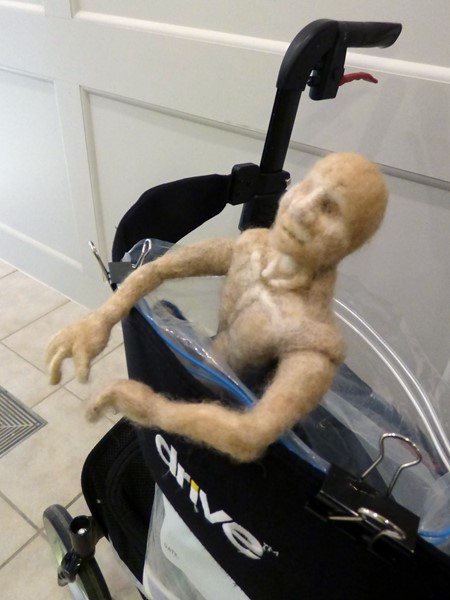
21) sharkboy standing in his project bag, attached to my walker.21) Shark Boy standing in his project bag, attached to my walker.

Even though he didn’t have any luck finding hair I think Shark Boy enjoyed his outing. It was still a worthwhile shopping trip with new fibre and spindle.

I was still feeling pretty good so we decided to head on to UCV, maybe it would cheer up Shark Boy! There is a mill, the blacksmith shop, the weaving house (with spinning) and the dressmaker’s house. We packed up the car and headed a bit further south and east arriving at a very busy Upper Canada village parking lot. We found a good parking spot in the mostly empty handicapped section (I was very glad for that parking permit by the time we made it back to the car!)

22) Sharkboy checks out the special parking for Mer-people (and those with walkers) as we arrive at UCV.22) Shark Boy checks out the special parking for Mer-people (and those with walkers) as we arrive at UCV.

Unfortunately, that change of plans thing I mentioned at the beginning happened Tuesday morning and is preventing me from telling you about the rest of my visit. As soon as I can I will tell you all about the fun we had visiting the village, and a bit of its background.

23) The entrance buildings of Upper Canada village.23) The entrance buildings of Upper Canada village.

Weaving with my stash

Weaving with my stash

So, what are you going to do with all this – stuff?  Its a valid question posed by my grandson.  He’s helping me clear out the house and storage spaces and there really is a lot of ‘stuff’ to deal with.  Time to get weaving.

I chose a warp that had a khaki base made up of lots of different fall colours so it could handle loads of different colours in the rest of the warp.  Colours don’t have to ‘match’ when weaving. The don’t have to match ever come to think of it.  This is the colour palette I chose.

hand spun skeing of khaki green beside mixed fall colour threads

This warp was longer than usual because I wanted to attach any subsequent hand spun warps to the wastage.  Wastage can be very expensive and finding a way to minimize this loss is good economics.  My plan is to have a yard/meter of extra fiber at the end of the weaving that I can tie the new warp onto.  This will save me wastage of a meter/yard per warp.  The only wastage will be a few inches at the beginning and end of each new warp until that extra yard is all used up.

The colours look great and the yardage I was able to get from my hand spun was really surprising, kind of shocking actually.  Really looking forward to getting started on the threading and weaving.

multi-coloured warp on leash sticks to keep cross in place

When making a warp a cross is introduced on purpose to keep the threads separate.  This cross is maintained throughout the threading process; it protects the warp from turning into a tangled mess.  The oldest and simplest way to do this is by inserting sticks on either side of the cross, tying them securely in place and getting on to the next step of threading the loom. This time I chose to thread from front to back of the loom.  Starting by threading through the reed – the metal comb installed in the beater – and then threading the threads through the four different harnesses.  Each thread has a specific spot on the loom where it fits.  Its a bit like programming a computer by hand, really by hand.

The threads were sett at 10 ends per inch which might be a bit snug, but it looks good and once the scarf is finish it should be soft and snuggly.

repair a broken warp thread with inserting and weaving thread

When a thread broke I was not surprised, it’s almost inevitable, especially with the irregularities of hand spun, so I did a repair by pinning a thread in place, threading it through the reed and it’s spot on the harness.  Then it was weighted in the back of the loom with a small weight.  I use clip on table cloth weights for picnic table cloths. Once the damaged thread is woven in a sufficient length the true thread can be brought forward, pinned in place, woven for a little distance, then the weight removed from the patching thread.  This patching thread can be cut.

If you look at the purple stripe, everything looks fine.  The scarf is done, the length is just what I wanted and then I spotted it.  A whopper of a mistake that will set me back a little on my plans to reuse this warp, save time, blah, blah.

I have been weaving a very simple tabby, over-under, super basic.  It’s deceptive because its very difficult to get an even look to such a basic weave.  The threads had to be pulled into position, not beaten.  This way they would make nice little squares when the scarf was washed and fulled (hopefully).

Then I spotted the threading error, nearly at the end of all this fussing around drats.

Not threading error

Threading error

Not the end of the world, just a bit disappointing.  I’ll have to rethread about half the loom, and be more careful this time! Oh, and fix that single green thread that has errors all the way down the middle of the scarf.