This is a wet felted rug with archaic motif from Turkmenistan. It was a long process, about 1 weeks work. First I started on bubble wrap with design (wet pencil roving), then I filled with coloured wool and then on the top I put it 3 layers of wool. With rolling technique I finished the rug.
I showed you a historical felt pattern sample recently where I used a water soluble stabilizer to create the pattern. Obviously, in ancient times, this product would not have been available. So I needed to try a more traditional method.
I decided to try a different design based on wings. The pattern was printed twice and put one over top of the other in a mirrored pattern. The paper design was covered with plastic so I could lay wet wool down on top of the pattern. This is the method that Ildi uses, thanks again Ildi!
Next, wool yarn was wet down and applied over the pattern. Pre yarn would work better, but this is what I have in my stash.
The colors chosen were two shades of blue, one leaning towards blue green and the other leaning towards the violet side of blue. The fiber was wet down and laid in place. Layout definitely takes time with this method.
Then another layer of the dark blue was laid out on top of the wet wool pattern. I didn’t need to add any water to this wool as there was plenty already available. Next on to felting. The piece was kept in between plastic for the entire felting process but then with fulling, the piece was rolled against itself. Big mistake as this caused the yarn to fragment and pull free in some areas. Sigh.
Here’s the piece after felting and the black was not a clean line. Again, this is partly from using a twisted yarn instead of a pre yarn but also due to the fulling method.
I shaved the black but it is still not as clear as I would like. The design also had very sharp points where I cut the yarn and the ends didn’t felt in as well.
This is the sharpness that I would prefer. These two pieces were made quite a while ago. I made all the felt, then cut out the shapes and appliqued (hand stitched) them down. I then couched a green yarn around the shapes. This is a traditional ram’s horn design that is seen frequently in the Central Asian areas.
Lots of people asked to see my recent landscapes once they had been framed. I get my work professionally framed with a narrow, black wooden frame. If you’re in Whitefish, MT and need some framing done, I highly recommend my framer, FoR Fine Art. They also have a wonderful art gallery in Whitefish and Bigfork, MT and Tucson, AZ.
Here are the two biggest pieces after framing. They are approximately 20″ x 30-32″.
Here’s a couple more that I completed over the winter.
And the last one with it’s new frame. I have been working on getting new gallery representation and contacted a couple of places. I heard back from Northwest Handmade in Sandpoint, ID. I took 16 pieces over to them and will be taking them some snow dyed silk scarves when we go back by there in July. Yay, happy dance.
I decided to make a few more 5″ x 7″ pieces to take with me but didn’t get a chance to show them here. These are included in the 16 pieces that went to Sandpoint. If you happen to be in the area, please stop by and visit Northwest Handmade!
The five framed pieces shown at the top of the post weren’t ready when I went to Sandpoint. I picked them up from the framers and the next day, I heard back from 4 Ravens Gallery in Missoula, MT. They were interested in carrying my work too! Wow! Those five landscapes will be on display towards the end of June. Again, if you happen to be in Missoula, MT, please stop by and visit 4 Ravens Gallery.
It is great to have two galleries carrying my artwork but now I have to get busy and make some new pieces to replace any that sell. (I’m being hopeful and thinking positively.)
As I told you in my last post about our trip to New York City, I visited the Met Museum’s Watson library. I am doing research on ancient felt making patterns in and around Central Asia.
This is one of the books that I found in the library and it had loads of illustrations with different patterns. But, the book was written in Russian. I went ahead and scanned the illustrations and hoped that I would be able to get it translated when I got home. It took me a few days to realize that I knew someone who speaks Russian, Galina! She is a member of The Felting and Fiber Studio Forum and will be teaching another Fantasy Fish online class soon. Galina kindly translated for me and also told me a little bit about the book. The book is about the Nogais, a Turkic ethnic group, who now live in the North Caucasus region. This is “next door” to Central Asia and since these were nomadic people, I think I will include their patterns in my research. The book was written by Fatima Kanokova and her doctoral thesis had a theme of “Decorative Art of the Nogais.” Thanks so much Galina for your help!
I took one of the floral patterns from the book and enlarged it. I then painted it on paper in the colors I was going to use. The colors were limited to what size and color of prefelt I had available. I used a very lightweight commercial prefelt and decided I was going to need at least two layers and then a backing piece of prefelt. I did try and do a little dry felting of the two pieces of prefelt so they would stick together during cutting. This wasn’t very successful. I would highly recommend using a thicker piece of prefelt to begin with and the cutting process would have worked better. Next, I needed to decide how I would transfer the design.
I was thinking of using the freezer paper method like Lyn used with her pigeon/rubber ducky piece but then suddenly remembered that I had some Sulky Sticky Fabri-Solvy that I had bought for free motion machine embroidery. I did not like using it with the sewing machine or hand sewing because it gummed the needle up so much. But I hoped it would work with the prefelt.
The Sulky Sticky Fabri-Solvy has a paper backing on a sticky, water soluble fabric type stabilizer. So I traced the design and cut it out with a craft knife. I cut very carefully, so that I could use both portions of the design for the negative and positive shapes.
Here it is after cutting and you can see the negative and positive shapes that resulted.
Next was to peel the paper backing off and position the pieces on the various colors of prefelt.
Here is the prefelt with the cut shapes of Sticky Fabri-Solvy stuck in place. Now on to cutting them out. I tried cutting them with the craft knife but the two layers of prefelt kept shifting around. So I used a small, sharp scissors to cut out the shapes. Again, I was very careful so that I could use both the positive and negative shapes in the two different colors.
Here are the shapes after cutting. If you look closely, you can see the cutting wasn’t perfect. Again, this would have been easier with one piece of thicker prefelt.
Now to put the pieces together in an inlaid fashion. I used a piece of white prefelt behind the red background. If I had been thinking about it, I should have used a piece of red prefelt. Then you wouldn’t be able to see any movement of the cut shapes if it occurred during felting. But I didn’t have any white prefelt for the brown background piece. I decided to cut the edges of the brown piece and add a red background.
Here’s the brown piece after cutting and adding the red background. I didn’t inlay the brown into the red background, I just laid it on top.
On to felting everything. I covered both sides with a nylon curtain and wet the pieces down. Hopefully, you can see that the Sticky Fabri-Solvy mainly stuck on to the nylon curtain and then peeled off. I washed the remainder of the stickiness out of the nylon curtain and preceded with felting as I normally do. The little bits that were still stuck on the red prefelt dissolved. I’m sure the whole thing would have dissolved without pulling it off with the nylon curtain. But sometimes this type of water soluble fabric leaves a stiff residue and I didn’t want that to happen. So I was happy with it all peeling off easily. I had tried to peel if off before I wet it down but it would have damaged the prefelt. Also, I found that with the stabilizer in place, the pieces fit together easily and held their shape better than the other pieces that didn’t have any stabilizer. It didn’t really matter with the end result anyways.
And here you can see the two pieces after felting. The one on the right had a bit of ruffling edges since the prefelt in the center was thicker than the outer edge. But that didn’t matter because I was planning on trimming the pieces after felting.
Here are the two pieces after trimming. This method worked great and now I have a useful purpose for the roll of Sulky Sticky Fabri-Solvy that I have.
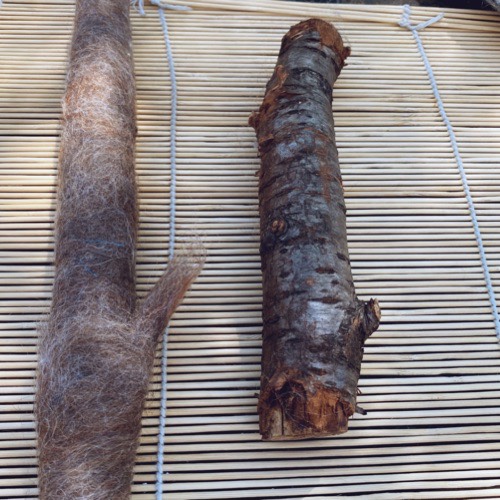
I actually had a plan for what I would write about in May. I planned to circle back, to my crocheted hexagons; discus finishing options and show some new color fun I have had. Then Porter, our 6 month old [Bernese Mountain] puppy delivered his latest woodworking project to the patio door. It was a perfect specimen for the second quarter challenge; “look at what is right around us, and make something.” I shot a couple pictures, of Porter and his woodworking pieces.
Porter and the Original Piece
Cherry Wood Specimen
I was planning to use the “tree knot” in the first photo, but my wool selection wasn’t right. We gathered all his dropped pieces on the patio table and found the perfect replacement: a piece of cherry wood from a previously removed tree. The colors were perfect with the wools I had to work with. I got my drum carder set up, and went to work, blending shades. The batt colors came out better than I expected.
Drum Carder and Wool Batts
I hoped to wet felt a piece that resembled our patio table. First I laid out the gray batt [top left] for the backing. In the opposite direction, I laid the batt blended in the colors of the table. [bottom right] I added wisps of additional colors in areas. Last, and to my regret, I added a brown Alpaca/ CVM yarn for grout lines. I wet it all down with soapy water, covered with fine mesh, and rubbed gently. After a few minutes, I removed the mesh, and replaced it with a second piece of bubble wrap. I flipped the piece over and rubbed on the back a little. The toothy wool was already attached fairly well. I placed this bubble bundle on a bamboo mat, and began rolling 25 times in each direction. When I checked the piece…ugh! I failed to think about what shrinkage would do to those grout lines.
Wonky Lines
Straight lines when felted go wonky! I should’ve thought to needle felt them in later. I look at all these situations as learning opportunities; and I won’t forget this lesson anytime soon. Overall, I am very pleased with my background attempt. All is not lost, I will store the piece away, and cut it up for other projects. My felted cherry wood piece, on the other hand, was a happy surprise! I have done some needle felting, but none of my 3D pieces, turned out the way I hoped.
I started the wood piece, by making a very tightly rolled snake, and stabbed at it only enough to keep it together. I rolled it together between my palms, and once it meshed together, it was longer than needed. I decided cutting the wool snake in half, and placing both halves together, would get me closer to the girth required. I used my 38 star needle to felt the pieces together, then rolled that up tightly, in another piece of the batt.
Needing to create a small protruding piece, I rolled some scraps together, folding in half as before. I stabbed the little piece to the lower part of the twig. Then to hold everything together and create the inner coloring, I rolled the whole piece in a brown/tan batt, splitting the fiber when I came to the knot. This is what it looked like:
Wool wrapped twig piece prior to Felting. Shown with the real piece of wood.
At this point I turned exclusively to my felting needle: felting around, and around, up and down the entire wool twig. Every once and a while, I made a series of stabs, on either end to begin shaping. Once the piece was good and firm, I applied a nice layer of the rusty/blue gray batt I blended with my carder. (photo 1, below) I needle felted the fiber in place, concentrating my attentions on the blue gray, and rust areas. (photo 2) I was really happy with my (accidental) blending capabilities. Lol:-)
1. Blended Batt 2. Initial Felting 3. Knot Area 4. Final Result
I used some brown alpaca yarn, to enhance the area under the knot. I continued to work on either end of the twig, using some lighter bits of wool. I stabbed some deep lines, coming up from the bottom, and tried to add a bit of realness to my specimen. (photo 4) Overall, I am really pleased with my felting experience, this time. I don’t know what I will do with my felted twig, but in the meantime it will hang out with knitted gnomes and the “As You Wish” sprite creature I created before the pandemic.
I was asked by my local community arts centre to run a felting workshop to contribute ‘something’ to a community art installation to celebrate Queen Elizabeth II’s forthcoming platinum jubilee. The wonderful Horsebridge Community Arts Centre in Whitstable is creating a ‘tea party with a twist’: everything will be hand-made and not necessarily from the usual materials. Think papier mâché teacups and crocheted sandwiches. The Horsebridge received a grant from Arts Council England to create their installation which meant participation was free but I would get paid to run the workshop – a win-win!
I mulled over what the ‘something’ might be and decided to run a workshop making wet felted flowers as table centre pieces.
I decided early on to take my colour inspiration from the Commonwealth flag – royal blue and golden yellow. This would reduce the choices people would have to make (which often take a long time!) and would be a change from the red, white and blue of our national flag.
I’ve not made flowers before so set about designing something that was as simple as possible to make. The creators were unlikely to have any felting experience and we were going to do this in 2½ hours – both demonstrate and make.
By now my friend Sue (a ceramicist) had agreed to run another workshop making slab pot vases for the flowers to sit in, so they needed to stand in a vase. I took some wool away on a trip with me and started trying out designs.
Prototype One: a loopy sort of flower made by laying out 5 separate petal shapes of wool (herring-bone style layout) then felting them together with a little wool in the middle.
I thought it was OK but getting the petals even was a little challenging and we’d have to use wire for the stems. I wasn’t sure they’d sit very well in vases and I generally thought I could do better, so moved on to my second design.
Prototype Two: I liked this a little better. It was laid out in a flat circle and the petals were cut part-way though fulling. It seemed pleasingly tulip-shaped. I wasn’t content to settle quite yet, though, as I had a few other ideas to try out.
Prototype Three: a more complex design laying out one larger circle of wool then covering it with a circular resist with a hole in the middle and laying out a smaller circle of wool on top of the resist, ensuring the two layers joined together through the hole. Not surprisingly, I realised that this was going to be way too complicated to create in the time available. The fulling took a long time. I did like the blue edging on the petals though so carried this through to the next sample.
Prototype Four: I wanted to try adding a felt rope stem so it would sit nicely in a vase without using wire so needed a fairly simple flower shape if there was going to be time to add the stem to the design. I made a felt rope in blue, keeping one end dry and fluffy to attach to the flower head. The head was laid out in a single yellow layer, radiating out from the centre, in a similar way to prototype 2. I joined the stem as I wetted down the wool and covered it with a piece of bubble wrap with a hole in the middle for the stem to poke through. This would prevent the body of the stem felting to the flower.
Once the flower and stem were at prefelt stage and the stem was securely attached, I picked up the flower by the stem and rolled it closed, mostly between my palms, to shape it into a 3D rather than flat flower.
Yes, this seemed just about do-able within the time and was reasonably simple for inexperienced felters to make. If anyone ran out of time they could skip the petal-cutting stage and make a cone-shape flower so they wouldn’t have to heal all the edges and shape every individual petal.
By the time I got back to my studio the right coloured wool had arrived, along with some yellow tussah silk. I already had blue and yellow nepps so I could set about refining my prototype. A few design changes: I decided we’d run a second layer of wool just around the outside of the flower head circle as this would give the petals a bit more body. Second, I’d add add nepps to the centre and a few strands of silk to the petals. Here’s the new layout.
And here’s the finished flower: advanced prototype 4!
Yes, I was pleased with the improvements and fairly confident the flowers would sit comfortably in their vases. I parcelled out the wool, nepps and silk and gathered together all the equipment ready for the workshop. It took a while!
Normally I teach a maximum of 8 people at a time but as this was a small make I rather recklessly committed to 16 – thinking I could have 2 people per table. Not a problem until I started to seek out 16 towels and 16 mats…..but it seems my hoarding tendencies came good! Cutting out 32 pieces of bubble wrap (16 of which needed a hole cutting in the middle) and 16 pieces of net started to feel like I was on a production line. Happily, though, I got everything together just in time for the day of the workshop.
Here’s the teaching room at the Horsebridge with everyone setting to work – a lovely light, airy and spacious room with people well spaced-out.
A couple of work in progress shots
And lots of happy felters with their beautiful creations.
The workshop seemed to go well and we produced plenty of flowers to add to the installation. I made sure people took photos of their own flowers as they can collect them after the event, if they want to.
Here’s most of them gathered at the end of the workshop.
Lessons: we needed more time! It’s hard to estimate how long it will take to demonstrate something and for people then to make it. I’d opted for 2½ hours but with hindsight should have gone for 3. I’ve left myself quite a lot of ‘finishing off’ to do – to make sure stems are firm enough for example – before the flowers go into the installation in early June. I could wrap the floppier stems in florists wire but I’d prefer them to be fully felted. It also took me way longer than I’d realised both to develop the prototypes and prep all the materials. Happily I was able to put the time in and I’m now fully ready for any future flower felting opportunities!
The installation is from 2 June and I’m really excited to see how it all comes together and how the flowers fit in. I took part in a couple of the other workshops: making slab pot vases and monoprint doilies. There’s something really joyous for me in taking part in a community art project and the Horsebridge have done a wonderful job in involving lots of people in the installation. As well as a series of workshops, they’ve sent out lots of making kits for people who can’t get to the centre to make things and worked really hard to involve lots of different members of the community. If you’re interested in the end result I’m sure the Horsebridge Arts Centre will post photos so here’s a link to their website. https://thehorsebridge.org.uk/ and a big thanks too to Arts Council England for providing the project funding. https://www.artscouncil.org.uk/.
This piece is large, somewhere in the 30″ length and 18-20″ width. This is the layout and I have sprinkled the cut up orange nuno felt over the base layer of green wool. I made sure that the orange bits were roughed up so they would stick down better.
Here is the piece after felting. I have pinned some larger poppies in the foreground made out of painted silk paper. I was distracted by the yellow in the direct center in the sky. I decided to add more yellow so that the one area wouldn’t stick out as much.
I needle felted some yellow across the left portion of the lower sky and a few wisps up higher. I also added some lighter/paler silk paper to the poppies as I felt they were too dark in the first try. Then I added some green locks to the foreground for foliage.
And here it is after finishing and “matting” on green fabric. Now Remembrance is ready to go the framer. Now I just have to find a new gallery to carry my work, easier said than done.
A few weeks ago I experienced the delight that is the Auckland Fun Felter’s Retreat, 2 full days of felting bliss! 🙂
We were 13 like-minded ladies at a retreat centre, tucked away in a quiet and leafy corner of west Auckland, we had the entire centre all to ourselves and were blessed with some lovely weather.
Jenny, our organiser extraordinaire, asked if anyone would be willing to teach / lead a short workshop on Saturday morning. Due to the pandemic, I haven’t had the chance to teach face to face since 2019 so jumped at the chance and then immediately panicked that I had nothing to teach this incredibly creative and experienced group (most of the members have been felting at least as long as I have!).
After several weeks mulling it over and talking to other AFF members I settled on “animal textures in felt”, I thought this would lend itself to a series of pre-prepared samples that we could discuss the potential pitfalls and then each member could incorporate one or two into their own project. This group is so experienced I couldn’t imagine any of them wanting to waste their precious felting time watching me laying out fibre over a resist.
We all arrived on Friday afternoon, settled into our rooms and started playing with our fibres in the main hall. After talking to a few members I realised not everyone would be happy for me to share some samples and tips on how to achieve different effects, they wanted a project to follow…. my heart sank, I hadn’t planned for this, how was I going to come up with a project that included, fur, scales, eyes and locks before tomorrow morning?!!
So it was that Fugly was born….
A little pod critter, with eyes, scales on his back, a lambs tail and an unfortunate ear-hair problem – for the record I would never normally recommend trying to cram so many different techniques onto one item but now he is finished I do find Fugly quite endearing 🙂
To my surprise most of the group also made pods that incorporated most or all of the techniques and we ended up with a ?gaggle, ?fright, ?laughter <insert collective noun of your choice here> of funny little monsters:
A couple of members applied to techniques to small bags with great effect…
This weekend was such a success we agreed to do it all again in just 6 months time! 🙂
Recently, a local woman asked me to create a river view in felt for her. I created several watercolor sketches she could choose from so that we agreed on what the landscape would look like and what to include. The client lives on the Swan River here in Montana and decided she wanted a view similar to what she has behind her home.
After hand carding and blending colors, I started on the layout. I used a commercial prefelt background and mostly short fiber merino batts. Somehow, I wasn’t thinking correctly on shrinkage as I went with the idea that it would shrink 30%. But I forgot that I don’t normally full my wool paintings very hard as they don’t really need intense fulling.
I continued working down the picture laying out the distant trees, the river with the trees and mountains reflections and then into the foreground grass and lupines. At the same time I was laying out the big piece, I also laid out a smaller sample. That way I could try different options with final details and stitching. This shows the birch trees from silk paper that I was trying to decide upon. Luckily, I had made the birch tree silk paper several months ago at one of our local group meetings.
Here’s the small sample that I made. I tried the left tree trunk in prefelt and then used free motion machine stitching for the dark areas. The right tree trunk used silk paper which was painted for the dark areas. I also tried out some FME for the branches and the lupines. I didn’t feel that the FME was what I wanted for this piece and opted for the silk paper birch trunks. I had also used some brown/tan wool for the distant shoreline which was way too much if included in the original wet felting process. I ended up cutting out a portion of this sample so that the brown wool was showing much less. I then stitched the two pieces of the sample back together to give the feel of what I wanted in the large piece. This sample really saved me from making some big mistakes!
Here is what I had after wet felting. I had to full this piece very hard as the request was for a certain size. I don’t normally worry about size on my wet felted landscapes and I ended up cutting the edges because I had not figured the shrinkage correctly.
Next I started adding in needle felt details. I added more definition to the distant tress, added a shoreline and added some lines in the water to simulate movement.
Then I stitched some grass in the foreground and stitched down the silk paper tree trunks.
I continued on with details. I added some paint to the tree trunks, I couched down branches and added leaf details with needle felting. I added hand stitching in front of the trunks and some leaf details for the lupine.
Here’s a close up so you can see a bit of the detail in the foreground.
Then I found I already had enough green fabric that worked to finish the piece. My client is getting it framed with barn wood, so this is how I delivered the piece. And the wonderful thing is that she loved it. I’m so happy it worked out the way that she wanted.
These wall hangings were made for a customer order. The idea was to be something modern but inspired from archaic motifs. I love the central Asian motifs, so I decided to use these curves in different ways. I used the wet felting technique, first the design with pencil roving, then the coloured wool and finally the 3 layers of wool. With lot of rolling and work I finished these wall hangings.