
Upcycling a cotton warp
A few weeks ago our guild was offered the estate of one of our more noteworthy weavers. She had stipulated that all her weaving supplies and equipment were to be sold and a scholarship be set up to help educate and promote weaving. We were deeply saddened by the loss of this talented woman, who was also a great resource for our guild. Her generosity set a high bar for all of us. I did participate in the fundraising efforts and purchased a cotton warp to encourage me to get back into weaving. 
There was only a small problem with the warp; it no longer had a cross. The cross in a warp helps prevent the threads from tangling. This was going to be a huge challenge but one I wanted to tackle along with two other learning challenges.
Because I am self-taught there are huge gaps missing in my weaving knowledge. Some are very basic techniques. I desperately wanted to learn how to make a weavers knot. This is a knot that almost everyone involved in fibre seems to know how to make. Not me. I wanted it to become muscle memory, so I wanted to make lots and lots of knots. Then when the need arises it will be so easy for me to just – poof – make this non-slip permanent tiny little fastener.
Now comes part two of my learning challenge – reusing a threaded warp. If a weaver is careful and doesn’t remove the remnants of threads from the loom, and if they are long enough, they can be used as a labour-saving tool when threading through the heddles. The heddles are the little eyes on the loom. Threading heddles is a bit like threading very big needles and I really don’t like doing it.
I had preserved the previous warp. I knew it was narrower than the cotton warp I wanted to add, but I didn’t know how many threads were in the cotton warp. There is only one way to find out, count them. There are 225 threads by the way.
So I estimated I would need to add three inches of cotton on either side of the existing warp.
Then came the knots. First I just did overhand knots, but I really didn’t like them. They were thick and didn’t look like they would pass through the reed with ease. Then I started working on the weavers’ knots. Online demos are really interesting, but by the time I got back to the loom I’d forgotten how the loops worked and which way the thread wrapped around and it was all very frustrating. Finally, after a bit of digging, I found a printable diagram and that worked like a charm. My biggest concern is that I may not have a true weavers knot. This works, so maybe it doesn’t matter.


I had to thread the cotton through the heddles and Because the cotton along the sides was going to be a little shorter than the wool cotton combination in the middle I added a bit of an extender, sorry I didn’t get a picture of that.
And then it was time to start gently getting everything through the reed and the heddles. This was all done very slowly and carefully so that none of the threads would break. The weaver’s knot worked like a charm. The overhand knot was a bit thick and need some gentle nudging to make it through, but all in all, it worked.
Once the cotton was safely warped on the back beam it was a matter of untangling the threads and winding, untangling and winding. At some point, I was very tempted to just chop it all off the loom and throw it out. It was really getting to be a terrible mess, so discouraging. Then I would look at the back of the loom and see how ordered it was. Everything was coming together as it should, everything was aligned and going onto the beam the way it was supposed to, so I would take a break and come back to it a little later.


And then fairly quickly it was all done. I was a little surprised and definitely delighted.
All this time I had no idea what I was going to do on this warp, not a clue. Maybe make a table runner or some cushion covers. I have some really nice linen to use, some great thick and thin cotton or wool. Then last night it came to me. This lovely textured cotton warp with all its thick bits and thin threads, its ideal length of 4.5 yards (4 m) precise width of 18 in (45cm), it’s ability to take colour like a sponge will be perfect for the recycled kimono project!! Can hardly wait to get started.


 94 The 90” loom Samples 1 May 1973 to 1 May 1974


 95 – 101 sample pages from the 90” loom sample binder
 102 OVWSG 100” Loom Samples Aug 1982 to Oct 1983


 103- 110 sample pages from the 100” loom sample binder
 111 OVWSG 100” loom Samples 1987 to 1992 (while the loom was in Donna G’s Basement. Donna also taught the beginner and intermediate weaving at that time with table looms)


 112-121 sample pages from the 100” loom sample binder
 122 Part of the Reference Section of the Guild Library

 41 – 42 A long way to carry all the heavy boxes up from downstairs

 43-45 yes there is candy involved in the library book exchanged!
 46- 47 I locked up the library, took the camera and headed for the classroom.


 48- 51 The Unboxing had begun!


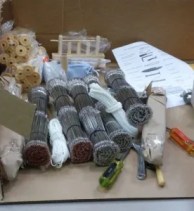
 52-57 OOH!!


 58 – 62 BIG!!!
 63 There was ergonomic unboxing while sitting on a chair.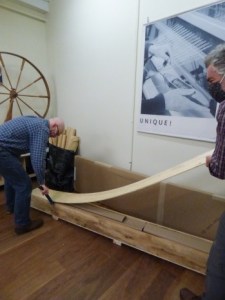


 64-68 the last wooden crate


 69-73 that box was the treadles!
 74-75 Bobbin rack!!
 76-77 well packed
 78
78

 79-81 the 3D “Kebec II Loom Counter-balance with Pulleys”

 82-84 Sectional pices yet to be attached.


 85-91Loom close ups
 92 – 93 the New loom even makes the Guild’s Grate Wheel look smaller!
 94 The 90” loom Samples 1 May 1973 to 1 May 1974
 1 Devonshire Public School (we were in the lower level with the closet under the stairs and the old gymnasium.)
 2 Heartwood house.
 3 Our new home in the basement of Heartwood house, with the 100-inch loom warped and ready to go! The loom was often in use since it was much easier to get into the guild studio and use it.


 4-7 Weavers work in pairs and weave 2 blankets. It takes two weavers weaving at once to make each blanket so they weave one for each of them. 2002


 8-12 Upstairs in the light warping team in February 2009
 13 Moving Out of old Heartwood House! 2013
 14-15 Moving into new Heartwood house (a lot of those boxes are the library!) 2013


 16-22 Weaving in the Studio 2014
 23-24 Moved to the Classroom Nov-Dec 2014

 25-27 This is the weaving draft for the coverlets. Here you can see tying on a new warp to the old. This is used to keep from rethreading the heddles or to save an expensive warp from being loom waste. It is the second use as a dummy warp this time. 06-29-2015
 28 Special guest in the studio (gratuitous lamb photo) Ann has the best living room decor!! Everyone enjoys when she shares and brings one of her bottle lambs to the studio.

 29-31 Our loom is getting more finicky to put the warp on the loom. 06 2016
 32 They are adjusting heddles and leveling harnesses before threading the next warp. 7-4-16 (you can see the wall is gone so its easier to warp the loom. (Well relatively easier))
 33-34 You can see the treadle patter and more of the classroom. Aug 2016.
 35-36 Overshot is a weave structure with a distinctive 45-degree angle to the pattern. It is starting to show that the tension is not even and there are problems with the loom.
 37-38 The weavers are having to argue with the loom to stay square and get the correct angle. Weaving has become slower. 2018
 29-40 The new floor is put in as we prepare for the new loom. July 2019
 1 Cindy O’Gorman our teacher
 6-7
6-7 8 My combing options.
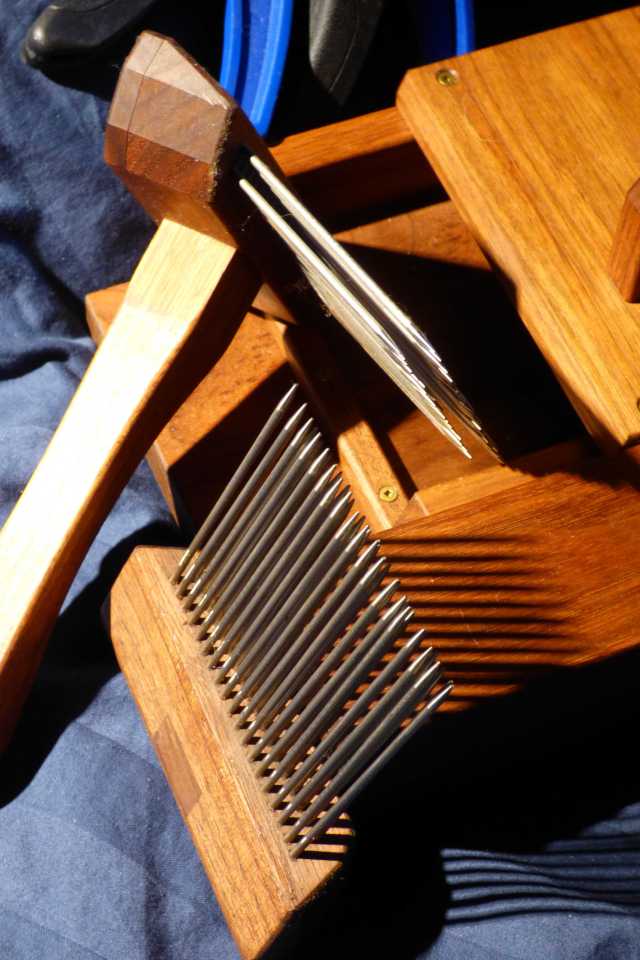 9 Alvin Ramer 2 pitch combs. I use the blue clamps with them since the original C-clamps stayed with one of the previous owners.
 10-11 Viking single pitch combs (with diz on the green gardening wire). They were a Christmas present from Glenn quite a few years ago.
 12 Bee Decapping combs (Bee combs) these were from Princess Auto but you can find them online. The handle angle is not the best for using as a pair the way normal combs work but can be used singly to tease open a lock.
 13 Dog comb. Again, this was ok to tease locks open but didn’t work as a comb.
 14
14 15
15 16
16


 17-20
17-20


 23-25
23-25


 31 I need a button with a slightly smaller hole and I should pick up a tiny crochet hook!
 32
32


 38
38


 39-44
39-44
 1 – Looms, yarn, notes, suplys coming in to the guild studio for the workshop
 2 – The options for Warp yarn #10 Crochet cotton or the thicker softer cotton
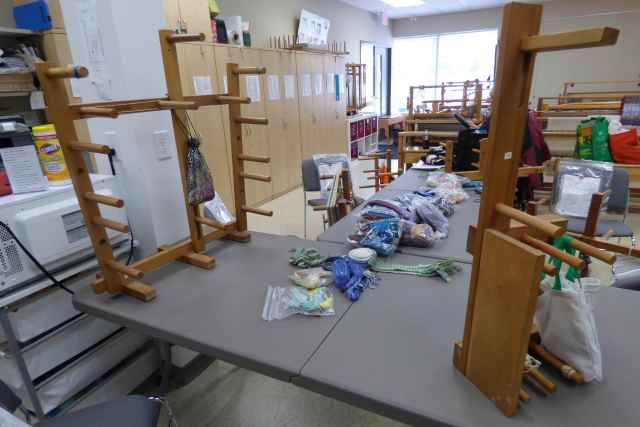 3 – setting up for the workshop, and found one of the two missing looms.
 4 – Lesson breakdown and count of warp threads both yarn sizes (the glass doors on the Ikea cabinets make a grate white board)
 5-6 –the notes and the important smarties
 7 – Samples of inkle and other 2 harness woven bands


 14
14


 21
21 22
22 23
23 24
24

 27
27 28
28 29
29
 Prototype marudai with garden Rabbit holder.
 “100% Cotton, each skein is 7.3m/23.9ft.”




 the mostly untangled thrums


