Browsed by
Category: tools

First Quarter Tree Finished and I Got Mail.

First Quarter Tree Finished and I Got Mail.

After some final fiddling with the width of the trunk and shadow and adding a little red bird for interest, I decided I am done with the winter tree.

Next is spring so I have to figure out what kind of tree I made. I wasn’t thinking of a particular tree when I started the experiment in making a tree. Here is the original tree experiment post. https://feltingandfiberstudio.com/2023/02/22/an-experiment-thinking-about-the-year-long-challenge/  After doing some picture searches I think it is most like an Oak tree. The other option was a Maple but the bark on a Maple is quite grey and Oaks have much more brown and textured bark. Naturally, neither of these makes the kind of flowers that pop into your head when you say tree in bloom. They make droopy green (sometimes red) tassels. Maples make maple keys and Oaks make acorns.  What kind of tree do you think it is?  I may decide it is a fantasy tree so I can make blossoms anyway. What do you think?


The other exciting thing Jan told you about too. I got my Package from Georgia (Russian Federation whether they like it or not).

Here are some unboxing pictures.


I was surprised it was all assembled. Jan had some assembly required with hers. The other fun thing is it is purple and has a cute little bee. It has 4 what look to be size 36 felting needles in it. It holds 4 of them.

Purple and a bee are all very well but how does it work? It took a little experimenting on how where to hold the machine in relation to the felt surface to get the best felting. It worked well but it is hard to engage all the barbs on such a long course needle. We decided to switch out my big needles for one of the smaller crown needles. This also helps with a comparison of Jan’s machine to mine as hers only holds one.  I like it. It is bigger than Jan’s and I like hers too.  I like the Chinese one the least. A lot of that is the way you hold it. It is a much slower machine and we all know that patience is not one of my stronger qualities. One thing I would recommend is that you get an awl or sewing stiletto or something similar to use to hold new fibres down so you are not getting your finger so close to the machine. Unless you have long talons like Jan for doing such things.


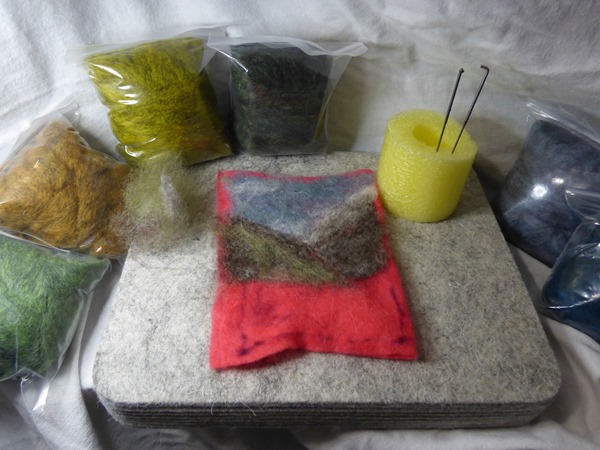
In this last picture, you can see how much ( the white fibres) gets punched through when you fully engage all the barbs of the large 36 triangle needles and how big the holes are even when you only engage the first barbs( yellow fibres).

You will get to hear about the rest of the testing later. Jan is making a chart and doing some analyzing of data. Better her than me. 🙂

First Tests of Ann’s and Jan’s New Felting Machines Part 3

First Tests of Ann’s and Jan’s New Felting Machines Part 3

Part 3:

This will be a “short post” since we have had a third machine to add to our investigation (which I hope will continue on next Monday).  Ann has received a package from Georgia, hopefully containing the Solar Bee she ordered. It is vary similar to the design of handle and motor placement of the Orange fly but instead of a single needle it can have up to 4 needles. We will let you know what we find out about it soon.

The continuing investigation into the first 2 electric felting machines (China and Ukraine)

A quick look at trying detail work on pre-felt:

I tried fine detail work on pre-felt with merino, first with the Orange Fly (Ukraine). I did not have trouble working along the edge of main branches but found that it felted much faster than I am use to. the increased speed of felting is especially noticeable when we tried felting the tiny branches. Although it worked well, I did not feel as confident in my control of wool moving, I suspect I just need more practice.

1- dry felting on dry pre-felt. creem prefelt, black winter bare tree, orange fly needle felting machene on foam mat with a cuple needles and a bit of black merino wool 1- dry felting on dry pre-felt.

Next I wanted to try a piece of pre-felt that had been wet felted by Ann. This was one of her tree prototypes that she did not use as her finished tree.

2-3 pre-felt with one of Ann’s wet felting tree tries. - During wet felting. 2-3 pre-felt with one of Ann’s wet felting tree tries.2-3 pre-felt with one of Ann’s wet felting tree tries.

   4-6  I wanted to try adding little cardinals (red birds) to the tree. adding red dots to tree branches to indicate cardnels (red birds) black tree branches on prefet with red dots, adding a bit more fiber suddenly got a lot bigger dot. 4-6  I wanted to try adding little cardinals (red birds) to the tree.

I found that the machine grabbed the fiber and pushed it with enthusiasm into the pre-felt. A bit more than I had expected.  Again I think more practice would improve the bird-ish-ness of my red blobs!

back of prefelt showing red wool penitration 7 the back of the pre-felt showing the red fibers pushed to the back.

 I also tried on the orange Fly on 2 more wet felted bases with good results and not as good results.

Our next test base was a felt Ann had made in two colours of brown.

It was about the thickness for a wet felted hat but could be a good surface for a picture.

The single needle of the orange fly did not have trouble embedding fiber into the felt.

adding blue fiber to solid wet felted wool on a wool pad back of wet felted wool pad showing penitration of fiber. adding blue fiber to solid wet felted wool on a wool pad adding blue fiber to solid wet felted wool on a wool pad. using orange felting machine on an angle.8-11 working on solid wool felt.

I found that I felt more fiber movement when I angled the needle insertion. This would allow more barbs to engage fiber without having to imbed the needle into the wool felting mat.  (Angling the needle reduces the depth of insertion while still allowing more barbs to grab and entangle fiber.)

Having only one needle should be slower when laying in a general background colour. But, it is still quite quick, and there was no stress on my wrists, fingers, elbow or shoulder.  Ann and I should try a race between the felting machines vs. the 10 needle bar tool, which I find very fast for laying in backgrounds. But speed is not the only factor that the machines address.

We also considered the mettle machine from china. As you remember the mettle machine did not like most of the felting surfaces as much as the orange fly did. We used the fake clover brush (driveway asphalt painting bush from the hardware store) which is what seemed to be its favorite surface so far in our investigations.

mettle machine felting into wet felted wool on bristal brush 12 Mettle machine felting into wet felted wool on the driveway brush

Wet felted (Fulled) knitting as a felting surface.

Ann had fulled a piece of knit sweater and brought a piece to try felting into. the orange fly did transfer the white fiber through the knitting successfully but it was a bit more resistant than the firm felt.  (It is quite firmly fulled knitting.)

felting into fulled knitting on wool pad back of fulled sweater showing wool penitration 13-14 Orange Fly felting fulled wool knitting on a wool pad

Next I tried the mettle machine on the same surface. I noticed one of the screws loosening so stopped and tightened it. I suspect that you may want to check all the screws occasionally just so you do not lose one.

  15 mettle machine felting into fulled sweater on wool mat, 16 one of the tiny screws had started to loosen.15-16  mettle machine felting into fulled sweater on wool mat, one of the tiny screws had started to loosen.

There is less resistance when using the driveway brush  as a work pad but there was still the most resistance when we were felting on the fulled sweeter. Running with 2 needles was also less resistance than running the machine with 4.

  17-19 checking work angle and comfort holding mettle machine

I again tried holding the machine vertically and on an angle.  Both were comfortable to hold and there was less vibration/resistance when using the brush with this machine.

I have been making a chart for the 3 machines so next we will investigate the machine from Georgia and fill in the rest of the chart. We will open the package and put it through its paces next Monday (which is a holiday) and hope to have some test results ready for the next blog post!

For working on wet felting the orange fly seems to be a bit more enthusiastic towards embedding fiber into the felt/fulled 2D picture ground .  I will not give up on the mettle machine, I suspect we have not found its forte yet. I want to look further at 3-D sculpture. i am a bit concerned with the machines hitting armature wires (I may have to find some safety goggles before I try that!)

Until we can find out what’s in Ann’s mysterious package, Have fun and keep felting!

20 the mysterious package arrives at Ann’s

First Tests of Ann’s and Jan’s New Felting Machines Part 2

First Tests of Ann’s and Jan’s New Felting Machines Part 2

Part 1 can be found here: https://feltingandfiberstudio.com/2023/03/06/first-tests-of-anns-and-jans-new-felting-machines-part-1/

Electric felting tool from Ukraine (Orange Fly felting machine)

 1) Ann found it on Etsy.  

We knew Glenn had found it on Etsy and had a long chat with the inventor.  He said that there had been illegal copies of his design, but they had not worked well having descriptions of falling apart and breaking quickly. His original design has been well-tested and had good reviews online.  Ann and I wanted to try it out and compare it to the Chinese design.

2) The orange Fly from Ukraine.  

Orange Fly from Ukraine came with Instructions.3) came with Instructions.

Like the Chinese machine, the price is fluctuating due to the changing value of the Canadian Dollar.

There are a couple of safety instructions with this machine which should be noted.

  • Do not run without a needle in the machine
  • Oil the bushing and inspect to make sure the needle is not heating (you need to add another drop of oil) also running at high speed will wear out the bushing and it will require replacement when the needle feels loose when sitting in it.
  • I would add keeping hair away from moving parts of the machine (I was one of the first 3 girls in shop class in my high school, and I remember long hair and power tools don’t mix well. It was one of the reasons the shop teacher would not let the girls use power tools in shop class.)

Material that makes up the machine

The first thing you will notice is that The Ukrainian machine is made of a plastic for the majority of its body, unlike the Chinese one whose body is made of metal.  I am not sure about the type or projected longevity of this plastic but as with most plastics it should last longer if a few precautions are taken:

  • Kept out of direct sunlight (can degrade some plastics)
  • Keep it at room temperature, and do not let it freeze or leave it in places of high heat (the dashboard of a car or in a sunny window.) being an electronic device it likely will not appreciate being left or used in high humidity. If in doubt it would be best to contact the manufacturer.

2 pictures of Ann holding the Ukrainian felting gun like machine, and 2 pictures of Ann holding the cylindrical mettle Chinese machine 4) Hand grips for both machines

Ergonomics/ comfortable grip:

The handle shapes and thus how you grip them are also different. You may find one more comfortable than the other. I found the grip on the Orange one comfortable and it was easy to see where I was pointing the needle.

Switch and switch placement: the switch or small on-off button are both located in the area where the hand will be near. (i did not test the orange fly with the left hand but may add that to the final tests). For the Ukrainian machine, I found the switch to be well located for the Right hand and easy to turn on and off.  The tiny black button on the Chinese machine was very sensitive and I inadvertently kept turning it back on as I tried to turn it off. This may just be me being too aggressive with my button-pushing. Ann seemed to be able to turn it off and on with less fumbling. You can see the Ukrainian switch in picture 2 of this post and in picture 7 from the last post, you can see the little black button from the Chinese machine. (https://i0.wp.com/feltingandfiberstudio.com/wp-content/uploads/2023/03/7.jpg?w=600&ssl=1)

Noise: the Orange Fly is slightly quieter than the Silver Chinese machine.

Needle penetration /Vibration/kickback;  very little resistance to any of the surfaces or work pads with this one needle machine. (the exception was a fulled bulky knit sweater which gave a bit of kickback but this was fixed by increasing the speed.)  This could be partly due to the decrease in resistance when working with one needle when compared to more needles working in close proximity. We were also not sure of the exact gauge the silver machine was using. Ann has some of the Crown 40-111 needles I sent over to her. These may improve the operation of the Chinese Silver machine and make the test more even. We will report back after her husband has a chance to de-crank the needles so they will work in the machine.

The second thing to mention about vibration is to further Ann’s finding or more correctly losing of a small screw from the Chinese machine. I found that one of mine (not one holding a needle) had loosened off when I was running a test comparing it with the Orange one. I spotted the black screw on the silver machine before it had a chance to fall out.

5) working on wool felt pad and wool felting base  /Needle penetration from the back5) working on wool felt pad and wool felting base  /Needle penetration from the back

 6) pre-felt on medium felt pad 6) pre-felt on medium felt pad

 7) pre-felt on bristle brush 7) pre-felt on a bristle brush

Changing needles

While using the tiny allen key with the Chinese machine was fiddly but reasonably easy, getting the needle into the Orange machine was a bit more complicated. The instructions definitely had English words but seeing a video of putting the needle in fixed the confusion. Not having to have the pre-step of cutting off the crank (which is required for the silver machine)  is an added incentive to look favourably on this one.

Overall, I liked this machine even more than I expected and Ann liked it too.  Next Ann and I will expand our investigation just a bit more and look at 3 thicknesses of wet felt bases. We will look at both the Ukrainian and Chinese machines. Ann may have a third machine, this one is coming from Georgia, and has multiple needles. if it arrives soon enough we will add it to the wet felt base info and let you know what it is like to work with too. I will try to give a synopsis of the machines.

We will also see if our suspicion that the crown needles with their shallow working depth will improve the interaction between the felting surface/wool, brush or foam pad and the Chines machine.

Ukraine felting machine: https://www.etsy.com/ca/listing/768372661/1-year-warranty-pro-level-felting?click_key=1b08e81e365eb8f181543dde3538da5ff5989e86%3A768372661&click_sum=b89a4923&ref=internal_similar_listing_bot-2&listing_id=768372661&listing_slug=1-year-warranty-pro-level-felting


PS: I have spent the last 2 days at the Ottawa Valley Farm Show, demoing felting with Mr. and Mrs. Mer as well as doing a bit of spinning on one of my travel wheels. I do want to show you some of the fun we got up to but wanted to tell you about the second felting machine before getting distracted again. I am hoping the spelling is ok and I haven’t forgotten anything! I am about to face-plant the keyboard so I think it’s time for bed!

First Tests of Ann’s and Jan’s New Felting Machines Part 1

First Tests of Ann’s and Jan’s New Felting Machines Part 1

This past Christmas I received an electric needle-felting tool. This one was made in Ukraine using 3D printing. It had a small motor driving a single needle. Glenn found it on Etsy after he notice I had been having long online chats with a representative, (Amy), of the brand XianDafu, sold by William Wool Felting Supplies Store. Who manufactures a different style of hand-held electric Felting machine from China.

Poor Amy, I spent a long time asking questions, mostly about their needles, what gauge, shape, and how many barbs per side. They are using needles with the crank and part of the shaft cut off (there are a couple of hand-held needle holders that require that the crank be removed too, but they’re not common). Ann’s very kind husband has cut needles for her before but I thought it sounded a bit intimidating so had been hesitant to buy one.  Amy was excellent to chat with, being quite familiar with the machine but didn’t have as much background with commercial felting needles.  So I went into teaching mode and likely overwhelmed her with details and info on needle shapes, gauges, barb placement…… and finally manufacturers I suggested checking out both the Chinese manufacturer Doer and the German Gross-Brecket. I passed on her information to Ann who decided it sounded interesting and placed an order.

By the time Ann’s order arrived and I got the chance to check it out, I decided it might be useful to have a second style of machine) the price had gone up! (Stupid fluctuating dollar value). The positive was that now there were a few options for accessories; I could order extra needles and/or extra screws. (They are tiny screws, so I thought it might be a good idea to get extras)

Ann’s Unboxing of the Chinese needle felting machine. opening the box, the parts are well packed in foam, vile of cut needles, the speed control with adapter for the plug1) Ann’s Unboxing 1

Ann’s unboxing 2 retractable guard. the guard retracted and extended.  2) Ann’s unboxing 2 retractable guard     

You can see my unboxing here https://feltingandfiberstudio.com/2023/02/04/felting-machines-from-ukraine-and-china/  The synopsis, in case you don’t want to go back and read the post, for the packaging from China it was amazing in its use of extreme layers of skid wrap, over Bubble wrap,  over shrink wrap and inside the box, lots of good foam. I suspect the Ukrainian machine was also well packed for shipping, but it was not wrapped for shipping when I was given it, in Christmas wrapping. (I am pretty sure it did not arrive through the mail covered only in Christmas wrapping paper)

The concepts of having an electric needle-felting machine are:

  • reduce strain on your body (reduce repetitive strain injuries or tendinitis irritation)
  • increase the speed you felt at (the machine can poke holes into wool far faster than I can.) you can also adjust the speed of the needle in both the Ukrainian and Chinese machines that we looked at)

other things to think of, Mechanical considerations:

  • Ergonomics: Is it comfortable to hold and use?
  • How difficult is it to change the needles?
  • Both have a limited run time for the motor then it will have to rest and cool down. We seemed to work for up to 5 minutes then pause to adjust or add wool. The suggested run time is 10 minutes for the Chinese version, so well over what we had been doing. It would be important to adhere to the run times so you don’t burn out the motor which would not let you enjoy the benefits of the machine
  • Vibration, noise and Kick back should be considered.
  • How many needles can the machine hold and effectively work?

Ann and I have been trying to meet on a Monday before a social at the local guild to try out your new felting tool.  We had a few things we wanted to test with both machines. My pre-test suspicion was that the Chinese machine would be best for pictures and the single-needle Ukrainian machine best for sculpture. Let us see if I am correct and what you think from our initial test runs.

Let’s start by looking at the Silver Metal Electric Needle felting tool from China first. (The script on the box seems to say “Zendaifuku fibre moulding machine”)

Let’s start with how to add needles, since if it is not reasonably easy to change needles then you will be less likely to use the machine.

Ann Adding needles to the machine using a small allen key and inserting the needles that have had the crank removed.3) Ann adding needles to her China-made machine

This machine requires that the top of the needle (the crank and part of the upper shaft) needs to be removed. This can be done with needles you already have or you can purchase precut needles from the manufacturer of this machine. This is an extra step that the Ukrainian machine does not have. On the other hand, being able to use up to 4 needles gives you more options than a single-needle machine.

We both found that adding or changing needles to this machine was not difficult. Because the screws are tiny, those with reduced eye acuity or essential tremors in their hands may find this a bit more challenging but it should still be achievable. Caution: if you want to run this one with less than 4 needles, I would suggest taking out the empty place screws and storing them in the little screw topped vile holding your needles. I would also suggest ordering extra screws they are so tiny and likely to disappear if you don’t keep your eye on them while changing needles. (Sneaky screws!!)

4) Needle holding vile with screw top (these are Ann’s, mine has extra screws in the vile)4) Needle-holding vile with a screw top (these are Ann’s, mine has extra screws in the vile)

Ann lost one of her screws while running the tests for this machine. She took out two of the four needles to see if fewer needles would create less resistance and less kickback. She had left the two screws in the machine without the needles. She noticed one of the screws without a needle was missing and we used a tool I have shown you before to look for it. (Princess Auto has these, extendible-handled-magnet-with-light. Very handy for picking up needles, screws or pins from your weaving)

Using the extendable magnet with light tool to look for the missing screw under the table and close up of tool 5) Extendable magnetic with light

We started with the different felting surfaces we had with us; Firm foam pad (yellow), pool-noodle-type garden kneeling foam pad (green), and medium firmness wool pad (charcoal).

pool-noodle-type garden kneeling foam pad (green)

   6) My accessories and felting machine on the green foam with extra needle cases, Allen keys and tiny screws. Back of 100% wool felt base with Ann’s machine with only 2 needles.   6) My accessories and felting machine on the green foam with extra needle cases, Allen keys and tiny screws. Back of 100% wool felt base with Ann’s machine with only 2 needles.  

The green kneeling pad produced some kickback, but the Chinese machine did embed the fibre into the green wool felt base. Though it did work better with Ann’s machine with 2 needles rather than mine with 4 needles.

Firm foam base (a piece of the kneeling pad) yellow

    7) Firm foam base (a piece of kneeling pad) yellow7) Firm foam base (a piece of the kneeling pad) yellow

The yellow firm foam had the most resistance to the needles and had the most kickback. Holding the machine on an angle helped the needle barbs engage the fibre.

Wool mat (medium softness) (I have one that is thinner and firmer and one that is thicker and softer)

8) 2D and 3D on wool mat with Chinese machine8) 2D and 3D on a wool mat with the Chinese machine

On first impressions with this tool and this wool mat, Ann liked the 3d more than the 2d felting.

 9) Increasing Speed using dile on cord 9) Increasing Speed

Increasing the speed improved felting in both 2 and 3 D but she is still having some kickback with 4 needles.  She also found that working on an angle worked better than vertically. We again suspected that the lower angle might be engaging more of the barbs with the fibre, than when held vertically. With the amount of resistance felt with this surface, we may not have the speed, gauge and number of needles set up to optimize for this machine. We will investigate further.

Ann held the tool at an angle and found it worked better. We think that the surface may be too resistant to the needles in use. We suspected finer gauge needles or fewer needles might improve the felting.  For a second try, Ann switched to two needles instead of four this reduced the kickback but didn’t remove it.
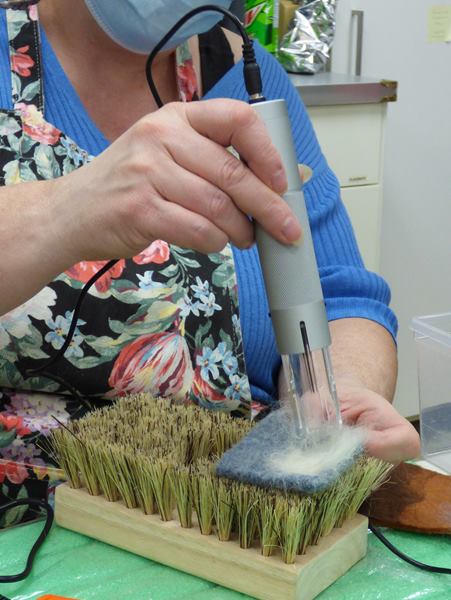
10) Ann reduced to two needles and tried the wool mat again. it was more effective.10) Ann reduced to two needles and tried the wool mat again. it was more effective.

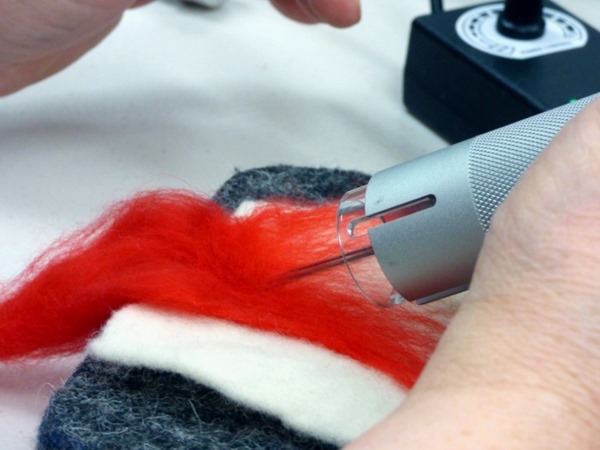
11) We also tried a 3-D object, using 2 needles and without an armature.11) We also tried a 3-D object, using 2 needles and without an armature.

This caught and entangled fibres into the felt successfully. As you can see, Ann was running it with the guard locked in the retracted position.

After checking the mats we had with us, we came to the conclusion that there may be too much resistance and maybe we needed something more like the clover brush pad to allow the machine to work to its best potential. Neither Ann nor I have one and they are so small a work surface. We needed to come up with an alternative. I found my red kitchen scrub brush and Ann went to a hardware store and found a bristle scrub brush and a driveway brush. So we now had 3 brushes of different stiffness, height of bristles and bristle density to try next.

  12) 3 brushes to try (since we dont own clover brushes)12) 3 brushes to try

 13) Princess Auto red scrub brush; tightly packed, stiff plastic bristles. 13) Princess Auto red scrub brush; tightly packed, stiff plastic bristles.

14) Whisk brush with handle from Home Hardware longer and softer bristles that are tightly packed.14) Whisk brush with handle from Home Hardware, longer and softer bristles that are tightly packed.
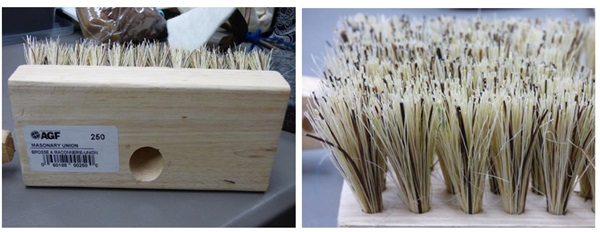
15)  Driveway brush without its pole handle also from the hardware store; firm bristles more dispersed than the other two brushes.15)  Driveway brush without its pole handle also from the hardware store; firm bristles more dispersed than the other two brushes.

16) Prefelt over the driveway brush 16) Prefelt over the driveway brush

Using the driveway brush as you would a clover brush seemed to be the most effective of the options we have tried. The other two brushes were found to be too stiff (Red) and on the other, the bristles seemed too close (Black). The driveway brush created less resistance than even the pool noodle-type garden kneeling pad foam, which was better than the wool or hard foam with this machine.

I suspect that if changed to finer needles, with the barbs located closer to the tip we would again see an improvement in fibre engagement.

If this company makes a new version I would suggest it would be nice to have the guard able to lock at a couple of spots so you could set the depth the needles would penetrate. Secondly add “Extra Fine” needles to their options, with barb placement close to the tip. (a shallow working depth but maybe not as shallow as the crown needles)

The machine itself felt comfortable in the hand, it felt safe and solid to work with. The adjustable speed worked well and we remembered not to get too excited and overwork the machine, so no more than 10 minutes on. We probably were working more in the 5-minute run times, then letting it rest as we set up the next bit of wool to work on.

Next, we will look at the “orange Fly” electric needle felting machine from Ukraine. We can then compare the two.

Ann and I would be interested to hear if you have tried the metal electric needle-felting machine from China. How did you find it?

This is the link to the Chinese Needle felting Machine. The price has fluctuated quite a bit due to the strength of the Canadian dollar. https://www.aliexpress.com/item/1005004984061419.html?spm=a2g0o.detail.1000014.4.64382604aj7QsK&gps-id=pcDetailBottomMoreOtherSeller&scm=1007.40050.281175.0&scm_id=1007.40050.281175.0&scm-url=1007.40050.281175.0&pvid=c33f93e0-5aac-4884-bd34-54c5fe444a00&_t=gps-id:pcDetailBottomMoreOtherSeller,scm-url:1007.40050.281175.0,pvid:c33f93e0-5aac-4884-bd34-54c5fe444a00,tpp_buckets:668%232846%238114%231999&pdp_ext_f=%7B%22sku_id%22%3A%2212000031240835199%22%2C%22sceneId%22%3A%2230050%22%7D&pdp_npi=3%40dis%21CAD%21206.27%21206.27%21%21%21%21%21%402101d1b516779458756708517ed103%2112000031240835199%21rec%21CA%211912286868

Felting Machines, from Ukraine and China

Felting Machines, from Ukraine and China

I was surprised at Christmas with a single needle hand-held felting machine from Ukraine.  (Glenn said he had been told by the seller on Etsy that there is a Russian rip-off, which had horrible reviews. It either seized or flings parts of itself off as you try to use it.) The Ukrainian one he gave me, seems to want to keep all its parts together.

1) Ukrainian made single needle felting machine. Speed control is on the power supply.1) Ukrainian-made single needle felting machine. Speed control is on the power supply.

2) Ann liked it and suspects it will work with sculptural projects.2) Ann liked it and suspects it will work with sculptural projects.

3) It came with a thank you card from the maker3) It came with a thank you card from the maker

  4-5) and instructions.4-5) and instructions.

 Glenn had seen me waffling about a 4-needle hand-held felting machine out of china. That one required the needles to have the crank end cut off. I was not too excited by the idea of cutting needles, so was waffling. I spent a long time chatting with different customer representatives asking lots of questions about needle gauges and shapes. They listed 3 unspecified sizes. I put on my teacher hat and went into education mode and explanations of needles (you may remember my meandering through the topic of needles in a previous blog.)  I passed all the info I had gleaned from them to Ann, who did order one which arrived in early January. She will, I am sure, tell you more about how she is finding it. We will also likely do a comparison of the two types we have acquired.  After seeing Ann’s I decided it looked like it will probably work well for Picture Felting.

Today a mysterious package arrived from China, well a few little parcels also arrived including the metal thimbles I was waiting for. It was covered in a layer of clear tape with layers of skid rap under that! (Skid wrap is like cling wrap but extra clingy!! It holds boxes or other things on a shipping skid.)

6) tape over skid wrapped cardboard box sitting on a clear box of tiny colourful elastics.6) tape over skid wrapped cardboard box sitting on a clear box of tiny colourful elastics.

7) protective waterproofing covering removed from small cardboard box7) protective waterproofing covering removed from a small cardboard box

I carefully extracted the box from the wrapping with the help of some scissors.  There were multiple layers of Skid wrap so the scissors were the best solution.

Now to get into the box without damaging the contents….

8) Bring on the Norway pewter Heilag Olav letter opener!! (small cardboard box balancing on small clear plastic box of tiny elastics balancing on a mettle box that use to hold quality street candy8) Bring on the Norway pewter Heilag Olav letter opener!! (small cardboard box balancing on a small clear plastic box of tiny elastics balancing on a mettle box that use to hold quality street candy

Hum what is this? Wow, this is well-wrapped!! There is something loose underneath it!

9) Surprise! A bubble wrapped object 3 small canisters and cloth rose.9) Surprise! A bubble-wrapped object, 3 small canisters and a cloth rose.

9) Surprise! A bubble wrapped object 3 small canisters and cloth rose. 9-10)  Surprise! OH MY!!! That was unexpected! A rose as well as 3 tubes of extra needles!9-10)  Surprise! OH MY!!! That was unexpected! A rose as well as 3 tubes of extra needles!

11) Opening the end of the bubble wrap bag I found More sealed plastic in the next layer!!! 11) Opening the end of the bubble wrap bag I found More sealed plastic in the next layer!!!

I am starting to wonder if they were expecting horrific weather in Canada or if there will actually be an end to the protective wrapping!! (it may be all packaging and nothing inside?)

 12) Aha!! A fancy white box with writing I cant read and a sticker with some sort of cool pattern on it.12) Aha!! A fancy white box with writing I can’t read and a sticker with some sort of cool pattern on it.

It may be one of those boxes other people’s phones can read. (I did mention my phone only claims to be smarty….but it is mostly out of power and is just a phone. It doesn’t even text. Which is good since it’s a phone so friends should just call me.)

 13) Gold text on the white box, any idea what it says? 13) Gold text on the white box, any idea what it says?

Removing the outer layer and lifting the lid I found helpful instructions, including some English!!

14) the instructions in multiple languages14) the instructions in multiple languages

Oh no more packing, this is very well-packed!

15) Now we are getting to the heart of the matter! lifting the thin foam layer I can see a silver solid mettle with plastic sliding needle guard and the nob for the speed control and anther bottle of needles all nestled securely in more packing foam.15) Now we are getting to the heart of the matter! lifting the thin foam layer I can see a silver solid mettle with a plastic sliding needle guard and the nob for the speed control and another bottle of needles all nestled securely in more packing foam.

16) Digging a bit further I found the power cords with speed control and a white plug adapter that I wound need on this side of the ocean.16) Digging a bit further I found the power cords with speed control and a white plug adapter that I would need on this side of the ocean.

17) all the parts extracted from the packing, plus the 3 viles of needles an the cloth rose.17) all the parts extracted from the packing, plus the 3 viles of needles and the cloth rose.

The needle canister with the machine has three sets of four needles, I did not ever get any of the otherwise very helpful company reps to tell me what gauges these are. It may be 32, 36 and 40 gauge but I’m not sure. I may investigate more Sunday.

18) Allen Key inserted to add the first needle. 18) Allen Key inserted to add the first needle.
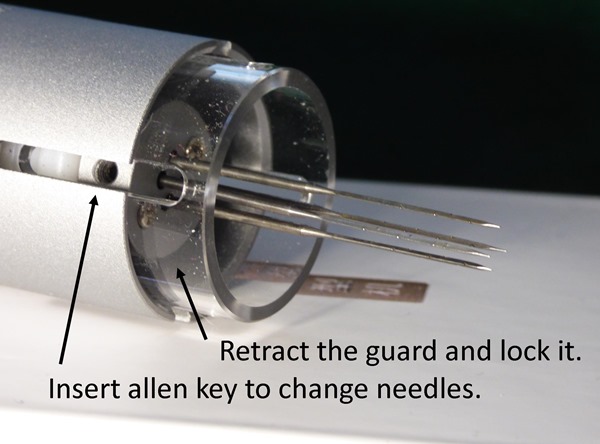
Referring back to the instructions, yes it is best to actually read them and not just guess. I loosened the needle-holding screw with the Allen key provided. (I got extra screws and Allen keys since I don’t want tiny parts to go missing.)

Each of the four needles has a tiny screw that needs to be backed off to insert the cut needle and then tighten. You can run it with one needle or up to all four.

19-20) When the needle(s) have been added you can twist the guard and release it. showing guard retracted and extended.19-20) When the needle(s) have been added you can twist the guard and release it. showing the guard retracted and extended.

This is what it looks like with the guard extended.  It slides up and down like the Clover and fake clover tools do.

I have to get back to getting ready for tomorrow, which will be the Spin in, in Chesterville, a small town south of Ottawa. I hopefully will have photos for you of the fun and shopping, in an upcoming post.

there are a number of other hand-held felting machines (tools) have you tried either of these or one of the other ones? once I have given these a good test run we can evaluate the ergonomics and get a better idea of their effectiveness.

A new spindle

A new spindle

Both Jan and Bernadette have told you about our guild sale and exhibition. Now it’s my turn. I didn’t have my own booth this year so I got to wander around and fill in and help out wherever I was needed. It was really nice to not be assigned anywhere and just enjoy the show and chat with everyone after not seeing so many in person for a couple of years.

I am not a big spender at these things. I look for new fibres and add-ons and how people are combining things. Then I  go looking for the ingredients to make my own.

The one thing I do buy is spindles. I bought a new spindle from Judy Kavanaugh. https://www.etsy.com/ca/shop/JudyKavanagh  She makes all kinds of tools and patterns.  This one is a bedouin-style spindle.  It has 4 arms and is a top whorl spindle instead of a bottom whorl spindle I usually use.  The wood is beautiful.


Bedouin Spindle

People kept asking if it was a Turkish spindle but you can’t take the arms off this one and you don’t wrap your yarn around them. this is the other way up so you can see the wool cob on it. The angle makes it look small.

close up of the wool yarn on spindle

I am enjoying spinning on it. and that brings up to the other things I bought. I bought 2 batts from Bernadette. I like to buy them from Bernadette because she isn’t recarding wool tops. She is using wool she processed herself and it is really nice to spin.

blue wool batts for spinning. a bedouin spindle

The Darker blue is what I am spinning on my new spindle and it’s marked as mixed fibre. It’s soft and a little shiny.

The brighter blue I am spinning on another spindle.

bright blue wool batt and drop spindle close up of yarn of a drop spindle

The wool is much spongier and I have lost the label but I am betting it’s Coopworth. It’s very nice to spin too.

This post is a bit backward because I bought the wool first and the spindle second. The new spindle is more exciting to chat about so it got top billing. It really went like this. I started to spin the bright blue batt first. Then I decided that a blue spindle that Judy had for sale really was calling my name. When I went to get it, someone had already bought it. You snooze you lose. then standing there chatting with Judy I saw her spinning on a Bedouin spindle and gave it a try and decided it was just as well the other one was sold. I picked out the lovely one at the top. So then I abandoned this lovely fibre and started spinning on my new spindle with the other batt.

All in all, I think I was very restrained in my buying. There were so many pretty things I could have bought.

Here is a picture of me spinning at the show. And yes I really did chop my hair off. It was time for a change and it will grow again.

28 Ann took her new spindle for a spin!


A Question about Crown felting needles

A Question about Crown felting needles

A couple of days ago I was watching an online demo of Needle Felting Faces done by Marie from living felt out of Texas. She was using one of the new firmer wool felting mats (it looks similar to the ironing felt mats). She was using a 42Triangle (42T) needle. She said she chose this needle because she wanted to “have the fiber sit on top of the picture and not underneath”. I am not sure if she is using a triangle needle with 3 barbs per side (a 42T 333) or only 2 barbs per side (a 42T 222). A T42-333 would be more aggressive at moving fiber than a T42-222.

I asked in the chat; “Since you are focusing on adding the wool mainly to the surface have you tried a 40 or 42 Crown needle? A crown needle has the barbs very close to the tip of the needle so works with little (depth of) poking.” I did not get an answer from Marie but it started a side conversation about Crown needles with a European felter in the chat.

I was surprised that Crown needles were not well known. They have been available for a few years; at fiber festivals, online and if you are lucky at the local fiber arts stores.  I am sure most of you have bumped into them but may not have had the opportunity to try them out.

Let’s look at where they come from, the working parts of the needle, why would you want one and what is it good for?

Where the Crown needle comes from;

One of the manufacturers of felting needles is Groz-Beckert, who classifies crown and fork needles as “Structuring” needles.  A Structuring needle works on “structuring previously bonded nonwoven fabric” in a machine to produce a Velvety or grainy surface texture. They are designed originally to plunge through the felt pulling fibers to the opposite side as can be seen in this video. https://www.youtube.com/watch?v=aWE4tvHF0xU

As felters we tend to look at items not originally intended or designed for felting and turn them into felting tools. Bubble wrap, lids of Tupper wear jugs, pool noodles, garden kneeling pads and we look at the industrial felting needles and go “AH!! I could do this with them instead!”  In this case, instead of pushing fiber to the far side of the felt and through creating a surface texture, we can reduce the depth we work at and secure fibers close to the surface of your work.

Crown Needle diagram1) a close up of the end of a Crown needle.  https://www.groz-beckert.com/mm/media/web/3_felting_1/bilder_14/composings_3/FN_Composing_23.jpg

Parts of a felting needle 2) Parts of a felting needle

How the needle works and the structure of the needle

Let’s review how a felting needle works. As the needle enters the fibers/felt, its barbs (notches in the needle which can vary in number and placement along the working part of the needle) grab some of the fiber and as it is inserted drags the fiber with it into the felt.  Since the barbs are one directional the fiber carried by the barb stays at the depth it was pushed as the needle is removed. This repeated entanglement creates felt. The felt can be a 2D picture, a 3D sculpture or industrially the needles can create the non-woven fabric used to line the trunk or cover the door panels of your car.

With the Crown needle, the bards are located very close to the tip of the needle and are arranged one per each working side (3 working sides in a triangular needle). This means the working depth is the distance from the tip to where the barbs engage and entangle fiber into the web (felt ground). So on my crown needles, it’s about 1/4th of an inch. There are different styles of tips and different lengths of barbs so there can be a bit of variation if you look at the industrial options. But overall, the distance from the first barb to the tip is very close compared to other types of needles.

Where did I find mine?

Ann and I were both curious a few years ago and I bought a box of the Crown 40-111 from Doer out of china. The price for the needles (500 in a box) was good but the shipping cost was a bit painful (but still cheaper than a flight to China and buying them there!). At present, there are listings for 40, 42,43, and 46 gauge Crown needles from Doer. Groz-Beckert’s PDF lists Crown needles in gauges from 25 to 46. Some of the Groz-Beckerts range would likely not be useful to us but is an impressive amount of options!  With both companies, the working part is triangular as you can see in the last picture from the group below.

box of 500 Crown needles3) box of 500 Crown needles

the designations for the 40gauge crown needles I purchased4) the designations for the 40gauge crown needles I purchased
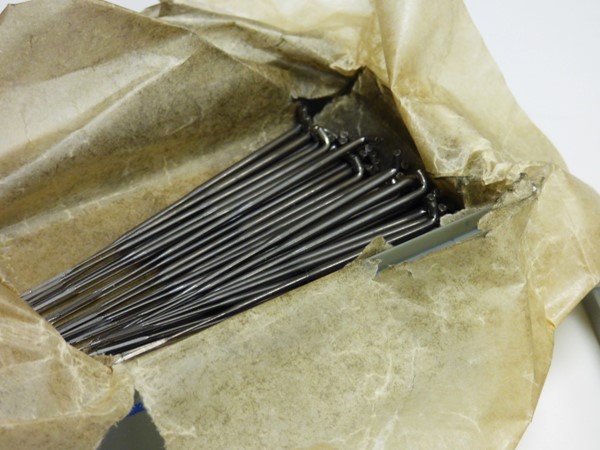
needle are wrapped in bundles within the box5) needle are wrapped in bundles within the box

close up of one of the needles6) close up of one of the needles

For part of the surface decoration on the iris flower, I used crown needles individually and in groups of 2 or 3 held together with a small rubber hair elastic.

using crown needles to add detail to the Iris petals, note the shallow angle I was working at7) using crown needles to add detail to the Iris petals, note the shallow angle I was working at

Why would I want a crown needle and what do they do?

When you want to affect the surface of your felting, you can try the crown needles and/or you can change the angle that you are inserting the needles. A very shallow angle, (almost parallel with the felt surface) will keep the barbs from going through a thin petal or 2d picture.

With a crown needle, there is a reduced distance the needle needs to travel to engage the fiber and secure it into the web.  This reduction in range of movement may reduce some of the strain on the body during the movement of felting, especially if the movement is slower and involved a more careful insertion of the needle. That said you will further reduce your likelihood of muscle fatigue or injury if you also remember to take (Stretch) breaks or let your bladder help remind you to take breaks by drinking liquids like ice tea or water. It’s not a good idea to ignore your bladder when it asks you to stop felting!

Gauge vs fiber size

As the gauge of the needle gets bigger, say a 40 crown vs a 46 crown the fiber diameter/fineness that will be most effective with the needle will change. A 46 crown needle will work better with finer fibers. Conversely, a larger courser fiber may not engage or be grabbed effectively by the finer needles and barbs. Fine needles will also leave less surface distortion than a larger needle. Sometimes if you are getting large dents when using fine needles, it may be more a matter that you just need to keep felting until the entire surface is evenly compacted, all at the level of the original dents. That said a finer needle and/or a shallow angle of insertion will also reduce the dented texture on a surface.

Conclusion

Depending on the project, you will likely have a couple of favourite needles you keep picking up. It may even be the same needles you gravitate to over many projects. So why, if you don’t already have crown needles, mite you want to consider adding another needle type to your collection? Their ability to work at a shallow depth gives them an advantage over other needles whose first barb placement is farther away from the needle tip. Crown needles can be very useful in portraiture, very thin structures like petals or butterfly’s or adding detail to your wet felted vessels, hats or garments. Basically any time you don’t want fiber added to one side to show on the other. (This may also require a very shallow angle of insertion.)

A Crown needle may not be the needle you reach for the most in your needle felting but when you want to work superficially, it is an excellent option to consider adding to your choices of tools.


If you are still curious and want to know more about other needles that are available in the industry you may enjoy looking through this PDF from Groz-Beckert.

https://www.groz-beckert.com/mm/media/en/web/pdf/Felting_and_structuring_needles.pdf


possibly for my next post; Mr. Mer has been digging through the fiber Bernadette brought in to a library day to see if I could find some acceptable (to Mr. Mer), Mer hair.

Felted Iris Flowers Part 2

Felted Iris Flowers Part 2

Last week we got the petals to the point they were firm and reasonably thin. As I promised let’s look at the new equipment I am about to use.

I ordered a felting pad for ironing. it is a little firmer than the white felting mat I was just trying out. I also ordered the clover craft iron II (with accessories). I spotted it on at a lower price than I had seen it in previous weeks so ordered it. Checking on the day it arrived it was up in price over 10.00, while today the price is back down to 2.00 more than I got it for! Prices are acting very strangely lately.

Let’s look at the Felt Ironing Mat first.

23 Wool ironing mat “14″x14″ Wool Pressing Mat for Quilting”

Yesterday I found out some felters are using these ironing pads as felting mats. Ironing mats, (about .5 inch thick) are thinner than the 1 to 1.2 inch felting mats. The ironing pad is a bit firmer than the white felting mat. It arrived folded, with instructions that include “do not fold”. If I use it as a chair pad I will likely flatten it quickly, but I tried it in its present state. It is about half an inch thick. I measured the white wool mat at about an inch thick. The grey wool mat was about an inch and a quarter. (See Photo below)

24 comparing thicknesses

25 (Ironing mat, White wool mat, Grey wool mat)

I did a brief test with the bad sheep picture. This would let me check the end feel of the needle entering the ironing pad, which is quite resistant but does work.

26 needle test of the ironing felt mat

I suspect using the ironing mat may increase the strain on the arm/wrist/finger muscles with prolonged enthusiastic (stabbing) use for felting. I do not like ironing except for before sewing projects, so I am unlikely to injure myself using this as an ironing pad. This thought may come back to haunt me……

The Clover mini iron II and accessories came with a lot of instructions and diagrams. i read them over when they arrived then put everything away in a nice little box.

27  Clover Mini Iron II

28  I found a plastic box at Dollerama to keep the Iron and its attachment options in.

The iron is usually used with appliqué by quilters. The various attachments will get into small corners and the ball attachment will accentuate dishing shapes. The Iron is designed to flatten and smooth the surface of the felt, more like the commercial hot press felts.  It may be interesting to try starches or misting with this too. (oh no a distracting thought escaped!)

There are other similar-looking devices which are used for Auto body repair and another for taking wrinkles out of leather goods (shoes, bags etc.). Check the temperature range on each type, you don’t want to scorch your felt.

One last thing to remember about the mini iron, from what I have read online, it is very important to keep the iron rest, (the plastic and wire thing that supports the iron tip), somewhere you will not lose it. I read many warnings that this part can mysterious disappearance and happens frequently.

Tiny Craft iron time!

Ok, now I am ready for the next step that I skipped with the prototype.

 29 I plugged in the iron and waited for the iron to heat up

After a couple of minutes, I tried it on the prototype. Hum it doesn’t seem to be hot yet. The wool is not warm? I wonder if it’s working? Did I get a broken one? Let me check…Ooops! OWW! No, it’s hot now.

30  I guess this means the Iron is not broken. Owwww.

I carefully ironed each petal, first the prototype then the new petals I had made. There was a bit of thinning visible. I will have to try pressing a bit harder but i didn’t want to scorch the wool. Next flower I will try to get a wire that is closer to the petal colour since the black and green floral wires are still slightly visible, at least in the photos.

31 Carefully ironing the petals

I took them in to show Ann on Library day. It was not as busy as we had hoped so Ann got her dry felting experiment done and I showed her skinny petals.

32-33 Ann inspects the thinness. She said she had not anticipated them to be so firm.

There was one more step I had skipped in the instructions for making a rose from Tjarda’s Workshop.  She had very carefully trimmed any fluffy, flyaway edgings on her petals. I recently purchased a few more variations on curved bladed scissors. I selected one with a short curve to the blade that seemed to fit the petal and started trimming. I think I was a bit more enthusiastic than Tjarda but did get all the fluff removed and smoothed the curves.

34 trimming the edge fluff

35 close up of scissor blade curvature

36 Here is a before (R) and after (L) petal.

After trimming, I tugged gently on the edge of the petal to give a bit of the frill. The tugging is along the length of the edge.

The next step will be adding the last details to the iris petals and then assembly! But that will be another time, I have a bit more library work to do. So, while I am off doing that I hope you are enjoying spring and getting a chance to have fun felting.

Update; we seem to have had a week of mid-summer weather (not so good for the spring flowers). This weekend we made a trip to the first biggish Fiber Festival which was only a 3-hour drive away in Peterborough Ont!  It was so good to be able to feel fibre in person! if you are interested I took a few pictures (121 actually) but promise I won’t inflict them all on you! I am sorry I did not get a picture of the beaver we saw sitting in the grass beside the highway (i was driving) I thought it was only a groundhog as we approached but saw the distinctive tail as we passed. What a fun Saturday! I hope you are enjoying your weekend too!

Felted Iris Flowers Part 1

Felted Iris Flowers Part 1

This week, I am back to working on felted flowers between Library work. I have the last bit of data I needed for my year-end report (so I had better take a moment to fill that in and send it off to the guild executive). Now that is done I can get back to Felting.

A few weeks ago, I watched a workshop given by Tjarda van der Dussen. She made rose petals that were wonderfully thin. Next, she used a tiny craft iron to flatten them further. Then finally, she assembled them, adding leaves to the stems, into a life-like Rose.

I made a prototype of iris petals (https://feltingandfiberstudio.com/2022/04/14/inspired-to-felt-an-iris-prototype/) but did not yet have a tiny iron to try that part of her instructions. The prototype iris proved that the pattern I had found online made a reasonably accurate bearded iris.  I gave it a ZZ top beard, not a respectable Gotee but I was having fun and it was a prototype.

1 Prototype iris testing the pattern

I am very fond of irises, I think they may be my favourite flowers. (if only they flowered longer!)  I have had different colours, but most are of the large bearded variety.  The frilly peach one in the backyard, came with us from the townhouse we rented before I bot this little house.  (My house is a semidetached bungalow, so I guess technically it is only half a house.) The location was good, and the yard was about twice as big as a townhouse with more room for plants, so I bought it. The house came with a dieing red maple tree, which I could put my hands around.  The first spring I added a garden to the front yard with the unhappy tree. Unfortunately when I watered the front garden the mostly dead red maple grew and over the next few years became a heavy shade-producing tree, thus all the sun-loving plants I had planted were not impressed. My back yard will likely have the same fate since there is now a rapidly growing red maple in the yard behind me, which will eventually shade a lot of my yard too. (Don’t tell my plants!!)

So let’s look at a few Iris from my garden over the years. I hope they will inspire you too.

2 Bronz and White iris

The bronze Iris is quite hardy but is not as flashy as some of the blues, or as delicate as the frill-edged peach. The white is also quite delicate in looks and does not flower every year.

3-4 Frill-edged Peach Iris

The frill-edge Peach is particularly showy but has been known to face plant since the flower is large and the stem is long. I have to remember to tie it up before it falls over this year.

5 I have two of the smaller varieties of iris,  this smaller variety, and an early dwarf spring clump that is an even darker blue dark.

I have had several iris in the front yard that have slowly died back and disappeared as both my tree and the neighbour’s Linden tree continued to grow and make shade. Some have been quite spectacular and I am sorry they did not last.

6 Fancy Iris

My backyard iris have fared better but were threatened with shade from an over-enthusiastic grapevine last year. (There will be a discussion of boundaries involving sheers shortly with said vine.)

7 backyard iris

I have even grown some, through the summer, in pots to good effect.

8 Iris in pots

On to the next (felt) iris.

I tried World of Wool core wool with the bit of kemp on the first petal. Laying out the general shape then adding a bit of the mixed blue merino braid I had used before for edging colour.

9 laying out the fibre

10 adding the blue edging

I used the T-36 to tack it in the general area, leaving some hanging off the edge of the petal to add to the underside when I flipped the petal.  I switched to the fake clover tool to imbed the blue fibre into the white. I realized I had forgotten to add the wire to pose the petal so added it now then back to poking.  I flipped frequently and found that if I worked a bit deeper I would transfer some of the blues to the other side giving a better mottle.

I worked one side and then the other side until the petal was the correct shape but not as thin as I wanted.

11 switching to the fake clover tool

I left the first petal at this point and started a second, this time using a small batt I had purchased from Wabi Sabi in Ottawa. It was a Rambouillet/ Merino mix batt, that had a nice crimp but was not quite as lustrous as the core wool.

12 Batt of Merino- Rambouillet

I did the same layout of fibre poking at a low angle along the edge of the pattern piece to get the shape required.

13 when I had the fibre holding together (not good felt but it was not falling apart) I added the wire.

14 adding wire through the center

After making more petals I may role the tip end as well as make a long role back just so it won’t poke up into the flower petal. Again, I added the blue to the edge and wrapped it over the edge of the petal, taking down the fibres with the 36T and then using the fake clover tool with the 40t’s.

15 adding the blue edging

Comparing the two petals, I decided to continue with the small batt of Rambouillet /merino.

16 comparing the two types of wool in the petals

  17  I suspect that this type of foam mat may be demoted back to a garden kneeling pad.

A couple of days earlier Ann had spotted another wool felting mat on Amazon. It was white and similar in size to the grey one I purchased and reviewed recently. This one was described as; “KEO ST. Needle Felting Pad – 100% New Zealand Wool Mat for Precision Felting. Natural Cream Color, 10” x 8” x 1” – Complete with 2 Handmade Leather Finger Guards”. (that was a mouthful lets just call it the white wool mat.

I also ordered a “14″x14″ Wool Pressing Mat for Quilting” so I would be ready to use the “Clover Mini Iron II-The Adapter Set” which I had ordered when it went on sale earlier. (It’s back up to an exorbitant price again.)

18 the new white felting pad (it came with more finger cots!)

19 let’s try it out

So let’s try this one out. It is much firmer felt than the gray wool with kemp felting mat. It is still softer to work into than the firm red foam. It does not leave little bits of red foam in the felt. Unlike the softer grey wool with kemp mat, it had no aroma. Both seem to be made in layers that are commercially needle felted together. The needle end-feel on the white is firmer than the grey but still less than the red kneeling foam. I did find I had some fibre transfer but I was trying to move the blue colour from one side of the petal to the other. The fibre transfer to the mat would have been less if I had not wanted to work so deeply. (a reverse needle would have been able to pull fibre from one side to the other too.)

I have recently seen the use of a thinner piece of firm felt placed over a mat to protect the mat from getting fibre transfer. Sort of like putting a mattress topper on top of a mattress to make it more comfortable and longer waring.  (not the type of mattress that has a built-in top since you cant flip them only rotate them they tend not to last as long as the un-pillow-toped mattresses. Sorry got distracted. Back to felt!) I may try to track down a light and a dark piece of firmer felt about a ¼ inch thick to try as a cover for my felt pads. I could see it extending the life of the mat, whether or not it works to keep fibre colour transfer from your work.

As long as you are lifting frequently and flipping the petal I found both the white (stiffer end feel) and the Grey (softer end feel) wool pads comfortable to work on.  They would be comfortable to work a picture on (again lifting frequently) or to use as a working surface for a sculpture.

I worked on the larger lower petals and then worked on the smaller upper petals.

20-21  using the needle at a low angle and moving the tinning fibre towards the center of the petal

My focus was to work as thin as I could while still creating a firm felt. I found that working around the edge with the multi-tool tended to spread the shape while it thinned the felt. I would alternate multi-tool to flatten then switch to a single needle working more horizontally towards the center to counter the spread. The pattern piece was helpful to check the size and get it back into the correct shape.

The other technical detail to consider is about the wire within the petal. I have quite a bit of experience felting with armatures. Very occasionally working needles through the wool and around wire I will brake one. It is usually when I start to try to work too quickly or I am distracted (trying to watch YouTube rather than listen to an audiobook).  Working with such thin felt defiantly requires more care and less speed. In the center of the petals where the wire is located, I found I had problems with the fake clover multi-tool and broken needles. I eventually shifted to focusing the multi-tool to thin the edges and the single needles to work near the wire and reshape the petals. This improved the longevity of my needles.

I worked the petals in stages. First holding together enough to insert the wire, then to the point it was the correct size and shape but not firm enough, then finally going back over each petal until it was the firmness I wanted and about the correct shape.

22 comparing thinness

The petal on the right is the basic petal shape which has been worked long enough to hold its shape.  For the petal on the left, I have continued to work with both the multi-tool and the single needle to the point of being quite a firm felt. If the felt was this dense but thicker (more of it) the light gauge of wire I am using would not be strong enough to hold a shape against the strength of the wool. I tried floral wire gauge 20 and an undesignated floral wire that I think maybe 24gauge.  I continued working with the other petals until all seemed to be as thin as I could get them.

Next week we will look at the new equipment that has arrived so i can continue working on these petals.


Felting Surfaces & The new game, “What is that smell?”

Felting Surfaces & The new game, “What is that smell?”

A short bit more about felting surfaces

As you may remember from my last post, I wanted to look at some of the types of felt pads but had not yet got my hands on them. Well, this week 2 examples have arrived! I hope you won’t mind and will join me as I investigate.

The felt pads from the descriptions and images seem to come in 2 main types.

Thick felt pad; the photos look like industrial Felt, which is made with hot pressed steam rather than a felting machine.  (Photos can be deceptive!)

Felt pillow; which looked like an outer felt layer stuffed with something, hopefully, wool.

Testing tools.

For this test, I used two thin layers of commercial red craft felt. It is a cheap, not 100% wool felt and is very thin like a pre-felt which stretches easily. It is not as nice as the real wool felt but also not as unpleasant as some of the acrylic felt that seems to be shredded fibre (and possibly dryer lint) held together partly by glue. For needles, I am trying a single T36 and the fake clover tool with T40s, the fibre is from my stash, some are from Bernadette’s Batts, some was Galaxy Melange (died grey wool) from the World of Wool (UK) and a bit of died core wool from Sarafina fibre arts. (Just in case anything looked particularly appealing and you desperately needed a bit for yourself.)

 1 craft felt – has the thickness of very thin prefelt


Test subject #1:

2  Comes in a nice cardboard box with a wooden needle holder just like the ones I have been ordering from China.

3  Close up of felt pillow showing value-added felting tool.

Let’s start with the smaller pad, 7.08 x 7.87 x 1.57 inches (with a nice 3 needle wooden needle holder).

Its described as “Thick and sturdy: Our gray needle felting mat is thicker than ordinary felt, and it is not easy to scratch the tabletop. Felting needles is made of soft felt and dense sponge. The needle felting mat has the best density. It is also equipped with felting needle supplies, allowing you to get a better needle felt experience.”  The Cost was CDN$ 16.99 (Not cheap but it did come with the expensive wooden 3 needle holder I was already familiar with. The needle holder has a bit of a wobble as you unscrew the handle but doesn’t rub or catch, so is not one of the factory seconds I had purchased directly from china). The description left me a bit confused but still curious enough to get it.

The cover felt layer is approximately 1/8” thickness with a sewn seam connecting the two layers. The interior feels like a piece of foam or firm sponge. The edges look like it has had heat applied to them.  The way the edge of the felt layers has bits of melted fibres suggests that the felt has a lower wool component so likely a higher component of synthetic than wool.

4 edge of the felt outer layer with a firm melted edge.

The feel of the needle entering the top layer of the pad feels like the short stapled acrylic felt that is partly held together with glue. There is a noticeable resistance to the needle penetrating into the felt layer of the pad. This is less noticeable as I add more wool to the little picture I am working on. This may not be an issue when working on a  thicker ground layer to the picture than it would be with such a thin one.

5  Starting with a bit of sky

6  Adding some hills,

Pushing the needle through the felt had resistance, similar to that found in the cheap craft felt that has a glue component to it. It requires the piece you are working on to be lifted regularly so it won’t cling to the felt cover. Once the needle had penetrated the felt the feel of the sponge or foam inside is comfortable. There does not seem to be shifting between the foam and the outer felt so I don’t think there will be any added worry about lateral movement and broken needles. I suspect this is not a felting surface I will use frequently although the wooden needle holder is always a nice addition to my collection. This pad will likely be put aside for students to look at during workshops.

After working with the pad for about an hour I noticed that I could see a red tint of fibres from the felt base I was using.  A firmer base felt for my picture may not have left as much residue.

7  Red residue left from the back of  my felted picture


Test Subject #2

8  the second felt pad, came with 9 needles in 2 lengths

“Needle Felting Pad made of pure wool dimensions 10 x 8 x 1.2 inches, Needles and leather finger pads included.” The cost was CDN$ 13.99.

As I opened the taped closed plastic sleeve that the pad was in,  I inadvertently did a sniff test. Ummm…. Well, that is an odd aroma…. Slightly like, petroleum? Ann took a sniff when she was over, she may have a better description.  The smell decreased to barely-there over the last 2 days. I suspect the smell may dissipate if left sitting outside in the sun… for a while.

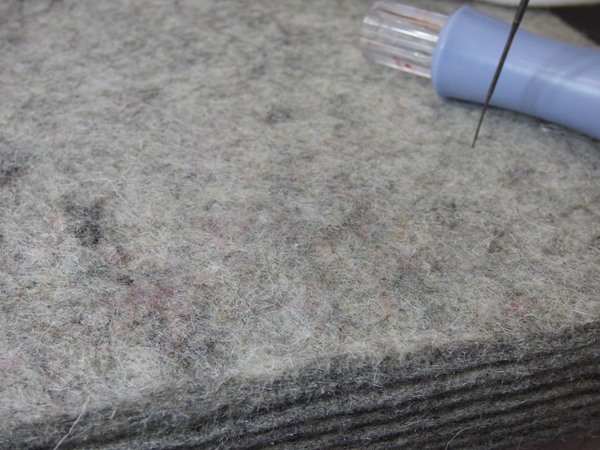
The second felt pad defiantly is made of wool that has a lot of kemp in it. The edges look like it is made in layers or it may have been the implement that cut the felt has left bands and groves. The close-up photos hopefully makes the kemp easy to see. if you look closely you can see fibres (Kemp) descending from one layer into a lower layer. This makes me suspect that this has been made in a needle felting machine. From the original photos, I had expected this to be the hard industrial felt used in ironing pads but this has some give to the surface.

9  Note the kemp which there is a lot of.
(Video testing firmness) P1790339 10 checking squishiness

I added more wool to the picture to test how the pad feels when used. Not bad. The surface is soft and the needle has much less resistance on entering the pad. I like this one better than the last one.

11 Testing felt pad 2

12 Adding World of Wool fibre.

 13 Shortening the hills, adding foreground and water. This makes me think of the north.

Ok, that is working well, let’s see what else I can try. I had meant to make the picture 3×5  but I am interested to see where the water is going. (you can’t trust the sneaky wet stuff, it’s likely trying to escape the picture and make a run for it.)  Let us change the size of the picture and make it a 5×7. So I need to add both length and width to the picture. I added fibre around the edges of the picture building up the size to what I wanted. I found lifting frequently kept the fibre from sticking.

14 Here is the front of the picture

15  You can see how the original rectangle has expanded with the added fibre. (What a mess! I will not frame this one with double glass!)

I did find that there was some transfer of the kemp from the pad to the back of the piece. I do not know if this will lessen as I use the pad. I suspect it may.

16 Kemp transferring from the mat to the back of the piece.
17  There was a small amount of red f transferred from the back of the picture to the mat.

This mat I would use again. It has improved in smell, it is comfortable to use, and it can hold a 5×7 or a bit larger picture.

We have a new game to play!

Today was our local guilds Library day. I had been into the studio last week pulling requested books and getting everything ready for today.  Ann had seen and smelled the second pad right after it arrived, (when it was at its stinky-est). Today I brought the finished piece and the mat to have a few brave people try the fun new game “what is that smell?”  After some careful sniffing, we have come to two suggestions from a number of players. One was it was “ode de Mutton Urine” or possibly “ode de petroleum product”.  The suspicions were that the wool may not have been as clean as we normally deal with or the lubricants used in the carding process had gotten in the wool giving it the odd aroma.

 18  The new game “What is that smell?”

19  “Sniff”

20  “Oh my!  Ode de Sheep Urine?”

21 Testing it with a needle

22 Admiring the little test picture

The original wool may have been a lower grade or kempy carpet wool (not a bad wool just more ideal for hard-wearing carpets than soft woolly underwear. There are many types of sheep and many uses for each of their different type of wool)

I hope that gives you a couple more options for taking out your more violent stabby tendencies. I may still try to make my own pad using a felt outer layer and wool core. I am suspecting there may be less compacting of the inner core of wool if I use something that is more like hair than something with a lot of crimps. I wonder if I can find some unwanted Tog (I have been collecting tog for an Icelandic blanket project but may need to find more!) if I don’t want to waste good tog, I can always take a quick trip to Carlton Place and visit the Wool Growers Co-Op and see what they have in there carpet wool box! That sounds like a reason for a road trip!!!

On another topic, Signs of spring!

I am sure I will soon be out in my garden side yard studio. I know this since I have seen signs that the first of my trees have migrated to their summer location! (Spring tree migration time!!) Spring must be getting close!! I hope you are enjoying spring or can see it coming (keep an eye out for those migrating trees!) and I hope you are having fun felting.

23 The day-old tell-tail-tracks of tree migration

24 The tracks end here where we find the noble wandering trees (their poplars) I am sure the rest will follow their lead in the next week or two! (yes I have a small portable forest)