Browsed by
Category: Design

A Sample for my Seat Cushion

A Sample for my Seat Cushion

I decided to make a sample before plunging into making a seat cushion. I decided this for 2 reasons. First, I am not sure where most of the batts are hiding, so I only had a small batt handy. Second, I needed to do some quick felting for the blog today. The sample fit the bill perfectly.

This is a Swiss Mountain batt. I got it off Etsy a few years ago.

I decided 10 inches by 10 inches is a good size for a sample and makes shrinkage easy to calculate. Please excuse my dirty-looking table; it’s some sort of glue that won’t come off.

The edges a thin, so I folded them down to make it square.

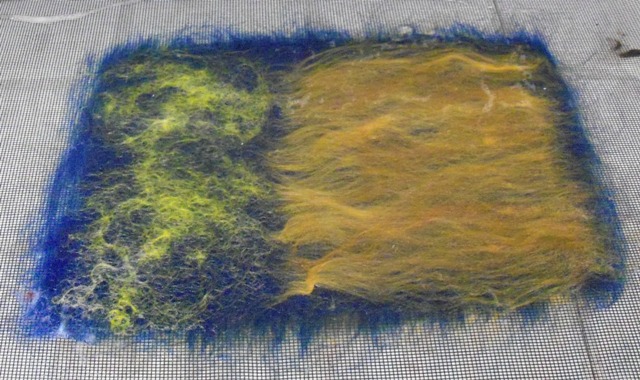
I added a layer going up and down.

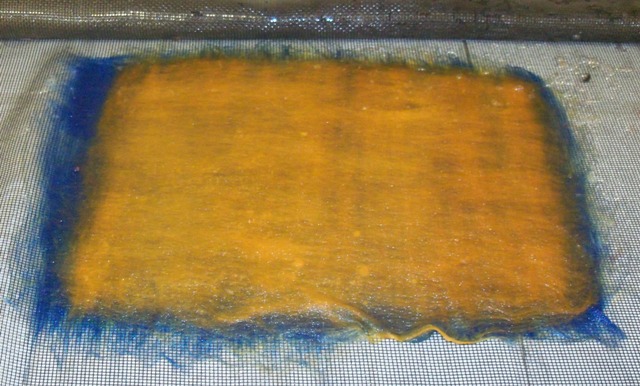
Once it was wet down, I folded the thin edge top and bottom to square it to 10 inches. That would have been enough to make a sample, but it would also be very boring.

I got out some balls of my handspun and made a spiral. Who doesn’t like a spiral?

I spent longer than normal rubbing so the yarn would stick without moving too much. My impatience usually results in wobbly lines.

Then, of course, lots of rolling to full it properly.

The finished sample ended up just about  7 by 7 inches

It ended up fairly sturdy. The spiral ended up holding its shape very well. However, it is quite hairy and I think it would be a bit prickly to sit on with thin pants or a dress. Once it is dry, I will try shaving it, but I don’t think it will work. There will still be short, strong fibres on the surface. I may have to try some Blue-faced Leicester or maybe some Corriedale. What’s your favourite strong wool for sturdy applications?

Stitching progress

Stitching progress

My post this month is – surprise – more stitching on my jacket. Last time I was unsure of what pattern or design to stitch on the side panels at the back of the jacket. I did think about a group of straight lines in a vague fan shape for these panels, but I wanted something that would be a little more challenging for me to do, and also, would be interesting to look at.

I saw a design that I liked very much from ‘The Green Wrapper’ on her Youtube channel – I have mentioned her work previously. I changed the pattern slightly and worked it on a 2.5cm grid, and then used a 5cm diameter circle, in a pattern, so that each circle interlocks with it’s neighbour. This interlocking of circles provides the final pattern.


I drew the grid, and circles with a Frixion pen; some circles are misplaced, and are clearly visible, but I did not risk removing them with the iron, for fear of removing too much of the correct marking, and having to repeat it all again. Luckily, I could clearly see the path of the pattern, and I added extra pen marks to assist. To draw the circles I used a small sherry glass, it was a touch under 5 cm diameter, but also just perfect! The two photos below show where I have made mistakes.


The next decision was to decide to use just one colour thread, or many colours. I went with the latter, and I did not think too much about the direction of each colour in the stitching. I used stranded embroidery floss, and a little wax to help ease it through the fabric.

Initially, I planned the pattern up to the armscye, but halfway through the stitching I decided to extend it up to the yoke. I do think it looks better having the pattern fill the space of the panel. The stitching is almost complete on this side, and I have removed the pen marks on the lower half of the panel with the iron, so that the pattern is more easily visible. The colours are not as bright in the photos as they are in real life, but I hope that you can see the pattern fairly well.


Now to decide what to put on to the other side panel, whether to do the same one, or find a different design.

Demoing Felting Question: “How does that work?”

Demoing Felting Question: “How does that work?”

Demoing Felting Question: “How does that work?”

Summer is the season of planned and spontaneous demos.  Whether it’s planned, demonstrating felting at fairs, craft shows, fibre or yarn stores, or less planned, felting sitting in front of your home, or waiting at a doctor’s office,  it’s an opportunity to introduce others to the fun of felting. I wanted to chat about this today, since I have recently overhead others say they haven’t signed up to do guild demos because they don’t know what they will get asked at the demo. Also, they have never demoed before and feel that they need to be really good to demo.

Demos are an opportunity for us to show others what cool things we are doing. We don’t have to be masters at what we are showing, but we have to be enthusiastic (without scaring the public) and look like we are having fun. Seeing someone who is enjoying what they are demoing is likely to inspire someone to try whatever they are doing. It is also good to see someone who is just starting to let others know they can do this, too.

jan working on felted pictue of 2 sheep in front of large burlap bails of wool at wool growers co-op 2019 1) 2019 Wool Growers Co-Op Demo

If you have never demoed before, try a group demo where you are not alone and have others who can answer questions and take the lead.  You can also just bring your felting with you when you will be waiting somewhere for a while, like the doctor’s office or emergency department, most people will just smile and watch. (They are usually happy to have something to distract them from why they are there. It’s a good way to get used to being watched while you’re working.)  Spinning is particularly popular with people in the emergency waiting room.

I have found that at most big demos, I have to start talking to people before they will approach. When I first started to demo, it was weaving I was showing. If someone seemed curious, but not brave enough to ask what I was doing, I would ask what type of loom they had at home (even when I was reasonably sure they had never seen a loom before). They usually laughed and started talking to me, often about their grandmother’s spinning wheel! (We will not discuss today anyone loudly saying “look she is making wool!!” while I am spinning, or “Look she is spinning!!” when I am weaving. It’s a bit trickier, so getting Sleeping Beauty’s spindle wheel confused with Rumpelstiltskin’s flax wheel is slightly understandable.) Nevertheless, it was an opening, and I could tell them about the magic of watching cloth appear as you change the order of harnesses, which changes the pattern.


Now let’s consider what seems to be the most scary for new demo-ers, what am I going to get asked?

First, you are not required to know everything to demo! If you get a question you don’t know the answer to, admit that, and suggest they contact the local or online group. You don’t have to be an expert! Enthusiasm and looking like you are having fun will inspire others to try. That said, whether I am demoing needle felting in 2D or 3D, I most commonly get a few questions repeated as I am working.  Let’s take a look at some of the most common questions.

The first is “How does that work?”

If you don’t know how the needle’s barbs grab the fibre and push it into the felt or ground fabric, it does look like magic.  I try to show them the barbs along the working part of the needle. If you have a course needle, it’s easier for people to see or feel the barbs (32g or courser).  If they are having trouble seeing, I let them hold the needle, warning them the end is very sharp, and have them run their fingernail over the area where the barbs are located.

*I did have one person tell me they had tried using a needle to felt and it hadn’t worked at all. After I showed her the barbs on my needle, she admitted she had tried a sewing needle. I can see why she was having trouble getting the wool to felt.


Doer felting needle 32G diagram2.1) Doer felting needle 32G

Doer needle chart to help ordering triangle needles2.2) Doer needle chart for triangle needles

2019 small muskox landscape, Demoing at a social, under drawing and adding wool, finished image2.3) 2019 small muskox landscape, Demoing at a social, under drawing and adding wool, finished image


Common 3-D Question:

When I am working on a 3D piece, I get asked variations on “how do you move the wool where you want it to go?”.

First, the wool moves in the direction that the needle is travelling. Poke in the direction you want the wool to move. While also being aware of the position of your barbs, and thus your working depth, so you are getting the barbs to entangle or move the fibre to the location you want it to be.  It’s easy to say, and sounds simple, but I have seen beginner felters poking vertically (up and down), while trying to move the wool horizontally. It would be more effective if they poked the needle horizontally (moving left and right) or rotated their shape to align with the direction the needle is moving.

You can get quite devious with this concept.  While working on a sheep broach, I had the face quite sheepish, but the nose was not as firm as I wanted.  Who wants a soft-nosed sheep, that is just flaccid, or a limp-nosed un-sheepish aardvarkish-sheep?  If I poke from the outside, into the nose, I will distort the nose, and I will have to add more wool and reshape it.  There is a second way to firm up under a surface structure that you are already pleased with, if you have not finished sculpting the back side. You need to know where the first barbs are on your needle and how far to push the wool so the needle does not emerge past the finished surface.  In this case, I worked from the back of the head, pushing fibre through the sheep’s head broach towards the nose, from the back, to firm up the nose without changing the outer surface. It’s sneaky, but it works.

diagram working from the back of the head to firm up the nose without changing the external shape3.1) Moving the wool to firm up the face if needed.

2020 demoing for delivery guy while i was sitting by my side door. image shows the front edge of a manta wing adding black figer and sculping intersection betweeen colours i am useing a pen tool wiht 2 needles (can hold up to 3 needles) 3.2) 2020 demoing for the delivery guy sitting by my side door

I also usually explained that needle felting sculpture is both additive (like clay) and Subtractive (like Stone). Usually, you use some of both concepts when you sculpt with wool.

Additive:

  • You can make a shape and then add it to your creation. Sara from Sarafina Fiber Arts (lots of YouTube videos, including the Mermaid feltalong) works a lot this way. It has the advantage of being easy to explain what you are doing and is repeatable by other felters.
  • You can build up a body by layers of muscle, which is a great way to study musculature, but not a fast way to sculpt. Most sane people just add the general superficial musculature in a simplified form. You can also just go for cute and make more of a caricature of what you are making.

diagram showing felting across a cercle then folding the cercle along the felted line then felting along the fold to give a shape with a loose edge that can be attached to the maine shape. 4.11) A circle of fibre, needle felt across the diameter, then fold in half. Felt along fold line and as far down as needed, leaving an unfelted fringe giving an edge to attach to the main shape.   Sara creates most of her sculptures this way.

adding fins that have been pre-shaped and the attachment edge left loose to allow it to be (sharkboy under structure and 2 fins)4.12) adding fins that have been pre-shaped and the attachment edge left loose to allow it to be secured to Shark Boy

Subtractive:

  • If you poke in the same spot repeatedly, the fibre under that spot will entangle and compact. Visually, you will see the area that is being poked indent. Which looks like you have removed the wool above the dented area, while in fact it’s just compacted the fibres and moved them in the direction the needle was pointing.

diagram shows stabbing repeatedly in the same spot will both indent and compact that spot relative to the surrounding area.4.2) Stabbing repeatedly in the same spot will both indent and compact that spot relative to the surrounding area.

Hybrid – working with loose fibre (using both additive and subtractive methods to sculpt):

  • I often use loose fibre, use a few pokes to attach it to the area I want to sculpt and then, by careful poking, shape it into what I want to see. I tend to do this more when I am building up the under structure. But sometimes for adding detail, too. This is not as fast as remaking a shape and adding it, but it’s a lot of fun.

Miss Manta demonstrating adding loose wool and sculpting it into place. tail detial corner of mouth and scoops being sculped with loose fiber4.31- 4.32) Miss Manta demonstrating adding loose wool and sculpting it into place.


Common 2-D felting question:

When I am working on a picture, people will stop and watch me add small wisps of fibre, layering them to get to the depth of colour I want.  “Oh, I would never have the patience to do that!” OK, that technically isn’t a question, but that gives me the opportunity to talk about the various ways you can approach making a picture with needle felting that they could use.

Like a pastel: (usually a good approach with landscapes)

  • Working from the background towards the foreground.
  • It is easier to overlap images and create depth.
  • This usually makes the most sense for most images as an order of working.

Treating wool/fibre like a watercolour: (slow but impressive results)

  • Slowly layering tiny bits of fibre like washes in water colour painting. The transparency of the application allows the upper layer to be affected by the under layers. If you have lots of patience or just like to putter on a project, this may be your choice.

Like an acrylic (paint by number or colouring books): (much quicker than working like a water colour)

  • If you use a small window to isolate part of your reference image, you can match the colour you see in the little window, mix that colour, and then add it. Move to another spot and match and add that colour. You can think of this more like a paint-by-numbers kind of approach.
  • You can mix larger amounts of colours that occur in various parts of the image, which gives the image cohesion and it’s faster than mixing the same tone multiple times.
  • This is quicker than working like washes of watercolours.

Using a bit of each approach:

  • If you use the work order (like a pastel) from the background /mid-ground /foreground
  • Use colour matching to lay out the main parts of the picture, then
  • Use wisps of colour for blends and highlights in the blocks of colour.

displaying fox picture and working on sheep image. 3-D dragon with hand died silk wings in background more of table display, to right huge fish cat cave eating Struffed cat, table drape has name of guild and just out of from is web site and QR code for contact info5.1-5.2) 2018 Makers fair demo


I also get asked about “What fibres are you working with?”

This gives me the opportunity to talk about different properties of fibres. We can use lots of different kinds of fibre, sheep, alpaca, lama, Dog, Cat, Yak, silk, even plant and manmade fibre.  I can show on the fox picture that some of the cream coloured fibre is cat hair. That there is silk in some of the highlights, and the whiskers are horse hair, but I am looking for the outer guard hairs of a muskox, which I think will work better. Most of the rest is various breeds of wool.

  • Different types of sheep have different wool properties. (light reflection/ texture/crimp) fibre preparation; carded or combed, can also be used to affect your picture)
    • Merino absorbs light, so it works wonderfully for shadows
    • Bluefaced Leicester has a higher light reflection, so it works well for highlights
    • Shetland and Coriedale are what I tend to use for most of the image
  • We can also use fibres from other fur-bearing animals; dogs, cats, llama, alpaca, muskox, yak, bison, angora goat or rabbit, etc.

“Where do you get your fibres”? It is usually the next question.

  • Local yarn or fibre shops, online, and local farms.
  • Try to give a few options that are near to where you are demoing, if possible

2017 Ann demoing Blending board at the carp fair. explaining what happens with leftover bits of fiber she dosnt use up in projects. the blending board was poplular with adults and kids watching 6.1) 2017 Ann demoing the Blending board at the carp fair

If the demo is at a fair or large event, remember you may only get a few minutes of their time,  so give the brief version of an answer (I have trouble with this. I can be verbose, I know you are shocked to hear that!). If they don’t look like they need to leave, you can either go into more depth or ask them if they have more questions. If they look interested, but rushed (kids are trying to drag them away to the rides), try to have contact info for the local group that they can track down later. A business card is great to hand out, or a sign with the contact info that they can take a photo of and consult later is helpful too.

2019 Farm show demo, part of table display shows table drape with contact info and name of guild. also a strong selection of felting6.2) 2019 Farm show demo, part of the table display

2025 Dickonson day demo, Amanda getting help with her spinning this kid was facinated by the wheel. adults can also be captivated but are usualy more reserved about trying it out.6.3) 2025 Dickonson day demo, Amanda getting help with her spinning


Synopsis:

Smile, engage people by asking them questions, show them what you are doing, and have a contact for more information (it can be an online option if you don’t have a local guild/group). If you don’t know the answer, say so and suggest they contact the local group for more information.

The three important concepts for needle felting are

  • Rule 1) the sharp end of the needle goes in the wool, not your finger (following this rule saves on bandaids)
  • Rule 2) the needle goes into and out of the wool in the same vector (no changing direction as you poke), and
  • Rule 2.5) The direction you poke is the direction the wool will move.

I hope this gives those who have not tried demoing yet some encouragement. It’s lots of fun and you get to meet future fibre people! Have a wonderful long weekend, Monday!  The next long weekend will be Labour Day Monday,  September 1st, 2025! Have fun and keep felting!

I Need a Seat Cushion.

I Need a Seat Cushion.

Last time, at the end of my post, I said my next project needs to be a seat cushion. I have a plastic roller chair for my studio. It is pretty comfortable as these chairs go. However, after spending a long time in it, taking pictures for the book resist workshop, I decided it needs some padding.

I thought about just felting a thick piece of felt, but I don’t think it is that easy to get really thick felt.   But what about 2 flat pieces? Then sew it together with some wool stuffed between. That would mean I have to find the one bobbin I have for my sewing machine ( after uncovering the machine). Then I thought, just do it over a resist. Then it’s twice as thick, and I can still stuff it with some wool. I would need to wash some wool for stuffing, but I could do that.

I think the resist is the best one. Have you made felt seat pads or cushions?

I can calculate shrinkage easily enough. I know it means I have to make a sample. I am always advising others to make samples; I guess I should listen to myself and not skip it.  I have some Swiss Mountain Sheep batts that should work well for a cushion.

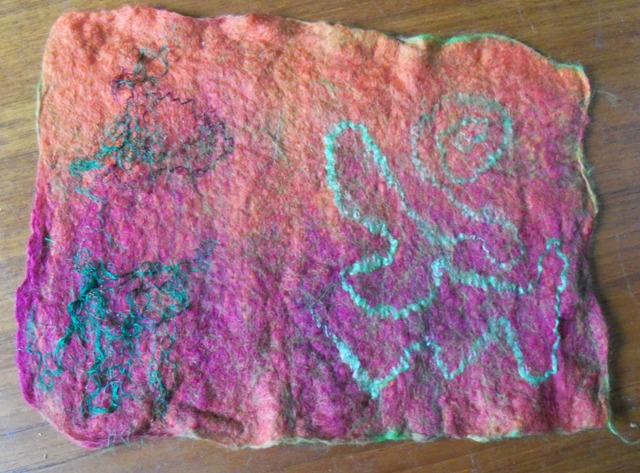
I need to design a picture or motif for the top of the cushion, or maybe both sides. I don’t want a boring cushion. I am thinking that on one side, I could use the wet wool outline technique I learned from Ildie here on the blog/ I could probably do my farm logo. Here is one of Ildie’s posts https://feltingandfiberstudio.com/2022/08/22/modern-art-wallhanging/. I did a mirror cover for my car in this style.

After shaving

My logo and farm name are not that exciting, so I will need to do something more interesting on the other side.

Maybe a mountain scene on the other side? But in real or bold colours, subtle or bold lines. I can’t make up my mind.

Maybe a bigger version of this Monet-inspired fish pond I did.

I have been working on the online Book Resist workshop. I have all the pictures taken and edited. I added them to the instructions, and now I need to fiddle with the layout.  I do have someone taking a look at it to find the glaring mistakes. After a while, it sort of all blurs together. In-person workshops are so much easier. I had planned the workshop as a 3-part workshop. Each part is self-contained, so I will do the first part as a workshop this fall and get the other two parts done for the spring, and then expand it.

Felted Cat Cave, a quick how to -revisited.

Felted Cat Cave, a quick how to -revisited.

I am supposed to have the summer off. So far, I don’t seem to have stopped running. So I have nothing new to tell you about. So I am going to share this with you again. I hope you enjoy it again if you have already seen it.  I am at a Demo today. I plan to take lots of pictures and blog about it on July 23. It sounds so far away, but I am sure it will be here the day after tomorrow.

I have been wanting to make a cat cave for some time now. I decided it needed to be bright. I picked some Blue Faced Leicester wool so it would be strong and dyed it chartreuse. Then I picked some purple and magenta for the spikes.

Spikes and Wool

I wanted an oval cat cave. I used my oval hat form to get the shape and gradually sized it up.

Drawing the Resist

I laid out 4 layers of wool for strength and even shrinkage. I put the first side aside, and after laying out the second side, I poked holes to put the spikes through.

Spikes in the Wool

After wetting it all down, I wrapped each spike in plastic wrap so it would not get felted down flat.

Spikes all Wrapped Up

I covered it with a sheer curtain and rubbed both sides for a while and rolled it for a while, and then wrapped it up, put it in the dryer twice, changing the position of the felt each time.  It was starting to shrink, so I cut out the resist and switched to rolling it in a stick blind. I find the stick blinds to be very aggressive and shrinks the felt quickly.  I did do some throwing, too. Finally, I rinsed the cave out in a bucket of alternately hot and cold water, being quite aggressive with it. I then had to stretch the top so it would be domed. I steamed it to heat it and make it easier to stretch. Mostly, I used a wooden spoon to push in a sliding motion to get the shape. Here it is on top of the resist, so you can see how much it shrank.

Finished Cave on top of the Resist

Here it is in use; it didn’t take long for one of my cats, Wu, to take up residence.


Cat in Cave

As a footnote, Wu (the queen of all things) is no longer with us. This is one of my favourite pictures of her. She really liked the cave; we buried her in it, here on the farm.

A Little Light-up Lantern

A Little Light-up Lantern

A while ago, I picked up a few little hanging displays.

I thought a little light-up sphere would be a fun thing to put in one.

I have a really small Tupperware lid that I used to draw around for a circle. It’s about 2 inches(25 mm) across.  Then I enlarged it. I drew the size of the fake candle in the middle just to see the size relationship.

I used some wool I had with sparkle in it. It is called Moss from World of Wools’ Glitzy collection. I did one thin layer as I want he light to show through. I am surprised at how well the sparkle shows in the picture.

Once it started to shrink, I popped the resist out. You can see it hasn’t shrunk much yet. I cut a fairly large hole as I want to put the fake candle inside.

I just kept going until I was at this size

It fits the holder just fine. It is still wet here. I had to take it home and stuff it so it could dry in the right shape. And now I’ve come to writing about it, I can’t find what I did with it.  I will search for it some more and hopefully find it for some pictures with the light inside before I have to publish this in a few days

Progress on my denim jacket

Progress on my denim jacket

My Studio post this month is about the stitching progress on my denim jacket. Last time, I had made a start on the centre back panel with a grid pattern. The colour of the thread is a muted green, similar to a sage green colour, I like it a lot. The thread I have used is DMC coton a broder, so, not a stranded embroidery floss, and the whole thread is used. My stitching is in the style of sashiko, but I do not regard my efforts as sashiko.

I do not have any sashiko thread, which I think is a little thicker than the coton a broder. I wanted to use materials that I have without having to buy anything new – my jacket being a (bargain) charity shop buy, and it’s pale blue colour does suit the muted colours of my thread. I may buy some proper sashiko thread in the future though.

Marking the grid.

I did buy 2 pieces of a ‘Solvy’ pattern paper sometime ago to try out – curiosity really, and I had seen some people use it on IG. The idea is to stick the paper to the item you wish to enhance or mend, stitch the pattern and then soak the item in water to dissolve it. However, I found it very difficult to stitch through (on denim), I found it was only possible to do one stitch at a time, as opposed to taking several bites of fabric without the solvy. It is definitely not the easy solution as described by IG or YouTube people. I used one piece, and extended the pattern on the rest of the back panel using a ruler and a Frixion pen. The first photo shows the Solvy paper in place as I mark my pattern, and a partial pattern completed due to sore fingers.

These two photos showing progress and the grid.

A YouTube channel, for such stitching that I like very much, is called ‘The Green Wrapper’; the presenter demonstrates on small squares of fabric, mostly a 10cm square, or a 20 cm square; text on the screen describes, and gives instructions to achieve the sashiko design. Sometimes she uses items of clothing to stitch on. I have followed her instructions, and they are really clear.

I drew some circles, some interlocking, using two different sizes of a drinking glass. I then drew the grid using 0.5 cm lines with the frixion pen, and followed the channel directions, and pausing the channel several times until it was stuck in my head! It is amazing that such seemingly complicated patterns can be made using a simple grid, and basically a running stitch. I used two other colours of thread (ran out of the green)


I remain undecided about what to stitch on the side panels; I have drawn a fan shape of lines radiating from the bottom upwards, but I will wait a while before committing with needle and thread.

I love how my jacket looks. I have worn it out a few times, and friends have been complimentary about it. I will do some thinking about the front of the jacket too, and will write more about it for next time.

Some of my photos remain large, I am sorry about this, but I did manage to make two of them a little smaller – hope for me yet!!!


CanGames and Felting Convention 2025 Part 2

CanGames and Felting Convention 2025 Part 2

Saturday

I hope you are well rested after your nap at the end of my last post. If we want to have accessible parking, we should get going early! Don’t forget to bring a bit of money, there are other vendors and the second-hand game sale is today. Now off to the car with an extra item (ok, Glenn was carrying the extra item). Wow, the highway in town is not busy this morning, oh yes, it’s Saturday, not Monday!

I am again set up by the open games area. I think they are used to me sneaking in beside them by now. Today I brought in my little Canadian wheel, the Lendrum Rook. Gord Lendrum, a Canadian spinning wheel maker, made about 40 of them in the mid-1980s. Mine needs a bit of repair, it was at least second-hand when I got it. The weaver spinner whom I was chatting with on Friday said she would be dropping by, I can show her how this one works and hope it’s similar to the wheel she has at home.

6.1) The Rook wheel and some pretty roving were added to yesterday’s felting stuff.

I worked for a bit while watching for the line to start, then it was time to line up for the sale. This year, I was second in line! Again, with the same person in front of me, last year I was third in line. This year, Glenn had me hunting for another train game. This one was called “British Rails”.  It still does not sound as fun as sheep.  While the organisers were setting up, they put a pile of train games close to the checkout. I was able to see them from the line! I know where to check first!

pile of games on the table more will be added. 6.2) A quick peek as the games are still coming in this morning to the sale and are being put out on the tables. By 10 am, the time the sale starts, games more than fill every table!

Last year, I had bought some of the games Glenn had brought in to sell, because they looked like ones he would enjoy.  This year, I know his badge number, so I will try not to do that again! Shortly before 10 am, I looked behind me to see how long the line had grown. It went all the way across the curling rink!…. turned and started up the far side of the rink, passing where my table was and extending past the open gaming section!!  Oh my! I am glad I am second. I put away boyfriend-mer, who I had been working on while sitting in my portable chair (ok it’s my studio on wheels… er.. alright it’s my walker) and got ready to shop.

looking back across curling rink to see the lenght of people lined up for the sale 6.3) The line goes across the curling rink and then proceeds along the far wall

10 am arrived, and they let the shopping horde surge forward. All of us are trying to fit into the confines of one little corner of the rink with tables stacked high with piles of games. Some were in rows on their side, but most were piled multiple games high. All the miniatures for war gaming were on the back table, I skipped that for now and headed to beside the cash where I had seen a pile of train games. (You may want to go the other way around the table and keep an eye out for the elusive sheep games! Even an alpaca game could be thematically fun?)

I picked up the train game he wanted, found a few more and spotted one of those unfun 18XX games Glenn likes, sold by badge number 118, oh Drat! He is badge 118, so I better not buy it for him!  There were lots of pretty boxes to look over. I was trying to shop for Glenn and find some games for my brother’s cottage, too. I even found another Sheep game to add to the collection. This one is for 2 players and has little wooden sheep tokens.  They are sooo cute!!!

I finally escaped the crushing throng of game seekers and made it back to my little table to resume work on the new mer-person. Building up his torso, now his head seems too small.. ok add more brains!  (think zombie voice “Brains”) Glenn returned from his morning train game, victorious (he came in first) and was checking over what I had found. I was successful in my game quest for him, and he was pleased with the others I picked up.

game with sheep on the cover6.4) “Agricola” is a 2 Person game about raising sheep. (We have not tried it yet, but the sheep are wooden and look very cute!)

pile of games on small table 6.5 Some of the Games I found, including what he had requested!

We took another peek at the games as the crowd thinned. Odd, I saw lots of things I had not noticed the first time. I added a couple more to the pile while Glenn got us lunch. The curling rink caterers are very good this year. I had asked for grilled cheese with bacon, but got a club sandwich, which was very tasty, but seemed short of the grilling and the cheese. Well, maybe we can have that for dinner?

I did promise I would get back to work on felt-related matters (this is a gaming and felting convention!).  I continued slowly building up the muscles on my new Mer-Boyfriend.

upper torso from the back of Mer person, felting needle sticking out of his back 7.1) stabbed in the back by a felting needle, but he has a bit more latts!

mer person lounging on bag of white core wool7.2) Lounging on the bag of world of wool core carded roving

mer person from the back starting to work on glutes 7.3) Ooh, I have reached the glutes and the first fins!! Oh, the possibilities, they have to be good glutes, to attract Miss Teen Mer back to the office when I get home!

Then I realised the weaver spinner I was speaking with yesterday should be arriving soon, back from her shopping trip to Wabi Sabi (that’s one of the local yarn and fibre shops in Ottawa). I had better get ready for her arrival and switched to my wheel. I have a bit of yarn on the bobbin and some of the same fibre left to spin.  Let’s finish spinning that and then wind it off into a double-ended ball. That means it’s wound so you can pull from the inside of the ball and the outside end of the ball at the same time. The advantage to this, over plying with two bobbins, is you always get to the middle at the same time from the outside and the inside piece! With 2 bobbins, often you have one bobbin still having yarn on it when you have emptied the other. The drawback of a double-ended ball is that it can all go horribly wrong and get tangled if you are not careful (and sometimes even when you are careful), but if you’re frugal or only have one bobbin, this is a handy way to ply yarn.  Oh yes, not all of you spin, plying is taking the single yarn you just spun and spinning it back in 2 layers or plys in the opposite direction you spun the single ply. See clear as mud! But it keeps your yarn balance if you do it just rite. If you knit with energised yarn, you can make diamonds instead of squares, which can be interesting but probably not what you wanted.

You can weave with energised singles yarn (there is still a good amount of twist energy present in the singles). There are some medieval fabric finds that are woven in plain weave (under over under over under over……). Because they are warped in little groups of yarn spun with the twist going one direction (Z) beside little groups with the twist going the other (S), when you take the fabric off the loom, the twist fights with its neighbour, producing what looks like some complicated twill all in plain weave. I will try to show you that someday.

Lendrum Rook spinning wheel with tiny scain of blue/green yarn7.4) cleaned off the little bit of yarn on the bobbin, ready for spinning.

I got back to felting. I continued to asked anyone who stopped to chat the questions; if they thot an Orca or Sturgeon boyfriend would be better….I continue to get the orca would look better, but the sturgeon voters kept reminding me about the horrible, possible slaughter of her family if she dated an Orca!

8.1 The open gaming section filled up after the game sale had slowed down and remained full all day.

mer person on table with foam nealing pad as work serface game going on in background 8.2) I added sewing pins to give me eye locations while I work. It’s getting very busy with games now.

Since there is no sign of the spinner/weaver, let’s take a quick look at what gaming is happening today.

There were games I had no idea what was happening, and battles setting up for carnage and slaughter

game with small shapes making a pathway with little meeples on the path 9.1) Not a clue what is happening, but they seemed very focused and having fun.

car racing game very pritty bord and extras 9.2) This is a racing game that was being played on the table beside me. Like many of the games I was seeing, it has lovely graphics.  Even if watching cars drive in a mostly circular track isn’t really your thing, it’s still really pretty to look at.

part of an army about to go to battle stored in top of box 9.3) Definitely impending carnage!

small painted buildings as part of playing area for combat game 9.4) Some of the war games with figures had very interesting architecture or terrains

town with trees set up as playing aria of this war game.9.5) This one had a part of a town, I don’t remember what kind of army was fighting through it. It was possibly more normal than guys in space suits from the other table.

Being set up at the other end of the hall from me was a large metal cube that rotated on a frame. That looks intriguing, shall we go have a look?

table in front has cards and robots for the game cube on the next table10.1) This game is for 12 little magnetic robots. You can see the little robots on the nearby table, all sides of the cube is where they will be racing.

close ups of game being played10.2) A robot racing game on a cube

This metal cube has magnetic-backed maps showing pathways on each side. The robots are also magnetic and will drive around the various sides of the cube. Each robot has a hand of cards; they have to select five instructions for their robot to follow like a program, and lay the cards face down in the order they want the robot to move. Everyone reveals one card at a time, and the movement occurs. Unfortunately, things can go horribly wrong when robots try to land on the same square or miss count and bump into a wall or other obstacles.

takgin a photo of one side of cube to figure out the next 5 instructions to give the robot10.3) A good strategy seemed to be to take a picture of the part of the board your robot was on, then select your cards from your photo(then hope for the best).

cube showing robots are now on 2 differnt sides of the cube  10.4) As you can see, the robots are dispersing on two sides now

5 cards layed out the first 2 are now turned up 10.5) They are working through the second card of this round.  They are having lots of fun, and it’s been fun to watch.

I wandered back to my felting but again got distracted by all the cool details in the  3-D printed dungeon architecture.

3-D printed rubble and castle doors10.6) You can see the layers, so those must be a sedimentary plastic rock, maybe sandstone? Such fine detail in the 3-D plastic!

skelitons in coffins and skelitons climeing out of graves10.7) These little skeletons were so cool, but where would I put them? I did enjoy looking at them over the weekend, and they were quite photogenic for skeletons.

Glenn has returned victorious in another train game, and I was wiped. Even though I had not seen the weaver spinner yet, it was definitely time to go home to sleep. You can stay on if you like, and I will meet you back here for day 3 tomorrow. I hope to get started on the fishy parts then!

Vessel Class

Vessel Class

I taught a lovely and fun group of ladies how to make a vesel. One of the ladies made a really nice Instagram reel. I am going to try embedding it here. Fingers crossed. It was hosted here https://hookingoutsidethelines.com/  I will share stills of the finished vessels below it. If it doesn’t work, then try this link:

https://www.instagram.com/reel/DI7Voy2xnr2/?utm_source=ig_web_copy_link


Here’s a group shot,

Here are some closer pictures of the vessels.

This one was cut across the circle about 1/8 of the way down to get the resist out, so she has a flat coaster, too


This one was also cut about 1/8 of the way down, but she opted for a shallow dish.

This one was cut just about halfway. She has two similar-sized bowls. Here, I was showing her how she could reverse them to have the pattern on the inside.

A nice round green one with lots of sari silk waste

Pretty pink with silk hearts on it

Jan told you about the sale we went to a little while ago. I was much better behaved and only bought a few things. Two small sample rolags and 3 bags of slubs. I have been wanting to try slubs. I know the neps are very hard to keep in the yarn when spinning, and do not like to stick to a felting project. I am hoping slubbs will stick better in both. If they do, then I may have to order some and dye them myself. One more thing on the to-do list.

Edge Exhibition

Edge Exhibition

I live in a coastal town in SE England called Whitstable. As a member of a group called Made in Whitstable (a loose affiliation of local artists & makers) we had a group exhibition coming up with the title of “EDGE” at The Horsebridge – our wonderful local community arts centre. We needed to produce at least one item that fit the Edge brief, however we wanted to interpret it. The rest of our work was entirely up to us. 

I could have got away with explaining that practically everything in my wet-felted pictures happens at the water’s edge, and it therefore met the brief. But I was actually quite excited to think through some new and different work. I particularly like working 3D and it feels like a while since I’ve felt really energised by the creative process. So, I thought about what ‘edge’ might mean and I ended up making 3 different interpretations.

Edge 1

For my first piece I pondered the edge of the felt as a focus of a picture. 

I decided on a flat background with strips of felt jutting out to show their edges. I’ve made things like this using multiple resists to create flaps that then stand out. I wondered if I could pre-felt some strips before attaching, rather than creating flaps with resists in the lay-out stage. 

I selected some home-dyed Corriedale wool I had left over from an old project. Just as I’d decided to use this I noticed how well the colours went with a second-hand silk scarf I’d just bought so I decided to use some of that too. 

Home-dyed Corriedale wool and charity shop silk scarf

After I’d laid it out, leaving a fluffy edge to help attach it to the background, I realised I’d made it far too wide. “Oh well”, I thought, “I’ll cut it into strips once it’s prefelted”. I’d intended this to be a test for a more thought-through piece.

I decided to stick with what I’d done and move on to something else: I never made the more thought-through piece.

Edge 2

For my second piece I started to think about the outside edges of a shape. I decided I’d try using a book resist to make a vessel with a large surface area. 

I scanned the internet for book resist ideas that didn’t have too many ‘pages’. I alighted on an article Gladys Paulus (a felting hero of mine) had written for DHG comparing bergschaf and merino wools in which she included a 3 page book resist.

https://dhgshop.it/blog/article-compares-carded-wool-bergschaf-and-merino_88.php

I decided I’d use a similar shape using black and white wool but would cut and shape it differently from Gladys’s. 

I wanted to use carded batts as they’re much easier to lay out than tops / rovings when navigating complex shapes.  I had a good supply of white Norwegian wool batts but was struggling to lay my hands on anything appropriate in black.  I found a black merino batt and decided to go with that, though I wasn’t sure how the wools would interact, with the Norwegian being much more coarse than the merino.

Book resist
Starting to full the shape

The Norwegian wool was slow to felt and the black merino didn’t come through as much as I’d imagined. Interesting, if not surprising.  Eventually I ended up with something that looked decidedly anatomical: three lungs was the most polite thing I could think of.  I got a lot of comments about the anatomical possibilities of this one!

The vessel is an odd shape so I decided to embrace its oddness and bought some curved screw-in metal studs to add to the top of each segment. Given the brief was ‘edge’, I thought these would add a little extra edginess.

Edge 3

And, finally, I created a vessel using a circular resist that I would stand on its edge.  I’d recently bought a carded merino and silk (70% : 30%) batt from World of Wool that I was dying to use – it is deliciously soft and scrumptious to feel.

I laid out the first layer clockwise around the resist, and the second in circles radiating from the centre. 

Having wetted the fibre out, I turned it tightly over the resist then set about laying out another two fine layers in the same pattern.  Or at least, that’s what I intended. Looking back, I think I got distracted and may have only laid out two layers on one side, as the reverse side feels decidedly thin and soft, despite long and patient fulling.  Distracted? When I’m making something I’m finding fun, I tend to add lots of “what if”s and “how about”s instead of sticking to my original plan. See the ‘ooh, shall I add some silk’ for Edge 1.  On this occasion my “how about”s included a stripe of mohair tops, a dark circle cut from Edge 2’s offcuts (one on each side) and a strip of curly locks.  Fun, but not very scientific.

Adding ‘stuff’

Anyhoo, here’s Edge 3.  It does feel lovely and is very light but I wish I’d paid more attention to the layout.  I’m tempted to make something similar with a 6 layer layout.

In the meantime, here’s my exhibition space. I was pleased with the results and had very much enjoyed making three experimental pieces. 

Before I leave you, I thought I’d show you a natural phenomenon I saw while I was making my edge pieces. Being lucky enough to live by the coast, I often have a speed walk in the morning by way of exercise and enjoyment. It was a clear and sunny early morning when I noticed some mist rolling in. I saw a puzzling white arc in the sky – sort of like a rainbow except it wasn’t raining. I decided it might be a ‘mistbow’ and looked it up when I got home. Turns out it’s called a ‘fogbow’. It’s unusual as you have to have very specific conditions: enough mist or fog to reflect the sunlight but a low sun behind you which isn’t obscured by the mist / fog. The water droplets in mist are very small so don’t refract the light like raindrops do, they just reflect it. It’s also called a ghost rainbow. I saw this photo while I was uploading the images for this post and thought you might be interested. I’d never even heard of such a thing but I found it really lovely.