Browsed by
Author: mariees26

Retired Nurse Practitioner. Irish Woman abroad. Devoted granny.
More work on my blanket.

More work on my blanket.

I am making progress with my ‘found’ blanket, and I have decorated another corner of it with some needle felted flowers. Again, I have used some more of the plants from my garden as inspiration.

The flowers I used last time were from spring  – tulips and primulas – and Spring seems such a long time ago now. This is a photo of the first corner I wrote about for that post.


The plants that I have chosen for this corner of the blanket are from the summer flowering groups. I have chosen alliums and some ‘red hot pokers’, as they are commonly known – the proper name is kniphofia, but I think red hot pokers sounds so much better! This photo is of some of my alliums, and pokers, but I have cropped the photo too much I think – but I hope that you get the idea.

I love purple and orange in the garden, I think they go together really well as a plant group.

I have needle felted my picture, and then wetted with water and the use of some soap to encourage better adhesion to the corner of the blanket. Some yarn is added to give the impression of stalks. I used some little scraps of orange felt for the pokers.


These orange scraps did not show up very well in the photo, so I have used a little orange acrylic paint to enhance the colour.


Now to decide what stitching to add, and hopefully add some definition. I used some french knots in a lighter colour of floss, on the alliums, in an attempt to highlight the little individual tiny flowers, that form each allium. These little individual flowers on the alliums provide food for bees, and make a lovely dried seed head to add interest later on in the season.


I used a fly stitch on the pokers, and I have couched the yarn ‘stalks’, both done for added security in the event of inquisitive little fingers in the future.

I am pleased with my progress on the blanket, it is really nice to take time to think about plants and seasons when doing something like this, instead of the constant rushing and wishing for the next lot of plants in the garden to show themselves.

I have two more corners to decorate, and I am making plans for that – well thinking about it anyway!

So, this photo shows both corners together, leaving me an impression of spring and summer in my garden.

My aim for the final two corners is to have an autumn and winter feel, perhaps with some seed heads and leaves.

Decorating a small blanket

Decorating a small blanket

I spied a small woollen blanket in my local charity shop earlier in the year. I think it probably was used as a cot blanket earlier in it’s life. The blanket measures 38 inches x 46 inches, the colour of cream and has a lovely blanket stitch all along the folded edges.


No label on the blanket, but it is wool, and there are one or two nibbled areas from one or two moths.


I have a plan is to turn this old unloved blanket into a usable blanket for the younger grandchildren when they visit – to use in the house, or as a car rug, or to cuddle up with if tired. I will add a soft backing to one side – either a piece of flannel or fleece, and that should prevent the itchy scratchy feel of a woollen blanket that so many of us will be familiar with.


I decided to add some colour to each corner, and perhaps along the sides, throughout the rest of this year, and it may be done for Christmas time. I found my bag of scrap felt pieces and made a few layouts until I was happy with one that provided some colour and interest.


I have stitched these shapes down using my sewing machine. These pieces of felt are left from other projects, and some are prefelt (probably) and are placed with some artistic licence. I used a needle felting tool from Clover (green/yellow) to secure the pieces to the blanket, and I was quite surprised by how well it worked. I also have the fake/copy item (blue).


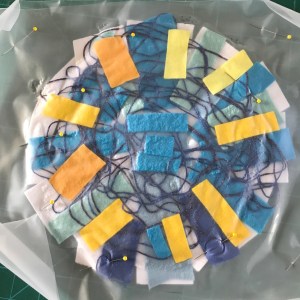
I continued adding to my layout, trying to give an impression of a little piece of my garden.


To secure the work thus far, I decided to add some water, soap and some friction to ensure that everything will stay well and truly stuck on.


I will continue working on this blanket through the rest of the year, and will show my progress in my posts. I am pleased with it so far, and now I must think of what to do for the next corner. I will also  attempt to cover with some wool or embroidery stitches on the areas where some moths have had a lunch or two. A little needle felting and some embroidery stitches should do the trick.

The garden is looking so nice despite all the rain we have had so far this year. Here is a photo of a bumble bee on one of the alliums, no matter how hard I tried he would not stay in one spot, and my beautiful peony with so many blooms, and keeping fingers crossed that they survive the rain.


A New Lampshade.

A New Lampshade.

I have been searching for a replacement shade for a pendant light for some time, but I was not having any success with finding something that I liked. So I thought, how difficult can it be to recover a lampshade?

Some years ago I tried to make a wet felted bowl, but somehow it all went wrong, and I could not get the bowl to ‘sit’ right. I had a table lamp that needed a shade, and as I was looking at it, and my felt bowl, I had one of those ‘lightbulb’ moments – sorry! I re-wet my ‘bowl’, then cut a hole in the middle and after some tugging and a little more trimming, I managed to stretch it over the lampshade frame. I liked the look of it very much, it fitted very well too, so I hand stitched along the top and the bottom to neaten, and to prevent both edges from becoming undone.

So, now I have another lamp shade frame that I want to make a cover for. I found a ‘how to make a lamp shade’  book in my library, and I borrowed it. I wanted to make some nuno felt to use as the fabric outer. I made 2 pieces of nuno felt using 2 different shades of green mixes of merino. The base fabric is a very fine open weave cotton, that in a previous life was a lightweight curtain.

Making the shade.

This involved a few steps; I read the appropriate sections in my borrowed book several times, and then made sure that I had everything I needed. I planned to make and hand stitch each panel to the frame; the other method is to sew all the panels together using the sewing machine and then stretch it over the frame, and hand stitch the top and bottom to the frame. This method is quicker, but the fabric needs to be cut on the bias to allow the shade to stretch over the frame.

The frame is wrapped in cotton tape and secured with a stitch. Each metal section/strut is wrapped in tape. Not all hand made shades will require each strut to be wrapped, but the top and the bottom will need to be wrapped.

Lining.

I used a white 2 way stretch jersey to make the lining for the shade. I cut 2 pieces and stitched to the inside of frame, folding and gathering as I progressed. Lining is desirable if you do not wish to see all the stitching when viewing the shade from underneath, and it gives a nicely finished look to the shade.

Pattern for a segment.

My shade has 8 segments. I traced around one segment on some paper, cut it out and tested how well it covered a section between the struts.


Cutting the fabric.

I cut 8 pieces, 4 from each colour, on the straight grain. Sometimes the fabric will need to be cut on the bias, but I did not need to do this. The fabric needs to be held tight between each strut, not quite drum tight, but not loose or floppy either.


Stitching each panel.

There is a special stitch used to attach each panel piece to the frame. This is called a ‘streetly stitch’, it is a locking stitch and it firmly secures each fabric panel to each section of the frame. In this instance you can see this stitch on the white lining fabric more clearly than you can on the nuno fabric. This stitching can make for very tender/painful fingertips trying to push the needle and thread through the fabric and the tape, while escaping the pins at the same time.


I neatened all the edges with a small sharp scissors, as each panel is completed,  but without cutting any of the stitching. I did not want to restitch any part of the shade.

Attaching trim to cover all the seams.

Trim is attached to each seam and top and bottom of the frame. There is a huge selection and variety (and price) of trim available, and the search can encourage many trips down various rabbit holes. Trim is attached with glue, either hot glue, or fabric glue from a tube. Care and attention to detail while attaching the trim will ensure that the newly covered frame will look really nice.  I soon forgot about my sore finger tips.

I did enjoy making my lampshade, and I hope that I have explained the process I used well enough for you all to understand. This is a view of it in place in the bedroom used by the grandchildren when they stay over.

The book I borrowed from the library is called:

Sewing Lampshades by Joanna Heptinstall; Search Press 2018.

Valentine hearts.

Valentine hearts.

Valentine’s Day is almost here, and many a lovesick young man or woman will be in agonies deciding whether to buy, or make, a love token or two for their heart’s desire. Or, will they wonder if all that effort infused with such emotion, will be appreciated or even reciprocated?

No? Yes? Too much drama? Stick with some tasty snacks, yummy chocolates and a lovely bottle of red to enjoy on my own? That will be me then!

Anyway.

I will join in, my grandchildren will have my love with these felt and fabric hearts filled with lavender from my garden, to place with their clothing in their wardrobe or chest of drawers. And as always grandchildren are my heart’s desire these days.

I have used some left over pieces of my flat felt, and some fabric that I have cut into heart shapes.

This is the front and reverse of each heart

A heart shape of red felt with a smaller heart shape on top.

  Another red felt heart with a smaller felt heart on top


A felt heart shape multi coloured.               


Two fabric hearts, a lovely purple batik. This was a small piece of fabric picked up in a charity shop.

Purple fabric heart shape

The hearts have been stitched these together using hand sewing, and decorated each with another smaller heart shape, mostly for interest.

I have a jar dried lavender left over from last summer, a couple of spoonfuls used to fill the heart shapes, and after filling the shapes, the opening has been securely stitched closed.


A jar of dried lavender

A little ribbon attached to the top and secured with a pretty button and these little hearts can be hung on a garment /clothes hanger if wished, or stored in a drawer. Either way the lavender fragrance will hopefully remind them of me.

Red buttons and ribbon 2 red heart shaped buttons, and 2 other red buttons

This is the finished look of my felt and fabric hearts. I think they are pleasing to look at and they smell lovely too!


It is pleasing to see that my lavender shrubs are all putting on a fresh show of growth for the new year, and I can look forward to another crop of lavender for drying in the summer. Must remember to leave some for the bees though.


Lavender shrub


PS.

I seem to have got all my photo sizing mixed up this time, despite all best intentions of Ruth and Helene. I am sorry. I have a new phone too, mine had developed the battery life of a gnat, and had become very annoying.  The new photos on my phone are not behaving on my laptop. Hopefully I will figure it out before my next post – fingers crossed!

Completing my sample book.

Completing my sample book.

The previous post on the start of my sample folder is here:

https://feltingandfiberstudio.com/wp-admin/post.php?post=60081&action=edit&classic-editor

For the pages of my folder, I have used some more pieces of the linen sheet that I had discovered in a charity shop. The pages I have made are double sided, so I have eight pages in total, along with the front and back inside covers.

I stitched some more pieces of fabric, and the fabric elephant shapes to the pages. The fabric pieces are hexagon shapes from a previous project some years ago.


I have also used 2 fabric placemats, and I stitched these to 2 of my linen pages. These are not really practicable for use as placemats, but they are very decorative items. They had been gifted to me by a family member following their visit to Japan some years ago. So I have more of them for other uses – I wonder if I could use a couple for nuno felt? An experiment for next time perhaps.


The linen sheet is really interesting.

There is a line of fine mending on the linen that is not immediately noticeable, but on closer inspection it is more visible.  See below photos. The repair to the linen is lovely and gives further life to this fabric. It can be imagined that it’s life was not part of a ‘throwaway’ culture that is often talked about today. The cloth can still be used as bed linen or to make clothing, and now, many years later it remains useful to me. I think this repair shows how skilled women and girls were at mending and needlework. Fabric may not have been as plentiful or affordable perhaps, world conflicts will have impacted many people, and make do and mend became the norm.


I have placed some of my flat felt sample pieces in my folder.


The pages are attached along the centre of the folder using a few stitches with embroidery floss and tied to secure.

I am really pleased that I have a place to keep these little pieces, and that I will know where they are in future rather than rummaging around in various drawers/boxes. I may add more pages in due course.

Fabric folder.

Fabric folder.

I needed something to keep my various sample pieces in one place, and that I would know without much head scratching or searching around for any particular piece of work. Of course, I would need to not misplace this folder too!

I had a fabric tote bag that had become a little frayed at the edges of the straps; the pieces of tweed used to make the bag were fine, with no damage or fraying. The bag just needed a wash.

The bag had been a Christmas present to me from my daughter several years ago, and I used it daily. I am not a ‘bag’ person, that is, having a bag for every and any social occasion, or day of the week for that matter. This bag was made at Garvald Textiles, this is a textile studio offering creative opportunities for adults with various learning disabilities, and the studio sells many of the items made by the artists there. My daughter worked for this registered charity in Edinburgh when she lived there some years ago, and much of her present buying that year was made from this source. Leonor may be aware of them, I think she lives in Edinburgh? Photo of the label attached, and remaining leftover bag pieces.

I have made another bag for myself from scrap pieces of tweed fabric bought when I visited Harris in the Western Isles.


To make the folder, I cut the body of the bag into smaller pieces and the stitched them onto a shaped piece of spare calico. I was hoping that I would have enough squares, but I did use another spare piece of tweed to complement the colours. I used my sewing machine to zig zag each piece together onto the calico. The size I was aiming for was an open A4 folder.


For the inside I choose to use up many small pieces of fabric, and to quilt them on to another piece of calico using a ‘crazy’ quilting theme, and also using hand stitching/embroidery. I embellished some pieces with embroidery, a piece of lace, a crinoline lady, and a couple of heart shaped pieces of fabric. I had 2 vintage hankies, and these I folded into ‘butterfly’ shapes and stitched them down

Both the inside and outside were completed separately, and then stitched together, inside out, before turning the right way out and securing the opening. I did think of adding some bias binding to the outside edge, but in the end I just stitched all around the edge with a blanket stitch.

I added a few felted leaves to the front of the folder, I had made these ?last year, and I think they complete the folder front very nicely. I added 2 pieces of ribbon to use for closure, but I will review this in time for my next post, and I will add some ‘pages’ to my folder to attach my work to.

I am very happy with this piece. I have reused some items, and other pieces I used were already in my fabric scrap box.


A new life for a coat.

A new life for a coat.

Another clothing post from me this time.

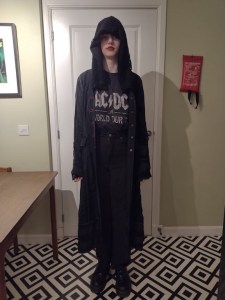
I found this coat in a charity shop. It is a long/mid calf length coat from a UK/British designer, the label has ‘Out of Exile’ on the tag inside the coat. I was not aware of this design label, but on checking with Mr Google, this brand does make desirable items of clothing and, are expensive to buy new. I paid £5. The coat had a good weight, and is probably a viscose mix fabric. Please excuse this photo, it is the only photo showing the coat length that I managed to keep on my phone. I probably need lessons in photographing black fabric!

This coat is destined for No 1 grand daughter – she loves dark/black clothes and loves a ‘Goth’ image. I showed the coat to my daughter and she liked it too, and agreed that grand daughter would love it.

When I inspected the coat, I could see very little damage. There was a little tear at the back, and the buttons were a little loose. The damage looked to be easily fixable. No 1 grand daughter loves a hood, so I did have to think about how to make and attach one, I do have a large hood on my raincoat, so I made a pattern from that.


To repair the tear at the back, I used a piece of ‘grunge’ red cotton fabric. I cut a diamond shape and stitched that to the coat using a blanket stitch also in red embroidery floss. The coat is unlined, so I used a little black interfacing at the back of the tear. I cut two more diamond shapes of the red fabric and attached one to each pocket flap using a blanket stitch. I loved the effect of the three patches on the coat.


The coat has beautiful black shiny oval shaped buttons, and all were intact – no marks or scratches seen. I restitched the buttons using the red embroidery floss, and then restitched the button holes using the same thread. I added some black stabiliser to the rear of the buttons for strength. There was a little weakness there, but no tears were visible.


Fabric for the hood was very troublesome to find. Who knew that there could be so many shades of black? Anyway, I did find some that I was happy with – a dress from the charity shop, that had a lace overlay. I used the lace to make a outer layer of the hood, same pattern as the hood. I am so very happy with the coat and it’s new look, even though the photos don’t do it justice. I managed to salvage enough lace to attach a little frill to the cuffs as a finishing touch.


I am sorry that some of my photos are not of better quality, the model was less than enthusiastic on the day, and occasionally she is just not keen on modelling clothes for her Mum.

I do love mending clothing, and trying to fix a problem area on an item of treasured clothing that has been well made, rather than consigning it to the waste bin. Thank you for reading.


A Scrap Felt bowl

A Scrap Felt bowl

Click to access felt-scrap-bowl-tutorial.pdf

It has been a busy month for me, with family visits, and babysitting duties. With all that excitement I had totally forgotten that my scheduled post for the forum was due until the other day. What to do?

I have been wanting to try Ruth’s scrap felt tutorial for a little while, so I thought this is an ideal time to try my hand and make a bowl. The link for Ruth’s tutorial is above.

I have some pieces of commercial scrap felt in a variety of colours,  bought some time ago from a craft shop sale. I also have some small pieces of me made felt. Some glittery yarn was used. I found some Madeira Avalon water soluble firm stabilizer in a cupboard. I used a 12″square of the Avalon, or rather 2 squares of it, and sandwiched the felt pieces, and the glittery yarn in the middle. Ruth suggests to very lightly dampen the felt pieces to stop them moving about; I very lightly spritzed the arranged felt pieces before placing the water soluble Avalon on top. This definitely stopped the pieces moving. I placed a few pins around the edges to secure, and transferred to my sewing machine.


Stitching, was as Ruth suggests, in a circular pattern starting around the outside edge, and working towards the centre. Then further stitching in a spindle/spoke pattern to further secure all the pieces. All the pins are now removed and nothing is moving! Then I made some small circles all over the piece in a different thread colour.


Completed stitching, top and bottom.

The water soluble material was trimmed and I rinsed the piece in some hot water, for perhaps 20 – 30 seconds. Ruth suggests that some of the stabilizer should remain to help stiffen the bowl as it dries. I placed the felt over a glass dish to dry overnight.

I changed the dish to a tin of beans after an hour or so, and I think it will provide a  better final shape. I am really pleased with the outcome, so much so I made another bowl and that is drying just now. The second bowl is more ‘holey’ than the first, both are very firm, and wondering if I should have rinsed out more of the water soluble.

Photos of completed bowls, and holding some spools of thread (4 large, 7 small).


Thanks for the tutorial Ruth, I really enjoyed making them.


A cushion cover

A cushion cover

I feel that you can never have too many cushion covers for cushions. They are such useful items of soft furnishings, and they can help brighten a room in no time.

My offering this month is a mixture of felt, thread and fabric waste, and free motion stitching to make a cushion cover. I wanted to give the impression of looking into a puddle with leaves floating on top.


This is the front and rear, before cushion cover making.


I used a variety of left over threads, pieces of felt, and fabric trimmings. I placed all of these on a piece of white fabric, and covered everything up with a piece of tulle. This was stitched down very securely, and it did begin to look as if it was a watery puddle.


I had some pieces of felt, left over from another project, and I cut some leaf shapes from this, and placed them over the stitched down tulle. I added some leaf veining as I arranged and stitched them down, in a fairly random placement on the surface.

I do think it turned out quite nicely. Then I had to choose some fabric to complete the cushion cover, in a colour to complement the orange leaves. I had found some purple fabric with a oil slick type pattern, in a charity shop last year, and as soon as I placed them side by side I knew it was a perfect match.


When I was in hospital, there was a good view of some trees from the window of my ward. This is a tree that I became fascinated with. I am still convinced that I can see Mr Mer sitting in the branches! Maybe it is just me!!


Further thinking and stitching.

Further thinking and stitching.

When I worked on the stitched piece for my last studio post, I still had a decision to make about adding ‘something’ to the central square. I had left it blank and I was unsure about whether or not to add anything to it. Looking at it again in time for this post, I decided to add some more fabric scraps and further rows of running stitch to secure them to the background linen.


This is my stitching as I had left it on my previous post.


I have added a variety of small fabric squares into the centre blank square of my stitched piece, and I have managed to fill the blank space quite well. The fabrics I chose complement the fabrics that are already on the outer border, and measure about 1″ – 1  1/2″ square ish!

I have added a row of double herringbone stitches at two edges of the stitching, to secure the edges of the fabrics that I feel are not secured well enough with the running stitch.

The orientation or direction of the stitching echoes the outer border.

Whipped running stitches add definition to the inner square, and to the outer smaller squares, and add to the overall effect.


I have really enjoyed adding more stitches to this piece. I continue to find stitching very mindful, and calming. I am so pleased that I found this linen sheet at the charity shop that day, a lovely happenstance.

I think the completed work looks good, I will decide about adding some machine stitching and perhaps a little applique, as another layer when I look at it again.  Open to suggestions from you too of course!

I have another hospital stay looming when this post is due, so I probably will be late in acknowledging comments, but I will read them.