I am still not up to the next step in the phone-carrying project, mega-stega-blob (fibre layout and wet felting come next). No, I am not just avoiding getting wet! I have tried to do non-offensive activities beyond lying down, watching movies and reading my audiobook (mostly not all at the same time). Monday I got to the guild studio and worked on the library (the books felt heavier and more tome like than usual.) Tuesday I pulled photos then pulled weeds, while sitting and started my blog chatting with you! Since I am still waiting for a few items from Aliexpress to arrive, (they may be in a literal slow boat from China) I think I should consider a few other aspects of the topic they will cover. (Ooh I’m being verbose, cryptic and obscure! I am defiantly feeling better!)
Recently I have had a few different questions about aspects of safety. I want to chat about how to keep you and your needles safely not attached to each other, by stabbing, poking and other forms of impalement. I have been making a chart of the different types of options and want to also test them, with Ann, with the enthusiastic needle felting tools we both purchased last winter. The chart is underway, but with more possible safety items on their way, let’s wait on that aspect of safety.
Instead, let’s turn from the sharp pointy blood-inducing excitement of needles to something softer that can also be dangerous to felters. Wool (and other fibres). What could be dangerous, concerning or even caution inducing about wool? It’s so soft and fluffy! It has that lovely sheepy aroma when it’s fresh off the sheep. Sometimes it’s even still warm if it’s really fresh off the sheep.
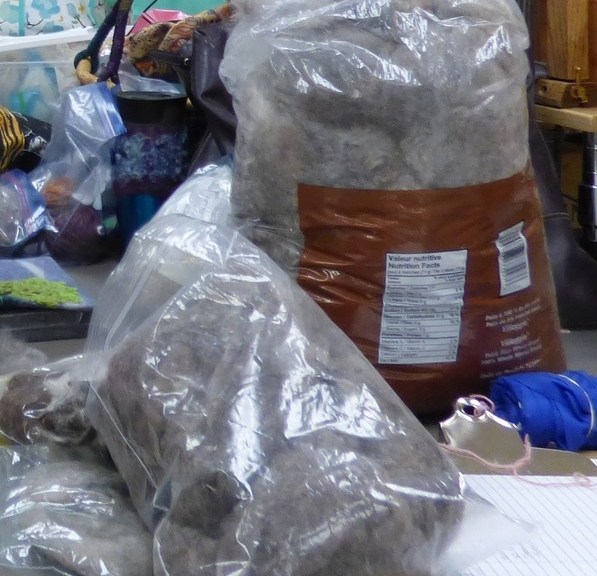
 skirting dirty raw wool at the OVWSG studio.
Ok you can get muscle aches or strains washing it, wet wool is quite heavy and moving big bins of water around can defiantly get painful. When I phoned my doctor to mention my tetanus shot was due and I was about to wash a bunch of dirty sheep fleece, she had me come in the next day to get my booster. (This was near the start of covid when restrictions were most enthusiastically applied, so I was very surprised at how insistent she was that I should come into the office and have the tetanus shot before working with dirty wool. I would rather be safe than sick or sorry. Even if it means getting the other kind of needle.)
Most of us avoid any thoughts of buying aromatic wool, tetanus or the fun of skirting a fleece by just purchasing prepared fibre, usually even pre-died.
So if you are avoiding working with raw wool in your endeavours, have we avoided all potential problems with wool? No, but don’t rush off to throw out your fibre horde of fabulous feeling fibres and colours!! The precautions for wool are quite specific and can be mitigated. As you probably remember I love anatomy, physiology and pathology. I know not everyone is quite so excited about how it all works or how it all can go wrong! So I will not get into the details of alveoli to capillaries’ oxygen exchange (whew, I bet you are breathing a sigh of relief and thankful there is no exam at the end of this post!!) You are likely already aware but I do want to mention a bit about the historical problem with the wool-to-yarn industry.
For many activities or professions, there is a pathology associated with it.
- Tennis has Tennis elbow (lateral epicondylitis),
- golfers can get golfers elbow (medial epicondylitis) or
- Weavers can get Weavers bottom, (a false bursa on the ischial tuberosity). Weavers get their pathology from many hours of rocking side to side while sitting on a hard loom bench.
By the time of the industrial revolution and the introduction of large mills, we see a rise of a pathology with wool (Wool Lung) and a slightly different one (Byssinosis) associated with breathing in cotton dust or dust from other vegetable fibres such as flax, hemp, or sisal. This was exacerbated by working with the fibres in enclosed, poorly ventilated areas (the mill buildings) for long periods of time (working for years, at 6 work days a week).
The pathology wool lung is neither as cozy nor warm as it sounds. (Wool lung sounds like someone kindly wrapped your lungs in a soft fluffy blanket of wool.) The way the pathology works is that small airborne particles lodge in the lung. Over time these partials make breathing increasingly difficult and interfere with the lung’s ability to bring air into the body. A similar problem can develop with breathing in dust from other vegetable fibres. If you are a weaver look under the loom after you have woven a tea towel with tow linen, (for non-weavers, you probably have a lot of dust and bits of broken fibre under the loom to clean up.)
There is another potential problem with wool, (even if you skip working in an early industrial mill, and avoid raw fleece processing), is the nature of the fibre and its ability to get airborne. Think of it as the quality of fluffability. Finer fibres, shorter fibres and older brittle fibres that can break into even smaller pieces will all become airborne more easily than courser, heavier, and longer fibres. I have found that I have the most airborne fibre particulate from older dry short fibres. Fine fibres that attract static can also be problematic.
Grater fluffatude: Fibers and parasitical are more likely to get airborne.
- Finer,
- shorter,
- older fibres that are dryer and prone to breakage,
- dusty fibres
less fluffiness: are Less likely to get airborne
- course,
- longer,
- less fragile fibres
In my stash, I have many types of fibre. Some are brand new and recently acquired and some are quite old, second-hand acquisitions or appreciated gifts of often unknown age. I have a few bits in the fibre stash that are brittle and quite suspect but are just the colour I wanted. So if I don’t want to just avoid using fibre that I suspect may have nefarious plans for my health, there are ways to keep us safer. (Re; not wanting to throw away fibre may require Fiber AAA: I have trouble throwing out wool, I know it’s a problem but the first step is to admit it is a problem.)
Most fibre we use is not a problem or is only mildly so. If we have decided to keep a fibre we know or suspect is problematic, that the fibres are likely to get mobile and try to end up in our lungs, what should we do to reduce this possibility?
There are a few things we can do to mitigate getting fibre, dust, and bacterial content from the fibres, into our lungs.
Keep the fibre from getting in the lungs: (its so much nicer when wool is on the outside of the body)
- Protect your lungs. We all have N95 masks from the pandemic. There are also wonderful repertory masks, with even finer particulate-blocking abilities. (They are more industrial looking and are not as stylish as the blue medical ones from covid). (There is more about this at the end of the blog)
- Improve ventilation. This can be working in an outside studio (when weather permits), or using a good air filter if you are working in a smaller indoor studio. I would not suggest an oscillating fan near your fibre work to improve air circulation, that can go terribly wrong –think parts of your 2-D picture can decide to just wander off as the fan turns farther than you thought it was set to turn!!! I guess that mountain was not inclined to be there, (like the Frank slide the mountainside got up and left!) we will now have to add a grassy plane or maybe more sky?
- Label your stash, if you cannot part with something that is problematic, (but the colour, crimp, or lustre is just too good to part with) label it or leave a paper mask with the bag so you will remember to avoid getting wool on the inside of your body.
- Be aware of which fibres are likely to get airborne (short, brittle, older, or finer) and protect yourself if those are the fibres you need to use in your projects.
- Check with your Doctor, If you are going to be working with raw wool or doing fibre prep, of wool or other fibres, you may want to check your tetanus shot is up to date. We used old slightly rusty hackles when processing flax and I have never seen a sheep have a thorough bath before getting their haircut! So, I suspect the enthusiasm of my doctor to make sure I had mine was not just her wanting to stab me with a needle. (really I don’t bug her very often!)
- Reduce static: Ann had a spray bottle to mist fibre as she used her big drum carder. This reduced static and thus reduced the amount of fly-away fibre. Misting wool, if you are needle felting, may be problematic if you get the wool too wet. Wet wool can reduce the life of the needle. I have heard that leaving a dryer sheet, (or a piece of cloth that had been soaked in fabric softener (unscented) and left to dry will work) will reduce the static in fine loose fibres like angora rabbit.
- Use the weather to help you. (this is probably more of a sub-point to #6 (maybe 6.1) but it’s nice to have lots of options) Use the weather to help you keep the fibres in line. if it’s humid, as it tends to be in parts of our summers, fibre is not as likely to get airborne as it will if the humidity drops which happens in our winters.
- read #1 again and don’t forget to wear a mask if you are working with problematic fibres.
Masks a quick overview of options:
 Dusk mask, medical mask and 3 types of fibre (Short turquoise, older dry brown top and unwashed short locks)
Masks come in various options, from large full-face and half-face air filtering masks, (they look very cool and Sci-Fi but may not be the strong fashion statement you wanted to make while working.) I have a half-face mask with the lovely double respirators but took it to a workshop and now I can’t find where it is. If you ask Mr. Google to show you a “Half face woodworking respirator mask” you can see ones similar to what I picked up at Princess Auto on sale. There are other options that are less striking in their fashion statement in case your workspace may be visible to others. (this may be a good option if you have preexisting respiratory issues.)
I also have what used to be sold as a painter or dust mask (possibly for automotive painting?) the Dollar Store used to have them regularly. They hold the mask away from the nose so are more comfortable for some people.
 “Dust mask” in packaging N95 designation
You may still have the blue paper filter masks that were very popular (or unpopular in parts of Canada and the States). I was ahead of the crowd and had one hanging by my office desk for use with old dry wool well before covid arrived. I have since used up all the masks I had for work and for wool, stupid covid.
 Short fibre, this particular fibre is standing in for some of the equity short but much more fly away fibre that is hiding in the basement and would not come out for the photo shoot.
Not all fibre has this problem, in fact, most do not, but if you bump into some that make your nose twitch and your Kleenex seems an odd colour when you sneeze (the colour of the wool you’re working with) then its time to grab a mask, improve the ventilation, use an air filter in your studio or use the outside studio, and reduce the static/lack of humidity. Once the offensive fibre is well embedded in your wet or dry felting, it should not be a danger to us or others, being that it is no longer airborne. (Well, unless you are using some fabulous aroma added to your felting work and there is a lot of wool sniffing going on!) hummmm….. no don’t get distracted!
I am hopeful I will be back to the Mega-Stega-Blob soon! Have fun, stay healthy and keep felting.
Like this:
Like Loading...