
What is a balanced yarn?
Weaving and all its assorted challenges were starting to get me frustrated, coupled with the instability we all have faced made me step away from any challenges. So I went back to my spinning wheel and a delicious bag of dyed locks from my favourite indie dyer. The breed remains a mystery, but the length of the locks, softness, crimp is fantastic.

I seldom do lock spinning with anything this long. I know other spinners do amazing work with long wool, but I’ve never mastered the skill, so I flick card the fibers on my hand cards and use the opened locks to spin a worsted/semi-worsted yarn.


The locks were anywhere from 6 in. to 9 in (16 cm to 23 cm) and spun a single that was more than forty wpi, so it was extremely fine. Just as an example of what 40 wraps per inch looks like …

When I get a single this fine I do not use a centre pull ball for plying. The tendency for tangles to form in the core of the ball and pull out in a nasty mess are constant and dealing with that just ruins the spinning experience. I much prefer plying from two bobbins, which is what I did to get my puzzling results.
Balanced yarn, as defined by just about every book and online tutorial hangs in a nice loop. This is done after taking the wool off the ply bobbin and soaking it in warm water to set the twist. The yarn is hung to dry, naturally without weights; it might be twirled to remove excess water but it’s left to dry on its own. If the final product twists counter clockwise it is under spun, and can benefit from some added twist.

Technically, this rather dark image is of a balanced yarn. It hangs in a perfect loop, just like all the books/instructors say. Initially, I was really pleased with the results, for the first time in ages, I’d hit it bang on with the ply. But on closer inspection, not so much. The yarn was really not usable for knitting and probably not usable for weaving either. 
There are far too many gaps in the ply, needles would get stuck and for all that it’s lovely and fluffy, it still had loads of areas that were not evened out of their excess twist.
The only choice was to run it through the wheel again to try to fix the problem. I gave it more twist, hot water soaked it and hung it to dry as before. The results are really great and I’m pleased as can be. Except… these results gave an over twisted yarn.

The over twist is really minimal but just the same it’s there. I don’t know if it will have a negative impact for knitters or not. I think as a weaver it will be just fine. The colours as shown here are very misleading. They are in fact deep heather tones, so I’ll be using black and brown to weave them into something dressy for my son’s. They both expressed a strong dislike for the original colours but love the final yarn.
This is a very brief posting to allow all of you to get back to enjoying your New Years celebrations. Happy New Year to everyone. I hope it brings great things to you all.


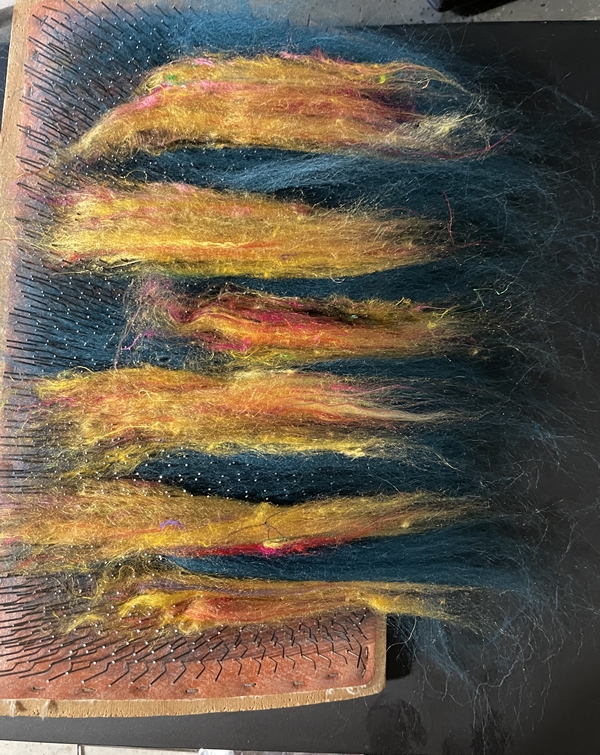


 brilliant red thrum, trimmed the ribbon end and trimmed some silk fibers. The ribbon was soaked in hot water to le
 ech out the dye. The colour saturation was evident as soon as the ribbon was in the jar. The water was totally red, but there is no way to do any metrics on this because the original silk was dyed with an unknown quantity of dye. All this is just a “see if this works” experiment. I snipped a tiny quantity of silk fiber, set it aside to mix with the wool roving I ha
 d chosen for dying.


 Friday spinning upstairs beside the Curling club kitchen. The Road bug spinning wheel fits in the trundle box for travel.

 Part of the super wash Merino acquisition.


 Put the end of the singles yarn through one of the end rings and put your thumb over the tail as you start to wind on. (Alternating sections of diagonals similar to a Nostipine work well)
 Working at a distance helps to even out the tension consistency.
 Wind off the bobbin onto the plying tool. You can put it down and go look at something then finish winding. When you get to the end, remove the beginning and the end from the rings and tie them together.
 I use my Left hand to slide through the double ended ball, gripping the beginning and end with the fingers,
 Now slide the ball off the implement and onto your wrist.
 After the bobbin of plied yarn was full (ok I played yarn chicken to get it all to fit back on the plying bobbin and won) l I used the cheap easy to make niddy noddy to wind into skeins. (PVC Pipe from Home Depot)

 The Chariot Race


