Browsed by
Tag: fiber preparation

Trying to wash fleece on a good day

Trying to wash fleece on a good day

Preamble (not about fiber but i promise i will get there!)

Usually, towards the end of June, the local grocery store garden centers close up for the season.  It may be that slowly recovering after surgery continues to distort time, since it seems very early to be closing up the plant shopping for the year. Anyways the massive sell off of all the last remaining plants, cheap, is happening now! I got one car load full from one store, including 2 flats of ever-berring strawberries, some lavender (Munstead usually overwinters here) and some more herbs.  The next day I went to the local Loblaws and they were closing that day, even better sales! More lavender, herbs Columnar basal and lemon verbena mainly and even a few flowers followed me home. I also bought 5 dead hanging baskets and 2 slightly alive ones for .26 cents each (I am short on hanging baskets). Both my fabulous halls were unloaded onto the side bench and one of the fleece drying racks in the side yard. then it took a couple days to recover before i could start working on them.

vew looking down the side yard, past plants. in front of garage the stock tank and closed big umbrella can be seen0.1) looking down the side yard towards the fleece washing area

I have been puttering along,  planting some into pots and Glenn has promised to help with the lavender and strawberrys that will go into the garden. I am also trying to catch up on the weeding, where do they keep popping up from?

I think it was Wednesday, foggy time continues…, we had a warning of possible severe thunderstorms with hail and high wind for 5am. So the evening before,  I carefully moved all the hanging baskets I had just planted, down under the bench, under the fleece drying rack and prepped for a horrible storm, that maybe impending.

two large saucers of plant pots, a mix of flowers, herbs and house plants. 0.2) two large saucers of plant pots, a mix of flowers, herbs and house plants.

Nothing happened at 5am, but 9am arrived and so did the storm, with heavy rain but no hail. Afterwords I went out to do a bit of weeding. A bit after lunch the blue sky was again gone, and so was my Large Umbrella I had be using while weeding. It had escaped and was trying to figure out how to open the front door. (It is bad luck to have umbrellas open in the house so I closed it and got it back in its weighted base. (Sorry no pictures)  oww…. Time to sit or maybe lie down would be better. yes lying down was much better.

(I am getting to the point)

Today, Friday, Ottawa is sunny, no rumors of thunderstorms and my front and back are willing to consider something other than sitting or lying down today, YAY!!!  I had asked Glenn to pull out the bins of unwashed fleece from the garage so I can see what I want to wash next.

My choices from the Garage are 3, all waiting for attention (2 yellow and 1 clear plastic bin, in front of fence and abandoned snow shovels.) I don’t remember what I put in them.0.3) My choices from the Garage are 3, all waiting for attention (2 yellow and 1 clear plastic bin, in front of fence and abandoned snow shovels.) I don’t remember what I put in them.

1- First, I Need to set up the fleece washing aria. The tub has some rainwater, a few bits of leaves, dead bugs, Miskito larvae and a moth in it. Maybe a large fish tank net would get the not-water-bits out? Maybe a trip to Dollerama later? the water is still cleaner than the fleece so lets proceed.

Stock tub, Bits of leaves, Miskito larva and other bugs, and one floating moth. 1.1)  Stock tub, Bits of leaves, Miskito larva and other bugs, and one floating moth.

Next, I should  set up the umbrella by the garage. Why is it not working, oh broken stay is interfering with it extending. Got that sorted, and set up the second fleece drying rack again.

fighting with umbrella with broken strut. With the broken arm it fits perfectly between the garage and the back of the house.1.2) fighting with umbrella with broken strut. With the broken arm it fits perfectly between the garage and the back of the house.

now that i have that sorted i’m sure it will all go fine from here!

2-Select a fleece,  this is like Christmas, i cant remember what i put in there so its all new and exciting surprises!

Option 1: white-ish fleece in plastic bag inside clear plastic bin.2.1) Option 1: white-ish fleece in plastic bag inside clear plastic bin.

Option 2: White-ish fleece in black garbage bag inside yellow Ruff tote bin.2.2)  Option 2: White-ish fleece in black garbage bag inside yellow Ruff tote bin.

Option 3: creamy white with lots of crimp. Loose in the ruff tote and has some bits of lavender on top of it.2.3)  Option 3: creamy white with lots of crimp. Loose in the ruff tote and has some bits of lavender on top of it.

Option 3 wins. I am going with the last one, It looks like quite a big fleece.  after looking all through the side yard, I seem to only have 4 fleece staining buckets?  I hope it didn’t blow away, no found it, Glenn stuck stuff in it. ….. OK, I will try washing 4 at a time rather than 5.

4 strainer baskets on drying rack with fleece in tub in back ground, pole from umbrella in foreground.2.4) 4 strainer baskets on drying rack with fleece in tub in back ground, pole from umbrella in foreground.

Ok fleece selected, no skirting table available but i am sure this will be fine. i just have to add water, soap to the Stock Tank and dirty fleece in strainer baskets to start soaking, i will have this done by lunch!

3- Drat, The hose is up by the front door, but I cant get the hose back here until I put away the recycling box. There are still a couple hanging baskets, hiding under the bench in the way (where i need to put the recycling box). So, move the baskets first. Found the hooks to hang up the baskets, and got them up out of the way. Oh no back just did that cold running water down the back feeling, got to sit down now for a moment. I have to make room for the blue chair so first put the recycling box away. Ahhh that’s better. While I’m sitting here i can see the drying rack in the side yard. There are still a couple hanging baskets, under the drying rack, better put them up too.  And sit again.

hanging baskets, pots of plants waiting to be planted , wooden bench, recycling bins below, and big garden thermometer3.1) hanging baskets, pots of plants waiting to be planted , wooden bench, recycling bins below, and big garden thermometer

4- Right I am sitting looking at the drying rack covered in plants. That won’t work out well, i will need that space for the fleece soon…. need to move and organize all the little plants in pots I purchased. I have 4 saucers and a shallow bin partly full of plants but give me a moment and let me get the strawberries all in one, the plants that will be house plants and the last of the inpatients are in one. i found 2 more saucers (ok they are oil change black saucers but they work) one is now full of Lavender and the other is a mix of herbs. And back to sitting. (i feel like i’m am doing some odd form of and English country dance but in stead of “everyone turns around” after doing anything, i do something followed by “i sit down”. i miss dancing, the Black nag was fun and i miss the Manshaft pavan, the 8 count reverrance was deadly! i must stop thinking about medieval dances and get back to work!)

Oil draining saucers full of herbs and lavender sitting on green bin and garbage can 4.1) Oil draining saucers full of herbs and lavender sitting on green bin and garbage can

5-Lets move the hose I think that was what I was working towards. Ok, dragged it back and have the tank filling. Where is the soap?…..  did it fall off the end of the bench? Maybe under it? behind the spin dryer? In the spin dryer? No sign of it, better go in and call glenn. And sit for a bit. Maybe I will look by the kitchen sink first, but why would it be there?

6-Found the fleece washing dish soap in the kitchen…. Ok took it back outside. It’s the sheep-washing dish soap, not the dish-washing dish soap, they are totaly different! so it should be outside with the fleece washing stuff.

sunlight Dish washing soap also cuts lanolin and removes dirt from sheeps' wool. )yellow plastic bottle of dish soap sitting on 4X4 beside stock tank with hose going into tank behind it.)6.1) sunlight Dish washing soap also cuts lanolin and removes dirt from sheeps’ wool. (yellow plastic bottle of dish soap sitting on 4X4 beside stock tank with hose going into tank behind it.)

7- Tipped the big ruff tote partly out onto the drying rack and picked through clumps looking for second cuts, excessive Vegi-matter or the extra smelly dark bits I don’t want to deal with. this fleece has little second cuts with kemp, I found a small section with less crimp but since I cant see the hole fleece I am not sure where it was growing or if its some one else’s fleece that got mixed in accidentally.

dirty wool cascading out of yellow plastic bin.7.1) dirty wool cascading out of yellow plastic bin.

8-Picked over good raw fleece got dropped in a strainer bucket, while the rejected bits got dumped on the lid. I did not fill them quite as much as last wash since I will have to do more bins than last fleece. I wonder if this one was a ram? or just a much bigger sheep?

the rejected bits I tossed on the lid until I can get them into a yard wast bag. There are a lot of odd little seeds stuck in spots in the fleece so I don’t want to add whatever that is to the garden.8.1) the rejected bits I tossed on the lid until I can get them into a yard wast bag. There are a lot of odd little seeds stuck in spots in the fleece so I don’t want to add whatever that is to the garden.

OK my aim is not 100% accurate I will clean that up tomorrow, I hope8.2) OK my aim is not 100% accurate I will clean that up tomorrow, I hope.

9-As the strainer bin got to about ¾ full I added it to the stock tank to start the soak. When I had all four in the tank I added a bit more water, gently lifted and lowered the strainer baskets a few times. I will now let it sit and soak. I should put all the icky parts in the yard waste bag but I think it would be better to go in and sit and maybe write a blog post.

starting the soap water soak  I left it in just over 3 hours.9.1) starting the soap water soak  I left it in just over 3 hours.

10- I want to give it a few hours of soaking then start the first rinse in case there is rain tomorrow. The water is definitely needing changing and the strainers baskets are hanging to drip.

Lets take a peek at this crimp in the raw wool. It is quite a dirty sheep, but not as much Vege-matter as I was expecting. As I said there is definitely a bit of kemp in odd sposts in this fleece (mostly second cuts), but I think it will still be nice.

closes up of crimp10.1)closes up of crimp

pulling sections of fleece I don’t have room to spread out the hole fleece so I am pulling out sections and looking over that bit. (yellow large plastic tote with unwashed fleece spilling out onto drying rack. 10.2) pulling sections of fleece. I don’t have room to spread out the hole fleece so I am pulling out sections and looking over that bit. (yellow large plastic tote with unwashed fleece spilling out onto drying rack.

strainer baskets coming out of wash water 10.3) strainer baskets coming out of wash water

Dirty water but I think we can g3et this fleece cleaner.10.4) Dirty water but I think we can get this fleece cleaner.

While we are back here lets  take a peek at the blackberries and see if they are ready yet, almost!

Blackberrys along the back of the house lots of berrys ripening11.1) Blackberrys along the back of the house lots of berrys ripening

close up of blackberrys and blackberry flowers11.2) close up of blackberrys and blackberry flowers

The trumpet vine is flowering again too!

Trumpet vine11.3) Trumpet vine

Scarlet runner bean flowers11.4) Scarlet runner bean flowers

It always takes longer now than i think, to get anything done. i did not get this done before lunch, i acutaly forgot about lunch and kept puttering along.  now that i have this much blog post written, its dark out, but the fleece should be drained by now. back wiling, i can finish draining the stock tank and give it a rinse before refilling it and starting the first rinse. wish me luck avoiding the masketos.

I hope you are taking advantage of these lovely sunny days, to have fun with fiber; prepping it, felting, spinning or weaveing with it.

Upgrading my Fiber Prep system

Upgrading my Fiber Prep system

Earlier this spring we went out to Princess Auto to look at some fiber prep equipment, who would have thot they would have such fabulous fiber equipment. The item I was considering was on sale, but Glenn thought he could modify my small fleece washing bins. I was getting sore, so we headed home without it. I had not-buyers-Regret.

It’s now June, last week was very hot, sunny and perfect for washing fleeces, but I had no buckets ready to go.  I was finding it more and more difficult to use the large buckets and strainer baskets. Tipping the buckets when they were full of water was getting challenging. What I was looking at has a drainage system that a tap and hose could be attached to. That would eliminate the tipping of heavy buckets full of very dirty water.

We are very lucky, we live in a city with two Princess autos. I went online to see if the West End store had one in stock, nope, but the East End store has four. So off we went in my little KIA soul to find “the item”.

75galon stock tank black with a drain.1) LITTLE GIANT 75 Gallon Black Poly Stock Tank, SKU: 9281205, In Stock Online, 4 available for In Store $129.99

This is called a stock tank. It is meant to hold water for cows or horses. This seems to be the smallest size with a drain option.  This one is 48 x 34.5 x 18 in. (L x W x H). In larger sizes, they are also used by athletes for ice baths, and by koi as a backyard pool.

When we arrived at Princess Auto, we headed to the customer service desk. The nice lady immediately asked what I was driving. I said “a KIA”! Her response was “I hope it’s not a Soul”. “Why yes, my soul is grey, not black!” I replied. She looked worried and called the warehouse. She asked if they thought it might fit in a Kia Soul. They were sure it would. I added “with a walker?”  The answer was still “it should”. We were to browse for about 5 minutes, and then go pick it up at the back of the store.

Ooh Lovely!! Yes, that will probably fit in the car. I purchased it and a couple of other things we found while browsing and headed back to the car.  Glenn was able to put it in the back of the Kia Soul, and stuff the grocery bags in the tub and still have room for the walker too!

When the last renter next door moved out, he left a metal backless bench. It’s very rusted and doesn’t have a cushion. I was going to put plants on it. I think I have a better idea. Glenn found the hose extension and the tap attachment, which we hooked up to the tank, which is now sitting on the bench with a base of 3 4×4’s for extra support.

close up vew of tap and hose extender 2.1) The stock tank sitting on 3 4X4s on top of the metal bench. Connected to the drain is a hose extender, then the tap valve and the old hose to send the water down the driveway.

All right, I have a hypothesis. This should be easier to use than the big round bins I had been trying to bend over to lift baskets and tip the bin to drain. (Lately, it tended to get me wet and make me sore. But, they did work!) You have seen me use the strainer baskets in previous posts, but I have to go one basket at a time. I think I can do at least 3 baskets per wash in the stock tub, and just turning the drain should be much easier on my back.

Now I need a volunteer fleece to help me test out the new tub. Cupcake has volunteered! Thank you, Cupcake!

flece a mix of colours from dark brown to bage and grey 3.1) Cupcake is a BFL X Romney fleece, which was 6.4lbs. 

Normally, I would set up my skirting table, but I gave away the extra small rain barrels, which were part of its supports. Ok, it looks like it was well skirted, and not too much Vegi-matter. So let’s see if I can sort directly into the strainer baskets.

I gave the stock bin a quick rinse and realised the drain is over an inch up the side….. ok, there will need to be a bit of tipping to get the last bit of water out. Silly me, I got too excited to be fleece washing again and put the soap in before getting a couple of inches of water added. Oh well, the suds will dissipate, eventually.

added soap too soon as i added water stock tank now has water covered in suds3.2) Too many suds, I guess the fleece is about to have a bubble bath instead of scouring.

Since I don’t have hot water outside and I don’t have a space inside to set up to wash fleeces, the fleeces get a bath in the ambient temperature water. That’s ok, if there is a bit of lanolin left in the fleece, it works wonderfully to wind bird feet and toes.

Now let’s see how many bins I can fit in. I think I may be able to get four in the stock tank! The fleece is (6.4 lbs), and I split it into five bins. It’s a bit tight, but I can get 5 bins in.

5 strainer baskets in soap filled stock tank3.3) 5 bins just fit in this size!

There is a smaller size of strainer basket if I want to work in smaller amounts. What I have now is the larger one from Dollarama.

the soap is helping the wool get wet 3.4) The soap (not Detergent) helps with wetting the fibre as well as releasing the dirt. Look at all the fabulous colours in this fleece

soap has disapated, water is a shade of dark brown, the 5 bins sit in the stock tub3.5) A good soaking and suds-be-gone, so time to get out of the bath.

draining one bucket before hanging it up to finish dripping, the dark brown water is visible in the stock tank.3.6) Look at the dark brown colour of the soap wash water as fleece-filled strainer buckets are coming out. That sheep was dirtier than it looked!

starting to refill the stock tank (the tank has 3 rings each suggests it is 25 gallons. i will be filling to the first line so 25 gallons3.7) Rinse #1 refilling stock tank to the first ledge.

lighter brown water after fist rince 3.8) Rinse #1, after the strainer baskets have been removed, inside the stock tank, the water is getting closer to clean!

The inside of the stock tank has 3 stepped edges, which are spaced to suggest each is 25 gallons, since the total it can hold is 75 gallons. So, I am using about 25 gallons for each wash and rinse of five strainer buckets.

Rinse #2 cleaner still, but we were rushing against the weather, which was threatening rain. I also had a camera malfunction…. Both the battery died (I can recharge it) and the lens cap I just bought a week ago broke. I will order another one.

2 stranier buckets saoking in second rince Draing strainer basket by resting it on the edge of teh stock tank. you can see the water is closer to clean then rince 13.91-3.92) End of rinse #2. And resting the strainer bucket on the side of the rim to drain most of the water out before hanging it up to finish dripping.

I can not feel the lanolin, and the fibre feels quite clean. I have had to rinse out fine sand each time I clean out the stock tank. Did this sheep have a fabulous beach holiday?

Glenn is on holiday, and since we are not going to the States, he is helping me today. Two of the strainer baskets look like they need another rinse, but three are looking good. So each basket that seems clean gets gently dumped into the spin dryer.

RV hand washer spinner for cloths4.1) This is an RV washer/spin dryer.

Think of it like a giant salad spinner for clothes, er.. Fleece! There is a dial at the lower edge that can turn on the drain or keep the water in and rotate your clothes.  I set it to drain, and Glenn spun it for me! I found this at a second-hand store, recognised it as a wonderful fibre prep equipment, and bought it!!

the lid off teh RV washer spinner showing fleece inside4.2) just like a giant salad spinner (but I don’t advise it for clothes or salad after all the fleeces it’s been washing.

Glenn brought the drying racks (from Ikea) up from the basement and put them under the covered area of the back patio (the part that doesn’t have blacksmithing stuff)

sears Robuck light dutie farm forge, and larger forge under cover.5.1) the small forge, Sears-Roebuck light duty farm forge and the bigger forge under the large black cover.

We set one drying rack up behind the large forge and the other on the other side by the house.

the green strainer bucket is from the RV spin washer 5.2) The green bucket is handy to move the fleece to the drying racks.

first bucket full on driying rack with plastic owl watching in back grond wool is on ike cloths drying rack5.3) The plastic owl takes his job of guarding the wool seriously.

the patio behind the bigger forge, has 2 drying racks full of fleece, a rain barrel and wooden fence in background  5.4) Two buckets on the right drying rack, and one on the Left. The plastic owl is still supervising. I hope it keeps the evil chipmunk from “Helping”. He will be eating all my blackberries shortly!

blackbarry plants with flowers along the back of the brick house, blue tarp covers blacksmiths foot vice5.5) This is part of the blackberries along the house, and one of Glenn’s blacksmith footed vices under the blue tarp. It could be a very good crop of blackberries (which will make up for the rabbit cutting all the canes off at about a foot for the raspberries.

We pulled out the last two buckets to drain a bit before going onto the racks. And I got busy weeding and then adding more little plants of Tie basil and parsley to the planters. There is a bit more Thai basil and weeding to do, but it’s starting to drip.  What have we learned in previous summers about drying wool?  If you put wool out to dry, it will probably rain….

We moved the 2 draining buckets a bit closer to the overhang, moved the umbrella to give more cover and then put the drying fleeces back in their buckets and moved them and the racks under the cover of the dog-covered area of the side yard. I had a barking Cat, not a dog. He didn’t like to go out if it was raining, so we had to cover a section for him. It’s where I set up my outdoor studio. I haven’t got that sorted out yet this summer.

2 ikea cloths driying rack full of drying fleece5.6) Moved drying racks under cover to avoid the rain.

In the morning, the wind is up, and the fibre is still there, but still not dry. Ok, one drying rack when in front of the garage under the last umbrella, and the other went by the side door.

one drying rack moved under umbrella by garage one rack by side door wool is getting closer to dry but still is a bit damp5.7-5.8) I still have one strainer basket to put out to dry.

strainer basket of wool wating for space to put wool on drying rack5.9) The last strainer basket waiting for space on the drying racks.

I have been ready to start another fleece, but with the drying racks being full, I don’t have a spot to put them once they are washed. So this is the new bottleneck in fleece washing.

Let’s review the Stock tank: Pros /Cons

chart of pros and cons of the stock tank

6.1) Chart of pros and cons that I can think of for the stock tank as a fleece washing tool.

For those who want to see if the washing worked, let’s take a last look at this lovely fleece.

locks of wool draped accross fingers locks of wool Blue faced lester cross romni draped on ruler very crimpy lenght is up to about 3.5inches long7.1-7.2) Washed locks of BFL X Romni. The locks are very soft and crimpy. Unstretched, the locks range up to 3.5 inches

If you think this may work for you and are now thinking about a quest for a stock tank, look at farm supply stores if you don’t have access to such a diverse store like Princess Auto (they also have some blacksmithing equipment).

So I think the stock tank will be a great improvement to fleece washing. I will now have to figure out an upgrade to my fleece drying equipment. Maybe I will have to take the long, arduous, 7-stop sign (one is in their parking lot) trip to IKEA and get a third drying rack. I love an excuse to go to IKEA!!! (and it is just down the street, dangerously close to home.) I hope you are enjoying lovely fleece washing weather and getting some fun felting done while the fleeces are drying!

UPDATE: the Princess Auto Flyer just arrived. the 75 Gallon stock tack will be going on sale July 1-13th 2025, but the store is closed July 1st for Canada day. check on line, there may be a free shipping option. or watch for one at a garage sale!

A tutorial: how to make roving with a drum carder

A tutorial: how to make roving with a drum carder

This week has been hectic. I haven’t had much time to do any felting. I did a little bit of stitching on my seascape, but not enough to show you and a little bit on a set of shoelaces. Mostly I made pasties for the market. They are more popular than we anticipated and we are down to the last few.  This is a few about to go in the freezer. They get bagged once they are frozen.

I thought you might like to see this post from way back at the beginning of our blog journey. This is one of the first posts I did.

After you have carded your wool and it is still on the drum you might like to have it as roving instead of a batt. This will show you how to use a simple diz to do that.  You can make a diz out of almost anything. mine is a piece of plastic cut from the side of a plastic sour cream container, it has a hole in the middle for the wool to come through. you pull a small bit of the carded wool through the hole and turning the drum backwards slide the diz around the drum pulling the wool through in a long rope as you go.  the diz rest directly on the drum. You control the amount of wool in the rope by how fast you slide it across the drum as you go around. If its too hard, you are trying to pull too much wool through the hole.

Ann

Prep and Finishing

Prep and Finishing

This last little week hasn’t been a felting week its been a preparation and finishing week with an emphasis on preparation. I carded up all my dyed balls of merino. You can see all my sheep on the top shelf.

caded wool on drum carded wool on shelf


I added the sheep to my little bag, it needs to be reblocked from having little balls of wool in it and hanging out in my purse for a few weeks until I got round to doing the sheep

sheep bag


and doing some doodling in my sketch book, I would like to do more felt art work.

sketch collage

The other thing is I have been  thinking or things that might sell in the summer. I made some felt laundry balls and some tea cozies and bags that might go well in the summer. What do you make for warm weather sales?


From Raw Fleece to Carded Batts of Wool

From Raw Fleece to Carded Batts of Wool

Our guest author/artist today is Zara Tuulikki Rooke.  She generously offered to take us through the process of preparing fibers from her own sheep to use for felting.

As I enjoy felting, I feel very fortunate to also be able to keep a couple of sheep. My four ewes are crossbreeds, from traditional Swedish breeds including the more well-known Gotland, and the perhaps internationally less well-known Rya and Finull. In any case, they do have really nice locks.

Photo 1

In Sweden, the common recommendation (with exceptions for certain breeds) is to shear the sheep both in the spring (to remove the thick winter fleece before they have their lambs and before the summer) and in the autumn (when they return to the barn and start spending more time indoors). The summer fleece (sheared in the autumn) is considered to be of higher quality. It has been grown while the sheep have been out grazing nutritious green grass, and not full of hay and straw like the winter fleece. Below is a photo of their summer fleece, sheared last autumn. The lighter, brown tips are from bleaching by the sun (and probably some dirt as they are unwashed).

Photo 2

My ram is from an old breed called Åsen. His fleece is straighter, without real locks. This breed can have a variety of fleece characteristics and different colours in patches on the same individual animal. My neighbour also has a ram of the same breed, and the darker fleece (black-brown-grey) on the photo below is from one of her lambs.

Photo 3

In addition, I also buy raw fleeces from pure Gotland sheep from a farm in a neighbouring village. The photo below shows some of the variation you can get between individuals, both in colour and in the size and shape of the locks. The lambs are born black, but later the wool turns grey and the once black tips are bleached by the sun. Or rather, they grown an increasing proportion of white hairs – there are no grey hairs, just different proportions of white or black hairs making the fleece look grey.

Photo 4

To a felter, this abundance of raw fleeces must seem like an ideal situation. And I certainly think it is. But, the process of turning raw fleece into carded wool is quite time-consuming. And that is what this post is really about.

After shearing, the fleece needs to be skirted and sorted, to take away wool that is too short, dirty or tangled. The short wool can either be from the head or legs of the sheep, or the result of what we call double-shearing (i.e. shearing a patch a second time to even it out). You usually also need to remove a fair amount of grass seeds and other vegetable matter that gets stuck in the fleece. That can take a lot of time, but it helps to do the sorting on some kind of wire mesh that allows small bits to fall through.

Then comes the washing. I try to get as much washing as I can done outdoors in the autumn, after shearing, up until the temperatures drop below freezing (in the North of Sweden that can be quite early in the season). I leave the wool to soak overnight in net-baskets in an old bathtub filled with cold water. The next day, the water will be really brown, but that just shows how much dirt you can actually clean out from a raw fleece with just cold water. I change the water at least twice after that, allowing the wool to soak for at least a few hours between changes, until the water no longer looks dirty. In my opinion, washing the wool in just cold water is sufficient if I am going to use the wool for wet-felting. During felting it will anyhow get washed again with hot water and soap.

Photo 5

During the winter, I do the washing in my bathtub indoors (which prevents anyone in the family taking a shower/bath for 24 hours), and then I usually use lukewarm water. If the wool is very dirty, I also add some washing powder (the type used for knitted wool items). The main rules when washing, to avoid felting the wool in the process, it to avoid too hot water, or quick changes in water temperature, and to disturb the wool as little as possible.

After washing comes drying. The net-baskets are easy to just lift out of the water and then I usually hang them up for a while to drip off a bit. If I am washing a smaller amount of wool, I often use one of those contraptions meant for spinning water from salad. Then I lay it out to dry, on a wire mesh or on towels on a clothes drying rack. Drying takes time, usually several days. It helps to turn the wool over each day and fluff it up a bit each time. It may seem dry on the surface, but wool has an incredible capacity for retaining moisture.
Finally, you have your washed and dried wool, ready for carding. However, some locks do need to be teased first. This means pulling apart the locks/fibres – and you will probably find even more grass seeds now. The photo shows washed locks, before and after teasing. It´s an extra step in the process, but if the locks are tangled in the tips, teasing really does facilitate the carding.

Photo 6

I own a drum-carder, which really does save time compared to using hand-carders. The wool is feed in under the small drum, which in turn feeds it onto the larger drum, as you turn the handle. After two or three runs through the drum-carder, you can finally lift off a batt of lovely, fluffy, carded wool. Then you can start felting!

Photo 7

It does take a lot of time and effort, and I do swear about grass seeds through the whole process, but each step also has its own charm. I often find it very relaxing to sort, tease and card wool. It provides an opportunity to really feel and look at the locks – and to plan what to do with them. And at the end of the day, when I look at my washed locks and carded batts of wool, I feel really wealthy. Perhaps, in part, because I know how much time and effort has been invested into those locks and batts of wool.

Thank you  Zara for such a wonderful tutorial with exceptional pictures to show us the whole  process from fleece to wool batts!

Carding Some Wool

Carding Some Wool

I dye most of my own wool. The problem is that I tend to felt my roving a bit when I am rinsing. That means I have to recard it. I had some not very pretty pink that I got bought cheap because it was a little felted. I recarded it with some other colours.

pink precarding

This is the wool combination I will put through the carder. the carder is big. There isn’t that much wool only about 150 grams, so I only use part of the carder.

pink into the carder

This is the first run through.

pink out of the carder 1

After I take it off the drum I split the batt and flipped each section to run them through again.

pink out of the carder 2 pink finished

This is the second time through and the final ball of wool.

This is all the wool I did.

carded wool

There are a couple more blended wools in there too. Now I have to make them into something.


Bits and Pieces

Bits and Pieces

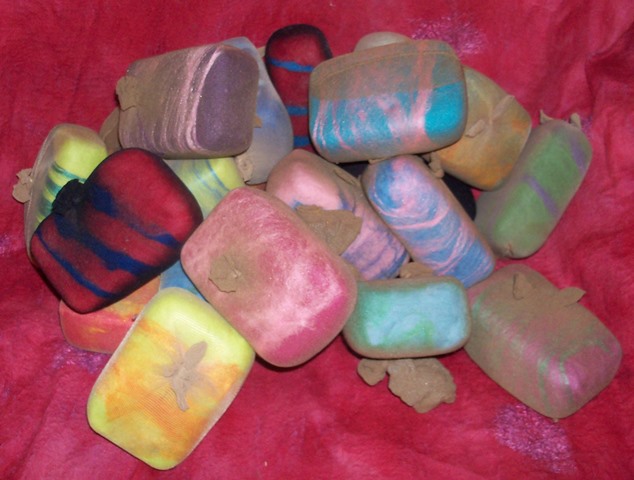
This week has been about getting things moving towards upcoming shows. I spent an afternoon wrapping soap in wool and putting them in little nylon bags ready to felt.

soap

I sent another afternoon getting sheep parts ready to felt. The body parts are roughly needle felted then wet felted. The legs are wet felted.

sheep parts

This is what they look like when they are all put together and their wool is added.

sheep small

Lastly I have been soaking a fleece. I have no idea what kind of wool it is. it was a bag given to me a couple of years ago. Here it is getting a rain water rinse hanging in my apple tree. That wasn’t on purpose but the thunderstorm came in before I got it back into a bucket for its first rinse.

wool hanging


Prefelt

Prefelt

There are two kinds of prefelt. One is needled prefelt. Commercial prefelt is done this way. It is needled just enough to hold together.  I use this sometimes, it works very well. I get it in small pieces and by the yard from Dreamspin Fibers. http://www.dreamspinfibres.ca/  (shameless plug for a friend).

The second is wet felted and this is easy to make yourself. Lately that is what I have been doing. You layout your felt as usual but you stop when it is just holding together.  Rinse it out carefully and let it dry. it is till fragile but strong enough to cut out shapes when you don’t want the fuzzy edges that traditional layout gives you.   I have been making  small pieces and some from the ends of some batts that are not big enough to do much with. They are very helpful when you want very definite shapes.

prefelt on table

I don’t have any exact plans for them but they are very handy to have around.


Beyond Nuno Giveaway Winner…and about the Studio Site

Beyond Nuno Giveaway Winner…and about the Studio Site

The Winner of the Beyond Nuno Giveaway is … Wendy who commented on February 25th. Congratulations, Wendy 🙂 Please will you leave a comment on this post so I can email you with the download details, Thanks 🙂  Thanks a lot for entering and for leaving such nice comments, everyone 🙂

Beyond Nuno giveaway winner

A Guide to The Felting and Fiber Studio Site

We’ve had a lot of new visitors to the Studio site recently, and lots of new members on the forum, so I thought it might be time to do a reminder about everything we have to offer here on the Studio site. Before we started the blog just over a year ago, the four of us spent about 6 weeks working on the site, filling it with as much info as we could. We wanted to build the site into a valuable ‘One-Stop’ resource for anyone interested in felting and fibre.

Studio About us2The ‘About Us’ page tells you a little bit about why we started the Studio site, and there are sub pages for each of us with some info about ourselves and our interests.

Studio Felting Pages

In the Felting section there’s a short introduction about the many different kinds of felting. The main pages for Machine, Needle, Nuno and Wet felting all have more in-depth information, and each has a gallery page with many different examples of that particular type of felting.

Studio Mixed media

Mixed media simply means artwork that is made with more than one medium, but for the purpose of the site we use it to mean artwork made mainly with felt or fabric combined with other materials. This section features pages about Beads and Beading, Hand Stitching, Machine Stitching and Surface Design. Each page’s gallery features many examples of artwork.

Studio Fibers

The Fibers section is packed full of information about wool and other animal fibres. The main Fibers page explains some of the different terms that are used to describe wool in its various stages of processing. The Wool and Other Animal Fibers page has a lot of information about wool, animal fibres from animals such as Alpaca, Angora goat, Llama and Camel. There is also an explanation of the Micron and Bradford Count systems of measuring a fibre’s fineness or coarseness; and a PDF guide to the most common sheep breeds and their Bradford and Micron numbers. The gallery page features photos of different animal fibres. Preparing Fibers has a guide to processing your own wool, from washing a raw fleece to carding it into fluffy batts ready for felting or spinning. There is a photo set and detailed description.

Studio other Fibers

The Other Fibers section has lots of information about the non animal fibres we commonly use in felting, such as silk and organza fabrics; fibre prepared into tops like bamboo, banana, viscose, and the more unusual fibres like crimped nylon, plastic and Angelina fibres.

The Silk page shows the many different silk products available, for example, silk carrier rods, silk hankies and silk throwster’s waste and the gallery page features many uses of these. The Man-made fibers page and its gallery have examples of fibres and their uses including commercial art yarns and  some nuno felt examples with synthetic fabrics. The Plant Based Fibers page has many examples of these gorgeous luxurious fibres and felted pieces using them.

Studio tutorials

The Tutorials section is another area with a wealth of information. There are free Dyeing, Felting, Fiber preparation and Mixed media tutorials all written by one of us, including a video on how to make your own roving using a diz, PDFs on Degumming silk and dyeing it; Stitching on felt, making mixed media wall art, using a sander for wet-felting, a beginners guide to using a drop spindle and dyeing with food colouring.

And if you can’t find what you want there, there are also links to outside sites in the Links/Resources section, including rosiepink’s free felting tutorials and their fantastic e-book showing how to make amazing felt artwork and Ruth’s book The Complete Photo Guide To Felting.

So, make yourself comfortable and come and have a look around the site.  We’re always happy to read comments and listen to suggestions for adding more to the site, or to requests for articles or tutorials. Maybe you are a fibre artist with an interesting skill that would make a great feature or you’d like us to link to a tutorial, if you have anything felt or fibre related you want to tell us about, we’d love to hear about it 🙂

Dyeing Some Waste

Dyeing Some Waste

Dyeing some waste.  Throwsters waste that is and I suppose it must have been trash at some point or they wouldn’t call it that. Throwing is was they call reeling silk for thread and this is the left over little bits.  I have a batch of white and needed some colours for a project.  The pictures of wet silk an bags did not turn out but I have some nice pictures of the end.

I dyed small amounts in plastic sandwich bags. First I placed each blob of waste  in a bag and added some soapy water to get it wet. I let it sit to soak while I got the dye ready. I used MX dye as it would be the fastest and easiest. I poured of the extra water out then poured in the dye,  just enough to get it all wet. I squished it around in the bag to make sure it all got dye.  No worries about felting the silk, a nice change from dyeing wool.  I did the same for all the colours and let them sit for 10 min. I added a solution of PH up and water. Buying the pool chemical is the cheapest way to buy Sodium Carbonate, especially at the end of the season.

I made a solution and poured in enough to cover the silk. I let it sit for about half an hour then drained and rinsed the silk. Here is what it looks like drying on my front porch.

Throwsters Waste Drying

Not so great looking. I had squeezed all the extra water out of them. However after they were dry I fluffed them up and they look like this.

Fluffed up
Second Half All Fluffed Up

As you can see fluffed up they barely fit on the same drying rack in 2 batches. My project didn’t work out, the waste I used  on the surface sank into the courser wool I was using and disappeared so I have nothing to show you right now. I am planing to use some more on hats so I will do a post with them later.